Selection Methods- selection for Several
traits-selection in natural stands, unimproved
plantations, even and uneven aged stands
SELECTION
 Choosing individuals with desired qualities to
serve as parents for the next generation
 Primarily used for Tree Improvement
Selection for single traits
 Mass selection
 Family selection
 Sib selection
 Progeny testing
 Within-Family selection
 Family plus within family selection
Mass selection
 Choosing – based on phenotypes.
 Highly heritable traits – phenotype - reflection
of genotype
 Only type – parentage - unknown
Family Selection
 Average phenotypic values.
 Low heritable traits – phenotypes – not good
reflection of genotypes.
 Rarely used in forestry
 Inbreeding issues
Sib selection
 Selection based on siblings performance.
 Individual’s performance is not considered.
 Rarely used in forestry
Progeny Testing
 Selection of parent trees based upon the
performance of their progeny
 precise selection method
 Initial selection by progeny testing lengthens
the time interval.
 Since the goal of tree improvement is to
achieve maximum amount of gain in unit time.
Within Family Selection
 Here individuals are chosen on the basis of
their deviation from the family mean, and
family values per se are given no weight when
selections are made.
 Rarely used in tree improvement
Family Plus Within Family Selection
 This two-stage method involves selection on
families followed by selection of individuals
within families.
 It consists of choosing best families along with
the best individuals in them
 Predominant form of selection in most tree
improvement programs.
Selection for several traits
Most tree improvement programs are geared towards
the improvement of several traits at the same time.
 Tandem Selection
 Independent culling
 Selection Index
Tandem Selection
 Breeding is for one trait at a time until a
desired level of improvement is made
 desired improvement - obtained first -usually
most important trait, selection and breeding
effort are then concentrated on other traits.
 Rarely used
 Disease resistance
 Cold hardiness
Independent Culling
 Involves setting minimum values for each trait
of interest.
 Individuals must meet these minimum criteria
if they are to be retained.
 Very widely used - forest tree improvement
Selection Index
 combines information on all traits of interest into a
single index
 Enables breeders to assign total score to each
individual
 Most complete and complex form, a selection
index combines family plus individual information
for all traits into one index
Recurrent Selection
 The selection procedure that involves many
cycles of selection and breeding is known as
recurrent selection
 The most often used in tree improvement is
known as simple recurrent selection
 There are 2 major kind of forest stands
Even-aged wild stands or plantations from
unimproved seed where the parentage of the tree
is unknown
Uneven aged, scattered or sprouting spp where
the parentage is not known
Selection from Even-aged Stands
 Individual selection works best when good even-
aged stands of the proper age are available. This
allows efficient comparisons are to be made
among selected trees and checks
 Individual tree selection is best in even aged
natural stand compose primarily 1 species or in
plantations
 Comparison tree system of selection can be
used
Guidelines
1. The search should be concentrated on stands
plantations that are average or better in growth, pruning,
straightness, branch angle, and other characteristics of
interest.
Outstanding stand of trees - plus stands
2. Stands & Plantations in which candidate trees are
sought should be located on the same sites where
plantation from improved seed will ultimately be
established.
 There should never selections from the very highest
site quality lands, if the plantations are established on
average or poor sites.
3. When selections are made from plantations,
information about the suitability of seed source used in
the planting should be obtained.
4. In older stands, the search effort should be confined
to trees that have an age range of not more than 10 to 15
years younger or older than the projected rotation age of
the plantation age of the plantation that are to be
established.
5. Selection should be made from stands that are pure
in species composition as possible.
6. Stands must be avoided that have been logged for
poles or piling or that have been otherwise high graded
or thinned from above.
7. The minimum size of a stand or plantation in which
a candidate is located is immaterial. Stand is large
enough to locate a good candidate tree & allow to
choose comparison trees
8. Preferably only 1 select tree should be accepted from
any one small natural stand to reduce the possibility of
obtaining candidate tree that are close relatives. Does
not apply for selection in plantation
9. Although it is highly desirable for candidate trees to
exhibit a heavy flower or cone crop, these characters
are not given much emphasis
10. Once the decision has be made to look over an area
for candidate tree, a thorough systematic search
should be made and not in a haphazard manner
11. A comparison or check tree selection should be
used when feasible, this helps to accounts for
environmental differences within the stands & permits
more efficient & the objective selection of superior
trees.
Candidate Tree
A tree that has be selected for grading because of
its desirable phenotypic qualities but that has not
yet been tested or graded.
Select, Superior or Plus Tree
recommended for production or breeding
orchard.
superior phenotype for growth, form, wood
quality or other desired characteristics and
appear to be adaptable.
 It has not yet been tested for its genetic worth.
Elite Tree
Proven to be genetically superior
Winner from a selection program
 Most desired for mass production of seeds or vegetative
propagules
Comparison or Check Tree
Trees that are located in the same stand are of nearly the
same age, are growing on the same sites as the select tree &
against which select tree is graded.
Selection criteria
 Different species have by nature different architecture
 Selection traits may vary between different species and
improvement programmes
The ideal plus tree has the following characteristics, viz.,
•Straight, cylindrical, non forking, non twisting bole
•Fast growth
•Narrow crown
•Thin branches with wide branch angles
•High wood density and long fiber
•Resistance to pest and disease
Where to select?
Carried out in natural stands or preferably in plantations
Certain considerations as importance in the choice of the
site for selection are as below,
Selection should be made from stands that are pure in
species composition
It should be concentrated on stands or plantations that
are average or better in traits of interest
Selection work is better in an even aged stand, since age
difference can then be eliminated from the evaluation
Selection is best carried out in a nature stand, i.e. near to
maximum height
Selection in natural forests where selective logging has
taken place should be avoided
Criteria of selection
for non wood products …
Tannin content
Resin content
Gum yield
Seed oil content
Seed protein content
Medicinal value
Dyes
Catechin content
Criteria of selection
for wood characters …
Specific gravity
Lumen diameter
Cell wall thickness
Fiber length
Cellulose
Hemi cellulose
Lignin
Other extractives
Steps in plus tree selection
1. Preliminary reporting of the outstanding trees called
candidate trees
Age
Growth
Stem form
Crown and branching
Free from insect and disease attack
Moderate to good flowering fruiting
2. Final phenotypic appraisal and approval as plus trees
PLUS TREE – SCORING FORM ( OCULAR ESTIMATES )
1. VIGOUR
a) TOTAL HEIGHT
0 – Shorter than shorter
1 – Intermediate
2 – Equal to tallest
3 – Taller than tallest
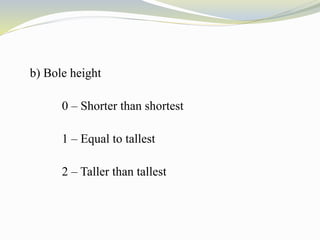
b) Bole height
0 – Shorter than shortest
1 – Equal to tallest
2 – Taller than tallest
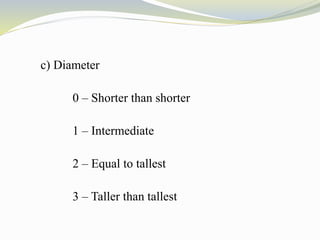
c) Diameter
0 – Shorter than shorter
1 – Intermediate
2 – Equal to tallest
3 – Taller than tallest
2. FORM
a) Bole Straightness
0 – Less straight than poorest
1 – Intermediate
2 – Equal to the Straightest
3 – Better than straightest
b) Tapering ( longitudinal section )
0 – More than most tapering
1 – Intermediate
2 – Equal to least tapering
3 – Less than least tapering
c) Shape ( Cross Section )
0 – Less circular than poorest
1 – Intermediate
2 – Equal to best
3 – Better than best
d) Straight grain
0 – Less straight grain than poorest
1 – Intermediate
2 – Equal to best
3 – Better than the best
e) Fluting
0 – More fluted than poorest
1 – Intermediate
2 – Equal to least fluted
3 – Less than least fluted
3.CROWN
a) Epicormic branches
0 – Denser than tree worst
1 – Intermediate
2 – Equal to lightest
3 – Lighter than lightest
b) Natural pruning
0 – Not as good as poorest
1 – Intermediate
2 – Equal to best pruned
3 – Better than best pruned
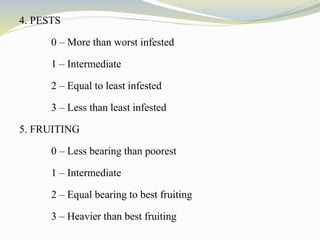
4. PESTS
0 – More than worst infested
1 – Intermediate
2 – Equal to least infested
3 – Less than least infested
5. FRUITING
0 – Less bearing than poorest
1 – Intermediate
2 – Equal bearing to best fruiting
3 – Heavier than best fruiting
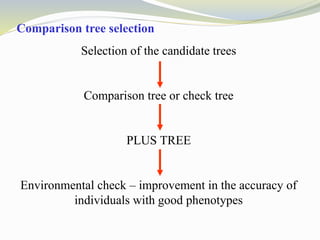
Comparison tree selection
Selection of the candidate trees
Comparison tree or check tree
PLUS TREE
Environmental check – improvement in the accuracy of
individuals with good phenotypes
Regression selection system
The most useful method of tree grading for uneven aged or mixed
spp type stand
A regression selection system is built by sampling a number of
trees for a desired characteristics such as volume growth on a
given site, then plotting them against the age.
A reliable regression for height or volume can be made with about
50 trees, if there is a reasonable age-class distribution.
Steps
1. A candidate tree is chosen, on the judgment of the selector and
measured for the characteristics desired viz ht. or vol.
2. The trait is plotted on the regression graph using the proper age
and site
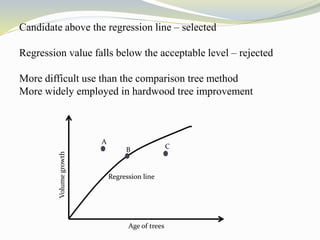
Candidate above the regression line – selected
Regression value falls below the acceptable level – rejected
More difficult use than the comparison tree method
More widely employed in hardwood tree improvement
A
B C
Age of trees
Volumegrowth
Regression line
The mother tree system
When there is no immediate urgency to obtain large amounts of
improved seed, the mother tree system of selection may be best.
It consists of locating “good” trees that are usually not as good as
select trees in the comparison tree or regression systems
Then, one must obtain seed from these and establish seedlings in
genetic tests.
After this, either the best parent trees or the best trees of the best
families used in a vegetative orchard
If suitably laid out, the progeny test may be thinned to create a
seedling seed orchard.
Disadvantage
Time is lost before commercial quantities of seed are available for
planting programs.
The testing must be carried on for a long period
This method has been extensively used for hardwoods for which
planting programs are small and seed are not immediately needed
It also works very well for species that are grown on very short
rotations such as Eucalyptus
The mother tree system also be best in seriously high-graded stands
where few good phenotypes are available.
It may also be best for characteristics such as disease resistance that
can often can only be determined through testing
The Subjective grading system
Some persons who are familiar with a species feel that an
acceptable job of selection can be done based on the judgment of
the grader about what constitutes a good tree
This is certainly possible, but the grader must know the species
intimately and must be as unbiased as possible.
This system is used successfully but has also failed
The tendency, when the subjective system is used, is to spend less
time seeking the candidate trees, thus choosing less out standing
trees. This results in less gain.
Selection methods in forestry

Selection methods in forestry

  • 1.
    Selection Methods- selectionfor Several traits-selection in natural stands, unimproved plantations, even and uneven aged stands
  • 2.
    SELECTION  Choosing individualswith desired qualities to serve as parents for the next generation  Primarily used for Tree Improvement
  • 3.
    Selection for singletraits  Mass selection  Family selection  Sib selection  Progeny testing  Within-Family selection  Family plus within family selection
  • 4.
    Mass selection  Choosing– based on phenotypes.  Highly heritable traits – phenotype - reflection of genotype  Only type – parentage - unknown
  • 5.
    Family Selection  Averagephenotypic values.  Low heritable traits – phenotypes – not good reflection of genotypes.  Rarely used in forestry  Inbreeding issues
  • 6.
    Sib selection  Selectionbased on siblings performance.  Individual’s performance is not considered.  Rarely used in forestry
  • 7.
    Progeny Testing  Selectionof parent trees based upon the performance of their progeny  precise selection method  Initial selection by progeny testing lengthens the time interval.  Since the goal of tree improvement is to achieve maximum amount of gain in unit time.
  • 8.
    Within Family Selection Here individuals are chosen on the basis of their deviation from the family mean, and family values per se are given no weight when selections are made.  Rarely used in tree improvement
  • 9.
    Family Plus WithinFamily Selection  This two-stage method involves selection on families followed by selection of individuals within families.  It consists of choosing best families along with the best individuals in them  Predominant form of selection in most tree improvement programs.
  • 10.
    Selection for severaltraits Most tree improvement programs are geared towards the improvement of several traits at the same time.  Tandem Selection  Independent culling  Selection Index
  • 11.
    Tandem Selection  Breedingis for one trait at a time until a desired level of improvement is made  desired improvement - obtained first -usually most important trait, selection and breeding effort are then concentrated on other traits.  Rarely used  Disease resistance  Cold hardiness
  • 12.
    Independent Culling  Involvessetting minimum values for each trait of interest.  Individuals must meet these minimum criteria if they are to be retained.  Very widely used - forest tree improvement
  • 13.
    Selection Index  combinesinformation on all traits of interest into a single index  Enables breeders to assign total score to each individual  Most complete and complex form, a selection index combines family plus individual information for all traits into one index
  • 14.
    Recurrent Selection  Theselection procedure that involves many cycles of selection and breeding is known as recurrent selection  The most often used in tree improvement is known as simple recurrent selection
  • 16.
     There are2 major kind of forest stands Even-aged wild stands or plantations from unimproved seed where the parentage of the tree is unknown Uneven aged, scattered or sprouting spp where the parentage is not known
  • 18.
    Selection from Even-agedStands  Individual selection works best when good even- aged stands of the proper age are available. This allows efficient comparisons are to be made among selected trees and checks  Individual tree selection is best in even aged natural stand compose primarily 1 species or in plantations  Comparison tree system of selection can be used
  • 19.
    Guidelines 1. The searchshould be concentrated on stands plantations that are average or better in growth, pruning, straightness, branch angle, and other characteristics of interest. Outstanding stand of trees - plus stands 2. Stands & Plantations in which candidate trees are sought should be located on the same sites where plantation from improved seed will ultimately be established.
  • 20.
     There shouldnever selections from the very highest site quality lands, if the plantations are established on average or poor sites. 3. When selections are made from plantations, information about the suitability of seed source used in the planting should be obtained. 4. In older stands, the search effort should be confined to trees that have an age range of not more than 10 to 15 years younger or older than the projected rotation age of the plantation age of the plantation that are to be established.
  • 21.
    5. Selection shouldbe made from stands that are pure in species composition as possible. 6. Stands must be avoided that have been logged for poles or piling or that have been otherwise high graded or thinned from above. 7. The minimum size of a stand or plantation in which a candidate is located is immaterial. Stand is large enough to locate a good candidate tree & allow to choose comparison trees
  • 22.
    8. Preferably only1 select tree should be accepted from any one small natural stand to reduce the possibility of obtaining candidate tree that are close relatives. Does not apply for selection in plantation 9. Although it is highly desirable for candidate trees to exhibit a heavy flower or cone crop, these characters are not given much emphasis 10. Once the decision has be made to look over an area for candidate tree, a thorough systematic search should be made and not in a haphazard manner
  • 23.
    11. A comparisonor check tree selection should be used when feasible, this helps to accounts for environmental differences within the stands & permits more efficient & the objective selection of superior trees.
  • 24.
    Candidate Tree A treethat has be selected for grading because of its desirable phenotypic qualities but that has not yet been tested or graded. Select, Superior or Plus Tree recommended for production or breeding orchard. superior phenotype for growth, form, wood quality or other desired characteristics and appear to be adaptable.  It has not yet been tested for its genetic worth.
  • 25.
    Elite Tree Proven tobe genetically superior Winner from a selection program  Most desired for mass production of seeds or vegetative propagules Comparison or Check Tree Trees that are located in the same stand are of nearly the same age, are growing on the same sites as the select tree & against which select tree is graded.
  • 26.
    Selection criteria  Differentspecies have by nature different architecture  Selection traits may vary between different species and improvement programmes The ideal plus tree has the following characteristics, viz., •Straight, cylindrical, non forking, non twisting bole •Fast growth •Narrow crown •Thin branches with wide branch angles •High wood density and long fiber •Resistance to pest and disease
  • 27.
    Where to select? Carriedout in natural stands or preferably in plantations Certain considerations as importance in the choice of the site for selection are as below, Selection should be made from stands that are pure in species composition It should be concentrated on stands or plantations that are average or better in traits of interest
  • 28.
    Selection work isbetter in an even aged stand, since age difference can then be eliminated from the evaluation Selection is best carried out in a nature stand, i.e. near to maximum height Selection in natural forests where selective logging has taken place should be avoided
  • 29.
    Criteria of selection fornon wood products … Tannin content Resin content Gum yield Seed oil content Seed protein content Medicinal value Dyes Catechin content
  • 30.
    Criteria of selection forwood characters … Specific gravity Lumen diameter Cell wall thickness Fiber length Cellulose Hemi cellulose Lignin Other extractives
  • 31.
    Steps in plustree selection 1. Preliminary reporting of the outstanding trees called candidate trees Age Growth Stem form Crown and branching Free from insect and disease attack Moderate to good flowering fruiting 2. Final phenotypic appraisal and approval as plus trees
  • 32.
    PLUS TREE –SCORING FORM ( OCULAR ESTIMATES ) 1. VIGOUR a) TOTAL HEIGHT 0 – Shorter than shorter 1 – Intermediate 2 – Equal to tallest 3 – Taller than tallest
  • 33.
    b) Bole height 0– Shorter than shortest 1 – Equal to tallest 2 – Taller than tallest
  • 34.
    c) Diameter 0 –Shorter than shorter 1 – Intermediate 2 – Equal to tallest 3 – Taller than tallest
  • 35.
    2. FORM a) BoleStraightness 0 – Less straight than poorest 1 – Intermediate 2 – Equal to the Straightest 3 – Better than straightest b) Tapering ( longitudinal section ) 0 – More than most tapering 1 – Intermediate 2 – Equal to least tapering 3 – Less than least tapering
  • 36.
    c) Shape (Cross Section ) 0 – Less circular than poorest 1 – Intermediate 2 – Equal to best 3 – Better than best d) Straight grain 0 – Less straight grain than poorest 1 – Intermediate 2 – Equal to best 3 – Better than the best
  • 37.
    e) Fluting 0 –More fluted than poorest 1 – Intermediate 2 – Equal to least fluted 3 – Less than least fluted
  • 38.
    3.CROWN a) Epicormic branches 0– Denser than tree worst 1 – Intermediate 2 – Equal to lightest 3 – Lighter than lightest b) Natural pruning 0 – Not as good as poorest 1 – Intermediate 2 – Equal to best pruned 3 – Better than best pruned
  • 39.
    4. PESTS 0 –More than worst infested 1 – Intermediate 2 – Equal to least infested 3 – Less than least infested 5. FRUITING 0 – Less bearing than poorest 1 – Intermediate 2 – Equal bearing to best fruiting 3 – Heavier than best fruiting
  • 40.
    Comparison tree selection Selectionof the candidate trees Comparison tree or check tree PLUS TREE Environmental check – improvement in the accuracy of individuals with good phenotypes
  • 42.
    Regression selection system Themost useful method of tree grading for uneven aged or mixed spp type stand A regression selection system is built by sampling a number of trees for a desired characteristics such as volume growth on a given site, then plotting them against the age. A reliable regression for height or volume can be made with about 50 trees, if there is a reasonable age-class distribution. Steps 1. A candidate tree is chosen, on the judgment of the selector and measured for the characteristics desired viz ht. or vol. 2. The trait is plotted on the regression graph using the proper age and site
  • 43.
    Candidate above theregression line – selected Regression value falls below the acceptable level – rejected More difficult use than the comparison tree method More widely employed in hardwood tree improvement A B C Age of trees Volumegrowth Regression line
  • 44.
    The mother treesystem When there is no immediate urgency to obtain large amounts of improved seed, the mother tree system of selection may be best. It consists of locating “good” trees that are usually not as good as select trees in the comparison tree or regression systems Then, one must obtain seed from these and establish seedlings in genetic tests. After this, either the best parent trees or the best trees of the best families used in a vegetative orchard If suitably laid out, the progeny test may be thinned to create a seedling seed orchard.
  • 45.
    Disadvantage Time is lostbefore commercial quantities of seed are available for planting programs. The testing must be carried on for a long period This method has been extensively used for hardwoods for which planting programs are small and seed are not immediately needed It also works very well for species that are grown on very short rotations such as Eucalyptus The mother tree system also be best in seriously high-graded stands where few good phenotypes are available. It may also be best for characteristics such as disease resistance that can often can only be determined through testing
  • 46.
    The Subjective gradingsystem Some persons who are familiar with a species feel that an acceptable job of selection can be done based on the judgment of the grader about what constitutes a good tree This is certainly possible, but the grader must know the species intimately and must be as unbiased as possible. This system is used successfully but has also failed The tendency, when the subjective system is used, is to spend less time seeking the candidate trees, thus choosing less out standing trees. This results in less gain.