1
Fine Root Dynamics in Trees
Vikas Kumar
2013-27-102
Dept. of Silviculture & Agroforestry
College of Forestry, KAU, Thrissur
Mo. No.: 9995093698
Email ID: vkskumar49@gmail.com
PhD second seminar
Contents
Introduction
Fine Root Production/ Biomass (FRP/FRB)
Method of estimation of FRP
Factors influence FRP
FRP research in various ecosystems
Conclusion
Future line of work
2
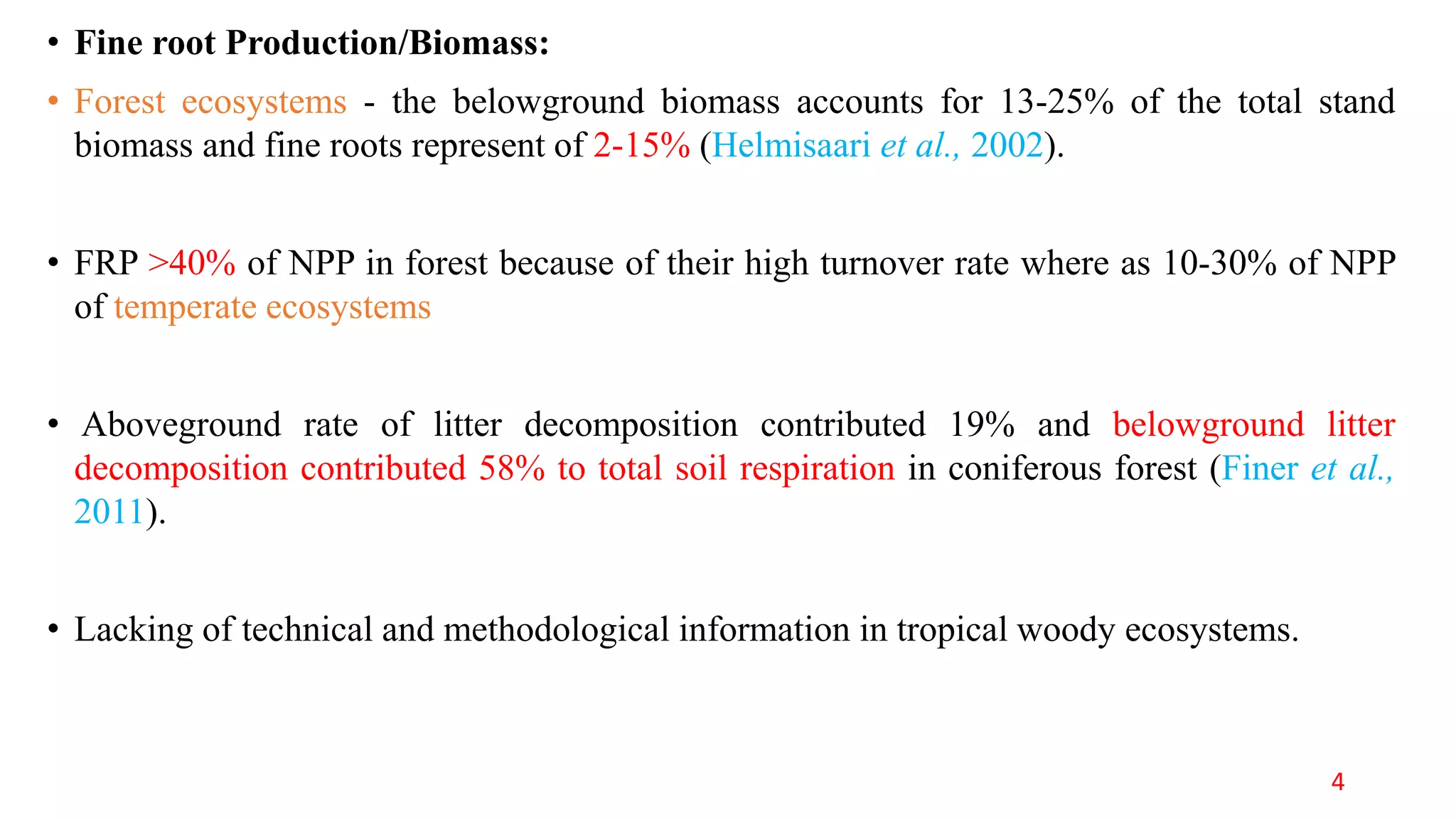
 Non-woody and having <2 mm diameter (Zobel and Waisel, 2010).
 High biological activity and resource cycling.
 Short life span and continuous turnover (van Noordwijk et al., 1994).
Aboveground litter and belowground fine roots are the principal components of
nutrient cycling- adding to soil carbon and nutrient pools (Finner et al., 2011).
Introduction
3
• Fine root Production/Biomass:
• Forest ecosystems - the belowground biomass accounts for 13-25% of the total stand
biomass and fine roots represent of 2-15% (Helmisaari et al., 2002).
• FRP >40% of NPP in forest because of their high turnover rate where as 10-30% of NPP
of temperate ecosystems
• Aboveground rate of litter decomposition contributed 19% and belowground litter
decomposition contributed 58% to total soil respiration in coniferous forest (Finer et al.,
2011).
• Lacking of technical and methodological information in tropical woody ecosystems.
4
Fine root biomass and production
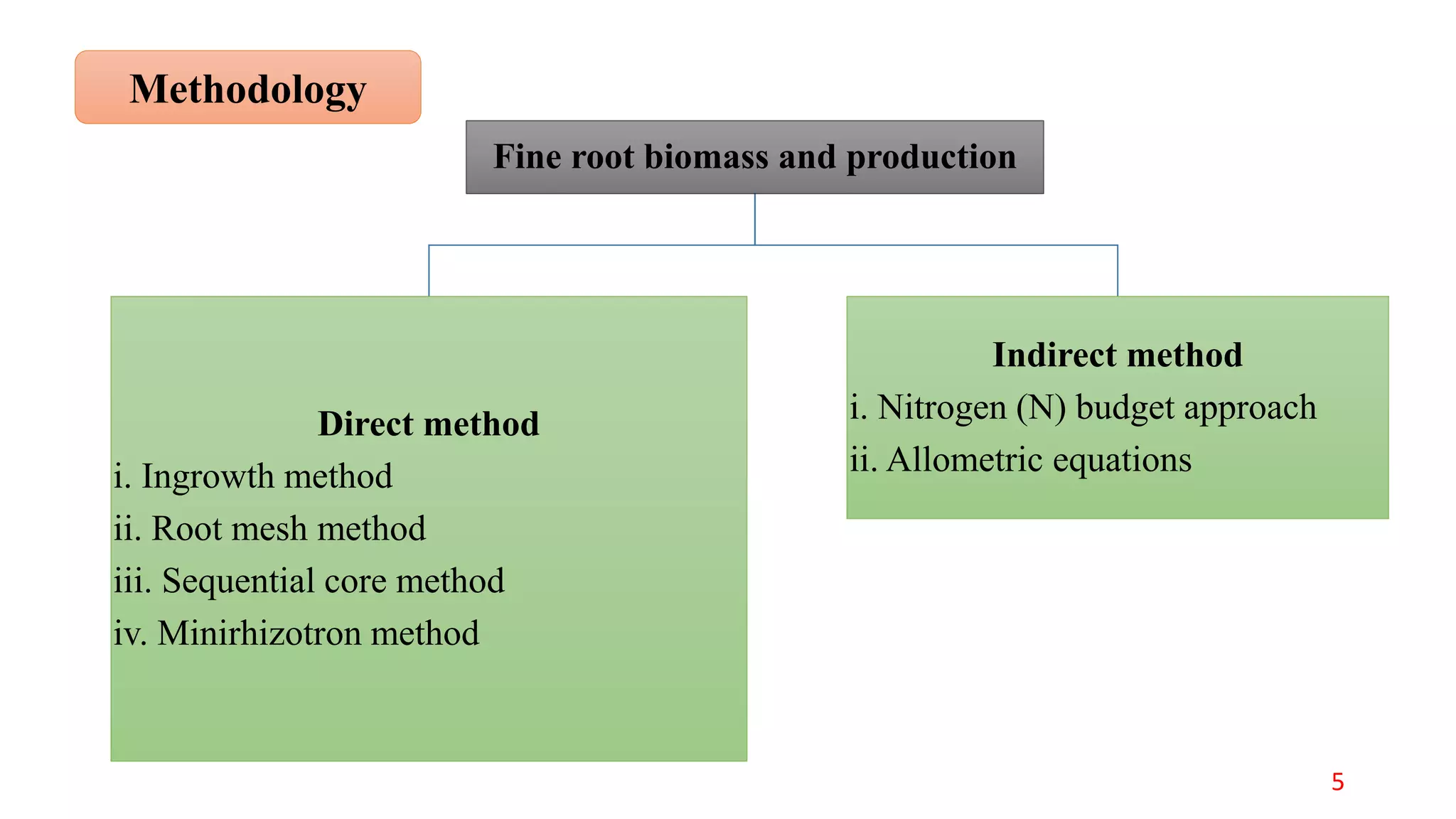
Direct method
i. Ingrowth method
ii. Root mesh method
iii. Sequential core method
iv. Minirhizotron method
Indirect method
i. Nitrogen (N) budget approach
ii. Allometric equations
Methodology
5
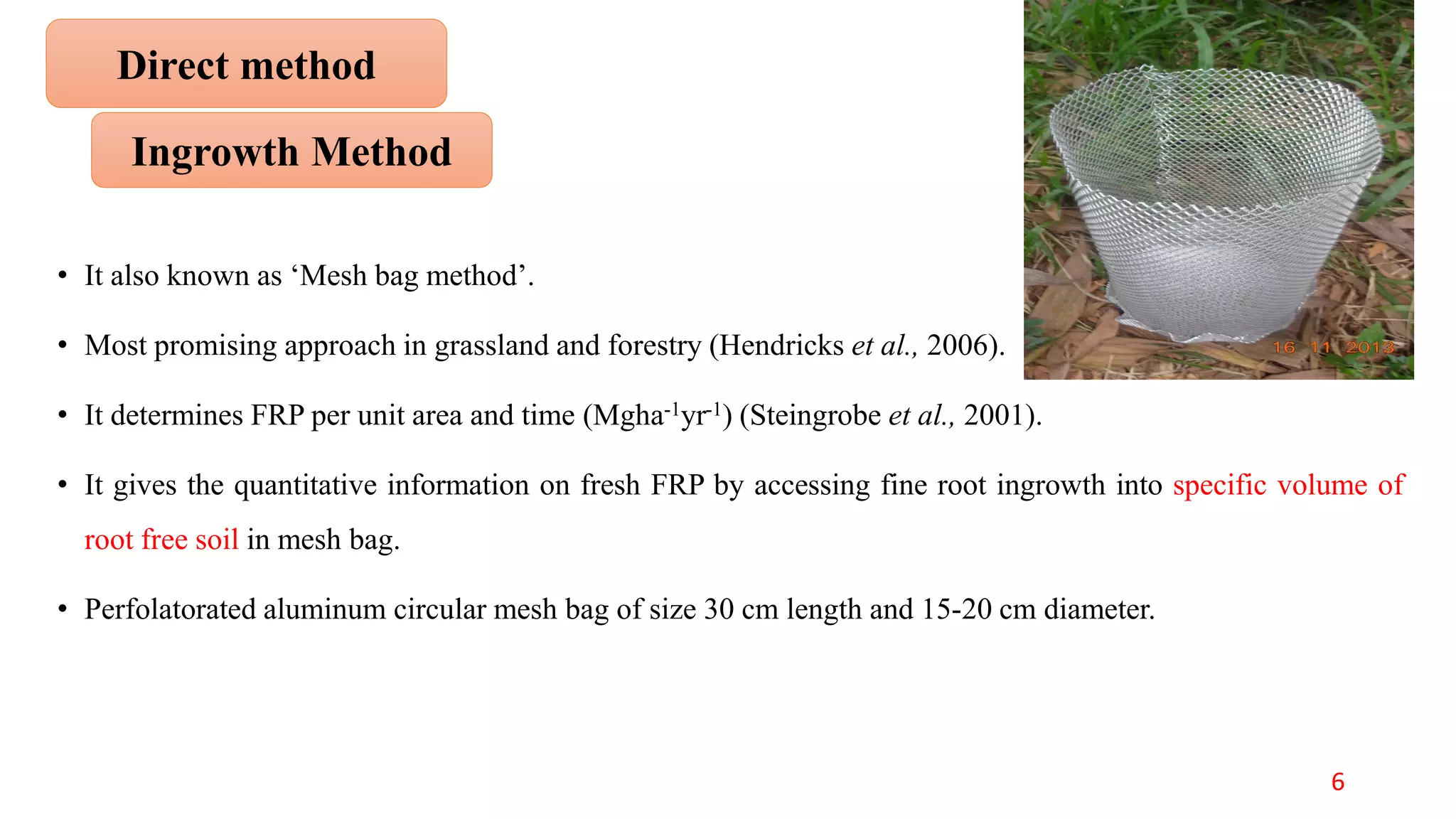
• It also known as ‘Mesh bag method’.
• Most promising approach in grassland and forestry (Hendricks et al., 2006).
• It determines FRP per unit area and time (Mgha-1yr-1) (Steingrobe et al., 2001).
• It gives the quantitative information on fresh FRP by accessing fine root ingrowth into specific volume of
root free soil in mesh bag.
• Perfolatorated aluminum circular mesh bag of size 30 cm length and 15-20 cm diameter.
Ingrowth Method
Direct method
6
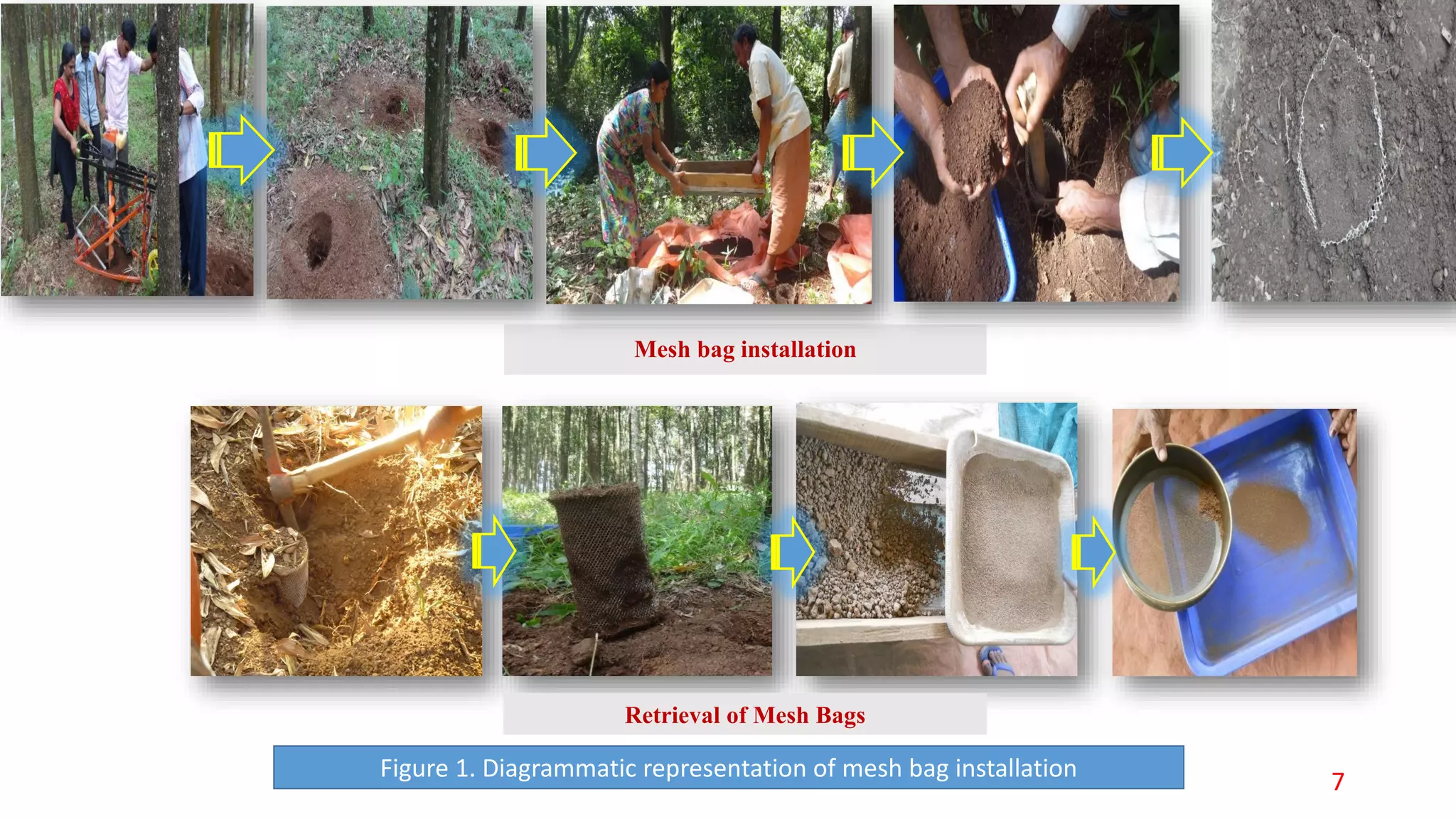
Mesh bag installation
Retrieval of Mesh Bags
Figure 1. Diagrammatic representation of mesh bag installation 7
1. High disturbance to root and rooting environment.
2. Physical properties may change especially BD.
3. Severing of the roots may lead to fine root proliferation and hence may lead to
over estimation.
4. Decomposition is not quantified.
Limitation of Ingrowth method
8
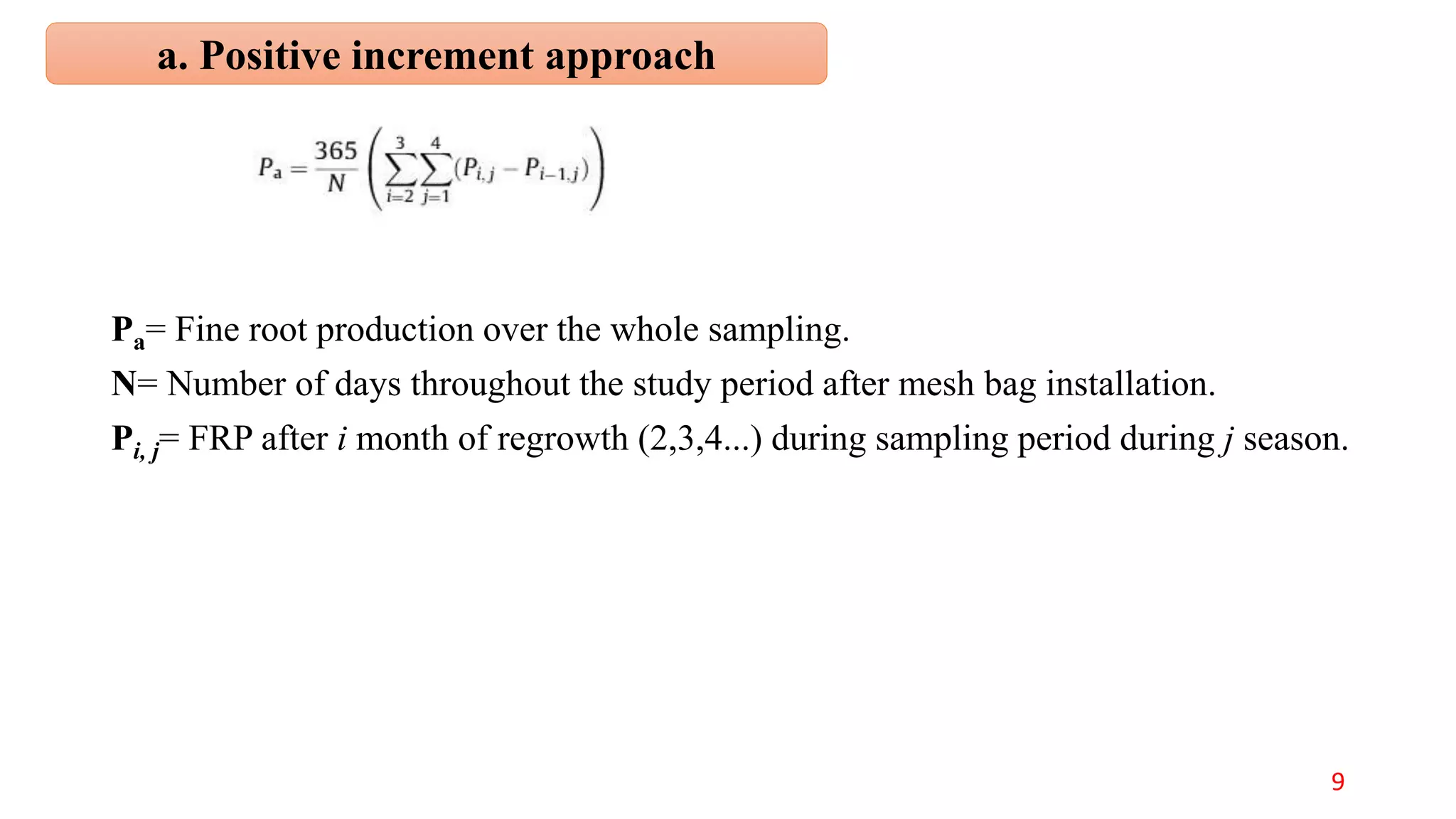
a. Positive increment approach
9
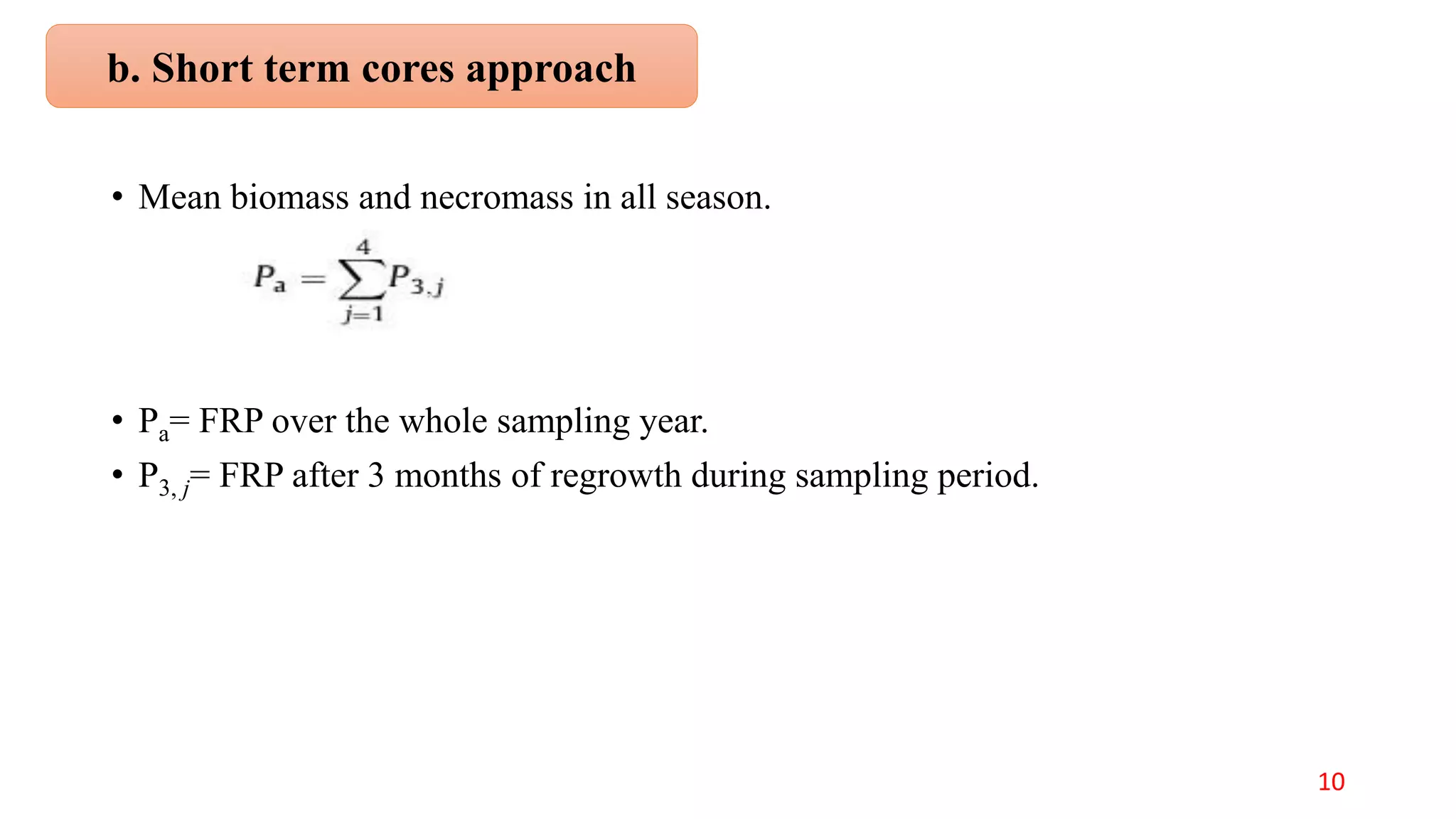
Pa= Fine root production over the whole sampling.
N= Number of days throughout the study period after mesh bag installation.
Pi, j= FRP after i month of regrowth (2,3,4...) during sampling period during j season.
• Mean biomass and necromass in all season.
• Pa= FRP over the whole sampling year.
• P3, j= FRP after 3 months of regrowth during sampling period.
b. Short term cores approach
10
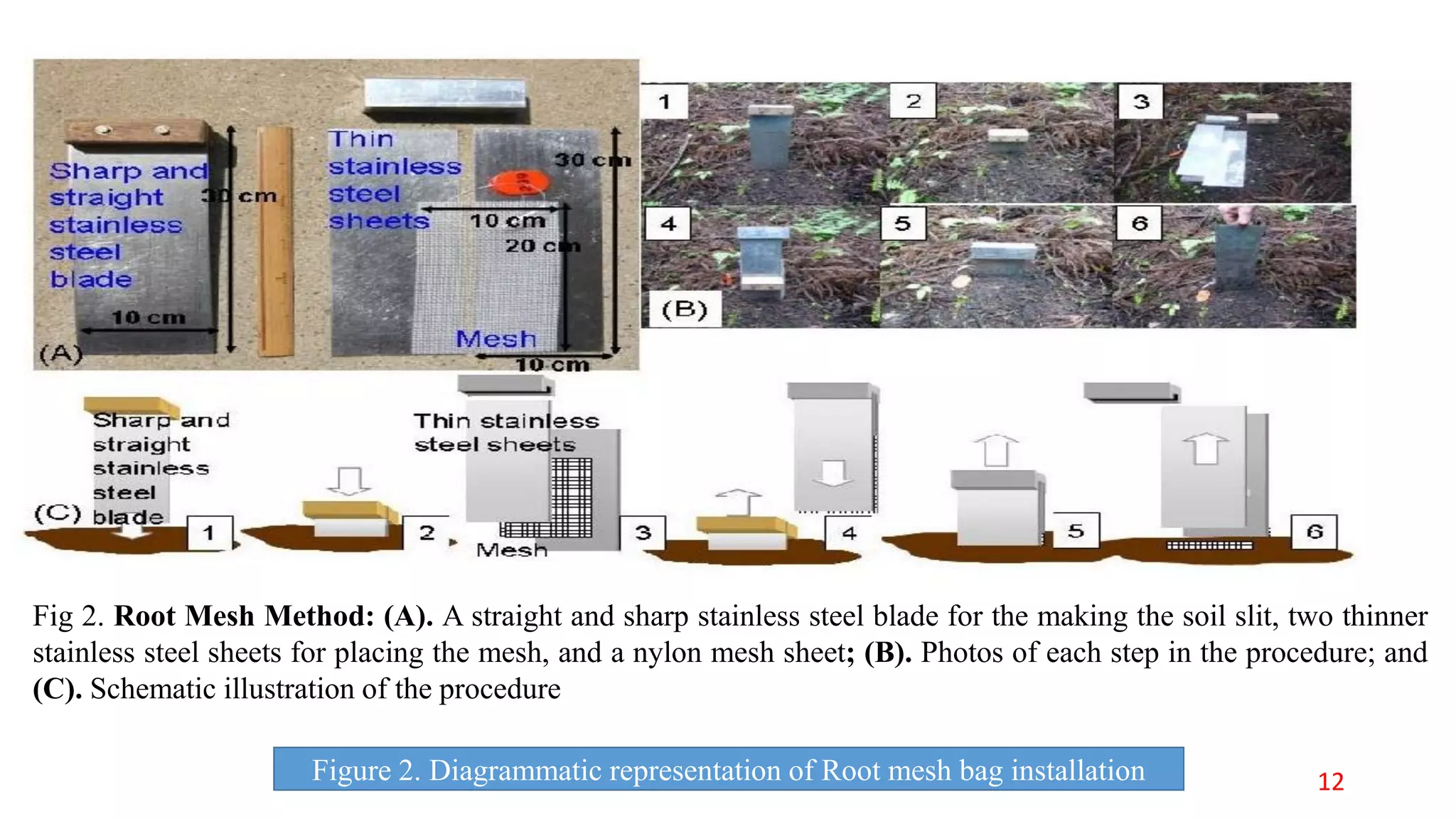
The following procedure as follows:
I. Take a straight stainless steel blade size (10 x 30 x 0.2 cm) and push into the soil surface
up to depth of 20 cm.
II. A nylon mesh size (10 x 10 x 0.1 cm) fit between two thin straight stainless steel sheets
(10 x 30 x 0.1 cm) attach to a single handle.
III. The apparatus containing the mesh insert gradually into the slit, along the inserted blade.
IV. The blade was removed slowly from the slit.
V. The handle of the apparatus made of two thin stainless steel sheets remove and each sheet
individually extracted from the slit, leaving the mess insert vertically in the soil.
Root Mesh Method
11
Fig 2. Root Mesh Method: (A). A straight and sharp stainless steel blade for the making the soil slit, two thinner
stainless steel sheets for placing the mesh, and a nylon mesh sheet; (B). Photos of each step in the procedure; and
(C). Schematic illustration of the procedure
Figure 2. Diagrammatic representation of Root mesh bag installation 12
• Fine root production and necromass over time.
• Carried out repeatedly in the same location to establish inter annual variation.
• Sum of all fine root biomass between growing seasons on a year.
Sequential Coring
13
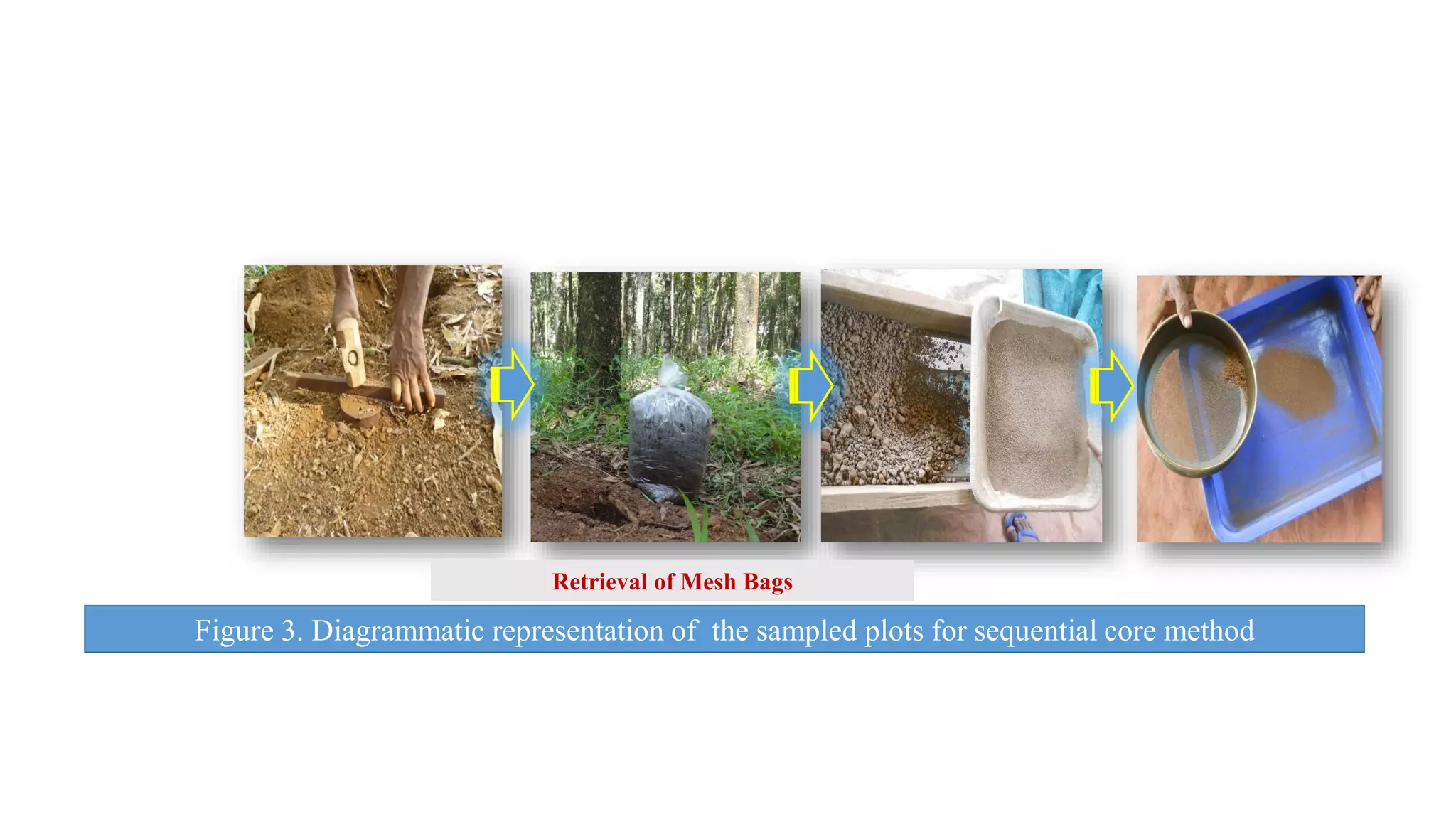
Figure 3. Diagrammatic representation of the sampled plots for sequential core method
Retrieval of Mesh Bags
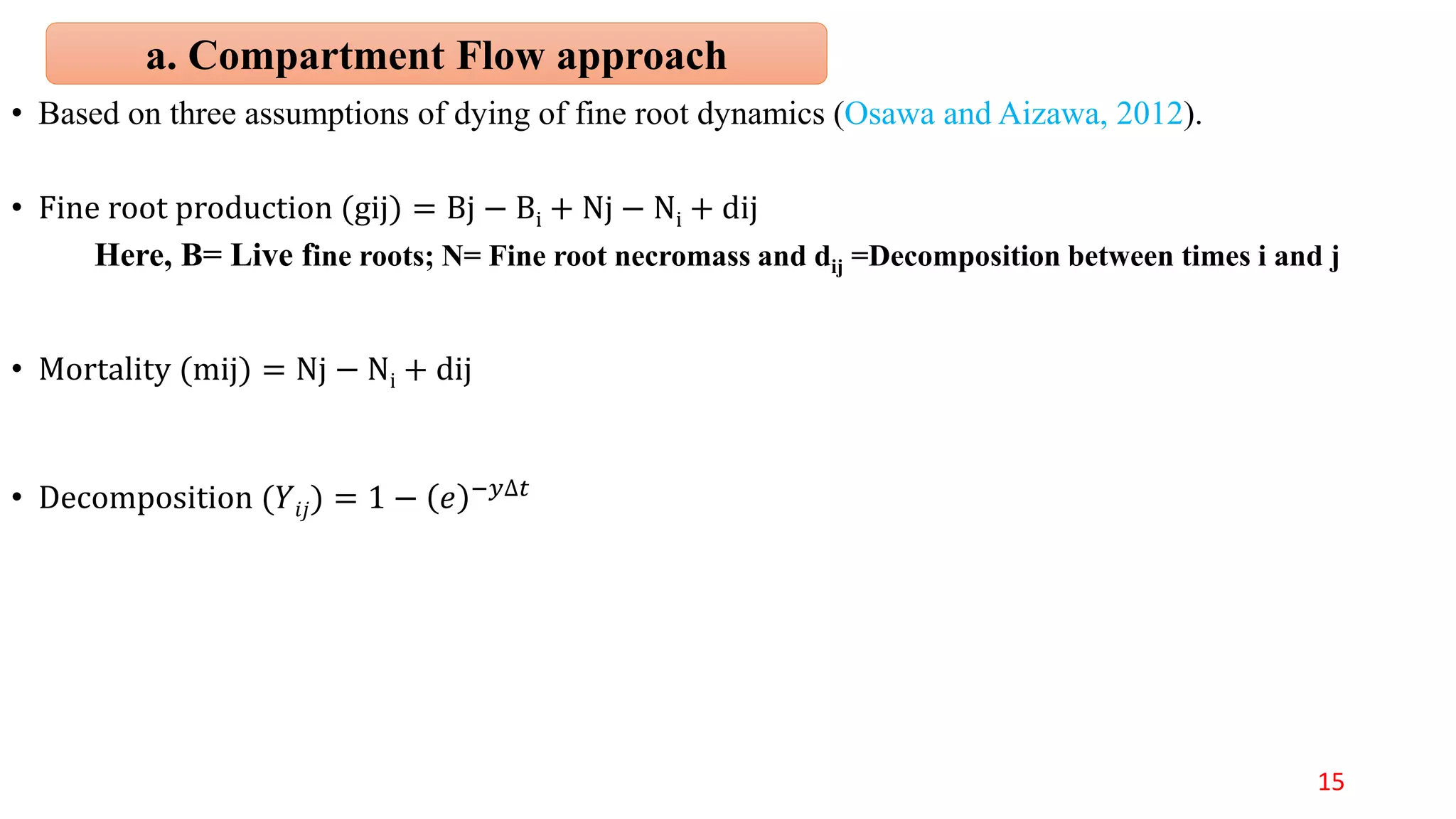
• Based on three assumptions of dying of fine root dynamics (Osawa and Aizawa, 2012).
• Fine root production (gij) = Bj − Bi + Nj − Ni + dij
Here, B= Live fine roots; N= Fine root necromass and dij =Decomposition between times i and j
• Mortality (mij) = Nj − Ni + dij
• Decomposition (𝑌𝑖𝑗) = 1 − )( 𝑒 −𝑦∆𝑡
a. Compartment Flow approach
15
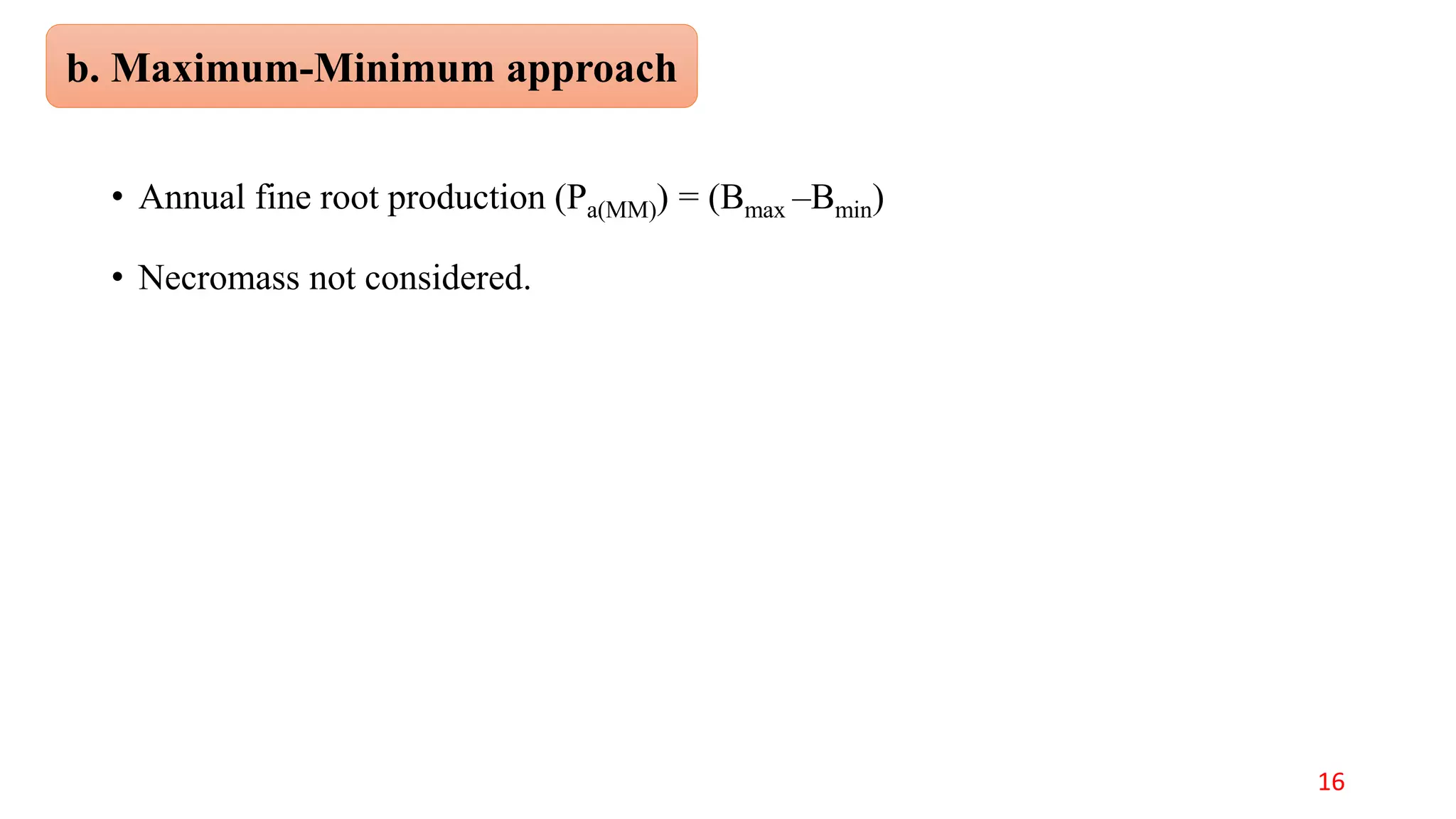
• Annual fine root production (Pa(MM)) = (Bmax –Bmin)
• Necromass not considered.
b. Maximum-Minimum approach
16
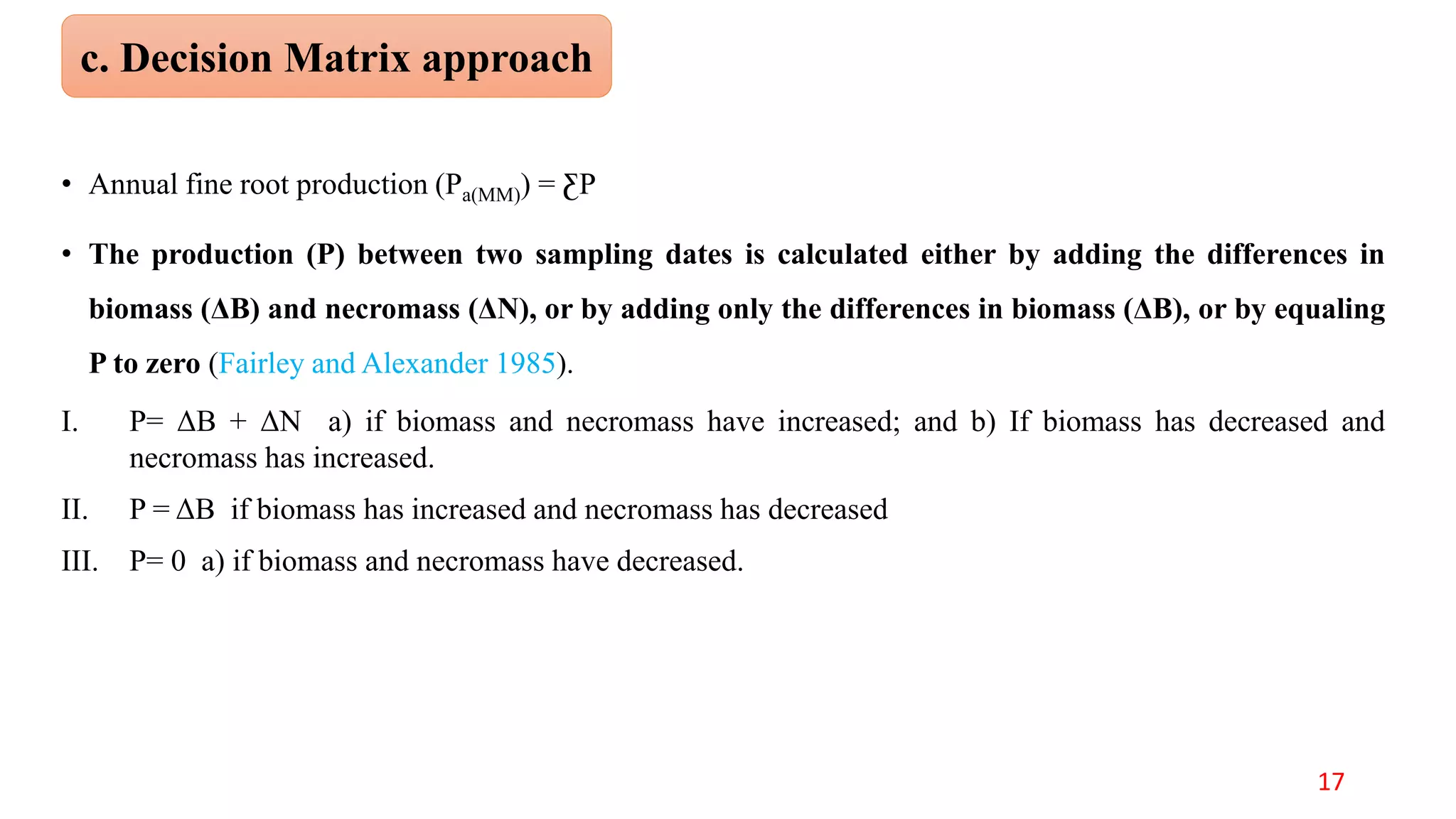
• Annual fine root production (Pa(MM)) = ƸP
• The production (P) between two sampling dates is calculated either by adding the differences in
biomass (ΔB) and necromass (ΔN), or by adding only the differences in biomass (ΔB), or by equaling
P to zero (Fairley and Alexander 1985).
I. P= ΔB + ΔN a) if biomass and necromass have increased; and b) If biomass has decreased and
necromass has increased.
II. P = ΔB if biomass has increased and necromass has decreased
III. P= 0 a) if biomass and necromass have decreased.
c. Decision Matrix approach
17
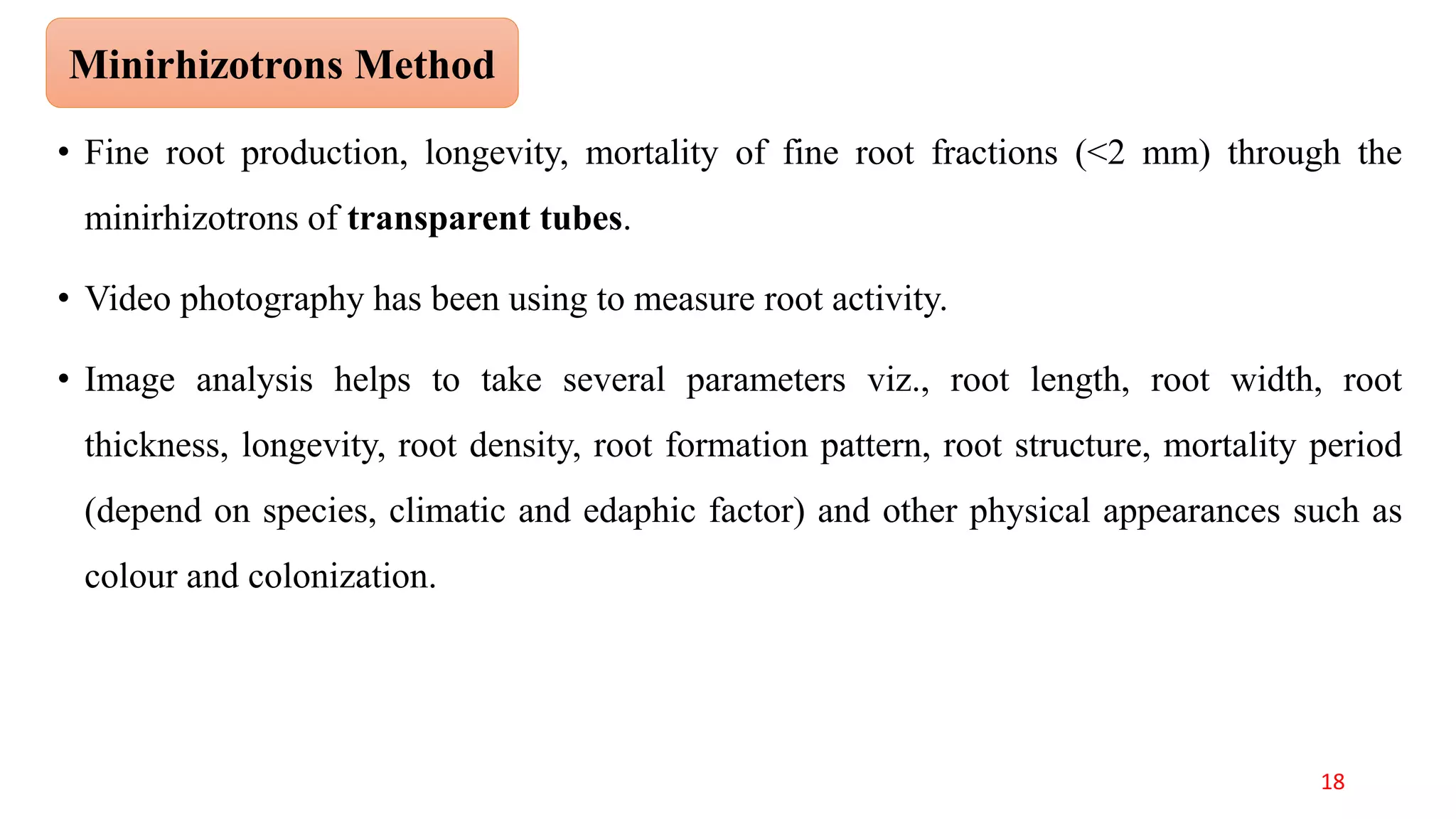
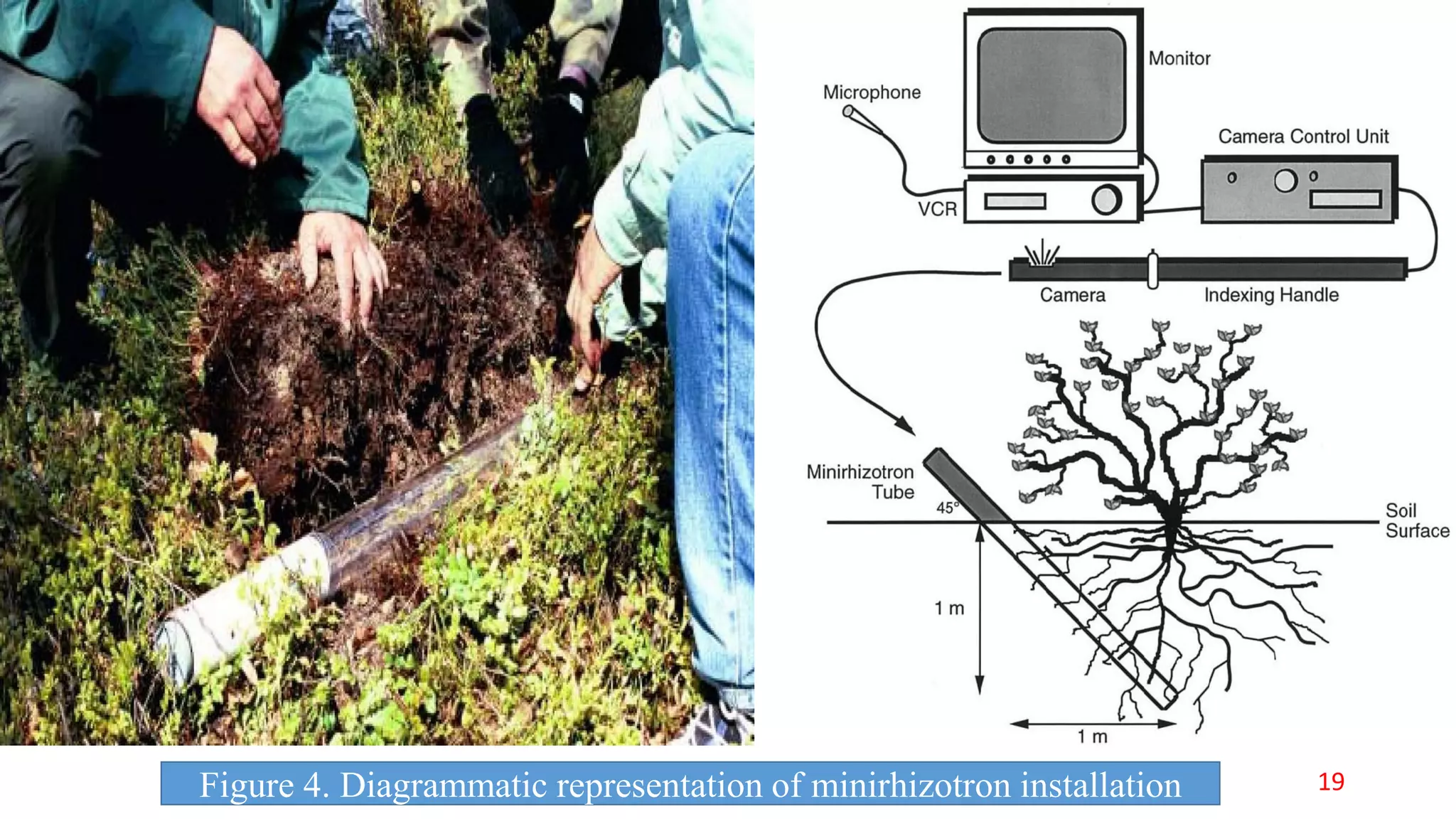
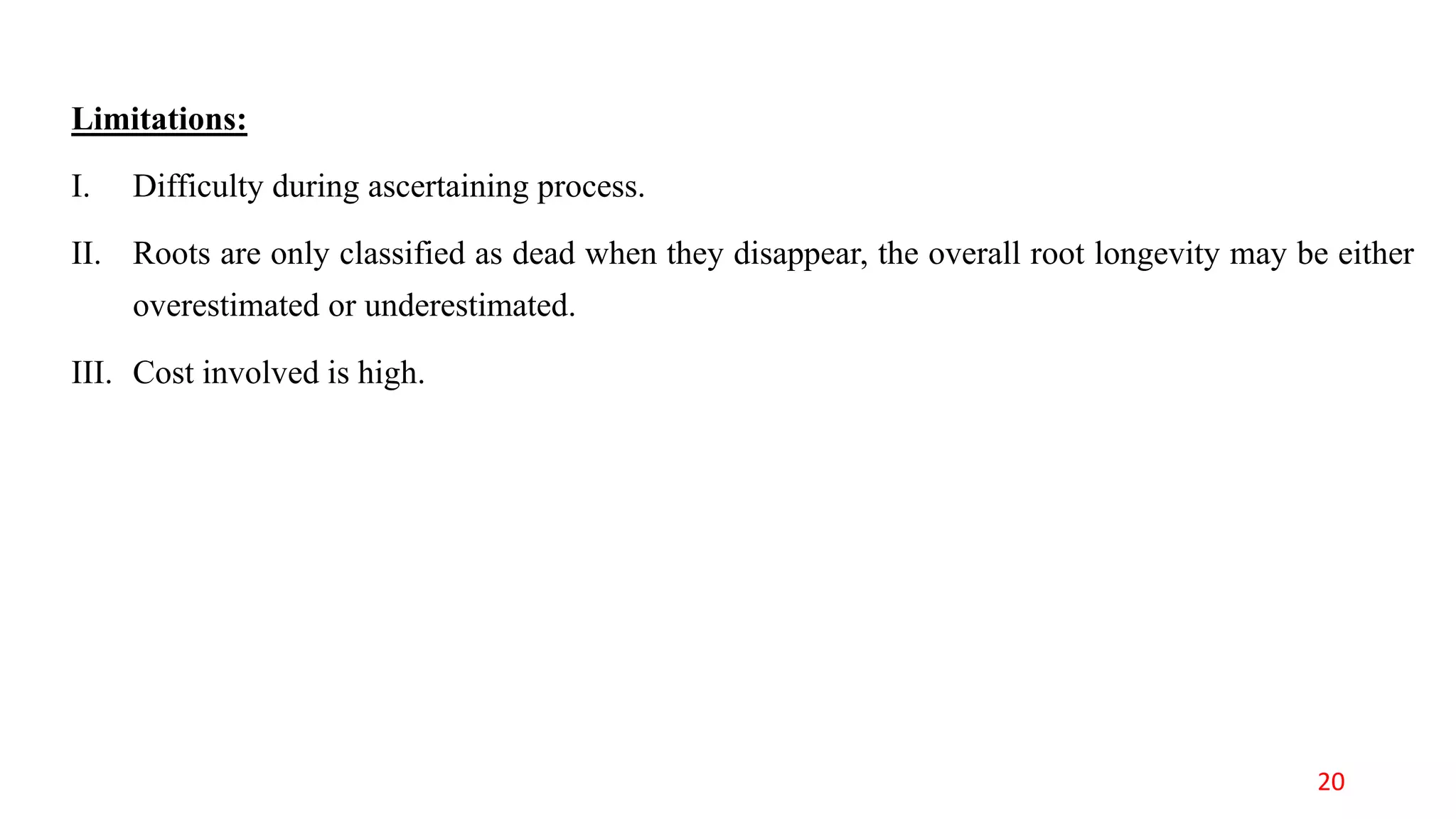
• Fine root production, longevity, mortality of fine root fractions (<2 mm) through the
minirhizotrons of transparent tubes.
• Video photography has been using to measure root activity.
• Image analysis helps to take several parameters viz., root length, root width, root
thickness, longevity, root density, root formation pattern, root structure, mortality period
(depend on species, climatic and edaphic factor) and other physical appearances such as
colour and colonization.
Minirhizotrons Method
18
Figure 4. Diagrammatic representation of minirhizotron installation 19
Limitations:
I. Difficulty during ascertaining process.
II. Roots are only classified as dead when they disappear, the overall root longevity may be either
overestimated or underestimated.
III. Cost involved is high.
20
• Annual N allocation to FR= Difference between net N mineralization in soil and net N flux into
aboveground tissues.
• FRP = Production of annual N allocation to fine roots and the C:N ratio in fine roots (Aber et., 1985).
• N budget approach to work the following information:
i. N inputs into an ecosystem,
ii. N storage in all plant tissues, and
iii. N mineralization rates in the soil.
• Several assumptions:
i. No N retranslocation from roots,
ii. Steady-state conditions,
iii. Mineralizable N is totally taken up by plants, and
iv. N limits plant growth.
Nitrogen (N) Budget Approach
Indirect method
21
• FRB can also be estimated based on easily measurable aboveground metrics such as basal
diameter, DBH, height and crown foliage (Ammer and Wagner, 2002).
• These models function on the basis of a strong relationship between FRB and aboveground
variables at both tree and stand-levels, although this may not apply to all sites (Jurasinski et
al., 2012).
Allometric equations method
22
Limitations
• Leading to uncertainties in the estimates they produce (Jurasinski et al., 2012).
• Unable to reflect the high temporal and spatial heterogeneity in FRB distribution common in most
ecosystems (Zerihun et al., 2007).
• Some of the assumptions used to parameterize models may not hold true for all tree species and
ecosystems (Lee et al., 2004).
23
24
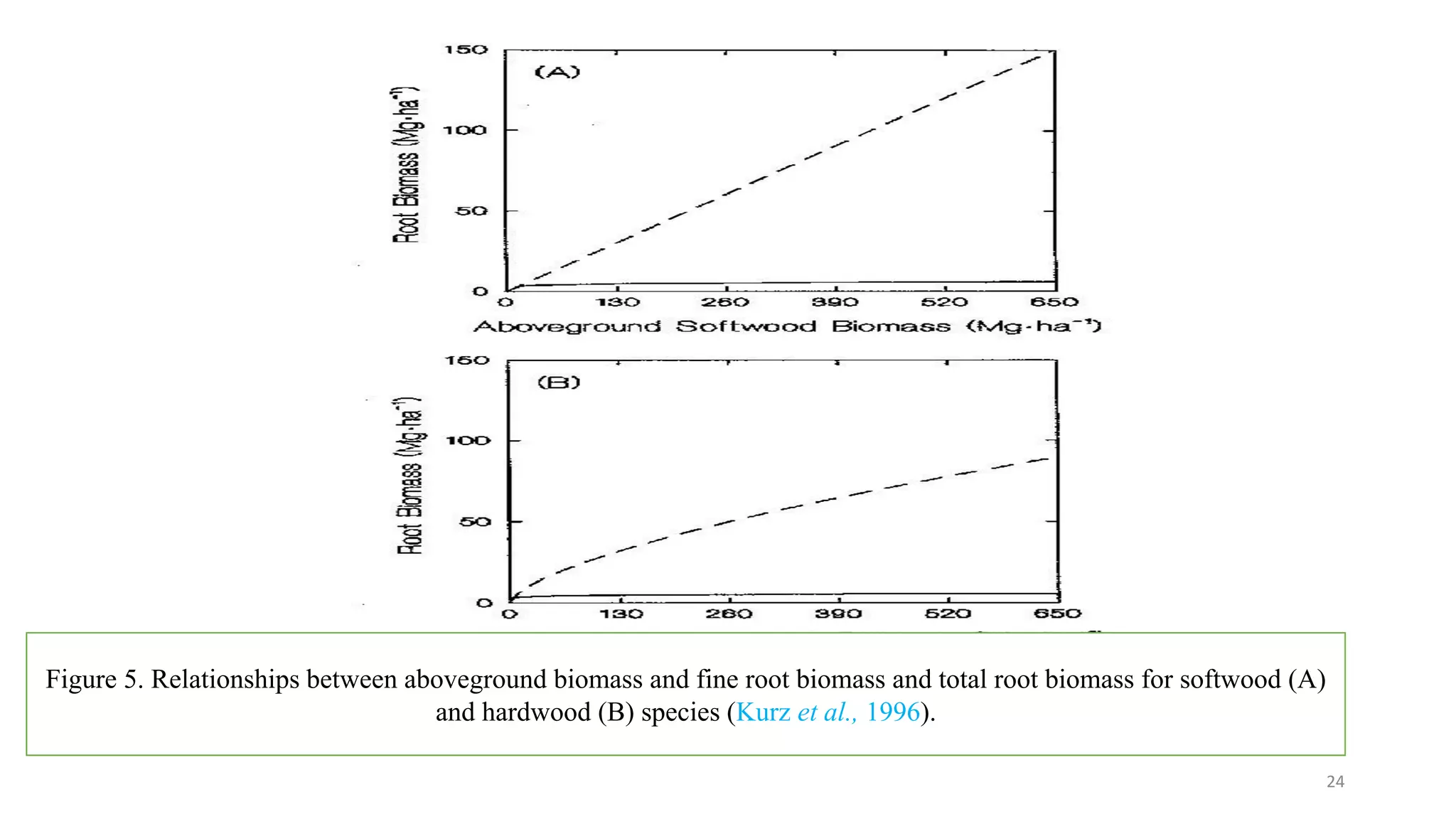
Figure 5. Relationships between aboveground biomass and fine root biomass and total root biomass for softwood (A)
and hardwood (B) species (Kurz et al., 1996).
25
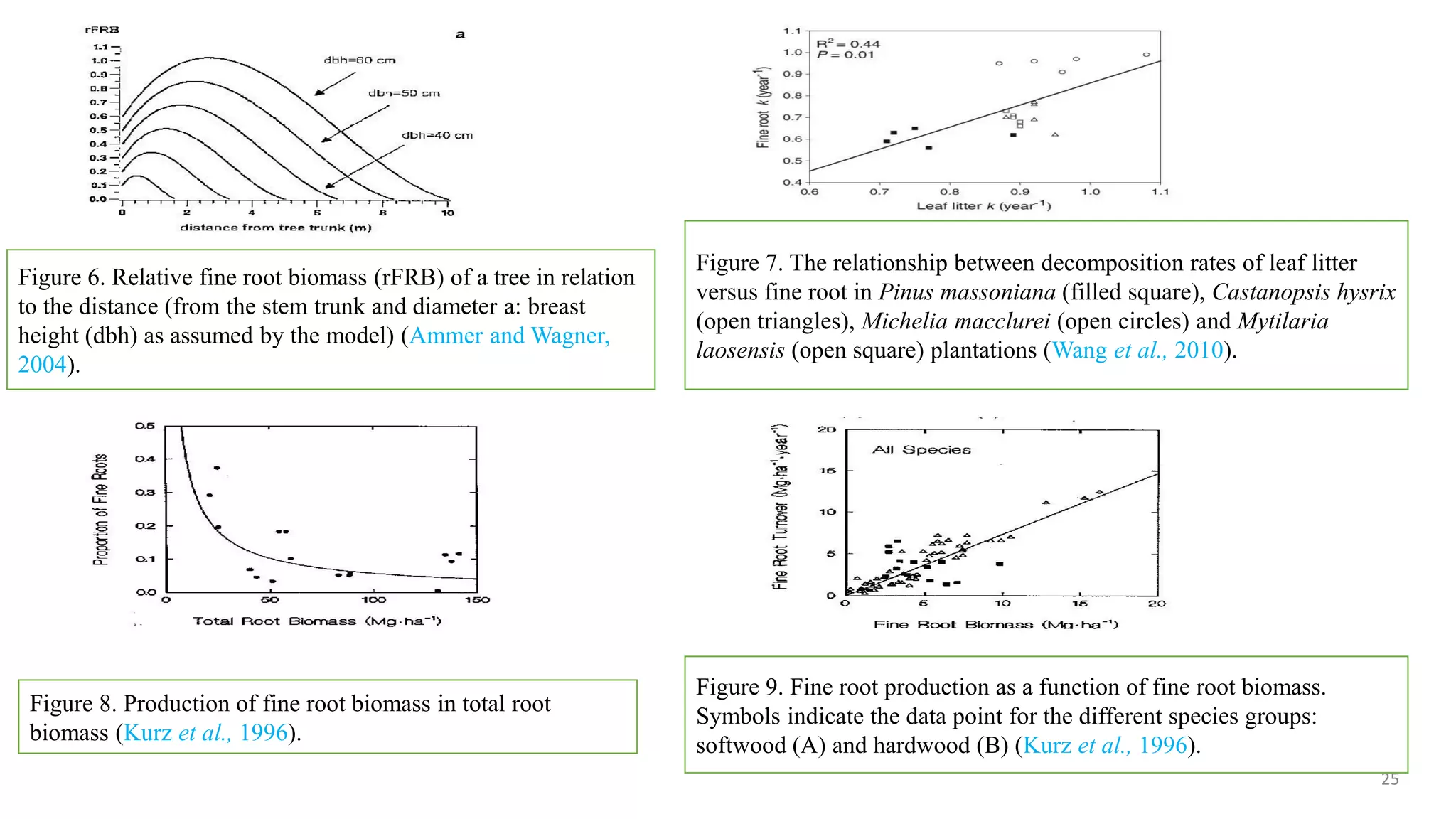
Figure 6. Relative fine root biomass (rFRB) of a tree in relation
to the distance (from the stem trunk and diameter a: breast
height (dbh) as assumed by the model) (Ammer and Wagner,
2004).
Figure 7. The relationship between decomposition rates of leaf litter
versus fine root in Pinus massoniana (filled square), Castanopsis hysrix
(open triangles), Michelia macclurei (open circles) and Mytilaria
laosensis (open square) plantations (Wang et al., 2010).
Figure 8. Production of fine root biomass in total root
biomass (Kurz et al., 1996).
Figure 9. Fine root production as a function of fine root biomass.
Symbols indicate the data point for the different species groups:
softwood (A) and hardwood (B) (Kurz et al., 1996).
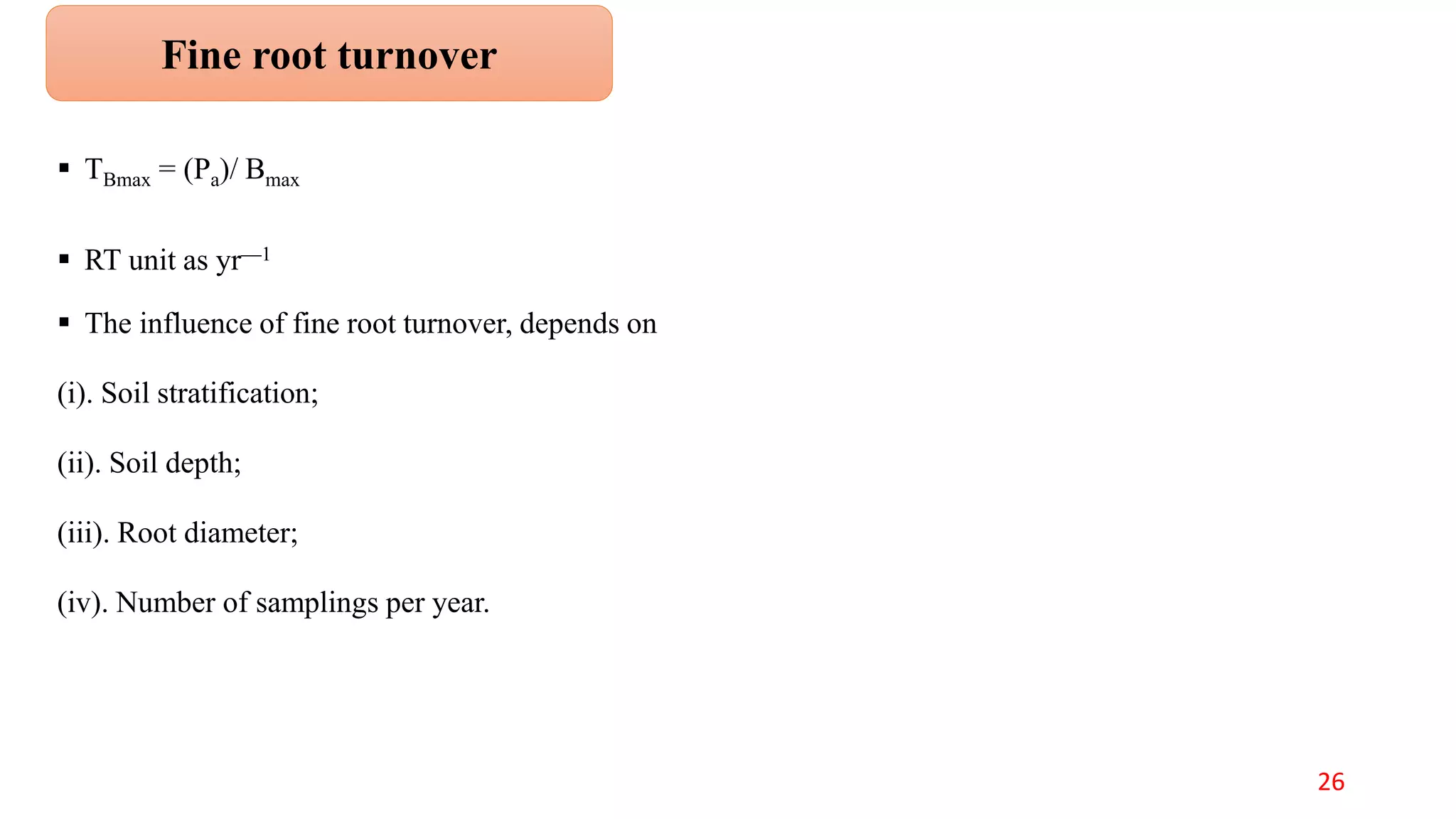
 TBmax = (Pa)/ Bmax
 RT unit as yr—1
 The influence of fine root turnover, depends on
(i). Soil stratification;
(ii). Soil depth;
(iii). Root diameter;
(iv). Number of samplings per year.
Fine root turnover
26
Factors influencing FRP/FRT
CO2
 Soil depth
 Stand management
 Species composition
 Stand age
 Season
 Soil nutrients
 Soil pH
 Basal area
27
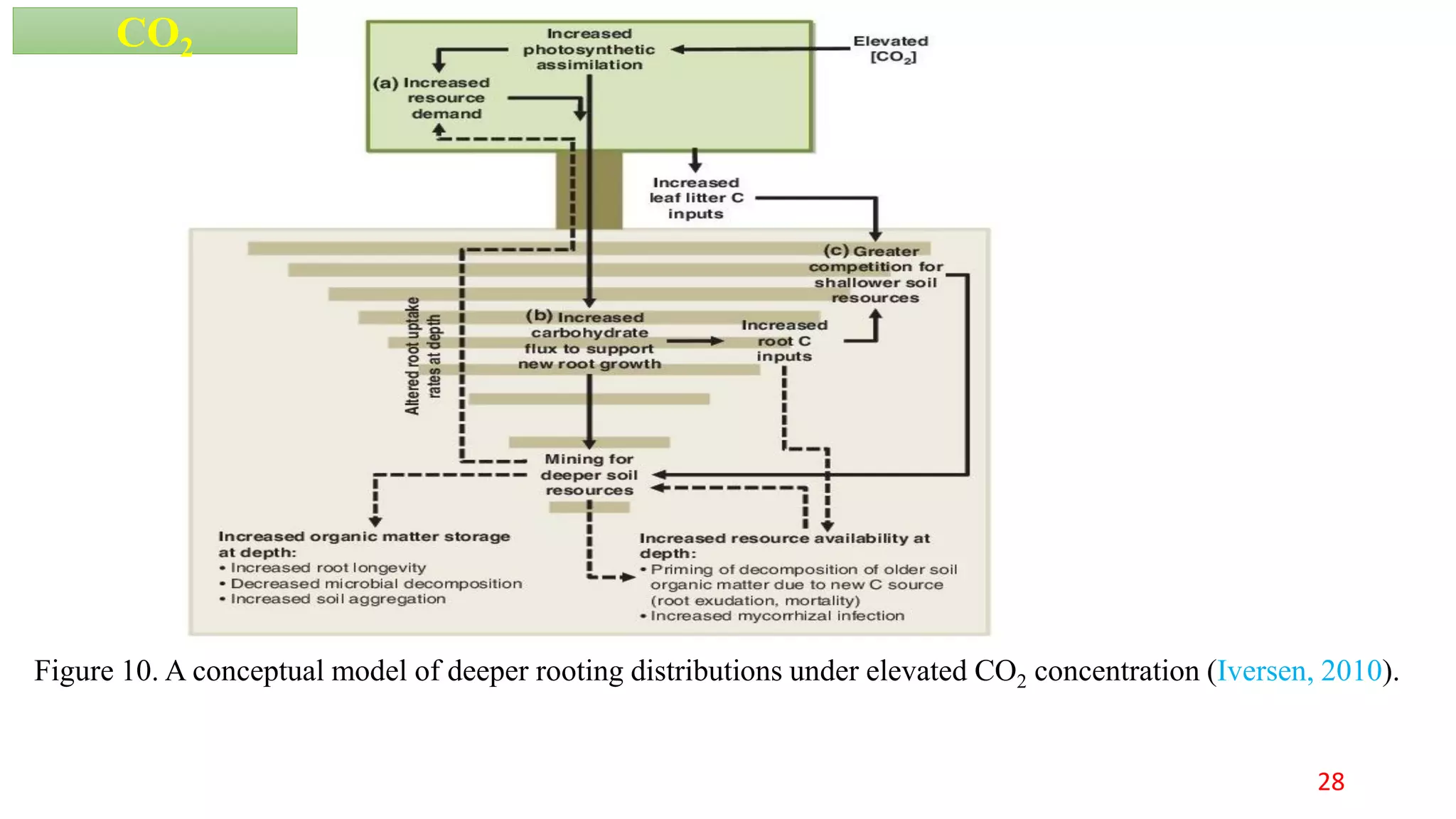
Figure 10. A conceptual model of deeper rooting distributions under elevated CO2 concentration (Iversen, 2010).
CO2
28
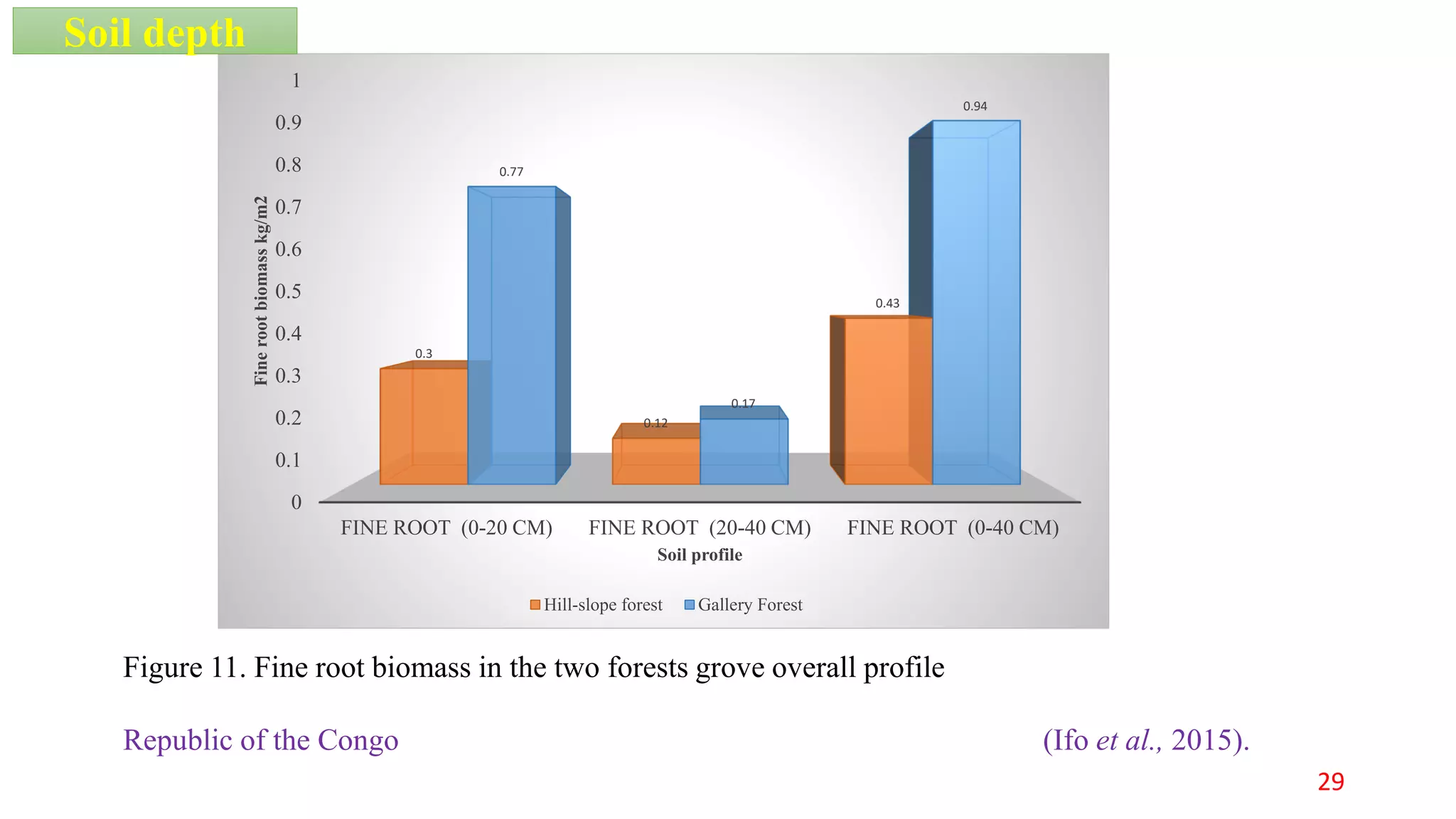
0
0.1
0.2
0.3
0.4
0.5
0.6
0.7
0.8
0.9
1
FINE ROOT (0-20 CM) FINE ROOT (20-40 CM) FINE ROOT (0-40 CM)
0.3
0.12
0.43
0.77
0.17
0.94
Finerootbiomasskg/m2
Soil profile
Hill-slope forest Gallery Forest
Figure 11. Fine root biomass in the two forests grove overall profile
Republic of the Congo (Ifo et al., 2015).
Soil depth
29
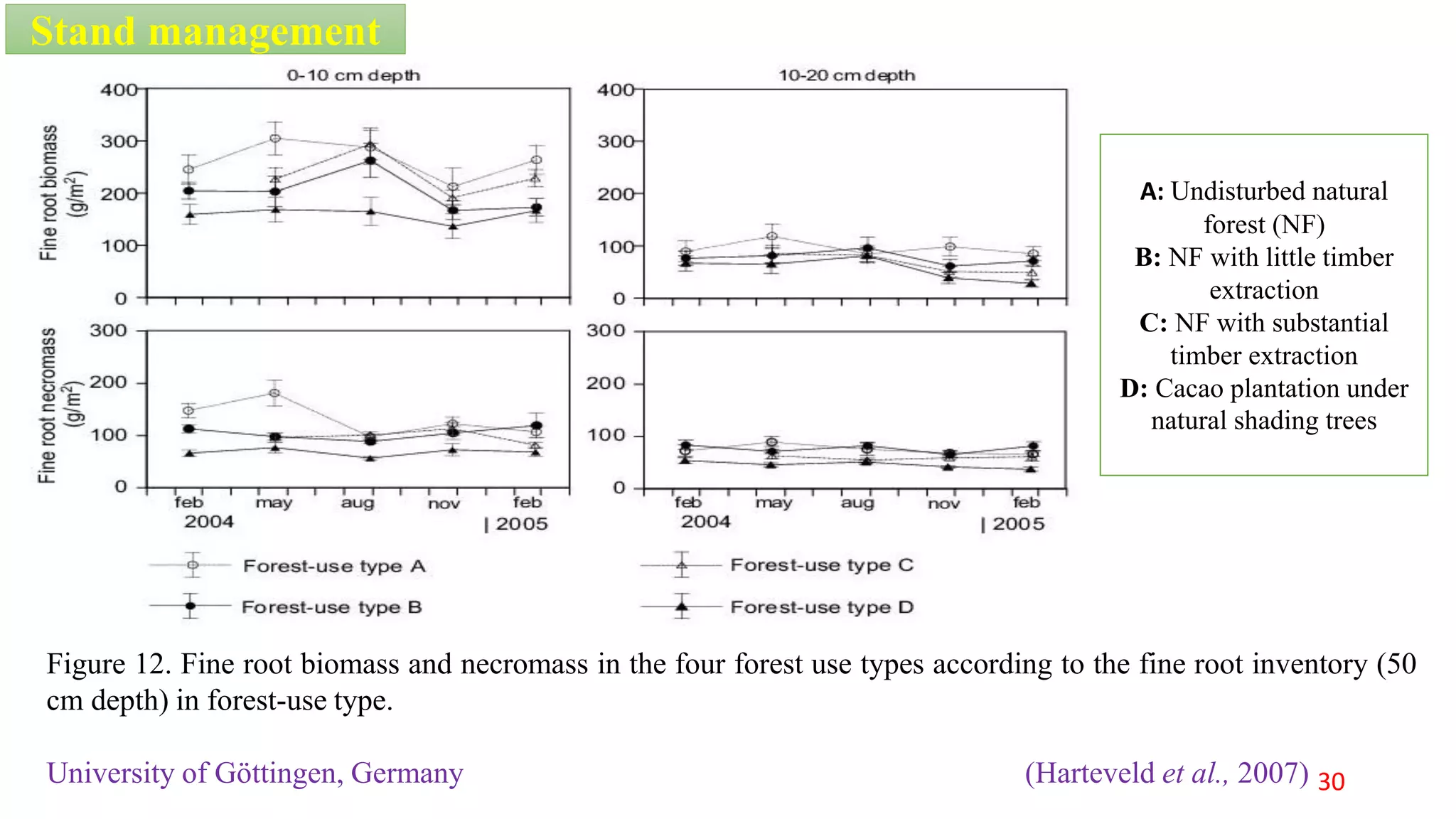
Figure 12. Fine root biomass and necromass in the four forest use types according to the fine root inventory (50
cm depth) in forest-use type.
University of Göttingen, Germany (Harteveld et al., 2007)
Stand management
30
A: Undisturbed natural
forest (NF)
B: NF with little timber
extraction
C: NF with substantial
timber extraction
D: Cacao plantation under
natural shading trees
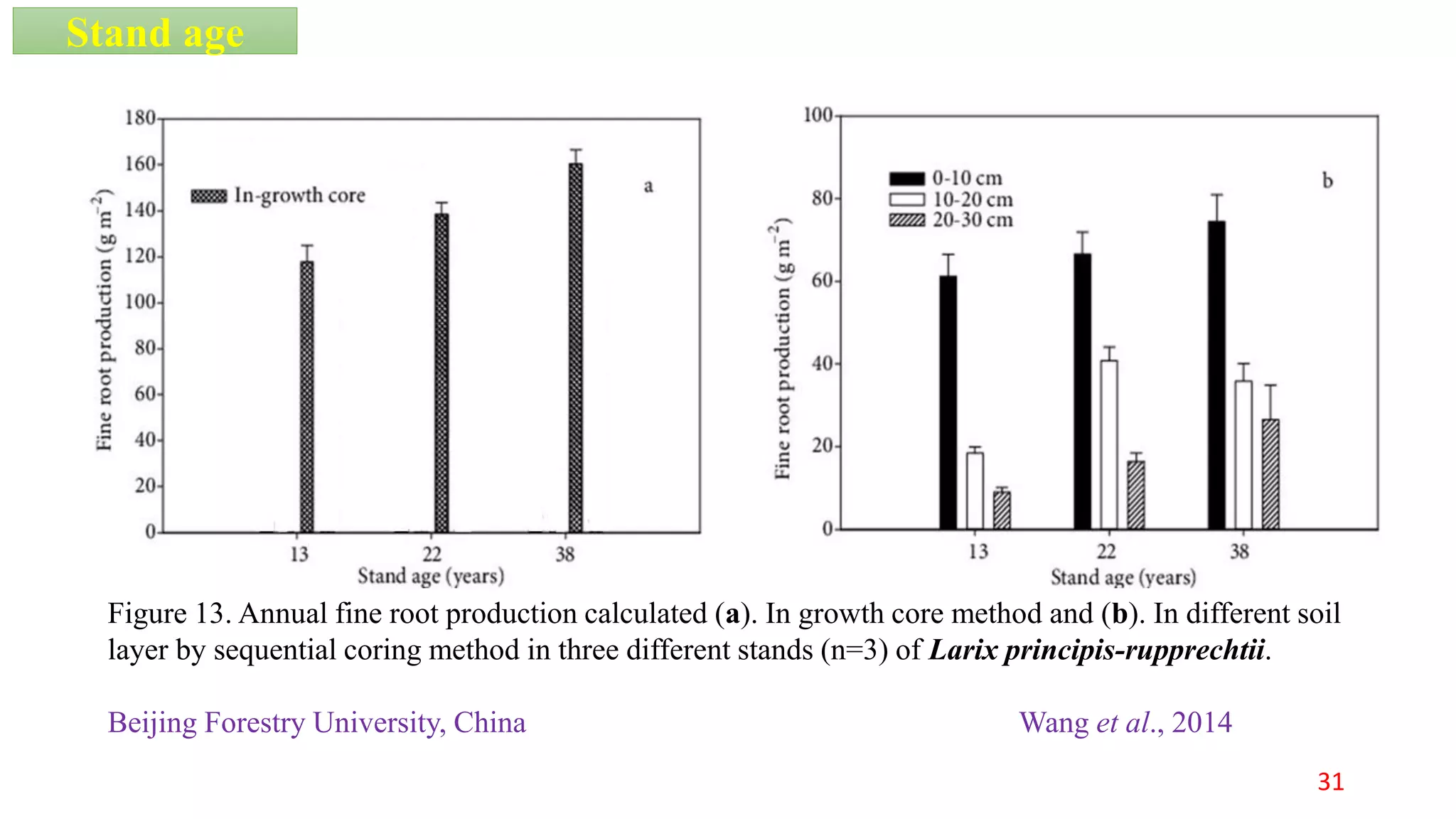
Figure 13. Annual fine root production calculated (a). In growth core method and (b). In different soil
layer by sequential coring method in three different stands (n=3) of Larix principis-rupprechtii.
Beijing Forestry University, China Wang et al., 2014
Stand age
31
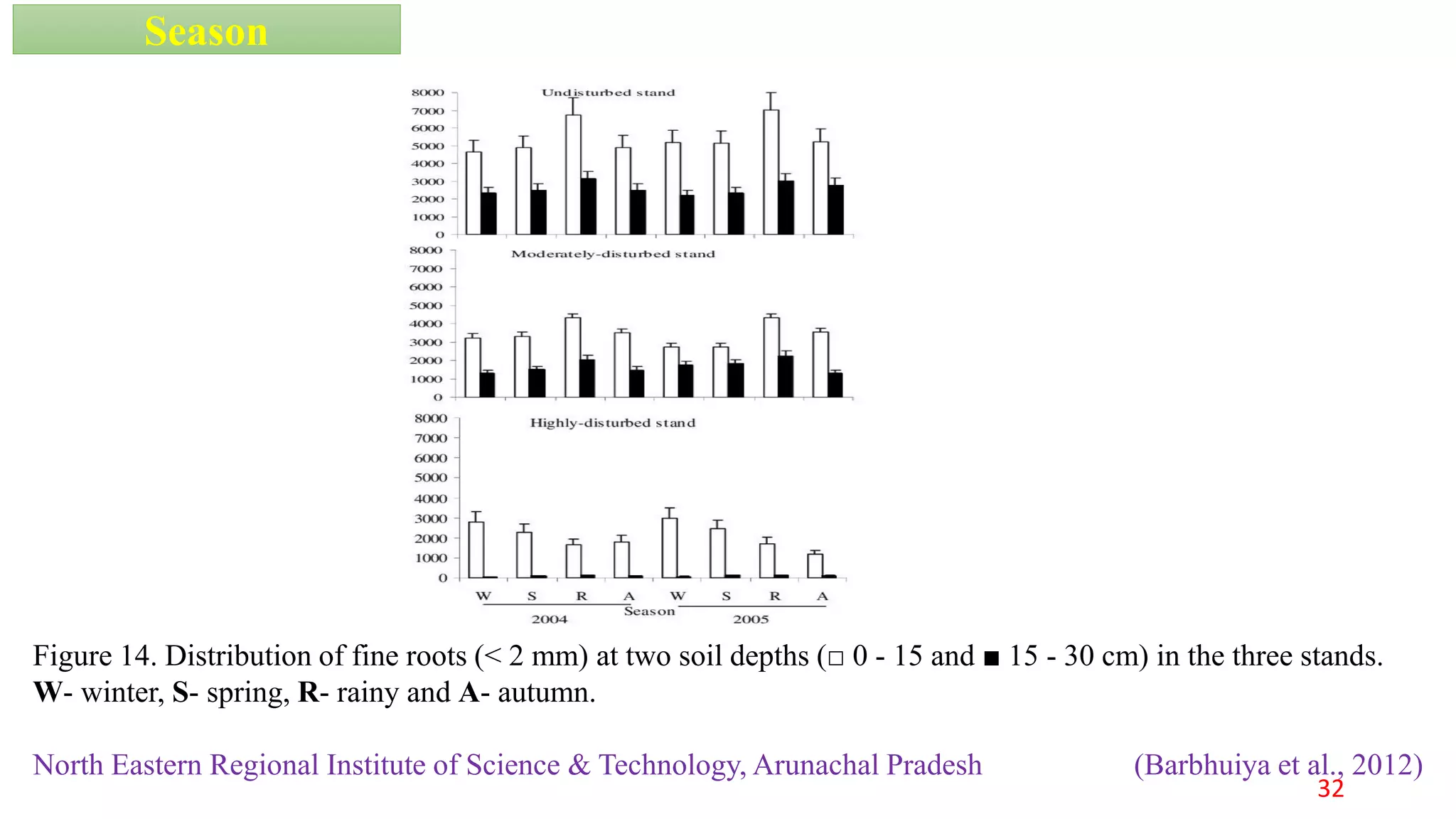
Figure 14. Distribution of fine roots (< 2 mm) at two soil depths (□ 0 - 15 and ■ 15 - 30 cm) in the three stands.
W- winter, S- spring, R- rainy and A- autumn.
North Eastern Regional Institute of Science & Technology, Arunachal Pradesh (Barbhuiya et al., 2012)
Season
32
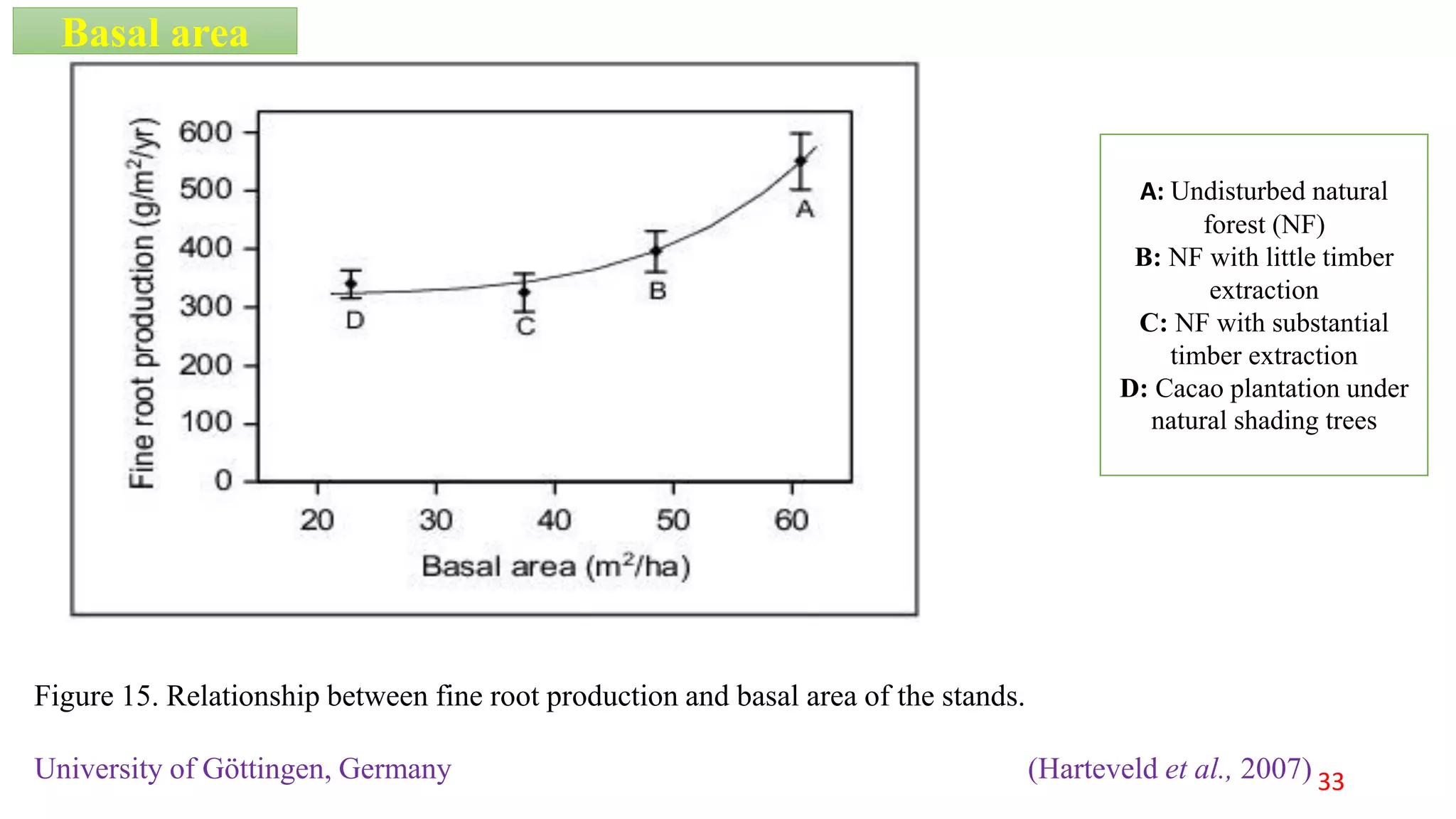
Figure 15. Relationship between fine root production and basal area of the stands.
University of Göttingen, Germany (Harteveld et al., 2007)
Basal area
33
A: Undisturbed natural
forest (NF)
B: NF with little timber
extraction
C: NF with substantial
timber extraction
D: Cacao plantation under
natural shading trees
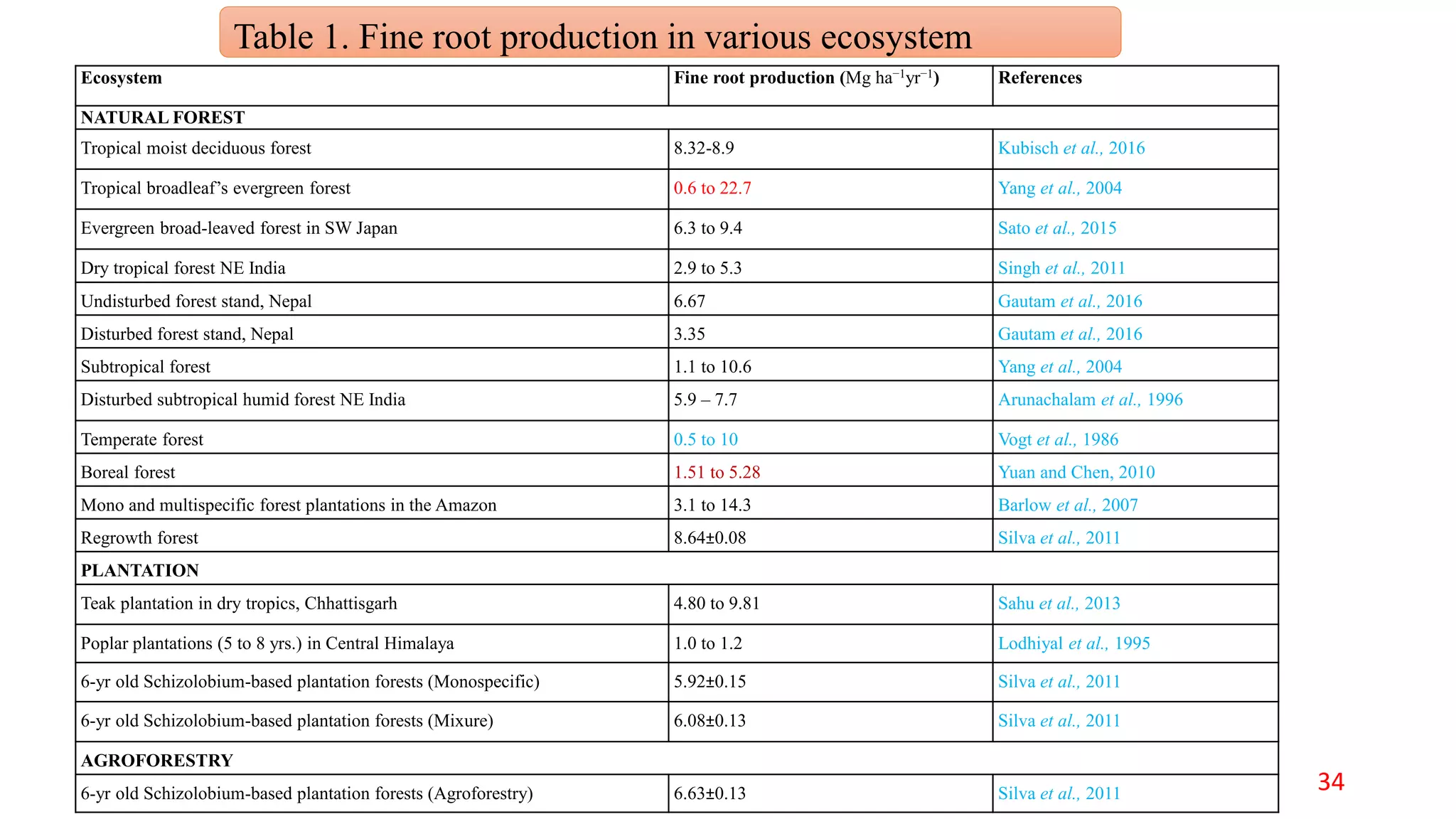
Table 1. Fine root production in various ecosystem
Ecosystem Fine root production (Mg ha−1yr−1) References
NATURAL FOREST
Tropical moist deciduous forest 8.32-8.9 Kubisch et al., 2016
Tropical broadleaf’s evergreen forest 0.6 to 22.7 Yang et al., 2004
Evergreen broad-leaved forest in SW Japan 6.3 to 9.4 Sato et al., 2015
Dry tropical forest NE India 2.9 to 5.3 Singh et al., 2011
Undisturbed forest stand, Nepal 6.67 Gautam et al., 2016
Disturbed forest stand, Nepal 3.35 Gautam et al., 2016
Subtropical forest 1.1 to 10.6 Yang et al., 2004
Disturbed subtropical humid forest NE India 5.9 – 7.7 Arunachalam et al., 1996
Temperate forest 0.5 to 10 Vogt et al., 1986
Boreal forest 1.51 to 5.28 Yuan and Chen, 2010
Mono and multispecific forest plantations in the Amazon 3.1 to 14.3 Barlow et al., 2007
Regrowth forest 8.64±0.08 Silva et al., 2011
PLANTATION
Teak plantation in dry tropics, Chhattisgarh 4.80 to 9.81 Sahu et al., 2013
Poplar plantations (5 to 8 yrs.) in Central Himalaya 1.0 to 1.2 Lodhiyal et al., 1995
6-yr old Schizolobium-based plantation forests (Monospecific) 5.92±0.15 Silva et al., 2011
6-yr old Schizolobium-based plantation forests (Mixure) 6.08±0.13 Silva et al., 2011
AGROFORESTRY
6-yr old Schizolobium-based plantation forests (Agroforestry) 6.63±0.13 Silva et al., 2011 34
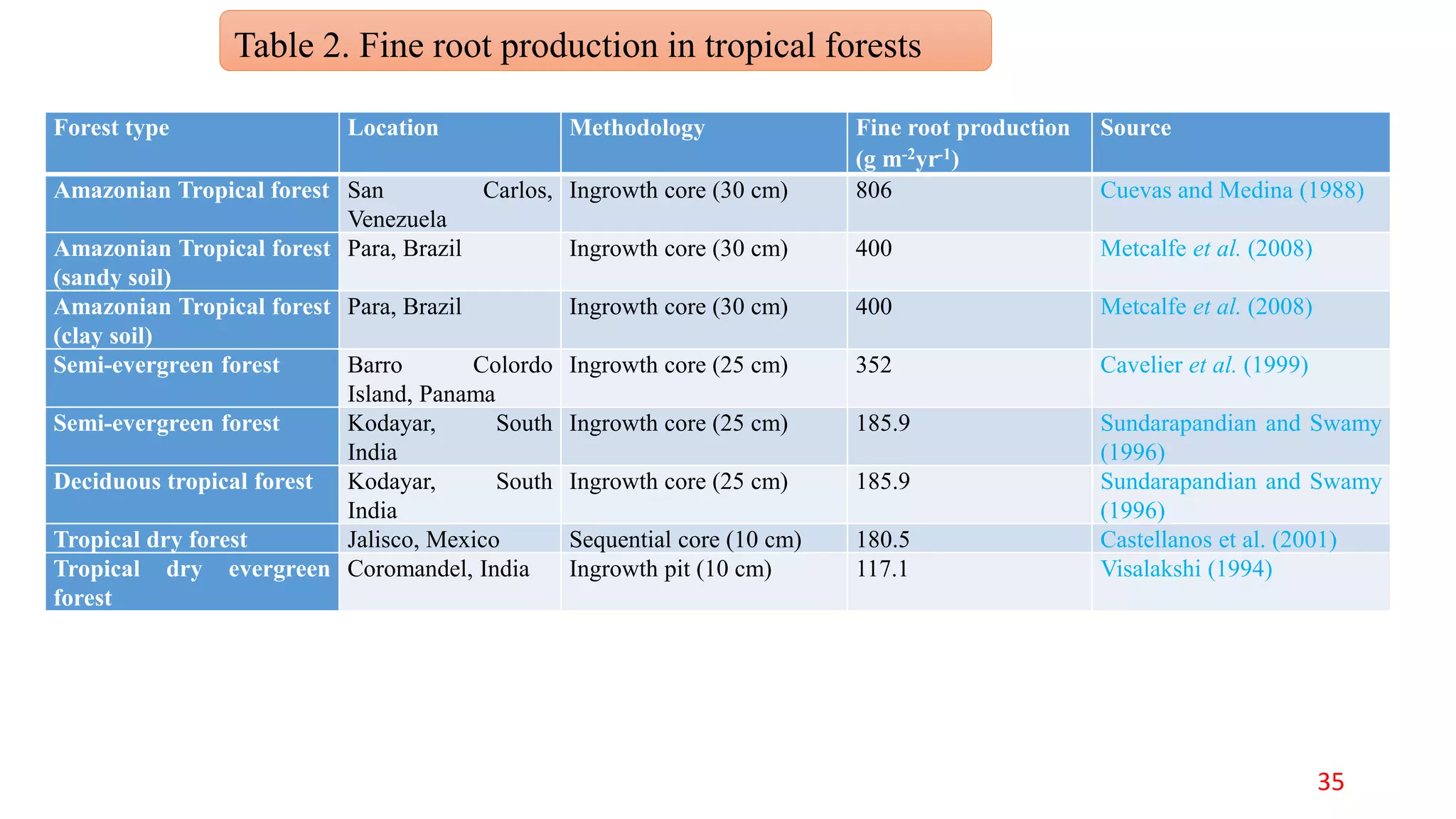
Forest type Location Methodology Fine root production
(g m-2yr-1)
Source
Amazonian Tropical forest San Carlos,
Venezuela
Ingrowth core (30 cm) 806 Cuevas and Medina (1988)
Amazonian Tropical forest
(sandy soil)
Para, Brazil Ingrowth core (30 cm) 400 Metcalfe et al. (2008)
Amazonian Tropical forest
(clay soil)
Para, Brazil Ingrowth core (30 cm) 400 Metcalfe et al. (2008)
Semi-evergreen forest Barro Colordo
Island, Panama
Ingrowth core (25 cm) 352 Cavelier et al. (1999)
Semi-evergreen forest Kodayar, South
India
Ingrowth core (25 cm) 185.9 Sundarapandian and Swamy
(1996)
Deciduous tropical forest Kodayar, South
India
Ingrowth core (25 cm) 185.9 Sundarapandian and Swamy
(1996)
Tropical dry forest Jalisco, Mexico Sequential core (10 cm) 180.5 Castellanos et al. (2001)
Tropical dry evergreen
forest
Coromandel, India Ingrowth pit (10 cm) 117.1 Visalakshi (1994)
Table 2. Fine root production in tropical forests
35
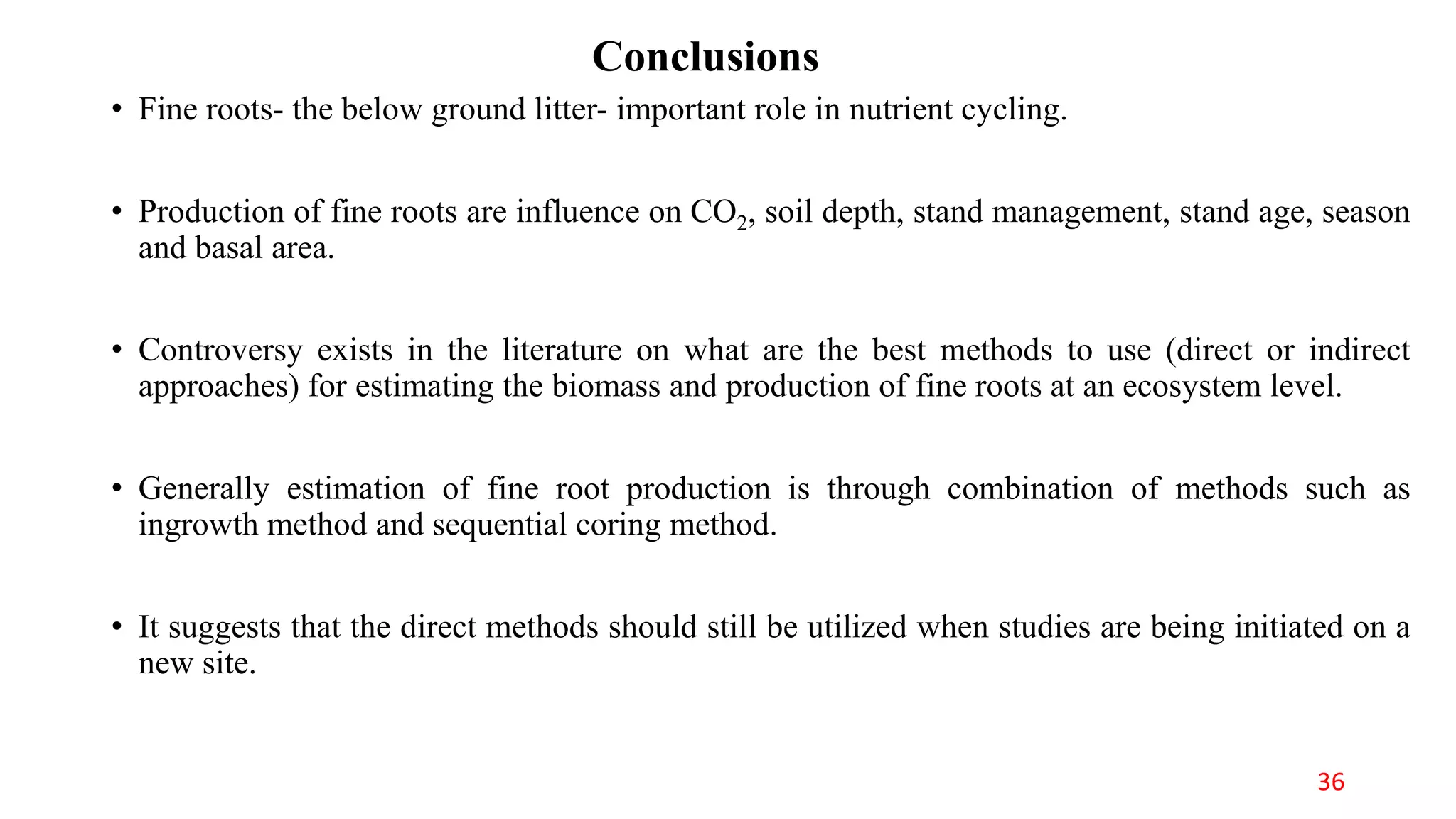
Conclusions
• Fine roots- the below ground litter- important role in nutrient cycling.
• Production of fine roots are influence on CO2, soil depth, stand management, stand age, season
and basal area.
• Controversy exists in the literature on what are the best methods to use (direct or indirect
approaches) for estimating the biomass and production of fine roots at an ecosystem level.
• Generally estimation of fine root production is through combination of methods such as
ingrowth method and sequential coring method.
• It suggests that the direct methods should still be utilized when studies are being initiated on a
new site.
36
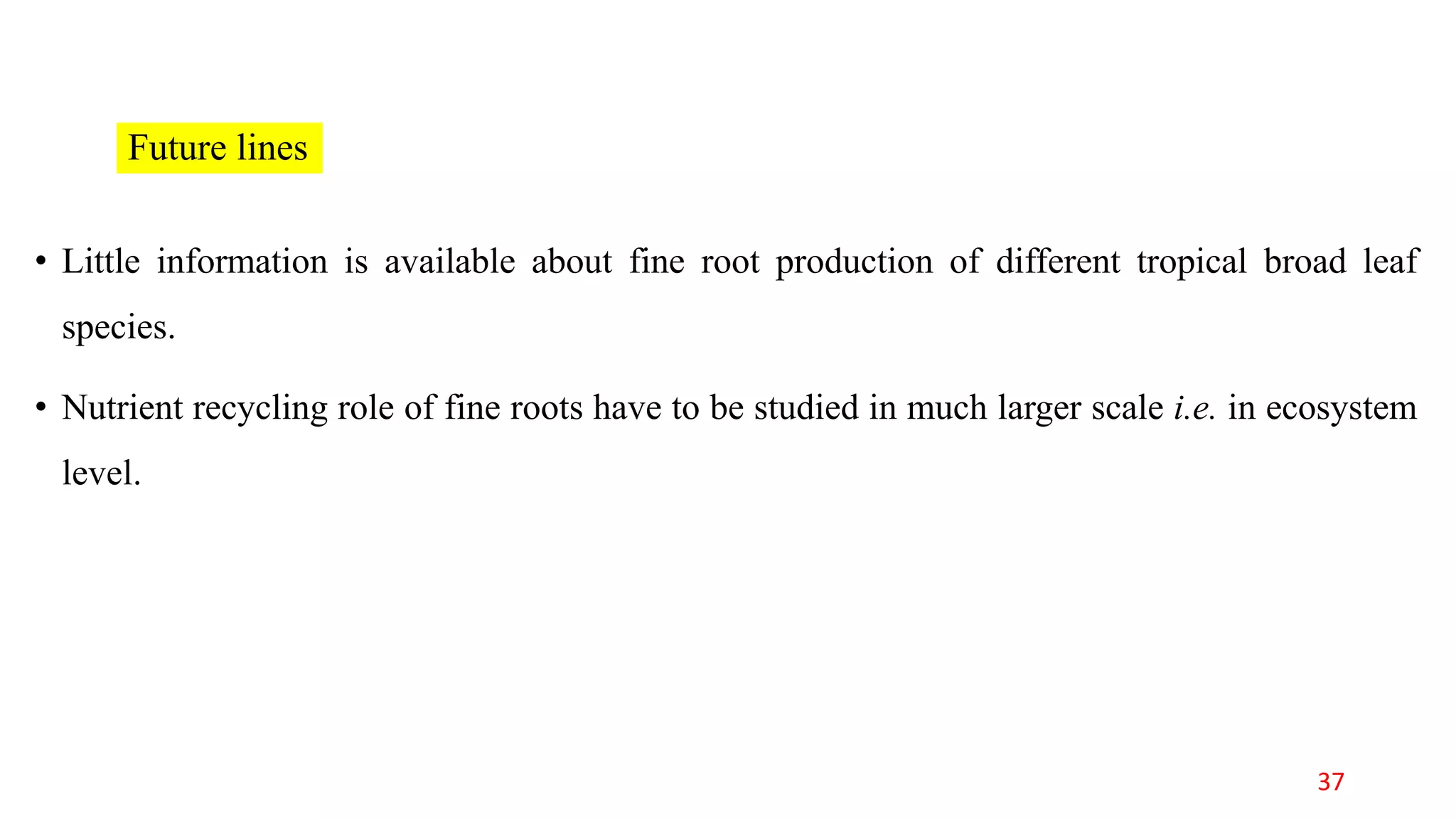
Future lines
• Little information is available about fine root production of different tropical broad leaf
species.
• Nutrient recycling role of fine roots have to be studied in much larger scale i.e. in ecosystem
level.
37
38

Fine roots dynamics in trees

  • 1.
    1 Fine Root Dynamicsin Trees Vikas Kumar 2013-27-102 Dept. of Silviculture & Agroforestry College of Forestry, KAU, Thrissur Mo. No.: 9995093698 Email ID: vkskumar49@gmail.com PhD second seminar
  • 2.
    Contents Introduction Fine Root Production/Biomass (FRP/FRB) Method of estimation of FRP Factors influence FRP FRP research in various ecosystems Conclusion Future line of work 2
  • 3.
     Non-woody andhaving <2 mm diameter (Zobel and Waisel, 2010).  High biological activity and resource cycling.  Short life span and continuous turnover (van Noordwijk et al., 1994). Aboveground litter and belowground fine roots are the principal components of nutrient cycling- adding to soil carbon and nutrient pools (Finner et al., 2011). Introduction 3
  • 4.
    • Fine rootProduction/Biomass: • Forest ecosystems - the belowground biomass accounts for 13-25% of the total stand biomass and fine roots represent of 2-15% (Helmisaari et al., 2002). • FRP >40% of NPP in forest because of their high turnover rate where as 10-30% of NPP of temperate ecosystems • Aboveground rate of litter decomposition contributed 19% and belowground litter decomposition contributed 58% to total soil respiration in coniferous forest (Finer et al., 2011). • Lacking of technical and methodological information in tropical woody ecosystems. 4
  • 5.
    Fine root biomassand production Direct method i. Ingrowth method ii. Root mesh method iii. Sequential core method iv. Minirhizotron method Indirect method i. Nitrogen (N) budget approach ii. Allometric equations Methodology 5
  • 6.
    • It alsoknown as ‘Mesh bag method’. • Most promising approach in grassland and forestry (Hendricks et al., 2006). • It determines FRP per unit area and time (Mgha-1yr-1) (Steingrobe et al., 2001). • It gives the quantitative information on fresh FRP by accessing fine root ingrowth into specific volume of root free soil in mesh bag. • Perfolatorated aluminum circular mesh bag of size 30 cm length and 15-20 cm diameter. Ingrowth Method Direct method 6
  • 7.
    Mesh bag installation Retrievalof Mesh Bags Figure 1. Diagrammatic representation of mesh bag installation 7
  • 8.
    1. High disturbanceto root and rooting environment. 2. Physical properties may change especially BD. 3. Severing of the roots may lead to fine root proliferation and hence may lead to over estimation. 4. Decomposition is not quantified. Limitation of Ingrowth method 8
  • 9.
    a. Positive incrementapproach 9 Pa= Fine root production over the whole sampling. N= Number of days throughout the study period after mesh bag installation. Pi, j= FRP after i month of regrowth (2,3,4...) during sampling period during j season.
  • 10.
    • Mean biomassand necromass in all season. • Pa= FRP over the whole sampling year. • P3, j= FRP after 3 months of regrowth during sampling period. b. Short term cores approach 10
  • 11.
    The following procedureas follows: I. Take a straight stainless steel blade size (10 x 30 x 0.2 cm) and push into the soil surface up to depth of 20 cm. II. A nylon mesh size (10 x 10 x 0.1 cm) fit between two thin straight stainless steel sheets (10 x 30 x 0.1 cm) attach to a single handle. III. The apparatus containing the mesh insert gradually into the slit, along the inserted blade. IV. The blade was removed slowly from the slit. V. The handle of the apparatus made of two thin stainless steel sheets remove and each sheet individually extracted from the slit, leaving the mess insert vertically in the soil. Root Mesh Method 11
  • 12.
    Fig 2. RootMesh Method: (A). A straight and sharp stainless steel blade for the making the soil slit, two thinner stainless steel sheets for placing the mesh, and a nylon mesh sheet; (B). Photos of each step in the procedure; and (C). Schematic illustration of the procedure Figure 2. Diagrammatic representation of Root mesh bag installation 12
  • 13.
    • Fine rootproduction and necromass over time. • Carried out repeatedly in the same location to establish inter annual variation. • Sum of all fine root biomass between growing seasons on a year. Sequential Coring 13
  • 14.
    Figure 3. Diagrammaticrepresentation of the sampled plots for sequential core method Retrieval of Mesh Bags
  • 15.
    • Based onthree assumptions of dying of fine root dynamics (Osawa and Aizawa, 2012). • Fine root production (gij) = Bj − Bi + Nj − Ni + dij Here, B= Live fine roots; N= Fine root necromass and dij =Decomposition between times i and j • Mortality (mij) = Nj − Ni + dij • Decomposition (𝑌𝑖𝑗) = 1 − )( 𝑒 −𝑦∆𝑡 a. Compartment Flow approach 15
  • 16.
    • Annual fineroot production (Pa(MM)) = (Bmax –Bmin) • Necromass not considered. b. Maximum-Minimum approach 16
  • 17.
    • Annual fineroot production (Pa(MM)) = ƸP • The production (P) between two sampling dates is calculated either by adding the differences in biomass (ΔB) and necromass (ΔN), or by adding only the differences in biomass (ΔB), or by equaling P to zero (Fairley and Alexander 1985). I. P= ΔB + ΔN a) if biomass and necromass have increased; and b) If biomass has decreased and necromass has increased. II. P = ΔB if biomass has increased and necromass has decreased III. P= 0 a) if biomass and necromass have decreased. c. Decision Matrix approach 17
  • 18.
    • Fine rootproduction, longevity, mortality of fine root fractions (<2 mm) through the minirhizotrons of transparent tubes. • Video photography has been using to measure root activity. • Image analysis helps to take several parameters viz., root length, root width, root thickness, longevity, root density, root formation pattern, root structure, mortality period (depend on species, climatic and edaphic factor) and other physical appearances such as colour and colonization. Minirhizotrons Method 18
  • 19.
    Figure 4. Diagrammaticrepresentation of minirhizotron installation 19
  • 20.
    Limitations: I. Difficulty duringascertaining process. II. Roots are only classified as dead when they disappear, the overall root longevity may be either overestimated or underestimated. III. Cost involved is high. 20
  • 21.
    • Annual Nallocation to FR= Difference between net N mineralization in soil and net N flux into aboveground tissues. • FRP = Production of annual N allocation to fine roots and the C:N ratio in fine roots (Aber et., 1985). • N budget approach to work the following information: i. N inputs into an ecosystem, ii. N storage in all plant tissues, and iii. N mineralization rates in the soil. • Several assumptions: i. No N retranslocation from roots, ii. Steady-state conditions, iii. Mineralizable N is totally taken up by plants, and iv. N limits plant growth. Nitrogen (N) Budget Approach Indirect method 21
  • 22.
    • FRB canalso be estimated based on easily measurable aboveground metrics such as basal diameter, DBH, height and crown foliage (Ammer and Wagner, 2002). • These models function on the basis of a strong relationship between FRB and aboveground variables at both tree and stand-levels, although this may not apply to all sites (Jurasinski et al., 2012). Allometric equations method 22
  • 23.
    Limitations • Leading touncertainties in the estimates they produce (Jurasinski et al., 2012). • Unable to reflect the high temporal and spatial heterogeneity in FRB distribution common in most ecosystems (Zerihun et al., 2007). • Some of the assumptions used to parameterize models may not hold true for all tree species and ecosystems (Lee et al., 2004). 23
  • 24.
    24 Figure 5. Relationshipsbetween aboveground biomass and fine root biomass and total root biomass for softwood (A) and hardwood (B) species (Kurz et al., 1996).
  • 25.
    25 Figure 6. Relativefine root biomass (rFRB) of a tree in relation to the distance (from the stem trunk and diameter a: breast height (dbh) as assumed by the model) (Ammer and Wagner, 2004). Figure 7. The relationship between decomposition rates of leaf litter versus fine root in Pinus massoniana (filled square), Castanopsis hysrix (open triangles), Michelia macclurei (open circles) and Mytilaria laosensis (open square) plantations (Wang et al., 2010). Figure 8. Production of fine root biomass in total root biomass (Kurz et al., 1996). Figure 9. Fine root production as a function of fine root biomass. Symbols indicate the data point for the different species groups: softwood (A) and hardwood (B) (Kurz et al., 1996).
  • 26.
     TBmax =(Pa)/ Bmax  RT unit as yr—1  The influence of fine root turnover, depends on (i). Soil stratification; (ii). Soil depth; (iii). Root diameter; (iv). Number of samplings per year. Fine root turnover 26
  • 27.
    Factors influencing FRP/FRT CO2 Soil depth  Stand management  Species composition  Stand age  Season  Soil nutrients  Soil pH  Basal area 27
  • 28.
    Figure 10. Aconceptual model of deeper rooting distributions under elevated CO2 concentration (Iversen, 2010). CO2 28
  • 29.
    0 0.1 0.2 0.3 0.4 0.5 0.6 0.7 0.8 0.9 1 FINE ROOT (0-20CM) FINE ROOT (20-40 CM) FINE ROOT (0-40 CM) 0.3 0.12 0.43 0.77 0.17 0.94 Finerootbiomasskg/m2 Soil profile Hill-slope forest Gallery Forest Figure 11. Fine root biomass in the two forests grove overall profile Republic of the Congo (Ifo et al., 2015). Soil depth 29
  • 30.
    Figure 12. Fineroot biomass and necromass in the four forest use types according to the fine root inventory (50 cm depth) in forest-use type. University of Göttingen, Germany (Harteveld et al., 2007) Stand management 30 A: Undisturbed natural forest (NF) B: NF with little timber extraction C: NF with substantial timber extraction D: Cacao plantation under natural shading trees
  • 31.
    Figure 13. Annualfine root production calculated (a). In growth core method and (b). In different soil layer by sequential coring method in three different stands (n=3) of Larix principis-rupprechtii. Beijing Forestry University, China Wang et al., 2014 Stand age 31
  • 32.
    Figure 14. Distributionof fine roots (< 2 mm) at two soil depths (□ 0 - 15 and ■ 15 - 30 cm) in the three stands. W- winter, S- spring, R- rainy and A- autumn. North Eastern Regional Institute of Science & Technology, Arunachal Pradesh (Barbhuiya et al., 2012) Season 32
  • 33.
    Figure 15. Relationshipbetween fine root production and basal area of the stands. University of Göttingen, Germany (Harteveld et al., 2007) Basal area 33 A: Undisturbed natural forest (NF) B: NF with little timber extraction C: NF with substantial timber extraction D: Cacao plantation under natural shading trees
  • 34.
    Table 1. Fineroot production in various ecosystem Ecosystem Fine root production (Mg ha−1yr−1) References NATURAL FOREST Tropical moist deciduous forest 8.32-8.9 Kubisch et al., 2016 Tropical broadleaf’s evergreen forest 0.6 to 22.7 Yang et al., 2004 Evergreen broad-leaved forest in SW Japan 6.3 to 9.4 Sato et al., 2015 Dry tropical forest NE India 2.9 to 5.3 Singh et al., 2011 Undisturbed forest stand, Nepal 6.67 Gautam et al., 2016 Disturbed forest stand, Nepal 3.35 Gautam et al., 2016 Subtropical forest 1.1 to 10.6 Yang et al., 2004 Disturbed subtropical humid forest NE India 5.9 – 7.7 Arunachalam et al., 1996 Temperate forest 0.5 to 10 Vogt et al., 1986 Boreal forest 1.51 to 5.28 Yuan and Chen, 2010 Mono and multispecific forest plantations in the Amazon 3.1 to 14.3 Barlow et al., 2007 Regrowth forest 8.64±0.08 Silva et al., 2011 PLANTATION Teak plantation in dry tropics, Chhattisgarh 4.80 to 9.81 Sahu et al., 2013 Poplar plantations (5 to 8 yrs.) in Central Himalaya 1.0 to 1.2 Lodhiyal et al., 1995 6-yr old Schizolobium-based plantation forests (Monospecific) 5.92±0.15 Silva et al., 2011 6-yr old Schizolobium-based plantation forests (Mixure) 6.08±0.13 Silva et al., 2011 AGROFORESTRY 6-yr old Schizolobium-based plantation forests (Agroforestry) 6.63±0.13 Silva et al., 2011 34
  • 35.
    Forest type LocationMethodology Fine root production (g m-2yr-1) Source Amazonian Tropical forest San Carlos, Venezuela Ingrowth core (30 cm) 806 Cuevas and Medina (1988) Amazonian Tropical forest (sandy soil) Para, Brazil Ingrowth core (30 cm) 400 Metcalfe et al. (2008) Amazonian Tropical forest (clay soil) Para, Brazil Ingrowth core (30 cm) 400 Metcalfe et al. (2008) Semi-evergreen forest Barro Colordo Island, Panama Ingrowth core (25 cm) 352 Cavelier et al. (1999) Semi-evergreen forest Kodayar, South India Ingrowth core (25 cm) 185.9 Sundarapandian and Swamy (1996) Deciduous tropical forest Kodayar, South India Ingrowth core (25 cm) 185.9 Sundarapandian and Swamy (1996) Tropical dry forest Jalisco, Mexico Sequential core (10 cm) 180.5 Castellanos et al. (2001) Tropical dry evergreen forest Coromandel, India Ingrowth pit (10 cm) 117.1 Visalakshi (1994) Table 2. Fine root production in tropical forests 35
  • 36.
    Conclusions • Fine roots-the below ground litter- important role in nutrient cycling. • Production of fine roots are influence on CO2, soil depth, stand management, stand age, season and basal area. • Controversy exists in the literature on what are the best methods to use (direct or indirect approaches) for estimating the biomass and production of fine roots at an ecosystem level. • Generally estimation of fine root production is through combination of methods such as ingrowth method and sequential coring method. • It suggests that the direct methods should still be utilized when studies are being initiated on a new site. 36
  • 37.
    Future lines • Littleinformation is available about fine root production of different tropical broad leaf species. • Nutrient recycling role of fine roots have to be studied in much larger scale i.e. in ecosystem level. 37
  • 38.