Plus Tree Selection
Prepared by
Karthik K C
MSc Forestry
College of Forestry,
Vellanikkara
KERALA AGRICULTURAL UNIVERSITY
College of Forestry, Vellanikkara
Department of Forest Biology and Tree Improvement
Objective
 To obtain genetic gain quickly and inexpensively
 Maintaining a broad genetic base.
 To cater the urgency requirement for production of improved
propagules for reforestation and to establish seedling
seed orchard or clonal seed orchard.
Definitions
Candidate tree
 A tree that has been selected for grading because of its
desirable phenotypic qualities but has not been graded or
tested.
Plus tree / Select / Superior
 A tree that has been recommended for production or
breeding following grading.
 It has a superior phenotype for growth, form, wood
quality or other desired characteristics and appears to be
adaptable.
 It is yet to be tested for its genetic superiority, although the
chance of it having a good genotype is high with a
reasonable heritability.
Elite tree
 The selected trees that have proven to be genetically
superior by means of progeny testing.
 An elite tree is the "winner" from a selection programme and
is most desired for use in mass production of seeds or
vegetative propagules.
Comparison or check tree
 Trees that are located in the same stand, which are of the
same age growing on the same or better site as the plus tree
and against which the plus tree is graded.
 Trees chosen as comparison trees are the best in the stand,
with characteristics similar to "crop" trees that would be
chosen in a silvicultural operation.
Selection criteria
The ideal plus tree has the following characteristics.
 Straight, cylindrical, non-forking, non-
twisting bole
 Fast growth
 Narrow crown
 Thin branches with wide branch angles
 High wood density and long fiber
 Resistance to pests and diseases
-Clarke and Wilson 2005
Effects of the Environment
a) A tree in a stand may be tall and voluminous because,
 It is older than the other trees in the stand
 It is growing on a better micro site than the surrounding trees
 It has more space i.e. less competition from other trees
c) A tree may have a large, wide crown if it,
 Overgrows the other trees
 It grows with wide spacing, i.e. little competition
d) A tree may have a poor bole form because of,
 Adverse light conditions and competition during juvenile growth
 Mechanical or other damage to top shoot during juvenile growth
 Damage of bole by adverse environmental factors
e) High wood density may be due to slow growth
Mukhtar and Faisal 2015
Where to select?
• Selection is carried out in natural stands or preferable in
plantations.
• Stands that are as pure in species composition as possible.
• Selection should be concentrated on stands or
plantations that are average or better in traits of interest.
• Selection work is better in an even aged stand, since age
difference can then be eliminated from the
evaluation.
• Natural forests where selective logging has taken place
should be avoided.
Criteria of selection for non-wood Products
• Tannin content
• Resin content
• Gum yield
• Seed oil content
• Seed protein content
Criteria of selection for wood characters
• Specific gravity
• Lumen diameter
• Cell wall thickness
• Fiber length
• Cellulose
• Hemi cellulose
• Lignin (Tewari, 1994)
How many trees per stand?
 The number of plus trees in a stand is evaluated after
grading.
 The candidates should not be selected too close to each other,
since closely growing trees may be related, e.g. same
parents.
 A rule of thumb suggests 1 tree/hectare, i.e. one per 1000
trees with initial spacing of 3x3 m.
Selection for Single traits
• Mass selection
• Family selection
• Sib selection
• Progeny testing
• Within-Family selection
• Family plus within family selection
Mass selection
• Choosing – Based on
Phenotypes
• Highly heritable traits –
phenotypes reflects genotype
• Parentage unknown
Sib selection
• Selection based on siblings
performance.
• Individuals performance is not
considered.
• Rarely used in forestry
Progeny Testing
• Selection of parent trees based upon the
performance of their progeny.
• Its is precise selection method
• Initial selection by progeny testing
lengthens the time interval.
• Since the goal of tree improvement is to
achieve maximum amount of gain in unit
time.
Within Family Selection
• Here individuals are chosen on
the basis on the basis of their
deviation from family mean.
• Rarely used in tree
improvement
Family plus within Family
Selection
• This two-stage method involves selection on
families followed by selection of individuals
within families.
• It consists of choosing best families along
with the best individuals in them.
• Predominant form of selection in most tree
improvement programs
Family Selection
• Average phenotypic values
• Low heritable traits – phenotype
is not reflection of genotypes
• Rarely used and inbreeding
issues
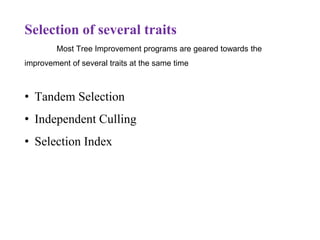
Selection of several traits
Most Tree Improvement programs are geared towards the
improvement of several traits at the same time
• Tandem Selection
• Independent Culling
• Selection Index
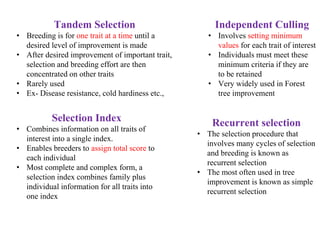
Tandem Selection
• Breeding is for one trait at a time until a
desired level of improvement is made
• After desired improvement of important trait,
selection and breeding effort are then
concentrated on other traits
• Rarely used
• Ex- Disease resistance, cold hardiness etc.,
Independent Culling
• Involves setting minimum
values for each trait of interest
• Individuals must meet these
minimum criteria if they are
to be retained
• Very widely used in Forest
tree improvement
Selection Index
• Combines information on all traits of
interest into a single index.
• Enables breeders to assign total score to
each individual
• Most complete and complex form, a
selection index combines family plus
individual information for all traits into
one index
Recurrent selection
• The selection procedure that
involves many cycles of selection
and breeding is known as
recurrent selection
• The most often used in tree
improvement is known as simple
recurrent selection
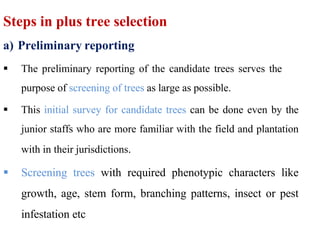
Steps in plus tree selection
a) Preliminary reporting
 The preliminary reporting of the candidate trees serves the
purpose of screening of trees as large as possible.
 This initial survey for candidate trees can be done even by the
junior staffs who are more familiar with the field and plantation
with in their jurisdictions.
 Screening trees with required phenotypic characters like
growth, age, stem form, branching patterns, insect or pest
infestation etc
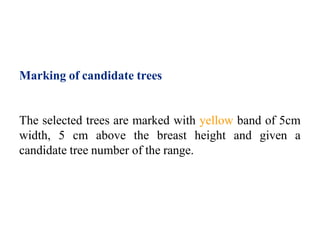
Marking of candidate trees
The selected trees are marked with yellow band of 5cm
width, 5 cm above the breast height and given a
candidate tree number of the range.
b. Final phenotypic appraisal
 The final phenotypic appraisal is done jointly by the
Forest Geneticist, Silviculturist and other members of tree
improvement group, so that the candidate's superiority
of the phenotypic expression is critically analyzed and
discussed without any bias going in favour or against the
selection.
 For height, clean bole and diameter the actual
measurement are taken but for other characteristics
scoring is done with the help of occular estimates.
 The details of scoring are provided in the plus tree
scoring form and the data are entered in plus tree
identification data sheet
Methods of plus tree selection
1. Comparison tree method
• Even aged stands for a pure species (Cech, 1959 and Pitcher,1967).
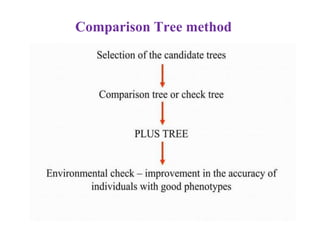
• The first step is the selection of the candidate trees. Once the
candidate trees are selected, they are screened for traits as in relation
to few surrounding trees called comparison tree or check tree.
• If the candidate tree exceeds the comparison tree, it is selected
as " PLUS TREE." The objective behind comparison tree is to
adjust or correct the phenotypic value of the candidate tree for
environmental effects common to that particular stand.
Comparison Tree method
b) Base line selection
 While selecting plus tree in an uneven aged stand with
mixed species, the method adopted is the base line
selection.
 In this method the individuals are located and their value for
traits of interest is compared to the average of the region in
which the selection is made.
 The average is a "base line" giving the system its more
common name " base line selection".
 If the candidate tree exceeds the base line by a
considerable amount, it is selected and incorporated in the
breeding population.
 The base may take the form of a regression equation that takes
into account physical factors of the site.
 The tree in this case is not compared to surrounding trees.
i) Regression selection system
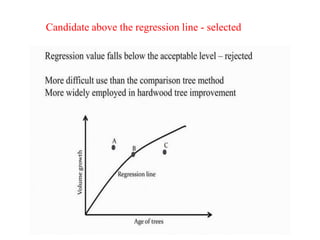
• Uneven aged or mixed species type stands.
• A reliable regression curve for height or volume can be made with about
50 trees(candidate trees), if there is a reasonable age-class distribution.
• Volume/height V/S Age class
– The trait is plotted on the regression graph using the proper age and site.
If the candidate tree falls above the curve, it has the desired growth for
its age whereas some may fall on the line i.e. average, therefore, its use
depends on other characteristics and some fall below the curve,
therefore it has inferior growth for its age and should not be used.
Candidate above the regression line - selected
ii) Mother tree system
• Where there is no immediate urgency to obtain large
amounts of improved seed, the mother tree system of
selection may be the best.
• It consists of locating "good" trees that are usually not as good
as plus trees in the comparison tree or regression system.
Then, one must obtain seed from these and establish
seedlings in genetic tests.
• After this, either the best parent trees or the best trees of
the best families can be used in a vegetative orchard.
• If suitably laid out, the progeny test may be thinned to
create a seedling seed orchard.
• The main disadvantage of the mother tree system is that time
is lost before commercial quantities of seed are needed for
planting programmes. However, this can be used for
hardwoods for which planting programmes are small and
seeds are not immediately needed.
iii) The subjective grading system
• The subjective grading system is frequently used
for hardwoods but is successful only if the grader
is experienced and dedicated to find out the best
tree possible.
• Here the times spend for seeking the candidate
trees is less, which results in choosing less
outstanding trees with smaller selection
differentials.
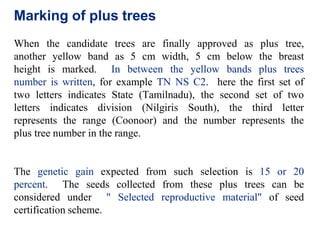
Marking of plus trees
When the candidate trees are finally approved as plus tree,
another yellow band as 5 cm width, 5 cm below the breast
height is marked. In between the yellow bands plus trees
number is written, for example TN NS C2. here the first set of
two letters indicates State (Tamilnadu), the second set of two
letters indicates division (Nilgiris South), the third letter
represents the range (Coonoor) and the number represents the
plus tree number in the range.
The genetic gain expected from such selection is 15 or 20
percent. The seeds collected from these plus trees can be
considered under " Selected reproductive material" of seed
certification scheme.
Objective
Selection of candidate plus trees of Melia for
development of superior quality planting material for
mass propagation and future tree improvement
programmes.
Methodology followed
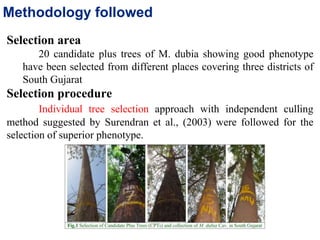
Selection area
20 candidate plus trees of M. dubia showing good phenotype
have been selected from different places covering three districts of
South Gujarat
Selection procedure
Individual tree selection approach with independent culling
method suggested by Surendran et al., (2003) were followed for the
selection of superior phenotype.
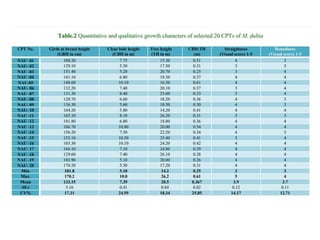
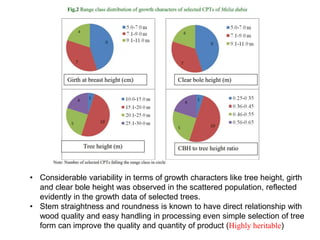
• Considerable variability in terms of growth characters like tree height, girth
and clear bole height was observed in the scattered population, reflected
evidently in the growth data of selected trees.
• Stem straightness and roundness is known to have direct relationship with
wood quality and easy handling in processing even simple selection of tree
form can improve the quality and quantity of product (Highly heritable)
• The analysis of additive genetic coefficients of variation suggested that
height and diameter (medians 8.5% and 8.6%, respectively) had lower
values than straightness (median 11.65%).
• Since, M. dubia is widely promoted as potential pulpwood and plywood
species therefore, economic traits like girth size, clear merchantable bole
height, tree height and clear bole height : tree height ratio were also given
priority for individual tree selection
• Present findings suggest that tree with larger height had larger girth at breast
height so direct selection on the basis of these characters may enhance the
genetic gain in subsequent progeny.
THANK YOU…

plus tree selection.pptx

  • 1.
    Plus Tree Selection Preparedby Karthik K C MSc Forestry College of Forestry, Vellanikkara KERALA AGRICULTURAL UNIVERSITY College of Forestry, Vellanikkara Department of Forest Biology and Tree Improvement
  • 2.
    Objective  To obtaingenetic gain quickly and inexpensively  Maintaining a broad genetic base.  To cater the urgency requirement for production of improved propagules for reforestation and to establish seedling seed orchard or clonal seed orchard.
  • 3.
    Definitions Candidate tree  Atree that has been selected for grading because of its desirable phenotypic qualities but has not been graded or tested. Plus tree / Select / Superior  A tree that has been recommended for production or breeding following grading.  It has a superior phenotype for growth, form, wood quality or other desired characteristics and appears to be adaptable.  It is yet to be tested for its genetic superiority, although the chance of it having a good genotype is high with a reasonable heritability.
  • 4.
    Elite tree  Theselected trees that have proven to be genetically superior by means of progeny testing.  An elite tree is the "winner" from a selection programme and is most desired for use in mass production of seeds or vegetative propagules. Comparison or check tree  Trees that are located in the same stand, which are of the same age growing on the same or better site as the plus tree and against which the plus tree is graded.  Trees chosen as comparison trees are the best in the stand, with characteristics similar to "crop" trees that would be chosen in a silvicultural operation.
  • 5.
    Selection criteria The idealplus tree has the following characteristics.  Straight, cylindrical, non-forking, non- twisting bole  Fast growth  Narrow crown  Thin branches with wide branch angles  High wood density and long fiber  Resistance to pests and diseases -Clarke and Wilson 2005
  • 6.
    Effects of theEnvironment a) A tree in a stand may be tall and voluminous because,  It is older than the other trees in the stand  It is growing on a better micro site than the surrounding trees  It has more space i.e. less competition from other trees c) A tree may have a large, wide crown if it,  Overgrows the other trees  It grows with wide spacing, i.e. little competition d) A tree may have a poor bole form because of,  Adverse light conditions and competition during juvenile growth  Mechanical or other damage to top shoot during juvenile growth  Damage of bole by adverse environmental factors e) High wood density may be due to slow growth Mukhtar and Faisal 2015
  • 7.
    Where to select? •Selection is carried out in natural stands or preferable in plantations. • Stands that are as pure in species composition as possible. • Selection should be concentrated on stands or plantations that are average or better in traits of interest. • Selection work is better in an even aged stand, since age difference can then be eliminated from the evaluation. • Natural forests where selective logging has taken place should be avoided.
  • 8.
    Criteria of selectionfor non-wood Products • Tannin content • Resin content • Gum yield • Seed oil content • Seed protein content Criteria of selection for wood characters • Specific gravity • Lumen diameter • Cell wall thickness • Fiber length • Cellulose • Hemi cellulose • Lignin (Tewari, 1994)
  • 9.
    How many treesper stand?  The number of plus trees in a stand is evaluated after grading.  The candidates should not be selected too close to each other, since closely growing trees may be related, e.g. same parents.  A rule of thumb suggests 1 tree/hectare, i.e. one per 1000 trees with initial spacing of 3x3 m.
  • 10.
    Selection for Singletraits • Mass selection • Family selection • Sib selection • Progeny testing • Within-Family selection • Family plus within family selection
  • 11.
    Mass selection • Choosing– Based on Phenotypes • Highly heritable traits – phenotypes reflects genotype • Parentage unknown Sib selection • Selection based on siblings performance. • Individuals performance is not considered. • Rarely used in forestry Progeny Testing • Selection of parent trees based upon the performance of their progeny. • Its is precise selection method • Initial selection by progeny testing lengthens the time interval. • Since the goal of tree improvement is to achieve maximum amount of gain in unit time.
  • 12.
    Within Family Selection •Here individuals are chosen on the basis on the basis of their deviation from family mean. • Rarely used in tree improvement Family plus within Family Selection • This two-stage method involves selection on families followed by selection of individuals within families. • It consists of choosing best families along with the best individuals in them. • Predominant form of selection in most tree improvement programs Family Selection • Average phenotypic values • Low heritable traits – phenotype is not reflection of genotypes • Rarely used and inbreeding issues
  • 13.
    Selection of severaltraits Most Tree Improvement programs are geared towards the improvement of several traits at the same time • Tandem Selection • Independent Culling • Selection Index
  • 14.
    Tandem Selection • Breedingis for one trait at a time until a desired level of improvement is made • After desired improvement of important trait, selection and breeding effort are then concentrated on other traits • Rarely used • Ex- Disease resistance, cold hardiness etc., Independent Culling • Involves setting minimum values for each trait of interest • Individuals must meet these minimum criteria if they are to be retained • Very widely used in Forest tree improvement Selection Index • Combines information on all traits of interest into a single index. • Enables breeders to assign total score to each individual • Most complete and complex form, a selection index combines family plus individual information for all traits into one index Recurrent selection • The selection procedure that involves many cycles of selection and breeding is known as recurrent selection • The most often used in tree improvement is known as simple recurrent selection
  • 15.
    Steps in plustree selection a) Preliminary reporting  The preliminary reporting of the candidate trees serves the purpose of screening of trees as large as possible.  This initial survey for candidate trees can be done even by the junior staffs who are more familiar with the field and plantation with in their jurisdictions.  Screening trees with required phenotypic characters like growth, age, stem form, branching patterns, insect or pest infestation etc
  • 16.
    Marking of candidatetrees The selected trees are marked with yellow band of 5cm width, 5 cm above the breast height and given a candidate tree number of the range.
  • 17.
    b. Final phenotypicappraisal  The final phenotypic appraisal is done jointly by the Forest Geneticist, Silviculturist and other members of tree improvement group, so that the candidate's superiority of the phenotypic expression is critically analyzed and discussed without any bias going in favour or against the selection.  For height, clean bole and diameter the actual measurement are taken but for other characteristics scoring is done with the help of occular estimates.  The details of scoring are provided in the plus tree scoring form and the data are entered in plus tree identification data sheet
  • 18.
    Methods of plustree selection 1. Comparison tree method • Even aged stands for a pure species (Cech, 1959 and Pitcher,1967). • The first step is the selection of the candidate trees. Once the candidate trees are selected, they are screened for traits as in relation to few surrounding trees called comparison tree or check tree. • If the candidate tree exceeds the comparison tree, it is selected as " PLUS TREE." The objective behind comparison tree is to adjust or correct the phenotypic value of the candidate tree for environmental effects common to that particular stand.
  • 19.
  • 20.
    b) Base lineselection  While selecting plus tree in an uneven aged stand with mixed species, the method adopted is the base line selection.  In this method the individuals are located and their value for traits of interest is compared to the average of the region in which the selection is made.  The average is a "base line" giving the system its more common name " base line selection".  If the candidate tree exceeds the base line by a considerable amount, it is selected and incorporated in the breeding population.  The base may take the form of a regression equation that takes into account physical factors of the site.  The tree in this case is not compared to surrounding trees.
  • 21.
    i) Regression selectionsystem • Uneven aged or mixed species type stands. • A reliable regression curve for height or volume can be made with about 50 trees(candidate trees), if there is a reasonable age-class distribution. • Volume/height V/S Age class – The trait is plotted on the regression graph using the proper age and site. If the candidate tree falls above the curve, it has the desired growth for its age whereas some may fall on the line i.e. average, therefore, its use depends on other characteristics and some fall below the curve, therefore it has inferior growth for its age and should not be used.
  • 22.
    Candidate above theregression line - selected
  • 23.
    ii) Mother treesystem • Where there is no immediate urgency to obtain large amounts of improved seed, the mother tree system of selection may be the best. • It consists of locating "good" trees that are usually not as good as plus trees in the comparison tree or regression system. Then, one must obtain seed from these and establish seedlings in genetic tests. • After this, either the best parent trees or the best trees of the best families can be used in a vegetative orchard. • If suitably laid out, the progeny test may be thinned to create a seedling seed orchard. • The main disadvantage of the mother tree system is that time is lost before commercial quantities of seed are needed for planting programmes. However, this can be used for hardwoods for which planting programmes are small and seeds are not immediately needed.
  • 24.
    iii) The subjectivegrading system • The subjective grading system is frequently used for hardwoods but is successful only if the grader is experienced and dedicated to find out the best tree possible. • Here the times spend for seeking the candidate trees is less, which results in choosing less outstanding trees with smaller selection differentials.
  • 25.
    Marking of plustrees When the candidate trees are finally approved as plus tree, another yellow band as 5 cm width, 5 cm below the breast height is marked. In between the yellow bands plus trees number is written, for example TN NS C2. here the first set of two letters indicates State (Tamilnadu), the second set of two letters indicates division (Nilgiris South), the third letter represents the range (Coonoor) and the number represents the plus tree number in the range. The genetic gain expected from such selection is 15 or 20 percent. The seeds collected from these plus trees can be considered under " Selected reproductive material" of seed certification scheme.
  • 26.
    Objective Selection of candidateplus trees of Melia for development of superior quality planting material for mass propagation and future tree improvement programmes.
  • 27.
    Methodology followed Selection area 20candidate plus trees of M. dubia showing good phenotype have been selected from different places covering three districts of South Gujarat Selection procedure Individual tree selection approach with independent culling method suggested by Surendran et al., (2003) were followed for the selection of superior phenotype.
  • 29.
    • Considerable variabilityin terms of growth characters like tree height, girth and clear bole height was observed in the scattered population, reflected evidently in the growth data of selected trees. • Stem straightness and roundness is known to have direct relationship with wood quality and easy handling in processing even simple selection of tree form can improve the quality and quantity of product (Highly heritable)
  • 30.
    • The analysisof additive genetic coefficients of variation suggested that height and diameter (medians 8.5% and 8.6%, respectively) had lower values than straightness (median 11.65%). • Since, M. dubia is widely promoted as potential pulpwood and plywood species therefore, economic traits like girth size, clear merchantable bole height, tree height and clear bole height : tree height ratio were also given priority for individual tree selection • Present findings suggest that tree with larger height had larger girth at breast height so direct selection on the basis of these characters may enhance the genetic gain in subsequent progeny.
  • 31.