
Social Forestry
Dr. Shailendra Bhalawe
Assistant Professor-Agroforestry
College of Agriculture Balaghat
Jawaharlal Nehru Krashi Vishwavidyalaya Jabalpur
(M.P.)
Social Forestry
•Social forestry is the practice of forestry on lands outside the
conventional forest area for the benefit of the rural and urban communities.
•The term was coined by J.C. Westoby. It was first recognized as an important
component of forestry for meeting rural needs in the interim report of the National
Commission on Agriculture (NCA, 1976).
•The objectives of social forestry adopted by the NCA were to fulfill the basic and
economic needs of the community.
•The scope of social forestry defined by the NCA included farm forestry, community
woodlots and reforestation in degraded lands.
•By mid-1980, the concept of social forestry was firmly established as forestry of the
people, by the people and for the people.
•Social Forestry was first adopted successfully in Gujarat.
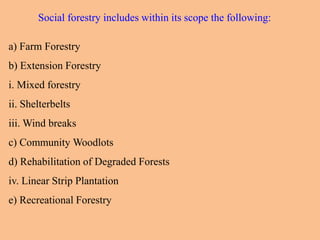
Social forestry includes within its scope the following:
a) Farm Forestry
b) Extension Forestry
i. Mixed forestry
ii. Shelterbelts
iii. Wind breaks
c) Community Woodlots
d) Rehabilitation of Degraded Forests
iv. Linear Strip Plantation
e) Recreational Forestry
a) Farm Forestry: Farm forestry is the practice of forestry on farms in the
form of raising rows of tree on bunds or boundaries of field and individual
trees in private agriculture land as well as creation of wind breaks, which are
protective vegetal screens created round a farm or an orchard by raising one or
two lines of trees fairly close with shrubs in between.
b) Extension Forestry: Extension forestry is the practice of forestry in areas
devoid of tree growth and other vegetation and situated in places away from
the conventional forest areas with the object of increasing the area under tree
growth. It includes within its scope the following:
i. Mixed forestry: Mixed forestry is practice of forestry for raising fodder
grass with scattered fodder trees, fruit trees and fuel-wood trees on suitable
waste lands, panchayat land and village commons land.
ii. Shelterbelts: Shelterbelts is defined as ‘a belt of trees and/or shrubs maintained for
the purpose of shelter from wind, sun, snow-drift, etc. they are generally more
extensive than the wind-breaks covering areas larger than a single farm and
sometimes whole regions on a planned pattern.’ Or Shelterbelt is wide belt of tree,
shrubs and grasses which goes right across the land at right angle to the direction of
prevailing wind in order to Reduce wind velocity
•Deflect wind current
•Protect public properly in leeward side
iii. Wind breaks: It is a protective planting around a garden, a farm or a field to
protect it against strong winds. It usually consists of 2-3 rows of trees or shrubs,
spaced at 0.5 m to 2.5 m apart, depending on the species.
iv. Linear Strip Plantation: These are plantations of fast-growing species on linear
strips of land on the sides of public roads, canals and railway lines.
c) Community Woodlots: The community woodlots, consists of plantations of
fuelwood species on community village lands, with intended objective of increasing a
villager’s access to fuel wood, fruits and fodder.
d) Rehabilitation of Degraded Forests
As a third component, the interim report of the NCA, 1976 suggested reforestation of
degraded forests to achieve the following objectives:
•To grow short rotation fuel and timber species for meeting the requirements.
•To organize fuelwood supplies at reasonable rates, this will prevent pilferage from
neighbouring commercial forests.
•To tie up degraded forest areas with the nearby rural and semi-urban centers for their
requirements of fuelwood.
•To provide employment.
•To rehabilitate the degraded forests in the process.
e) Recreation Forestry: Recreation forestry is the practice of forestry with the object
of raising avenue/flowering trees and shrubs mainly to serve as recreation forests for
the urban and rural population. This type of forestry is also known as Aesthetic
forestry which is defined as the practice of forestry with the object of developing or
maintaining a forest of high scenic value.
Distinction between Social Forestry and Agroforestry
Social Forestry Agroforestry
1. Social forestry is a plantation made on
lands outside conventional forest areas
for the benefit of rural and urban
communities, with objectives to supply
fuel wood to divert cow dung from
village hearths to village fields, small
timber for housing and agricultural
implements and fodder for cattle of the
rural population, protection of agriculture
by creation of diverse ecosystem and
arresting wind and water erosion, provide
raw material for village cottage industries
and improve scenic value in rural and
urban areas.
1. Agroforestry is a sustainable land
management system that increases the
overall production, combines
agricultural crops, tree crops
and forest plants and/or animals
simultaneously or sequentially, and
applies management practices that are
compatible with the cultural patterns of
the local population.
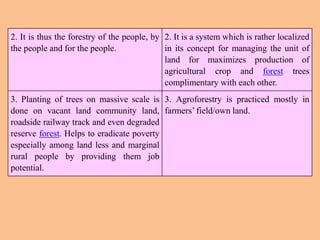
2. It is thus the forestry of the people, by
the people and for the people.
2. It is a system which is rather localized
in its concept for managing the unit of
land for maximizes production of
agricultural crop and forest trees
complimentary with each other.
3. Planting of trees on massive scale is
done on vacant land community land,
roadside railway track and even degraded
reserve forest. Helps to eradicate poverty
especially among land less and marginal
rural people by providing them job
potential.
3. Agroforestry is practiced mostly in
farmers’ field/own land.
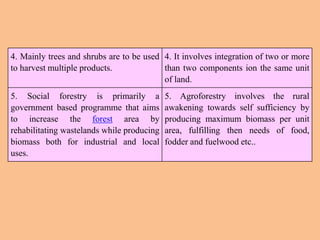
4. Mainly trees and shrubs are to be used
to harvest multiple products.
4. It involves integration of two or more
than two components ion the same unit
of land.
5. Social forestry is primarily a
government based programme that aims
to increase the forest area by
rehabilitating wastelands while producing
biomass both for industrial and local
uses.
5. Agroforestry involves the rural
awakening towards self sufficiency by
producing maximum biomass per unit
area, fulfilling then needs of food,
fodder and fuelwood etc..
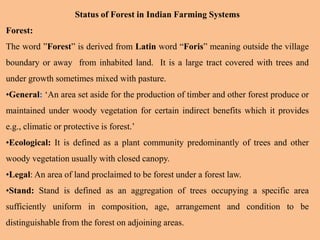
Status of Forest in Indian Farming Systems
Forest:
The word ”Forest” is derived from Latin word “Foris” meaning outside the village
boundary or away from inhabited land. It is a large tract covered with trees and
under growth sometimes mixed with pasture.
•General: ‘An area set aside for the production of timber and other forest produce or
maintained under woody vegetation for certain indirect benefits which it provides
e.g., climatic or protective is forest.’
•Ecological: It is defined as a plant community predominantly of trees and other
woody vegetation usually with closed canopy.
•Legal: An area of land proclaimed to be forest under a forest law.
•Stand: Stand is defined as an aggregation of trees occupying a specific area
sufficiently uniform in composition, age, arrangement and condition to be
distinguishable from the forest on adjoining areas.
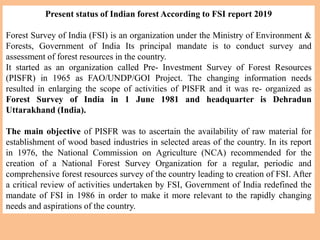
Present status of Indian forest According to FSI report 2019
Forest Survey of India (FSI) is an organization under the Ministry of Environment &
Forests, Government of India Its principal mandate is to conduct survey and
assessment of forest resources in the country.
It started as an organization called Pre- Investment Survey of Forest Resources
(PISFR) in 1965 as FAO/UNDP/GOI Project. The changing information needs
resulted in enlarging the scope of activities of PISFR and it was re- organized as
Forest Survey of India in 1 June 1981 and headquarter is Dehradun
Uttarakhand (India).
The main objective of PISFR was to ascertain the availability of raw material for
establishment of wood based industries in selected areas of the country. In its report
in 1976, the National Commission on Agriculture (NCA) recommended for the
creation of a National Forest Survey Organization for a regular, periodic and
comprehensive forest resources survey of the country leading to creation of FSI. After
a critical review of activities undertaken by FSI, Government of India redefined the
mandate of FSI in 1986 in order to make it more relevant to the rapidly changing
needs and aspirations of the country.
As per the ISFR 2019, the top five states in terms of increase in forest
cover are Karnataka (1,025 sq. km.), Andhra Pradesh (990 sq. km.), Kerala
(823 sq. km.), Jammu & Kashmir (371 sq. km.) and Himachal Pradesh (334
sq km).
In terms of area, Madhya Pradesh has the largest forest cover in the
country followed by Arunachal Pradesh, Chhattisgarh, Odisha and
Maharashtra. In terms of forest cover as a percentage of their total
geographical area, the top five states are Mizoram (85.41 percent), Arunachal
Pradesh (79.63 percent), Meghalaya (76.33 percent), Manipur (75.46
percent) and Nagaland (75.31 percent).
The report also highlighted that there are 62,466 wetlands in the country
and amongst the states, Gujarat has the largest area of wetlands (within the
RFA) in the country followed by West Bengal. The report has identified
wetlands of more than one-hectare area within the RFAs.
Role of Forest in Indian Farming:
Forests are known as the world’s air-conditioner and the earth’s blanket. Without
forests, this world would be an inhospitable place to live in. Forests play an important
role in environmental stability and provide a variety of benefits to the economy. Of
all the ecosystems, forests are the largest, most complex and self-perpetuating. The
maintenance of forests is vital for all sections of society regardless of their stage of
development. Forests perform various functions. Some of these functions are:
1) Productive functions of the forest
2) Protective and ameliorative functions of forest
3) Recreational and educational function of forest
4) Developmental functions of forest
1) Productive functions of the forest
Forests are valuable natural resources. The goods provided by forests are of immense
importance. Wood is a major forest produce and is used extensively for various
purposes.
Wood is a universal fuel. For thousands of years, until the advent of coal, oil, gas,
electricity, etc., wood constituted man’s chief source of fuel. Even today more than
half of the total world consumption of wood is for fuel.
Wood remains the major source of domestic fuel in India. Out of the total
requirement of 201 million tones fuelwood, 103 million tonnes is met from
the forest areas (including plantations), which constitutes nearly 51 percent of the
total requirement, and the balance 98 million tonnes from farm forestry sector
including plantation on common land.
Forests provide raw material to a large number of industries, e.g., paper and pulp,
ply board and other boards, saw-mill, furniture, packing cases, matches, toys, etc.
Out of 64 million m3 timber demand, nearly 31 million m3 comes from farm
forestry and other woodlands and 12 million m3 from forests. The balance 21 million
m3 is removed from plantations and from natural forests, largely (70%) as small
timber to meet the domestic need.
A large number of non-wood products are also obtained from forests. These are
commonly called minor forest products, not because they are of minor significance,
but because they are harvested in smaller quantities. Some of the important
minor forest products are as under:
a.Fibers and flosses
b.Grassesan bamboos
c.Essential oils
d.Oilseedse. Tans and dyes
f.Gums and resins
g.Drugs, spices and insecticides
h.Tendu and other leaves
i.Edible products
j.Lac and other products
k. Fodder and grazing
2) Protective and ameliorative functions of forest
i. Forests play a significant role in maintaining the CO2 balance in the atmosphere.
Without sufficient forest cover, all the CO2 released in the atmosphere will not be
utilized, resulting in a higher percent of CO2 in the atmosphere. This, according to
scientists, will result in warming of the world temperature, disturbance in the climate,
melting of polar ice caps, increase in sea levels, etc. The CO2 percent in the
atmosphere has already reached 0.042% against the normal of 0.030%. If this
increases continuously, higher temperature and other disturbances on the earth may
bring unimaginable miseries to mankind.
ii. Forests increase local precipitation by about 5 to 10% due to their orographic and
microclimate effect and create conditions favourable for the condensation of clouds.
iii. Forests reduce temperature and increase humidity. The temperature in forests is
3° C - 8° C less than in adjoining open areas. Reduced temperature makes life
comfortable. It also reduces evaporation losses. The effect of forests on temperature
is not limited to forests areas; it extends far beyond the boundaries of the forests.
iv. Forests maintain the productivity of the soil through adding a large quantity of
organic matter and recycling of nutrients. The leaves of trees are used as manure.
Supply of firewood from forests releases dung for use, as manure.
v. Tree crowns reduce the violence of rain and checks splash erosion. Forests increase
the infiltration and water-holding capacity of the soil, resulting in much lower surface
run-off. This in turn results in checking of soil erosion.
vi. Forests check floods. Forests conserve both soil and water. Forests prolong the
water cycle from its inception to the final disposal as run-off into streams and ocean.
The longer the water retained in the land, the greater is its usefulness in nurturing
crops and trees, and in maintaining a regular supply of water in streams throughout
the year. Forests increase subsurface run-off which is much slower than surface run-
off and the sub-surface run-off does not cause erosion.
vii. Forests and trees reduce wind velocity considerably. Reduction of wind velocity
causes considerable reduction in wind erosion, checks shifting of sand dunes and
halts the process of desertification.
viii. Forests and trees provide a shelterbelt and wind breaks effect which is beneficial
to agricultural crops, particularly in arid and semi-arid areas, and increase in
agricultural production.
3) Recreational and educational function of forest
i. Forests provide recreational facilities to the people. A large variety of trees and
shrubs, animals and birds attract a large number of people towards them. National
parks and sanctuaries rich in flora and fauna are visited by a large number of people
every year.
ii. Forests provide an experimental area and laboratory for college and university
students. Forests provide sites for ecological studies.
iii. Forests have a natural healing effect for a number of diseases. Most of the
sanatoria are found in a forested locality.
4) Developmental functions of forest
i. Forests provide employment to a large number of people. Almost all forestry activities are
labour intensive and provide considerable employment in primary and secondary sectors.
ii. Forests and various forest activities help tribals to improve their socioeconomic condition
through collection, processing and marketing of various forest products and by providing
gainful employment. Forestry is an important activity in poverty alleviation programme.
iii. Forests provide a good sum as revenue to the government which is used for various
developmental works.
iv. Forests help in biological rejuvenation of soils. Trees through their sturdy root structures
open the soil; improve it by adding organic litter or humus rendering it hospitable to useful
micro and macro flora and fauna.
v. Trees provide subsistence products, like fodder and other non-wood forest products nearly
30% of the fodder requirement of the country comes from the forest areas. There is removal to
the extent of 145 million tonnes of dry fodder and 178 million tonnes of green fodder annually
from the forest areas.
vi. In semi-arid regions trees increase soil productivity and land sustainability through
nutrient recycling and by providing mulch and shade for crops, thus complement
agricultural production.
vii. The most widespread benefit from keeping trees on farms is the soil enriching
effect of trees and protection against erosion.
viii. Trees are planted on farm boundaries, or inter-cropped with field crops with a
view to get supplementary income from trees without much loss of the main crops.
ix. Homestead plantation increases overall income from land.
x. Where income from agriculture is uncertain and inadequate and there is little
possibility for farmer to seek work outside the village; in such conditions, even small
farmers shift their lands to trees, which demand less labour and concentrate on wage
labour for meeting their immediate consumption needs.
xi. Where trees substitute agricultural crops for increasing total profits from land.
Thank You

Social Forestry.pptx

  • 1.
    Social Forestry Dr. ShailendraBhalawe Assistant Professor-Agroforestry College of Agriculture Balaghat Jawaharlal Nehru Krashi Vishwavidyalaya Jabalpur (M.P.)
  • 2.
    Social Forestry •Social forestryis the practice of forestry on lands outside the conventional forest area for the benefit of the rural and urban communities. •The term was coined by J.C. Westoby. It was first recognized as an important component of forestry for meeting rural needs in the interim report of the National Commission on Agriculture (NCA, 1976). •The objectives of social forestry adopted by the NCA were to fulfill the basic and economic needs of the community. •The scope of social forestry defined by the NCA included farm forestry, community woodlots and reforestation in degraded lands. •By mid-1980, the concept of social forestry was firmly established as forestry of the people, by the people and for the people. •Social Forestry was first adopted successfully in Gujarat.
  • 3.
    Social forestry includeswithin its scope the following: a) Farm Forestry b) Extension Forestry i. Mixed forestry ii. Shelterbelts iii. Wind breaks c) Community Woodlots d) Rehabilitation of Degraded Forests iv. Linear Strip Plantation e) Recreational Forestry
  • 4.
    a) Farm Forestry:Farm forestry is the practice of forestry on farms in the form of raising rows of tree on bunds or boundaries of field and individual trees in private agriculture land as well as creation of wind breaks, which are protective vegetal screens created round a farm or an orchard by raising one or two lines of trees fairly close with shrubs in between. b) Extension Forestry: Extension forestry is the practice of forestry in areas devoid of tree growth and other vegetation and situated in places away from the conventional forest areas with the object of increasing the area under tree growth. It includes within its scope the following: i. Mixed forestry: Mixed forestry is practice of forestry for raising fodder grass with scattered fodder trees, fruit trees and fuel-wood trees on suitable waste lands, panchayat land and village commons land.
  • 5.
    ii. Shelterbelts: Shelterbeltsis defined as ‘a belt of trees and/or shrubs maintained for the purpose of shelter from wind, sun, snow-drift, etc. they are generally more extensive than the wind-breaks covering areas larger than a single farm and sometimes whole regions on a planned pattern.’ Or Shelterbelt is wide belt of tree, shrubs and grasses which goes right across the land at right angle to the direction of prevailing wind in order to Reduce wind velocity •Deflect wind current •Protect public properly in leeward side iii. Wind breaks: It is a protective planting around a garden, a farm or a field to protect it against strong winds. It usually consists of 2-3 rows of trees or shrubs, spaced at 0.5 m to 2.5 m apart, depending on the species. iv. Linear Strip Plantation: These are plantations of fast-growing species on linear strips of land on the sides of public roads, canals and railway lines.
  • 6.
    c) Community Woodlots:The community woodlots, consists of plantations of fuelwood species on community village lands, with intended objective of increasing a villager’s access to fuel wood, fruits and fodder. d) Rehabilitation of Degraded Forests As a third component, the interim report of the NCA, 1976 suggested reforestation of degraded forests to achieve the following objectives: •To grow short rotation fuel and timber species for meeting the requirements. •To organize fuelwood supplies at reasonable rates, this will prevent pilferage from neighbouring commercial forests. •To tie up degraded forest areas with the nearby rural and semi-urban centers for their requirements of fuelwood. •To provide employment. •To rehabilitate the degraded forests in the process.
  • 7.
    e) Recreation Forestry:Recreation forestry is the practice of forestry with the object of raising avenue/flowering trees and shrubs mainly to serve as recreation forests for the urban and rural population. This type of forestry is also known as Aesthetic forestry which is defined as the practice of forestry with the object of developing or maintaining a forest of high scenic value.
  • 8.
    Distinction between SocialForestry and Agroforestry Social Forestry Agroforestry 1. Social forestry is a plantation made on lands outside conventional forest areas for the benefit of rural and urban communities, with objectives to supply fuel wood to divert cow dung from village hearths to village fields, small timber for housing and agricultural implements and fodder for cattle of the rural population, protection of agriculture by creation of diverse ecosystem and arresting wind and water erosion, provide raw material for village cottage industries and improve scenic value in rural and urban areas. 1. Agroforestry is a sustainable land management system that increases the overall production, combines agricultural crops, tree crops and forest plants and/or animals simultaneously or sequentially, and applies management practices that are compatible with the cultural patterns of the local population.
  • 9.
    2. It isthus the forestry of the people, by the people and for the people. 2. It is a system which is rather localized in its concept for managing the unit of land for maximizes production of agricultural crop and forest trees complimentary with each other. 3. Planting of trees on massive scale is done on vacant land community land, roadside railway track and even degraded reserve forest. Helps to eradicate poverty especially among land less and marginal rural people by providing them job potential. 3. Agroforestry is practiced mostly in farmers’ field/own land.
  • 10.
    4. Mainly treesand shrubs are to be used to harvest multiple products. 4. It involves integration of two or more than two components ion the same unit of land. 5. Social forestry is primarily a government based programme that aims to increase the forest area by rehabilitating wastelands while producing biomass both for industrial and local uses. 5. Agroforestry involves the rural awakening towards self sufficiency by producing maximum biomass per unit area, fulfilling then needs of food, fodder and fuelwood etc..
  • 11.
    Status of Forestin Indian Farming Systems Forest: The word ”Forest” is derived from Latin word “Foris” meaning outside the village boundary or away from inhabited land. It is a large tract covered with trees and under growth sometimes mixed with pasture. •General: ‘An area set aside for the production of timber and other forest produce or maintained under woody vegetation for certain indirect benefits which it provides e.g., climatic or protective is forest.’ •Ecological: It is defined as a plant community predominantly of trees and other woody vegetation usually with closed canopy. •Legal: An area of land proclaimed to be forest under a forest law. •Stand: Stand is defined as an aggregation of trees occupying a specific area sufficiently uniform in composition, age, arrangement and condition to be distinguishable from the forest on adjoining areas.
  • 12.
    Present status ofIndian forest According to FSI report 2019 Forest Survey of India (FSI) is an organization under the Ministry of Environment & Forests, Government of India Its principal mandate is to conduct survey and assessment of forest resources in the country. It started as an organization called Pre- Investment Survey of Forest Resources (PISFR) in 1965 as FAO/UNDP/GOI Project. The changing information needs resulted in enlarging the scope of activities of PISFR and it was re- organized as Forest Survey of India in 1 June 1981 and headquarter is Dehradun Uttarakhand (India). The main objective of PISFR was to ascertain the availability of raw material for establishment of wood based industries in selected areas of the country. In its report in 1976, the National Commission on Agriculture (NCA) recommended for the creation of a National Forest Survey Organization for a regular, periodic and comprehensive forest resources survey of the country leading to creation of FSI. After a critical review of activities undertaken by FSI, Government of India redefined the mandate of FSI in 1986 in order to make it more relevant to the rapidly changing needs and aspirations of the country.
  • 13.
    As per theISFR 2019, the top five states in terms of increase in forest cover are Karnataka (1,025 sq. km.), Andhra Pradesh (990 sq. km.), Kerala (823 sq. km.), Jammu & Kashmir (371 sq. km.) and Himachal Pradesh (334 sq km). In terms of area, Madhya Pradesh has the largest forest cover in the country followed by Arunachal Pradesh, Chhattisgarh, Odisha and Maharashtra. In terms of forest cover as a percentage of their total geographical area, the top five states are Mizoram (85.41 percent), Arunachal Pradesh (79.63 percent), Meghalaya (76.33 percent), Manipur (75.46 percent) and Nagaland (75.31 percent). The report also highlighted that there are 62,466 wetlands in the country and amongst the states, Gujarat has the largest area of wetlands (within the RFA) in the country followed by West Bengal. The report has identified wetlands of more than one-hectare area within the RFAs.
  • 14.
    Role of Forestin Indian Farming: Forests are known as the world’s air-conditioner and the earth’s blanket. Without forests, this world would be an inhospitable place to live in. Forests play an important role in environmental stability and provide a variety of benefits to the economy. Of all the ecosystems, forests are the largest, most complex and self-perpetuating. The maintenance of forests is vital for all sections of society regardless of their stage of development. Forests perform various functions. Some of these functions are: 1) Productive functions of the forest 2) Protective and ameliorative functions of forest 3) Recreational and educational function of forest 4) Developmental functions of forest
  • 15.
    1) Productive functionsof the forest Forests are valuable natural resources. The goods provided by forests are of immense importance. Wood is a major forest produce and is used extensively for various purposes. Wood is a universal fuel. For thousands of years, until the advent of coal, oil, gas, electricity, etc., wood constituted man’s chief source of fuel. Even today more than half of the total world consumption of wood is for fuel. Wood remains the major source of domestic fuel in India. Out of the total requirement of 201 million tones fuelwood, 103 million tonnes is met from the forest areas (including plantations), which constitutes nearly 51 percent of the total requirement, and the balance 98 million tonnes from farm forestry sector including plantation on common land. Forests provide raw material to a large number of industries, e.g., paper and pulp, ply board and other boards, saw-mill, furniture, packing cases, matches, toys, etc.
  • 16.
    Out of 64million m3 timber demand, nearly 31 million m3 comes from farm forestry and other woodlands and 12 million m3 from forests. The balance 21 million m3 is removed from plantations and from natural forests, largely (70%) as small timber to meet the domestic need. A large number of non-wood products are also obtained from forests. These are commonly called minor forest products, not because they are of minor significance, but because they are harvested in smaller quantities. Some of the important minor forest products are as under: a.Fibers and flosses b.Grassesan bamboos c.Essential oils d.Oilseedse. Tans and dyes f.Gums and resins g.Drugs, spices and insecticides h.Tendu and other leaves i.Edible products j.Lac and other products k. Fodder and grazing
  • 17.
    2) Protective andameliorative functions of forest i. Forests play a significant role in maintaining the CO2 balance in the atmosphere. Without sufficient forest cover, all the CO2 released in the atmosphere will not be utilized, resulting in a higher percent of CO2 in the atmosphere. This, according to scientists, will result in warming of the world temperature, disturbance in the climate, melting of polar ice caps, increase in sea levels, etc. The CO2 percent in the atmosphere has already reached 0.042% against the normal of 0.030%. If this increases continuously, higher temperature and other disturbances on the earth may bring unimaginable miseries to mankind. ii. Forests increase local precipitation by about 5 to 10% due to their orographic and microclimate effect and create conditions favourable for the condensation of clouds. iii. Forests reduce temperature and increase humidity. The temperature in forests is 3° C - 8° C less than in adjoining open areas. Reduced temperature makes life comfortable. It also reduces evaporation losses. The effect of forests on temperature is not limited to forests areas; it extends far beyond the boundaries of the forests. iv. Forests maintain the productivity of the soil through adding a large quantity of organic matter and recycling of nutrients. The leaves of trees are used as manure. Supply of firewood from forests releases dung for use, as manure.
  • 18.
    v. Tree crownsreduce the violence of rain and checks splash erosion. Forests increase the infiltration and water-holding capacity of the soil, resulting in much lower surface run-off. This in turn results in checking of soil erosion. vi. Forests check floods. Forests conserve both soil and water. Forests prolong the water cycle from its inception to the final disposal as run-off into streams and ocean. The longer the water retained in the land, the greater is its usefulness in nurturing crops and trees, and in maintaining a regular supply of water in streams throughout the year. Forests increase subsurface run-off which is much slower than surface run- off and the sub-surface run-off does not cause erosion. vii. Forests and trees reduce wind velocity considerably. Reduction of wind velocity causes considerable reduction in wind erosion, checks shifting of sand dunes and halts the process of desertification. viii. Forests and trees provide a shelterbelt and wind breaks effect which is beneficial to agricultural crops, particularly in arid and semi-arid areas, and increase in agricultural production.
  • 19.
    3) Recreational andeducational function of forest i. Forests provide recreational facilities to the people. A large variety of trees and shrubs, animals and birds attract a large number of people towards them. National parks and sanctuaries rich in flora and fauna are visited by a large number of people every year. ii. Forests provide an experimental area and laboratory for college and university students. Forests provide sites for ecological studies. iii. Forests have a natural healing effect for a number of diseases. Most of the sanatoria are found in a forested locality.
  • 20.
    4) Developmental functionsof forest i. Forests provide employment to a large number of people. Almost all forestry activities are labour intensive and provide considerable employment in primary and secondary sectors. ii. Forests and various forest activities help tribals to improve their socioeconomic condition through collection, processing and marketing of various forest products and by providing gainful employment. Forestry is an important activity in poverty alleviation programme. iii. Forests provide a good sum as revenue to the government which is used for various developmental works. iv. Forests help in biological rejuvenation of soils. Trees through their sturdy root structures open the soil; improve it by adding organic litter or humus rendering it hospitable to useful micro and macro flora and fauna. v. Trees provide subsistence products, like fodder and other non-wood forest products nearly 30% of the fodder requirement of the country comes from the forest areas. There is removal to the extent of 145 million tonnes of dry fodder and 178 million tonnes of green fodder annually from the forest areas.
  • 21.
    vi. In semi-aridregions trees increase soil productivity and land sustainability through nutrient recycling and by providing mulch and shade for crops, thus complement agricultural production. vii. The most widespread benefit from keeping trees on farms is the soil enriching effect of trees and protection against erosion. viii. Trees are planted on farm boundaries, or inter-cropped with field crops with a view to get supplementary income from trees without much loss of the main crops. ix. Homestead plantation increases overall income from land. x. Where income from agriculture is uncertain and inadequate and there is little possibility for farmer to seek work outside the village; in such conditions, even small farmers shift their lands to trees, which demand less labour and concentrate on wage labour for meeting their immediate consumption needs. xi. Where trees substitute agricultural crops for increasing total profits from land.
  • 22.