Compact Thermal Energy Storage Wim van Helden Webinar Leonardo-Energy 23 Jan. 2009
Contents of this Webinar Share and potential of Thermal Energy Storage Introduction to Compact TES TES technologies: principles and applications Phase Change Materials Sorption Thermal Storage Thermochemical Materials International developments
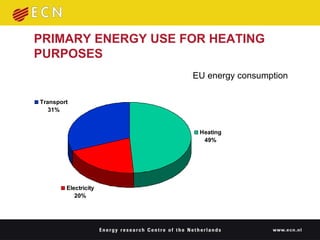
PRIMARY ENERGY USE FOR HEATING PURPOSES EU energy consumption
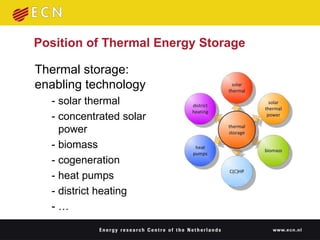
Position of Thermal Energy Storage Thermal storage: enabling technology solar thermal concentrated solar power biomass cogeneration heat pumps district heating …
enables a larger share of renewables system optimisation - diminish the number of on/off cycles - satify peak demand (enabling smaller heat generators) demand-side management - operation determined by energy prices - optimally controlling (micro) cogeneration Relevance of Thermal Energy Storage For all energy sources buffering of heat is  desirable . For the application of solar thermal   energy and ambient heat   buffering is even  necessary .
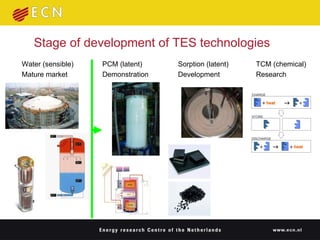
Stage of development of TES technologies TCM (chemical) Research Sorption (latent) Development PCM (latent) Demonstration Water (sensible) Mature market
Sensible heat - principle: heat capacity  - reservoirs, aquifers, ground/soil Latent heat - principle: phase change (melting, evaporation, crystallisation) - water, organic and inorganic PCMs Sorption heat and Chemical heat - principle: physical (adhesion) or chemical bond (reaction enthalpy) - a d sorption and a b sorption and chemical reactions Principles for Thermal Energy Storage
Classification of Thermal Energy Storage
Characteristics of TES Values Unit temperature level [ºC] specific energy density [kJ/kg] or [MJ/m 3 ] thermal power [kW] Categories Choice between -  time to market research/test,demo/available for market storage period day / week, month / season Building integration possible / not possible
COMPACT HEAT STORAGE When available storage volume is limited    compact heat storage Volume of a seasonal storage  for a single family house (m 3 ) kWh/m 3 140-830 70 31 MJ/m 3 500-3000 250 110 Storage density Chemical Latent Sensible
Phase Change Materials Principle: heat used to melt or evaporate material Typical storage densities  334 kJ/liter (ice-water) 250 kJ/liter (parafines) Applications Cold storage Overheat protection Comfort temperature control CSP: system optimisation
PCM Energy stored as function of temperature
Latent heat storage in PCMs PCM interesting at small temperature difference (around melting temperature) Left: volume of water and of TH29 needed for storage of 1 MJ heat. Right: mass of water and of TH29 needed for storage of 1 MJ heat. Volume water and TH29  for 1 MJ storage 0 5 10 15 20 25 0 - 100 10 - 60 15 - 40 20 - 30 temperature difference (°C) litres water TH29 Mass of water and TH29  for 1 MJ storage 0 5 10 15 20 25 0 - 100 10 - 60 15 - 40 20 - 30 temperature difference (°C) kilograms water TH29
Water as Phase Change Material storage of heat in phase change from solid - liquid (334 kJ/kg) cheap medium (also available encapsulated) interesting in case of combined heating and cooling demand water-ice mixture behaves like liquid up to 20-25 % ice storage at 0ºC results in small losses to ambient storage at 0ºC results in necessary upgrading heat (heat pump)
Latent heat storage in ice Storage tanks for water filled polyethene balls, 2 projects in United States
for instance paraffines or polymers heat conduction of material determines charging power, length of polymer chains determines melting temperature relative to anorganic PCMs: larger melting heat and higher heat capacity uniform melting behaviour, stable, non toxic, non corrosive suited for impregnation of building materials prevention of evaporation, odours and volume changes by encapsulation available in different forms Organic PCMs
Organic PCMs Left to right: - powder: 60% paraffine and   silica material - granulate: 35% paraffine    and diatomee earth  - boards: 65% paraffine and   wood fibre board New development.  Compound: 80% paraffine, for direct contact with water, for instance in reservoir
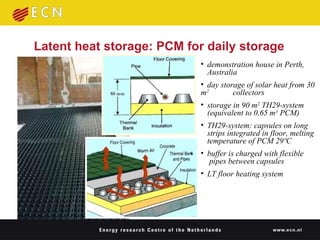
Latent heat storage: PCM for daily storage demonstration house in Perth,    Australia day storage of solar heat from 30 m 2   collectors storage in 90 m 2  TH29-system   (equivalent to 0,65 m 3  PCM) TH29-system: capsules on long  strips integrated in floor, melting  temperature of PCM 29ºC buffer is charged with flexible     pipes between capsules LT floor heating system
Phase change Materials in walls development project with the partners  BASF, caparol, maxit and Sto with Fraunhofer ISE 1/1999 - 9/2004 funded by BMWi FKZ 0329840A-D
measurements  two identical rooms measured without and with two PCM products monitored  one year each result:  - 4 K difference reached - night ventilation  essential
Since 2004 several products: Different products with microcapsules: plaster, plasterbords, porous concrete… ….. Different macrocapsules: Dörken, Rubitherm, SGL, Climator and others BASF: micronal SmartBoard™ Other systems: Energain, Rubitherm granules Foto: BASF
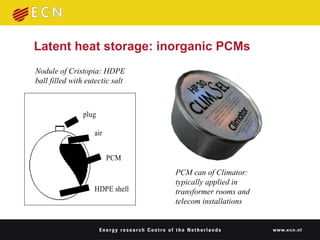
Latent heat storage: inorganic PCMs PCM can of Climator: typically applied in transformer rooms and telecom installations Nodule of Cristopia: HDPE ball filled with eutectic salt
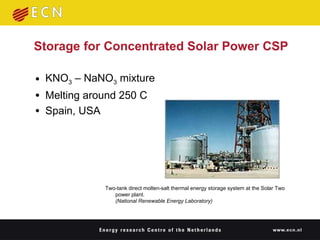
Storage for Concentrated Solar Power CSP KNO 3  – NaNO 3  mixture Melting around 250 C Spain, USA Two-tank direct molten-salt thermal energy storage system at the Solar Two power plant. (National Renewable Energy Laboratory)
Sorption heat storage Physi-sorption: molecular adhesion forces Adsorption: Surface effect, porous media Silicagel, zeolites Mixing effect: absorption NH 3 , LiCl, LiBr Similar to sorption heat pumps
Zeolites Microporous structure Composed of AlO 2  and SiO 2  with metal atoms Adsorption of vapours and gases Selective adsorption dependent on molecule size Stronger bond: higher desorption temperature Crystal structures of three basic zeolite types: ITA, CHA and MFI
Temperature dependance Differential mass loss for ALPO-18, ALPO-5, LiNaX (zeolite) and SAPO-34 as function of temperature (Jänchen, 2005)
Zeolite Zeolite 13X beads and pellets Small zeolite particles are bound with clay-like binding materials
Heat Storage with Zeolite Monosorp system (ITW Stuttgart, DE) Zeolite channeled bricks Solar thermally loaded heat exchanger
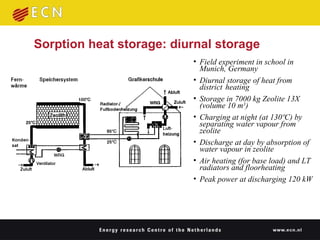
Sorption heat storage: diurnal storage Field experiment in school in Munich, Germany Diurnal storage of heat from district  heating Storage in 7000 kg Zeolite 13X (volume 10 m 3 ) Charging at night (at 130ºC) by separating water vapour from zeolite  Discharge at day by absorption of water vapour in zeolite Air heating (for base load) and LT radiators and floorheating Peak power at discharging 120 kW
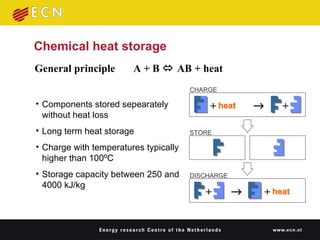
Chemical heat storage General principle  A + B    AB + heat Components stored sepearately without heat loss  Long term heat storage Charge with temperatures typically higher than 100ºC Storage capacity between 250 and 4000 kJ/kg
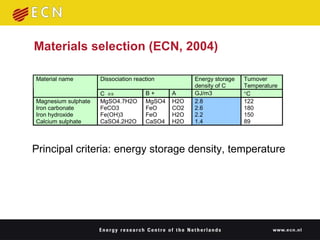
Materials selection (ECN, 2004) Principal criteria: energy storage density, temperature
Thermochemical material – MgSO 4 x7H 2 O Reaction:  MgSO 4 xnH 2 O + heat     MgSO 4  + nH 2 O Sample mass decreases at increasing temperature
The scale of chemi-sorption Grain of MgSO 4
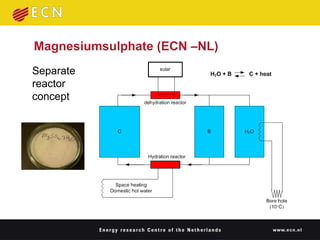
Magnesiumsulphate (ECN –NL) Separate reactor concept
Sodiumhydroxide Storage (EMPA – CH) 2NaOH    Na 2 O + H 2 O
Chemical heat storage at higher temperatures Chemical reactions e.g. 1/2 N 2  + 3/2 H 2     NH 3  + heat (Nat. University of Canberra, Australia) presently 1 kW prototype: dissociation (charging) at 400 - 500ºC and discharge in a reactor that drives a steam cycle  plans to scale up to a 15 kW system
TCM Research and Development Goal: a compact heat storage  system  with storage density 8 times better than water. Activities: materials research process development system development Typical system requirements for application of TCM heat storage in the built environment: storage density > 1 GJ/m 3 driving temperatures < 180  °C charge/discharge power 1-10 kW storage capacity 100 kWh (micro-cogeneration) – 20 GJ (seasonal storage) # cycles: 30 (seasonal storage) – 1500 (micro-cogeneration)
International developments IEA SHC Task 32: Advanced storage systems for solar and low energy houses (www.iea-shc.org/task32) PREHEAT project: raising the political awareness of the importance of Thermal Energy Storage. (www.preheat.org) ESTTP Strategic Research Agenda SRA (esttp.org) National R&D programs for TES (FR, GE, …) New IEA SHC/ECES joint Task 42/24: Compact Thermal Energy Storage: Materials Development for System Integration (www.iea-shc.org/task42)
Materials and Applications Two International Energy Agency (IEA) programs: Energy Conservation through Energy Storage Solar Heating and Cooling
Task 42/24: Compact Thermal Energy Storage: Material Development for System Integration Joint Task between Solar Heating and Cooling (SHC) and Energy Conservation through Energy Storage (ECES) Operating Agents: SHC: Wim van Helden, ECN (NL) ECES: Andreas Hauer, ZAE Bayern (DE) January 2009 – December 2012 Kick-off meeting: 11-13 February 2009. Bad Tolz, DE Main added value: Bring together experts from applications  and  material science
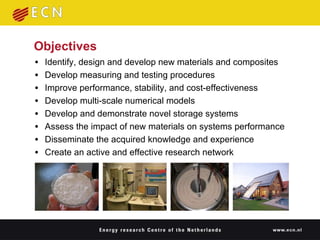
Objectives Identify, design and develop new materials and composites Develop measuring and testing procedures Improve performance, stability, and cost-effectiveness Develop multi-scale numerical models Develop and demonstrate novel storage systems Assess the impact of new materials on systems performance Disseminate the acquired knowledge and experience Create an active and effective research network
IEA Task/Annex 42/24 Matrix approach
The building blocks for Compact Thermal Energy Storage Political awareness International programmed approach Active national participation Active industrial participation Clever ideas from.. ..Bright enthusiastic people
References IEA 32:  www.iea-shc.org/task32 Ecostock conference:  http://intraweb.stockton.edu/eyos/page.cfm?siteID=82&pageID=29 Preheat project: www.preheat.org IEA ECES Annex 19, see www.iea-eces.org T4224: www.iea-shc.org/task42 wikis.lib.ncsu.edu/index.php/Zeolites

Compact Thermal Energy Storage

  • 1.
    Compact Thermal EnergyStorage Wim van Helden Webinar Leonardo-Energy 23 Jan. 2009
  • 2.
    Contents of thisWebinar Share and potential of Thermal Energy Storage Introduction to Compact TES TES technologies: principles and applications Phase Change Materials Sorption Thermal Storage Thermochemical Materials International developments
  • 3.
    PRIMARY ENERGY USEFOR HEATING PURPOSES EU energy consumption
  • 4.
    Position of ThermalEnergy Storage Thermal storage: enabling technology solar thermal concentrated solar power biomass cogeneration heat pumps district heating …
  • 5.
    enables a largershare of renewables system optimisation - diminish the number of on/off cycles - satify peak demand (enabling smaller heat generators) demand-side management - operation determined by energy prices - optimally controlling (micro) cogeneration Relevance of Thermal Energy Storage For all energy sources buffering of heat is desirable . For the application of solar thermal energy and ambient heat buffering is even necessary .
  • 6.
    Stage of developmentof TES technologies TCM (chemical) Research Sorption (latent) Development PCM (latent) Demonstration Water (sensible) Mature market
  • 7.
    Sensible heat -principle: heat capacity - reservoirs, aquifers, ground/soil Latent heat - principle: phase change (melting, evaporation, crystallisation) - water, organic and inorganic PCMs Sorption heat and Chemical heat - principle: physical (adhesion) or chemical bond (reaction enthalpy) - a d sorption and a b sorption and chemical reactions Principles for Thermal Energy Storage
  • 8.
  • 9.
    Characteristics of TESValues Unit temperature level [ºC] specific energy density [kJ/kg] or [MJ/m 3 ] thermal power [kW] Categories Choice between - time to market research/test,demo/available for market storage period day / week, month / season Building integration possible / not possible
  • 10.
    COMPACT HEAT STORAGEWhen available storage volume is limited  compact heat storage Volume of a seasonal storage for a single family house (m 3 ) kWh/m 3 140-830 70 31 MJ/m 3 500-3000 250 110 Storage density Chemical Latent Sensible
  • 11.
    Phase Change MaterialsPrinciple: heat used to melt or evaporate material Typical storage densities 334 kJ/liter (ice-water) 250 kJ/liter (parafines) Applications Cold storage Overheat protection Comfort temperature control CSP: system optimisation
  • 12.
    PCM Energy storedas function of temperature
  • 13.
    Latent heat storagein PCMs PCM interesting at small temperature difference (around melting temperature) Left: volume of water and of TH29 needed for storage of 1 MJ heat. Right: mass of water and of TH29 needed for storage of 1 MJ heat. Volume water and TH29 for 1 MJ storage 0 5 10 15 20 25 0 - 100 10 - 60 15 - 40 20 - 30 temperature difference (°C) litres water TH29 Mass of water and TH29 for 1 MJ storage 0 5 10 15 20 25 0 - 100 10 - 60 15 - 40 20 - 30 temperature difference (°C) kilograms water TH29
  • 14.
    Water as PhaseChange Material storage of heat in phase change from solid - liquid (334 kJ/kg) cheap medium (also available encapsulated) interesting in case of combined heating and cooling demand water-ice mixture behaves like liquid up to 20-25 % ice storage at 0ºC results in small losses to ambient storage at 0ºC results in necessary upgrading heat (heat pump)
  • 15.
    Latent heat storagein ice Storage tanks for water filled polyethene balls, 2 projects in United States
  • 16.
    for instance paraffinesor polymers heat conduction of material determines charging power, length of polymer chains determines melting temperature relative to anorganic PCMs: larger melting heat and higher heat capacity uniform melting behaviour, stable, non toxic, non corrosive suited for impregnation of building materials prevention of evaporation, odours and volume changes by encapsulation available in different forms Organic PCMs
  • 17.
    Organic PCMs Leftto right: - powder: 60% paraffine and silica material - granulate: 35% paraffine and diatomee earth - boards: 65% paraffine and wood fibre board New development. Compound: 80% paraffine, for direct contact with water, for instance in reservoir
  • 18.
    Latent heat storage:PCM for daily storage demonstration house in Perth, Australia day storage of solar heat from 30 m 2 collectors storage in 90 m 2 TH29-system (equivalent to 0,65 m 3 PCM) TH29-system: capsules on long strips integrated in floor, melting temperature of PCM 29ºC buffer is charged with flexible pipes between capsules LT floor heating system
  • 19.
    Phase change Materialsin walls development project with the partners BASF, caparol, maxit and Sto with Fraunhofer ISE 1/1999 - 9/2004 funded by BMWi FKZ 0329840A-D
  • 20.
    measurements twoidentical rooms measured without and with two PCM products monitored one year each result: - 4 K difference reached - night ventilation essential
  • 21.
    Since 2004 severalproducts: Different products with microcapsules: plaster, plasterbords, porous concrete… ….. Different macrocapsules: Dörken, Rubitherm, SGL, Climator and others BASF: micronal SmartBoard™ Other systems: Energain, Rubitherm granules Foto: BASF
  • 22.
    Latent heat storage:inorganic PCMs PCM can of Climator: typically applied in transformer rooms and telecom installations Nodule of Cristopia: HDPE ball filled with eutectic salt
  • 23.
    Storage for ConcentratedSolar Power CSP KNO 3 – NaNO 3 mixture Melting around 250 C Spain, USA Two-tank direct molten-salt thermal energy storage system at the Solar Two power plant. (National Renewable Energy Laboratory)
  • 24.
    Sorption heat storagePhysi-sorption: molecular adhesion forces Adsorption: Surface effect, porous media Silicagel, zeolites Mixing effect: absorption NH 3 , LiCl, LiBr Similar to sorption heat pumps
  • 25.
    Zeolites Microporous structureComposed of AlO 2 and SiO 2 with metal atoms Adsorption of vapours and gases Selective adsorption dependent on molecule size Stronger bond: higher desorption temperature Crystal structures of three basic zeolite types: ITA, CHA and MFI
  • 26.
    Temperature dependance Differentialmass loss for ALPO-18, ALPO-5, LiNaX (zeolite) and SAPO-34 as function of temperature (Jänchen, 2005)
  • 27.
    Zeolite Zeolite 13Xbeads and pellets Small zeolite particles are bound with clay-like binding materials
  • 28.
    Heat Storage withZeolite Monosorp system (ITW Stuttgart, DE) Zeolite channeled bricks Solar thermally loaded heat exchanger
  • 29.
    Sorption heat storage:diurnal storage Field experiment in school in Munich, Germany Diurnal storage of heat from district heating Storage in 7000 kg Zeolite 13X (volume 10 m 3 ) Charging at night (at 130ºC) by separating water vapour from zeolite Discharge at day by absorption of water vapour in zeolite Air heating (for base load) and LT radiators and floorheating Peak power at discharging 120 kW
  • 30.
    Chemical heat storageGeneral principle A + B  AB + heat Components stored sepearately without heat loss Long term heat storage Charge with temperatures typically higher than 100ºC Storage capacity between 250 and 4000 kJ/kg
  • 31.
    Materials selection (ECN,2004) Principal criteria: energy storage density, temperature
  • 32.
    Thermochemical material –MgSO 4 x7H 2 O Reaction: MgSO 4 xnH 2 O + heat  MgSO 4 + nH 2 O Sample mass decreases at increasing temperature
  • 33.
    The scale ofchemi-sorption Grain of MgSO 4
  • 34.
    Magnesiumsulphate (ECN –NL)Separate reactor concept
  • 35.
    Sodiumhydroxide Storage (EMPA– CH) 2NaOH    Na 2 O + H 2 O
  • 36.
    Chemical heat storageat higher temperatures Chemical reactions e.g. 1/2 N 2 + 3/2 H 2  NH 3 + heat (Nat. University of Canberra, Australia) presently 1 kW prototype: dissociation (charging) at 400 - 500ºC and discharge in a reactor that drives a steam cycle plans to scale up to a 15 kW system
  • 37.
    TCM Research andDevelopment Goal: a compact heat storage system with storage density 8 times better than water. Activities: materials research process development system development Typical system requirements for application of TCM heat storage in the built environment: storage density > 1 GJ/m 3 driving temperatures < 180 °C charge/discharge power 1-10 kW storage capacity 100 kWh (micro-cogeneration) – 20 GJ (seasonal storage) # cycles: 30 (seasonal storage) – 1500 (micro-cogeneration)
  • 38.
    International developments IEASHC Task 32: Advanced storage systems for solar and low energy houses (www.iea-shc.org/task32) PREHEAT project: raising the political awareness of the importance of Thermal Energy Storage. (www.preheat.org) ESTTP Strategic Research Agenda SRA (esttp.org) National R&D programs for TES (FR, GE, …) New IEA SHC/ECES joint Task 42/24: Compact Thermal Energy Storage: Materials Development for System Integration (www.iea-shc.org/task42)
  • 39.
    Materials and ApplicationsTwo International Energy Agency (IEA) programs: Energy Conservation through Energy Storage Solar Heating and Cooling
  • 40.
    Task 42/24: CompactThermal Energy Storage: Material Development for System Integration Joint Task between Solar Heating and Cooling (SHC) and Energy Conservation through Energy Storage (ECES) Operating Agents: SHC: Wim van Helden, ECN (NL) ECES: Andreas Hauer, ZAE Bayern (DE) January 2009 – December 2012 Kick-off meeting: 11-13 February 2009. Bad Tolz, DE Main added value: Bring together experts from applications and material science
  • 41.
    Objectives Identify, designand develop new materials and composites Develop measuring and testing procedures Improve performance, stability, and cost-effectiveness Develop multi-scale numerical models Develop and demonstrate novel storage systems Assess the impact of new materials on systems performance Disseminate the acquired knowledge and experience Create an active and effective research network
  • 42.
    IEA Task/Annex 42/24Matrix approach
  • 43.
    The building blocksfor Compact Thermal Energy Storage Political awareness International programmed approach Active national participation Active industrial participation Clever ideas from.. ..Bright enthusiastic people
  • 44.
    References IEA 32: www.iea-shc.org/task32 Ecostock conference: http://intraweb.stockton.edu/eyos/page.cfm?siteID=82&pageID=29 Preheat project: www.preheat.org IEA ECES Annex 19, see www.iea-eces.org T4224: www.iea-shc.org/task42 wikis.lib.ncsu.edu/index.php/Zeolites