SHRI MATA VAISHNO DEVI
UNIVERSITY
Topic : Phase change material
Submitted by : Junaid bhat
Enrollment n.o : 17mma007
Semester : 3rd[m.tech ]
Submitted to : Mrs varun datta
CONTENT
 Introduction
 Thermal storage
 Thermal storage methods
 Classification
 Advantage
 Disadvantages
 Applications
INTRODUCTION
 What is a PCM?
 It’s a phase changing material which stores and
releases energy during phase change example
water.
 These materials store, release or absorb heat as
they oscillate between solid and liquid form.
 Giving off heat as they change to a solid state and
absorbing it as they return to a liquid state.
 It stores large amounts of energy in a definite
volume.
CONTINUE….
 Energy is mainly stored as ‘latent heat’.
 It has high storage density with small temperature
swing.
 It can act as thermal storage system
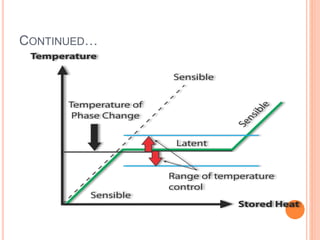
CONTINUED…
CONTINUED..
 Two methods by which energy can be stored
include:
 Sensible heat storage.
 Latent heat storage.
 Since, amount of heat energy stored as the latent
heat will be higher than the sensible heat therefore
LHS system is preferred.
THERMAL ENERGY STORAGE
 Energy can neither be created nor be destroyed .
 But it can be stored ,so that it can be utilized when
the demand arises.
 Further available renewable sources of energy like
solar energy can be stored to serve the energy
need.
THERMAL STORAGE METHODS
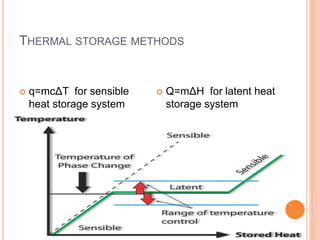
 q=mcΔT for sensible
heat storage system
 Q=mΔH for latent heat
storage system
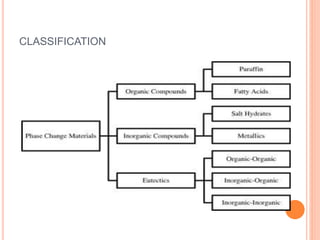
CLASSIFICATION
 Three classes of pcm are as under:
 Organic pcm
 Inorganic pcm
 Eutectic pcm
CLASSIFICATION
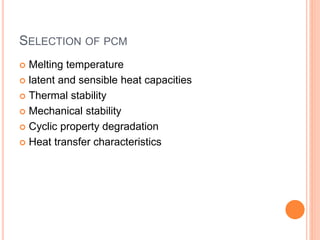
SELECTION OF PCM
 Melting temperature
 latent and sensible heat capacities
 Thermal stability
 Mechanical stability
 Cyclic property degradation
 Heat transfer characteristics
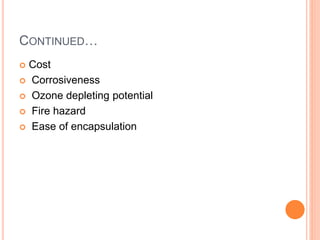
CONTINUED…
 Cost
 Corrosiveness
 Ozone depleting potential
 Fire hazard
 Ease of encapsulation
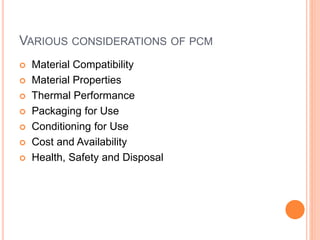
VARIOUS CONSIDERATIONS OF PCM
 Material Compatibility
 Material Properties
 Thermal Performance
 Packaging for Use
 Conditioning for Use
 Cost and Availability
 Health, Safety and Disposal
ADVANTAGES AND DISADVANTAGES
 Benefits:
 Higher storage density than sensible heat
 Smaller volume
 Smaller temperature change between absorbing
and releasing energy
DEMERTIS
 High cost
 Corrosiveness
 Density change
 Low thermal conductivity
 Phase separation
 Incongruent melting
 Super cooling
APPLICATIONS
 Construction-building materials
 Textiles
 Food packaging industry
 Medical packaging industry
 Automobile
 Transportation

Pcm ppt

  • 1.
    SHRI MATA VAISHNODEVI UNIVERSITY Topic : Phase change material Submitted by : Junaid bhat Enrollment n.o : 17mma007 Semester : 3rd[m.tech ] Submitted to : Mrs varun datta
  • 2.
    CONTENT  Introduction  Thermalstorage  Thermal storage methods  Classification  Advantage  Disadvantages  Applications
  • 3.
    INTRODUCTION  What isa PCM?  It’s a phase changing material which stores and releases energy during phase change example water.  These materials store, release or absorb heat as they oscillate between solid and liquid form.  Giving off heat as they change to a solid state and absorbing it as they return to a liquid state.  It stores large amounts of energy in a definite volume.
  • 4.
    CONTINUE….  Energy ismainly stored as ‘latent heat’.  It has high storage density with small temperature swing.  It can act as thermal storage system
  • 5.
  • 6.
    CONTINUED..  Two methodsby which energy can be stored include:  Sensible heat storage.  Latent heat storage.  Since, amount of heat energy stored as the latent heat will be higher than the sensible heat therefore LHS system is preferred.
  • 7.
    THERMAL ENERGY STORAGE Energy can neither be created nor be destroyed .  But it can be stored ,so that it can be utilized when the demand arises.  Further available renewable sources of energy like solar energy can be stored to serve the energy need.
  • 8.
    THERMAL STORAGE METHODS q=mcΔT for sensible heat storage system  Q=mΔH for latent heat storage system
  • 9.
    CLASSIFICATION  Three classesof pcm are as under:  Organic pcm  Inorganic pcm  Eutectic pcm
  • 10.
  • 11.
    SELECTION OF PCM Melting temperature  latent and sensible heat capacities  Thermal stability  Mechanical stability  Cyclic property degradation  Heat transfer characteristics
  • 12.
    CONTINUED…  Cost  Corrosiveness Ozone depleting potential  Fire hazard  Ease of encapsulation
  • 13.
    VARIOUS CONSIDERATIONS OFPCM  Material Compatibility  Material Properties  Thermal Performance  Packaging for Use  Conditioning for Use  Cost and Availability  Health, Safety and Disposal
  • 14.
    ADVANTAGES AND DISADVANTAGES Benefits:  Higher storage density than sensible heat  Smaller volume  Smaller temperature change between absorbing and releasing energy
  • 15.
    DEMERTIS  High cost Corrosiveness  Density change  Low thermal conductivity  Phase separation  Incongruent melting  Super cooling
  • 16.
    APPLICATIONS  Construction-building materials Textiles  Food packaging industry  Medical packaging industry  Automobile  Transportation