
I. History
- CLL was developed by
Charles A. Curran and his
associates in Chicago in
1970-1980.
- CLL is taken from the “
Counseling Learning
Approach” by Charles A.
Curran.
Charles A. Curran
II. Main features
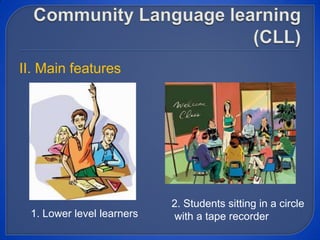
2. Students sitting in a circle
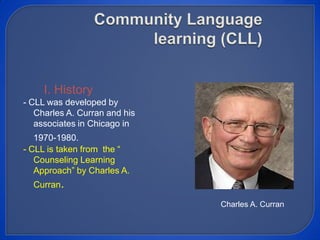
with a tape recorder1. Lower level learners
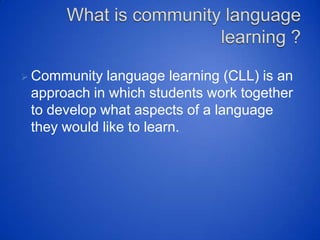
 Community language learning (CLL) is an
approach in which students work together
to develop what aspects of a language
they would like to learn.
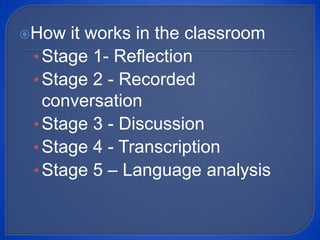
How it works in the classroom
• Stage 1- Reflection
• Stage 2 - Recorded
conversation
• Stage 3 - Discussion
• Stage 4 - Transcription
• Stage 5 – Language analysis
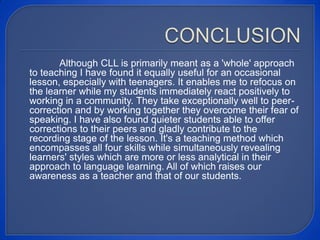
Although CLL is primarily meant as a 'whole' approach
to teaching I have found it equally useful for an occasional
lesson, especially with teenagers. It enables me to refocus on
the learner while my students immediately react positively to
working in a community. They take exceptionally well to peer-
correction and by working together they overcome their fear of
speaking. I have also found quieter students able to offer
corrections to their peers and gladly contribute to the
recording stage of the lesson. It's a teaching method which
encompasses all four skills while simultaneously revealing
learners' styles which are more or less analytical in their
approach to language learning. All of which raises our
awareness as a teacher and that of our students.
Community language learning

Community language learning

  • 2.
    I. History - CLLwas developed by Charles A. Curran and his associates in Chicago in 1970-1980. - CLL is taken from the “ Counseling Learning Approach” by Charles A. Curran. Charles A. Curran
  • 3.
    II. Main features 2.Students sitting in a circle with a tape recorder1. Lower level learners
  • 4.
     Community languagelearning (CLL) is an approach in which students work together to develop what aspects of a language they would like to learn.
  • 5.
    How it worksin the classroom • Stage 1- Reflection • Stage 2 - Recorded conversation • Stage 3 - Discussion • Stage 4 - Transcription • Stage 5 – Language analysis
  • 6.
    Although CLL isprimarily meant as a 'whole' approach to teaching I have found it equally useful for an occasional lesson, especially with teenagers. It enables me to refocus on the learner while my students immediately react positively to working in a community. They take exceptionally well to peer- correction and by working together they overcome their fear of speaking. I have also found quieter students able to offer corrections to their peers and gladly contribute to the recording stage of the lesson. It's a teaching method which encompasses all four skills while simultaneously revealing learners' styles which are more or less analytical in their approach to language learning. All of which raises our awareness as a teacher and that of our students.