Cristian Camilo Reyes Galeano
Aura Cecilia Collazos Gómez .
COMMUNITY LANGUAGE
LEARNING
During long time, different theories and methods to
teach languages have been structured in order to
have success in the teaching and learning processes
This method has helped to
develop skills in students
considering their personal
development, their skills, and
their motivations regarding
learning a foreign language.
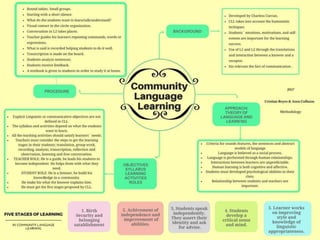
The objectives of this method are to help the
students to develop five stages of
independence in learning
These stages are the goals
to achieve by teachers and
students in this method
considering that it is a
process which is performed
though a mutual work.
A relationship among teachers and students
is central at the moment of teaching and
acquiring another language
Then all of these requirements become weighty at the
moment to start the process of second language acquisition
because for this method of learning, it is important to reflect
how the student is feeling with himself and his environment,
so that as teacher could improve those facts that are affecting
his learning process due to it is upsetting not only the student,
but also the community of learning where he is a member
There is not a specific syllabus or model to
perform a class into the Community
Language Learning Method
It will help the community
of learning to get the
communicative objectives
of the course even when
they are not planned.
Apprentices’ roles in Community Language
Learning are well defined due to the stages that are
structured to make noteworthy their learning process
Students are conscious
of their learning
process and what they
have to do in their
community of learning
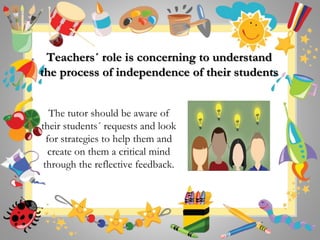
Teachers´ role is concerning to understand
the process of independence of their students
The tutor should be aware of
their students´ requests and look
for strategies to help them and
create on them a critical mind
through the reflective feedback.
During the procedures used in a class based
on Community Language Learning creativity
is a great ally
A specific coherence
and objectivity should
be present in the
techniques used to
accomplish the stages
language improvement
It is important to consider that this
method allows for the uses of L1 and L2
Both students and teachers are responsible
of their process of learning and role they
play into the community: make the
teaching and learning process
conscious and significant.
CONCLUSIONS
REFERENCES
• - Hull, P. (1984). Community Language Learning: Is It a Method?
SAGE journals, 15-25.
• - Marchetti, G. (2002). A Theory of Consciousness. University
Ubino Editorial, 29-48.
• - Novak, J. D. (2011). A theory of education: Meaningful learning
underlies the constructive integration of thinking , feeling and
acting. Aprendizagem Significativa em Revista, 1-11.
• - Richards, J., & Rodgers, T. (1986). Approaches and Methods in
Language Teaching. En J. Richards, & T. Rodgers, Community
Language Learning (págs. 90-99). Cambridge, United Kingdom :
Cambridge University Press .
• - Rowan, J. (2005). A guide to Humanistic Psychology. London
UK: Association of Humanistic Psychology Practitioners.

Community Language Learning

  • 1.
    Cristian Camilo ReyesGaleano Aura Cecilia Collazos Gómez . COMMUNITY LANGUAGE LEARNING
  • 2.
    During long time,different theories and methods to teach languages have been structured in order to have success in the teaching and learning processes This method has helped to develop skills in students considering their personal development, their skills, and their motivations regarding learning a foreign language.
  • 3.
    The objectives ofthis method are to help the students to develop five stages of independence in learning These stages are the goals to achieve by teachers and students in this method considering that it is a process which is performed though a mutual work.
  • 4.
    A relationship amongteachers and students is central at the moment of teaching and acquiring another language Then all of these requirements become weighty at the moment to start the process of second language acquisition because for this method of learning, it is important to reflect how the student is feeling with himself and his environment, so that as teacher could improve those facts that are affecting his learning process due to it is upsetting not only the student, but also the community of learning where he is a member
  • 5.
    There is nota specific syllabus or model to perform a class into the Community Language Learning Method It will help the community of learning to get the communicative objectives of the course even when they are not planned.
  • 6.
    Apprentices’ roles inCommunity Language Learning are well defined due to the stages that are structured to make noteworthy their learning process Students are conscious of their learning process and what they have to do in their community of learning
  • 7.
    Teachers´ role isconcerning to understand the process of independence of their students The tutor should be aware of their students´ requests and look for strategies to help them and create on them a critical mind through the reflective feedback.
  • 8.
    During the proceduresused in a class based on Community Language Learning creativity is a great ally A specific coherence and objectivity should be present in the techniques used to accomplish the stages language improvement
  • 9.
    It is importantto consider that this method allows for the uses of L1 and L2 Both students and teachers are responsible of their process of learning and role they play into the community: make the teaching and learning process conscious and significant.
  • 11.
  • 12.
    REFERENCES • - Hull,P. (1984). Community Language Learning: Is It a Method? SAGE journals, 15-25. • - Marchetti, G. (2002). A Theory of Consciousness. University Ubino Editorial, 29-48. • - Novak, J. D. (2011). A theory of education: Meaningful learning underlies the constructive integration of thinking , feeling and acting. Aprendizagem Significativa em Revista, 1-11. • - Richards, J., & Rodgers, T. (1986). Approaches and Methods in Language Teaching. En J. Richards, & T. Rodgers, Community Language Learning (págs. 90-99). Cambridge, United Kingdom : Cambridge University Press . • - Rowan, J. (2005). A guide to Humanistic Psychology. London UK: Association of Humanistic Psychology Practitioners.