COMMUNICATIVE
APPROACH
AN INTERACTION AND DYNAMIC TEACHING ON REAL LIFE
DEFINITION
 The communicative approach is based on the idea that learning language
successfully comes through having to communicate real meaning. When learners
are involved in real communication, their natural strategies for language acquisition
will be used, and this will allow them to learn to use the language.
 Example
Practicing question forms by asking learners to find out personal information about
their colleagues is an example of the communicative approach, as it involves
meaningful communication.
LANGUAGE IN USE
 The language we speak or write is governed by a number rules, styles and
contraints. According to this we quite apart from the meaning we wish to convey,
and we have to think how to teach in our school using those four skills (speaking,
listening, reading, writing) vinculated with our mission, vision, abilities and
methodology.
THEORIES – METHODS - TECNIQUES
 Approach: To refer to theories about the nature of language and language
learning which are the source of the way things are done in the classroom.
 Method: Is the practical realisation of an approach, or types of activities, teachers
and learners role.
 Procedure: Is an ordered sequence of techniques.
 Tecnique: Is a single activity that involve the approach.
 “If the language teacher´s management activities are directed exclusively at
involving the learners in solving communication problems in the target language
then learning will take care of itself”
LEARNERS VS TEACHERS
 Aptitude and Intelligence: Analyse various ways individual needs and behaviors
profiles
 Good learner characteristics: Tolerance, high aspirations, perseverance, creative
 Learner Styles: Categories
 a. Convergers: Independant and confident
 b. Conformist: Prefer to emphasise learning about language over learning to use
it.
 c. Concrete Learners: They enjoy the social aspects from direct experience.
 d. Communicative Learners: Comfortable out of class and show a degree of
confidence, interested in social interaction.
MANAGING LEARNING
 Three Methods: Developed in the 1970s and 1980s, Suggestopedia, Total Physical
Response, Silent Way,
 Communicative Language Teaching(CLT): Desire communicate something
 Task-based Learning(TBL): Task central to the learning process: Pre task, task,
planning, report, language focus
 The Lexical Approach: Is based on the assertion that language not traditional
language
 Methods and Culture: Native speakerism to describe teaching methodology
 Making Choices: six strands: Affect, input, output, grammar, cognitive effort
BASIC LEARNING RIGHTS
 The Basic Learning Rights (BLRs) un the area English language are an essential tool
ensuring quality and equity in education for all children in Colombia. These rights
describe the knowledge and skills that students must learn in english class in
grades 6° to 11° in the Colombia educational system.
LANGUAGE SKILL
 Language abilities are developing communicative competence in English.
 This allows promoting communicative situations: Before stages, during stages, after
stages.
 To be able to evidence the level of performance achieved by students in their
language abilities national and international frameworks.
FOCUSING ON TEACHING: SCOPE-
SEQUENCE
 Language study in lesson sequences: The status of language study depends on
why and when it occurs.
 Scope and Sequence: Describe the curriculum as a matrix of objectives assigned
to the grades(sequence) and group according to a common theme(scope).
 Content Scheme: Indicates a list of topics to cover arranged as a scheme.
 Modules: Democracy and Peace, Health, Sustainability, Globalization.
CURRICULAR PROPOSAL
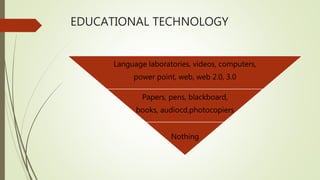
EDUCATIONAL TECHNOLOGY
Language laboratories, videos, computers,
power point, web, web 2.0, 3.0
Papers, pens, blackboard,
books, audiocd,photocopiers
Nothing
EVALUATION
 Diagnostica
 Sumativa
 Formativa

Communicative approach slideshare (1)

  • 1.
    COMMUNICATIVE APPROACH AN INTERACTION ANDDYNAMIC TEACHING ON REAL LIFE
  • 2.
    DEFINITION  The communicativeapproach is based on the idea that learning language successfully comes through having to communicate real meaning. When learners are involved in real communication, their natural strategies for language acquisition will be used, and this will allow them to learn to use the language.  Example Practicing question forms by asking learners to find out personal information about their colleagues is an example of the communicative approach, as it involves meaningful communication.
  • 3.
    LANGUAGE IN USE The language we speak or write is governed by a number rules, styles and contraints. According to this we quite apart from the meaning we wish to convey, and we have to think how to teach in our school using those four skills (speaking, listening, reading, writing) vinculated with our mission, vision, abilities and methodology.
  • 4.
    THEORIES – METHODS- TECNIQUES  Approach: To refer to theories about the nature of language and language learning which are the source of the way things are done in the classroom.  Method: Is the practical realisation of an approach, or types of activities, teachers and learners role.  Procedure: Is an ordered sequence of techniques.  Tecnique: Is a single activity that involve the approach.  “If the language teacher´s management activities are directed exclusively at involving the learners in solving communication problems in the target language then learning will take care of itself”
  • 5.
    LEARNERS VS TEACHERS Aptitude and Intelligence: Analyse various ways individual needs and behaviors profiles  Good learner characteristics: Tolerance, high aspirations, perseverance, creative  Learner Styles: Categories  a. Convergers: Independant and confident  b. Conformist: Prefer to emphasise learning about language over learning to use it.  c. Concrete Learners: They enjoy the social aspects from direct experience.  d. Communicative Learners: Comfortable out of class and show a degree of confidence, interested in social interaction.
  • 6.
    MANAGING LEARNING  ThreeMethods: Developed in the 1970s and 1980s, Suggestopedia, Total Physical Response, Silent Way,  Communicative Language Teaching(CLT): Desire communicate something  Task-based Learning(TBL): Task central to the learning process: Pre task, task, planning, report, language focus  The Lexical Approach: Is based on the assertion that language not traditional language  Methods and Culture: Native speakerism to describe teaching methodology  Making Choices: six strands: Affect, input, output, grammar, cognitive effort
  • 7.
    BASIC LEARNING RIGHTS The Basic Learning Rights (BLRs) un the area English language are an essential tool ensuring quality and equity in education for all children in Colombia. These rights describe the knowledge and skills that students must learn in english class in grades 6° to 11° in the Colombia educational system.
  • 8.
    LANGUAGE SKILL  Languageabilities are developing communicative competence in English.  This allows promoting communicative situations: Before stages, during stages, after stages.  To be able to evidence the level of performance achieved by students in their language abilities national and international frameworks.
  • 9.
    FOCUSING ON TEACHING:SCOPE- SEQUENCE  Language study in lesson sequences: The status of language study depends on why and when it occurs.  Scope and Sequence: Describe the curriculum as a matrix of objectives assigned to the grades(sequence) and group according to a common theme(scope).  Content Scheme: Indicates a list of topics to cover arranged as a scheme.  Modules: Democracy and Peace, Health, Sustainability, Globalization.
  • 10.
  • 11.
    EDUCATIONAL TECHNOLOGY Language laboratories,videos, computers, power point, web, web 2.0, 3.0 Papers, pens, blackboard, books, audiocd,photocopiers Nothing
  • 12.