Communicative
Approach -
Approaches to
Language Testing
Aida-Maira-Nadhira-Sara-Put-Ain-
Amanda-Azreena-Irdina
9th Grade
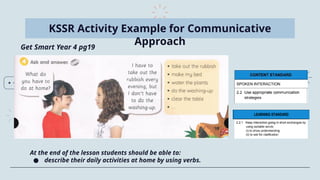
KSSR Activity Example for Communicative
Approach
Get Smart Year 4 pg19
At the end of the lesson students should be able to:
● describe their daily activities at home by using verbs.
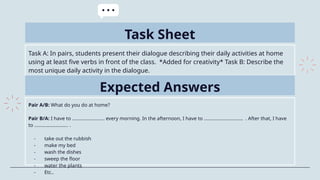
Task Sheet
Task A: In pairs, students present their dialogue describing their daily activities at home
using at least five verbs in front of the class. *Added for creativity* Task B: Describe the
most unique daily activity in the dialogue.
Expected Answers
Pair A/B: What do you do at home?
Pair B/A: I have to ……………………. every morning. In the afternoon, I have to ………………………… . After that, I have
to …………………….. .
- take out the rubbish
- make my bed
- wash the dishes
- sweep the floor
- water the plants
- Etc..
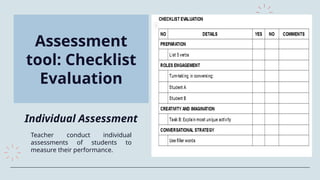
Assessment
tool: Checklist
Evaluation
Individual Assessment
Teacher conduct individual
assessments of students to
measure their performance.
What is communicative approach in teaching?
Communicative Language Teaching (CLT) is an approach that aims to achieve communicative
rather than linguistic competence through learner interaction. Born in the 1980s, this strategy to
language teaching is based on the philosophy that, in order to learn a language, one must practice
using that language to communicate meaning to others. It refers to approaches where practice in
using language within a real communicative context is the focus, where real information is
exchanged, and where the language used is not totally predictable. For example, students might
have to draw a map of their neighborhood and answer questions about the location of different
places, such as the nearest bus stop, the nearest café, etc.
EXAMPLES:
Roleplay Debate
Group project
work
Information gaps Interview
https://online.ulm.edu/degrees/education/med/curriculum-and-instruction/communicative-language-approach/
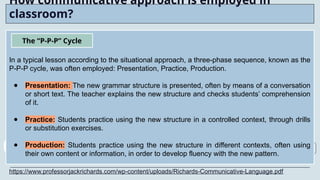
How communicative approach is employed in
classroom?
In a typical lesson according to the situational approach, a three-phase sequence, known as the
P-P-P cycle, was often employed: Presentation, Practice, Production.
● Presentation: The new grammar structure is presented, often by means of a conversation
or short text. The teacher explains the new structure and checks students’ comprehension
of it.
● Practice: Students practice using the new structure in a controlled context, through drills
or substitution exercises.
● Production: Students practice using the new structure in different contexts, often using
their own content or information, in order to develop fluency with the new pattern.
The “P-P-P” Cycle
https://www.professorjackrichards.com/wp-content/uploads/Richards-Communicative-Language.pdf
ACCURACY OR FLUENCY?
One of the goals of Communicative approach is to develop fluency in language use.
Fluency is natural language use occurring when a speaker engages in meaningful
interaction and maintains comprehensible and ongoing communication despite
limitations In his or her communicative competence. Fluency is developed by creating
classroom activities in which students must negotiate meaning, use communication
strategies, correct misunderstandings, and work to avoid communication breakdowns.
Activities focusing on fluency
● Reflect natural use of language
● Focus on achieving communication
● Require meaningful use of language
● Require the use of communication strategies
● Produce language that may not be predictable
● Seek to link language use to context
https://www.professorjackrichards.com/wp-content/uploads/Richards-Communicative-Language.pdf
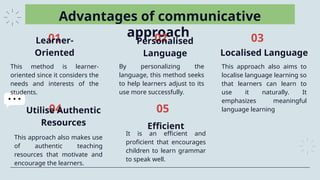
Advantages of communicative
approach
This approach also makes use
of authentic teaching
resources that motivate and
encourage the learners.
This method is learner-
oriented since it considers the
needs and interests of the
students.
By personalizing the
language, this method seeks
to help learners adjust to its
use more successfully.
It is an efficient and
proficient that encourages
children to learn grammar
to speak well.
This approach also aims to
localise language learning so
that learners can learn to
use it naturally. It
emphasizes meaningful
language learning
01
04
02
05
03
Learner-
Oriented
Personalised
Language Localised Language
Utilise Authentic
Resources Efficient
Accuracy is lacking due to explicit
focus on fluency.
Removing errors is reduce to avoid
disruption of conversation
Disadvantages of communicative
approach
The learning and teaching
context is not taken into
account
Teacher might understand
students interpretation but
native speakers may not.
Students flow more with incorrect
grammatical sentences due to unfix
errors
1. Lack of Context
3. Lack of Accuracy
4. Lack of Errors Reduction
2. False
Interpretation 5. Incoherence
Resourse:
https://educationsummary.com/lesson/advantages-and-disadvantages-of-com


TUTO 3 COMMUNCATIVE APPROACH (GROUP 1).pptx

  • 1.
    Communicative Approach - Approaches to LanguageTesting Aida-Maira-Nadhira-Sara-Put-Ain- Amanda-Azreena-Irdina 9th Grade
  • 2.
    KSSR Activity Examplefor Communicative Approach Get Smart Year 4 pg19 At the end of the lesson students should be able to: ● describe their daily activities at home by using verbs.
  • 3.
    Task Sheet Task A:In pairs, students present their dialogue describing their daily activities at home using at least five verbs in front of the class. *Added for creativity* Task B: Describe the most unique daily activity in the dialogue. Expected Answers Pair A/B: What do you do at home? Pair B/A: I have to ……………………. every morning. In the afternoon, I have to ………………………… . After that, I have to …………………….. . - take out the rubbish - make my bed - wash the dishes - sweep the floor - water the plants - Etc..
  • 4.
    Assessment tool: Checklist Evaluation Individual Assessment Teacherconduct individual assessments of students to measure their performance.
  • 5.
    What is communicativeapproach in teaching? Communicative Language Teaching (CLT) is an approach that aims to achieve communicative rather than linguistic competence through learner interaction. Born in the 1980s, this strategy to language teaching is based on the philosophy that, in order to learn a language, one must practice using that language to communicate meaning to others. It refers to approaches where practice in using language within a real communicative context is the focus, where real information is exchanged, and where the language used is not totally predictable. For example, students might have to draw a map of their neighborhood and answer questions about the location of different places, such as the nearest bus stop, the nearest café, etc. EXAMPLES: Roleplay Debate Group project work Information gaps Interview https://online.ulm.edu/degrees/education/med/curriculum-and-instruction/communicative-language-approach/
  • 6.
    How communicative approachis employed in classroom? In a typical lesson according to the situational approach, a three-phase sequence, known as the P-P-P cycle, was often employed: Presentation, Practice, Production. ● Presentation: The new grammar structure is presented, often by means of a conversation or short text. The teacher explains the new structure and checks students’ comprehension of it. ● Practice: Students practice using the new structure in a controlled context, through drills or substitution exercises. ● Production: Students practice using the new structure in different contexts, often using their own content or information, in order to develop fluency with the new pattern. The “P-P-P” Cycle https://www.professorjackrichards.com/wp-content/uploads/Richards-Communicative-Language.pdf
  • 7.
    ACCURACY OR FLUENCY? Oneof the goals of Communicative approach is to develop fluency in language use. Fluency is natural language use occurring when a speaker engages in meaningful interaction and maintains comprehensible and ongoing communication despite limitations In his or her communicative competence. Fluency is developed by creating classroom activities in which students must negotiate meaning, use communication strategies, correct misunderstandings, and work to avoid communication breakdowns. Activities focusing on fluency ● Reflect natural use of language ● Focus on achieving communication ● Require meaningful use of language ● Require the use of communication strategies ● Produce language that may not be predictable ● Seek to link language use to context https://www.professorjackrichards.com/wp-content/uploads/Richards-Communicative-Language.pdf
  • 8.
    Advantages of communicative approach Thisapproach also makes use of authentic teaching resources that motivate and encourage the learners. This method is learner- oriented since it considers the needs and interests of the students. By personalizing the language, this method seeks to help learners adjust to its use more successfully. It is an efficient and proficient that encourages children to learn grammar to speak well. This approach also aims to localise language learning so that learners can learn to use it naturally. It emphasizes meaningful language learning 01 04 02 05 03 Learner- Oriented Personalised Language Localised Language Utilise Authentic Resources Efficient
  • 9.
    Accuracy is lackingdue to explicit focus on fluency. Removing errors is reduce to avoid disruption of conversation Disadvantages of communicative approach The learning and teaching context is not taken into account Teacher might understand students interpretation but native speakers may not. Students flow more with incorrect grammatical sentences due to unfix errors 1. Lack of Context 3. Lack of Accuracy 4. Lack of Errors Reduction 2. False Interpretation 5. Incoherence Resourse: https://educationsummary.com/lesson/advantages-and-disadvantages-of-com