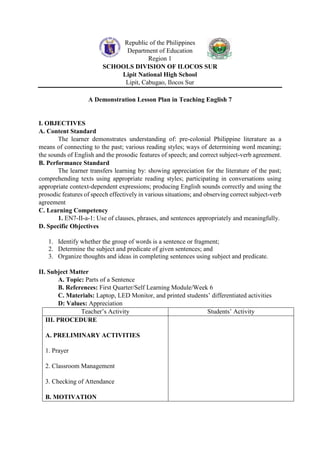
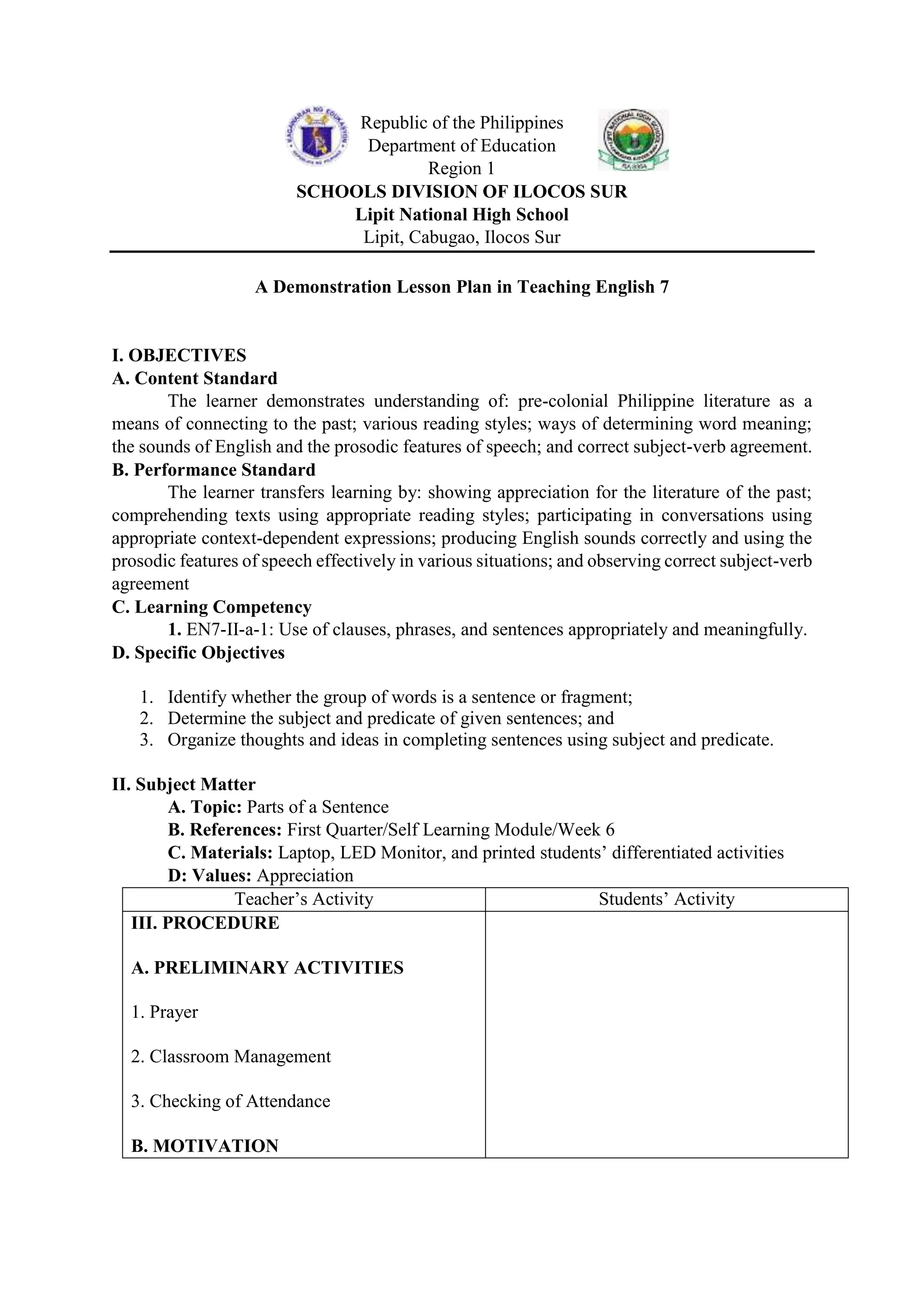
Republic of the Philippines
Department of Education
Region 1
SCHOOLS DIVISION OF ILOCOS SUR
Lipit National High School
Lipit, Cabugao, Ilocos Sur
A Demonstration Lesson Plan in Teaching English 7
I. OBJECTIVES
A. Content Standard
The learner demonstrates understanding of: pre-colonial Philippine literature as a
means of connecting to the past; various reading styles; ways of determining word meaning;
the sounds of English and the prosodic features of speech; and correct subject-verb agreement.
B. Performance Standard
The learner transfers learning by: showing appreciation for the literature of the past;
comprehending texts using appropriate reading styles; participating in conversations using
appropriate context-dependent expressions; producing English sounds correctly and using the
prosodic features of speech effectively in various situations; and observing correct subject-verb
agreement
C. Learning Competency
1. EN7-II-a-1: Use of clauses, phrases, and sentences appropriately and meaningfully.
D. Specific Objectives
1. Identify whether the group of words is a sentence or fragment;
2. Determine the subject and predicate of given sentences; and
3. Organize thoughts and ideas in completing sentences using subject and predicate.
II. Subject Matter
A. Topic: Parts of a Sentence
B. References: First Quarter/Self Learning Module/Week 6
C. Materials: Laptop, LED Monitor, and printed students’ differentiated activities
D: Values: Appreciation
Teacher’s Activity Students’ Activity
III. PROCEDURE
A. PRELIMINARY ACTIVITIES
1. Prayer
2. Classroom Management
3. Checking of Attendance
B. MOTIVATION
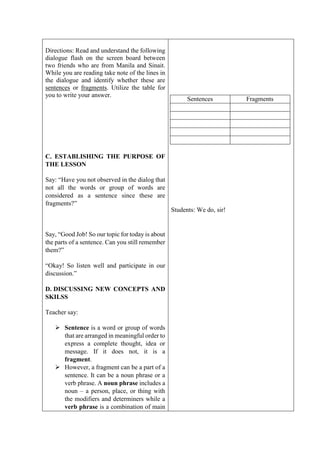
Directions: Read and understand the following
dialogue flash on the screen board between
two friends who are from Manila and Sinait.
While you are reading take note of the lines in
the dialogue and identify whether these are
sentences or fragments. Utilize the table for
you to write your answer.
C. ESTABLISHING THE PURPOSE OF
THE LESSON
Say: “Have you not observed in the dialog that
not all the words or group of words are
considered as a sentence since these are
fragments?”
Say, “Good Job! So our topic for today is about
the parts of a sentence. Can you still remember
them?”
“Okay! So listen well and participate in our
discussion.”
D. DISCUSSING NEW CONCEPTS AND
SKILSS
Teacher say:
 Sentence is a word or group of words
that are arranged in meaningful order to
express a complete thought, idea or
message. If it does not, it is a
fragment.
 However, a fragment can be a part of a
sentence. It can be a noun phrase or a
verb phrase. A noun phrase includes a
noun – a person, place, or thing with
the modifiers and determiners while a
verb phrase is a combination of main
Students: We do, sir!
Sentences Fragments
verb and its auxiliary (helping verb) in
a sentence.
 The teacher also discusses the parts of
the sentence and later, he will give
examples.
 The teacher may also allow the
students to give other examples and
dissect the sentence into its parts as
discussed earlier.
E. DEVELOPING MASTERY
 Say “To test your understanding, let us
answer the following activities.
 Are you ready?
 Okay! Let’s do this.”
Activity 1
Directions: You have learned that not all word
groups are sentences. On the space provided
before each number, write S if the word group
is a sentence and F if it is a fragment. Put a
period after each sentence.
__________1. We are all familiar with the
planet earth
__________2. The earth is the planet on which
we live
__________3. Can support life
__________4. Has an atmosphere
__________5. The earth has one moon
__________6. Roughly spherical in shape
__________7. Temperature on earth is well
suited to life
__________8. Seen from space
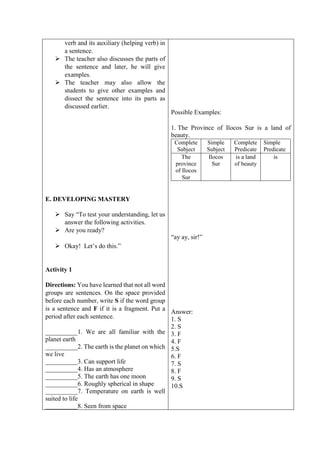
Possible Examples:
1. The Province of Ilocos Sur is a land of
beauty.
Complete
Subject
Simple
Subject
Complete
Predicate
Simple
Predicate
The
province
of Ilocos
Sur
Ilocos
Sur
is a land
of beauty
is
“ay ay, sir!”
Answer:
1. S
2. S
3. F
4. F
5.S
6. F
7. S
8. F
9. S
10.S
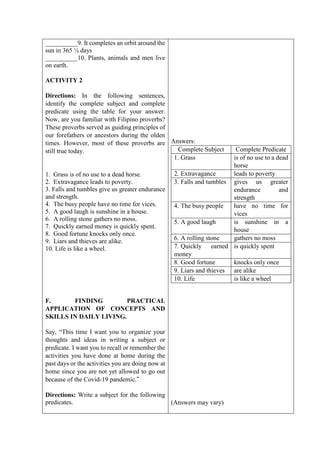
__________9. It completes an orbit around the
sun in 365 ¼ days
__________10. Plants, animals and men live
on earth.
ACTIVITY 2
Directions: In the following sentences,
identify the complete subject and complete
predicate using the table for your answer.
Now, are you familiar with Filipino proverbs?
These proverbs served as guiding principles of
our forefathers or ancestors during the olden
times. However, most of these proverbs are
still true today.
1. Grass is of no use to a dead horse.
2. Extravagance leads to poverty.
3. Falls and tumbles give us greater endurance
and strength.
4. The busy people have no time for vices.
5. A good laugh is sunshine in a house.
6. A rolling stone gathers no moss.
7. Quickly earned money is quickly spent.
8. Good fortune knocks only once.
9. Liars and thieves are alike.
10. Life is like a wheel.
F. FINDING PRACTICAL
APPLICATION OF CONCEPTS AND
SKILLS IN DAILY LIVING.
Say, “This time I want you to organize your
thoughts and ideas in writing a subject or
predicate. I want you to recall or remember the
activities you have done at home during the
past days or the activities you are doing now at
home since you are not yet allowed to go out
because of the Covid-19 pandemic.”
Directions: Write a subject for the following
predicates.
Answers:
Complete Subject Complete Predicate
1. Grass is of no use to a dead
horse
2. Extravagance leads to poverty
3. Falls and tumbles gives us greater
endurance and
strength
4. The busy people have no time for
vices
5. A good laugh is sunshine in a
house
6. A rolling stone gathers no moss
7. Quickly earned
money
is quickly spent
8. Good fortune knocks only once
9. Liars and thieves are alike
10. Life is like a wheel
(Answers may vary)
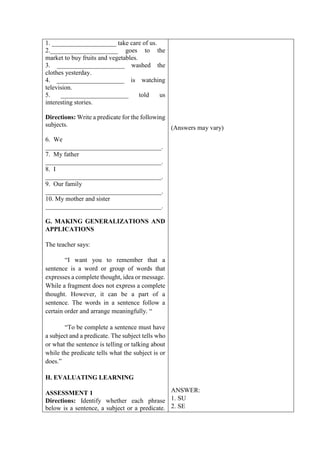
1. ____________________ take care of us.
2._____________________ goes to the
market to buy fruits and vegetables.
3. _____________________ washed the
clothes yesterday.
4. _____________________ is watching
television.
5. _____________________ told us
interesting stories.
Directions: Write a predicate for the following
subjects.
6. We
____________________________________.
7. My father
____________________________________.
8. I
____________________________________.
9. Our family
____________________________________.
10. My mother and sister
____________________________________.
G. MAKING GENERALIZATIONS AND
APPLICATIONS
The teacher says:
“I want you to remember that a
sentence is a word or group of words that
expresses a complete thought, idea or message.
While a fragment does not express a complete
thought. However, it can be a part of a
sentence. The words in a sentence follow a
certain order and arrange meaningfully. “
“To be complete a sentence must have
a subject and a predicate. The subject tells who
or what the sentence is telling or talking about
while the predicate tells what the subject is or
does.”
H. EVALUATING LEARNING
ASSESSMENT 1
Directions: Identify whether each phrase
below is a sentence, a subject or a predicate.
(Answers may vary)
ANSWER:
1. SU
2. SE
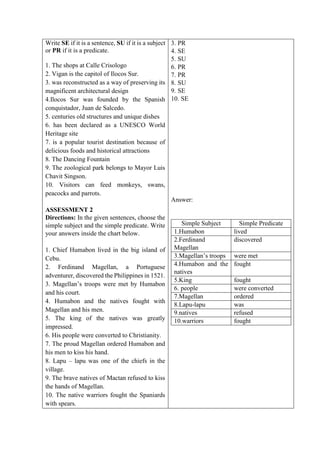
Write SE if it is a sentence, SU if it is a subject
or PR if it is a predicate.
1. The shops at Calle Crisologo
2. Vigan is the capitol of Ilocos Sur.
3. was reconstructed as a way of preserving its
magnificent architectural design
4.Ilocos Sur was founded by the Spanish
conquistador, Juan de Salcedo.
5. centuries old structures and unique dishes
6. has been declared as a UNESCO World
Heritage site
7. is a popular tourist destination because of
delicious foods and historical attractions
8. The Dancing Fountain
9. The zoological park belongs to Mayor Luis
Chavit Singson.
10. Visitors can feed monkeys, swans,
peacocks and parrots.
ASSESSMENT 2
Directions: In the given sentences, choose the
simple subject and the simple predicate. Write
your answers inside the chart below.
1. Chief Humabon lived in the big island of
Cebu.
2. Ferdinand Magellan, a Portuguese
adventurer, discovered the Philippines in 1521.
3. Magellan’s troops were met by Humabon
and his court.
4. Humabon and the natives fought with
Magellan and his men.
5. The king of the natives was greatly
impressed.
6. His people were converted to Christianity.
7. The proud Magellan ordered Humabon and
his men to kiss his hand.
8. Lapu – lapu was one of the chiefs in the
village.
9. The brave natives of Mactan refused to kiss
the hands of Magellan.
10. The native warriors fought the Spaniards
with spears.
3. PR
4. SE
5. SU
6. PR
7. PR
8. SU
9. SE
10. SE
Answer:
Simple Subject Simple Predicate
1.Humabon lived
2.Ferdinand
Magellan
discovered
3.Magellan’s troops were met
4.Humabon and the
natives
fought
5.King fought
6. people were converted
7.Magellan ordered
8.Lapu-lapu was
9.natives refused
10.warriors fought
Simple Subject Simple Predicate
1.
2.
3.
4.
5.
6.
7.
8.
9.
10.
IV. ASSIGNMENT
Write at least five (5) sentences in your
notebook then identify the simple subject and
simple predicate by underlining once the
simple and twice the simple predicate. Be
ready to present it in our class.
PREPARED BY: NOTED BY:
RUSSEL M. PAGANAO MA. CHITO B. AGBULOS
TEACHER I HEAD TEACHER II

Demo Teaching (First Quarter).docx

  • 1.
    Republic of thePhilippines Department of Education Region 1 SCHOOLS DIVISION OF ILOCOS SUR Lipit National High School Lipit, Cabugao, Ilocos Sur A Demonstration Lesson Plan in Teaching English 7 I. OBJECTIVES A. Content Standard The learner demonstrates understanding of: pre-colonial Philippine literature as a means of connecting to the past; various reading styles; ways of determining word meaning; the sounds of English and the prosodic features of speech; and correct subject-verb agreement. B. Performance Standard The learner transfers learning by: showing appreciation for the literature of the past; comprehending texts using appropriate reading styles; participating in conversations using appropriate context-dependent expressions; producing English sounds correctly and using the prosodic features of speech effectively in various situations; and observing correct subject-verb agreement C. Learning Competency 1. EN7-II-a-1: Use of clauses, phrases, and sentences appropriately and meaningfully. D. Specific Objectives 1. Identify whether the group of words is a sentence or fragment; 2. Determine the subject and predicate of given sentences; and 3. Organize thoughts and ideas in completing sentences using subject and predicate. II. Subject Matter A. Topic: Parts of a Sentence B. References: First Quarter/Self Learning Module/Week 6 C. Materials: Laptop, LED Monitor, and printed students’ differentiated activities D: Values: Appreciation Teacher’s Activity Students’ Activity III. PROCEDURE A. PRELIMINARY ACTIVITIES 1. Prayer 2. Classroom Management 3. Checking of Attendance B. MOTIVATION
  • 2.
    Directions: Read andunderstand the following dialogue flash on the screen board between two friends who are from Manila and Sinait. While you are reading take note of the lines in the dialogue and identify whether these are sentences or fragments. Utilize the table for you to write your answer. C. ESTABLISHING THE PURPOSE OF THE LESSON Say: “Have you not observed in the dialog that not all the words or group of words are considered as a sentence since these are fragments?” Say, “Good Job! So our topic for today is about the parts of a sentence. Can you still remember them?” “Okay! So listen well and participate in our discussion.” D. DISCUSSING NEW CONCEPTS AND SKILSS Teacher say:  Sentence is a word or group of words that are arranged in meaningful order to express a complete thought, idea or message. If it does not, it is a fragment.  However, a fragment can be a part of a sentence. It can be a noun phrase or a verb phrase. A noun phrase includes a noun – a person, place, or thing with the modifiers and determiners while a verb phrase is a combination of main Students: We do, sir! Sentences Fragments
  • 3.
    verb and itsauxiliary (helping verb) in a sentence.  The teacher also discusses the parts of the sentence and later, he will give examples.  The teacher may also allow the students to give other examples and dissect the sentence into its parts as discussed earlier. E. DEVELOPING MASTERY  Say “To test your understanding, let us answer the following activities.  Are you ready?  Okay! Let’s do this.” Activity 1 Directions: You have learned that not all word groups are sentences. On the space provided before each number, write S if the word group is a sentence and F if it is a fragment. Put a period after each sentence. __________1. We are all familiar with the planet earth __________2. The earth is the planet on which we live __________3. Can support life __________4. Has an atmosphere __________5. The earth has one moon __________6. Roughly spherical in shape __________7. Temperature on earth is well suited to life __________8. Seen from space Possible Examples: 1. The Province of Ilocos Sur is a land of beauty. Complete Subject Simple Subject Complete Predicate Simple Predicate The province of Ilocos Sur Ilocos Sur is a land of beauty is “ay ay, sir!” Answer: 1. S 2. S 3. F 4. F 5.S 6. F 7. S 8. F 9. S 10.S
  • 4.
    __________9. It completesan orbit around the sun in 365 ¼ days __________10. Plants, animals and men live on earth. ACTIVITY 2 Directions: In the following sentences, identify the complete subject and complete predicate using the table for your answer. Now, are you familiar with Filipino proverbs? These proverbs served as guiding principles of our forefathers or ancestors during the olden times. However, most of these proverbs are still true today. 1. Grass is of no use to a dead horse. 2. Extravagance leads to poverty. 3. Falls and tumbles give us greater endurance and strength. 4. The busy people have no time for vices. 5. A good laugh is sunshine in a house. 6. A rolling stone gathers no moss. 7. Quickly earned money is quickly spent. 8. Good fortune knocks only once. 9. Liars and thieves are alike. 10. Life is like a wheel. F. FINDING PRACTICAL APPLICATION OF CONCEPTS AND SKILLS IN DAILY LIVING. Say, “This time I want you to organize your thoughts and ideas in writing a subject or predicate. I want you to recall or remember the activities you have done at home during the past days or the activities you are doing now at home since you are not yet allowed to go out because of the Covid-19 pandemic.” Directions: Write a subject for the following predicates. Answers: Complete Subject Complete Predicate 1. Grass is of no use to a dead horse 2. Extravagance leads to poverty 3. Falls and tumbles gives us greater endurance and strength 4. The busy people have no time for vices 5. A good laugh is sunshine in a house 6. A rolling stone gathers no moss 7. Quickly earned money is quickly spent 8. Good fortune knocks only once 9. Liars and thieves are alike 10. Life is like a wheel (Answers may vary)
  • 5.
    1. ____________________ takecare of us. 2._____________________ goes to the market to buy fruits and vegetables. 3. _____________________ washed the clothes yesterday. 4. _____________________ is watching television. 5. _____________________ told us interesting stories. Directions: Write a predicate for the following subjects. 6. We ____________________________________. 7. My father ____________________________________. 8. I ____________________________________. 9. Our family ____________________________________. 10. My mother and sister ____________________________________. G. MAKING GENERALIZATIONS AND APPLICATIONS The teacher says: “I want you to remember that a sentence is a word or group of words that expresses a complete thought, idea or message. While a fragment does not express a complete thought. However, it can be a part of a sentence. The words in a sentence follow a certain order and arrange meaningfully. “ “To be complete a sentence must have a subject and a predicate. The subject tells who or what the sentence is telling or talking about while the predicate tells what the subject is or does.” H. EVALUATING LEARNING ASSESSMENT 1 Directions: Identify whether each phrase below is a sentence, a subject or a predicate. (Answers may vary) ANSWER: 1. SU 2. SE
  • 6.
    Write SE ifit is a sentence, SU if it is a subject or PR if it is a predicate. 1. The shops at Calle Crisologo 2. Vigan is the capitol of Ilocos Sur. 3. was reconstructed as a way of preserving its magnificent architectural design 4.Ilocos Sur was founded by the Spanish conquistador, Juan de Salcedo. 5. centuries old structures and unique dishes 6. has been declared as a UNESCO World Heritage site 7. is a popular tourist destination because of delicious foods and historical attractions 8. The Dancing Fountain 9. The zoological park belongs to Mayor Luis Chavit Singson. 10. Visitors can feed monkeys, swans, peacocks and parrots. ASSESSMENT 2 Directions: In the given sentences, choose the simple subject and the simple predicate. Write your answers inside the chart below. 1. Chief Humabon lived in the big island of Cebu. 2. Ferdinand Magellan, a Portuguese adventurer, discovered the Philippines in 1521. 3. Magellan’s troops were met by Humabon and his court. 4. Humabon and the natives fought with Magellan and his men. 5. The king of the natives was greatly impressed. 6. His people were converted to Christianity. 7. The proud Magellan ordered Humabon and his men to kiss his hand. 8. Lapu – lapu was one of the chiefs in the village. 9. The brave natives of Mactan refused to kiss the hands of Magellan. 10. The native warriors fought the Spaniards with spears. 3. PR 4. SE 5. SU 6. PR 7. PR 8. SU 9. SE 10. SE Answer: Simple Subject Simple Predicate 1.Humabon lived 2.Ferdinand Magellan discovered 3.Magellan’s troops were met 4.Humabon and the natives fought 5.King fought 6. people were converted 7.Magellan ordered 8.Lapu-lapu was 9.natives refused 10.warriors fought
  • 7.
    Simple Subject SimplePredicate 1. 2. 3. 4. 5. 6. 7. 8. 9. 10. IV. ASSIGNMENT Write at least five (5) sentences in your notebook then identify the simple subject and simple predicate by underlining once the simple and twice the simple predicate. Be ready to present it in our class. PREPARED BY: NOTED BY: RUSSEL M. PAGANAO MA. CHITO B. AGBULOS TEACHER I HEAD TEACHER II