Communication Skills
and Focused Listening Module
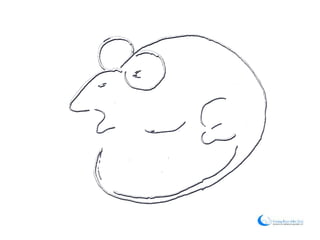
What is this?!
What is this?!
What is this?!
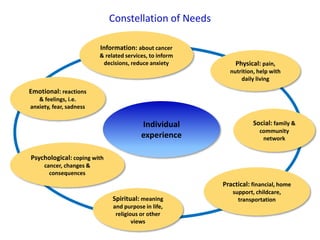
Constellation of Needs
Individual
experience
Spiritual: meaning
and purpose in life,
religious or other
views
Emotional: reactions
& feelings, i.e.
anxiety, fear, sadness
Practical: financial, home
support, childcare,
transportation
Social: family &
community
network
Physical: pain,
nutrition, help with
daily living
Information: about cancer
& related services, to inform
decisions, reduce anxiety
Psychological: coping with
cancer, changes &
consequences
COMMUNICATION SKILLS
When connecting with patients/
family members you will be talking
in a specialized way. You are
following the individuals agenda.
Good Communication Starts with
Empathy
• Intellectual and emotional awareness
and understanding of another person’s
thoughts, feelings and behavior, including
emotions that are distressing
• “As little as 40 seconds of empathic language
results in significant changes in
patient’s anxiety level”.
HOW TO BE A GOOD LISTENER
• EMPATHIZE: Put yourself in the other person’s
shoes, this is different then sympathy.
• STAY IN THE MOMENT: Focus on listening vs.
formulating your response.
• MAKE UNDERSTANDING YOUR GOAL: Allow
people to elaborate and explain themselves as
needed. Focus on understanding what the
patient/family is saying, meaning and feeling and
why it is important to them. Really make
understanding your primary goal.
HOW TO BE A GOOD LISTENER
• LISTEN ACTIVELY: Check your understanding
by repeating back the main points as you’ve
heard them.
• BE AWARE of ASSUMPTIONS: Avoid assuming,
check it out.
• LISTEN FOR WHAT IS MISSING: What
information or emotion has been left out that
could give you a clearer picture?
• DON’T RUSH IN TO: soothe, fix, and advise.
HOW TO BE A GOOD LISTENER
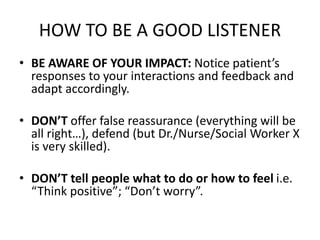
• BE AWARE OF YOUR IMPACT: Notice patient’s
responses to your interactions and feedback and
adapt accordingly.
• DON’T offer false reassurance (everything will be
all right…), defend (but Dr./Nurse/Social Worker X
is very skilled).
• DON’T tell people what to do or how to feel i.e.
“Think positive”; “Don’t worry”.
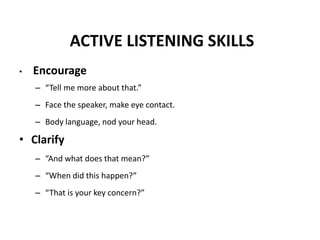
ACTIVE LISTENING SKILLS
• Encourage
– “Tell me more about that.”
– Face the speaker, make eye contact.
– Body language, nod your head.
• Clarify
– “And what does that mean?”
– “When did this happen?”
– “That is your key concern?”
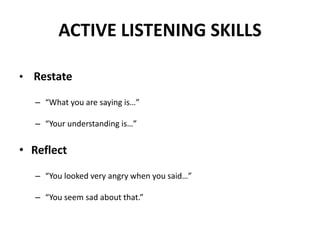
ACTIVE LISTENING SKILLS
• Restate
– “What you are saying is…”
– “Your understanding is…”
• Reflect
– “You looked very angry when you said…”
– “You seem sad about that.”
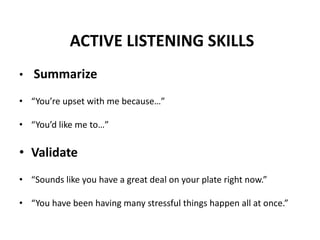
ACTIVE LISTENING SKILLS
• Summarize
• “You’re upset with me because…”
• “You’d like me to…”
• Validate
• “Sounds like you have a great deal on your plate right now.”
• “You have been having many stressful things happen all at once.”
Techniques that Facilitate
Communication
• Body Language: be relaxed and confident
• Start where the patient is: Allow the patient to
take the lead
• Clarify- restate, paraphrase and translate feelings
• Use open ended questions that cannot be
answered by YES or NO
• Validating
• Using silence with non verbal body language
Techniques that block communication
• Offering false reassurance
• Making promises you can’t keep
• Expressing judgment
• Disagreeing
• Making stereotype comments “Just listen to
your doctor, he/she knows”
• Changing the subject to something unrelated
Expressing Empathy
The key to responding to the
PERSON
is responding to their
EMOTIONS
Scenario
• “I have gone from the body of an active 18 year old doing pretty
much whatever I wanted, to a much weaker and more fragile one. [I
had a] seemingly never ending list of complications ranging from
routine fevers to pancreatitis, which caused severe pain attacks and
further complications which I am still dealing with. This may have
been the most trying period mentally as well, because it seemed
like I got a never ending stream of bad news.
• I did not really want to make my issues public, especially at first... I
find that I have to make an effort to will myself to go out and be
with my friends.
• [Cancer] has forced me to sit back and take a look at life and what it
means, who I am and where I am going... as well as seeing the value
of just living day to day, for the moment.”
[Young man, diagnosed with Leukemia]
Practicing Communication Guidelines:
Active Listening Skills based on Scenario
1. Provide an example of how you could express empathy
and validate their experience.
2. Provide an example of assumptions that you might
make and how you might check them out.
3. What is something supportive that you can say that is
not “false reassurance” nor providing information?
4. Provide an example of strengths you are hearing from
the patient and how you might reflect them back.
5. Provide an example of how can you wrap up the
conversation.
Role Plays

Communication Skills and Focused Listening Module

  • 1.
  • 2.
  • 4.
  • 6.
  • 10.
    Constellation of Needs Individual experience Spiritual:meaning and purpose in life, religious or other views Emotional: reactions & feelings, i.e. anxiety, fear, sadness Practical: financial, home support, childcare, transportation Social: family & community network Physical: pain, nutrition, help with daily living Information: about cancer & related services, to inform decisions, reduce anxiety Psychological: coping with cancer, changes & consequences
  • 11.
    COMMUNICATION SKILLS When connectingwith patients/ family members you will be talking in a specialized way. You are following the individuals agenda.
  • 12.
    Good Communication Startswith Empathy • Intellectual and emotional awareness and understanding of another person’s thoughts, feelings and behavior, including emotions that are distressing • “As little as 40 seconds of empathic language results in significant changes in patient’s anxiety level”.
  • 13.
    HOW TO BEA GOOD LISTENER • EMPATHIZE: Put yourself in the other person’s shoes, this is different then sympathy. • STAY IN THE MOMENT: Focus on listening vs. formulating your response. • MAKE UNDERSTANDING YOUR GOAL: Allow people to elaborate and explain themselves as needed. Focus on understanding what the patient/family is saying, meaning and feeling and why it is important to them. Really make understanding your primary goal.
  • 14.
    HOW TO BEA GOOD LISTENER • LISTEN ACTIVELY: Check your understanding by repeating back the main points as you’ve heard them. • BE AWARE of ASSUMPTIONS: Avoid assuming, check it out. • LISTEN FOR WHAT IS MISSING: What information or emotion has been left out that could give you a clearer picture? • DON’T RUSH IN TO: soothe, fix, and advise.
  • 15.
    HOW TO BEA GOOD LISTENER • BE AWARE OF YOUR IMPACT: Notice patient’s responses to your interactions and feedback and adapt accordingly. • DON’T offer false reassurance (everything will be all right…), defend (but Dr./Nurse/Social Worker X is very skilled). • DON’T tell people what to do or how to feel i.e. “Think positive”; “Don’t worry”.
  • 16.
    ACTIVE LISTENING SKILLS •Encourage – “Tell me more about that.” – Face the speaker, make eye contact. – Body language, nod your head. • Clarify – “And what does that mean?” – “When did this happen?” – “That is your key concern?”
  • 17.
    ACTIVE LISTENING SKILLS •Restate – “What you are saying is…” – “Your understanding is…” • Reflect – “You looked very angry when you said…” – “You seem sad about that.”
  • 18.
    ACTIVE LISTENING SKILLS •Summarize • “You’re upset with me because…” • “You’d like me to…” • Validate • “Sounds like you have a great deal on your plate right now.” • “You have been having many stressful things happen all at once.”
  • 19.
    Techniques that Facilitate Communication •Body Language: be relaxed and confident • Start where the patient is: Allow the patient to take the lead • Clarify- restate, paraphrase and translate feelings • Use open ended questions that cannot be answered by YES or NO • Validating • Using silence with non verbal body language
  • 20.
    Techniques that blockcommunication • Offering false reassurance • Making promises you can’t keep • Expressing judgment • Disagreeing • Making stereotype comments “Just listen to your doctor, he/she knows” • Changing the subject to something unrelated
  • 21.
    Expressing Empathy The keyto responding to the PERSON is responding to their EMOTIONS
  • 22.
    Scenario • “I havegone from the body of an active 18 year old doing pretty much whatever I wanted, to a much weaker and more fragile one. [I had a] seemingly never ending list of complications ranging from routine fevers to pancreatitis, which caused severe pain attacks and further complications which I am still dealing with. This may have been the most trying period mentally as well, because it seemed like I got a never ending stream of bad news. • I did not really want to make my issues public, especially at first... I find that I have to make an effort to will myself to go out and be with my friends. • [Cancer] has forced me to sit back and take a look at life and what it means, who I am and where I am going... as well as seeing the value of just living day to day, for the moment.” [Young man, diagnosed with Leukemia]
  • 23.
    Practicing Communication Guidelines: ActiveListening Skills based on Scenario 1. Provide an example of how you could express empathy and validate their experience. 2. Provide an example of assumptions that you might make and how you might check them out. 3. What is something supportive that you can say that is not “false reassurance” nor providing information? 4. Provide an example of strengths you are hearing from the patient and how you might reflect them back. 5. Provide an example of how can you wrap up the conversation.
  • 24.