Current and Emerging Issues in Guidance and Counseling  in the Philippines by Reynante S. Tagum GC504: Counseling Theory & Practice II
Current & Emerging Issues in GC in the Philippines Children/Youth of today are Adults/Parents of tomorrow .. Adults / Parents STRESS Depression Suicide Bullying / Cyberbullying Risk-Taking Behavior Addiction PMS – AIDS/STD’s, Early Pregnancy, & Abortion Smoking, Alcohol, Illegal Drugs, Gangs, etc.. Substance abuse, Computer/Internet Abuse, Pornography, etc.. OFW / Migrant Workers Separated / Annulled Solo Parent Absentee Parent Children / Students (Youth) SSA & LGBT Violence Against Children & Women
Current & Emerging Issues in GC in the Philippines - Stress - Depression - Suicide
Are you stressed?  Stress Video Clip..
Modern life  is full of hassles, deadlines, frustrations, and demands.
Stress isn’t always bad.. In small doses,  it can help us perform under pressure  and motivate us to do our best.
But  when we are constantly running  in emergency mode, out mind and body  pay the price..
What is stress? When we perceive a threat, our nervous  System responds by releasing a flood of stress  hormones, adrenaline and cortisol.
These hormones  awakens  our body for  emergency  action..
Stress affects: Mind  Body  Behavior Relationship
Three Common Ways  People Respond when Overwhelmed by Stress Foot on the gas Foot on the brake  Foot on both
Foot on the gas: An angry or agitated response.  You’re heated up, overly emotional,  and unable to sit still .
Foot on the break: A withdrawn or depressed stress response. You shut down, space out, and show very little  energy or  emotion.
Foot on both: A  tense and frozen stress response.  You freeze under pressure and can’t do anything. You looked paralyzed, but under the surface you  are extremely agitated.
Sign and Symptoms Stress Overload Cognitive / Emotional Symptoms  Memory problems Inability to concentrate  Poor judgment Seeing only the negative Anxious or racing thoughts Constant worrying Moodiness Irritability or short temper Agitation, inability to relax Feeling overwhelmed Sense of loneliness and isolation Depression or general unhappiness
Sign and Symptoms Stress Overload Physical / Behavioral Symptoms Aches and pains Diarrhea or constipation Nausea, dizziness Chest pain Rapid heartbeat Loss sex drive Frequent colds  Eating more or less Sleeping too much or  too little Isolating yourself from others Procrastinating or neglecting responsibilities Using alcohol, cigarettes, or drugs to relax Nervous habits (e.g. nail-biting)
Effects of Chronic Stress It raise blood pressure, Suppress the immune system Increase the risk of heart attack  and stroke Contribute to infertility Speed up the aging process
Many health problems are caused or exacerbated by stress: Pain of any kind Heart disease Digestive problems Sleep problems Depression Obesity Autoimmune diseases Skin conditions
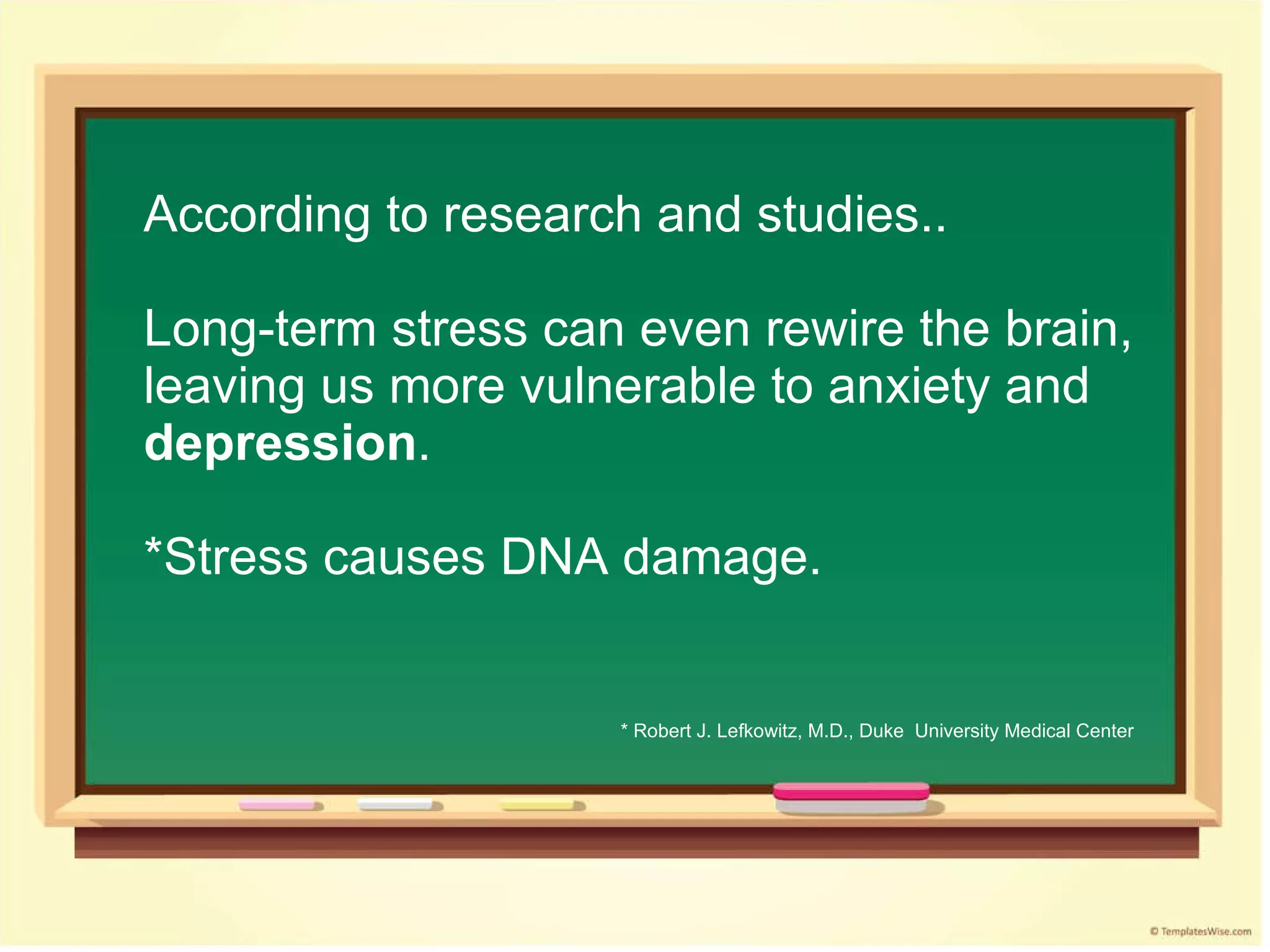
According to research and studies.. Long-term stress can even rewire the brain, leaving us more vulnerable to anxiety and depression . *Stress causes DNA damage. * Robert J. Lefkowitz, M.D., Duke  University Medical Center
Depression Fighting Depression Documentary Video
Depression is much more than just sadness. .. feelings of helplessness,  hopelessness, and  worthlessness  are intense and  unrelenting.
Depression is a major risk factor for suicide.  The deep despair and hopelessness that  goes along with depression can make  suicide feel like the only way to escape the  pain. 
Thoughts of death or suicide are  a serious symptom of depression,  so take any suicidal talk or  behavior seriously.  It's not just a warning sign that the person is  thinking about suicide:  it's a cry for help .
The U.S. National Institute of Mental Health  stated that untreated depression is the  number one cause of suicide, the 3rd leading  cause of death among their teenagers.
Depression self-help tip 1 Cultivate supportive relationships 10 tips for reaching out and building relationships Talk to one person about your feelings.  Help someone else by volunteering.  Have lunch or coffee with a friend.  Ask a loved one to check in with you regularly.  Accompany someone to the movies, a concert,  or a small get-together.
Depression self-help tip 1: Cultivate supportive relationships 10 tips for reaching out and building relationships Call or email an old friend.  Go for a walk with a workout buddy.  Schedule a weekly dinner date.  Meet new people by taking a class  or joining a club.  Confide in a counselor, therapist,  or clergy member.
Depression self-help tip 2:  Take care of yourself Do things you enjoy (or used to) Develop a wellness toolbox  Adopt healthy lifestyle habits Fight depression by managing stress
Depression self-help tip 3:  Get regular exercise
Depression self-help tip 4:  Eat a healthy, mood-boosting diet
Depression self-help tip 5:  Challenge negative thinking
Depression self-help tip 6:  Raise your emotional intelligence
Depression self-help tip 7:  Know when to get additional help
Natasha Goulbourn Foundation  Mindstrong, a campaign that focuses not on the  tragedy of suicide and depression but rather on  harnessing one’s mental resilience and cultivating  a feeling of flourishing. These are antidotes to the  downward spiral that depression brings.
Essentially, the campaign helps make individuals  more optimistic, mentally agile, self-aware,  self-regulating. It enables one to focus on one’s  strengths and build better connections with the  people around him or her.  Mindstrong, like an earlier campaign,  My Happy Hour, is an initiative not to treat  depression but to prevent it by taking positive  steps in small, regular doses.  http://www.ngf-hope.org/
NGF 24/7 HOPE LINE  (In Partnership with UGAT Foundation): 0917-558-HOPE (4673) or (632)211-4550 0917-845-HOPE and 0917-842-HOPE In Touch Crisis Lines: 0917-572-HOPE or (632)211-1305 (632) 893-7606 (24/7) (632)893-7603 (Mon-Fri, 9am-5pm) Globe (63917) 800.1123 or (632) 506.7314 Sun (63922) 893.8944 or (632) 346.8776 "Dial a Friend“ Hotlines:(632) 525-1743 / (632) 525-1881
Suicide News to Go Depression at Suicide
The World Health Organization estimates that  on the average, almost 3,000 people commit  suicide daily. According to WHO suicide rates statistics,  one person commits suicide every 40 seconds.  Suicide rates all over the world have increased  by 5% - 62% in the last two  decades.
*Of the 107 suicides in the Philippines reported in  the first half of 2010, 82 were male while 21  were female. Seventy one of the suicides were in  Metro Manila – the bulk coming from Quezon City,  mostly by hanging. Most of the suicides are in the 21 to 40 age group,  followed by 41 and above and 20 and below. *Manila Bulletin
Today My Life Begins It Gets Better by Bruno Mars

Current issues in Guidance and Counseling in the Philippines

  • 1.
    Current and EmergingIssues in Guidance and Counseling in the Philippines by Reynante S. Tagum GC504: Counseling Theory & Practice II
  • 2.
    Current & EmergingIssues in GC in the Philippines Children/Youth of today are Adults/Parents of tomorrow .. Adults / Parents STRESS Depression Suicide Bullying / Cyberbullying Risk-Taking Behavior Addiction PMS – AIDS/STD’s, Early Pregnancy, & Abortion Smoking, Alcohol, Illegal Drugs, Gangs, etc.. Substance abuse, Computer/Internet Abuse, Pornography, etc.. OFW / Migrant Workers Separated / Annulled Solo Parent Absentee Parent Children / Students (Youth) SSA & LGBT Violence Against Children & Women
  • 3.
    Current & EmergingIssues in GC in the Philippines - Stress - Depression - Suicide
  • 4.
    Are you stressed? Stress Video Clip..
  • 5.
    Modern life is full of hassles, deadlines, frustrations, and demands.
  • 6.
    Stress isn’t alwaysbad.. In small doses, it can help us perform under pressure and motivate us to do our best.
  • 7.
    But whenwe are constantly running in emergency mode, out mind and body pay the price..
  • 8.
    What is stress?When we perceive a threat, our nervous System responds by releasing a flood of stress hormones, adrenaline and cortisol.
  • 9.
    These hormones awakens our body for emergency action..
  • 10.
    Stress affects: Mind Body Behavior Relationship
  • 11.
    Three Common Ways People Respond when Overwhelmed by Stress Foot on the gas Foot on the brake Foot on both
  • 12.
    Foot on thegas: An angry or agitated response. You’re heated up, overly emotional, and unable to sit still .
  • 13.
    Foot on thebreak: A withdrawn or depressed stress response. You shut down, space out, and show very little energy or emotion.
  • 14.
    Foot on both:A tense and frozen stress response. You freeze under pressure and can’t do anything. You looked paralyzed, but under the surface you are extremely agitated.
  • 15.
    Sign and SymptomsStress Overload Cognitive / Emotional Symptoms Memory problems Inability to concentrate Poor judgment Seeing only the negative Anxious or racing thoughts Constant worrying Moodiness Irritability or short temper Agitation, inability to relax Feeling overwhelmed Sense of loneliness and isolation Depression or general unhappiness
  • 16.
    Sign and SymptomsStress Overload Physical / Behavioral Symptoms Aches and pains Diarrhea or constipation Nausea, dizziness Chest pain Rapid heartbeat Loss sex drive Frequent colds Eating more or less Sleeping too much or too little Isolating yourself from others Procrastinating or neglecting responsibilities Using alcohol, cigarettes, or drugs to relax Nervous habits (e.g. nail-biting)
  • 17.
    Effects of ChronicStress It raise blood pressure, Suppress the immune system Increase the risk of heart attack and stroke Contribute to infertility Speed up the aging process
  • 18.
    Many health problemsare caused or exacerbated by stress: Pain of any kind Heart disease Digestive problems Sleep problems Depression Obesity Autoimmune diseases Skin conditions
  • 19.
    According to researchand studies.. Long-term stress can even rewire the brain, leaving us more vulnerable to anxiety and depression . *Stress causes DNA damage. * Robert J. Lefkowitz, M.D., Duke University Medical Center
  • 20.
  • 21.
    Depression is muchmore than just sadness. .. feelings of helplessness, hopelessness, and worthlessness are intense and unrelenting.
  • 22.
    Depression is amajor risk factor for suicide. The deep despair and hopelessness that goes along with depression can make suicide feel like the only way to escape the pain. 
  • 23.
    Thoughts of deathor suicide are a serious symptom of depression, so take any suicidal talk or behavior seriously. It's not just a warning sign that the person is thinking about suicide: it's a cry for help .
  • 24.
    The U.S. NationalInstitute of Mental Health stated that untreated depression is the number one cause of suicide, the 3rd leading cause of death among their teenagers.
  • 25.
    Depression self-help tip1 Cultivate supportive relationships 10 tips for reaching out and building relationships Talk to one person about your feelings. Help someone else by volunteering. Have lunch or coffee with a friend. Ask a loved one to check in with you regularly. Accompany someone to the movies, a concert, or a small get-together.
  • 26.
    Depression self-help tip1: Cultivate supportive relationships 10 tips for reaching out and building relationships Call or email an old friend. Go for a walk with a workout buddy. Schedule a weekly dinner date. Meet new people by taking a class or joining a club. Confide in a counselor, therapist, or clergy member.
  • 27.
    Depression self-help tip2: Take care of yourself Do things you enjoy (or used to) Develop a wellness toolbox Adopt healthy lifestyle habits Fight depression by managing stress
  • 28.
    Depression self-help tip3: Get regular exercise
  • 29.
    Depression self-help tip4: Eat a healthy, mood-boosting diet
  • 30.
    Depression self-help tip5: Challenge negative thinking
  • 31.
    Depression self-help tip6: Raise your emotional intelligence
  • 32.
    Depression self-help tip7: Know when to get additional help
  • 33.
    Natasha Goulbourn Foundation Mindstrong, a campaign that focuses not on the tragedy of suicide and depression but rather on harnessing one’s mental resilience and cultivating a feeling of flourishing. These are antidotes to the downward spiral that depression brings.
  • 34.
    Essentially, the campaignhelps make individuals more optimistic, mentally agile, self-aware, self-regulating. It enables one to focus on one’s strengths and build better connections with the people around him or her. Mindstrong, like an earlier campaign, My Happy Hour, is an initiative not to treat depression but to prevent it by taking positive steps in small, regular doses. http://www.ngf-hope.org/
  • 35.
    NGF 24/7 HOPELINE (In Partnership with UGAT Foundation): 0917-558-HOPE (4673) or (632)211-4550 0917-845-HOPE and 0917-842-HOPE In Touch Crisis Lines: 0917-572-HOPE or (632)211-1305 (632) 893-7606 (24/7) (632)893-7603 (Mon-Fri, 9am-5pm) Globe (63917) 800.1123 or (632) 506.7314 Sun (63922) 893.8944 or (632) 346.8776 "Dial a Friend“ Hotlines:(632) 525-1743 / (632) 525-1881
  • 36.
    Suicide News toGo Depression at Suicide
  • 37.
    The World HealthOrganization estimates that on the average, almost 3,000 people commit suicide daily. According to WHO suicide rates statistics, one person commits suicide every 40 seconds. Suicide rates all over the world have increased by 5% - 62% in the last two decades.
  • 38.
    *Of the 107suicides in the Philippines reported in the first half of 2010, 82 were male while 21 were female. Seventy one of the suicides were in Metro Manila – the bulk coming from Quezon City, mostly by hanging. Most of the suicides are in the 21 to 40 age group, followed by 41 and above and 20 and below. *Manila Bulletin
  • 39.
    Today My LifeBegins It Gets Better by Bruno Mars