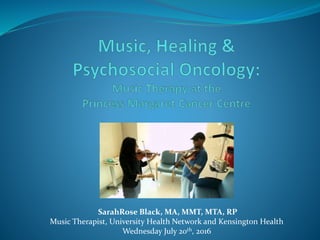
SarahRose Black, MA, MMT, MTA, RP
Music Therapist, University Health Network and Kensington Health
Wednesday July 20th, 2016
Overview and Learning Objectives
 The role of music therapy in:
 Palliative care
 Inpatient oncology
 Four facets
 How music therapy can affect a patient’s experience
 Information on how to become a music therapist
What is Music Therapy?
 The Canadian Association for Music Therapy defines music therapy as:
“The skillful use of music and musical elements by an
accredited music therapist to promote, maintain, and
restore mental, physical, emotional, and spiritual health.
Music has nonverbal, creative, structural, and emotional
qualities. These are used in the therapeutic relationship to
facilitate contact, interaction, self-awareness, learning,
self-expression, communication, and personal
development.”
Canadian Association for Music Therapy / Association de Musicothérapie du Canada Annual General Meeting, Vancouver, British
Columbia, May 6, 1994
To summarize:
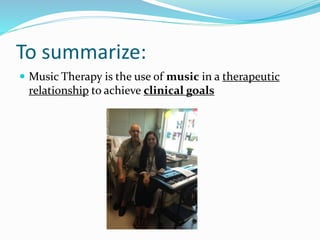
 Music Therapy is the use of music in a therapeutic
relationship to achieve clinical goals
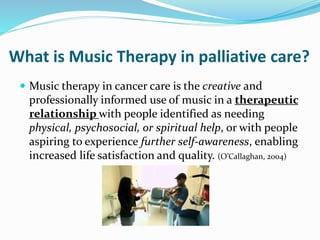
What is Music Therapy in palliative care?
 Music therapy in cancer care is the creative and
professionally informed use of music in a therapeutic
relationship with people identified as needing
physical, psychosocial, or spiritual help, or with people
aspiring to experience further self-awareness, enabling
increased life satisfaction and quality. (O’Callaghan, 2004)
Clinical Goals of Palliative MT
 Music therapy can support CURRENT goals
 Music therapy can create NEW goals
Examples of MT Clinical Goals:
Evidence – Based Work
 Pain/symptom management (Magill, 1993, O’Callaghan, 2012)
 Anxiety relief (Hilliard, 2001; O‟Callaghan, 2001)
 Creating legacies for family and friends (Clements-Cortes, 2009)
 Relaxation (Hilliard, 2003)
 Support for families (Hogan, 1999)
 Support (physical- breathing, emotional-comforting) at
end of life (Salmon, 2003)
 Providing a positive distraction from treatment/symptoms
 Providing a non-verbal space for communication
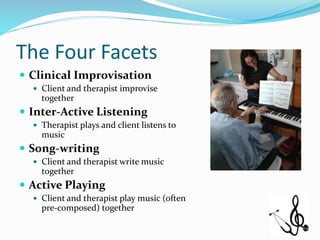
The Four Facets
 Clinical Improvisation
 Client and therapist improvise
together
 Inter-Active Listening
 Therapist plays and client listens to
music
 Song-writing
 Client and therapist write music
together
 Active Playing
 Client and therapist play music (often
pre-composed) together
Clinical Improvisation
 Defined as: the spontaneous creation of music
between therapist and client using instruments and/or
voice (Lee, 2003)
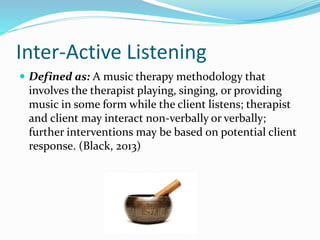
Inter-Active Listening
 Defined as: A music therapy methodology that
involves the therapist playing, singing, or providing
music in some form while the client listens; therapist
and client may interact non-verbally or verbally;
further interventions may be based on potential client
response. (Black, 2013)
Song-writing
 Defined as: the creation of a song (either with or
without lyrics) by therapist and client that may reflect
the client’s experiences. Song-writing is often done as
legacy work for a client’s family.
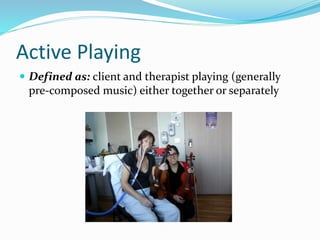
Active Playing
 Defined as: client and therapist playing (generally
pre-composed music) either together or separately
The Referral Process:
 Why refer?
 Who refers?
Inpatient Care
 Pain and symptom management
 Anxiety relief and emotional support
 Psychosocial support through verbal and non-verbal
creative self-expression
 Familial support
 Reflection, reminiscence
 Processing of current experience
 Legacy work
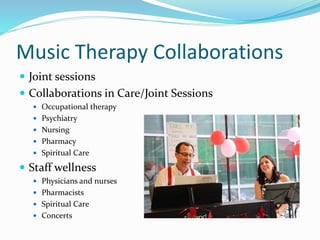
Music Therapy Collaborations
 Joint sessions
 Collaborations in Care/Joint Sessions
 Occupational therapy
 Psychiatry
 Nursing
 Pharmacy
 Spiritual Care
 Staff wellness
 Physicians and nurses
 Pharmacists
 Spiritual Care
 Concerts
Stories from the Bedside
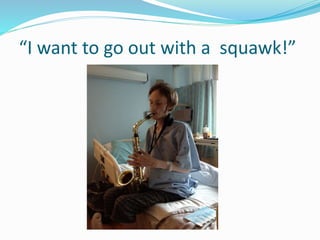
 Jason’s Saxophone- active playing and improvisation
Jason’s Saxophone
 Creating meaning in the
moment
 Embracing a defining
part of his life
 “I want to go out with a
squawk”
“I want to go out with a squawk!”
Experiential: Singing Bowl
Reflecting
 In what setting might this be most appropriate?
 What do you think clinical goals of this intervention
might be?
 What did you notice in your own body?
 Thoughts? Images? Sensations?
 How do you think this intervention could promote
health and healing?
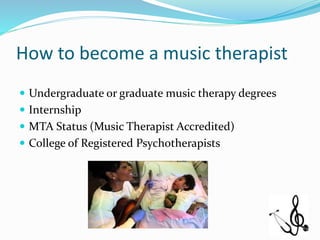
How to become a music therapist
 Undergraduate or graduate music therapy degrees
 Internship
 MTA Status (Music Therapist Accredited)
 College of Registered Psychotherapists
Working in the Field
 Music therapists work in all kinds of settings:
 Hospitals
 Rehabilitation centres
 Schools
 Correctional facilities
 Academic settings
 Home settings
 Private practice
 The possibilities are endless…
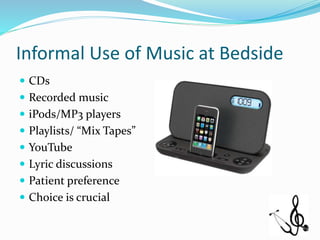
Informal Use of Music at Bedside
 CDs
 Recorded music
 iPods/MP3 players
 Playlists/ “Mix Tapes”
 YouTube
 Lyric discussions
 Patient preference
 Choice is crucial
Summarizing:
 Creating meaningful moments through a musical
relationship incorporating clinical goals
 Creating legacies
 Providing emotional outlets
 Engaging staff
 Supporting grief
Thank you!
 Questions?
 Comments?
 Contact:
Sarahrose.black@uhn.ca
Selected Bibliography
 Bailey, L. M. (1984). The use of songs in music therapy with cancer patients and their families. Music Therapy, 4(1), 5-17.
 Canadian Association for Music Therapy (2004). Definition of Music Therapy. Retrieved from
http://www.musictherapy.ca/en/information/music-therapy.html.
 Clements-Cortes, A. (2004). The use of music in facilitating emotional expression in the terminally ill. American Journal
of Hospice and Palliative Medicine, 21(4), 255–260.
 Clements-Cortes, A. (2009). Episodes of relationship completion through song-writing in palliative care. (Doctoral
Dissertation, University of Toronto, 2009).Retrieved from https://tspace.library.utoronto.ca/handle/1807/17744.
 Curtis, S. (1986). The effect of music on pain relief and relaxation of the terminally ill. Journal of Music Therapy, 24(1),
10-24.
 Dileo, C., &Dneaster, D. (2005). Introduction: State of the art. In C. Dileo& J. V. Loewy (Eds.), Music therapy at the end
of life (pp. xix-xxvii). Cherry Hill, NJ: Jeffrey Books.
 Brandt, J., & Dileo, C. (2008).Music therapy for symptom relief and support in end-of-life care. [Protocol] Cochrane
Pain, Palliative Care and Support Group. Cochrane Database of Systematic Reviews, 2.
 Hilliard, R.E. (2001). The use of music therapy in meeting the multidimensional needs of hospice patients and families.
Journal of Palliative Care, 17, 161-166.
 Hilliard, R.E. (2005). Music therapy in hospice and palliative care: A review of the empirical data. Evidence Based
Complementary Alternative Medicine, 2(2), 173-178.
 Hogan, B. (1999). The experience of music therapy for terminally ill patients: A phenomenological research project. In
R. R. Pratt and D. E. Grocke (Eds.),Music Medicine 3: Music Medicine and Music Therapy (pp. 242-54). Australia
Expanding Horizons, Faculty of Music, University of Melbourne.
 Lee, C.A. (2003). The architecture of aesthetic music therapy. Gilsum, NH: Barcelona Publishers.
 O’Callaghan, C. (2001). Bringing music to life: A study of music therapy and palliative care experiences in a cancer
hospital. Journal of Palliative Care, 17, 155-160.
 O’Callaghan, C. & Barry, P. (2009). Music therapists‟ practice-based research in cancer and palliative care: Creative
methods and situated findings. Voices: A World Forum for Music Therapy, 9(3).
 Salmon, D. (2001).Music therapy as psychospiritual process in palliative care. Journal of Palliative Care, 17(3), 142-146.

Music Therapy

  • 1.
    SarahRose Black, MA,MMT, MTA, RP Music Therapist, University Health Network and Kensington Health Wednesday July 20th, 2016
  • 2.
    Overview and LearningObjectives  The role of music therapy in:  Palliative care  Inpatient oncology  Four facets  How music therapy can affect a patient’s experience  Information on how to become a music therapist
  • 3.
    What is MusicTherapy?  The Canadian Association for Music Therapy defines music therapy as: “The skillful use of music and musical elements by an accredited music therapist to promote, maintain, and restore mental, physical, emotional, and spiritual health. Music has nonverbal, creative, structural, and emotional qualities. These are used in the therapeutic relationship to facilitate contact, interaction, self-awareness, learning, self-expression, communication, and personal development.” Canadian Association for Music Therapy / Association de Musicothérapie du Canada Annual General Meeting, Vancouver, British Columbia, May 6, 1994
  • 4.
    To summarize:  MusicTherapy is the use of music in a therapeutic relationship to achieve clinical goals
  • 5.
    What is MusicTherapy in palliative care?  Music therapy in cancer care is the creative and professionally informed use of music in a therapeutic relationship with people identified as needing physical, psychosocial, or spiritual help, or with people aspiring to experience further self-awareness, enabling increased life satisfaction and quality. (O’Callaghan, 2004)
  • 6.
    Clinical Goals ofPalliative MT  Music therapy can support CURRENT goals  Music therapy can create NEW goals
  • 7.
    Examples of MTClinical Goals: Evidence – Based Work  Pain/symptom management (Magill, 1993, O’Callaghan, 2012)  Anxiety relief (Hilliard, 2001; O‟Callaghan, 2001)  Creating legacies for family and friends (Clements-Cortes, 2009)  Relaxation (Hilliard, 2003)  Support for families (Hogan, 1999)  Support (physical- breathing, emotional-comforting) at end of life (Salmon, 2003)  Providing a positive distraction from treatment/symptoms  Providing a non-verbal space for communication
  • 8.
    The Four Facets Clinical Improvisation  Client and therapist improvise together  Inter-Active Listening  Therapist plays and client listens to music  Song-writing  Client and therapist write music together  Active Playing  Client and therapist play music (often pre-composed) together
  • 9.
    Clinical Improvisation  Definedas: the spontaneous creation of music between therapist and client using instruments and/or voice (Lee, 2003)
  • 10.
    Inter-Active Listening  Definedas: A music therapy methodology that involves the therapist playing, singing, or providing music in some form while the client listens; therapist and client may interact non-verbally or verbally; further interventions may be based on potential client response. (Black, 2013)
  • 11.
    Song-writing  Defined as:the creation of a song (either with or without lyrics) by therapist and client that may reflect the client’s experiences. Song-writing is often done as legacy work for a client’s family.
  • 12.
    Active Playing  Definedas: client and therapist playing (generally pre-composed music) either together or separately
  • 13.
    The Referral Process: Why refer?  Who refers?
  • 14.
    Inpatient Care  Painand symptom management  Anxiety relief and emotional support  Psychosocial support through verbal and non-verbal creative self-expression  Familial support  Reflection, reminiscence  Processing of current experience  Legacy work
  • 15.
    Music Therapy Collaborations Joint sessions  Collaborations in Care/Joint Sessions  Occupational therapy  Psychiatry  Nursing  Pharmacy  Spiritual Care  Staff wellness  Physicians and nurses  Pharmacists  Spiritual Care  Concerts
  • 16.
    Stories from theBedside  Jason’s Saxophone- active playing and improvisation
  • 17.
    Jason’s Saxophone  Creatingmeaning in the moment  Embracing a defining part of his life  “I want to go out with a squawk”
  • 18.
    “I want togo out with a squawk!”
  • 19.
  • 20.
    Reflecting  In whatsetting might this be most appropriate?  What do you think clinical goals of this intervention might be?  What did you notice in your own body?  Thoughts? Images? Sensations?  How do you think this intervention could promote health and healing?
  • 21.
    How to becomea music therapist  Undergraduate or graduate music therapy degrees  Internship  MTA Status (Music Therapist Accredited)  College of Registered Psychotherapists
  • 22.
    Working in theField  Music therapists work in all kinds of settings:  Hospitals  Rehabilitation centres  Schools  Correctional facilities  Academic settings  Home settings  Private practice  The possibilities are endless…
  • 23.
    Informal Use ofMusic at Bedside  CDs  Recorded music  iPods/MP3 players  Playlists/ “Mix Tapes”  YouTube  Lyric discussions  Patient preference  Choice is crucial
  • 24.
    Summarizing:  Creating meaningfulmoments through a musical relationship incorporating clinical goals  Creating legacies  Providing emotional outlets  Engaging staff  Supporting grief
  • 25.
    Thank you!  Questions? Comments?  Contact: Sarahrose.black@uhn.ca
  • 26.
    Selected Bibliography  Bailey,L. M. (1984). The use of songs in music therapy with cancer patients and their families. Music Therapy, 4(1), 5-17.  Canadian Association for Music Therapy (2004). Definition of Music Therapy. Retrieved from http://www.musictherapy.ca/en/information/music-therapy.html.  Clements-Cortes, A. (2004). The use of music in facilitating emotional expression in the terminally ill. American Journal of Hospice and Palliative Medicine, 21(4), 255–260.  Clements-Cortes, A. (2009). Episodes of relationship completion through song-writing in palliative care. (Doctoral Dissertation, University of Toronto, 2009).Retrieved from https://tspace.library.utoronto.ca/handle/1807/17744.  Curtis, S. (1986). The effect of music on pain relief and relaxation of the terminally ill. Journal of Music Therapy, 24(1), 10-24.  Dileo, C., &Dneaster, D. (2005). Introduction: State of the art. In C. Dileo& J. V. Loewy (Eds.), Music therapy at the end of life (pp. xix-xxvii). Cherry Hill, NJ: Jeffrey Books.  Brandt, J., & Dileo, C. (2008).Music therapy for symptom relief and support in end-of-life care. [Protocol] Cochrane Pain, Palliative Care and Support Group. Cochrane Database of Systematic Reviews, 2.  Hilliard, R.E. (2001). The use of music therapy in meeting the multidimensional needs of hospice patients and families. Journal of Palliative Care, 17, 161-166.  Hilliard, R.E. (2005). Music therapy in hospice and palliative care: A review of the empirical data. Evidence Based Complementary Alternative Medicine, 2(2), 173-178.  Hogan, B. (1999). The experience of music therapy for terminally ill patients: A phenomenological research project. In R. R. Pratt and D. E. Grocke (Eds.),Music Medicine 3: Music Medicine and Music Therapy (pp. 242-54). Australia Expanding Horizons, Faculty of Music, University of Melbourne.  Lee, C.A. (2003). The architecture of aesthetic music therapy. Gilsum, NH: Barcelona Publishers.  O’Callaghan, C. (2001). Bringing music to life: A study of music therapy and palliative care experiences in a cancer hospital. Journal of Palliative Care, 17, 155-160.  O’Callaghan, C. & Barry, P. (2009). Music therapists‟ practice-based research in cancer and palliative care: Creative methods and situated findings. Voices: A World Forum for Music Therapy, 9(3).  Salmon, D. (2001).Music therapy as psychospiritual process in palliative care. Journal of Palliative Care, 17(3), 142-146.

Editor's Notes

  • #11 - May include guided imagery/relaxation scripts or other practices