ENHANCING INTERPERSONAL SKILLS
& MASTERING TELEPHONE
ETIQUETTE
YON BAHIAH BT WAN ARIS
INSTITUTE OF BUSINESS EXCELLENCE
10& 11TH MARCH 2015
PROGRAMME OUTCOMES
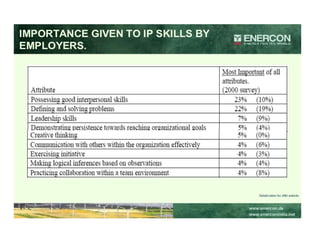
• Understand the importance for interpersonal
skills in both professional and personal lives
• Develop interpersonal competence to prepare for
challenges at the workplace and others
• Acquire the right skills and attitudes when
answering telephone
• Determine and apply key telephone etiquette and
communication skills
• Handle and manage difficult customers over the
telephone
INTRODUCTION
• The success or failure of an organization depends
highly on the individuals working in it. Within the
organizations, effective communication is required:-
• Internally
• - within the teams
• - across teams
• - within departments and across departments
• Externally
• - suppliers
• - customers
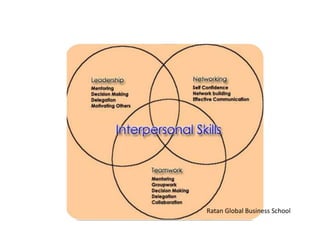
Foundations of interpersonal skills
• WHAT?
• A set of skills and abilities needed to effectively
interact and communicate with others
• Ability to get along with others and at the same
time getting tasks completed.
• Ability to convey, translate and interpret
information.
• Involves communication , listening, conflict
resolution , delegation etc
• Simply put , its actually people’s skills.
• Characteristic Traits such as Attitudes,
Manners, behavior, appearance when
communicating with others
• WHY?
• Changing work environment requires excellent
networking skills.
• Working in a team is a norm; enhance
productivity
• Maintain Personal & Professional relationships
• Able to receive & give feedback
• Able to understand others better
Ratan Global Business School
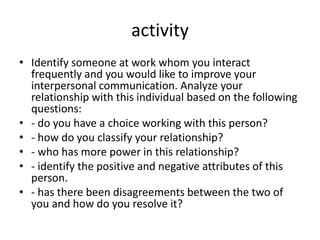
activity
• Identify someone at work whom you interact
frequently and you would like to improve your
interpersonal communication. Analyze your
relationship with this individual based on the following
questions:
• - do you have a choice working with this person?
• - how do you classify your relationship?
• - who has more power in this relationship?
• - identify the positive and negative attributes of this
person.
• - has there been disagreements between the two of
you and how do you resolve it?
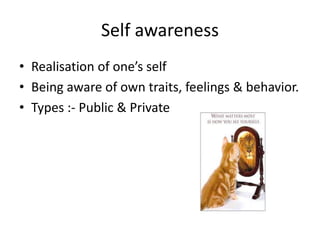
Self awareness
• Realisation of one’s self
• Being aware of own traits, feelings & behavior.
• Types :- Public & Private
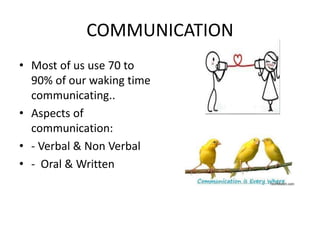
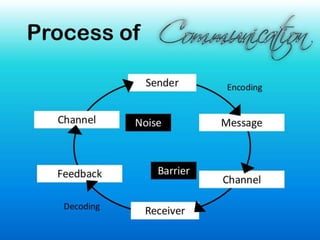
COMMUNICATION
• Most of us use 70 to
90% of our waking time
communicating..
• Aspects of
communication:
• - Verbal & Non Verbal
• - Oral & Written
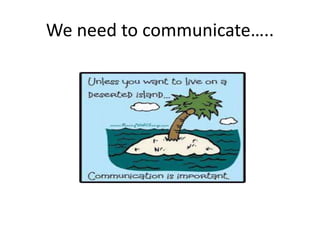
We need to communicate…..
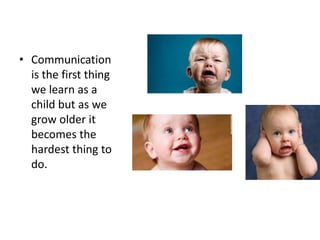
• Communication
is the first thing
we learn as a
child but as we
grow older it
becomes the
hardest thing to
do.
Effective communication is..
• Right people
getting the right
information at the
right time.
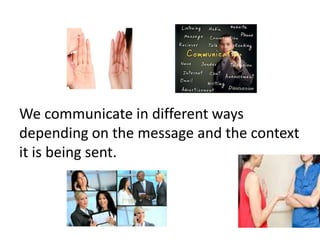
We communicate in different ways
depending on the message and the context
it is being sent.
Verbal
• Choice of words used to send a message.
• Word of mouth or by writing
• For effective verbal communication, keep it
simple and short.
• Involves memos, emails, faxes, blogs, Sms,
watsapp, twitter etc
• Influenced by choice of words, tone of voice,
speed, clarity of voice.
• Adv: fast feedback, can interpret,
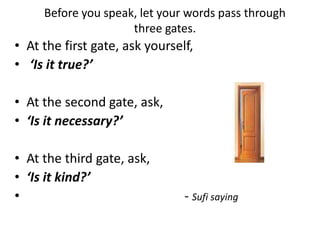
Before you speak, let your words pass through
three gates.
• At the first gate, ask yourself,
• ‘Is it true?’
• At the second gate, ask,
• ‘Is it necessary?’
• At the third gate, ask,
• ‘Is it kind?’
• - Sufi saying
Non Verbal
• Non Verbal communication- Communication
without the use of words
• Includes
• eg Body language , gestures, postures,
remaining silence, voice intonation and use of
silence ---- often sends a louder message to
other people than the words we say.
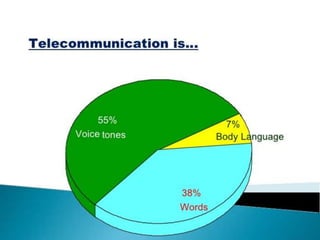
• Studies show that during interpersonal
communication only 7% of message is verbal;
while 93% is non verbal.
• Nonverbal skills must be practiced so that we
can be sure that we are actually sending the
message that we intend to send.
Fluency in non-verbal communication can
be as powerful a tool as masterful
negotiating techniques or expert
salesmanship.
• Joe Navarro
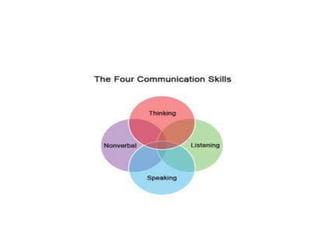
listening
• One of the most important communication
skill.
• Sometimes we think we are listening when in
actual fact we are Not.
• Listening takes practice and requires us to be
focus.
• How is listening different from hearing?
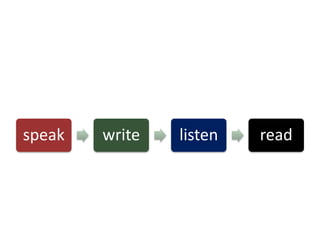
speak write listen read
Barriers to listening
• State of mind – Are you ready to listen? attitude
& emotional state of mind of listener
• Bias/ Prejudices on speaker
• Languages used – slang, accent etc
• Short span of attention – “wandering mind”
• Noise
• Frequent interruptions
• Too much information – message overload
• Impatient – too eager to speak
Tips to effective listening
• Appropriate eye contact
• Open mind – willing to listen & accept ideas
from others
• Empathy for speaker
• No interruptions
• Feedback (Verbal & Non verbal)
Active listening
• Involves hearing, understanding, judging and
evaluating message before responding
Tips to improve interpersonal skills
• Smile ( universal languagw; one smile makes
two.
• Communicate with clarity.
• Be honest when expressing your opinions.
• Compliment sincerely.
• Practice assertiveness.
End of day 1
Telephone etiquette
• Telephone is an important means of
communication as most businesses are still
conducted via the telephone.
• Company’s image/reputation is projected
through daily telephone communications.
• As such, it is important to communicate
professionally as well as effectively through the
telephones.
• Need to be fully aware of how we talk
& behave over the phone.
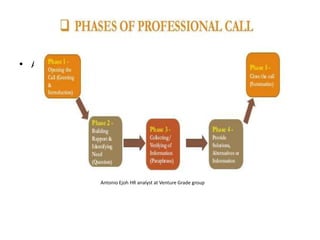
• Antonio Ejoh HR analyst at Venture Grade group
Antonio Ejoh HR analyst at Venture Grade group
• Each phone call is an attempt to communicate
between 2 parties, to impart and receive
information.
• Communication can be ineffective if
telephone etiquette is not observed.
• Listening is an integral
aspect of telephone
etiquette.
• As mentioned earlier,
some people have
problems with listening.
• However with practice,
we can get better.
• With two ears and one
mouth, are we using
them proportionately?
• Need to apply active
listening to tell customers
that you care about what
he/she has to say.
• Need to clarify what the
message communicated
to ensure that you fully
understand it.
• This means that you
confirm the message in
your own words.
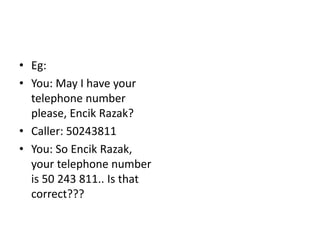
• Eg:
• You: May I have your
telephone number
please, Encik Razak?
• Caller: 50243811
• You: So Encik Razak,
your telephone number
is 50 243 811.. Is that
correct???
When using the telephone
• Need to:
• 1. listen carefully
• 2. listen actively
• 3. reduce talking
Basic elements of professional
telephone beavior
• Pay attention to caller & Stop doing whatever
it is you were doing before receiving the call.
• Concentrate on what the caller is trying to say.
Golden rules when telecommunicating
• Answer within 3 rings.
• Sit with appropriate
posture.
• Greet and identify
yourself.
• Smile.. even if caller
can’t see you.( a smile
can be heard over the
phone)
• Speak clearly no need
to shout.
• Use proper tone of
voice, should sound
friendly and
enthusiastic.
• Seek permission if you
need to put caller on
hold. (don’t put on hold
for more than 30
seconds)
• Ensure that caller is
aware that his call has
been transferred &
make sure call is
answered.
• Be a good listener ,
don’t interrupt.
• Take messages
correctly.. verify
• Personalize conversation
by using the caller’s name
eg: thank you Prof Mala
for calling us. If caller has
a title, refer to him/her by
he title.
• Listen to the end.. Don’t
hang up before the caller.
• End call courteously; use
magic words.
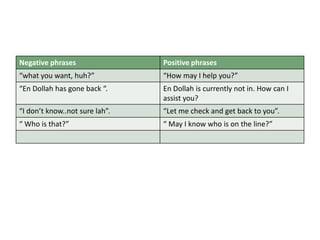
Negative phrases Positive phrases
“what you want, huh?” “How may I help you?”
“En Dollah has gone back “. En Dollah is currently not in. How can I
assist you?
“I don’t know..not sure lah”. “Let me check and get back to you”.
“ Who is that?” “ May I know who is on the line?”

Enhancing interpersonal skills & mastering telephone etiquette

  • 1.
    ENHANCING INTERPERSONAL SKILLS &MASTERING TELEPHONE ETIQUETTE YON BAHIAH BT WAN ARIS INSTITUTE OF BUSINESS EXCELLENCE 10& 11TH MARCH 2015
  • 2.
    PROGRAMME OUTCOMES • Understandthe importance for interpersonal skills in both professional and personal lives • Develop interpersonal competence to prepare for challenges at the workplace and others • Acquire the right skills and attitudes when answering telephone • Determine and apply key telephone etiquette and communication skills • Handle and manage difficult customers over the telephone
  • 3.
    INTRODUCTION • The successor failure of an organization depends highly on the individuals working in it. Within the organizations, effective communication is required:- • Internally • - within the teams • - across teams • - within departments and across departments • Externally • - suppliers • - customers
  • 5.
    Foundations of interpersonalskills • WHAT? • A set of skills and abilities needed to effectively interact and communicate with others • Ability to get along with others and at the same time getting tasks completed. • Ability to convey, translate and interpret information. • Involves communication , listening, conflict resolution , delegation etc • Simply put , its actually people’s skills.
  • 6.
    • Characteristic Traitssuch as Attitudes, Manners, behavior, appearance when communicating with others
  • 7.
    • WHY? • Changingwork environment requires excellent networking skills. • Working in a team is a norm; enhance productivity • Maintain Personal & Professional relationships • Able to receive & give feedback • Able to understand others better
  • 9.
  • 10.
    activity • Identify someoneat work whom you interact frequently and you would like to improve your interpersonal communication. Analyze your relationship with this individual based on the following questions: • - do you have a choice working with this person? • - how do you classify your relationship? • - who has more power in this relationship? • - identify the positive and negative attributes of this person. • - has there been disagreements between the two of you and how do you resolve it?
  • 11.
    Self awareness • Realisationof one’s self • Being aware of own traits, feelings & behavior. • Types :- Public & Private
  • 12.
    COMMUNICATION • Most ofus use 70 to 90% of our waking time communicating.. • Aspects of communication: • - Verbal & Non Verbal • - Oral & Written
  • 14.
    We need tocommunicate…..
  • 15.
    • Communication is thefirst thing we learn as a child but as we grow older it becomes the hardest thing to do.
  • 16.
    Effective communication is.. •Right people getting the right information at the right time.
  • 18.
    We communicate indifferent ways depending on the message and the context it is being sent.
  • 19.
    Verbal • Choice ofwords used to send a message. • Word of mouth or by writing • For effective verbal communication, keep it simple and short. • Involves memos, emails, faxes, blogs, Sms, watsapp, twitter etc • Influenced by choice of words, tone of voice, speed, clarity of voice. • Adv: fast feedback, can interpret,
  • 20.
    Before you speak,let your words pass through three gates. • At the first gate, ask yourself, • ‘Is it true?’ • At the second gate, ask, • ‘Is it necessary?’ • At the third gate, ask, • ‘Is it kind?’ • - Sufi saying
  • 21.
    Non Verbal • NonVerbal communication- Communication without the use of words • Includes • eg Body language , gestures, postures, remaining silence, voice intonation and use of silence ---- often sends a louder message to other people than the words we say.
  • 22.
    • Studies showthat during interpersonal communication only 7% of message is verbal; while 93% is non verbal. • Nonverbal skills must be practiced so that we can be sure that we are actually sending the message that we intend to send.
  • 24.
    Fluency in non-verbalcommunication can be as powerful a tool as masterful negotiating techniques or expert salesmanship. • Joe Navarro
  • 25.
    listening • One ofthe most important communication skill. • Sometimes we think we are listening when in actual fact we are Not. • Listening takes practice and requires us to be focus. • How is listening different from hearing?
  • 26.
  • 29.
    Barriers to listening •State of mind – Are you ready to listen? attitude & emotional state of mind of listener • Bias/ Prejudices on speaker • Languages used – slang, accent etc • Short span of attention – “wandering mind” • Noise • Frequent interruptions • Too much information – message overload • Impatient – too eager to speak
  • 31.
    Tips to effectivelistening • Appropriate eye contact • Open mind – willing to listen & accept ideas from others • Empathy for speaker • No interruptions • Feedback (Verbal & Non verbal)
  • 32.
    Active listening • Involveshearing, understanding, judging and evaluating message before responding
  • 33.
    Tips to improveinterpersonal skills • Smile ( universal languagw; one smile makes two. • Communicate with clarity. • Be honest when expressing your opinions. • Compliment sincerely. • Practice assertiveness.
  • 34.
  • 35.
    Telephone etiquette • Telephoneis an important means of communication as most businesses are still conducted via the telephone. • Company’s image/reputation is projected through daily telephone communications. • As such, it is important to communicate professionally as well as effectively through the telephones. • Need to be fully aware of how we talk & behave over the phone.
  • 36.
    • Antonio EjohHR analyst at Venture Grade group Antonio Ejoh HR analyst at Venture Grade group
  • 37.
    • Each phonecall is an attempt to communicate between 2 parties, to impart and receive information. • Communication can be ineffective if telephone etiquette is not observed.
  • 38.
    • Listening isan integral aspect of telephone etiquette. • As mentioned earlier, some people have problems with listening. • However with practice, we can get better. • With two ears and one mouth, are we using them proportionately?
  • 39.
    • Need toapply active listening to tell customers that you care about what he/she has to say. • Need to clarify what the message communicated to ensure that you fully understand it. • This means that you confirm the message in your own words.
  • 40.
    • Eg: • You:May I have your telephone number please, Encik Razak? • Caller: 50243811 • You: So Encik Razak, your telephone number is 50 243 811.. Is that correct???
  • 41.
    When using thetelephone • Need to: • 1. listen carefully • 2. listen actively • 3. reduce talking
  • 42.
    Basic elements ofprofessional telephone beavior • Pay attention to caller & Stop doing whatever it is you were doing before receiving the call. • Concentrate on what the caller is trying to say.
  • 44.
    Golden rules whentelecommunicating • Answer within 3 rings. • Sit with appropriate posture. • Greet and identify yourself. • Smile.. even if caller can’t see you.( a smile can be heard over the phone)
  • 45.
    • Speak clearlyno need to shout. • Use proper tone of voice, should sound friendly and enthusiastic. • Seek permission if you need to put caller on hold. (don’t put on hold for more than 30 seconds)
  • 46.
    • Ensure thatcaller is aware that his call has been transferred & make sure call is answered. • Be a good listener , don’t interrupt. • Take messages correctly.. verify
  • 47.
    • Personalize conversation byusing the caller’s name eg: thank you Prof Mala for calling us. If caller has a title, refer to him/her by he title. • Listen to the end.. Don’t hang up before the caller. • End call courteously; use magic words.
  • 48.
    Negative phrases Positivephrases “what you want, huh?” “How may I help you?” “En Dollah has gone back “. En Dollah is currently not in. How can I assist you? “I don’t know..not sure lah”. “Let me check and get back to you”. “ Who is that?” “ May I know who is on the line?”