Communication Models Unit 2: Listening & Comm. English 9 Mr. Hill
Introduction Communication, like most anything else, can be studied in order to find out exactly how it works. This can be done in real life situations or it can be done on a more “academic” level. This presentation will show you the three most recognized and accepted models of communication and how they work.
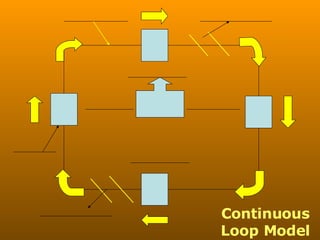
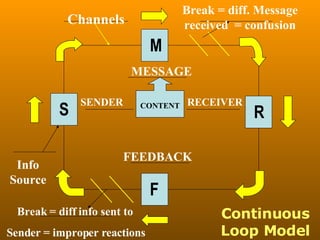
MODEL #1: CONTINUOUS LOOP MODEL This is the EARLIEST model of communication that has been presented and accepted by others who study the field. It is also the SIMPLEST model (though it might not look like it at first). It includes all of the basic parts/players in the communication process. There are still a few problems, though!
Continuous Loop Model
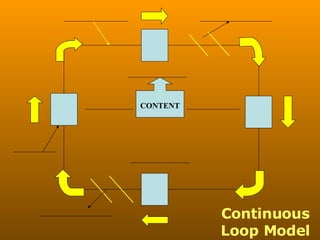
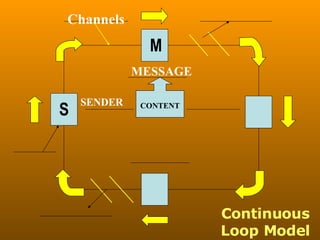
Continuous Loop Model CONTENT
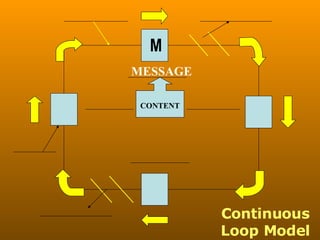
Continuous Loop Model M MESSAGE CONTENT
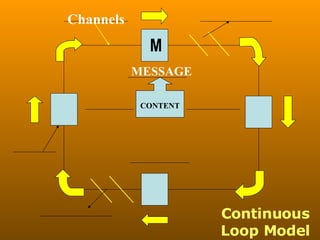
Continuous Loop Model M Channels MESSAGE CONTENT
Continuous Loop Model S M Channels SENDER MESSAGE CONTENT
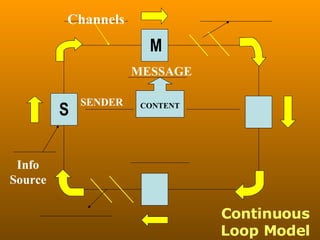
Continuous Loop Model S M Info Source Channels SENDER MESSAGE CONTENT
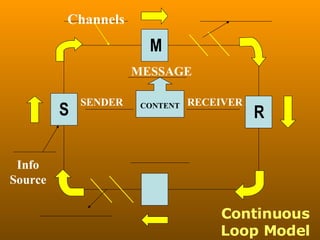
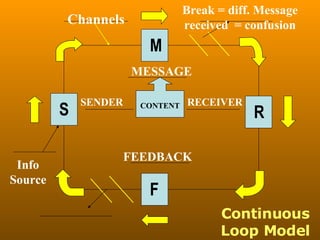
Continuous Loop Model S M R Info Source Channels SENDER MESSAGE RECEIVER CONTENT
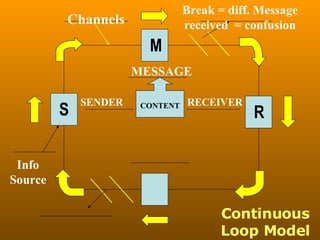
Continuous Loop Model S M R Info Source Channels Break = diff. Message received  = confusion SENDER MESSAGE RECEIVER CONTENT
Continuous Loop Model S M R F Info Source Channels Break = diff. Message received  = confusion SENDER MESSAGE RECEIVER FEEDBACK CONTENT
Continuous Loop Model S M R F Info Source Channels Break = diff. Message received  = confusion SENDER MESSAGE RECEIVER FEEDBACK Break = diff info sent to  Sender = improper reactions CONTENT
CONTINUOUS LOOP This model is based upon the concept that language is a system or a machine. In this machine, communication acts as the “gears” for the machine to work properly. Any breakdowns hurt efficiency!
CONTINUOUS LOOP While this is the EARLIEST model of communication, it is not known who the developer or the creator of the model was. The only thing we know for sure is that it was most-likely developed in the 1920s or 1930s.
CONTINUOUS LOOP One of the flaws of the model is that it assumes “continuous” communication. There are times when we choose to stop communicating. In other words, this is good on paper, but it does not fit all situations.
MODEL #2: SHANNON & WEAVER This model was created in 1949. It is not certain if this pair of researchers had seen the “Continuous Loop” model, but they were probably at least familiar with it. This model was designed to be practical!
MODEL #2: SHANNON & WEAVER Just as the “Loop” model was more “academic,” the Shannon & Weaver Model is more “down-to-earth.” The basis for this model was a study of telephone conversations over a very lengthy 2-year time.
MODEL #2: SHANNON & WEAVER The team studied only what they deemed to be “important” or “significant” calls of some length. Quick calls to a neighbor or a store were not considered for the study. The focus was on the “mechanics” of the messages.
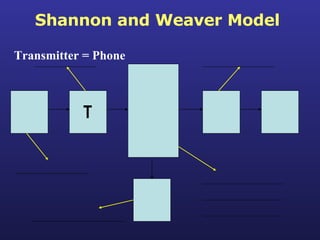
Shannon and Weaver Model T Transmitter = Phone
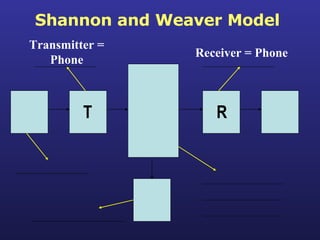
Shannon and Weaver Model T R Transmitter = Phone Receiver = Phone
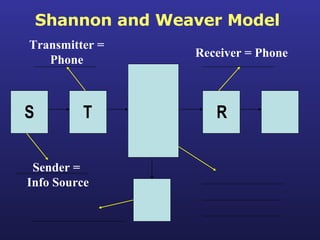
Shannon and Weaver Model S T R Transmitter = Phone Receiver = Phone Sender =  Info Source
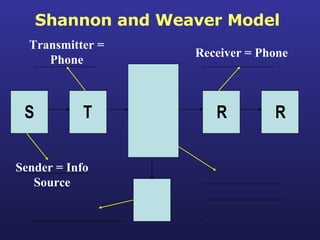
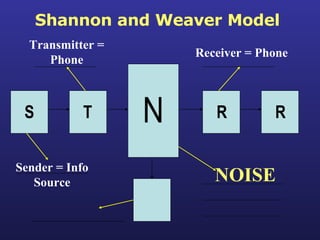
Shannon and Weaver Model S T R R Sender = Info Source Transmitter = Phone Receiver = Phone
Shannon and Weaver Model S T R R N Sender = Info Source Transmitter = Phone Receiver = Phone NOISE
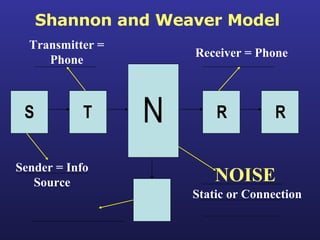
Shannon and Weaver Model S T R R N Sender = Info Source Transmitter = Phone Receiver = Phone NOISE Static or Connection
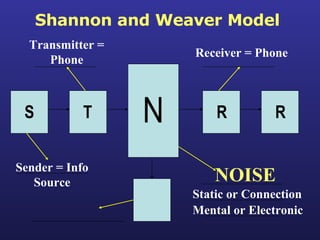
Shannon and Weaver Model S T R R N Sender = Info Source Transmitter = Phone Receiver = Phone NOISE Static or Connection Mental or Electronic
Shannon and Weaver Model S T R R N ? Sender = Info Source Transmitter = Phone Receiver = Phone NOISE Static or Connection Mental or Electronic
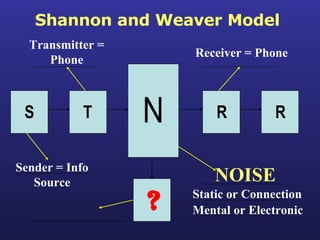
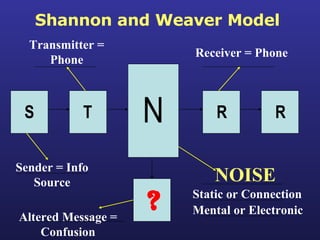
Shannon and Weaver Model S T R R N ? Sender = Info Source Transmitter = Phone Receiver = Phone Altered Message = Confusion NOISE Static or Connection Mental or Electronic
MODEL #3: BERLO’S “MODEL” This is the MOST RECENT model of communication study. An exact date is not given for the study, but it is believed to have been completed in the late 1970s or the early 1980s. This one is not designed to be “academic” or “practical.”  It is designed to be “ALL-INCLUSIVE”
MODEL #3: BERLO’S “MODEL” Even with all of the good things that this “model” illustrates and tries to describe, there is still one little issue to remember…
MODEL #3: BERLO’S “MODEL” IT’S NOT REALLY EVEN A TRUE MODEL IN THE FIRST PLACE!
MODEL #3: BERLO’S “MODEL” It is NOT a model because it was never actually tested. Berlo designed what he thought would be the ideal system to describe communication, but never had a chance to put it to the test in real life.
MODEL #3: BERLO’S “MODEL” Since it was never “field-tested,” the “model” that Berlo developed has to take on a new title…
MODEL #3: BERLO’S “MODEL” IT HAS TO BE CALLED A “THEORY”
Berlo’s Listening Theory
Berlo’s Listening Theory CONTENT
Berlo’s Listening Theory CONTENT CODE
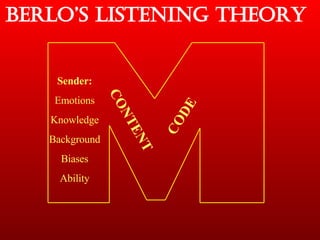
Berlo’s Listening Theory CONTENT CODE Sender: Emotions Knowledge Background Biases Ability
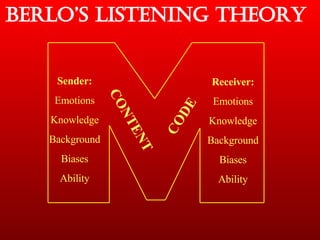
Berlo’s Listening Theory CONTENT CODE Sender: Emotions Knowledge Background Biases Ability Receiver: Emotions Knowledge Background Biases Ability

Communication Models Presentation

  • 1.
    Communication Models Unit2: Listening & Comm. English 9 Mr. Hill
  • 2.
    Introduction Communication, likemost anything else, can be studied in order to find out exactly how it works. This can be done in real life situations or it can be done on a more “academic” level. This presentation will show you the three most recognized and accepted models of communication and how they work.
  • 3.
    MODEL #1: CONTINUOUSLOOP MODEL This is the EARLIEST model of communication that has been presented and accepted by others who study the field. It is also the SIMPLEST model (though it might not look like it at first). It includes all of the basic parts/players in the communication process. There are still a few problems, though!
  • 4.
  • 5.
  • 6.
    Continuous Loop ModelM MESSAGE CONTENT
  • 7.
    Continuous Loop ModelM Channels MESSAGE CONTENT
  • 8.
    Continuous Loop ModelS M Channels SENDER MESSAGE CONTENT
  • 9.
    Continuous Loop ModelS M Info Source Channels SENDER MESSAGE CONTENT
  • 10.
    Continuous Loop ModelS M R Info Source Channels SENDER MESSAGE RECEIVER CONTENT
  • 11.
    Continuous Loop ModelS M R Info Source Channels Break = diff. Message received = confusion SENDER MESSAGE RECEIVER CONTENT
  • 12.
    Continuous Loop ModelS M R F Info Source Channels Break = diff. Message received = confusion SENDER MESSAGE RECEIVER FEEDBACK CONTENT
  • 13.
    Continuous Loop ModelS M R F Info Source Channels Break = diff. Message received = confusion SENDER MESSAGE RECEIVER FEEDBACK Break = diff info sent to Sender = improper reactions CONTENT
  • 14.
    CONTINUOUS LOOP Thismodel is based upon the concept that language is a system or a machine. In this machine, communication acts as the “gears” for the machine to work properly. Any breakdowns hurt efficiency!
  • 15.
    CONTINUOUS LOOP Whilethis is the EARLIEST model of communication, it is not known who the developer or the creator of the model was. The only thing we know for sure is that it was most-likely developed in the 1920s or 1930s.
  • 16.
    CONTINUOUS LOOP Oneof the flaws of the model is that it assumes “continuous” communication. There are times when we choose to stop communicating. In other words, this is good on paper, but it does not fit all situations.
  • 17.
    MODEL #2: SHANNON& WEAVER This model was created in 1949. It is not certain if this pair of researchers had seen the “Continuous Loop” model, but they were probably at least familiar with it. This model was designed to be practical!
  • 18.
    MODEL #2: SHANNON& WEAVER Just as the “Loop” model was more “academic,” the Shannon & Weaver Model is more “down-to-earth.” The basis for this model was a study of telephone conversations over a very lengthy 2-year time.
  • 19.
    MODEL #2: SHANNON& WEAVER The team studied only what they deemed to be “important” or “significant” calls of some length. Quick calls to a neighbor or a store were not considered for the study. The focus was on the “mechanics” of the messages.
  • 20.
    Shannon and WeaverModel T Transmitter = Phone
  • 21.
    Shannon and WeaverModel T R Transmitter = Phone Receiver = Phone
  • 22.
    Shannon and WeaverModel S T R Transmitter = Phone Receiver = Phone Sender = Info Source
  • 23.
    Shannon and WeaverModel S T R R Sender = Info Source Transmitter = Phone Receiver = Phone
  • 24.
    Shannon and WeaverModel S T R R N Sender = Info Source Transmitter = Phone Receiver = Phone NOISE
  • 25.
    Shannon and WeaverModel S T R R N Sender = Info Source Transmitter = Phone Receiver = Phone NOISE Static or Connection
  • 26.
    Shannon and WeaverModel S T R R N Sender = Info Source Transmitter = Phone Receiver = Phone NOISE Static or Connection Mental or Electronic
  • 27.
    Shannon and WeaverModel S T R R N ? Sender = Info Source Transmitter = Phone Receiver = Phone NOISE Static or Connection Mental or Electronic
  • 28.
    Shannon and WeaverModel S T R R N ? Sender = Info Source Transmitter = Phone Receiver = Phone Altered Message = Confusion NOISE Static or Connection Mental or Electronic
  • 29.
    MODEL #3: BERLO’S“MODEL” This is the MOST RECENT model of communication study. An exact date is not given for the study, but it is believed to have been completed in the late 1970s or the early 1980s. This one is not designed to be “academic” or “practical.” It is designed to be “ALL-INCLUSIVE”
  • 30.
    MODEL #3: BERLO’S“MODEL” Even with all of the good things that this “model” illustrates and tries to describe, there is still one little issue to remember…
  • 31.
    MODEL #3: BERLO’S“MODEL” IT’S NOT REALLY EVEN A TRUE MODEL IN THE FIRST PLACE!
  • 32.
    MODEL #3: BERLO’S“MODEL” It is NOT a model because it was never actually tested. Berlo designed what he thought would be the ideal system to describe communication, but never had a chance to put it to the test in real life.
  • 33.
    MODEL #3: BERLO’S“MODEL” Since it was never “field-tested,” the “model” that Berlo developed has to take on a new title…
  • 34.
    MODEL #3: BERLO’S“MODEL” IT HAS TO BE CALLED A “THEORY”
  • 35.
  • 36.
  • 37.
  • 38.
    Berlo’s Listening TheoryCONTENT CODE Sender: Emotions Knowledge Background Biases Ability
  • 39.
    Berlo’s Listening TheoryCONTENT CODE Sender: Emotions Knowledge Background Biases Ability Receiver: Emotions Knowledge Background Biases Ability