Process Communication®
Being in sync
working together
In recent times technological progress has changed the face
of organisations by providing immediate access to informa-
tion. New forms of communication now fill our TV and
­computer screens.
Despite these widespread advances, the corporate world is
still a matter of very real people, who through their talents,
training, experience and especially their personalities; truly
enhance the capabilities of their companies. Today people
are indeed the most valuable asset for any corporation.
Current technological and economic challenges demand
mobilisation; both as individuals and as groups. New leaders
are appearing to steer the most strategic projects within
matrix style organisational structures and task force teams,
in which hierarchy plays only a minor role. To meet the chal-
lenges of the new commercial markets work groups are
formed and dissolved at a rapidly increasing rate. Time in
which to establish contact and become familiar with people
has become very short. Inspiring others, giving meaning,
uniting a team to capitalise on the strengths of its members
and managing tensions in the workplace are all necessary
abilities required of the modern manager. Whilst managers
may be aware of the risks of stress, employees are also eager
to learn how to better resist pressure.
Self-knowledge, self-management, understanding others
and better relationship management will inevitably relieve
much of this pressure; especially if everyone, whether a
manager or not, were able to contribute by having their skills
enhanced in these important and vital areas. Being able to
effectively approach an interpersonal relationship challenge
and to ask for or offer help if needed is an indicator of
strength, though sadly many managers and employees do
not see things this way. Top athletes know how to regulate
the intensity of their effort; then to recuperate to prepare for
the next challenge when in individual competition; or the
importance by being an effective part of the group, when
taking part in team activities. So employees and managers
in the twenty-first century need to know how to bring their
performance to a peak, both as individual and team
players.
What business can afford to go without these skills today?
New challenges, new talents
Mathias, age 47 – Business Unit manager in a service industry
“I have observed considerable changes in how work is organised in recent years. It is no longer
a matter of whether people will be able to work together as a team or not, because teamwork
has become mandatory. Many companies are matrix systems in which each department’s action
is connected to the entire system. Departments no longer call themselves divisions since the
reality is quite the opposite: now it is about uniting people from different disciplines to work on
projects with shared ownership. Steering projects of this type requires new skills; like knowing
how to assume leadership roles without necessarily having any hierarchical relationship. This
change has been so rapid that we still need to support our employees in the acquisition and
application of this type of skill. An operation like this requires both relational and situational intel-
ligence. We want people who are capable of working independently, who are prepared to be part
of a team or to manage one for a period in order to create added value. Employees who feel
good about themselves and comfortable with each other are priceless assets to a business. As
managers and directors, we have our share of responsibility in this; the example must be set at
the top”.
What is Process Communication® ?
a communication model
Taibi Kahler PhD introduced Process Communication®
in the
United States in 1978, and was developed in part through research
conducted in the 1970’s whilst he was working with NASA. (See
paragraph on NASA below). The Personality Profile Inventory was
introduced in 1982. A major strength of PCM is that it provides a
high degree of behavioural predictability. The model does not
categorise people, but rather shows how all the possible personal-
ity types are in each of us, organised in our own unique order. It
offers valuable methods for enhancing communication across the
different personality types. Personality is composed of a unique,
mixture of six personality types and we can observe multiple
aspects of personality, including behavioural traits, perceptual
preferences, individualised motivators, unique ways of communi-
cating, & predictable, observable behaviour under stress. With
knowledge and understanding of these behaviours we can
improve the quality of our business and private relationships by
facilitating the individualisation of our style of communication and
leadership including our method of conflict management. With
knowledge of PCM it is possible to monitor communication inter-
action by interaction, to facilitate avoidance of miscommunication
with clearly defined strategies to restore communication, where it
has been broken. This relevant and efficient model has rapidly
grown in Europe to become an essential business tool.
The predictability of distress behaviour is one of the most
valuable tools in the Process Communication Model®
arsenal. As
a result of Dr. Kahler’s observations, we know that behaviour under
normal and severe stress is highly predictable. The model then
provides precise methods to enhance better self-management
and better management of our interpersonal relationships even
under stress. Because distress behaviours are very predictable,
observation of these patterns is another valuable tool for assessing
personality. Each personality type has its own way of behaving
depending upon the nature and intensity of the stress to which
they are subject. These six predictable, observable, and reversible
behavioural sequences provide insight into understanding and
managing interpersonal relationship difficulties and therefore,
enhancing our efficiency both at work and outside of it.
People who use the Process Communication Model®
benefit from
a whole range of practical tools specifically designed for successful
everyday management of communication.
Whether with employees, clients, partners, or colleagues; our
business relationships become smoother, teams more motivated;
team members accept ownership of projects and cooperate
together contributing to team synergy and increased productivity
with reduced stress levels.
Quality instruction
The Process Communication Model®
offers keys for better understanding personalities and providing practical communication tools. Teaching this
model requires expertise and may only be undertaken by certified PCM trainers. Coaching using this model requires expertise and must only be
delivered by certified PCM Coaches. The Kahler Communication companies active throughout Europe ensure a training curriculum for any coach or
trainer who wishes to receive Process Communication®
certification. A list of certified coaches, trainers and master trainers is available on the site
www.processcom.com.
Confidentiality and ethics
Any person who decides to take the Process Communication®
questionnaire is entitled to confidentiality regarding the resultant profile and
professionalism on the part of the coach or trainer. A Personality Inventory and the Profile that accompanies it are delivered directly only to the coach/
trainer to the individual. Profiles are only administered by a certified trainer or coach. After receiving the profile you will enter a dialogue with the certified
PCM provider to enable professional and insightful interpretation & understanding of your profile. During group seminars, each participant can decide
whether or not to share their profile with the other delegates and the vast majority share openly and gain from this process. The coach or trainer
guarantees observance of best practices to ensure that no value judgments are made regarding the profiles. We do not encourage a labelling process
and discus personality types ‘in’ people rather than types ‘of’ people, because no one is simply a ‘type’.
a tool for understanding personalities,
one’s own and that of others
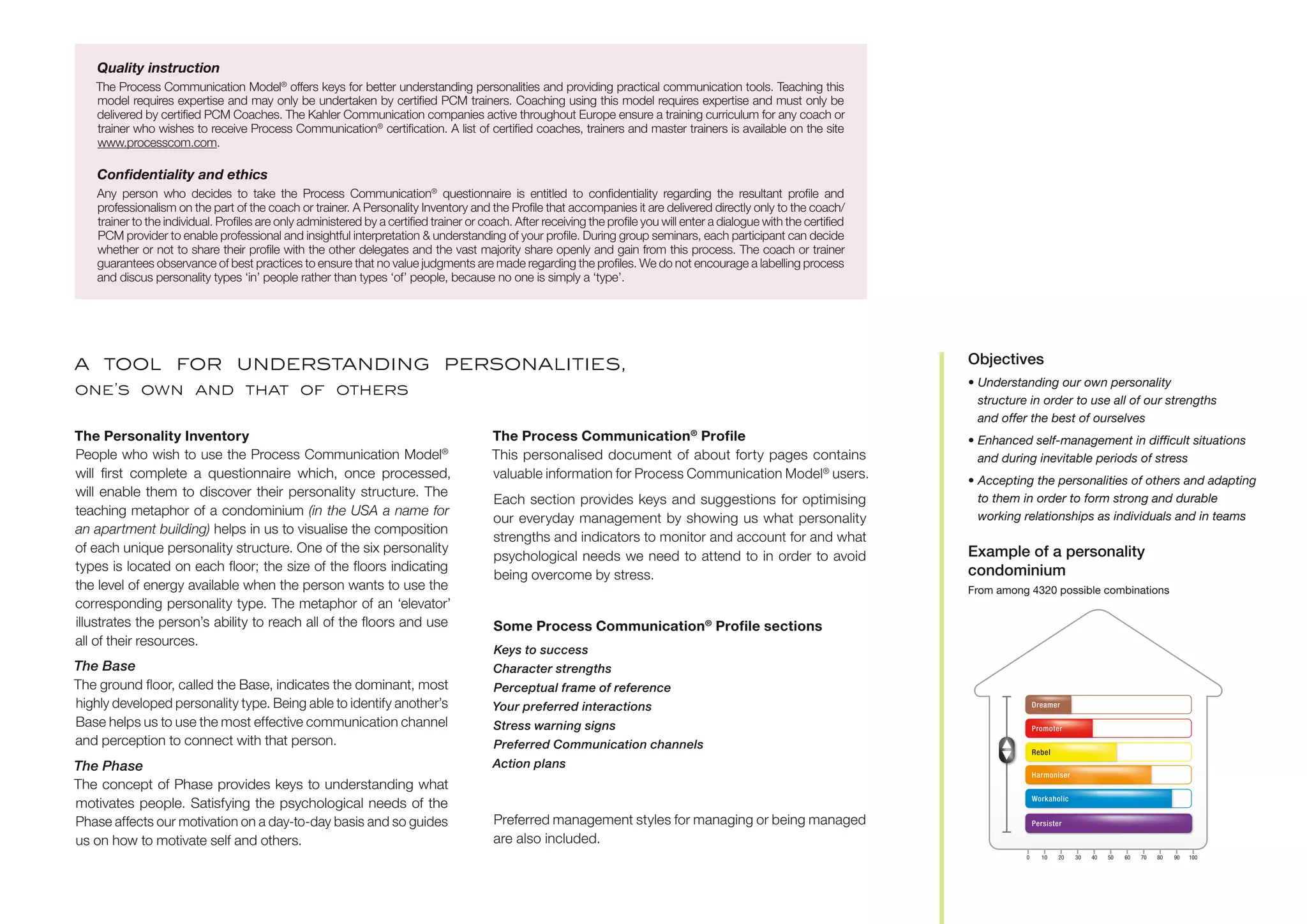
The Personality Inventory
People who wish to use the Process Communication Model®
will first complete a questionnaire which, once processed,
will enable them to discover their personality structure. The
teaching metaphor of a condominium (in the USA a name for
an apartment building) helps in us to visualise the composition
of each unique personality structure. One of the six personality
types is located on each floor; the size of the floors indicating
the level of energy available when the person wants to use the
corresponding personality type. The metaphor of an ‘elevator’
illustrates the person’s ability to reach all of the floors and use
all of their resources.
The Base
The ground floor, called the Base, indicates the dominant, most
highly developed personality type. Being able to identify another’s
Base helps us to use the most effective communication channel
and perception to connect with that person.
The Phase
The concept of Phase provides keys to understanding what
motivates people. Satisfying the psychological needs of the
Phase affects our motivation on a day-to-day basis and so guides
us on how to motivate self and others.
The Process Communication®
Profile
This personalised document of about forty pages contains
valuable information for Process Communication Model®
users.
Each section provides keys and suggestions for optimising
our everyday management by showing us what personality
strengths and indicators to monitor and account for and what
psychological needs we need to attend to in order to avoid
being overcome by stress.
Some Process Communication®
Profile sections
Keys to success
Character strengths
Perceptual frame of reference
Your preferred interactions
Stress warning signs
Preferred Communication channels
Action plans
Preferred management styles for managing or being managed
are also included.
Objectives
• Understanding our own personality
structure in order to use all of our strengths
and offer the best of ourselves
• Enhanced self-management in difficult situations
and during inevitable periods of stress
• Accepting the personalities of others and adapting
to them in order to form strong and durable
working relationships as individuals and in teams
0 10 20 30 40 50 60 70 80 90 100
Example of a personality
condominium
From among 4320 possible combinations
The many applications of Process Communication®
The Process Communication Model offers a wealth
of wide ranging tools to develop a variety of
­competencies within your organisation. The strength
of this approach lies in the originality of the model’s
components, which enable you to adjust your training
investment to match corporate strategy and your
employees’ needs.
 Management
Achieving excellence
 Sales relations
Taking performance to the next level
 Team building
Developing functional  competitive teams
 Team cohesion
Strengthening the bonds of cooperation
 Individual coaching
Raising awareness and fulfilling potential
 Team coaching
Maximising on the talents in the team
 Conflict management
Relieving tensions by managing conflict
 An aid in Recruitment
Making enlightened choices
 Staff Retention
Developing  motivating employees
 Internal trainers
Efficiently transmitting competencies
Coach or trainer certified in
PROCESS COMMUNICATION
MODEL®
Each year, Kahler Communication runs
training programmes in Europe for training,
coaching and recruitment professionals.
Certification follows a final examination
which qualifies the individual to use the
Process Communication Model®
in train-
ing, coaching and as a recruitment/selec-
tion tool.
Only certified coaches, trainers and other
professionals are authorised to use this
model in coaching, training or in recruit-
ment and their certification is verifiable on
www.processcom.com.
NASA The origins of Process Communication®
:
Dr. Kahler began his award-winning research on interpersonal communication and behaviour in the late 1960s and, in the 1970s, developed it
into what became known as the ‘process model.’
In 1978, Dr. Terry McGuire, NASA’s Lead Psychiatrist for Manned Spaceflight, invited Dr. Kahler to demonstrate the efficacy of his model in
connection with astronaut selection. After comparing notes on several candidates, Dr. McGuire hired Dr. Kahler, commenting that 10 minutes
of using his approach revealed as much or more about a candidate than a standard psychological interview of several hours. This began an
extended relationship with NASA (1978-96), during which Dr. Kahler worked with Dr. McGuire to incorporate the model into the astronaut
selection, evaluation, training and management processes and during which time Dr. Kahler also translated the concepts underlying his
model into behavioural terms. The predictability of PCM was essential to Dr McGuire because using it he was able to accurately predict
astronaut distress in space, important in crew selection for men working under such extreme conditions. In 1982 Dr Kahler brought the Process
Communication Model®
to the business world to enable organisations to offer their people tools and an approach to communication, motivation,
management, and stress management in the workplace. Since then the PCM approach has successfully benefitted well over a million people
around the world.
Theterm“ProcessCommunicationModel®
”isaregisteredtrademarkofKahlerCommunications,Inc.andisusedunderlicensewiththepermissionoftheowner.AGENCEPENNEL33(0)145262107-Photos©FrançoisFolcher
KAHLER COMMUNICATION Europe
Le Moulin du Béchet - 27120 Croisy/Eure - Tél. : +33 (0)2 32 22 22 50 - Fax : +33 (0)2 32 22 22 52
www.processcom.com

Brochure - Process Communication Model (PCM)

  • 1.
  • 2.
    working together In recenttimes technological progress has changed the face of organisations by providing immediate access to informa- tion. New forms of communication now fill our TV and ­computer screens. Despite these widespread advances, the corporate world is still a matter of very real people, who through their talents, training, experience and especially their personalities; truly enhance the capabilities of their companies. Today people are indeed the most valuable asset for any corporation. Current technological and economic challenges demand mobilisation; both as individuals and as groups. New leaders are appearing to steer the most strategic projects within matrix style organisational structures and task force teams, in which hierarchy plays only a minor role. To meet the chal- lenges of the new commercial markets work groups are formed and dissolved at a rapidly increasing rate. Time in which to establish contact and become familiar with people has become very short. Inspiring others, giving meaning, uniting a team to capitalise on the strengths of its members and managing tensions in the workplace are all necessary abilities required of the modern manager. Whilst managers may be aware of the risks of stress, employees are also eager to learn how to better resist pressure. Self-knowledge, self-management, understanding others and better relationship management will inevitably relieve much of this pressure; especially if everyone, whether a manager or not, were able to contribute by having their skills enhanced in these important and vital areas. Being able to effectively approach an interpersonal relationship challenge and to ask for or offer help if needed is an indicator of strength, though sadly many managers and employees do not see things this way. Top athletes know how to regulate the intensity of their effort; then to recuperate to prepare for the next challenge when in individual competition; or the importance by being an effective part of the group, when taking part in team activities. So employees and managers in the twenty-first century need to know how to bring their performance to a peak, both as individual and team players. What business can afford to go without these skills today? New challenges, new talents
  • 3.
    Mathias, age 47– Business Unit manager in a service industry “I have observed considerable changes in how work is organised in recent years. It is no longer a matter of whether people will be able to work together as a team or not, because teamwork has become mandatory. Many companies are matrix systems in which each department’s action is connected to the entire system. Departments no longer call themselves divisions since the reality is quite the opposite: now it is about uniting people from different disciplines to work on projects with shared ownership. Steering projects of this type requires new skills; like knowing how to assume leadership roles without necessarily having any hierarchical relationship. This change has been so rapid that we still need to support our employees in the acquisition and application of this type of skill. An operation like this requires both relational and situational intel- ligence. We want people who are capable of working independently, who are prepared to be part of a team or to manage one for a period in order to create added value. Employees who feel good about themselves and comfortable with each other are priceless assets to a business. As managers and directors, we have our share of responsibility in this; the example must be set at the top”.
  • 4.
    What is ProcessCommunication® ? a communication model Taibi Kahler PhD introduced Process Communication® in the United States in 1978, and was developed in part through research conducted in the 1970’s whilst he was working with NASA. (See paragraph on NASA below). The Personality Profile Inventory was introduced in 1982. A major strength of PCM is that it provides a high degree of behavioural predictability. The model does not categorise people, but rather shows how all the possible personal- ity types are in each of us, organised in our own unique order. It offers valuable methods for enhancing communication across the different personality types. Personality is composed of a unique, mixture of six personality types and we can observe multiple aspects of personality, including behavioural traits, perceptual preferences, individualised motivators, unique ways of communi- cating, & predictable, observable behaviour under stress. With knowledge and understanding of these behaviours we can improve the quality of our business and private relationships by facilitating the individualisation of our style of communication and leadership including our method of conflict management. With knowledge of PCM it is possible to monitor communication inter- action by interaction, to facilitate avoidance of miscommunication with clearly defined strategies to restore communication, where it has been broken. This relevant and efficient model has rapidly grown in Europe to become an essential business tool. The predictability of distress behaviour is one of the most valuable tools in the Process Communication Model® arsenal. As a result of Dr. Kahler’s observations, we know that behaviour under normal and severe stress is highly predictable. The model then provides precise methods to enhance better self-management and better management of our interpersonal relationships even under stress. Because distress behaviours are very predictable, observation of these patterns is another valuable tool for assessing personality. Each personality type has its own way of behaving depending upon the nature and intensity of the stress to which they are subject. These six predictable, observable, and reversible behavioural sequences provide insight into understanding and managing interpersonal relationship difficulties and therefore, enhancing our efficiency both at work and outside of it. People who use the Process Communication Model® benefit from a whole range of practical tools specifically designed for successful everyday management of communication. Whether with employees, clients, partners, or colleagues; our business relationships become smoother, teams more motivated; team members accept ownership of projects and cooperate together contributing to team synergy and increased productivity with reduced stress levels.
  • 5.
    Quality instruction The ProcessCommunication Model® offers keys for better understanding personalities and providing practical communication tools. Teaching this model requires expertise and may only be undertaken by certified PCM trainers. Coaching using this model requires expertise and must only be delivered by certified PCM Coaches. The Kahler Communication companies active throughout Europe ensure a training curriculum for any coach or trainer who wishes to receive Process Communication® certification. A list of certified coaches, trainers and master trainers is available on the site www.processcom.com. Confidentiality and ethics Any person who decides to take the Process Communication® questionnaire is entitled to confidentiality regarding the resultant profile and professionalism on the part of the coach or trainer. A Personality Inventory and the Profile that accompanies it are delivered directly only to the coach/ trainer to the individual. Profiles are only administered by a certified trainer or coach. After receiving the profile you will enter a dialogue with the certified PCM provider to enable professional and insightful interpretation & understanding of your profile. During group seminars, each participant can decide whether or not to share their profile with the other delegates and the vast majority share openly and gain from this process. The coach or trainer guarantees observance of best practices to ensure that no value judgments are made regarding the profiles. We do not encourage a labelling process and discus personality types ‘in’ people rather than types ‘of’ people, because no one is simply a ‘type’. a tool for understanding personalities, one’s own and that of others The Personality Inventory People who wish to use the Process Communication Model® will first complete a questionnaire which, once processed, will enable them to discover their personality structure. The teaching metaphor of a condominium (in the USA a name for an apartment building) helps in us to visualise the composition of each unique personality structure. One of the six personality types is located on each floor; the size of the floors indicating the level of energy available when the person wants to use the corresponding personality type. The metaphor of an ‘elevator’ illustrates the person’s ability to reach all of the floors and use all of their resources. The Base The ground floor, called the Base, indicates the dominant, most highly developed personality type. Being able to identify another’s Base helps us to use the most effective communication channel and perception to connect with that person. The Phase The concept of Phase provides keys to understanding what motivates people. Satisfying the psychological needs of the Phase affects our motivation on a day-to-day basis and so guides us on how to motivate self and others. The Process Communication® Profile This personalised document of about forty pages contains valuable information for Process Communication Model® users. Each section provides keys and suggestions for optimising our everyday management by showing us what personality strengths and indicators to monitor and account for and what psychological needs we need to attend to in order to avoid being overcome by stress. Some Process Communication® Profile sections Keys to success Character strengths Perceptual frame of reference Your preferred interactions Stress warning signs Preferred Communication channels Action plans Preferred management styles for managing or being managed are also included. Objectives • Understanding our own personality structure in order to use all of our strengths and offer the best of ourselves • Enhanced self-management in difficult situations and during inevitable periods of stress • Accepting the personalities of others and adapting to them in order to form strong and durable working relationships as individuals and in teams 0 10 20 30 40 50 60 70 80 90 100 Example of a personality condominium From among 4320 possible combinations
  • 6.
    The many applicationsof Process Communication® The Process Communication Model offers a wealth of wide ranging tools to develop a variety of ­competencies within your organisation. The strength of this approach lies in the originality of the model’s components, which enable you to adjust your training investment to match corporate strategy and your employees’ needs. Management Achieving excellence Sales relations Taking performance to the next level Team building Developing functional competitive teams Team cohesion Strengthening the bonds of cooperation Individual coaching Raising awareness and fulfilling potential Team coaching Maximising on the talents in the team Conflict management Relieving tensions by managing conflict An aid in Recruitment Making enlightened choices Staff Retention Developing motivating employees Internal trainers Efficiently transmitting competencies Coach or trainer certified in PROCESS COMMUNICATION MODEL® Each year, Kahler Communication runs training programmes in Europe for training, coaching and recruitment professionals. Certification follows a final examination which qualifies the individual to use the Process Communication Model® in train- ing, coaching and as a recruitment/selec- tion tool. Only certified coaches, trainers and other professionals are authorised to use this model in coaching, training or in recruit- ment and their certification is verifiable on www.processcom.com.
  • 7.
    NASA The originsof Process Communication® : Dr. Kahler began his award-winning research on interpersonal communication and behaviour in the late 1960s and, in the 1970s, developed it into what became known as the ‘process model.’ In 1978, Dr. Terry McGuire, NASA’s Lead Psychiatrist for Manned Spaceflight, invited Dr. Kahler to demonstrate the efficacy of his model in connection with astronaut selection. After comparing notes on several candidates, Dr. McGuire hired Dr. Kahler, commenting that 10 minutes of using his approach revealed as much or more about a candidate than a standard psychological interview of several hours. This began an extended relationship with NASA (1978-96), during which Dr. Kahler worked with Dr. McGuire to incorporate the model into the astronaut selection, evaluation, training and management processes and during which time Dr. Kahler also translated the concepts underlying his model into behavioural terms. The predictability of PCM was essential to Dr McGuire because using it he was able to accurately predict astronaut distress in space, important in crew selection for men working under such extreme conditions. In 1982 Dr Kahler brought the Process Communication Model® to the business world to enable organisations to offer their people tools and an approach to communication, motivation, management, and stress management in the workplace. Since then the PCM approach has successfully benefitted well over a million people around the world.
  • 8.