Basic Model of
Communication
The Shannon -
Weaver Model
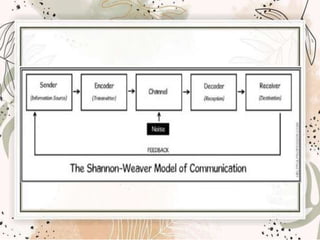
*The Shannon and Weaver Model of
Communication is a mathematical theory
of communication that argues that
human communication can be broken
down into 6 key concepts: sender,
encoder, channel, noise, decoder, and
receiver.
It is known as the “mother of all
models” because of its wide popularity.
The model is also known as
‘information theory’ or the ‘Shannon
theory’ because Claude Shannon was
the main person who developed the
theory.
1. Sender (Information Source)
The Shannon Weaver model starts
with the sender or “information
source”. They are the person (or
object, or thing – any information
source) who has the information to
begin with.
Example: An example of a sender
might be the person reading a
newscast on the nightly news. They
will choose what to say and how to
say it before the newscast begins.
2. Encoder (Transmitter)
The next step in the Shannon Weaver
model is the ‘encoder’. The encoder is
the machine (or person) that converts
the idea into signals that can be sent
from the sender to the receiver.
Examples: The encoder might be a
telephone, which converts our voice
into binary 1s and 0s to be sent down
the telephone lines (the channel).
Another encode might be a radio
station, which converts voice into
waves to be sent via radio to
someone.
3. Channel
The next step in the Shannon
Weaver model is the ‘channel’. The
channel of communication is the
infrastructure that gets information
from the sender and transmitter
through to the decoder and receiver.
We sometimes also call this the
‘medium’.
Examples: A person sending an
email is using the world wide web
(internet) as a medium. A person
talking on a landline phone is
using cables and electrical wires
as their channel.
4. Noise
The next step in the Shannon
Weaver model is ‘noise’. Noise
interrupts a message while it’s on
the way from the sender to the
receiver. It’s named after the idea
that ‘noise’ could interrupt our
understanding of a message.
There are two types of noise: internal
and external.
Internal noise happens when a sender
makes a mistake encoding a message or
a receiver makes a mistake decoding the
message.
At the point of encoding (for example, when you
misspell a word in a text message);
At the point of decoding (for example, when
someone misinterprets a sentence when reading
an email)
External noise happens when something
external (not in the control of sender or
receiver) impedes the message. So,
external noise happens:
At the point of transmission through the
channel (for example, when we’re having a
conversation by a busy highway and the
receiver is having trouble hearing over the
sound of cars)
Examples: Examples of external noise may
include the crackling of a poorly tuned radio, a
lost letter in the post, an interruption in a
television broadcast, or a failed internet
connection.
Examples of internal noise may include
someone having a headache so they can’t
concentrate, someone speaking with a
heavy accent, or when the sender mumbles
when speaking.
5. Decoder
The next step in the Shannon
Weaver model is ‘decoder’.
Decoding is the exact opposite of
encoding. Shannon and Weaver
made this model in reference to
communication that happens
through devices like telephones.
Examples: Decoders can include
computers that turn binary packets of 1s
and 0s into pixels on a screen that make
words, a telephone that turns signals
such as digits or waves back into sounds,
and cell phones that also turn bits of
data into readable (and listenable)
messages.
6. Receiver (Destination)
The next step in the Shannon
Weaver model is ‘receiver’ The
receiver is the end-point of the
original Shannon and Weaver
model of the technical
communication process.
Examples: Examples of a receiver
might be: the person on the other
end of a telephone, the person
reading an email you sent them, an
automated payments system online
that has received credit card details
for payment, etc.
7. Feedback
The final step in the Shannon Weaver
model is ‘feedback‘. Actually, the
‘feedback’ step was not originally
proposed by Shannon and Weaver in
1948. Norbert Weiner came up with
the feedback step in response to
criticism of the linear nature of the
approach.
Examples: Feedback does not
occur in all situations.
Sometimes, like when watching
TV, we don’t tend to let the
people talking on the TV know
what we’re thinking we simply
watch the show.
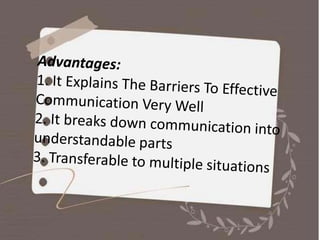
Advantages And
Disadvantages Of The
Shannon Weaver Model
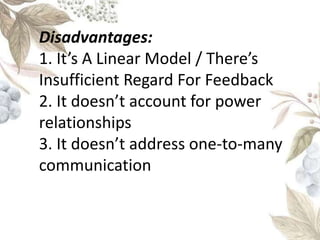
Disadvantages:
1. It’s A Linear Model / There’s
Insufficient Regard For Feedback
2. It doesn’t account for power
relationships
3. It doesn’t address one-to-many
communication
Prepared by:Binondo, Lilian P.
BEED 4

Shannon weaver mode

  • 1.
  • 2.
  • 3.
    *The Shannon andWeaver Model of Communication is a mathematical theory of communication that argues that human communication can be broken down into 6 key concepts: sender, encoder, channel, noise, decoder, and receiver.
  • 4.
    It is knownas the “mother of all models” because of its wide popularity. The model is also known as ‘information theory’ or the ‘Shannon theory’ because Claude Shannon was the main person who developed the theory.
  • 6.
    1. Sender (InformationSource) The Shannon Weaver model starts with the sender or “information source”. They are the person (or object, or thing – any information source) who has the information to begin with.
  • 7.
    Example: An exampleof a sender might be the person reading a newscast on the nightly news. They will choose what to say and how to say it before the newscast begins.
  • 8.
    2. Encoder (Transmitter) Thenext step in the Shannon Weaver model is the ‘encoder’. The encoder is the machine (or person) that converts the idea into signals that can be sent from the sender to the receiver.
  • 9.
    Examples: The encodermight be a telephone, which converts our voice into binary 1s and 0s to be sent down the telephone lines (the channel). Another encode might be a radio station, which converts voice into waves to be sent via radio to someone.
  • 10.
    3. Channel The nextstep in the Shannon Weaver model is the ‘channel’. The channel of communication is the infrastructure that gets information from the sender and transmitter through to the decoder and receiver. We sometimes also call this the ‘medium’.
  • 11.
    Examples: A personsending an email is using the world wide web (internet) as a medium. A person talking on a landline phone is using cables and electrical wires as their channel.
  • 12.
    4. Noise The nextstep in the Shannon Weaver model is ‘noise’. Noise interrupts a message while it’s on the way from the sender to the receiver. It’s named after the idea that ‘noise’ could interrupt our understanding of a message.
  • 13.
    There are twotypes of noise: internal and external.
  • 14.
    Internal noise happenswhen a sender makes a mistake encoding a message or a receiver makes a mistake decoding the message. At the point of encoding (for example, when you misspell a word in a text message); At the point of decoding (for example, when someone misinterprets a sentence when reading an email)
  • 15.
    External noise happenswhen something external (not in the control of sender or receiver) impedes the message. So, external noise happens: At the point of transmission through the channel (for example, when we’re having a conversation by a busy highway and the receiver is having trouble hearing over the sound of cars)
  • 16.
    Examples: Examples ofexternal noise may include the crackling of a poorly tuned radio, a lost letter in the post, an interruption in a television broadcast, or a failed internet connection. Examples of internal noise may include someone having a headache so they can’t concentrate, someone speaking with a heavy accent, or when the sender mumbles when speaking.
  • 17.
    5. Decoder The nextstep in the Shannon Weaver model is ‘decoder’. Decoding is the exact opposite of encoding. Shannon and Weaver made this model in reference to communication that happens through devices like telephones.
  • 18.
    Examples: Decoders caninclude computers that turn binary packets of 1s and 0s into pixels on a screen that make words, a telephone that turns signals such as digits or waves back into sounds, and cell phones that also turn bits of data into readable (and listenable) messages.
  • 19.
    6. Receiver (Destination) Thenext step in the Shannon Weaver model is ‘receiver’ The receiver is the end-point of the original Shannon and Weaver model of the technical communication process.
  • 20.
    Examples: Examples ofa receiver might be: the person on the other end of a telephone, the person reading an email you sent them, an automated payments system online that has received credit card details for payment, etc.
  • 21.
    7. Feedback The finalstep in the Shannon Weaver model is ‘feedback‘. Actually, the ‘feedback’ step was not originally proposed by Shannon and Weaver in 1948. Norbert Weiner came up with the feedback step in response to criticism of the linear nature of the approach.
  • 22.
    Examples: Feedback doesnot occur in all situations. Sometimes, like when watching TV, we don’t tend to let the people talking on the TV know what we’re thinking we simply watch the show.
  • 23.
    Advantages And Disadvantages OfThe Shannon Weaver Model
  • 25.
    Disadvantages: 1. It’s ALinear Model / There’s Insufficient Regard For Feedback 2. It doesn’t account for power relationships 3. It doesn’t address one-to-many communication
  • 26.