
It is a part of our daily life. It considers verbal & non-verbal communication such as facial expressions, body language etc. Communication is made in individual as well as team games. In individual games the communication is of non-verbal types. Individual games covers 90% of non-verbal communication and  remaining by verbal communication. Without effective communication team can never achieve success. The purpose of communication are persuasion, evaluation,  motivation etc.
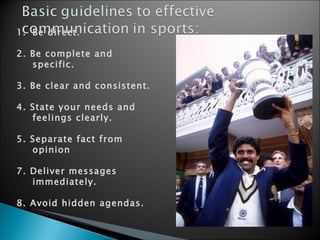
Be direct. 2. Be complete and specific. 3. Be clear and consistent. 4. State your needs and feelings clearly. 5. Separate fact from opinion 7. Deliver messages immediately. 8. Avoid hidden agendas.
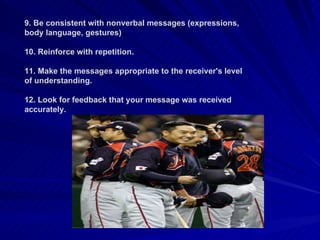
9. Be consistent with nonverbal messages (expressions, body language, gestures) 10. Reinforce with repetition. 11. Make the messages appropriate to the receiver's level of understanding. 12. Look for feedback that your message was received accurately.
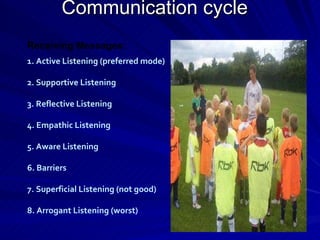
Communication cycle Receiving Messages: 1. Active Listening (preferred mode)   2. Supportive Listening   3. Reflective Listening   4. Empathic Listening   5. Aware Listening   6. Barriers   7. Superficial Listening (not good)   8. Arrogant Listening (worst)
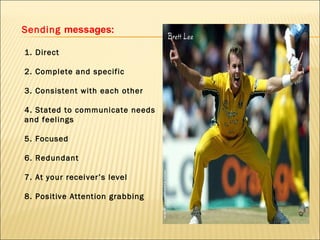
Sending  messages :  1. Direct   2. Complete and specific   3. Consistent with each other   4. Stated to communicate needs and feelings   5. Focused   6. Redundant   7. At your receiver’s level   8. Positive Attention grabbing
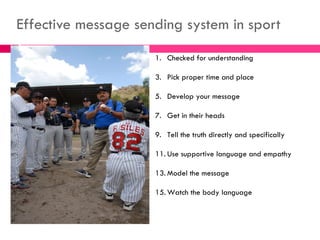
Effective message sending system in sport Checked for understanding Pick proper time and place Develop your message Get in their heads Tell the truth directly and specifically Use supportive language and empathy Model the message Watch the body language
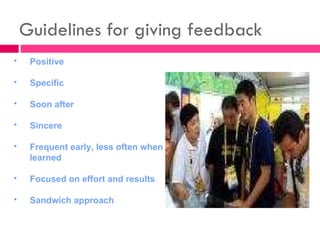
Guidelines for giving feedback Positive Specific Soon after Sincere Frequent early, less often when learned Focused on effort and results Sandwich approach
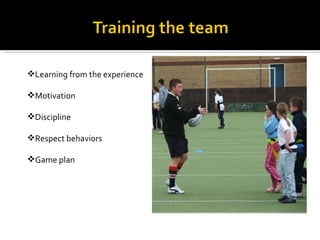
Learning from the experience Motivation Discipline Respect behaviors Game plan
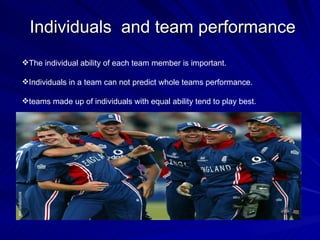
Individuals  and team performance The individual ability of each team member is important. Individuals in a team can not predict whole teams performance. teams made up of individuals with equal ability tend to play best.
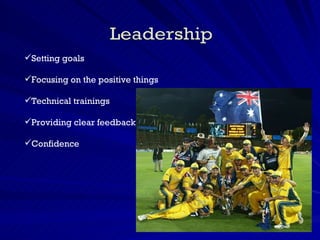
Setting goals Focusing on the positive things Technical trainings Providing clear feedback Confidence
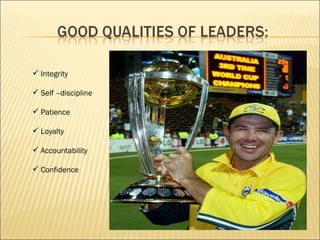
Integrity Self –discipline Patience Loyalty Accountability Confidence
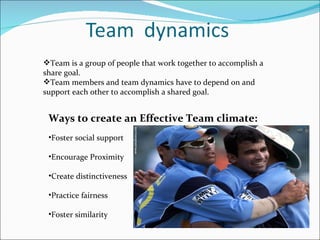
Team is a group of people that work together to accomplish a share goal. Team members and team dynamics have to depend on and support each other to accomplish a shared goal.  Ways to create an Effective Team climate:  Foster social support  Encourage Proximity  Create distinctiveness Practice fairness Foster similarity
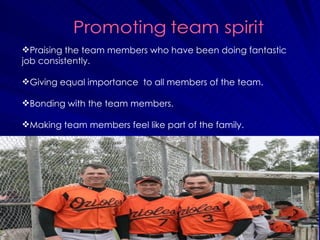
Praising the team members who have been doing fantastic job consistently. Giving equal importance  to all members of the team.  Bonding with the team members.  Making team members feel like part of the family.
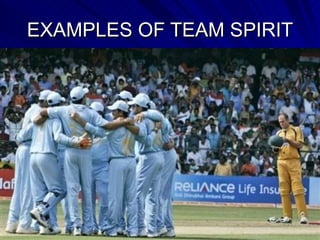
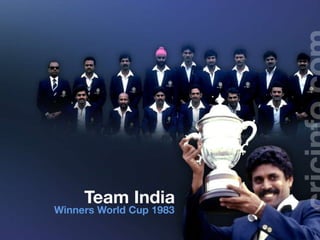
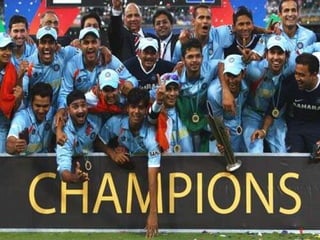
EXAMPLES OF TEAM SPIRIT
 
Motivation Supporting the team members who are not performing up to the mark Making them aware about their  potential  Giving the member confidence to excel in their game   Offering solutions to minimize their weakness
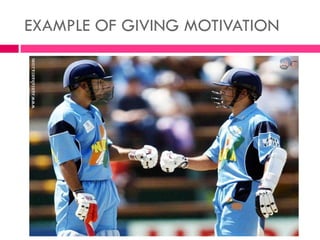
EXAMPLE OF GIVING MOTIVATION
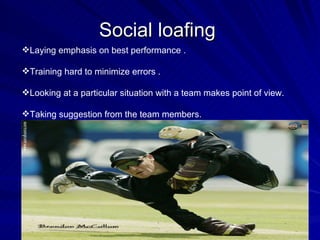
Social loafing  Laying emphasis on best performance . Training hard to minimize errors . Looking at a particular situation with a team makes point of view. Taking suggestion from the team members.
 
 
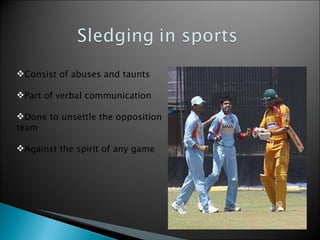
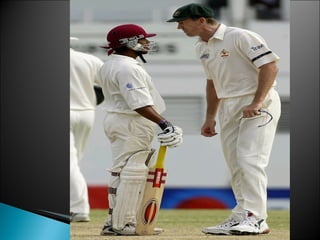
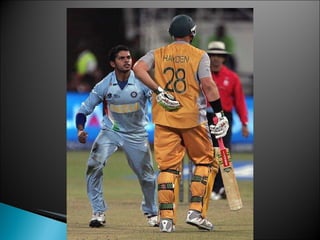
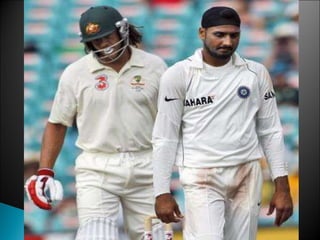
Consist of abuses and taunts  Part of verbal communication Done to unsettle the opposition team Against the spirit of any game


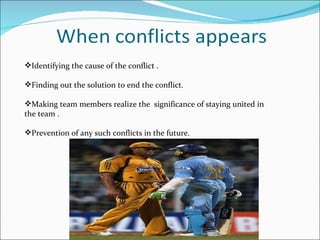
Identifying the cause of the conflict . Finding out the solution to end the conflict. Making team members realize the  significance of staying united in the team . Prevention of any such conflicts in the future.
HOW COMMUNICATION HELPS IN PROFESSIONAL SPORTS?  An organization tries to make all parties happy but not always successful The communication should be open & clear  Every professional team should use a relationship for different aspects of operation  Each team should conduct monthly as well as yearly meeting
It is the scientific study of players , their  behavior and their activities  It’s objective is to apply knowledge to the practical uses  It is applied to senior ‘s ,children ,physically mentally challenged coaches , teachers etc.
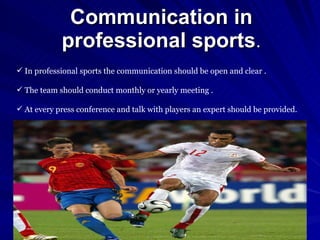
Communication in professional sports . In professional sports the communication should be open and clear . The team should conduct monthly or yearly meeting . At every press conference and talk with players an expert should be provided.
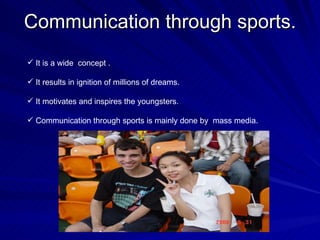
Communication through sports. It is a wide  concept . It results in ignition of millions of dreams.  It motivates and inspires the youngsters. Communication through sports is mainly done by  mass media.


Conclusion  If you take look at most successful franchises of  all sports you will see many similarities. All star player and a coach knows what they are doing. The players should work together and well respected.
CREATED BY SREENIVAS SANKAR

COMMUNICATION IN &THROUGH SPORTS

  • 1.
  • 2.
    It is apart of our daily life. It considers verbal & non-verbal communication such as facial expressions, body language etc. Communication is made in individual as well as team games. In individual games the communication is of non-verbal types. Individual games covers 90% of non-verbal communication and remaining by verbal communication. Without effective communication team can never achieve success. The purpose of communication are persuasion, evaluation, motivation etc.
  • 3.
    Be direct. 2.Be complete and specific. 3. Be clear and consistent. 4. State your needs and feelings clearly. 5. Separate fact from opinion 7. Deliver messages immediately. 8. Avoid hidden agendas.
  • 4.
    9. Be consistentwith nonverbal messages (expressions, body language, gestures) 10. Reinforce with repetition. 11. Make the messages appropriate to the receiver's level of understanding. 12. Look for feedback that your message was received accurately.
  • 5.
    Communication cycle ReceivingMessages: 1. Active Listening (preferred mode)   2. Supportive Listening   3. Reflective Listening   4. Empathic Listening   5. Aware Listening   6. Barriers   7. Superficial Listening (not good)   8. Arrogant Listening (worst)
  • 6.
    Sending messages: 1. Direct   2. Complete and specific   3. Consistent with each other   4. Stated to communicate needs and feelings   5. Focused   6. Redundant   7. At your receiver’s level   8. Positive Attention grabbing
  • 7.
    Effective message sendingsystem in sport Checked for understanding Pick proper time and place Develop your message Get in their heads Tell the truth directly and specifically Use supportive language and empathy Model the message Watch the body language
  • 8.
    Guidelines for givingfeedback Positive Specific Soon after Sincere Frequent early, less often when learned Focused on effort and results Sandwich approach
  • 9.
    Learning from theexperience Motivation Discipline Respect behaviors Game plan
  • 10.
    Individuals andteam performance The individual ability of each team member is important. Individuals in a team can not predict whole teams performance. teams made up of individuals with equal ability tend to play best.
  • 11.
    Setting goals Focusingon the positive things Technical trainings Providing clear feedback Confidence
  • 12.
    Integrity Self –disciplinePatience Loyalty Accountability Confidence
  • 13.
    Team is agroup of people that work together to accomplish a share goal. Team members and team dynamics have to depend on and support each other to accomplish a shared goal. Ways to create an Effective Team climate: Foster social support Encourage Proximity Create distinctiveness Practice fairness Foster similarity
  • 14.
    Praising the teammembers who have been doing fantastic job consistently. Giving equal importance to all members of the team. Bonding with the team members. Making team members feel like part of the family.
  • 15.
  • 16.
  • 17.
    Motivation Supporting theteam members who are not performing up to the mark Making them aware about their potential Giving the member confidence to excel in their game Offering solutions to minimize their weakness
  • 18.
  • 19.
    Social loafing Laying emphasis on best performance . Training hard to minimize errors . Looking at a particular situation with a team makes point of view. Taking suggestion from the team members.
  • 20.
  • 21.
  • 22.
    Consist of abusesand taunts Part of verbal communication Done to unsettle the opposition team Against the spirit of any game
  • 23.
  • 24.
  • 25.
  • 26.
    Identifying the causeof the conflict . Finding out the solution to end the conflict. Making team members realize the significance of staying united in the team . Prevention of any such conflicts in the future.
  • 27.
    HOW COMMUNICATION HELPSIN PROFESSIONAL SPORTS? An organization tries to make all parties happy but not always successful The communication should be open & clear Every professional team should use a relationship for different aspects of operation Each team should conduct monthly as well as yearly meeting
  • 28.
    It is thescientific study of players , their behavior and their activities It’s objective is to apply knowledge to the practical uses It is applied to senior ‘s ,children ,physically mentally challenged coaches , teachers etc.
  • 29.
    Communication in professionalsports . In professional sports the communication should be open and clear . The team should conduct monthly or yearly meeting . At every press conference and talk with players an expert should be provided.
  • 30.
    Communication through sports.It is a wide concept . It results in ignition of millions of dreams. It motivates and inspires the youngsters. Communication through sports is mainly done by mass media.
  • 31.
  • 32.
  • 33.
  • 34.
    Conclusion Ifyou take look at most successful franchises of all sports you will see many similarities. All star player and a coach knows what they are doing. The players should work together and well respected.
  • 35.