Ethical Issues in
Sports
Communication
Ethics
—  Ethics is what a person perceives to be right/
wrong, good/bad, moral/immoral
—  Ethics can be absolute – meaning that an action is
either ethical/unethical without question (e.g. it is
unethical to steal)
—  Ethics can be relative – meaning that an action is
either ethical/unethical based on the situation (e.g.
it is unethical to steal unless you need food)
Ethics
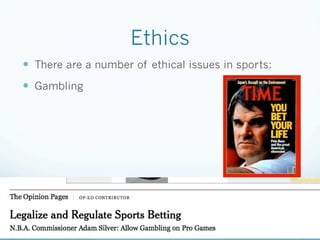
—  There are a number of ethical issues in sports:
—  Gambling
Ethics
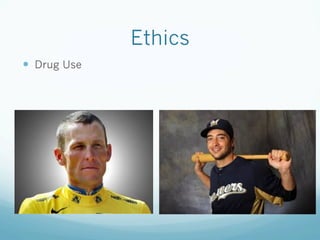
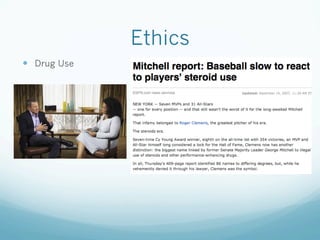
—  Drug Use
Ethics
—  Drug Use
Ethics
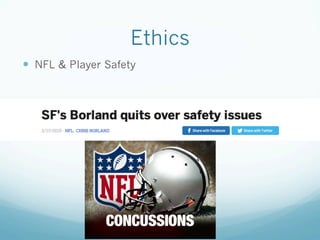
—  NFL & Player Safety
Ethics
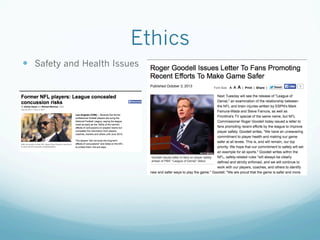
—  Safety and Health Issues
Ethics
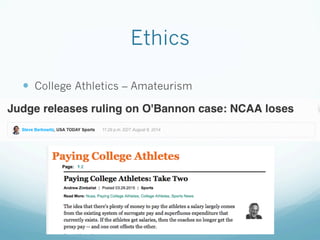
—  College Athletics – Amateurism
Ethics
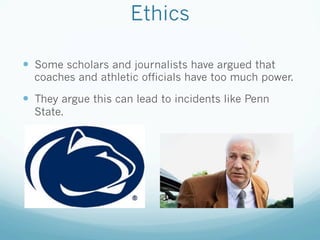
—  Some scholars and journalists have argued that
coaches and athletic officials have too much power.
—  They argue this can lead to incidents like Penn
State.
Ethics
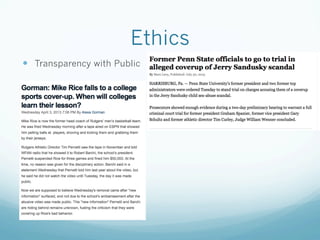
—  Transparency with Public
Ethics
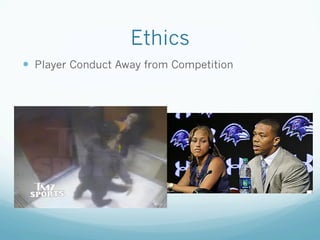
—  Player Conduct Away from Competition
Ethics
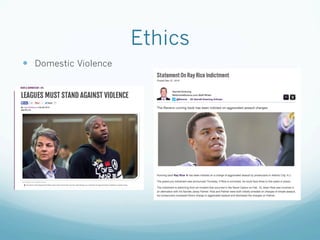
—  Domestic Violence
Ethics
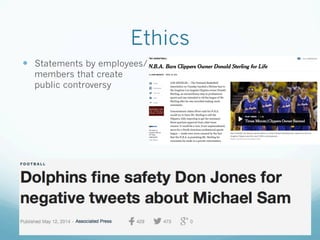
—  Statements by employees/
members that create
public controversy
Ethics
—  Interestingly, we’re seeing more issues with fantasy
sports
—  Lots of money involved
—  Websites to adjudicate fantasy sports issues are
now becoming quite popular
Ethics
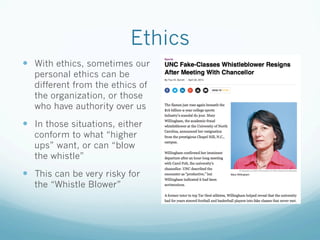
—  With ethics, sometimes our
personal ethics can be
different from the ethics of
the organization, or those
who have authority over us
—  In those situations, either
conform to what “higher
ups” want, or can “blow
the whistle”
—  This can be very risky for
the “Whistle Blower”
Takeaways:
—  It’s easy for us to make judgments about what is/is
not ethical, but when you’re the one “in the
situation” can be complicated
—  Transparency – Very difficult to keep things
confidential/private. In era of social media, issues
will get out.
—  Argument then to be more proactive and
transparent in letting public know how issues are
being handled.

Reading 1-1: Ethics in Sports Communication