By the end of session learners will be able
to;
Review communication process
Recognize the level of communication
Practice types of communication into
clinical setting
Identify the factors influence
communication
Determine the role and function of
administration in communication
To be an effective leader the nurses
needs the primary leadership skills as
skills of personal behavior,
communication, organization, and self
examination.
Communication
is the process in which people affect one
another through the exchange of
information, ideas and feelings.
is the process that requires interpretation,
sensitivity, imagination, and active
participation.
(Jenner, 2007)







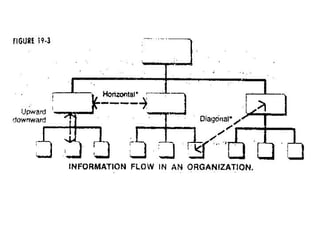
Downwards Communication :
Highly Directive
from Senior to subordinates
to assign duties
give instructions
to inform to offer feed back
approval to highlight problems etc.





Upwards Communications :
non directive in nature from down below
to give feedback
to inform about progress/problems
seeking approvals.





Lateral or Horizontal Communication:
Among colleagues,
peers at same level for information
sharing for coordination
to save time.
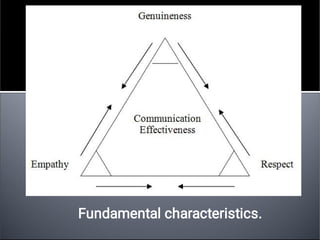
Fundamental characteristics.






Respect and empathy for the client .
Good communication skills .
Tolerance of values and beliefs different
from one’s own .
Unbiased attitudes .
Patience .
Awareness of gender issues.
1.
2.
3.
4.
5.
1- Non-verbal communication
Is what is observed and send .
* Is often more important than verbal
communication it includes:
Paralanguage : (tone of voice , stream of
talk)
Kinesis : (all body languages and facial
movement ).
Proxemies : (the distance between the
sender and the receiver ).
Touch .
Cultural arte facts : (the way a person
dressed , make up ) .





2- Verbal communication:
Is what is said and heard .
*It is the content of communication :
Use an appropriate tone of voice .
Give verbal encouragement .
Ask questions .
Paraphrase .
Seek clarification.
“It is powerful form of communication that
occurs within an individual. this level of
communication is also called self-talk, self-
verbalization, self-Instruction, inner thoughts and
inner Dialogue”. (Balzer-Riley, 1996)
People’s thoughts strongly influence perceptions,
feelings, behaviour and self-concept
Positive self-talk can be used as a tool to
improve the nurse’s or client’s health and self-
esteem.
Self instruction can provide a mental rehearsal
for difficult tasks or situations.
To develop self awareness and positive self-
concept that will enhance appropriate self-
expression.
It is one -to -one interaction between the nurse
and another person that often occurs face to
face.
It is most frequently used level.
It takes place within a social context and
includes all the symbols and cues used to give
and receive meaning.
Meaningful interpersonal communication results
in exchange of ideas, problem solving
expression of feelings, decision making, goal
accomplishment, team building and personal
growth.
Transpersonal communication is interaction that
occurs within a person’s spiritual domain. Many
persons use prayer, meditation, guided reflection,
religious rituals, or other means to communicate
with their “higher power”
Sellers and Haag (1998) found that nurses
enhance the spirituality of clients and their
families through prayer, active listening and
therapeutic communication, conveying
acceptance, respect and a non-judgmental
attitude, instilling hope and using presence and
touch.
Small-group communication is interaction that occurs
when a small number of persons meet together.
Usually goal directed and requires an understanding of
group dynamics.
Nurses work on task forces or committees, lead client
support groups, form research teams, or participate in
client care conferences, a small-group communication
process is used.
More effective when they are a workable size, have an
appropriate meeting place, suitable seating
arrangements and cohesiveness and commitment
among group members.
Public communication is interaction with an
audience. Nurses have opportunities to speak
with groups of consumers about health-related
topics, present scholarly work to colleagues at
conferences, or lead classroom discussions
with peers or students.
Requires special adaptations in eye contact,
gestures, voice inflection and use of media
materials to communicate messages effectively.
Increases audience knowledge.
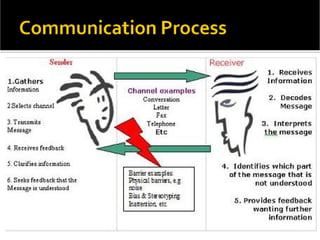
Communication is an ongoing, dynamic
and multidimensional process.
Nursing situations have many unique
aspects that influence the nature of
communication and interpersonal
relationships.
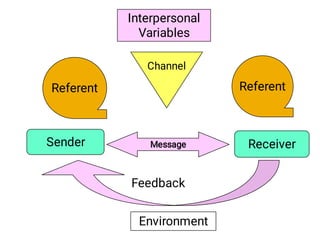
Referent
Message
Channel
Interpersonal
Variables
Sender
Referent
Receiver
Feedback
Environment
The referent motivates one person to
communicate with another. In a health
care setting, sights, sounds, odours, time
schedules, messages, objects, emotions,
sensations, perceptions, ideas and other
cues initiate communication.
The sender is the person who encodes and
delivers the message and the receiver is the
person who receives and decodes the message.
The sender puts ideas or feelings into a form.
Responsible for the accuracy of its content and
emotional tone.
Acts as a referent for the receiver.
Sender and receiver roles are fluid and change
back and forth as two persons interact, sending
and receiving may even occur simultaneously.
Closer the relationship the more likely they will
accurately perceive one another’s meaning and
respond accordingly.
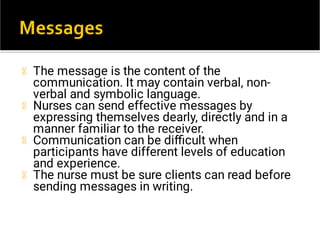
The message is the content of the
communication. It may contain verbal, non-
verbal and symbolic language.
Nurses can send effective messages by
expressing themselves dearly, directly and in a
manner familiar to the receiver.
Communication can be difficult when
participants have different levels of education
and experience.
The nurse must be sure clients can read before
sending messages in writing.
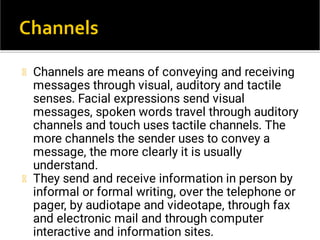
Channels are means of conveying and receiving
messages through visual, auditory and tactile
senses. Facial expressions send visual
messages, spoken words travel through auditory
channels and touch uses tactile channels. The
more channels the sender uses to convey a
message, the more clearly it is usually
understand.
They send and receive information in person by
informal or formal writing, over the telephone or
pager, by audiotape and videotape, through fax
and electronic mail and through computer
interactive and information sites.
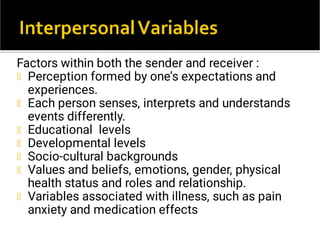
Factors within both the sender and receiver :
Perception formed by one’s expectations and
experiences.
Each person senses, interprets and understands
events differently.
Educational levels
Developmental levels
Socio-cultural backgrounds
Values and beliefs, emotions, gender, physical
health status and roles and relationship.
Variables associated with illness, such as pain
anxiety and medication effects
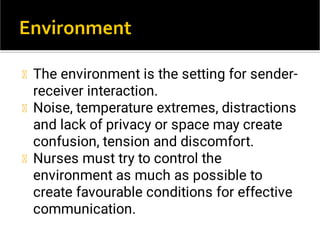
The environment is the setting for sender-
receiver interaction.
Noise, temperature extremes, distractions
and lack of privacy or space may create
confusion, tension and discomfort.
Nurses must try to control the
environment as much as possible to
create favourable conditions for effective
communication.
Communication is unsuccessful if
senders and receivers cannot translate
each other’s words and phrases.
Medical jargon
Technical terminology used by health care
providers.
Conversation is more successful at an
appropriate speed or pace.
Pacing is improved by thinking before
speaking and by developing awareness of
the cadence of one’s speech.
Tone of voice dramatically affects a
message’s meaning.
Simple question can express enthusiasm,
anger, concern, or indifference
A clients voice tone often provides
information about his or her emotional
state or energy
Effective communication is simple, brief,
and direct.
Fewer words result in less confusion.
Clarity is achieved by speaking slowly,
enunciating clearly, and used examples to
make explanation easier to understand.
Repeat important part of message.
Brevity achieved by using short sentences
and words that express an idea simply
and directly. “Where is pain? is much
better than “I would like you to describe
for m e the location of your pain.”
Timing is critical in communication, even
though a message is clear, poor timing
can prevent it from being effective.
Messages are effective if relevant to the
situation.
Eg:“Client facing an emergency surgery,
discussing the risks of smoking, is less
relevant than explaining peri-operative
procedures.
Facial appearance
Personal posture and gait
Facial expression
Eye contact
Gestures
Sounds
Territoriality and personal space
Courtesy
Use of names
Privacy and confidentiality
Trustworthiness
Autonomy and Responsibility
Assertiveness


Assessment:
Gather data about factors that influence
communication these include the participant’s
internal factors and characteristics, the nature
of their relationship, the situation promoting
communication, the environment, and the
socio-cultural elements
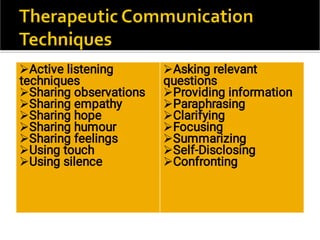
Active listening
techniques
Sharing observations
Sharing empathy
Sharing hope
Sharing humour
Sharing feelings
Using touch
Using silence








Asking relevant
questions
Providing information
Paraphrasing
Clarifying
Focusing
Summarizing
Self-Disclosing
Confronting








Asking personal questions
Changing the subject
Automatic responses
False reassurance
Sympathy
Asking Explanations
Approval or Disapproval
Defensive responses
Passive or aggressive responses
Arguing
Maintain a nonjudgmental interaction
Guide patient to reinterpret experiences
rationally
Track verbal interaction with clarifying
statements. Avoid changing the subject
(unless in the best interest of client).



Process Recordings
Analysis
symbolism
themes
communication blocks


All spoken words
Influence of culture
Explicit message
Implicit message
Connotations
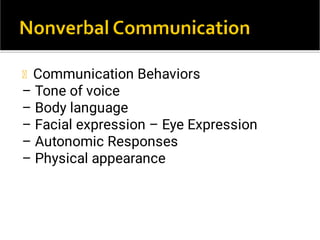
Communication Behaviors
– Tone of voice
– Body language
– Facial expression – Eye Expression
– Autonomic Responses
– Physical appearance



Downward communication.
Written orders,
speeches,
Policies and Procedure
Information is lost in the process


Upward communication
Managers filter the messages
Suggestions appeals group meetings
open door policies
Crosswise communication
Horizontal flow.
Diagonal flow.
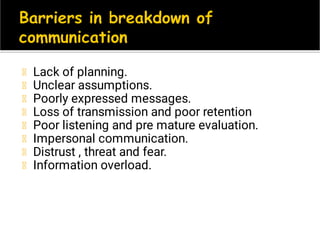
Lack of planning.
Unclear assumptions.
Poorly expressed messages.
Loss of transmission and poor retention
Poor listening and pre mature evaluation.
Impersonal communication.
Distrust , threat and fear.
Information overload.
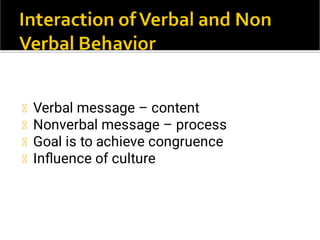
Verbal message – content
Nonverbal message – process
Goal is to achieve congruence
Influence of culture
Perceptions and Stereotypes
Environmental factors – personal space
Values
Emotions
Sociocultural issues
Knowledge
Clarity, Timing and Relevance
Brings about client insight, control of
symptoms, and healing
Nurse needs thorough understanding of
communication and how to build a
positive nurse-client relationship
Basavanthappa,B.T.(2008). Nursing Administration. New
Delhi: jaypee brothers.
Erb, G., & Kozier, B. (1998). Loss, Grieving and Death.
Fundamental of Nursing: concept, process, and
practice. (5th ed.). Addison: Wesley
Mohr, W. K. (2003). Therapeutic Relationship and
Communication. Psychiatric-Mental Health Nursing.
(5th ed.). Philadelphia: Lipincott.
Potter, P. A., & Perry, A. J. (2003). Fundamental of nursing.
St Louis: Mosby
Sullivan, E. J; & Decker, P. J. (2001). Effective leadership
& management in nursing.
(5th ed.). Jew jersey: Prentice Hall.
Scammell, B. (1991). Communication
skills. London: Macmillan
Communication(Mine). power point presentation

Communication(Mine). power point presentation

  • 2.
    By the endof session learners will be able to; Review communication process Recognize the level of communication Practice types of communication into clinical setting Identify the factors influence communication Determine the role and function of administration in communication
  • 3.
    To be aneffective leader the nurses needs the primary leadership skills as skills of personal behavior, communication, organization, and self examination.
  • 4.
    Communication is the processin which people affect one another through the exchange of information, ideas and feelings. is the process that requires interpretation, sensitivity, imagination, and active participation. (Jenner, 2007)
  • 10.
           Downwards Communication : HighlyDirective from Senior to subordinates to assign duties give instructions to inform to offer feed back approval to highlight problems etc.
  • 11.
         Upwards Communications : nondirective in nature from down below to give feedback to inform about progress/problems seeking approvals.
  • 12.
         Lateral or HorizontalCommunication: Among colleagues, peers at same level for information sharing for coordination to save time.
  • 13.
  • 14.
          Respect and empathyfor the client . Good communication skills . Tolerance of values and beliefs different from one’s own . Unbiased attitudes . Patience . Awareness of gender issues.
  • 15.
    1. 2. 3. 4. 5. 1- Non-verbal communication Iswhat is observed and send . * Is often more important than verbal communication it includes: Paralanguage : (tone of voice , stream of talk) Kinesis : (all body languages and facial movement ). Proxemies : (the distance between the sender and the receiver ). Touch . Cultural arte facts : (the way a person dressed , make up ) .
  • 16.
         2- Verbal communication: Iswhat is said and heard . *It is the content of communication : Use an appropriate tone of voice . Give verbal encouragement . Ask questions . Paraphrase . Seek clarification.
  • 17.
    “It is powerfulform of communication that occurs within an individual. this level of communication is also called self-talk, self- verbalization, self-Instruction, inner thoughts and inner Dialogue”. (Balzer-Riley, 1996) People’s thoughts strongly influence perceptions, feelings, behaviour and self-concept Positive self-talk can be used as a tool to improve the nurse’s or client’s health and self- esteem. Self instruction can provide a mental rehearsal for difficult tasks or situations. To develop self awareness and positive self- concept that will enhance appropriate self- expression.
  • 18.
    It is one-to -one interaction between the nurse and another person that often occurs face to face. It is most frequently used level. It takes place within a social context and includes all the symbols and cues used to give and receive meaning. Meaningful interpersonal communication results in exchange of ideas, problem solving expression of feelings, decision making, goal accomplishment, team building and personal growth.
  • 19.
    Transpersonal communication isinteraction that occurs within a person’s spiritual domain. Many persons use prayer, meditation, guided reflection, religious rituals, or other means to communicate with their “higher power” Sellers and Haag (1998) found that nurses enhance the spirituality of clients and their families through prayer, active listening and therapeutic communication, conveying acceptance, respect and a non-judgmental attitude, instilling hope and using presence and touch.
  • 20.
    Small-group communication isinteraction that occurs when a small number of persons meet together. Usually goal directed and requires an understanding of group dynamics. Nurses work on task forces or committees, lead client support groups, form research teams, or participate in client care conferences, a small-group communication process is used. More effective when they are a workable size, have an appropriate meeting place, suitable seating arrangements and cohesiveness and commitment among group members.
  • 21.
    Public communication isinteraction with an audience. Nurses have opportunities to speak with groups of consumers about health-related topics, present scholarly work to colleagues at conferences, or lead classroom discussions with peers or students. Requires special adaptations in eye contact, gestures, voice inflection and use of media materials to communicate messages effectively. Increases audience knowledge.
  • 22.
    Communication is anongoing, dynamic and multidimensional process. Nursing situations have many unique aspects that influence the nature of communication and interpersonal relationships.
  • 23.
  • 24.
    The referent motivatesone person to communicate with another. In a health care setting, sights, sounds, odours, time schedules, messages, objects, emotions, sensations, perceptions, ideas and other cues initiate communication.
  • 25.
    The sender isthe person who encodes and delivers the message and the receiver is the person who receives and decodes the message. The sender puts ideas or feelings into a form. Responsible for the accuracy of its content and emotional tone. Acts as a referent for the receiver. Sender and receiver roles are fluid and change back and forth as two persons interact, sending and receiving may even occur simultaneously. Closer the relationship the more likely they will accurately perceive one another’s meaning and respond accordingly.
  • 26.
    The message isthe content of the communication. It may contain verbal, non- verbal and symbolic language. Nurses can send effective messages by expressing themselves dearly, directly and in a manner familiar to the receiver. Communication can be difficult when participants have different levels of education and experience. The nurse must be sure clients can read before sending messages in writing.
  • 27.
    Channels are meansof conveying and receiving messages through visual, auditory and tactile senses. Facial expressions send visual messages, spoken words travel through auditory channels and touch uses tactile channels. The more channels the sender uses to convey a message, the more clearly it is usually understand. They send and receive information in person by informal or formal writing, over the telephone or pager, by audiotape and videotape, through fax and electronic mail and through computer interactive and information sites.
  • 28.
    Factors within boththe sender and receiver : Perception formed by one’s expectations and experiences. Each person senses, interprets and understands events differently. Educational levels Developmental levels Socio-cultural backgrounds Values and beliefs, emotions, gender, physical health status and roles and relationship. Variables associated with illness, such as pain anxiety and medication effects
  • 29.
    The environment isthe setting for sender- receiver interaction. Noise, temperature extremes, distractions and lack of privacy or space may create confusion, tension and discomfort. Nurses must try to control the environment as much as possible to create favourable conditions for effective communication.
  • 30.
    Communication is unsuccessfulif senders and receivers cannot translate each other’s words and phrases. Medical jargon Technical terminology used by health care providers.
  • 31.
    Conversation is moresuccessful at an appropriate speed or pace. Pacing is improved by thinking before speaking and by developing awareness of the cadence of one’s speech.
  • 32.
    Tone of voicedramatically affects a message’s meaning. Simple question can express enthusiasm, anger, concern, or indifference A clients voice tone often provides information about his or her emotional state or energy
  • 33.
    Effective communication issimple, brief, and direct. Fewer words result in less confusion. Clarity is achieved by speaking slowly, enunciating clearly, and used examples to make explanation easier to understand. Repeat important part of message. Brevity achieved by using short sentences and words that express an idea simply and directly. “Where is pain? is much better than “I would like you to describe for m e the location of your pain.”
  • 34.
    Timing is criticalin communication, even though a message is clear, poor timing can prevent it from being effective. Messages are effective if relevant to the situation. Eg:“Client facing an emergency surgery, discussing the risks of smoking, is less relevant than explaining peri-operative procedures.
  • 35.
    Facial appearance Personal postureand gait Facial expression Eye contact Gestures Sounds Territoriality and personal space
  • 36.
    Courtesy Use of names Privacyand confidentiality Trustworthiness Autonomy and Responsibility Assertiveness
  • 37.
      Assessment: Gather data aboutfactors that influence communication these include the participant’s internal factors and characteristics, the nature of their relationship, the situation promoting communication, the environment, and the socio-cultural elements
  • 38.
    Active listening techniques Sharing observations Sharingempathy Sharing hope Sharing humour Sharing feelings Using touch Using silence         Asking relevant questions Providing information Paraphrasing Clarifying Focusing Summarizing Self-Disclosing Confronting        
  • 39.
    Asking personal questions Changingthe subject Automatic responses False reassurance Sympathy Asking Explanations Approval or Disapproval Defensive responses Passive or aggressive responses Arguing
  • 40.
    Maintain a nonjudgmentalinteraction Guide patient to reinterpret experiences rationally Track verbal interaction with clarifying statements. Avoid changing the subject (unless in the best interest of client).
  • 41.
  • 42.
      All spoken words Influenceof culture Explicit message Implicit message Connotations
  • 43.
    Communication Behaviors – Toneof voice – Body language – Facial expression – Eye Expression – Autonomic Responses – Physical appearance
  • 44.
       Downward communication. Written orders, speeches, Policiesand Procedure Information is lost in the process
  • 45.
      Upward communication Managers filterthe messages Suggestions appeals group meetings open door policies Crosswise communication Horizontal flow. Diagonal flow.
  • 47.
    Lack of planning. Unclearassumptions. Poorly expressed messages. Loss of transmission and poor retention Poor listening and pre mature evaluation. Impersonal communication. Distrust , threat and fear. Information overload.
  • 50.
    Verbal message –content Nonverbal message – process Goal is to achieve congruence Influence of culture
  • 51.
    Perceptions and Stereotypes Environmentalfactors – personal space Values Emotions Sociocultural issues Knowledge Clarity, Timing and Relevance
  • 52.
    Brings about clientinsight, control of symptoms, and healing Nurse needs thorough understanding of communication and how to build a positive nurse-client relationship
  • 54.
    Basavanthappa,B.T.(2008). Nursing Administration.New Delhi: jaypee brothers. Erb, G., & Kozier, B. (1998). Loss, Grieving and Death. Fundamental of Nursing: concept, process, and practice. (5th ed.). Addison: Wesley Mohr, W. K. (2003). Therapeutic Relationship and Communication. Psychiatric-Mental Health Nursing. (5th ed.). Philadelphia: Lipincott. Potter, P. A., & Perry, A. J. (2003). Fundamental of nursing. St Louis: Mosby Sullivan, E. J; & Decker, P. J. (2001). Effective leadership & management in nursing. (5th ed.). Jew jersey: Prentice Hall.
  • 55.
    Scammell, B. (1991).Communication skills. London: Macmillan