Brokering: A sensitizing concept for
understanding learning
Sherrie Lee
Te Whiringa School of Educational Leadership and Policy
Te Kura Toi Tangata Faculty of Education
Overview
1 Research context
2 What is brokering?
3 Brokering in a social network
4 Knowledge brokering
5 Brokering in communities
6 Language brokering
7 What is brokering?
1
2
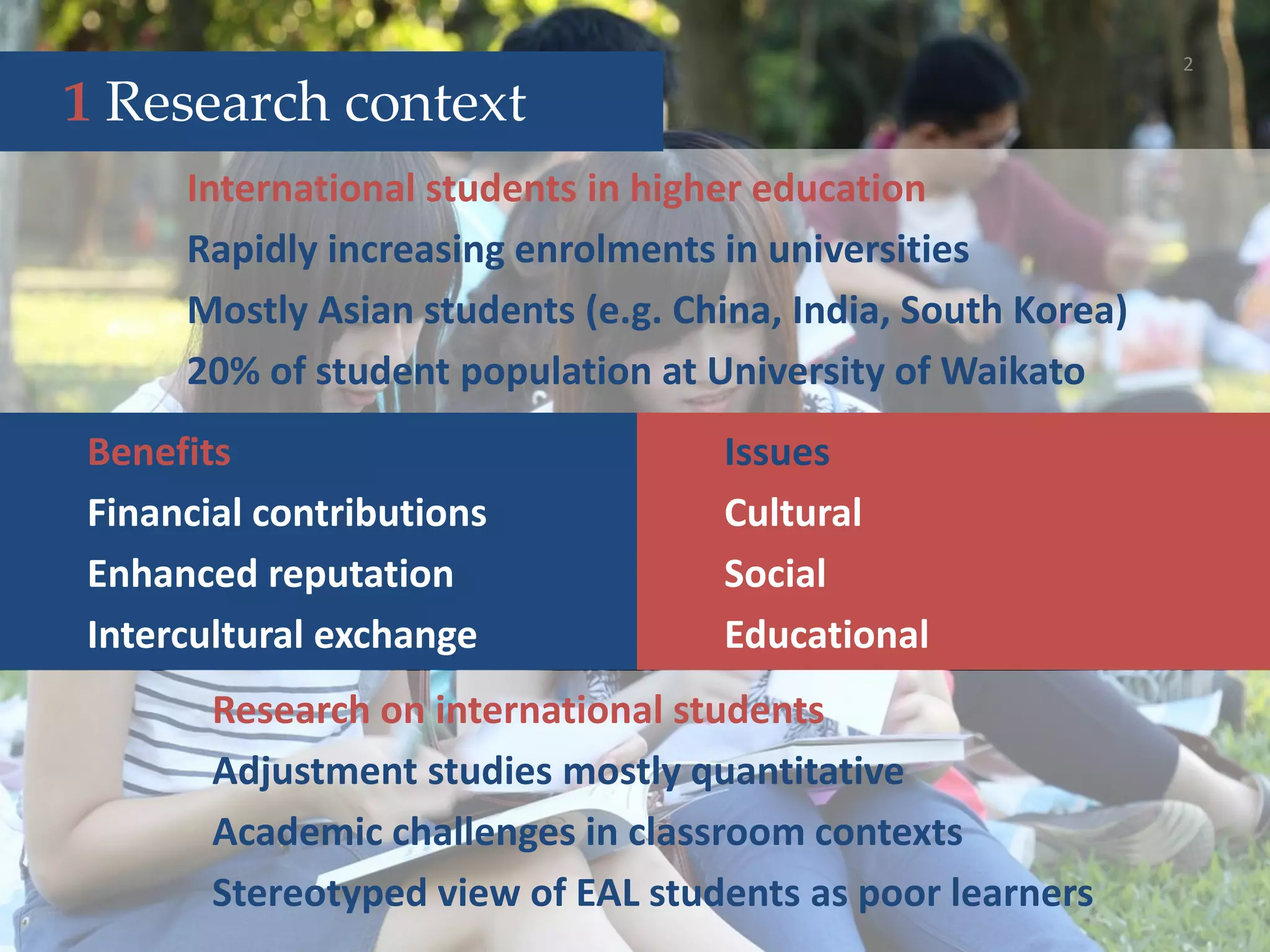
International students in higher education
Rapidly increasing enrolments in universities
Mostly Asian students (e.g. China, India, South Korea)
20% of student population at University of Waikato
Benefits
Financial contributions
Enhanced reputation
Intercultural exchange
Issues
Cultural
Social
Educational
Research on international students
Adjustment studies mostly quantitative
Academic challenges in classroom contexts
Stereotyped view of EAL students as poor learners
1 Research context
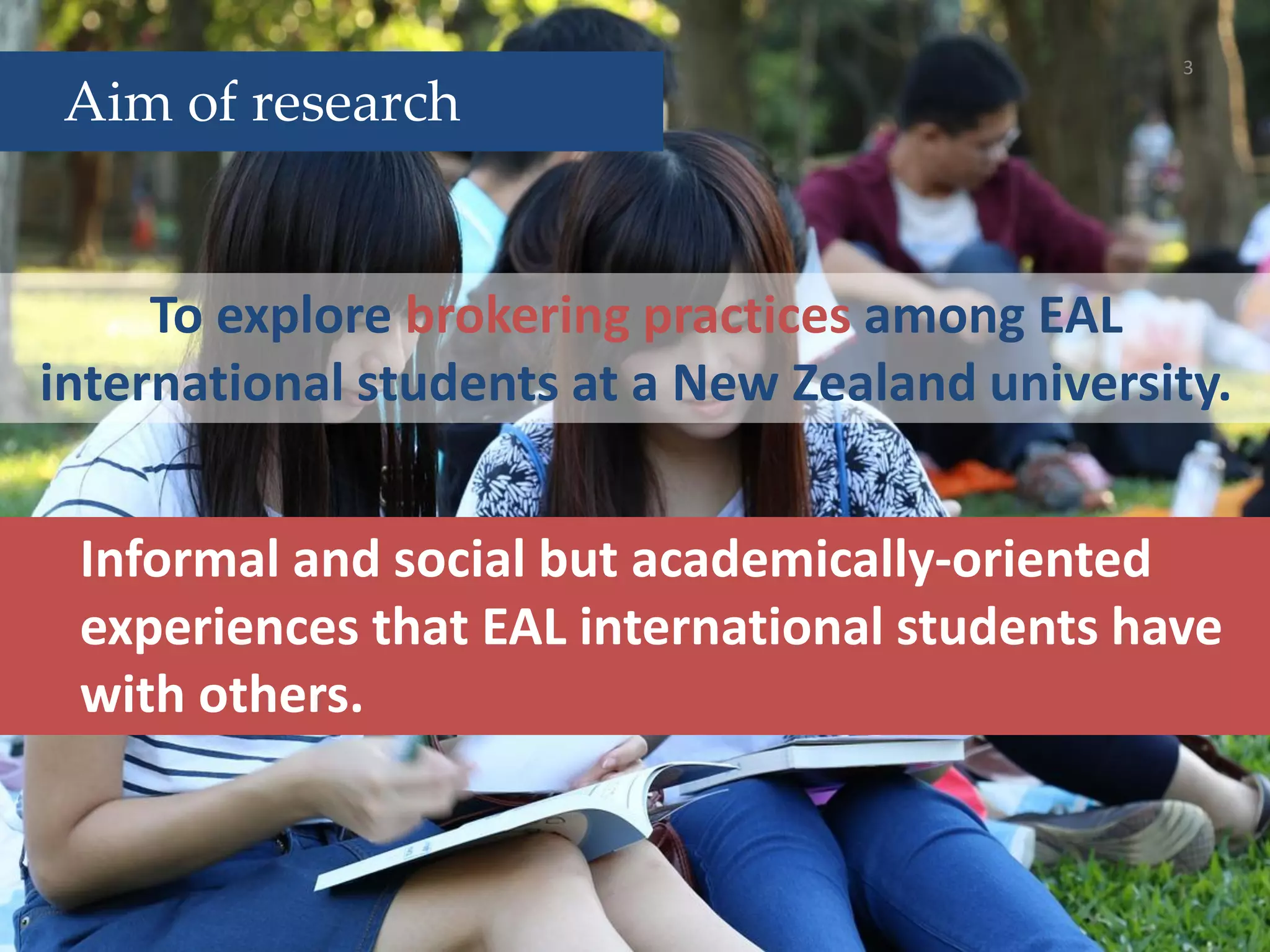
To explore brokering practices among EAL
international students at a New Zealand university.
3
Aim of research
Informal and social but academically-oriented
experiences that EAL international students have
with others.
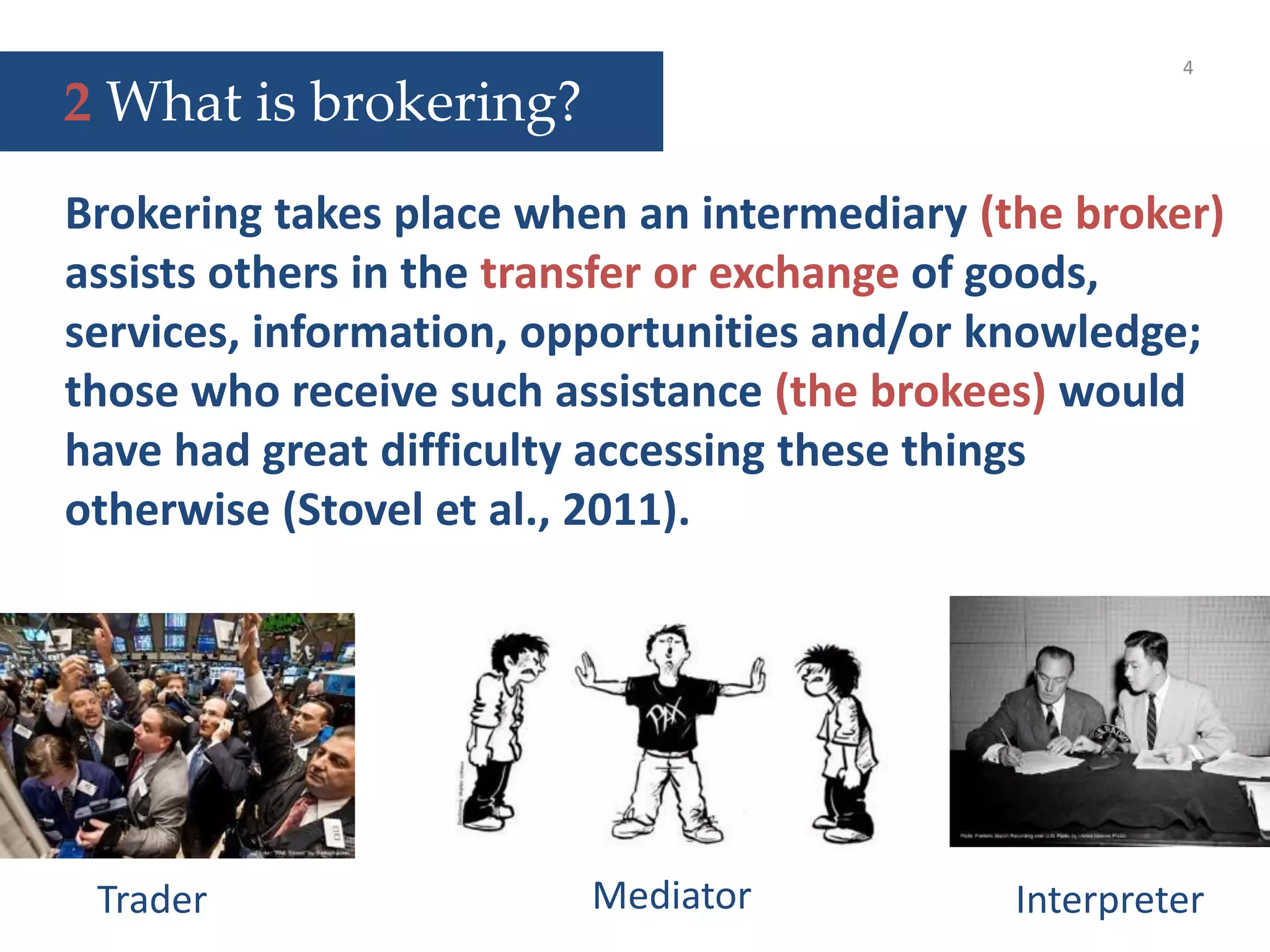
Trader InterpreterMediator
4
Brokering takes place when an intermediary (the broker)
assists others in the transfer or exchange of goods,
services, information, opportunities and/or knowledge;
those who receive such assistance (the brokees) would
have had great difficulty accessing these things
otherwise (Stovel et al., 2011).
2 What is brokering?
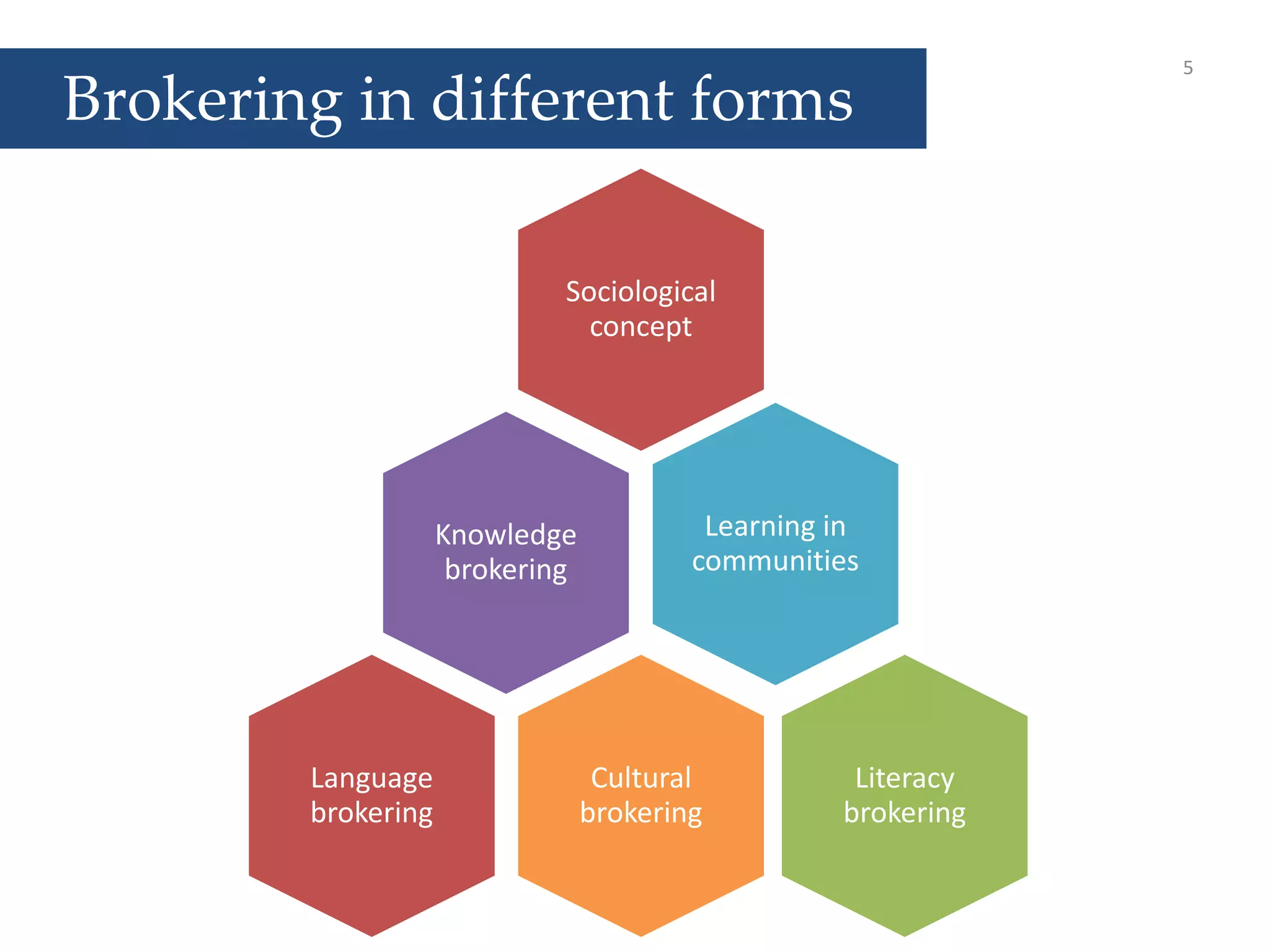
Brokering in different forms
5
Sociological
concept
Literacy
brokering
Knowledge
brokering
Learning in
communities
Cultural
brokering
Language
brokering
6
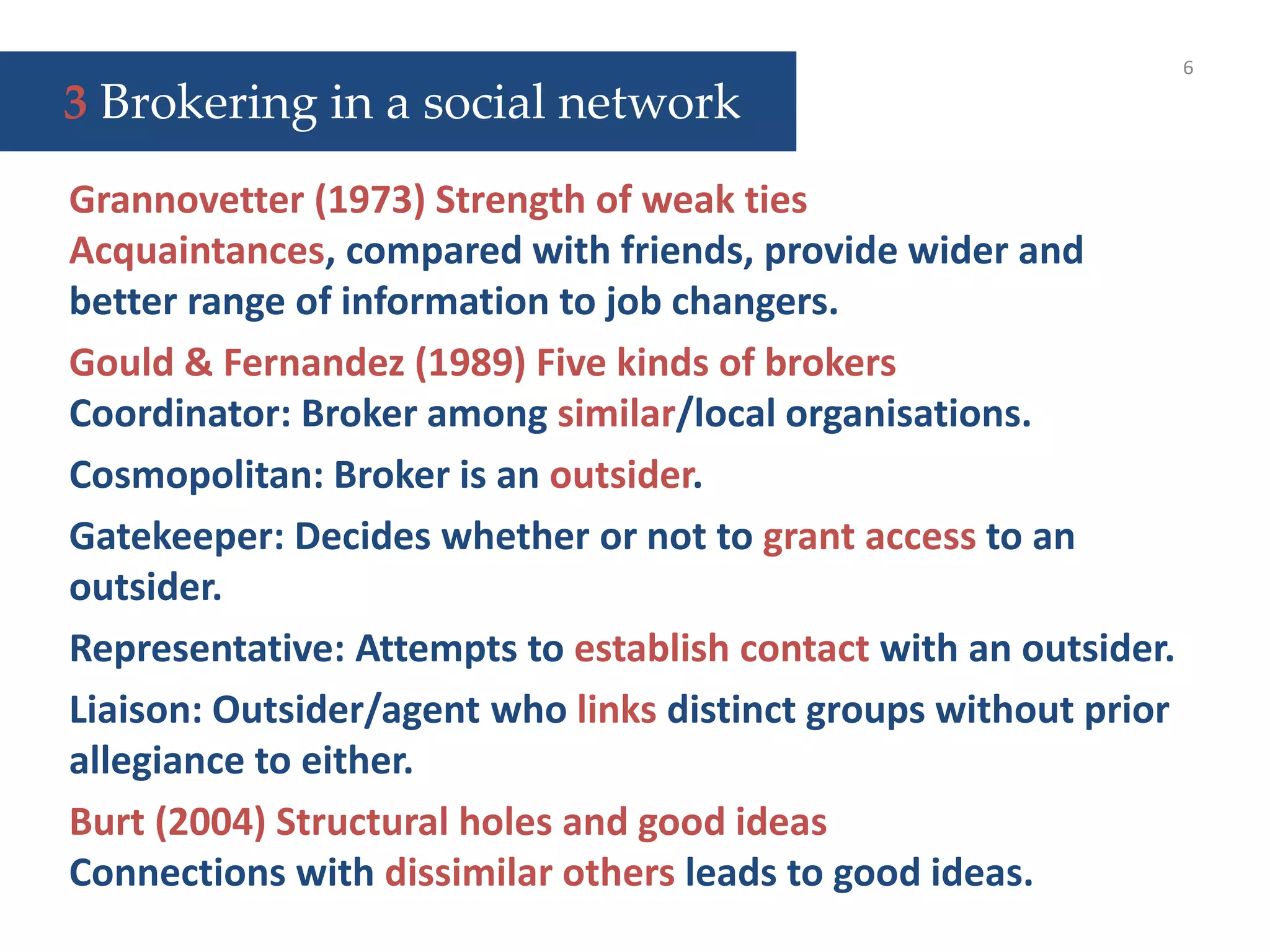
Grannovetter (1973) Strength of weak ties
Acquaintances, compared with friends, provide wider and
better range of information to job changers.
Gould & Fernandez (1989) Five kinds of brokers
Coordinator: Broker among similar/local organisations.
Cosmopolitan: Broker is an outsider.
Gatekeeper: Decides whether or not to grant access to an
outsider.
Representative: Attempts to establish contact with an outsider.
Liaison: Outsider/agent who links distinct groups without prior
allegiance to either.
Burt (2004) Structural holes and good ideas
Connections with dissimilar others leads to good ideas.
3 Brokering in a social network
7
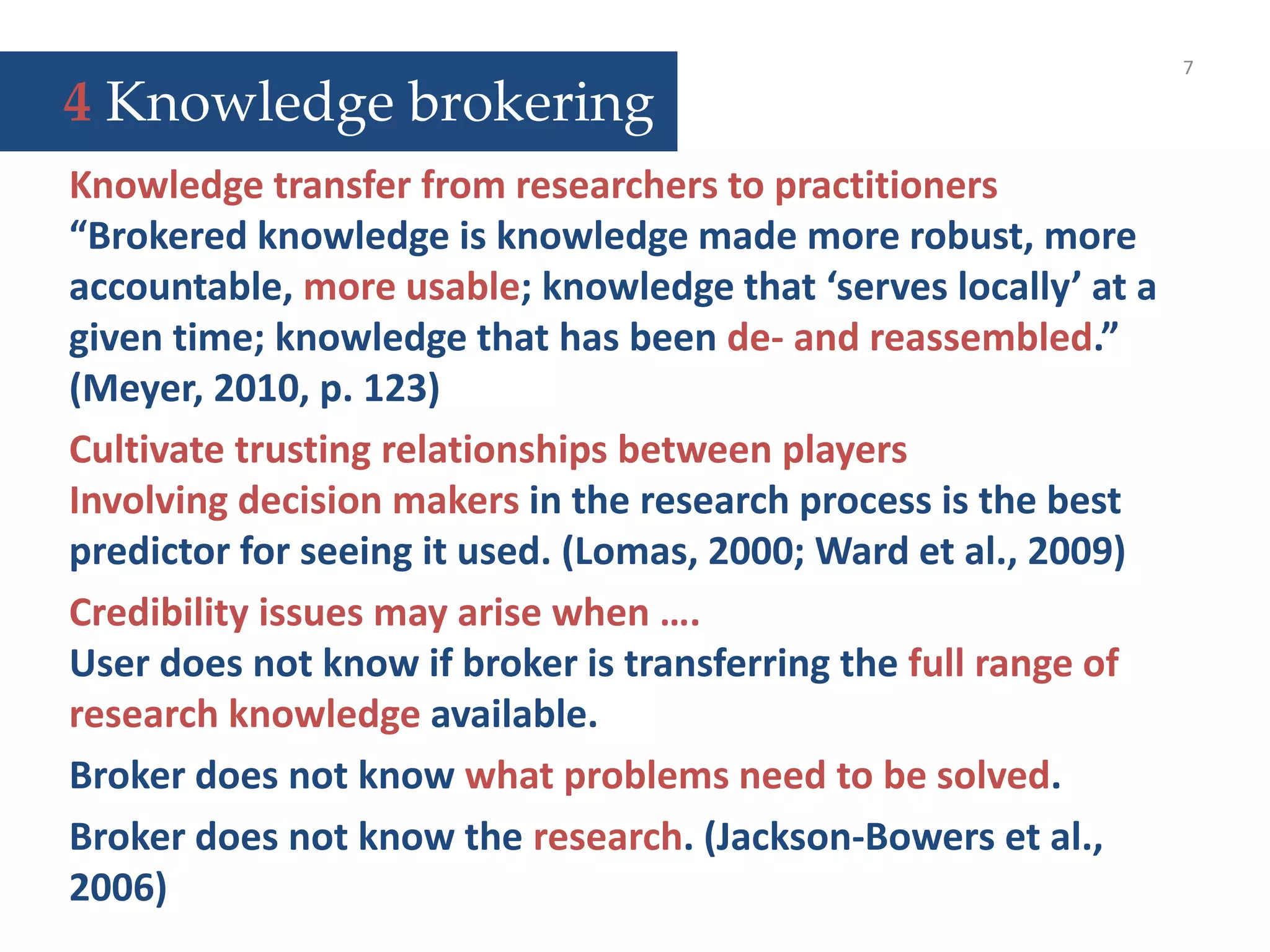
Knowledge transfer from researchers to practitioners
“Brokered knowledge is knowledge made more robust, more
accountable, more usable; knowledge that ‘serves locally’ at a
given time; knowledge that has been de- and reassembled.”
(Meyer, 2010, p. 123)
Cultivate trusting relationships between players
Involving decision makers in the research process is the best
predictor for seeing it used. (Lomas, 2000; Ward et al., 2009)
Credibility issues may arise when ….
User does not know if broker is transferring the full range of
research knowledge available.
Broker does not know what problems need to be solved.
Broker does not know the research. (Jackson-Bowers et al.,
2006)
4 Knowledge brokering
5 Brokering in communities
8
Wenger (1998): Brokering across communities of practice
“… connections provided by people who can introduce elements of
one practice into another.” (Wenger, 1998, p. 105)
Translation, coordination, and alignment between perspectives.
Legitimacy to influence others.
Cause learning by introducing into a practice elements of another.
Lillis & Curry (2006): Literacy brokering for multilingual scholars in
an academic discourse community
Brokers were academic, language, and non- professionals.
Interventions varied from sentence-level corrections to minor and
major shifts in content and knowledge claims.
Large amount of brokering carried out by academic professionals;
although scholars tend to frame these interventions in terms of
language or discourse, in fact, they tend to be related to content.
9
Definition
Interpreting and translating between linguistically and
culturally different parties; performed by bilinguals in daily
situations without special training. (Tse, 1995)
Context: Immigrant families
Child brokers are the middlemen between their family
members, and people and artefacts in their adopted culture.
They translate and interpret a range of documents such as
notes and letters from school, bank statements, immigration
forms and job applications. (Eksner & Orellana, 2012; Morales
et al., 2012; Tse, 1995)
Related terms – literacy brokering (Perry, 2009), cultural
brokering (Hall & Sham, 2007; Martinez et al., 2008)
6 Language brokering
10
Context: Bilingual classrooms
Dual language (English and Spanish) programmes in the US
English-dominant students broker for Spanish-dominant
students and vice versa.
Brokering (teaching) strategies: scaffolding, clarifying, and
providing non-verbal cues. (Angelova et al., 2006; Gort, 2008)
Brokering directionality (unidirectional or reciprocal) and points
of initiation (brokee-initiated or broker-initiated)
“[B]rokering … is a complex, interactional social phenomenon
that gets negotiated moment to moment.” (Coyoca & Lee, 2009,
p. 266)
Coyoca & Lee (2009): Use of positioning theory (Harré &
Langenhove (1999)
Language brokering
11
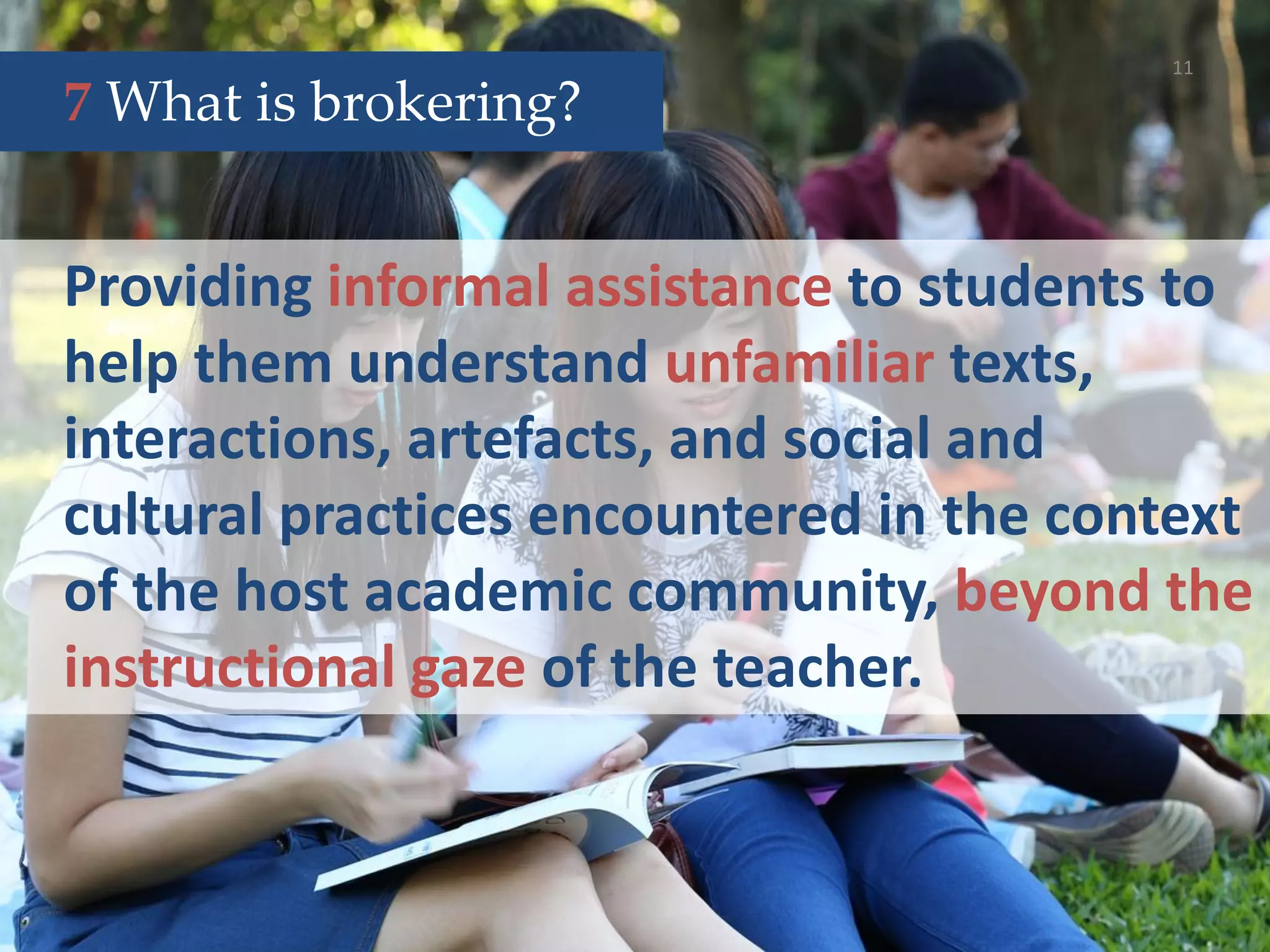
Providing informal assistance to students to
help them understand unfamiliar texts,
interactions, artefacts, and social and
cultural practices encountered in the context
of the host academic community, beyond the
instructional gaze of the teacher.
7 What is brokering?
References
Angelova, M., Gunawardena, D., & Volk, D. (2006). Peer teaching and learning: Co-
constructing language in a dual language first grade. Language and Education,
20(3), 173–190. http://doi.org/10.1080/09500780608668722
Burt, R. S. (2004). Structural holes and good ideas. American Journal of Sociology,
110(2), 349–399.
Coyoca, A. M. A. M., & Lee, J. S. (2009). A typology of language-brokering events in
dual-language immersion classrooms. Bilingual Research Journal, 32(3), 260–279.
http://doi.org/10.1080/15235880903372837
Eksner, H. J., & Orellana, M. F. (2012). Shifting in the zone: Latina/o child language
brokers and the co-construction of knowledge. Ethos, 40(2), 196–220.
http://doi.org/10.1111/j.1548-1352.2012.01246.x
Gort, M. (2008). “You give me idea!”: Collaborative strides toward bilingualism,
biliteracy, and cross-cultural understanding in a two-way partial immersion
program. Multicultural Perspectives, 10(4), 192–200.
http://doi.org/10.1080/15210960802526086
Gould, R. V, & Fernandez, R. M. (1989). Structures of mediation: A formal approach to
brokerage in transaction networks. Sociological Methodology, 19(1989), 89–126.
http://doi.org/10.2307/270949
12
References
Grannovetter, M. S. (1973). The strength of weak ties. The American Journal of
Sociology, 78(6), 1360–1380.
Hall, N., & Sham, S. (2007). Language brokering as young people’s work: Evidence from
Chinese adolescents in England. Language and Education, 21(1), 16–30.
http://doi.org/10.2167/le645.0
Harré, R., & van Langenhove, L. (1999). The dynamics of social episodes. In R. Harré &
L. van Langenhove (Eds.), Positioning theory: Moral contexts of intentional action
(pp. 1–14). Oxford, United Kingdom: Blackwell.
Jackson-Bowers, E., Kalucy, L., & McIntyre, E. (2006). Focus on knowledge brokering.
Primary Health Care Research & Information Service, 2006(4), 1–16.
http://doi.org/10.1517/14712598.2011.582463
Lillis, T., & Curry, M. J. (2006). Professional academic writing by multilingual scholars:
Interactions with literacy brokers in the production of English-medium texts.
Written Communication, 23(1), 3–35. http://doi.org/10.1177/0741088305283754
Lomas, J. (2007). The in-between world of knowledge brokering. British Medical
Journal, 334(7585), 129–132. http://doi.org/10.1136/bmj.39038.593380.AE
Martinez-Cosio, M., & Iannacone, R. M. (2007). The Tenuous Role of Institutional
Agents: Parent Liaisons as Cultural Brokers. Education and Urban Society, 39(3),
349–369. http://doi.org/10.1177/0013124506298165
13
References
Meyer, M. (2010). The Rise of the Knowledge Broker. Science Communication, 32(1),
118–127. http://doi.org/10.1177/1075547009359797
Morales, A., Yakushko, O. F., & Castro, A. J. (2012). Language brokering among Mexican-
immigrant families in the Midwest: A multiple case study. The Counseling
Psychologist, 40(4), 520–553. http://doi.org/10.1177/0011000011417312
Perry, K. H. (2009). Genres, contexts, and literacy practices: Literacy brokering among
Sudanese refugee families. Reading Research Quarterly, 44(3), 256–276.
Stovel, K., Golub, B., & Milgrom, E. M. M. (2011). Stabilizing brokerage. Proceedings of
the National Academy of Sciences, 108(Supplement_4), 21326–21332.
http://doi.org/10.1073/pnas.1100920108
Tse, L. (1995). Language brokering among Latino adolescents: prevalence, attitudes,
and school performance. Hispanic Journal of Behavioral Sciences, 17(2), 180–193.
http://doi.org/10.1177/07399863950172003
Ward, V., House, A., & Hamer, S. (2009). Knowledge brokering: The missing link in the
evidence to action chain? Evidence & Policy: A Journal of Research, Debate and
Practice, 5(3), 267–279. http://doi.org/10.1332/174426409X463811
Wenger, E. (1998). Communities of practice: Learning, meaning, and identity.
Cambridge, United Kingdom: Cambridge University Press.
14

Brokering: A sensitising concept for understanding learning

  • 1.
    Brokering: A sensitizingconcept for understanding learning Sherrie Lee Te Whiringa School of Educational Leadership and Policy Te Kura Toi Tangata Faculty of Education
  • 2.
    Overview 1 Research context 2What is brokering? 3 Brokering in a social network 4 Knowledge brokering 5 Brokering in communities 6 Language brokering 7 What is brokering? 1
  • 3.
    2 International students inhigher education Rapidly increasing enrolments in universities Mostly Asian students (e.g. China, India, South Korea) 20% of student population at University of Waikato Benefits Financial contributions Enhanced reputation Intercultural exchange Issues Cultural Social Educational Research on international students Adjustment studies mostly quantitative Academic challenges in classroom contexts Stereotyped view of EAL students as poor learners 1 Research context
  • 4.
    To explore brokeringpractices among EAL international students at a New Zealand university. 3 Aim of research Informal and social but academically-oriented experiences that EAL international students have with others.
  • 5.
    Trader InterpreterMediator 4 Brokering takesplace when an intermediary (the broker) assists others in the transfer or exchange of goods, services, information, opportunities and/or knowledge; those who receive such assistance (the brokees) would have had great difficulty accessing these things otherwise (Stovel et al., 2011). 2 What is brokering?
  • 6.
    Brokering in differentforms 5 Sociological concept Literacy brokering Knowledge brokering Learning in communities Cultural brokering Language brokering
  • 7.
    6 Grannovetter (1973) Strengthof weak ties Acquaintances, compared with friends, provide wider and better range of information to job changers. Gould & Fernandez (1989) Five kinds of brokers Coordinator: Broker among similar/local organisations. Cosmopolitan: Broker is an outsider. Gatekeeper: Decides whether or not to grant access to an outsider. Representative: Attempts to establish contact with an outsider. Liaison: Outsider/agent who links distinct groups without prior allegiance to either. Burt (2004) Structural holes and good ideas Connections with dissimilar others leads to good ideas. 3 Brokering in a social network
  • 8.
    7 Knowledge transfer fromresearchers to practitioners “Brokered knowledge is knowledge made more robust, more accountable, more usable; knowledge that ‘serves locally’ at a given time; knowledge that has been de- and reassembled.” (Meyer, 2010, p. 123) Cultivate trusting relationships between players Involving decision makers in the research process is the best predictor for seeing it used. (Lomas, 2000; Ward et al., 2009) Credibility issues may arise when …. User does not know if broker is transferring the full range of research knowledge available. Broker does not know what problems need to be solved. Broker does not know the research. (Jackson-Bowers et al., 2006) 4 Knowledge brokering
  • 9.
    5 Brokering incommunities 8 Wenger (1998): Brokering across communities of practice “… connections provided by people who can introduce elements of one practice into another.” (Wenger, 1998, p. 105) Translation, coordination, and alignment between perspectives. Legitimacy to influence others. Cause learning by introducing into a practice elements of another. Lillis & Curry (2006): Literacy brokering for multilingual scholars in an academic discourse community Brokers were academic, language, and non- professionals. Interventions varied from sentence-level corrections to minor and major shifts in content and knowledge claims. Large amount of brokering carried out by academic professionals; although scholars tend to frame these interventions in terms of language or discourse, in fact, they tend to be related to content.
  • 10.
    9 Definition Interpreting and translatingbetween linguistically and culturally different parties; performed by bilinguals in daily situations without special training. (Tse, 1995) Context: Immigrant families Child brokers are the middlemen between their family members, and people and artefacts in their adopted culture. They translate and interpret a range of documents such as notes and letters from school, bank statements, immigration forms and job applications. (Eksner & Orellana, 2012; Morales et al., 2012; Tse, 1995) Related terms – literacy brokering (Perry, 2009), cultural brokering (Hall & Sham, 2007; Martinez et al., 2008) 6 Language brokering
  • 11.
    10 Context: Bilingual classrooms Duallanguage (English and Spanish) programmes in the US English-dominant students broker for Spanish-dominant students and vice versa. Brokering (teaching) strategies: scaffolding, clarifying, and providing non-verbal cues. (Angelova et al., 2006; Gort, 2008) Brokering directionality (unidirectional or reciprocal) and points of initiation (brokee-initiated or broker-initiated) “[B]rokering … is a complex, interactional social phenomenon that gets negotiated moment to moment.” (Coyoca & Lee, 2009, p. 266) Coyoca & Lee (2009): Use of positioning theory (Harré & Langenhove (1999) Language brokering
  • 12.
    11 Providing informal assistanceto students to help them understand unfamiliar texts, interactions, artefacts, and social and cultural practices encountered in the context of the host academic community, beyond the instructional gaze of the teacher. 7 What is brokering?
  • 13.
    References Angelova, M., Gunawardena,D., & Volk, D. (2006). Peer teaching and learning: Co- constructing language in a dual language first grade. Language and Education, 20(3), 173–190. http://doi.org/10.1080/09500780608668722 Burt, R. S. (2004). Structural holes and good ideas. American Journal of Sociology, 110(2), 349–399. Coyoca, A. M. A. M., & Lee, J. S. (2009). A typology of language-brokering events in dual-language immersion classrooms. Bilingual Research Journal, 32(3), 260–279. http://doi.org/10.1080/15235880903372837 Eksner, H. J., & Orellana, M. F. (2012). Shifting in the zone: Latina/o child language brokers and the co-construction of knowledge. Ethos, 40(2), 196–220. http://doi.org/10.1111/j.1548-1352.2012.01246.x Gort, M. (2008). “You give me idea!”: Collaborative strides toward bilingualism, biliteracy, and cross-cultural understanding in a two-way partial immersion program. Multicultural Perspectives, 10(4), 192–200. http://doi.org/10.1080/15210960802526086 Gould, R. V, & Fernandez, R. M. (1989). Structures of mediation: A formal approach to brokerage in transaction networks. Sociological Methodology, 19(1989), 89–126. http://doi.org/10.2307/270949 12
  • 14.
    References Grannovetter, M. S.(1973). The strength of weak ties. The American Journal of Sociology, 78(6), 1360–1380. Hall, N., & Sham, S. (2007). Language brokering as young people’s work: Evidence from Chinese adolescents in England. Language and Education, 21(1), 16–30. http://doi.org/10.2167/le645.0 Harré, R., & van Langenhove, L. (1999). The dynamics of social episodes. In R. Harré & L. van Langenhove (Eds.), Positioning theory: Moral contexts of intentional action (pp. 1–14). Oxford, United Kingdom: Blackwell. Jackson-Bowers, E., Kalucy, L., & McIntyre, E. (2006). Focus on knowledge brokering. Primary Health Care Research & Information Service, 2006(4), 1–16. http://doi.org/10.1517/14712598.2011.582463 Lillis, T., & Curry, M. J. (2006). Professional academic writing by multilingual scholars: Interactions with literacy brokers in the production of English-medium texts. Written Communication, 23(1), 3–35. http://doi.org/10.1177/0741088305283754 Lomas, J. (2007). The in-between world of knowledge brokering. British Medical Journal, 334(7585), 129–132. http://doi.org/10.1136/bmj.39038.593380.AE Martinez-Cosio, M., & Iannacone, R. M. (2007). The Tenuous Role of Institutional Agents: Parent Liaisons as Cultural Brokers. Education and Urban Society, 39(3), 349–369. http://doi.org/10.1177/0013124506298165 13
  • 15.
    References Meyer, M. (2010).The Rise of the Knowledge Broker. Science Communication, 32(1), 118–127. http://doi.org/10.1177/1075547009359797 Morales, A., Yakushko, O. F., & Castro, A. J. (2012). Language brokering among Mexican- immigrant families in the Midwest: A multiple case study. The Counseling Psychologist, 40(4), 520–553. http://doi.org/10.1177/0011000011417312 Perry, K. H. (2009). Genres, contexts, and literacy practices: Literacy brokering among Sudanese refugee families. Reading Research Quarterly, 44(3), 256–276. Stovel, K., Golub, B., & Milgrom, E. M. M. (2011). Stabilizing brokerage. Proceedings of the National Academy of Sciences, 108(Supplement_4), 21326–21332. http://doi.org/10.1073/pnas.1100920108 Tse, L. (1995). Language brokering among Latino adolescents: prevalence, attitudes, and school performance. Hispanic Journal of Behavioral Sciences, 17(2), 180–193. http://doi.org/10.1177/07399863950172003 Ward, V., House, A., & Hamer, S. (2009). Knowledge brokering: The missing link in the evidence to action chain? Evidence & Policy: A Journal of Research, Debate and Practice, 5(3), 267–279. http://doi.org/10.1332/174426409X463811 Wenger, E. (1998). Communities of practice: Learning, meaning, and identity. Cambridge, United Kingdom: Cambridge University Press. 14

Editor's Notes

  • #2 Opener: Imagine you had to spend a considerable length of time in a foreign country, for work or study, how would you go about knowing what to do and how to do things in a different culture? Like preparing documents? Or how to interact with locals? Or joining a sports club? You could read guide books and trawl the internet, but the most likely thing you’d do is to ask someone else. Someone who’s been there, done that, or is there, doing that. These are the people I refer to as brokers; people who help you understand some aspect of a foreign language or culture. In my research on brokering practices among international students, I want to find out who the students’ brokers are, what kind of help students need from them, and how students maintain these brokering relationships. Treating brokering as a sensitizing concept in my research provides “a general sense of reference and guidance in approaching empirical instances” (Blumer, 1954, p. 7). Today, I’’ll be sharing the various manifestations of brokering and hope to start a conversation on how these various understandings of brokering help us understand learning among students.
  • #3 Overview Research context What is brokering? Brokering as social phenomenon Knowledge brokering Language and literacy brokering Literature review on brokering What is brokering?
  • #4 Research context Increasing enrolments of international students in universities Mostly Asian students International students account for 20% of the student population at the University of Waikato Benefits of international students Often cited benefit is financial contribution Presence of international students also contribute to university reputations and rankings There is also the potential for intercultural exchange between international and domestic students and staff Research has also highlighted cultural, social and educational issues, or broadly categorised as adjustment challenges among international students These challenges are related to students having English as a non-native language or English as an additional language – and I will subsequently refer to these students as EAL students Many studies on adjustment challenges are quantitative Qualitative studies that explore academic challenges are often done in classroom contexts The result of such research is a stereotyped view of EAL students as poor learners EAL international students at University of Waikato
  • #5 My response to current research is to reframe how we approach research on international students. I would like to look at their broader learning experiences which I believe include informal and social interactions they have with others. These informal and social interactions are part of what I refer to as brokering practices. So the aim of my research is to explore brokering practices among EAL international students at a New Zealand university.
  • #6 Brokering – a sociological definition Brokering takes place when an intermediary, the broker, assists others in the transfer or exchange of goods, services, information, opportunities and/or knowledge; those who receive such assistance, the brokees, would have had great difficulty accessing the goods, services, information, etc. otherwise (Stovel, Golub, & Milgrom, 2011). Oxford English Dictionary Financial / commercial meaning broker = dealer, agent one who buys on behalf of someone; E.g. stock trader Making connections broker= middleman, intermediary; E.g. interpreter, messenger, negotiator
  • #11 To illustrate how we can understand brokering among EAL students, I refer to Kristen Perry’s (2009) research on literacy brokering among Sudanese refugee families in the US. She documented how family members sought or provided informal assistance about certain aspects of unfamiliar texts and practices. For example, family members helped one another understand and interpret a range of written genres such as unsolicited mail, texts from school, as well as webpages and online forms. Similarly, EAL students may seek help with understanding different types of academic writing and the expectations of assignments.
  • #13 Brokering is a rich concept which helps us understand informal learning interactions among students. Notions of information, knowledge, language, literacy and cultural brokering can help us understand how EAL international students learn about academic literacy in a new social/cultural environment. My definition of brokering in the research is: providing informal assistance with understanding unfamiliar texts, interactions, artefacts (e.g. computer terminals, directories), and social and cultural practices encountered in the context of the host academic community, beyond the instructional gaze of the teacher.