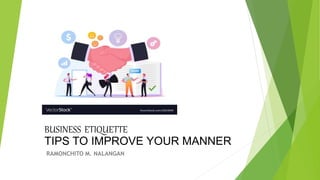
BUSINESS ETIQUETTE
TIPS TO IMPROVE YOUR MANNER
RAMONCHITO M. NALANGAN
Objectives
 To create a professional, mutually
respectful atmosphere and improves
communication, which helps an office serve as a
productive place.
 To exhibit behavior that leads to good manners
and common courtesy in a workplace.
PRE-TEST
It takes twenty years to build a
reputation and five minutes to
ruin it. If you think about that,
you’ll do things differently.
Warren
Buffet
Etiquette?
 The word "etiquette" comes from the French word
"estique," meaning to attach or stick. The noun
"etiquette" describes the requirements of
behaviors according to the conventions of society.
It includes the proper conduct that is established
by a community for various occasions, including
ceremonies, court, formal events and everyday
life. Although people have become more casual in
recent years, etiquette is not outdated.
 The short definition at Merriam-Webster.com is
"the rules indicating the proper and polite way to
behave." The full definition is "the conduct or
procedure required by good breeding or
prescribed by authority to be observed in social or
official life."
What is Business Etiquette?
 It is about building relationships with other
people.
 It is not about rules & regulations but is about
providing basic social comfort and creating an
environment where others feel comfortable and
secure,
 It is possible through better communication.
Business Etiquette
 As times change, so do social norms for personal
and professional behavior, but that doesn't mean
basic etiquette doesn't matter.
 Performance and quality are important, but not
exclusive.
 We must not forget that business is about people.
 There is no shortage of competent and reliable
people in the business world and manners can
make the difference.
Cont…
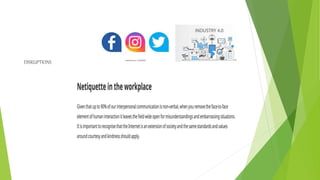
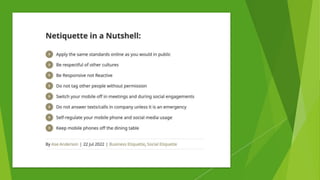
 Social media communication platforms (i.e.
Facebook, Linkedin) are evolving rapidly day by
day, as the concept of social media
etiquette(netiquette) becomes a crucial part of
business.
DISRUPTIONS
Business etiquette consists of two things.
 Firstly, thoughtful consideration of the interests and
feelings of others
 Secondly, being able to minimize misunderstandings.
These are influenced by individual behaviors & demeanor.
Business etiquette instructs this behavior.
Cont….
 Business etiquette differs from region to region and from
country to country.
 This creates a complex situation for people as it is hard to
balance the focus on both international business etiquette
and other business activities at the same time.
Therefore, a wise step is to focus on some key pillars of
business etiquette.
Elements of Business Etiquette
Business etiquette instructs on you how to present yourself
professionally in different cultures.
The keys for making a good impression
 Dressing appropriately
 Your body language
 Presenting your business cards
 Gift giving (Shāngwù sònglǐ)
 Conducting meetings etc.
Basic Rules of Business Etiquette
 When in doubt, introduce
others.
Always introduce people to
others whenever the opportunity
arises, unless you know that
they’re already acquainted. It
makes people feel valued,
regardless of their status or
position.
 Know the Names
Give others respect by knowing
their names which will increase
goodwill and communication. It is
also worth management stepping
back and acknowledging people
individually for their good work as
this will enhance their self esteem
and increase motivation.
 A handshake is still the professional standard.
Not only does this simple gesture demonstrate that
you’re polite, confident and approachable, it also sets the
tone for any potential future professional relationship. In a
very casual work atmosphere, you might be able to get away
with a nod or a hello, but it’s worth it to make the extra
effort to offer your hand.
 Always say “Please” and “Thank you.”
This should go without saying, but even in a very casual
professional atmosphere, this basic form of courtesy is still
imperative. Today, sending a thank you email is perfectly
acceptable, but a handwritten thank you note is always a
nice touch.
 Don’t interrupt.
We’ve become a nation of “over-talkers,” so eager to
offer our own opinions or press our point that we often
interrupt others mid-sentence. It can be tongue-bitingly
difficult to force ourselves not to interject, especially when
the discussion is heated. Don’t. It’s rude and shows
disrespect for the opinions of others. Remember, be
assertive, not aggressive.
 Watch your language.
Verbal and written communications
are often much less formal than in
times past but be careful to choose
your words wisely. Of course,
derogatory, rude or offensive language
is unacceptable, but so is slang. While
it may be commonplace in our society,
it’s never acceptable in a professional
atmosphere.
 Double check before you hit send.
While we’re on the subject of
communication, always check
your emails for spelling and grammar
errors. Since the advent of spell check,
there is no excuse for typos. Also, do a
quick read to make sure the meaning
and tone are what you wish to convey.
And no smileys, please.
 Don’t walk into someone’s office
unannounced.
It’s disrespectful to assume that
you have the right to interrupt other
people’s work. Knock on the door or
say hello if it’s open and ask if it’s a
good time to talk. If the discussion
is going to take more than a few
minutes, it’s a good idea to call or
e-mail and schedule a good time for
both of you.
 For better business etiquette,
be on time.
We’re all busy. Being punctual
shows others that you value their
time. Being late doesn’t mean that
you’re busier than other people; it
just means that you’re
inconsiderate.
 Don’t gossip.
It’s so hard sometimes to resist engaging in a little
“harmless” gossip. But the reality is that gossip is never
harmless. It is most certainly damaging to the subject of the
gossip, but it also reflects poorly on you. It’s natural to be
curious and interested in what other people are doing but
talking about someone who is not present is disrespectful.
 Don’t Judge
Everyone is unique in their own
way and uses a different approach
to deal with situations. Therefore, if
you disagree with another person’s
approach instead of criticizing try to
understand it from their point of
view. By doing so, you create a
friendly environment. Always
remember you get respect by giving
respect.
Whether in business or between individuals, one concern
is brand awareness. Individuals want to be noticed both
socially and professionally. People want to be remembered
by others.
However, in the digital landscape you have to be very
careful when trying to pursue your brand awareness. Think
carefully before doing. What we mean by this is that before
creating a hashtag, posting on a Facebook wall or texting –
think how the other person will feel when they receive your
message.
 Don’t eavesdrop.
Everyone is entitled to private conversations, in person
or over the phone. The same goes for email; don’t stand
over someone’s shoulder and read their emails.
 Focus on the Face, Not the
Screen
Never forget to switch off your
phone and try not to use any other
device just to prove you are a
multitasking individual. In fact, in
the world of business this is
considered bad manners.
Concentrate on the meeting and
listen to what people are saying.
 No phone during meetings.
When you’re in a meeting, focus on the meeting
discussion. Don’t take calls, text or check email. It’s
disrespectful to the other attendees, not to mention
extremely annoying. It also makes meetings last longer
because the participants keep losing focus.
 Show genuine interest.
Keep eye contact and make an
effort to truly listen to what others
are saying. We are so easily
distracted in this climate of
increasingly short attention spans; we
often can’t wait for the other person
to hurry up and finish so we can move
on to the next thing. Resist the lure
of distraction and haste. Take the
time to ask questions and show an
interest in the other person’s
thoughts.
 Acknowledge others.
When someone approaches you,
acknowledge him or her. If you’re in
the middle of something important,
it’s fine to ask them to wait a
minute while you finish. If you pass
someone in the hallway or on the
street, but don’t have time to talk,
at least wave a hand and say hello.
Business is not an excuse to ignore
people.
 Avoid the “Big Two.”
We have blurred many of the
personal and professional lines, but
politics and religion are still off-
limits. These topics are highly
charged minefields for a
professional atmosphere. Leave
them at the office door.
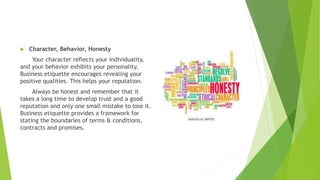
 Character, Behavior, Honesty
Your character reflects your individuality,
and your behavior exhibits your personality.
Business etiquette encourages revealing your
positive qualities. This helps your reputation.
Always be honest and remember that it
takes a long time to develop trust and a good
reputation and only one small mistake to lose it.
Business etiquette provides a framework for
stating the boundaries of terms & conditions,
contracts and promises.
 Sensitivity & Diplomacy
A key pillar of business etiquette
is sensitivity, meaning giving careful
thought to every business aspect
before making a judgement. This
gives a strong foundation to your
business. Also, thoughtless words
and actions lead to a negative
outcome. Being aware of business
etiquette encourages careful
thought.
Video
Quotable Quotes
 "Arriving late was a way of saying that your own time was more valuable
than the time of the person who waited for you." ― Karen Joy Fowler
 "Standards are not established by your proclamations they are established
by your routines." -- T Jay Taylor
 "Great things are not done by impulse, but by a series of small things
brought together." -- Vincent Van Gogh
 "Success means we go to sleep at night knowing that our talents and
abilities were used in a way that served others." -- Marianne Williamson
 "Cleanliness and order are not matters of instinct; they are matters of
education, and like most great things, you must cultivate a taste for
them." -- Benjamin Disraeli
Q & A
References
 Scuderi, Royale (2021) Basic Rules of Business Etiquette.
https://www.americanexpress.com/en-us/business/trends-and-
insights/articles/15-vital-business-etiquette-rules/
 International Business Etiquette – definition and tips
https://businessculture.org/business-culture/business-etiquette/

Bus. Etiquette.pptx

  • 1.
    BUSINESS ETIQUETTE TIPS TOIMPROVE YOUR MANNER RAMONCHITO M. NALANGAN
  • 2.
    Objectives  To createa professional, mutually respectful atmosphere and improves communication, which helps an office serve as a productive place.  To exhibit behavior that leads to good manners and common courtesy in a workplace.
  • 3.
  • 4.
    It takes twentyyears to build a reputation and five minutes to ruin it. If you think about that, you’ll do things differently. Warren Buffet
  • 5.
    Etiquette?  The word"etiquette" comes from the French word "estique," meaning to attach or stick. The noun "etiquette" describes the requirements of behaviors according to the conventions of society. It includes the proper conduct that is established by a community for various occasions, including ceremonies, court, formal events and everyday life. Although people have become more casual in recent years, etiquette is not outdated.
  • 6.
     The shortdefinition at Merriam-Webster.com is "the rules indicating the proper and polite way to behave." The full definition is "the conduct or procedure required by good breeding or prescribed by authority to be observed in social or official life."
  • 7.
    What is BusinessEtiquette?  It is about building relationships with other people.  It is not about rules & regulations but is about providing basic social comfort and creating an environment where others feel comfortable and secure,  It is possible through better communication.
  • 8.
    Business Etiquette  Astimes change, so do social norms for personal and professional behavior, but that doesn't mean basic etiquette doesn't matter.  Performance and quality are important, but not exclusive.  We must not forget that business is about people.  There is no shortage of competent and reliable people in the business world and manners can make the difference.
  • 9.
    Cont…  Social mediacommunication platforms (i.e. Facebook, Linkedin) are evolving rapidly day by day, as the concept of social media etiquette(netiquette) becomes a crucial part of business.
  • 10.
  • 12.
    Business etiquette consistsof two things.  Firstly, thoughtful consideration of the interests and feelings of others  Secondly, being able to minimize misunderstandings. These are influenced by individual behaviors & demeanor. Business etiquette instructs this behavior.
  • 13.
    Cont….  Business etiquettediffers from region to region and from country to country.  This creates a complex situation for people as it is hard to balance the focus on both international business etiquette and other business activities at the same time. Therefore, a wise step is to focus on some key pillars of business etiquette.
  • 14.
    Elements of BusinessEtiquette Business etiquette instructs on you how to present yourself professionally in different cultures. The keys for making a good impression  Dressing appropriately  Your body language  Presenting your business cards  Gift giving (Shāngwù sònglǐ)  Conducting meetings etc.
  • 15.
    Basic Rules ofBusiness Etiquette  When in doubt, introduce others. Always introduce people to others whenever the opportunity arises, unless you know that they’re already acquainted. It makes people feel valued, regardless of their status or position.
  • 16.
     Know theNames Give others respect by knowing their names which will increase goodwill and communication. It is also worth management stepping back and acknowledging people individually for their good work as this will enhance their self esteem and increase motivation.
  • 17.
     A handshakeis still the professional standard. Not only does this simple gesture demonstrate that you’re polite, confident and approachable, it also sets the tone for any potential future professional relationship. In a very casual work atmosphere, you might be able to get away with a nod or a hello, but it’s worth it to make the extra effort to offer your hand.
  • 18.
     Always say“Please” and “Thank you.” This should go without saying, but even in a very casual professional atmosphere, this basic form of courtesy is still imperative. Today, sending a thank you email is perfectly acceptable, but a handwritten thank you note is always a nice touch.
  • 19.
     Don’t interrupt. We’vebecome a nation of “over-talkers,” so eager to offer our own opinions or press our point that we often interrupt others mid-sentence. It can be tongue-bitingly difficult to force ourselves not to interject, especially when the discussion is heated. Don’t. It’s rude and shows disrespect for the opinions of others. Remember, be assertive, not aggressive.
  • 20.
     Watch yourlanguage. Verbal and written communications are often much less formal than in times past but be careful to choose your words wisely. Of course, derogatory, rude or offensive language is unacceptable, but so is slang. While it may be commonplace in our society, it’s never acceptable in a professional atmosphere.
  • 21.
     Double checkbefore you hit send. While we’re on the subject of communication, always check your emails for spelling and grammar errors. Since the advent of spell check, there is no excuse for typos. Also, do a quick read to make sure the meaning and tone are what you wish to convey. And no smileys, please.
  • 22.
     Don’t walkinto someone’s office unannounced. It’s disrespectful to assume that you have the right to interrupt other people’s work. Knock on the door or say hello if it’s open and ask if it’s a good time to talk. If the discussion is going to take more than a few minutes, it’s a good idea to call or e-mail and schedule a good time for both of you.
  • 23.
     For betterbusiness etiquette, be on time. We’re all busy. Being punctual shows others that you value their time. Being late doesn’t mean that you’re busier than other people; it just means that you’re inconsiderate.
  • 24.
     Don’t gossip. It’sso hard sometimes to resist engaging in a little “harmless” gossip. But the reality is that gossip is never harmless. It is most certainly damaging to the subject of the gossip, but it also reflects poorly on you. It’s natural to be curious and interested in what other people are doing but talking about someone who is not present is disrespectful.
  • 26.
     Don’t Judge Everyoneis unique in their own way and uses a different approach to deal with situations. Therefore, if you disagree with another person’s approach instead of criticizing try to understand it from their point of view. By doing so, you create a friendly environment. Always remember you get respect by giving respect.
  • 28.
    Whether in businessor between individuals, one concern is brand awareness. Individuals want to be noticed both socially and professionally. People want to be remembered by others. However, in the digital landscape you have to be very careful when trying to pursue your brand awareness. Think carefully before doing. What we mean by this is that before creating a hashtag, posting on a Facebook wall or texting – think how the other person will feel when they receive your message.
  • 30.
     Don’t eavesdrop. Everyoneis entitled to private conversations, in person or over the phone. The same goes for email; don’t stand over someone’s shoulder and read their emails.
  • 31.
     Focus onthe Face, Not the Screen Never forget to switch off your phone and try not to use any other device just to prove you are a multitasking individual. In fact, in the world of business this is considered bad manners. Concentrate on the meeting and listen to what people are saying.
  • 32.
     No phoneduring meetings. When you’re in a meeting, focus on the meeting discussion. Don’t take calls, text or check email. It’s disrespectful to the other attendees, not to mention extremely annoying. It also makes meetings last longer because the participants keep losing focus.
  • 33.
     Show genuineinterest. Keep eye contact and make an effort to truly listen to what others are saying. We are so easily distracted in this climate of increasingly short attention spans; we often can’t wait for the other person to hurry up and finish so we can move on to the next thing. Resist the lure of distraction and haste. Take the time to ask questions and show an interest in the other person’s thoughts.
  • 34.
     Acknowledge others. Whensomeone approaches you, acknowledge him or her. If you’re in the middle of something important, it’s fine to ask them to wait a minute while you finish. If you pass someone in the hallway or on the street, but don’t have time to talk, at least wave a hand and say hello. Business is not an excuse to ignore people.
  • 35.
     Avoid the“Big Two.” We have blurred many of the personal and professional lines, but politics and religion are still off- limits. These topics are highly charged minefields for a professional atmosphere. Leave them at the office door.
  • 36.
     Character, Behavior,Honesty Your character reflects your individuality, and your behavior exhibits your personality. Business etiquette encourages revealing your positive qualities. This helps your reputation. Always be honest and remember that it takes a long time to develop trust and a good reputation and only one small mistake to lose it. Business etiquette provides a framework for stating the boundaries of terms & conditions, contracts and promises.
  • 37.
     Sensitivity &Diplomacy A key pillar of business etiquette is sensitivity, meaning giving careful thought to every business aspect before making a judgement. This gives a strong foundation to your business. Also, thoughtless words and actions lead to a negative outcome. Being aware of business etiquette encourages careful thought.
  • 38.
  • 39.
    Quotable Quotes  "Arrivinglate was a way of saying that your own time was more valuable than the time of the person who waited for you." ― Karen Joy Fowler  "Standards are not established by your proclamations they are established by your routines." -- T Jay Taylor  "Great things are not done by impulse, but by a series of small things brought together." -- Vincent Van Gogh  "Success means we go to sleep at night knowing that our talents and abilities were used in a way that served others." -- Marianne Williamson  "Cleanliness and order are not matters of instinct; they are matters of education, and like most great things, you must cultivate a taste for them." -- Benjamin Disraeli
  • 40.
  • 41.
    References  Scuderi, Royale(2021) Basic Rules of Business Etiquette. https://www.americanexpress.com/en-us/business/trends-and- insights/articles/15-vital-business-etiquette-rules/  International Business Etiquette – definition and tips https://businessculture.org/business-culture/business-etiquette/