Treatment and Education of
Autistic and related
Communication
handicapped CHildren
TEACCH PROGRAMME
By
Dr Heba Essawy
What is TEACCH?
 Division TEACCH started in 1966 as part of
the Department of Psychiatry of the School of
Medicine at the University of North Carolina in
the USA.
 In 1972 the North Carolina General Assembly
passed legislation which enabled Division
TEACCH to become the first comprehensive
state-wide community-based programme of
services for autism and other similar
developmental disorders.
Aim of TEACCH
programme
 Prepare people with autism to live or
work more effectively at home, at
school and in the community.
 Special emphasis is placed on helping
people with autism and their families
live together more effectively by
reducing or removing 'autistic
behaviours'.
What is TEACCH?
 Diagnosis or Assessment. (PEP)
 Individualized Education programmes.(IEP)
Special education.
Social skills training.
Vocational training.
School consultations.
Parent training and counseling .
The TEACCH concept
 Improved adaptation: through the
two strategies of improving skills by
means of education and of modifying
the environment to accommodate
deficits.
 Parent collaboration: parents work
with professionals as co-therapists for
their children so that techniques can be
continued at home.
TEACCH concept
 Structured Teaching: Children with
autism benefit more from a structured
educational environment than from free
approaches.
TEACCH concept
 Structured class room:
1. Art.
2. Language.
3. Vocation.
4. Concepts
5. Listening.
6. Play Area.
TEACCH concept
 Structured Materials.
- Puzzles.
- - Pins.
 Scheduled board.( Exchange diary).
 Next Work Activity. (Pictures or blocks).
 Sound of Bell.
 Communication Functions.( Visual
Cues).
TEACCH concept
 Skill enhancement: assessment
identifies emerging skills and work then
focuses upon
 Cognitive and Behaviour Therapy
Educational procedures ,suggesting
that difficult behaviour may result from
underlying problems in perception and
understanding.
TEACCH concept
 Generalist Training: professionals in
the TEACCH system are trained as
generalists who understand the whole
child, and do not specialize as
psychologists, speech therapists.
TEACCH concept
 METHODS OF COMMUNACATION:
1. Words.
2. Gestures.
3. Pictures.
4. Objects.
5. Cards.
Psychoeducational profile
1. PEP tests :
 Identifie developmental level
 Clinical measure of ability in
developmental disability.
 Many nonverbal items .
 Flexible and untimed items.
 Normative data from 2 to 7 years
Psychoeducational
profile
 TASK Assessment:
- Pass or Appropriate( 2)
-Emerge or Mild (1)
- Fail or Severe( 0)
 Caregiver report for identifie developmental
level , degree of problem.
 Collaboration between parents & teachers.
PEP- 3
Examiner scoring
 - Section 1. Identifying Information.
 - Section 2. Record Of Subtest Scores
* Performance Subtests (10 items).
* Care Giver Subtests (3 items ).
Performance Subtests
 Developmental Ability:
1- Cognitive Verbal /preverbal.
2- Expressive Language .
3- Receptive Language.
4- Fine Motor .
5- Gross motor.
6- Visual- Motor Imitation.
Performance Subtests
 Maladaptive Behavior:
7- Affective Expression.
8- Social Reciprocity.
9- Characteristic Motor Behavior.
10- Characteristic Verbal Behavior.
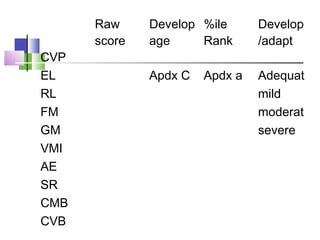
Raw
score
Develop
age
%ile
Rank
Develop
/adapt
CVP
EL Apdx C Apdx a Adequat
RL mild
FM moderat
GM severe
VMI
AE
SR
CMB
CVB
Caregiver Report Subtest
 Problem Behavior .
 Personal self- care .
 Adaptive Behavior .
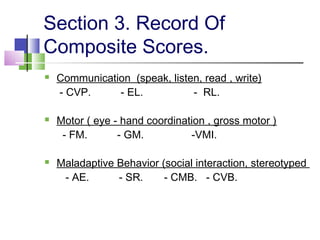
Section 3. Record Of
Composite Scores.
 Communication (speak, listen, read , write)
- CVP. - EL. - RL.
 Motor ( eye - hand coordination , gross motor )
- FM. - GM. -VMI.
 Maladaptive Behavior (social interaction, stereotyped
- AE. - SR. - CMB. - CVB.
Psychoeducational
profile- 3rd
edition
Section 4 .
Performance Subtest Scoring (172 items).
Section 5.
Caregiver Report subtest Scoring
. .
.
.
Psychoeducational profile- 3rd
edition
 Section 6. Profile of Developmental
Ages ( develop. Curve).
 Section 7. Interpretation and
recommendations.
 Section 8. Scoring for items 85, 86, 3 to
95.
Record of SUBTEST
scores
PERFORMANCE Subtest TEST :
1-Cognitive Verbal- Preverbal subtests (CVP)
(34 items )
- Verbal naming.
- SEQUENCING.
- Visual motor integration.
- Problem solving.
PERFORMANCE TESTPERFORMANCE TEST
2- Expressive language:(25 items)
Ability to express himself by speaking,
gestuting
- Requesting food.
- Naming.
3- Receptive language(19)
Ability to understasnd spoken language
- Identify letters , mean action verbs.
- Pointing body parts. colors.
PERFORMANCE TESTPERFORMANCE TEST
4-4- Fine motor (20 item):(3-4ys)Fine motor (20 item):(3-4ys)
- Coordination of different body parts.
- Blowing bubbles.
- Scissor grasp.
- Coloring within lines.
PERFORMANCE TEST
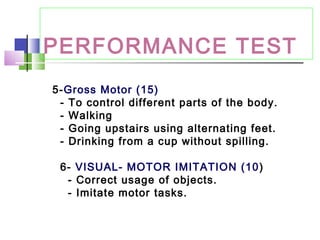
5-Gross Motor (15)
- To control different parts of the body.
- Walking
- Going upstairs using alternating feet.
- Drinking from a cup without spilling.
6- VISUAL- MOTOR IMITATION (10)
- Correct usage of objects.
- Imitate motor tasks.
PERFORMANCE TEST
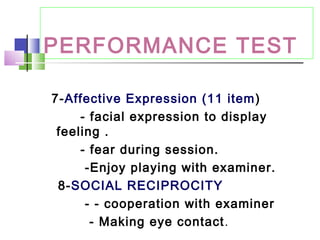
7-Affective Expression (11 item)
- facial expression to display
feeling .
- fear during session.
-Enjoy playing with examiner.
8-SOCIAL RECIPROCITY
- - cooperation with examiner
- Making eye contact.
PERFORMANCE TEST
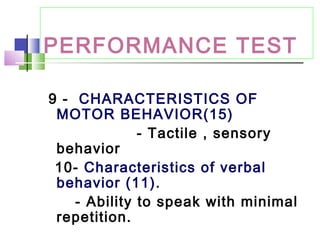
9 - CHARACTERISTICS OF
MOTOR BEHAVIOR(15)
- Tactile , sensory
behavior
10- Characteristics of verbal
behavior (11).
- Ability to speak with minimal
repetition.
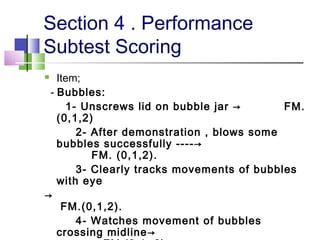
Section 4 . Performance
Subtest Scoring
 Item;
- Bubbles:
1- Unscrews lid on bubble jar → FM.
(0,1,2)
2- After demonstration , blows some
bubbles successfully ----→
FM. (0,1,2).
3- Clearly tracks movements of bubbles
with eye
→
FM.(0,1,2).
4- Watches movement of bubbles
crossing midline→
Section 5.Caregiver Report
Subtest Scoring
 Problem Behaviors
- Not A Problem= 2
- Mild/Moderate =1
- Severe Problem=0
 Personal self-Care *Adaptive Behavior
- First line=2.
- Second Line=1
- Third Line=0
Total Raw Score:------ --------- ---------
Section 6. Profile of
Developmental Ages
 CVP
 EL
 RL AGE IN MONTH
 FM
 GM CURVE
 VMI
 PSC
Section 7. Interpretation and
Recommendation
 Recording other information, further
assessment and intervention.
 Section 8. Scoring for special item
- points to picture (0-1).
- What it this ? (0-1).
Case formulation
1. Pattern of strengths and weaknesses.
2. Analysis of individual item passing and
emerging.
3. Review of pattern of maladaptive
behavior.
4. Review caregiver information.
5. Recommendation for educational
programming
THANK YOU
Psychoeducational
profile- 3rd
edition
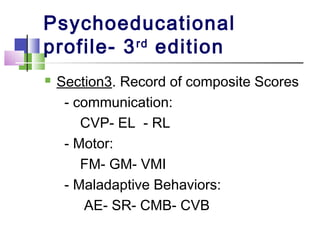
 Section3. Record of composite Scores
- communication:
CVP- EL - RL
- Motor:
FM- GM- VMI
- Maladaptive Behaviors:
AE- SR- CMB- CVB

Teacch programme for Autism spectrum Disorder

  • 1.
    Treatment and Educationof Autistic and related Communication handicapped CHildren TEACCH PROGRAMME By Dr Heba Essawy
  • 2.
    What is TEACCH? Division TEACCH started in 1966 as part of the Department of Psychiatry of the School of Medicine at the University of North Carolina in the USA.  In 1972 the North Carolina General Assembly passed legislation which enabled Division TEACCH to become the first comprehensive state-wide community-based programme of services for autism and other similar developmental disorders.
  • 3.
    Aim of TEACCH programme Prepare people with autism to live or work more effectively at home, at school and in the community.  Special emphasis is placed on helping people with autism and their families live together more effectively by reducing or removing 'autistic behaviours'.
  • 4.
    What is TEACCH? Diagnosis or Assessment. (PEP)  Individualized Education programmes.(IEP) Special education. Social skills training. Vocational training. School consultations. Parent training and counseling .
  • 5.
    The TEACCH concept Improved adaptation: through the two strategies of improving skills by means of education and of modifying the environment to accommodate deficits.  Parent collaboration: parents work with professionals as co-therapists for their children so that techniques can be continued at home.
  • 6.
    TEACCH concept  StructuredTeaching: Children with autism benefit more from a structured educational environment than from free approaches.
  • 7.
    TEACCH concept  Structuredclass room: 1. Art. 2. Language. 3. Vocation. 4. Concepts 5. Listening. 6. Play Area.
  • 8.
    TEACCH concept  StructuredMaterials. - Puzzles. - - Pins.  Scheduled board.( Exchange diary).  Next Work Activity. (Pictures or blocks).  Sound of Bell.  Communication Functions.( Visual Cues).
  • 9.
    TEACCH concept  Skillenhancement: assessment identifies emerging skills and work then focuses upon  Cognitive and Behaviour Therapy Educational procedures ,suggesting that difficult behaviour may result from underlying problems in perception and understanding.
  • 10.
    TEACCH concept  GeneralistTraining: professionals in the TEACCH system are trained as generalists who understand the whole child, and do not specialize as psychologists, speech therapists.
  • 11.
    TEACCH concept  METHODSOF COMMUNACATION: 1. Words. 2. Gestures. 3. Pictures. 4. Objects. 5. Cards.
  • 12.
    Psychoeducational profile 1. PEPtests :  Identifie developmental level  Clinical measure of ability in developmental disability.  Many nonverbal items .  Flexible and untimed items.  Normative data from 2 to 7 years
  • 13.
    Psychoeducational profile  TASK Assessment: -Pass or Appropriate( 2) -Emerge or Mild (1) - Fail or Severe( 0)  Caregiver report for identifie developmental level , degree of problem.  Collaboration between parents & teachers.
  • 14.
    PEP- 3 Examiner scoring - Section 1. Identifying Information.  - Section 2. Record Of Subtest Scores * Performance Subtests (10 items). * Care Giver Subtests (3 items ).
  • 15.
    Performance Subtests  DevelopmentalAbility: 1- Cognitive Verbal /preverbal. 2- Expressive Language . 3- Receptive Language. 4- Fine Motor . 5- Gross motor. 6- Visual- Motor Imitation.
  • 16.
    Performance Subtests  MaladaptiveBehavior: 7- Affective Expression. 8- Social Reciprocity. 9- Characteristic Motor Behavior. 10- Characteristic Verbal Behavior.
  • 17.
    Raw score Develop age %ile Rank Develop /adapt CVP EL Apdx CApdx a Adequat RL mild FM moderat GM severe VMI AE SR CMB CVB
  • 18.
    Caregiver Report Subtest Problem Behavior .  Personal self- care .  Adaptive Behavior .
  • 19.
    Section 3. RecordOf Composite Scores.  Communication (speak, listen, read , write) - CVP. - EL. - RL.  Motor ( eye - hand coordination , gross motor ) - FM. - GM. -VMI.  Maladaptive Behavior (social interaction, stereotyped - AE. - SR. - CMB. - CVB.
  • 20.
    Psychoeducational profile- 3rd edition Section 4. Performance Subtest Scoring (172 items). Section 5. Caregiver Report subtest Scoring . . . .
  • 21.
    Psychoeducational profile- 3rd edition Section 6. Profile of Developmental Ages ( develop. Curve).  Section 7. Interpretation and recommendations.  Section 8. Scoring for items 85, 86, 3 to 95.
  • 22.
    Record of SUBTEST scores PERFORMANCESubtest TEST : 1-Cognitive Verbal- Preverbal subtests (CVP) (34 items ) - Verbal naming. - SEQUENCING. - Visual motor integration. - Problem solving.
  • 23.
    PERFORMANCE TESTPERFORMANCE TEST 2-Expressive language:(25 items) Ability to express himself by speaking, gestuting - Requesting food. - Naming. 3- Receptive language(19) Ability to understasnd spoken language - Identify letters , mean action verbs. - Pointing body parts. colors.
  • 24.
    PERFORMANCE TESTPERFORMANCE TEST 4-4-Fine motor (20 item):(3-4ys)Fine motor (20 item):(3-4ys) - Coordination of different body parts. - Blowing bubbles. - Scissor grasp. - Coloring within lines.
  • 25.
    PERFORMANCE TEST 5-Gross Motor(15) - To control different parts of the body. - Walking - Going upstairs using alternating feet. - Drinking from a cup without spilling. 6- VISUAL- MOTOR IMITATION (10) - Correct usage of objects. - Imitate motor tasks.
  • 26.
    PERFORMANCE TEST 7-Affective Expression(11 item) - facial expression to display feeling . - fear during session. -Enjoy playing with examiner. 8-SOCIAL RECIPROCITY - - cooperation with examiner - Making eye contact.
  • 27.
    PERFORMANCE TEST 9 -CHARACTERISTICS OF MOTOR BEHAVIOR(15) - Tactile , sensory behavior 10- Characteristics of verbal behavior (11). - Ability to speak with minimal repetition.
  • 28.
    Section 4 .Performance Subtest Scoring  Item; - Bubbles: 1- Unscrews lid on bubble jar → FM. (0,1,2) 2- After demonstration , blows some bubbles successfully ----→ FM. (0,1,2). 3- Clearly tracks movements of bubbles with eye → FM.(0,1,2). 4- Watches movement of bubbles crossing midline→
  • 29.
    Section 5.Caregiver Report SubtestScoring  Problem Behaviors - Not A Problem= 2 - Mild/Moderate =1 - Severe Problem=0  Personal self-Care *Adaptive Behavior - First line=2. - Second Line=1 - Third Line=0 Total Raw Score:------ --------- ---------
  • 30.
    Section 6. Profileof Developmental Ages  CVP  EL  RL AGE IN MONTH  FM  GM CURVE  VMI  PSC
  • 31.
    Section 7. Interpretationand Recommendation  Recording other information, further assessment and intervention.  Section 8. Scoring for special item - points to picture (0-1). - What it this ? (0-1).
  • 32.
    Case formulation 1. Patternof strengths and weaknesses. 2. Analysis of individual item passing and emerging. 3. Review of pattern of maladaptive behavior. 4. Review caregiver information. 5. Recommendation for educational programming
  • 33.
  • 35.
    Psychoeducational profile- 3rd edition  Section3.Record of composite Scores - communication: CVP- EL - RL - Motor: FM- GM- VMI - Maladaptive Behaviors: AE- SR- CMB- CVB