Picture Exchange Communication System (PECS) Presented by: Erryn Garnett & Dana Justice
Introductions The Picture Exchange Communication System (PECS) second ed. training manual A method of teaching functional communication skills  Was designed by Lori Frost, M.S., CCC/SLP and Andy Bondy, Ph.D Published by Pyramid Education Products, Inc Based on the methodologies of  The Pyramid Approach to Education
Goals and Intended Outcomes Functional Communication  Social Skills Preventing and reducing contextually inappropriate behaviors Generalization/Independence
Intended Population Any child or adult who has communication difficulties or disorders Autism spectrum disorders Neurological disorders Developmental delays
Teaching Strategies/ Evaluation Procedures Teaching strategies include:  Shaping  the gradual change in the criteria we set for reinforcement Fading (verbal, gestural, modeling, physical prompts) Prompt hierarchies  (most to least, least to most) Delayed prompting  (constant, progressive) Chaining strategies (forward, backward chaining) Data-based Evaluation Procedures
Preparation for Training Assess student communication skills Organize training environment Establish reinforcer hierarchy Prepare materials
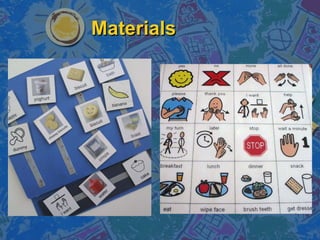
Materials
Phase I - “How” To Communicate Materials:  Picture symbols and highly preferred reinforcers Student learns the “nature” of communication Pick-up -> Reach -> Release  Physically Assisted Exchange (Two-Person Prompting) Backward Chain Independent Exchange Picture discrimination not yet required Structured and relaxed settings
Phase II - Distance and Persistence Materials:  Communication board, picture symbols, and reinforcers Teach students to communicate in “real world” situations and to “keep trying” Step 1: Remove picture from comm. book Step 2: Increase distance between trainer and student Step 3: Increase distance between student and comm. book Step 4: Assess and eliminate additional prompts: Distance to communicative partner Variety of communicative partners Variety of rooms (environments)
Phase III - Picture Discrimination Materials:  Communication book, highly preferred and low/non preferred R+ items, and their corresponding picture symbols Phase IIIA: High Preferences vs Low/non preferences Phase IIIB: 2-5 High Preferences Looks inside book Discrete Trial at structured table top setting
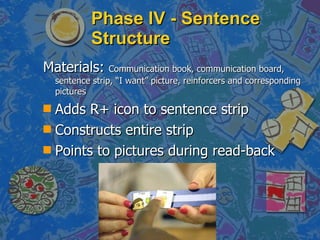
Phase IV - Sentence Structure Materials:  Communication book, communication board, sentence strip, “I want” picture, reinforcers and corresponding pictures Adds R+ icon to sentence strip Constructs entire strip Points to pictures during read-back
Attributes Materials:  Communication book, communication board, sentence strip, “I want” picture, reinforcers with varying levels of preferred attributes and corresponding pictures Constructs 3 icon sentence Discriminates High vs. low preference attribute icon Discriminates 2+ preference attribute icons Uses multiple exemplars Uses multiple attributes
Phase V – Responding to “What Do You Want?” Materials:  Communication book, communication board, sentence strip, “I want” picture, reinforcers and corresponding pictures 0 second delay 3-5 second delay Answers independently Answers and spontaneous requests
Phase VI - Commenting Materials:  Communication book, communication board, sentence strip, “I want” “I see” “I have” “I hear” “It is” pictures, reinforcers, stimuli and corresponding pictures First comment question Discriminate comment vs. request sentence starters Comment + Request + spontaneous request 2 nd  comment question Discriminates all sentence starters Spontaneously comments
Additional Skills Request assistance Indicate “no” Indicate “yes” Request “break”  Respond to “wait” Follow functional directions  Transition between activities Follow schedule
Modifications Although PECS is specially designed for students with special needs, additional modifications can be made Varying levels of PECS implementation based on skill set  Use of Assistive Communication Devices Different formats/sizes of pictures
Activity Phase IIIA: Discrimination between preferred and non-preferred items Groups of 2: Teacher and Student One picture represents preferred and the other represents the non-preferred item – You Choose! Complete Discrete trials Give praise and R+ for choosing “Preferred” picture  If student chooses “non-preferred” picture, allow access to non-preferred item then complete error correction procedure: Model - Tap target picture Prompt - Hold out hand for picture (but do not give R+) Switch – compliance or remove eye contact Repeat
Summary PECS is a adaptive system of functional communication intended for individuals with communication challenges. There are six phases. PECS can be used as a person’s primary mode of communication or can be phased out as verbal communication abilities progress beyond their current level of functioning with PECS
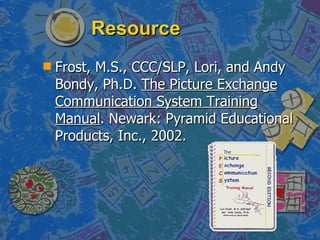
Resource Frost, M.S., CCC/SLP, Lori, and Andy Bondy, Ph.D.  The Picture Exchange Communication System Training Manual . Newark: Pyramid Educational Products, Inc., 2002.

PECS-Picture Exchange Communication System

  • 1.
    Picture Exchange CommunicationSystem (PECS) Presented by: Erryn Garnett & Dana Justice
  • 2.
    Introductions The PictureExchange Communication System (PECS) second ed. training manual A method of teaching functional communication skills Was designed by Lori Frost, M.S., CCC/SLP and Andy Bondy, Ph.D Published by Pyramid Education Products, Inc Based on the methodologies of The Pyramid Approach to Education
  • 3.
    Goals and IntendedOutcomes Functional Communication Social Skills Preventing and reducing contextually inappropriate behaviors Generalization/Independence
  • 4.
    Intended Population Anychild or adult who has communication difficulties or disorders Autism spectrum disorders Neurological disorders Developmental delays
  • 5.
    Teaching Strategies/ EvaluationProcedures Teaching strategies include: Shaping the gradual change in the criteria we set for reinforcement Fading (verbal, gestural, modeling, physical prompts) Prompt hierarchies (most to least, least to most) Delayed prompting (constant, progressive) Chaining strategies (forward, backward chaining) Data-based Evaluation Procedures
  • 6.
    Preparation for TrainingAssess student communication skills Organize training environment Establish reinforcer hierarchy Prepare materials
  • 7.
  • 8.
    Phase I -“How” To Communicate Materials: Picture symbols and highly preferred reinforcers Student learns the “nature” of communication Pick-up -> Reach -> Release Physically Assisted Exchange (Two-Person Prompting) Backward Chain Independent Exchange Picture discrimination not yet required Structured and relaxed settings
  • 9.
    Phase II -Distance and Persistence Materials: Communication board, picture symbols, and reinforcers Teach students to communicate in “real world” situations and to “keep trying” Step 1: Remove picture from comm. book Step 2: Increase distance between trainer and student Step 3: Increase distance between student and comm. book Step 4: Assess and eliminate additional prompts: Distance to communicative partner Variety of communicative partners Variety of rooms (environments)
  • 10.
    Phase III -Picture Discrimination Materials: Communication book, highly preferred and low/non preferred R+ items, and their corresponding picture symbols Phase IIIA: High Preferences vs Low/non preferences Phase IIIB: 2-5 High Preferences Looks inside book Discrete Trial at structured table top setting
  • 11.
    Phase IV -Sentence Structure Materials: Communication book, communication board, sentence strip, “I want” picture, reinforcers and corresponding pictures Adds R+ icon to sentence strip Constructs entire strip Points to pictures during read-back
  • 12.
    Attributes Materials: Communication book, communication board, sentence strip, “I want” picture, reinforcers with varying levels of preferred attributes and corresponding pictures Constructs 3 icon sentence Discriminates High vs. low preference attribute icon Discriminates 2+ preference attribute icons Uses multiple exemplars Uses multiple attributes
  • 13.
    Phase V –Responding to “What Do You Want?” Materials: Communication book, communication board, sentence strip, “I want” picture, reinforcers and corresponding pictures 0 second delay 3-5 second delay Answers independently Answers and spontaneous requests
  • 14.
    Phase VI -Commenting Materials: Communication book, communication board, sentence strip, “I want” “I see” “I have” “I hear” “It is” pictures, reinforcers, stimuli and corresponding pictures First comment question Discriminate comment vs. request sentence starters Comment + Request + spontaneous request 2 nd comment question Discriminates all sentence starters Spontaneously comments
  • 15.
    Additional Skills Requestassistance Indicate “no” Indicate “yes” Request “break” Respond to “wait” Follow functional directions Transition between activities Follow schedule
  • 16.
    Modifications Although PECSis specially designed for students with special needs, additional modifications can be made Varying levels of PECS implementation based on skill set Use of Assistive Communication Devices Different formats/sizes of pictures
  • 17.
    Activity Phase IIIA:Discrimination between preferred and non-preferred items Groups of 2: Teacher and Student One picture represents preferred and the other represents the non-preferred item – You Choose! Complete Discrete trials Give praise and R+ for choosing “Preferred” picture If student chooses “non-preferred” picture, allow access to non-preferred item then complete error correction procedure: Model - Tap target picture Prompt - Hold out hand for picture (but do not give R+) Switch – compliance or remove eye contact Repeat
  • 18.
    Summary PECS isa adaptive system of functional communication intended for individuals with communication challenges. There are six phases. PECS can be used as a person’s primary mode of communication or can be phased out as verbal communication abilities progress beyond their current level of functioning with PECS
  • 19.
    Resource Frost, M.S.,CCC/SLP, Lori, and Andy Bondy, Ph.D. The Picture Exchange Communication System Training Manual . Newark: Pyramid Educational Products, Inc., 2002.

Editor's Notes

  • #12 Backward Chain Sequence to be learned: Get book Remove “I want icon from book” Put “I want” icon on sentence strip Remove R+ picture from book Put reinforcer picture on sentence strip Remove sentence strip Give sentence strip to communicative partner Point to pictures during read-back
  • #13 I want red skittle I want red vs.yellow skittle I want blue vs red vs orange skittle I want red juice vs. candy vs. fruit roll I want big green box or I want round bumpy rug
  • #14 Train simultaneously with attributes
  • #15 Objective: The student answers “What do you want?” “What do you see?” “What do you have?” “What do you hear?” and “What is it?” and spontaneously requests and comments Requesting is in response to a need or desire and results in tangible reinforcement Commenting is in response to an interesting environmental event and results in social or environmental reinforcement “I see” “I have” “I hear” “It is”