1
DMND.Senevirathna
Lecturer
Department of Nursing & Midwifery
Faculty of Allied Health Sciences-KDU
Intended Learning outcomes,
❖ Briefly describe the elements of the communication process.
❖ Outline the flow of communication in an organization.
❖ Describe barriers to communication process.
❖ State importance non verbal communication
2
▪ Communication is the process by which people
attempt to transmit knowledge ,needs, desired,
feelings ,and attitudes through symbolic means such
as words ,gestures ,numbers ,letters and sounds.
3
 Vertical-downward
 Vertical-upwards
 Lateral/diagonal
4
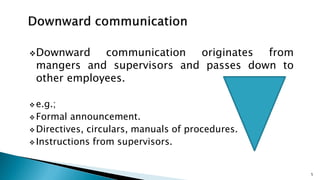
❖Downward communication originates from
mangers and supervisors and passes down to
other employees.
❖ e.g.;
❖ Formal announcement.
❖ Directives, circulars, manuals of procedures.
❖ Instructions from supervisors.
5
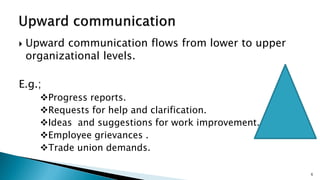
 Upward communication flows from lower to upper
organizational levels.
E.g.;
❖Progress reports.
❖Requests for help and clarification.
❖Ideas and suggestions for work improvement.
❖Employee grievances .
❖Trade union demands.
6
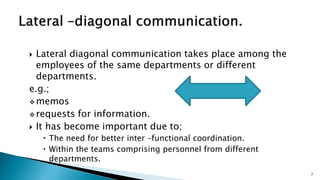
 Lateral diagonal communication takes place among the
employees of the same departments or different
departments.
e.g.;
❖ memos
❖ requests for information.
 It has become important due to;
 The need for better inter –functional coordination.
 Within the teams comprising personnel from different
departments.
7
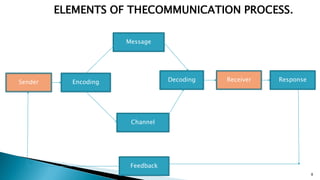
Encoding Decoding
Feedback
Receiver
Message
Sender
Channel
Response
ELEMENTS OF THECOMMUNICATION PROCESS.
8
 Sender
The person with a need, desire or information and a purpose to
convey to another person or group
 Encoding
The process of translating the need, desire, or information to a
serious of symbols or gestures
 Message
The physical form into which the sender encodes the information
9
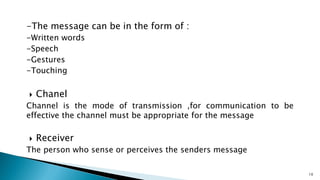
-The message can be in the form of :
-Written words
-Speech
-Gestures
-Touching
 Chanel
Channel is the mode of transmission ,for communication to be
effective the channel must be appropriate for the message
 Receiver
The person who sense or perceives the senders message
10
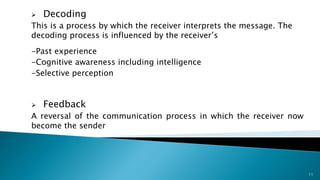
➢ Decoding
This is a process by which the receiver interprets the message. The
decoding process is influenced by the receiver’s
-Past experience
-Cognitive awareness including intelligence
-Selective perception
➢ Feedback
A reversal of the communication process in which the receiver now
become the sender
11
ATTRIBUTES OF THE SENDER ATTRIBUTES OF THE RECIEVER
KNOWLEDGE KNOWLEDGE
SKILLS SKILLS
ATTITUDES ATTITUDES
VALUES VALUES
EMOTIONS EMOTIONS
12
▪ Semantic problems
The same word could mean different things
▪ Para language
The tone of voice can convey a meaning different from
what was originally intended
▪ Body language
Gestures, facial expressions and other forms of body
language can help or hinder interpersonal communication
13
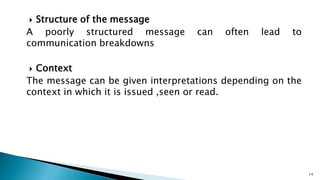
 Structure of the message
A poorly structured message can often lead to
communication breakdowns
 Context
The message can be given interpretations depending on the
context in which it is issued ,seen or read.
14
 It will work if we adopt a balanced contingency policy
based on integrated management options with optional
organizational projections utilizing responsive
transitional programming and parallel reciprocal
mobility implemented by functional third generation
hardware with a synchronized monitored time –phase
that has a compatible incremental capability.
15
 Inappropriate channel selection
-If the selected channel is not appropriate for the meaning to
be conveyed through the message there is a high possibility
for communication distortions and breakdowns.
 Number of links
-the greater the number of linked the greater is the potential
for communication distortions and breakdowns.
16
 Use feedback
 Recognize the use of non verbal signals
 Time the message
 Use proper channels
 Move from the defensive to supportive
communication
17
18
➢Nonverbal communication occurs primarily face to
face.
➢Relative impact of three cues on message
interpretation during face to face communication.
19
 Body signals.
-Slumped posture, clenched fist, raised eyebrows, nail
biting, staring, scratching the head, shaking the legs.
 Appearance.
-The way how person is dressed and groomed.
 Object signals
Type of office furniture, plaques and pictures hanging on
the wall, type of clothing
20
➢ Arnold, E., & Boggs, K., (1989). Interpersonal relationship:
Professional Communication Skills for Nurses. Philadelphia: W.
B Saunders Co.
➢ Berlo, D., (1960).The Process of Communication, New York,
Rinehart and Winston.
➢ Perry, A.,& Potter,P.,(1985).Fundamentals of nursing,7th
Ed.Elsevier
21
22

Elements of communication process

  • 1.
    1 DMND.Senevirathna Lecturer Department of Nursing& Midwifery Faculty of Allied Health Sciences-KDU
  • 2.
    Intended Learning outcomes, ❖Briefly describe the elements of the communication process. ❖ Outline the flow of communication in an organization. ❖ Describe barriers to communication process. ❖ State importance non verbal communication 2
  • 3.
    ▪ Communication isthe process by which people attempt to transmit knowledge ,needs, desired, feelings ,and attitudes through symbolic means such as words ,gestures ,numbers ,letters and sounds. 3
  • 4.
  • 5.
    ❖Downward communication originatesfrom mangers and supervisors and passes down to other employees. ❖ e.g.; ❖ Formal announcement. ❖ Directives, circulars, manuals of procedures. ❖ Instructions from supervisors. 5
  • 6.
     Upward communicationflows from lower to upper organizational levels. E.g.; ❖Progress reports. ❖Requests for help and clarification. ❖Ideas and suggestions for work improvement. ❖Employee grievances . ❖Trade union demands. 6
  • 7.
     Lateral diagonalcommunication takes place among the employees of the same departments or different departments. e.g.; ❖ memos ❖ requests for information.  It has become important due to;  The need for better inter –functional coordination.  Within the teams comprising personnel from different departments. 7
  • 8.
  • 9.
     Sender The personwith a need, desire or information and a purpose to convey to another person or group  Encoding The process of translating the need, desire, or information to a serious of symbols or gestures  Message The physical form into which the sender encodes the information 9
  • 10.
    -The message canbe in the form of : -Written words -Speech -Gestures -Touching  Chanel Channel is the mode of transmission ,for communication to be effective the channel must be appropriate for the message  Receiver The person who sense or perceives the senders message 10
  • 11.
    ➢ Decoding This isa process by which the receiver interprets the message. The decoding process is influenced by the receiver’s -Past experience -Cognitive awareness including intelligence -Selective perception ➢ Feedback A reversal of the communication process in which the receiver now become the sender 11
  • 12.
    ATTRIBUTES OF THESENDER ATTRIBUTES OF THE RECIEVER KNOWLEDGE KNOWLEDGE SKILLS SKILLS ATTITUDES ATTITUDES VALUES VALUES EMOTIONS EMOTIONS 12
  • 13.
    ▪ Semantic problems Thesame word could mean different things ▪ Para language The tone of voice can convey a meaning different from what was originally intended ▪ Body language Gestures, facial expressions and other forms of body language can help or hinder interpersonal communication 13
  • 14.
     Structure ofthe message A poorly structured message can often lead to communication breakdowns  Context The message can be given interpretations depending on the context in which it is issued ,seen or read. 14
  • 15.
     It willwork if we adopt a balanced contingency policy based on integrated management options with optional organizational projections utilizing responsive transitional programming and parallel reciprocal mobility implemented by functional third generation hardware with a synchronized monitored time –phase that has a compatible incremental capability. 15
  • 16.
     Inappropriate channelselection -If the selected channel is not appropriate for the meaning to be conveyed through the message there is a high possibility for communication distortions and breakdowns.  Number of links -the greater the number of linked the greater is the potential for communication distortions and breakdowns. 16
  • 17.
     Use feedback Recognize the use of non verbal signals  Time the message  Use proper channels  Move from the defensive to supportive communication 17
  • 18.
  • 19.
    ➢Nonverbal communication occursprimarily face to face. ➢Relative impact of three cues on message interpretation during face to face communication. 19
  • 20.
     Body signals. -Slumpedposture, clenched fist, raised eyebrows, nail biting, staring, scratching the head, shaking the legs.  Appearance. -The way how person is dressed and groomed.  Object signals Type of office furniture, plaques and pictures hanging on the wall, type of clothing 20
  • 21.
    ➢ Arnold, E.,& Boggs, K., (1989). Interpersonal relationship: Professional Communication Skills for Nurses. Philadelphia: W. B Saunders Co. ➢ Berlo, D., (1960).The Process of Communication, New York, Rinehart and Winston. ➢ Perry, A.,& Potter,P.,(1985).Fundamentals of nursing,7th Ed.Elsevier 21
  • 22.