The Communication Process
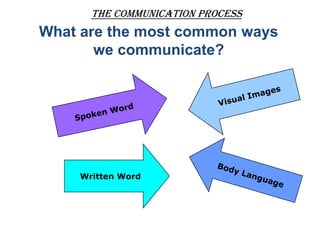
What are the most common ways
       we communicate?


    Written Word
The Communication Process


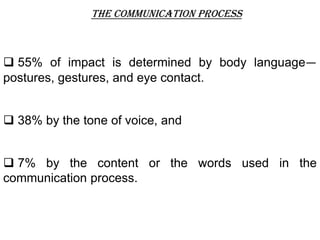
 55% of impact is determined by body language—
postures, gestures, and eye contact.


 38% by the tone of voice, and


 7% by the content or the words used in the
communication process.
The Communication Process

Communication is the process of sending and
receiving information among people…

                        Medium


                                  Barrier
   SENDER                                   RECEIVER
   (encodes)                                 (decodes)
                    Barrier


                       Feedback/Response
Communication Roles People Play
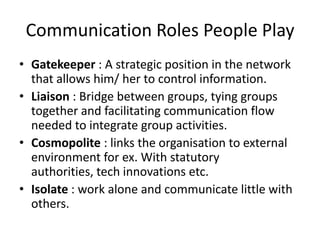
• Gatekeeper : A strategic position in the network
  that allows him/ her to control information.
• Liaison : Bridge between groups, tying groups
  together and facilitating communication flow
  needed to integrate group activities.
• Cosmopolite : links the organisation to external
  environment for ex. With statutory
  authorities, tech innovations etc.
• Isolate : work alone and communicate little with
  others.
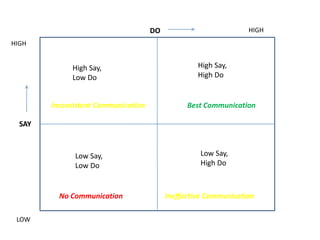
DO                          HIGH
HIGH


             High Say,                             High Say,
             Low Do                                High Do


        Inconsistent Communication              Best Communication

  SAY


              Low Say,                             Low Say,
              Low Do                               High Do


          No Communication                Ineffective Communication

 LOW
Individual Differences in
             Communication
• Whereas women tend to listen and lend
  social support, men tend to take control by
  offering advice.When men do this, they are
  asserting their power, contributing to a
  communication barrier between the sexes.
• While men may complain that women are ‘
  too emotional’, women may complain that
  men ‘do not listen’
Informal Communication Network
• The Old Boys’ Network : We tend to communicate
  most with those who are similar to ourselves on such
  key variables as age and the time working on the job.
• The Snowball Effect : Like a snowball which does not
  accumulate snowflakes randomly, but collects those
  that are in its path. Research shows patterns of
  voluntary turnover are not independently distributed
  within a work group, but are the result of people’
  influences on each other and informal communication
  pattern among them
• Grapevine
Types of Rumours
• Pipe Dreams : It reflects people’s wishes ( Ex. This
  year’s bonus will be higher than last year)
• Bogie Rumours : based on people’s fears and
  anxieties. ( Ex. Large scale downsizing)
• Wedge Drivers : malicious rumours with the
  intent of damaging someone’s reputation.
• Home Stretchers : Designed to reduce the degree
  of ambiguity in a situation by ‘ completing the
  puzzle” telling a story before it happens ( Ex.
  M&A)
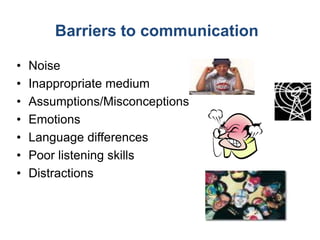
Barriers to communication

•   Noise
•   Inappropriate medium
•   Assumptions/Misconceptions
•   Emotions
•   Language differences
•   Poor listening skills
•   Distractions
What causes distortion?
• Speaker          • Listener
  o Language         o Perceptions
  o Wordiness        o Preconceived
  o Semantics          notions/expectation
  o Emotions         o Physical hearing
                       problem
  o Inflections
                     o Speed of thought
                     o Personal interests
                     o Emotions
                     o Attention span
                     o No active listening!

Communication

  • 1.
    The Communication Process Whatare the most common ways we communicate? Written Word
  • 2.
    The Communication Process 55% of impact is determined by body language— postures, gestures, and eye contact.  38% by the tone of voice, and  7% by the content or the words used in the communication process.
  • 3.
    The Communication Process Communicationis the process of sending and receiving information among people… Medium Barrier SENDER RECEIVER (encodes) (decodes) Barrier Feedback/Response
  • 4.
    Communication Roles PeoplePlay • Gatekeeper : A strategic position in the network that allows him/ her to control information. • Liaison : Bridge between groups, tying groups together and facilitating communication flow needed to integrate group activities. • Cosmopolite : links the organisation to external environment for ex. With statutory authorities, tech innovations etc. • Isolate : work alone and communicate little with others.
  • 5.
    DO HIGH HIGH High Say, High Say, Low Do High Do Inconsistent Communication Best Communication SAY Low Say, Low Say, Low Do High Do No Communication Ineffective Communication LOW
  • 6.
    Individual Differences in Communication • Whereas women tend to listen and lend social support, men tend to take control by offering advice.When men do this, they are asserting their power, contributing to a communication barrier between the sexes. • While men may complain that women are ‘ too emotional’, women may complain that men ‘do not listen’
  • 7.
    Informal Communication Network •The Old Boys’ Network : We tend to communicate most with those who are similar to ourselves on such key variables as age and the time working on the job. • The Snowball Effect : Like a snowball which does not accumulate snowflakes randomly, but collects those that are in its path. Research shows patterns of voluntary turnover are not independently distributed within a work group, but are the result of people’ influences on each other and informal communication pattern among them • Grapevine
  • 8.
    Types of Rumours •Pipe Dreams : It reflects people’s wishes ( Ex. This year’s bonus will be higher than last year) • Bogie Rumours : based on people’s fears and anxieties. ( Ex. Large scale downsizing) • Wedge Drivers : malicious rumours with the intent of damaging someone’s reputation. • Home Stretchers : Designed to reduce the degree of ambiguity in a situation by ‘ completing the puzzle” telling a story before it happens ( Ex. M&A)
  • 9.
    Barriers to communication • Noise • Inappropriate medium • Assumptions/Misconceptions • Emotions • Language differences • Poor listening skills • Distractions
  • 10.
    What causes distortion? •Speaker • Listener o Language o Perceptions o Wordiness o Preconceived o Semantics notions/expectation o Emotions o Physical hearing problem o Inflections o Speed of thought o Personal interests o Emotions o Attention span o No active listening!