
FORMS OF COMMUNICATION
Dr J Balamurugan
Dr J Balamurugan, SSL, VIT, TN.
Introduction
◦ People communicate with each other in a number of ways that depend upon the
message and its context in which it is being sent.
◦ Choice of communication channel and your style of communicating also affects
communication.
◦ Communication has been classified into several forms: in terms of the
◦ One way and two way
◦ Verbal and non-verbal
◦ Oral and written
◦ External and internal
◦ Formal and informal
◦ Horizontal and vertical
◦ Upward and downward Dr J Balamurugan, SSL, VIT, TN.
One way and two way communication
One-way communication:
◦ Sender sends a message without expecting a feedback.
Two-way communication:
◦ It takes place when the receiver provides feedback to the sender.
◦ Where accuracy of communication is important, two-way communication is durable.
Dr J Balamurugan, SSL, VIT, TN.
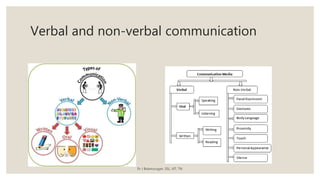
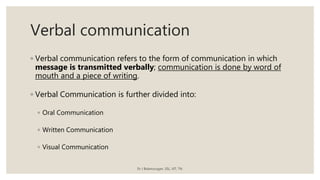
Verbal and non-verbal communication
Dr J Balamurugan, SSL, VIT, TN.
Verbal communication
◦ Verbal communication refers to the form of communication in which
message is transmitted verbally; communication is done by word of
mouth and a piece of writing.
◦ Verbal Communication is further divided into:
◦ Oral Communication
◦ Written Communication
◦ Visual Communication
Dr J Balamurugan, SSL, VIT, TN.
Non-verbal communication
◦ Nonverbal communication is the sending or receiving of wordless
messages.
◦ We can say that communication other than oral and written, such as
gesture, body language, posture, tone of voice or facial expressions, is called
nonverbal communication.
◦ Nonverbal communication is all about the body language of the speaker.
◦ Nonverbal communication have the following three elements: appearance,
body language and sound.
Dr J Balamurugan, SSL, VIT, TN.
Oral communication
◦ In oral communication, Spoken words are used.
◦ It includes face-to-face conversations, speech, telephonic conversation, video, radio,
television, voice over internet etc.
◦ In oral communication, communication is influence by pitch, volume, speed and clarity of
speaking.
◦ Instructions, lectures, meetings, interviews, rumours, etc., are the forms of oral
communication.
 Advantages of Oral communication are:
It brings quick feedback.
In a face-to-face conversation, by reading facial expression and body language one can guess
whether he/she should trust what’s being said or not.
◦ Disadvantage of oral communication
In face-to-face discussion, user is unable to deeply think about what he is delivering.
Dr J Balamurugan, SSL, VIT, TN.
Written communication
◦ In written communication, written signs or symbols are used to communicate.
◦ A written message may be printed or hand written.
◦ In written communication message can be transmitted via email, letter, report, memo, rules
and regulation, policies, instructions, orders, circulars, posters, annual reports, etc.
◦ Advantages of written communication includes:
Messages can be edited and revised many time before it is actually sent.
Written communication provide record for every message sent and can be saved for later
study.
A written message enables receiver to fully understand it and send appropriate feedback.
◦ Disadvantages of written communication includes:
Unlike oral communication, Written communication doesn’t bring instant feedback.
It take more time in composing a written message as compared to word-of-mouth. and
number of people struggles for writing ability.
Dr J Balamurugan, SSL, VIT, TN.
Visual communication
◦ This form of communication involves the visual display of information, wherein the
message is understood or expressed with the help of visual aids.
◦ For example, topography, photography, signs, symbols, maps, colors, posters, banners
and designs help the viewer understand the message visually.
◦ Movies and plays, television shows and video clips are all electronic form of visual
communication.
◦ Visual communication also involves the transfer of information in the form of text,
which is received through an electronic medium such as a computer, phone, etc.
◦ Icons are used in a public place, phone or computer, they instruct the user about their
meaning and usage.
Dr J Balamurugan, SSL, VIT, TN.
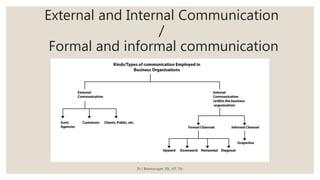
External and Internal Communication
/
Formal and informal communication
Dr J Balamurugan, SSL, VIT, TN.
Formal communication
◦ In formal communication, certain rules, conventions and principles are
followed while communicating message.
◦ Formal communication occurs in formal and official style.
◦ Usually professional settings, corporate meetings, conferences undergoes in
formal pattern.
◦ In formal communication, use of slang and foul language is avoided
and correct pronunciation is required.
◦ Authority lines are needed to be followed in formal communication.
Dr J Balamurugan, SSL, VIT, TN.
Informal communication
◦ It’s just a casual talk.
◦ It is established for societal affiliations of members in an organization and
face-to-face discussions. It happens among friends and family.
◦ In informal communication use of slang words, foul language is not
restricted.
◦ Usually, informal communication is done orally and using gestures.
◦ Informal communication, Unlike formal communication, doesn’t follow
authority lines.
◦ In an organization, it helps in finding out staff grievances as people express
more when talking informally.
◦ Informal communication helps in building relationships.Dr J Balamurugan, SSL, VIT, TN.
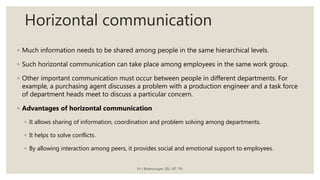
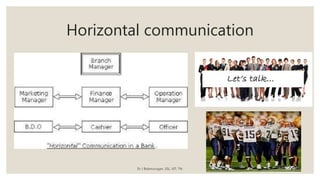
Horizontal communication
◦ Much information needs to be shared among people in the same hierarchical levels.
◦ Such horizontal communication can take place among employees in the same work group.
◦ Other important communication must occur between people in different departments. For
example, a purchasing agent discusses a problem with a production engineer and a task force
of department heads meet to discuss a particular concern.
◦ Advantages of horizontal communication
◦ It allows sharing of information, coordination and problem solving among departments.
◦ It helps to solve conflicts.
◦ By allowing interaction among peers, it provides social and emotional support to employees.
Dr J Balamurugan, SSL, VIT, TN.
Horizontal communication
Dr J Balamurugan, SSL, VIT, TN.
Vertical communication
(Downward communication)
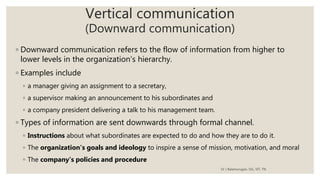
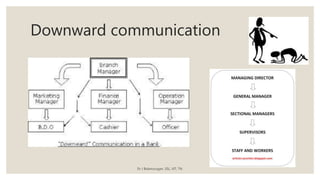
◦ Downward communication refers to the flow of information from higher to
lower levels in the organization’s hierarchy.
◦ Examples include
◦ a manager giving an assignment to a secretary,
◦ a supervisor making an announcement to his subordinates and
◦ a company president delivering a talk to his management team.
◦ Types of information are sent downwards through formal channel.
◦ Instructions about what subordinates are expected to do and how they are to do it.
◦ The organization's goals and ideology to inspire a sense of mission, motivation, and moral
◦ The company’s policies and procedure
Dr J Balamurugan, SSL, VIT, TN.
Downward communication
Dr J Balamurugan, SSL, VIT, TN.
Vertical communication
(Upward communication)
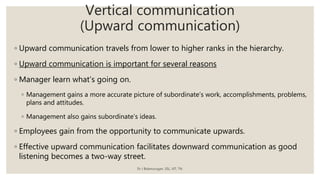
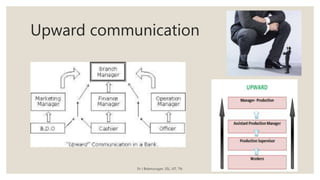
◦ Upward communication travels from lower to higher ranks in the hierarchy.
◦ Upward communication is important for several reasons
◦ Manager learn what’s going on.
◦ Management gains a more accurate picture of subordinate’s work, accomplishments, problems,
plans and attitudes.
◦ Management also gains subordinate’s ideas.
◦ Employees gain from the opportunity to communicate upwards.
◦ Effective upward communication facilitates downward communication as good
listening becomes a two-way street.
Dr J Balamurugan, SSL, VIT, TN.
Upward communication
Dr J Balamurugan, SSL, VIT, TN.
Other ways of communication
◦ One of the most common typology relates to the size of the social group
or the number of people involved in the experience of communication
◦ Intrapersonal communication
◦ Interpersonal communication
◦ Group communication
◦ Public communication
◦ Mass communication
Dr J Balamurugan, SSL, VIT, TN.
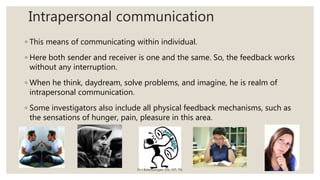
Intrapersonal communication
◦ This means of communicating within individual.
◦ Here both sender and receiver is one and the same. So, the feedback works
without any interruption.
◦ When he think, daydream, solve problems, and imagine, he is realm of
intrapersonal communication.
◦ Some investigators also include all physical feedback mechanisms, such as
the sensations of hunger, pain, pleasure in this area.
Dr J Balamurugan, SSL, VIT, TN.
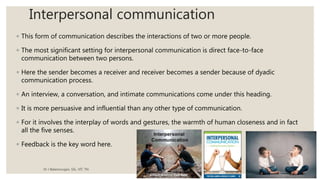
Interpersonal communication
◦ This form of communication describes the interactions of two or more people.
◦ The most significant setting for interpersonal communication is direct face-to-face
communication between two persons.
◦ Here the sender becomes a receiver and receiver becomes a sender because of dyadic
communication process.
◦ An interview, a conversation, and intimate communications come under this heading.
◦ It is more persuasive and influential than any other type of communication.
◦ For it involves the interplay of words and gestures, the warmth of human closeness and in fact
all the five senses.
◦ Feedback is the key word here.
Dr J Balamurugan, SSL, VIT, TN.
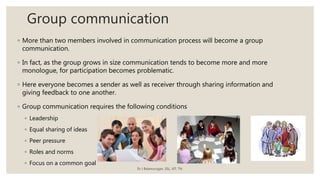
Group communication
◦ More than two members involved in communication process will become a group
communication.
◦ In fact, as the group grows in size communication tends to become more and more
monologue, for participation becomes problematic.
◦ Here everyone becomes a sender as well as receiver through sharing information and
giving feedback to one another.
◦ Group communication requires the following conditions
◦ Leadership
◦ Equal sharing of ideas
◦ Peer pressure
◦ Roles and norms
◦ Focus on a common goal
Dr J Balamurugan, SSL, VIT, TN.
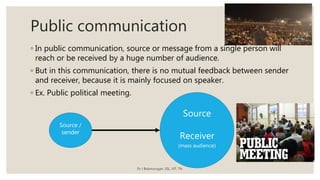
Public communication
◦ In public communication, source or message from a single person will
reach or be received by a huge number of audience.
◦ But in this communication, there is no mutual feedback between sender
and receiver, because it is mainly focused on speaker.
◦ Ex. Public political meeting.
Source /
sender
Source
Receiver
(mass audience)
Dr J Balamurugan, SSL, VIT, TN.
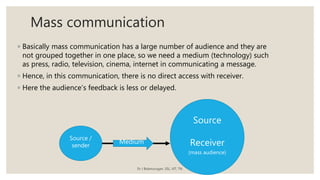
Mass communication
◦ Basically mass communication has a large number of audience and they are
not grouped together in one place, so we need a medium (technology) such
as press, radio, television, cinema, internet in communicating a message.
◦ Hence, in this communication, there is no direct access with receiver.
◦ Here the audience’s feedback is less or delayed.
Source /
sender
Source
Receiver
(mass audience)
Medium
Dr J Balamurugan, SSL, VIT, TN.
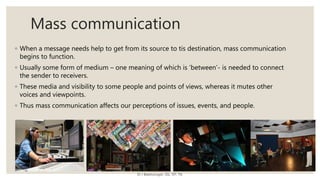
Mass communication
◦ When a message needs help to get from its source to tis destination, mass communication
begins to function.
◦ Usually some form of medium – one meaning of which is ‘between’- is needed to connect
the sender to receivers.
◦ These media and visibility to some people and points of views, whereas it mutes other
voices and viewpoints.
◦ Thus mass communication affects our perceptions of issues, events, and people.
Dr J Balamurugan, SSL, VIT, TN.
Thank you
Dr J Balamurugan, SSL, VIT, TN.

Forms of communication

  • 1.
    FORMS OF COMMUNICATION DrJ Balamurugan Dr J Balamurugan, SSL, VIT, TN.
  • 2.
    Introduction ◦ People communicatewith each other in a number of ways that depend upon the message and its context in which it is being sent. ◦ Choice of communication channel and your style of communicating also affects communication. ◦ Communication has been classified into several forms: in terms of the ◦ One way and two way ◦ Verbal and non-verbal ◦ Oral and written ◦ External and internal ◦ Formal and informal ◦ Horizontal and vertical ◦ Upward and downward Dr J Balamurugan, SSL, VIT, TN.
  • 3.
    One way andtwo way communication One-way communication: ◦ Sender sends a message without expecting a feedback. Two-way communication: ◦ It takes place when the receiver provides feedback to the sender. ◦ Where accuracy of communication is important, two-way communication is durable. Dr J Balamurugan, SSL, VIT, TN.
  • 4.
    Verbal and non-verbalcommunication Dr J Balamurugan, SSL, VIT, TN.
  • 5.
    Verbal communication ◦ Verbalcommunication refers to the form of communication in which message is transmitted verbally; communication is done by word of mouth and a piece of writing. ◦ Verbal Communication is further divided into: ◦ Oral Communication ◦ Written Communication ◦ Visual Communication Dr J Balamurugan, SSL, VIT, TN.
  • 6.
    Non-verbal communication ◦ Nonverbalcommunication is the sending or receiving of wordless messages. ◦ We can say that communication other than oral and written, such as gesture, body language, posture, tone of voice or facial expressions, is called nonverbal communication. ◦ Nonverbal communication is all about the body language of the speaker. ◦ Nonverbal communication have the following three elements: appearance, body language and sound. Dr J Balamurugan, SSL, VIT, TN.
  • 7.
    Oral communication ◦ Inoral communication, Spoken words are used. ◦ It includes face-to-face conversations, speech, telephonic conversation, video, radio, television, voice over internet etc. ◦ In oral communication, communication is influence by pitch, volume, speed and clarity of speaking. ◦ Instructions, lectures, meetings, interviews, rumours, etc., are the forms of oral communication.  Advantages of Oral communication are: It brings quick feedback. In a face-to-face conversation, by reading facial expression and body language one can guess whether he/she should trust what’s being said or not. ◦ Disadvantage of oral communication In face-to-face discussion, user is unable to deeply think about what he is delivering. Dr J Balamurugan, SSL, VIT, TN.
  • 8.
    Written communication ◦ Inwritten communication, written signs or symbols are used to communicate. ◦ A written message may be printed or hand written. ◦ In written communication message can be transmitted via email, letter, report, memo, rules and regulation, policies, instructions, orders, circulars, posters, annual reports, etc. ◦ Advantages of written communication includes: Messages can be edited and revised many time before it is actually sent. Written communication provide record for every message sent and can be saved for later study. A written message enables receiver to fully understand it and send appropriate feedback. ◦ Disadvantages of written communication includes: Unlike oral communication, Written communication doesn’t bring instant feedback. It take more time in composing a written message as compared to word-of-mouth. and number of people struggles for writing ability. Dr J Balamurugan, SSL, VIT, TN.
  • 9.
    Visual communication ◦ Thisform of communication involves the visual display of information, wherein the message is understood or expressed with the help of visual aids. ◦ For example, topography, photography, signs, symbols, maps, colors, posters, banners and designs help the viewer understand the message visually. ◦ Movies and plays, television shows and video clips are all electronic form of visual communication. ◦ Visual communication also involves the transfer of information in the form of text, which is received through an electronic medium such as a computer, phone, etc. ◦ Icons are used in a public place, phone or computer, they instruct the user about their meaning and usage. Dr J Balamurugan, SSL, VIT, TN.
  • 10.
    External and InternalCommunication / Formal and informal communication Dr J Balamurugan, SSL, VIT, TN.
  • 11.
    Formal communication ◦ Informal communication, certain rules, conventions and principles are followed while communicating message. ◦ Formal communication occurs in formal and official style. ◦ Usually professional settings, corporate meetings, conferences undergoes in formal pattern. ◦ In formal communication, use of slang and foul language is avoided and correct pronunciation is required. ◦ Authority lines are needed to be followed in formal communication. Dr J Balamurugan, SSL, VIT, TN.
  • 12.
    Informal communication ◦ It’sjust a casual talk. ◦ It is established for societal affiliations of members in an organization and face-to-face discussions. It happens among friends and family. ◦ In informal communication use of slang words, foul language is not restricted. ◦ Usually, informal communication is done orally and using gestures. ◦ Informal communication, Unlike formal communication, doesn’t follow authority lines. ◦ In an organization, it helps in finding out staff grievances as people express more when talking informally. ◦ Informal communication helps in building relationships.Dr J Balamurugan, SSL, VIT, TN.
  • 13.
    Horizontal communication ◦ Muchinformation needs to be shared among people in the same hierarchical levels. ◦ Such horizontal communication can take place among employees in the same work group. ◦ Other important communication must occur between people in different departments. For example, a purchasing agent discusses a problem with a production engineer and a task force of department heads meet to discuss a particular concern. ◦ Advantages of horizontal communication ◦ It allows sharing of information, coordination and problem solving among departments. ◦ It helps to solve conflicts. ◦ By allowing interaction among peers, it provides social and emotional support to employees. Dr J Balamurugan, SSL, VIT, TN.
  • 14.
    Horizontal communication Dr JBalamurugan, SSL, VIT, TN.
  • 15.
    Vertical communication (Downward communication) ◦Downward communication refers to the flow of information from higher to lower levels in the organization’s hierarchy. ◦ Examples include ◦ a manager giving an assignment to a secretary, ◦ a supervisor making an announcement to his subordinates and ◦ a company president delivering a talk to his management team. ◦ Types of information are sent downwards through formal channel. ◦ Instructions about what subordinates are expected to do and how they are to do it. ◦ The organization's goals and ideology to inspire a sense of mission, motivation, and moral ◦ The company’s policies and procedure Dr J Balamurugan, SSL, VIT, TN.
  • 16.
    Downward communication Dr JBalamurugan, SSL, VIT, TN.
  • 17.
    Vertical communication (Upward communication) ◦Upward communication travels from lower to higher ranks in the hierarchy. ◦ Upward communication is important for several reasons ◦ Manager learn what’s going on. ◦ Management gains a more accurate picture of subordinate’s work, accomplishments, problems, plans and attitudes. ◦ Management also gains subordinate’s ideas. ◦ Employees gain from the opportunity to communicate upwards. ◦ Effective upward communication facilitates downward communication as good listening becomes a two-way street. Dr J Balamurugan, SSL, VIT, TN.
  • 18.
    Upward communication Dr JBalamurugan, SSL, VIT, TN.
  • 19.
    Other ways ofcommunication ◦ One of the most common typology relates to the size of the social group or the number of people involved in the experience of communication ◦ Intrapersonal communication ◦ Interpersonal communication ◦ Group communication ◦ Public communication ◦ Mass communication Dr J Balamurugan, SSL, VIT, TN.
  • 20.
    Intrapersonal communication ◦ Thismeans of communicating within individual. ◦ Here both sender and receiver is one and the same. So, the feedback works without any interruption. ◦ When he think, daydream, solve problems, and imagine, he is realm of intrapersonal communication. ◦ Some investigators also include all physical feedback mechanisms, such as the sensations of hunger, pain, pleasure in this area. Dr J Balamurugan, SSL, VIT, TN.
  • 21.
    Interpersonal communication ◦ Thisform of communication describes the interactions of two or more people. ◦ The most significant setting for interpersonal communication is direct face-to-face communication between two persons. ◦ Here the sender becomes a receiver and receiver becomes a sender because of dyadic communication process. ◦ An interview, a conversation, and intimate communications come under this heading. ◦ It is more persuasive and influential than any other type of communication. ◦ For it involves the interplay of words and gestures, the warmth of human closeness and in fact all the five senses. ◦ Feedback is the key word here. Dr J Balamurugan, SSL, VIT, TN.
  • 22.
    Group communication ◦ Morethan two members involved in communication process will become a group communication. ◦ In fact, as the group grows in size communication tends to become more and more monologue, for participation becomes problematic. ◦ Here everyone becomes a sender as well as receiver through sharing information and giving feedback to one another. ◦ Group communication requires the following conditions ◦ Leadership ◦ Equal sharing of ideas ◦ Peer pressure ◦ Roles and norms ◦ Focus on a common goal Dr J Balamurugan, SSL, VIT, TN.
  • 23.
    Public communication ◦ Inpublic communication, source or message from a single person will reach or be received by a huge number of audience. ◦ But in this communication, there is no mutual feedback between sender and receiver, because it is mainly focused on speaker. ◦ Ex. Public political meeting. Source / sender Source Receiver (mass audience) Dr J Balamurugan, SSL, VIT, TN.
  • 24.
    Mass communication ◦ Basicallymass communication has a large number of audience and they are not grouped together in one place, so we need a medium (technology) such as press, radio, television, cinema, internet in communicating a message. ◦ Hence, in this communication, there is no direct access with receiver. ◦ Here the audience’s feedback is less or delayed. Source / sender Source Receiver (mass audience) Medium Dr J Balamurugan, SSL, VIT, TN.
  • 25.
    Mass communication ◦ Whena message needs help to get from its source to tis destination, mass communication begins to function. ◦ Usually some form of medium – one meaning of which is ‘between’- is needed to connect the sender to receivers. ◦ These media and visibility to some people and points of views, whereas it mutes other voices and viewpoints. ◦ Thus mass communication affects our perceptions of issues, events, and people. Dr J Balamurugan, SSL, VIT, TN.
  • 26.
    Thank you Dr JBalamurugan, SSL, VIT, TN.