
“Common Reporting Standard (CRS)’’
Presenters:
Andri Christodoulou, Matheos Hadjimatheou
AGENDA
• Preface
• Global and local Implementation
• Timeline for early adopters
• Integration of CRS into the Cyprus Tax National Law
• Entity Classification
• Reporting/Non-reporting Financial Institutions (FI)
• Defining FI
1. Depository Institutions
2. Specified Insurance Company
3. Custodial Institution
4. Investment Entities
• Defining Non-Financial Institutions (NFEs)
• Active NFEs
• Criteria of being considered a NFE
1. Based on Income and Assets
2. ‘Substantially all ’ - Holding Company
3. ‘Treasury Centre’ – Financing Company
4. Under CRS definitions & examples
5. Non-profit Organisations
• Reporting and Timing
• Sanctions for non-Compliance
Preface
• In February 2014 the OECD published initial documents entitled ‘The
Standard for Automatic Exchange of Financial Information in Tax
Matters’ (‘the Standard’).
• In October 2014 this was concluded and the final Standard was
composed – ‘Common Reporting Standard’ (CRS)
• Aim: looks towards a globally coordinated approach for prevention of
corruption, money laundering, tax evasion and terrorist financing.
• Reporting of financial account information
including: balances, interest, dividends, and
sales proceeds from financial assets, reported
to governments by financial institutions and
covering accounts held by individuals and
shell companies, trusts and similar
arrangements.
Global and Local Implimentation
• 40 of the contracting parties have committed in exchanging information
in 2017 – including Cyprus
• In order to access the List of signatories please visit:
http://www.oecd.org/tax/exchange-of-tax-information/Status_of_convention.pdf
Examples of Countries that will
report in 2017:
 BVI
Belgium
Bulgaria
Cayman Islands
Cyprus
Czech Republic
Denmark
Estonia
Finland
France
Germany
Examples of Countries that will
report in 2018:
 Albania
Australia
Austria
Belize
Brazil
Canada
Chile
China
Cook Islands
Hong-Kong
Israel
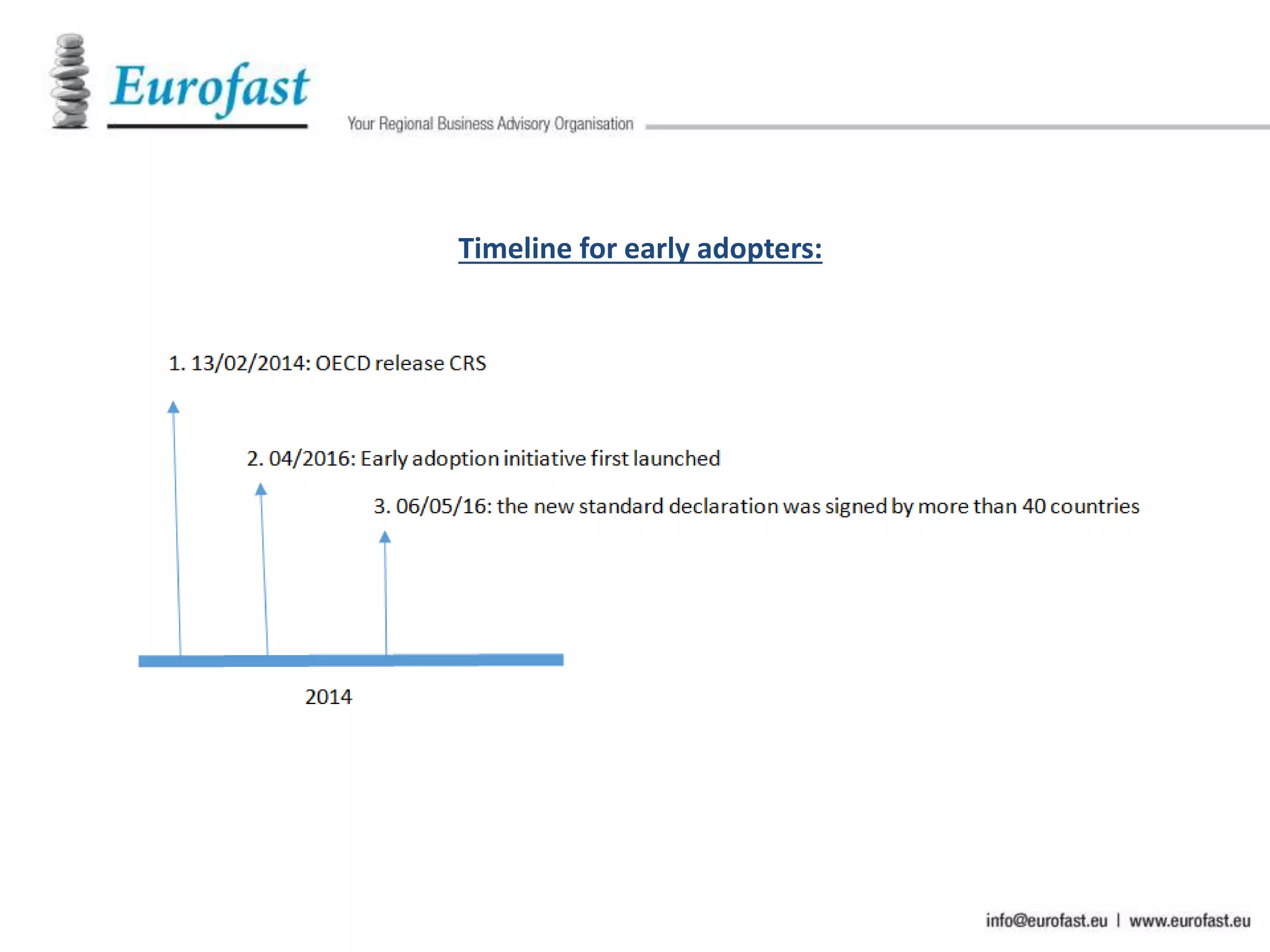
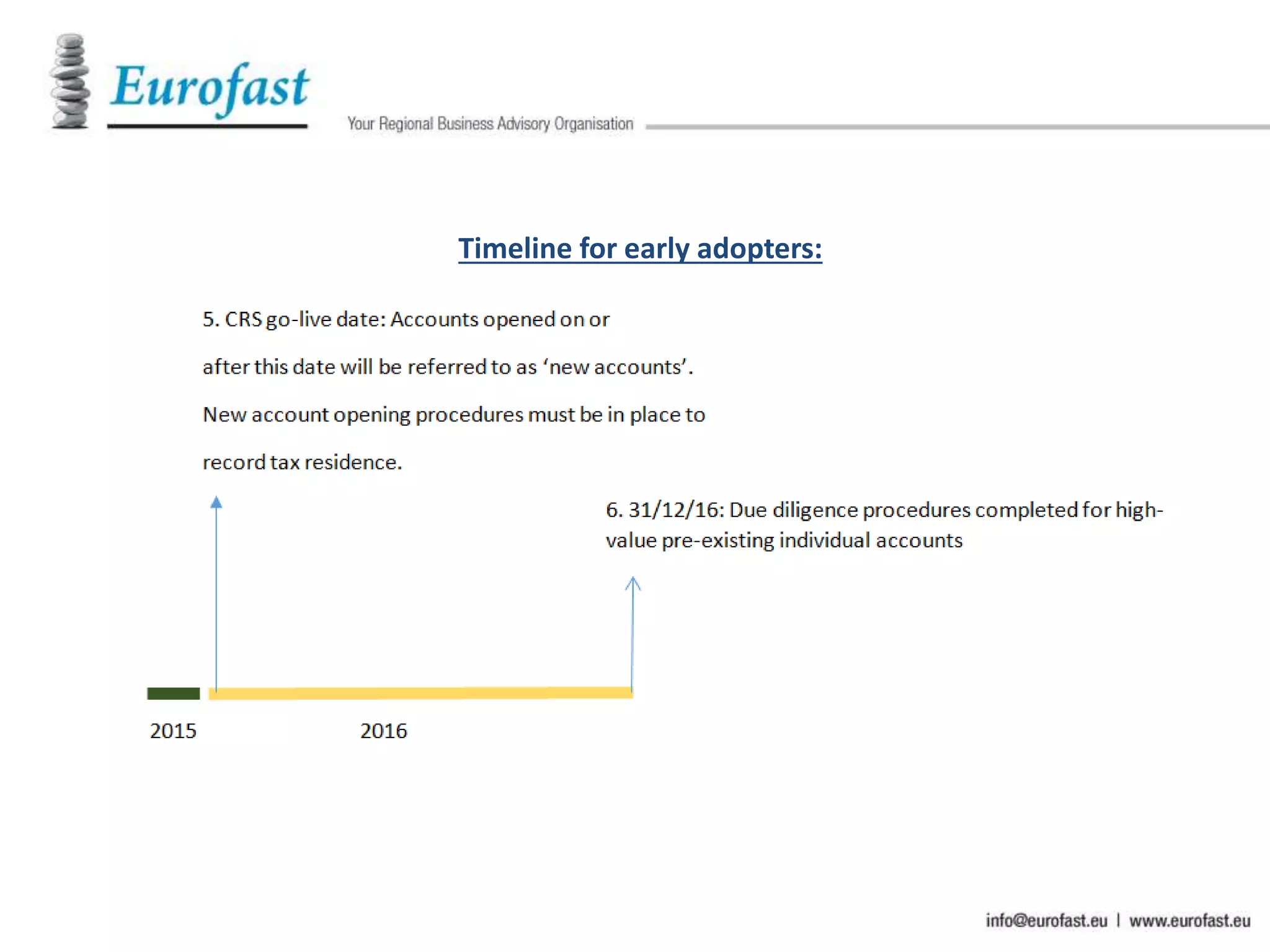
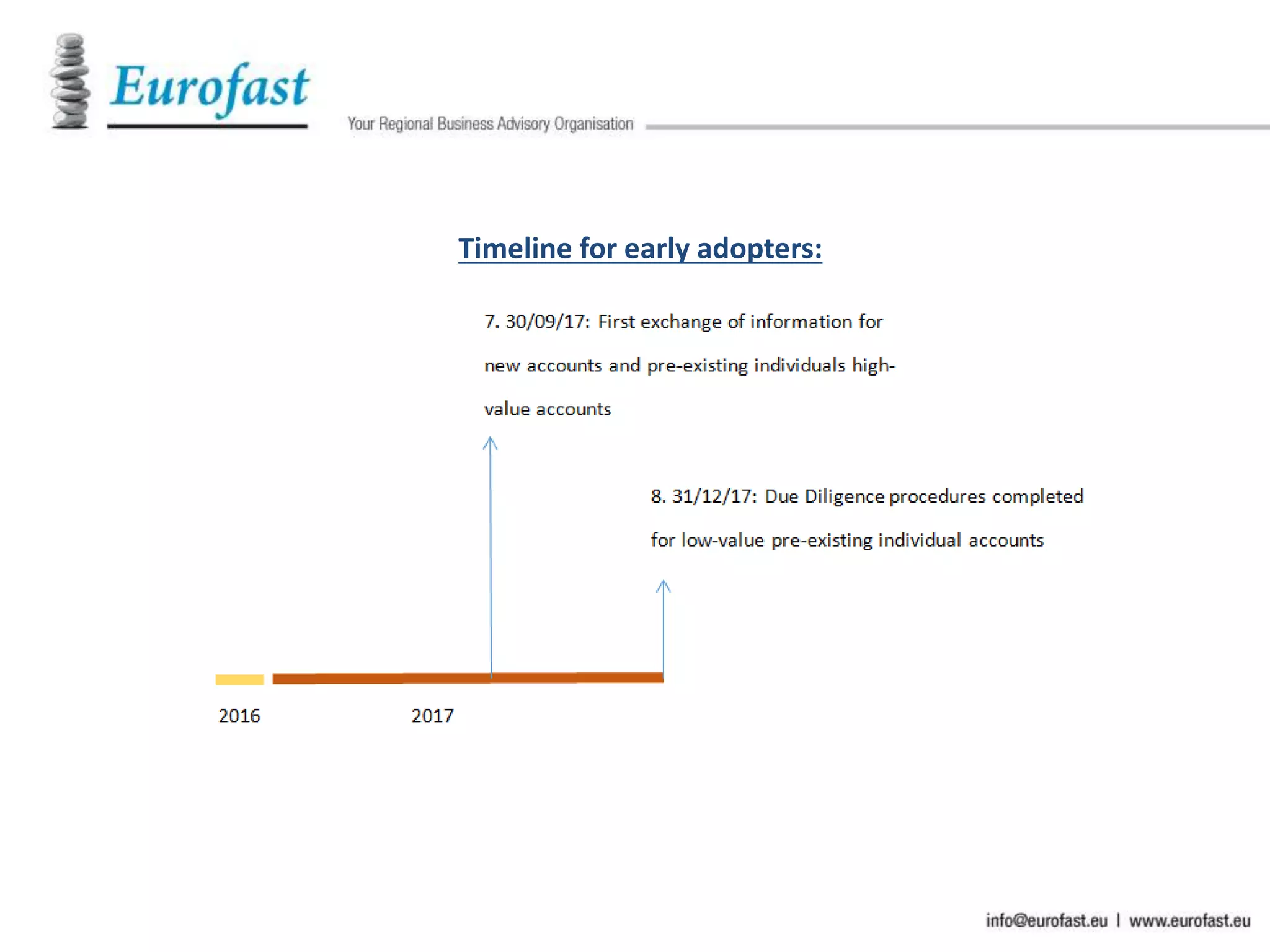
Timeline for early adopters:
• In order to transpose the Standard’s requirements into the domestic legislation of
Cyprus, a Decree was published on 31st December 2015, in accordance with the
provisions of Article 6(16) of the Assessment and Collection of Taxes Law of 1978 to
2015. The Decree entered into force on 1st January 2016.
• Further a decree has been officially issued describing the application of CRS in the
island by the Tax Department for assistance and guidance.
• Important Note: What is classified and declared under FATCA the same must apply
under CRS reporting.
• Warning: Correct Reporting in order to avoid
unnecessary reporting and sanctions
Integration of CRS into the Cyprus Tax National Law
Entity Classification
Types of Entities:
• Reporting FI
• Non-Reporting FI
• Active non-Financial Entity also know as Active NFE
• Passive NFE
Reporting/Non-Reporting Financial Institutions (FI)
• Examples of Non-Reporting FI:
 A corporation that is listed and trades in its country’s securities market
 A Governmental entity
 An International Organisation
 A Central Bank
 A pension fund of a Governmental Entity
 A Broad participation retirement fund
 An exempt Collective Investment Vehicle where all interests in the collective investment vehicle are held by or through
individuals or entities that are not reportable persons
 Any other entity that presents a low risk of being used to evade tax, that shares similar characteristics to any of the above
entities
• Exclusion from reporting obligations due to low risk of tax evasion
• Due diligence and reporting obligations only apply to Reporting financial Institutions
• Accounts held by FI are generally not reportable
EXCHANGE OF INFORMATION
Defining FI
• The Decree provides guidance as to the types of accounts, as well as the physical
or legal persons, which fall within its scope. In accordance with the Decree, those
institutions that fall within the definition of a “financial institution” are required
to set out the appropriate controls and procedures in order to identify, collect
and report information of account holders. The term “financial institutions”
includes:
1. Depository Institutions
2. Specified Insurance Company
3. Custodial Institution
4. Investment Entities
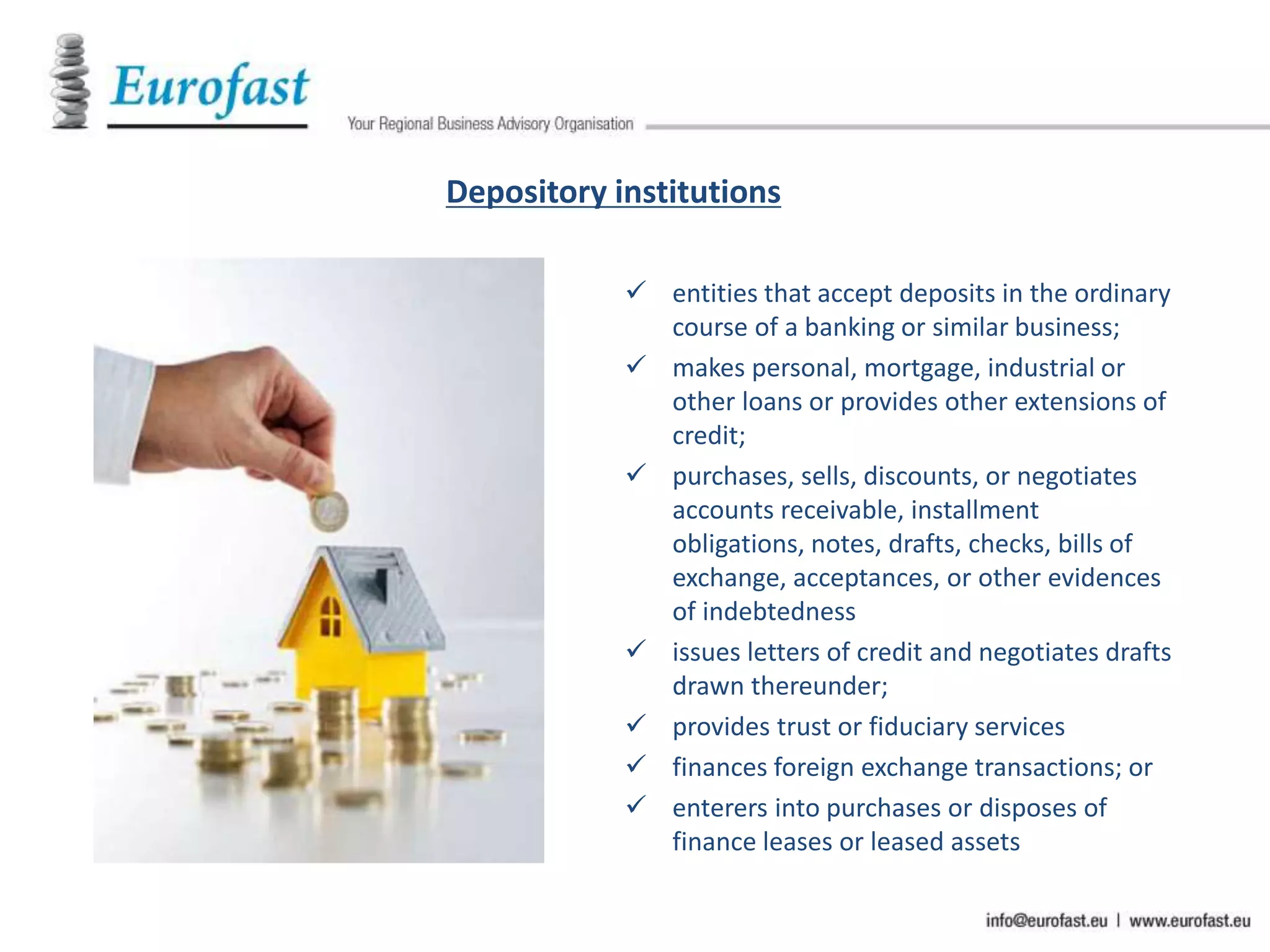
Depository institutions
 entities that accept deposits in the ordinary
course of a banking or similar business;
 makes personal, mortgage, industrial or
other loans or provides other extensions of
credit;
 purchases, sells, discounts, or negotiates
accounts receivable, installment
obligations, notes, drafts, checks, bills of
exchange, acceptances, or other evidences
of indebtedness
 issues letters of credit and negotiates drafts
drawn thereunder;
 provides trust or fiduciary services
 finances foreign exchange transactions; or
 enterers into purchases or disposes of
finance leases or leased assets
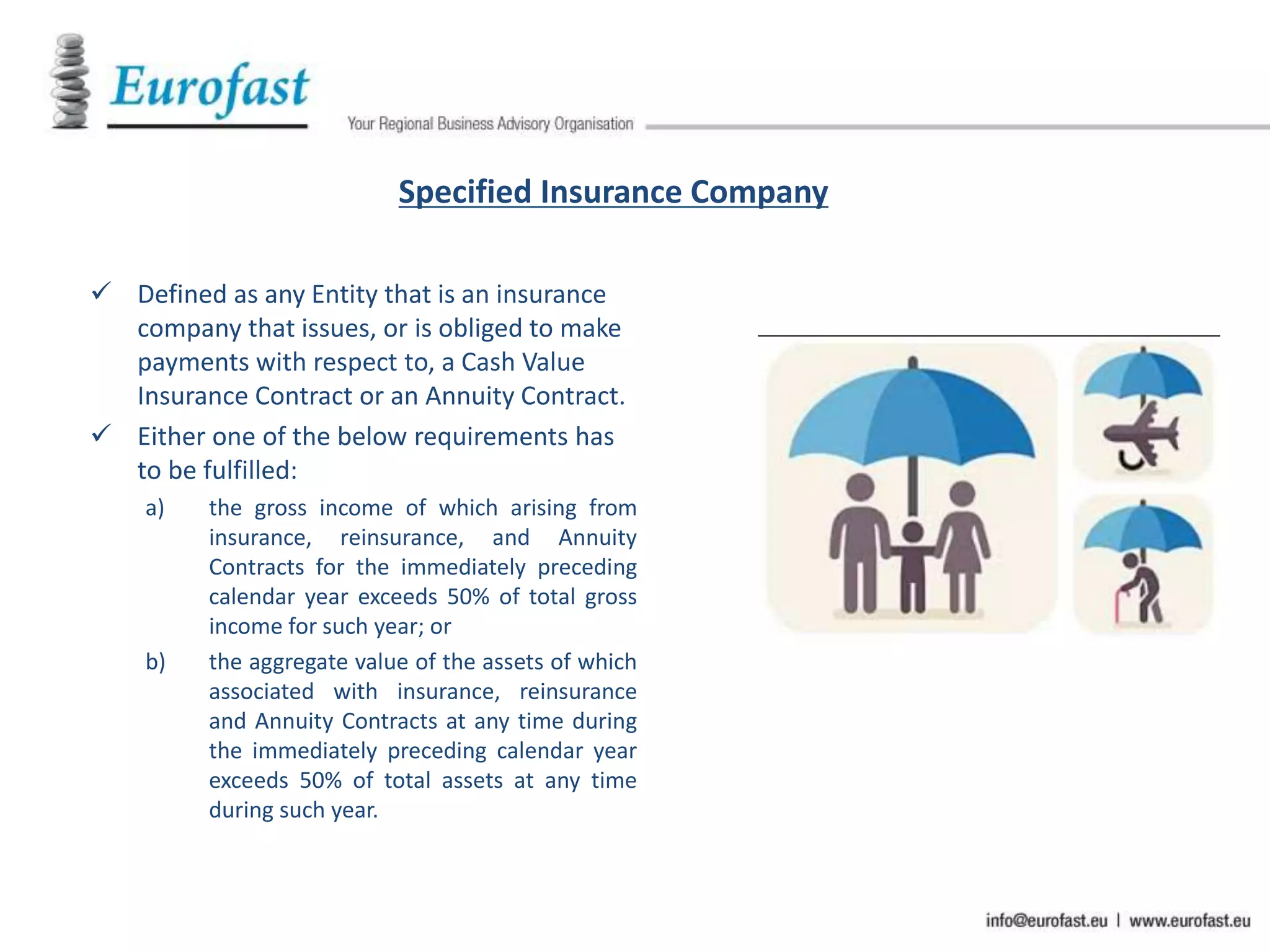
Specified Insurance Company
 Defined as any Entity that is an insurance
company that issues, or is obliged to make
payments with respect to, a Cash Value
Insurance Contract or an Annuity Contract.
 Either one of the below requirements has
to be fulfilled:
a) the gross income of which arising from
insurance, reinsurance, and Annuity
Contracts for the immediately preceding
calendar year exceeds 50% of total gross
income for such year; or
b) the aggregate value of the assets of which
associated with insurance, reinsurance
and Annuity Contracts at any time during
the immediately preceding calendar year
exceeds 50% of total assets at any time
during such year.
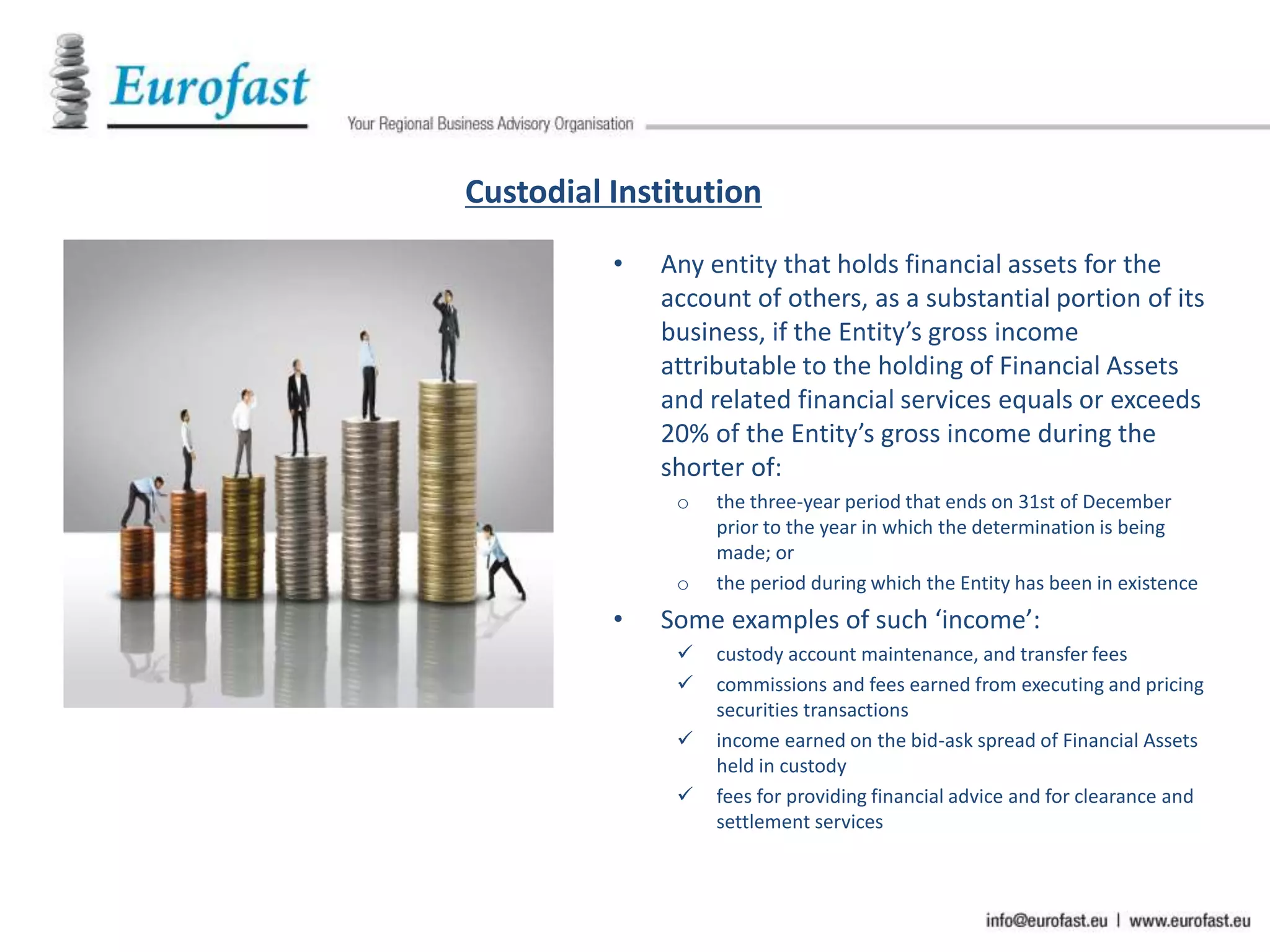
Custodial Institution
• Any entity that holds financial assets for the
account of others, as a substantial portion of its
business, if the Entity’s gross income
attributable to the holding of Financial Assets
and related financial services equals or exceeds
20% of the Entity’s gross income during the
shorter of:
o the three-year period that ends on 31st of December
prior to the year in which the determination is being
made; or
o the period during which the Entity has been in existence
• Some examples of such ‘income’:
 custody account maintenance, and transfer fees
 commissions and fees earned from executing and pricing
securities transactions
 income earned on the bid-ask spread of Financial Assets
held in custody
 fees for providing financial advice and for clearance and
settlement services
Investment Entity
• First Type:
Entities that primarily conduct as a business one or more of the following activities for or on behalf of a
customer:
a) Trading in money market instruments
b) Individual and collective portfolio management; or
c) Otherwise investing, administering, or managing Financial Assets or money on behalf of other persons
• Second Type:
Entities whose gross income is primarily attributable to investing, reinvesting, or trading in Financial Assets,
if the Entity is managed by another Entity that is a Depository Institution, a Custodial Institution, a Specified
Insurance Company or an Investment Entity.
• Please note:
 ‘Primarily’ is deemed to be considered as ‘equals or exceeds 50%
of the Entity’s gross income.
 Collective Investment Vehicles such as Funds.
Defining Non-Financial Institutions (NFEs)
• In the case the reportable entity is not a FI then the next step is to be considered as Non-
Financial Entity. The latter is divided into:
a) Passive NFE; or
b) Active NFE
• CRS defines a Passive NFE as not an Active NFE, therefore it is important to examine what
constitutes an Active NFE.
Active NFEs
• Definition: Entities that publicly trading in the stock market or related to a such Entity and
does not receive passive income or primarily hold amounts of assets that produce passive
income.
• Examples of passive income: dividends, royalties, interest, rents etc.
• It is vital to comprehend that if the examined Entity is in any case a passive NFE then the
controlling persons are always reportable.
• The Criteria of being an active NFE:
1. Based on income and assets
2. ‘Substantially all criterion’ under a Holding Company
3. ‘Treasury Centre’ under a Financing Company
4. Under CRS definitions & examples
5. Non-profit organisations
Criterion No1: Based on Income and Assets
• Less than 50% of the NFE’s gross income for
the preceding calendar year or other
appropriate reporting period is passive
income; and
• Less than 50% of the assets held by the NFE
during the preceding calendar year or other
appropriate reporting period are assets that
productive or are held for the production of
passive income.
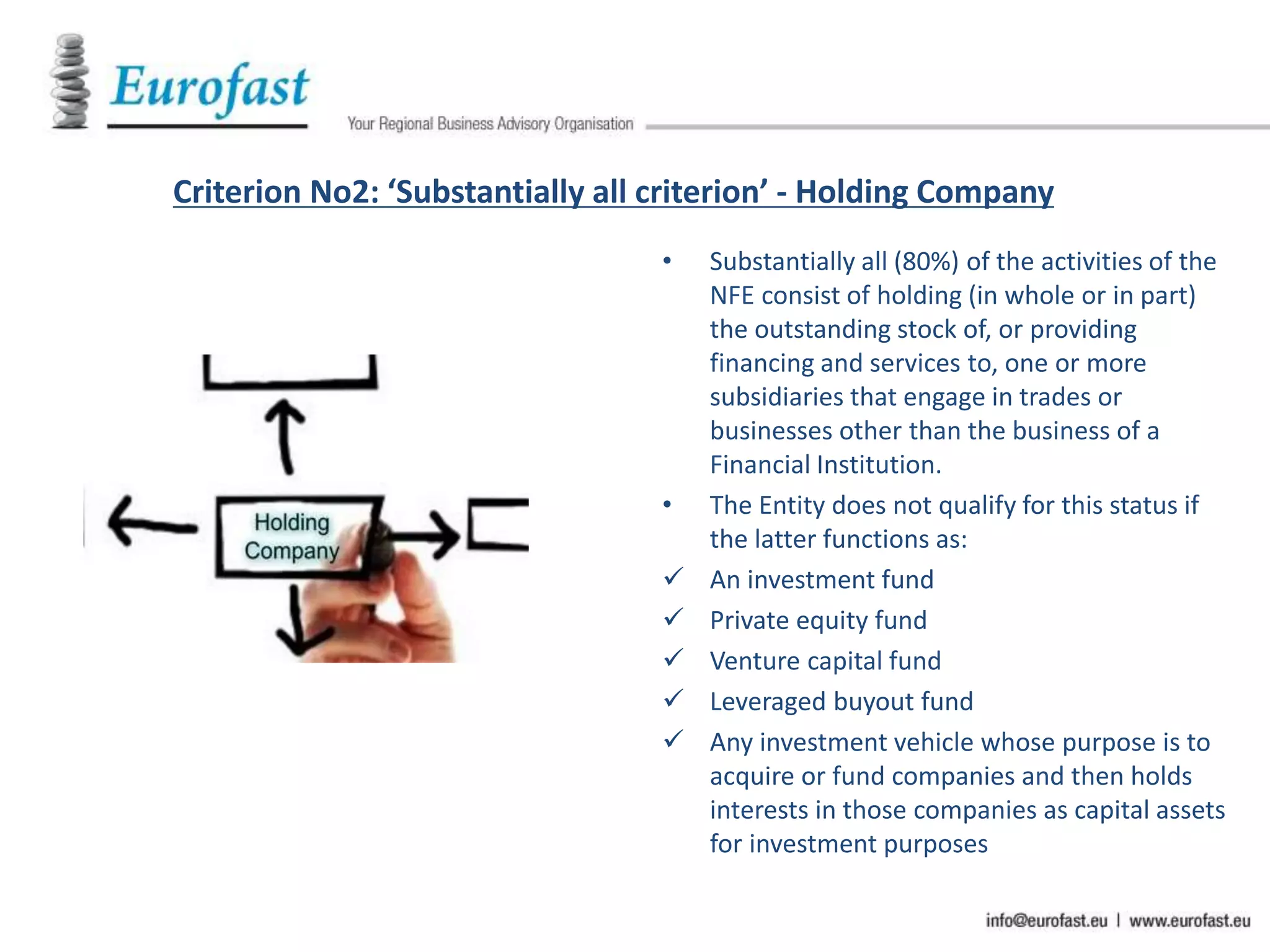
Criterion No2: ‘Substantially all criterion’ - Holding Company
• Substantially all (80%) of the activities of the
NFE consist of holding (in whole or in part)
the outstanding stock of, or providing
financing and services to, one or more
subsidiaries that engage in trades or
businesses other than the business of a
Financial Institution.
• The Entity does not qualify for this status if
the latter functions as:
 An investment fund
 Private equity fund
 Venture capital fund
 Leveraged buyout fund
 Any investment vehicle whose purpose is to
acquire or fund companies and then holds
interests in those companies as capital assets
for investment purposes
Criterion No3: ‘Treasury Centre’ – Financing Company
• The NFE primarily engages in financing and hedging transactions with, or for,
Related Entities that are not FI, and;
• Does not provide financing or hedging services to any Entity that is not a
Related Entity; and
• The group of any such Related Entities is primarily engaged in a business other
than that of a FI
Criterion No4: Under CRS Definitions
 Excepted nonfinancial start-up companies or companies entering a new line of
business
 Excepted nonfinancial entities in liquidation or bankruptcy
 Publicly traded corporation
 Exempt Beneficial Owners
Criterion No5: Non Profit Organisations
• Must be registered and operated exclusively for philanthropic, religious,
charitable, educational purposes etc.
• To be exempt from income tax in its jurisdiction of residence
• The members of the non-profit organisation should not have any rights to the
assets or the income of the aforementioned organisation
• The next factor relates to the relation of the members of the organisation and
the organisation itself.
Reporting and Timing
 All information collected will be submitted to the relevant tax authorities and
those will report all information to the other contracting members on an
automatic annual basis
 Details reported regarding the account holders of FI:
 Name
 Address
 Residence for tax purposes
 Tax identification number
 Date and place of birth
 Accounts balances and any income relating to these accounts
 Income from certain insurance products
 Gross sale proceeds of any financial assets
Sanctions for Non-Compliance
• No withholding
• Specific sanctions under each national law
• Reputational Risk
• Prevention of opening of new accounts
• Closure or suspension of accounts
A few words about Eurofast
Eurofast is a regional business advisory organisation
employing over 200 people in South East Europe &
East Mediterranean.
Our team of professionals is capable of efficiently
addressing all client needs in one single meeting,
using one single language for all the countries in the
Region.
•International Tax
•Mergers & Acquisitions and
Transactional Advisory
•Transfer pricing
•Accounting services
•Financial services
•Outsourced Payroll and Employment
solutions
•Corporate services
•Citizenship & Residency services
•HR administration
•Banking and Financial
services
•Business Restructuring &
Insolvency
•IT specialized services
•Tax Planning & Tax
Compliance
•Real Estate tax
•Shipping Tax
•Energy Tax
•Intellectual property
•Market entry services
Our Services
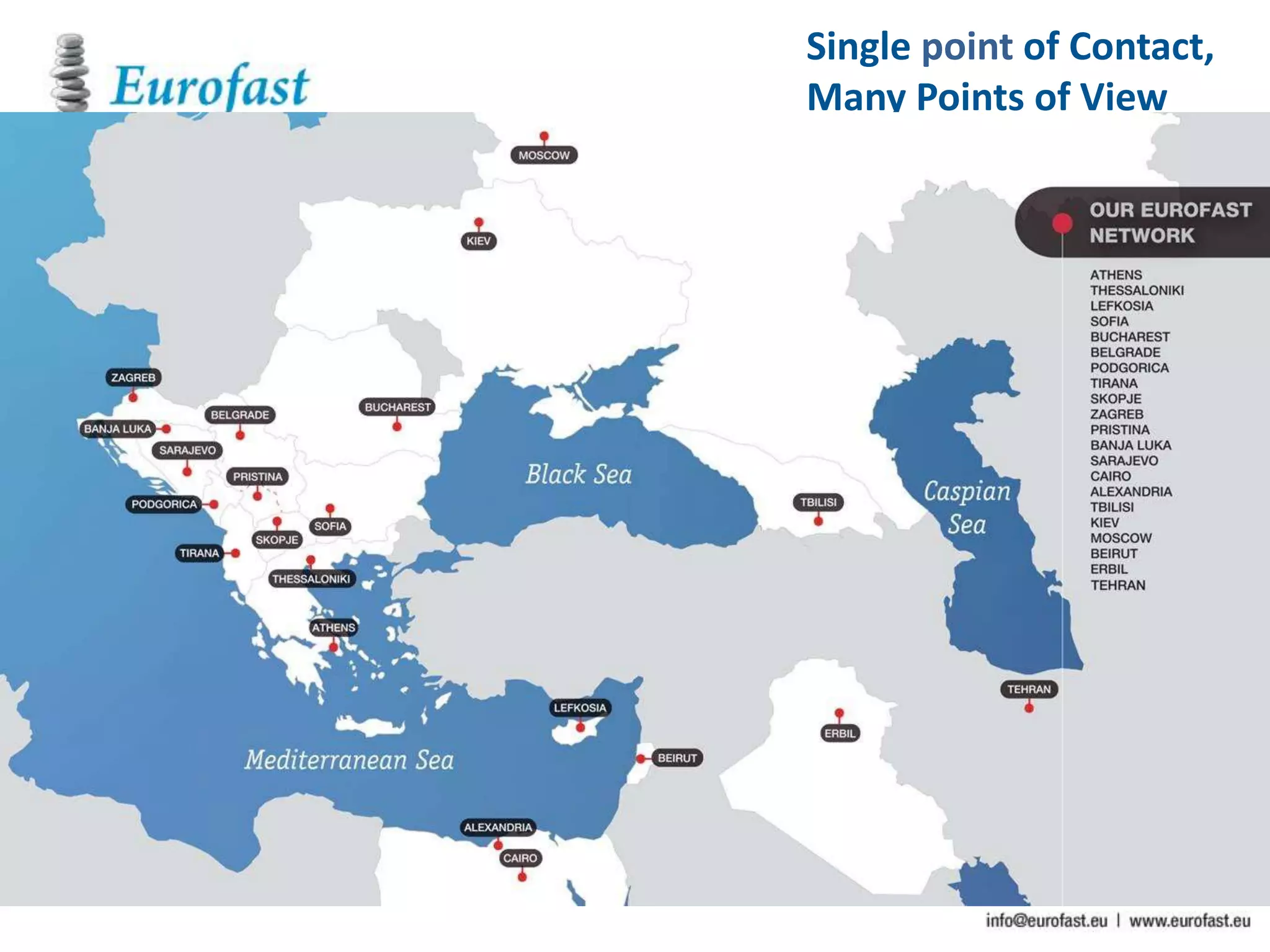
Single point of Contact,
Many Points of View
What others think about us
Find us online
www.eurofast.eu
• Do not hesitate to contact us:
Andri.christodoulou@eurofast.eu
Matheos.Hadjimatheou@eurofast.eu

Common Reporting Standard (CRS)

  • 1.
    “Common Reporting Standard(CRS)’’ Presenters: Andri Christodoulou, Matheos Hadjimatheou
  • 2.
    AGENDA • Preface • Globaland local Implementation • Timeline for early adopters • Integration of CRS into the Cyprus Tax National Law • Entity Classification • Reporting/Non-reporting Financial Institutions (FI) • Defining FI 1. Depository Institutions 2. Specified Insurance Company 3. Custodial Institution 4. Investment Entities • Defining Non-Financial Institutions (NFEs) • Active NFEs • Criteria of being considered a NFE 1. Based on Income and Assets 2. ‘Substantially all ’ - Holding Company 3. ‘Treasury Centre’ – Financing Company 4. Under CRS definitions & examples 5. Non-profit Organisations • Reporting and Timing • Sanctions for non-Compliance
  • 3.
    Preface • In February2014 the OECD published initial documents entitled ‘The Standard for Automatic Exchange of Financial Information in Tax Matters’ (‘the Standard’). • In October 2014 this was concluded and the final Standard was composed – ‘Common Reporting Standard’ (CRS) • Aim: looks towards a globally coordinated approach for prevention of corruption, money laundering, tax evasion and terrorist financing. • Reporting of financial account information including: balances, interest, dividends, and sales proceeds from financial assets, reported to governments by financial institutions and covering accounts held by individuals and shell companies, trusts and similar arrangements.
  • 4.
    Global and LocalImplimentation • 40 of the contracting parties have committed in exchanging information in 2017 – including Cyprus • In order to access the List of signatories please visit: http://www.oecd.org/tax/exchange-of-tax-information/Status_of_convention.pdf Examples of Countries that will report in 2017:  BVI Belgium Bulgaria Cayman Islands Cyprus Czech Republic Denmark Estonia Finland France Germany Examples of Countries that will report in 2018:  Albania Australia Austria Belize Brazil Canada Chile China Cook Islands Hong-Kong Israel
  • 5.
  • 6.
  • 7.
  • 8.
  • 9.
  • 10.
    • In orderto transpose the Standard’s requirements into the domestic legislation of Cyprus, a Decree was published on 31st December 2015, in accordance with the provisions of Article 6(16) of the Assessment and Collection of Taxes Law of 1978 to 2015. The Decree entered into force on 1st January 2016. • Further a decree has been officially issued describing the application of CRS in the island by the Tax Department for assistance and guidance. • Important Note: What is classified and declared under FATCA the same must apply under CRS reporting. • Warning: Correct Reporting in order to avoid unnecessary reporting and sanctions Integration of CRS into the Cyprus Tax National Law
  • 11.
    Entity Classification Types ofEntities: • Reporting FI • Non-Reporting FI • Active non-Financial Entity also know as Active NFE • Passive NFE
  • 12.
    Reporting/Non-Reporting Financial Institutions(FI) • Examples of Non-Reporting FI:  A corporation that is listed and trades in its country’s securities market  A Governmental entity  An International Organisation  A Central Bank  A pension fund of a Governmental Entity  A Broad participation retirement fund  An exempt Collective Investment Vehicle where all interests in the collective investment vehicle are held by or through individuals or entities that are not reportable persons  Any other entity that presents a low risk of being used to evade tax, that shares similar characteristics to any of the above entities • Exclusion from reporting obligations due to low risk of tax evasion • Due diligence and reporting obligations only apply to Reporting financial Institutions • Accounts held by FI are generally not reportable
  • 13.
    EXCHANGE OF INFORMATION DefiningFI • The Decree provides guidance as to the types of accounts, as well as the physical or legal persons, which fall within its scope. In accordance with the Decree, those institutions that fall within the definition of a “financial institution” are required to set out the appropriate controls and procedures in order to identify, collect and report information of account holders. The term “financial institutions” includes: 1. Depository Institutions 2. Specified Insurance Company 3. Custodial Institution 4. Investment Entities
  • 14.
    Depository institutions  entitiesthat accept deposits in the ordinary course of a banking or similar business;  makes personal, mortgage, industrial or other loans or provides other extensions of credit;  purchases, sells, discounts, or negotiates accounts receivable, installment obligations, notes, drafts, checks, bills of exchange, acceptances, or other evidences of indebtedness  issues letters of credit and negotiates drafts drawn thereunder;  provides trust or fiduciary services  finances foreign exchange transactions; or  enterers into purchases or disposes of finance leases or leased assets
  • 15.
    Specified Insurance Company Defined as any Entity that is an insurance company that issues, or is obliged to make payments with respect to, a Cash Value Insurance Contract or an Annuity Contract.  Either one of the below requirements has to be fulfilled: a) the gross income of which arising from insurance, reinsurance, and Annuity Contracts for the immediately preceding calendar year exceeds 50% of total gross income for such year; or b) the aggregate value of the assets of which associated with insurance, reinsurance and Annuity Contracts at any time during the immediately preceding calendar year exceeds 50% of total assets at any time during such year.
  • 16.
    Custodial Institution • Anyentity that holds financial assets for the account of others, as a substantial portion of its business, if the Entity’s gross income attributable to the holding of Financial Assets and related financial services equals or exceeds 20% of the Entity’s gross income during the shorter of: o the three-year period that ends on 31st of December prior to the year in which the determination is being made; or o the period during which the Entity has been in existence • Some examples of such ‘income’:  custody account maintenance, and transfer fees  commissions and fees earned from executing and pricing securities transactions  income earned on the bid-ask spread of Financial Assets held in custody  fees for providing financial advice and for clearance and settlement services
  • 17.
    Investment Entity • FirstType: Entities that primarily conduct as a business one or more of the following activities for or on behalf of a customer: a) Trading in money market instruments b) Individual and collective portfolio management; or c) Otherwise investing, administering, or managing Financial Assets or money on behalf of other persons • Second Type: Entities whose gross income is primarily attributable to investing, reinvesting, or trading in Financial Assets, if the Entity is managed by another Entity that is a Depository Institution, a Custodial Institution, a Specified Insurance Company or an Investment Entity. • Please note:  ‘Primarily’ is deemed to be considered as ‘equals or exceeds 50% of the Entity’s gross income.  Collective Investment Vehicles such as Funds.
  • 18.
    Defining Non-Financial Institutions(NFEs) • In the case the reportable entity is not a FI then the next step is to be considered as Non- Financial Entity. The latter is divided into: a) Passive NFE; or b) Active NFE • CRS defines a Passive NFE as not an Active NFE, therefore it is important to examine what constitutes an Active NFE.
  • 19.
    Active NFEs • Definition:Entities that publicly trading in the stock market or related to a such Entity and does not receive passive income or primarily hold amounts of assets that produce passive income. • Examples of passive income: dividends, royalties, interest, rents etc. • It is vital to comprehend that if the examined Entity is in any case a passive NFE then the controlling persons are always reportable. • The Criteria of being an active NFE: 1. Based on income and assets 2. ‘Substantially all criterion’ under a Holding Company 3. ‘Treasury Centre’ under a Financing Company 4. Under CRS definitions & examples 5. Non-profit organisations
  • 20.
    Criterion No1: Basedon Income and Assets • Less than 50% of the NFE’s gross income for the preceding calendar year or other appropriate reporting period is passive income; and • Less than 50% of the assets held by the NFE during the preceding calendar year or other appropriate reporting period are assets that productive or are held for the production of passive income.
  • 21.
    Criterion No2: ‘Substantiallyall criterion’ - Holding Company • Substantially all (80%) of the activities of the NFE consist of holding (in whole or in part) the outstanding stock of, or providing financing and services to, one or more subsidiaries that engage in trades or businesses other than the business of a Financial Institution. • The Entity does not qualify for this status if the latter functions as:  An investment fund  Private equity fund  Venture capital fund  Leveraged buyout fund  Any investment vehicle whose purpose is to acquire or fund companies and then holds interests in those companies as capital assets for investment purposes
  • 22.
    Criterion No3: ‘TreasuryCentre’ – Financing Company • The NFE primarily engages in financing and hedging transactions with, or for, Related Entities that are not FI, and; • Does not provide financing or hedging services to any Entity that is not a Related Entity; and • The group of any such Related Entities is primarily engaged in a business other than that of a FI
  • 23.
    Criterion No4: UnderCRS Definitions  Excepted nonfinancial start-up companies or companies entering a new line of business  Excepted nonfinancial entities in liquidation or bankruptcy  Publicly traded corporation  Exempt Beneficial Owners
  • 24.
    Criterion No5: NonProfit Organisations • Must be registered and operated exclusively for philanthropic, religious, charitable, educational purposes etc. • To be exempt from income tax in its jurisdiction of residence • The members of the non-profit organisation should not have any rights to the assets or the income of the aforementioned organisation • The next factor relates to the relation of the members of the organisation and the organisation itself.
  • 25.
    Reporting and Timing All information collected will be submitted to the relevant tax authorities and those will report all information to the other contracting members on an automatic annual basis  Details reported regarding the account holders of FI:  Name  Address  Residence for tax purposes  Tax identification number  Date and place of birth  Accounts balances and any income relating to these accounts  Income from certain insurance products  Gross sale proceeds of any financial assets
  • 26.
    Sanctions for Non-Compliance •No withholding • Specific sanctions under each national law • Reputational Risk • Prevention of opening of new accounts • Closure or suspension of accounts
  • 27.
    A few wordsabout Eurofast Eurofast is a regional business advisory organisation employing over 200 people in South East Europe & East Mediterranean. Our team of professionals is capable of efficiently addressing all client needs in one single meeting, using one single language for all the countries in the Region.
  • 28.
    •International Tax •Mergers &Acquisitions and Transactional Advisory •Transfer pricing •Accounting services •Financial services •Outsourced Payroll and Employment solutions •Corporate services •Citizenship & Residency services •HR administration •Banking and Financial services •Business Restructuring & Insolvency •IT specialized services •Tax Planning & Tax Compliance •Real Estate tax •Shipping Tax •Energy Tax •Intellectual property •Market entry services Our Services
  • 29.
    Single point ofContact, Many Points of View
  • 30.
  • 31.
  • 33.
    • Do nothesitate to contact us: Andri.christodoulou@eurofast.eu Matheos.Hadjimatheou@eurofast.eu