




Chapter 2
Instructor: Mahwish Khokhar



The main purpose of this chapter is to
introduce financial intermediaries.
Financial intermediaries include:






Commercial Banks
Savings and loan Associations
Investment Companies
Insurance Companies
Pension Funds

Their main function is inexpensive inflow of
money from savers to investors/borrowers.


Business entities include nonfinancial and
financial enterprises. Nonfinancial enterprises
provide following services:
 Nonfinancial enterprises manufacture products or

provide nonfinancial services


Financial enterprises provide following
services:
1. Transforming financial assets acquired through

the market and transforming them into different
and most widely used asset.
2. Exchanging the financial asset on behalf of
3.
4.

5.

6.

customer
Exchanging the financial asset on their own
account
Assisting in the creation of FA for their customers
and then selling those FA to other market
participants
Providing investment advise
Managing the portfolios of other market
participants


Financial Intermediaries also include depository
institutions (commercial banks, savings and loan
associations, savings bank and credit unions)
which acquire bulk of their funds by offering
their liabilities to their customers in the form of
deposits; insurance companies; pension funds;
and finance companies.



Financial intermediaries also provide services
like underwriting, brokers and dealers.


Typically the FI that provide underwriting services also provide

brokerage/dealer services.


Some nonfinancial enterprises also have subsidiaries that
provide financial services. These FI are also called Captive

Finance Companies. For example General Motors acceptance
corporation (a subsidiary of GM).


It means that GM have a subsidiary that provide financing to its
parent company.



General Electric has a subsidiary called General Electric Credit
Corporation.







FI obtain funds by issuing financial claims
against themselves to market participants and
then invest those funds.
The investment made by FI can be loan or
security. These investments are called direct
investment.
The participants who hold those financial claims
have said to made indirect investment.
Example: Commercial Banks, Investment
Companies (Pooling of Funds). (See book pg. 16)
FI provide four basic functions:
1. Maturity Intermediation: In our example of
commercial banks two things should be
noticed:
 The maturity of at least a portion of the
deposits accepted is typically short term.
(certain types of deposits are payable on
demand and others have specific maturity
date, but most are less than two years).
Maturity of the loans made by the commercial
banks may be considerably longer than two years.
(If the Commercial Bank is absent then what will
happen?)


The commercial bank by issuing it own financial
claim in essence transforms a longer-term asset
into a shorter-term one by giving the borrower
a loan for the length of the time sought and the
investor/depositor a FA for the desired
investment horizon. This function of Financial
Intermediary is called maturity intermediation.
2.

Reducing Risk via Diversification: FI convert
more risky funds into less risky funds.
Example: Enron

3.

Reducing the costs of contracting and
information processing: Investors purchasing
FA should take time to develop skills necessary
to understand how to evaluate an investment.
Once skills are developed, investors should apply
those skills to the analysis of specific FA that are
candidates for purchase (or subsequent sale).




Investors who want to make a loan to a
consumer or business will need to write the
loan contract (or hire an attorney to do so).
In addition to the opportunity cost of time to
process the information about the FA and its
issuer, there is cost of acquiring this
information. All these costs are called
information processing costs.
4.

Providing a payment mechanism: Although
most transactions made today are not done
with cash.

Instead payments are made using
checks, credit cards, debit cards, and the
electronic transfer of funds. These methods of
making payments is called payment
mechanisms, are provided by certain
financial intermediaries.
Part 1 Complete
Part 2 Starts below
OBJECTIVE:


To know why managers of FI invest in
particular types of Financial Assets and the
types of investment strategies they employ.


The nature of the liability dictates which strategy is
adopted.
Depository Institutions

Depository institutions buy money and sell money.
Banks BUY money by borrowing from depositors or
other sources of funds.
 And they SELL money by lending it to businesses
and individuals.
 The difference between the buying and selling value
is called SPREAD.
 The cost of the funds and the return on the funds
sold is expressed in terms of interest rate per unit of
time.


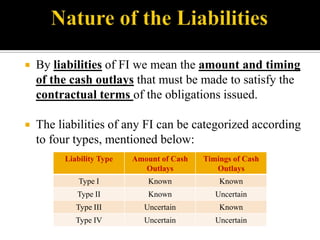
By liabilities of FI we mean the amount and timing
of the cash outlays that must be made to satisfy the
contractual terms of the obligations issued.



The liabilities of any FI can be categorized according
to four types, mentioned below:
Liability Type

Amount of Cash
Outlays

Timings of Cash
Outlays

Type I

Known

Known

Type II

Known

Uncertain

Type III

Uncertain

Known

Type IV

Uncertain

Uncertain



Both the amount and timings are known with certainty.
Example: a liability requiring FI to pay $50,000 six
months from now will be a good example. (Principal +
Interest). Where interest rate is always fixed.



Type I liabilities are not just sold by depository
institutions but also by life insurance companies.



EXAMPLE: Life insurance companies have obligation to
fulfill under this contract for some of money called
PREMIUM, it will guarantee an interest rate up to some
specified maturity date.


In type II liabilities the amount of the cash
outlay is known, but the timings are uncertain.



EXAMPLE: Life insurance policy. (will be
discussed in chapter 7).



In this type for an annual premium, a life
insurance company agrees to make specified
$$ payment to the policy beneficiaries/holders
upon the death of the insured.


In this type timing of the cash outlay is known but
the amount is uncertain.
EXAMPLE: FI issue an obligation in which the
interest rate adjusts periodically according to
some interest rate benchmark.



Depository Institutions issues:



 CD: Have stated maturity and Interest rate fluctuate over the

life of the deposit.
 3-years floating rate certificate of deposit: Interest rate adjusts
every 3-months and is benchmarked against the Treasury Bill
rate plus 1 percentage point. And matures after 3 years.


There are numerous insurance products and pension
obligations that present uncertainty to both the amount
and the timings of the cash outlay.



EXAPMPLE: Automobile and home insurance policies
in which amount/payment and timings are uncertain.



Also retirement benefits depends on the total number of
employment years and this will affect the cash outlay.




Because of the uncertainty about the timings
and amount of the cash outlays, a FI must be
prepared to fulfill/satisfy the financial
obligations.
EXAMPLE: If the depositor request the
withdrawal of the funds prior of the maturity
date. The deposit accepting institution will
grant this request will take an early
withdrawal penalty.


In certain type of investment companies the
shareholders have the right to redeem their
shares at any time.



Regulations and Taxation: Numerous
regulations ad tax considerations influence the
investment policies that FI pursue.


Categorization of Financial Innovation:
Since 1960s there is significant surge in
Financial Innovation. Here are just 3 ways to
categorize the innovations suggested by
Economic Council of Canada.
 Market Broadening Instruments: which increase

the liquidity of the markets and the availability of
the funds by attracting new investors and offering
new opportunities for the borrowers.
 Risk Management Instruments: which relocate

financial risk to those who are less averse to them
or who have better diversification.
 Arbitraging Instruments and Processes: which
enable the investors and borrowers to take
advantage of the differences in cost and return
between markets, which reflect differences in the
perception of the risk, as well as in information,
taxations and regulations.
THE END =D

Chapter2

  • 1.
  • 2.
      The main purposeof this chapter is to introduce financial intermediaries. Financial intermediaries include:      Commercial Banks Savings and loan Associations Investment Companies Insurance Companies Pension Funds Their main function is inexpensive inflow of money from savers to investors/borrowers.
  • 3.
     Business entities includenonfinancial and financial enterprises. Nonfinancial enterprises provide following services:  Nonfinancial enterprises manufacture products or provide nonfinancial services  Financial enterprises provide following services: 1. Transforming financial assets acquired through the market and transforming them into different and most widely used asset.
  • 4.
    2. Exchanging thefinancial asset on behalf of 3. 4. 5. 6. customer Exchanging the financial asset on their own account Assisting in the creation of FA for their customers and then selling those FA to other market participants Providing investment advise Managing the portfolios of other market participants
  • 5.
     Financial Intermediaries alsoinclude depository institutions (commercial banks, savings and loan associations, savings bank and credit unions) which acquire bulk of their funds by offering their liabilities to their customers in the form of deposits; insurance companies; pension funds; and finance companies.  Financial intermediaries also provide services like underwriting, brokers and dealers.
  • 6.
     Typically the FIthat provide underwriting services also provide brokerage/dealer services.  Some nonfinancial enterprises also have subsidiaries that provide financial services. These FI are also called Captive Finance Companies. For example General Motors acceptance corporation (a subsidiary of GM).  It means that GM have a subsidiary that provide financing to its parent company.  General Electric has a subsidiary called General Electric Credit Corporation.
  • 7.
        FI obtain fundsby issuing financial claims against themselves to market participants and then invest those funds. The investment made by FI can be loan or security. These investments are called direct investment. The participants who hold those financial claims have said to made indirect investment. Example: Commercial Banks, Investment Companies (Pooling of Funds). (See book pg. 16)
  • 8.
    FI provide fourbasic functions: 1. Maturity Intermediation: In our example of commercial banks two things should be noticed:  The maturity of at least a portion of the deposits accepted is typically short term. (certain types of deposits are payable on demand and others have specific maturity date, but most are less than two years).
  • 9.
    Maturity of theloans made by the commercial banks may be considerably longer than two years. (If the Commercial Bank is absent then what will happen?)  The commercial bank by issuing it own financial claim in essence transforms a longer-term asset into a shorter-term one by giving the borrower a loan for the length of the time sought and the investor/depositor a FA for the desired investment horizon. This function of Financial Intermediary is called maturity intermediation.
  • 10.
    2. Reducing Risk viaDiversification: FI convert more risky funds into less risky funds. Example: Enron 3. Reducing the costs of contracting and information processing: Investors purchasing FA should take time to develop skills necessary to understand how to evaluate an investment. Once skills are developed, investors should apply those skills to the analysis of specific FA that are candidates for purchase (or subsequent sale).
  • 11.
      Investors who wantto make a loan to a consumer or business will need to write the loan contract (or hire an attorney to do so). In addition to the opportunity cost of time to process the information about the FA and its issuer, there is cost of acquiring this information. All these costs are called information processing costs.
  • 12.
    4. Providing a paymentmechanism: Although most transactions made today are not done with cash. Instead payments are made using checks, credit cards, debit cards, and the electronic transfer of funds. These methods of making payments is called payment mechanisms, are provided by certain financial intermediaries.
  • 13.
    Part 1 Complete Part2 Starts below
  • 14.
    OBJECTIVE:  To know whymanagers of FI invest in particular types of Financial Assets and the types of investment strategies they employ.
  • 15.
     The nature ofthe liability dictates which strategy is adopted. Depository Institutions Depository institutions buy money and sell money. Banks BUY money by borrowing from depositors or other sources of funds.  And they SELL money by lending it to businesses and individuals.  The difference between the buying and selling value is called SPREAD.  The cost of the funds and the return on the funds sold is expressed in terms of interest rate per unit of time.
  • 16.
     By liabilities ofFI we mean the amount and timing of the cash outlays that must be made to satisfy the contractual terms of the obligations issued.  The liabilities of any FI can be categorized according to four types, mentioned below: Liability Type Amount of Cash Outlays Timings of Cash Outlays Type I Known Known Type II Known Uncertain Type III Uncertain Known Type IV Uncertain Uncertain
  • 17.
      Both the amountand timings are known with certainty. Example: a liability requiring FI to pay $50,000 six months from now will be a good example. (Principal + Interest). Where interest rate is always fixed.  Type I liabilities are not just sold by depository institutions but also by life insurance companies.  EXAMPLE: Life insurance companies have obligation to fulfill under this contract for some of money called PREMIUM, it will guarantee an interest rate up to some specified maturity date.
  • 18.
     In type IIliabilities the amount of the cash outlay is known, but the timings are uncertain.  EXAMPLE: Life insurance policy. (will be discussed in chapter 7).  In this type for an annual premium, a life insurance company agrees to make specified $$ payment to the policy beneficiaries/holders upon the death of the insured.
  • 19.
     In this typetiming of the cash outlay is known but the amount is uncertain. EXAMPLE: FI issue an obligation in which the interest rate adjusts periodically according to some interest rate benchmark.  Depository Institutions issues:   CD: Have stated maturity and Interest rate fluctuate over the life of the deposit.  3-years floating rate certificate of deposit: Interest rate adjusts every 3-months and is benchmarked against the Treasury Bill rate plus 1 percentage point. And matures after 3 years.
  • 20.
     There are numerousinsurance products and pension obligations that present uncertainty to both the amount and the timings of the cash outlay.  EXAPMPLE: Automobile and home insurance policies in which amount/payment and timings are uncertain.  Also retirement benefits depends on the total number of employment years and this will affect the cash outlay.
  • 21.
      Because of theuncertainty about the timings and amount of the cash outlays, a FI must be prepared to fulfill/satisfy the financial obligations. EXAMPLE: If the depositor request the withdrawal of the funds prior of the maturity date. The deposit accepting institution will grant this request will take an early withdrawal penalty.
  • 22.
     In certain typeof investment companies the shareholders have the right to redeem their shares at any time.  Regulations and Taxation: Numerous regulations ad tax considerations influence the investment policies that FI pursue.
  • 23.
     Categorization of FinancialInnovation: Since 1960s there is significant surge in Financial Innovation. Here are just 3 ways to categorize the innovations suggested by Economic Council of Canada.  Market Broadening Instruments: which increase the liquidity of the markets and the availability of the funds by attracting new investors and offering new opportunities for the borrowers.
  • 24.
     Risk ManagementInstruments: which relocate financial risk to those who are less averse to them or who have better diversification.  Arbitraging Instruments and Processes: which enable the investors and borrowers to take advantage of the differences in cost and return between markets, which reflect differences in the perception of the risk, as well as in information, taxations and regulations.
  • 25.