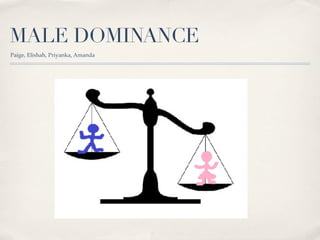
MALE DOMINANCE
Paige, Elishah, Priyanka, Amanda
WHAT IS MALE DOMINANCE
IN THE WORKPLACE?
You May Be Wondering Why We
Chose This Topic..


✤   Everlasting.

✤   Bigger deal than made out to be.

✤   Jeopardize our success in the future.

✤   NOT FAIR!!
GENDER DISCRIMINATION IN
THE WORKPLACE

✤   Difference of pay between men and women.

✤   Many examples shown in society.

✤   Woman looked down upon in the workplace.

✤   Discrimination in the workplace is shown through statistical
    discrimination.
DISCRIMINATION


✤   Some people think that the wage gap will eventually close sooner or
    later however as of right now it is essentially in every occupational
    category.

✤   Research done at the Centre for Gender Studies about wage
    differences.
HISTORY


✤   Ratio of even pay in the 1950s compared to in the 1990s.

✤   The Equal Pay Act (EPA) put into effect in 1963, required males and
    females doing the same job to be payed equally.
ROLE OF FAMILY STATUS
AND CHILDREN


✤   Relationship between family status and pay differs for both males and
    females.
RECENT WAGE GAP


✤   Women working full time who are not on maternity leave are only
    earning 77 cents for every full-time male dollar.

✤   A young woman who graduated last summer from high school will
    earn $700,000 less than a young man graduating in her same class.

✤   A young woman will lose $1.2 million compared to a man in her same
    class.
HISTORY OF WOMEN IN THE
WORKPLACE
✤   Scholars generally regard cultural beliefs about gender as
    foundational to discrimination against women in the workplace
    (Ridgeway and England 2007,193).

✤   Scholars generally regard cultural beliefs about gender as
    foundational to discrimination against women in the workplace
    (Ridgeway and England 2007,193).

✤   Scholars generally regard cultural beliefs about gender as
    foundational to discrimination against women in the workplace
    (Ridgeway and England 2007,193).

✤   Men were the breadwinners, women were the homemakers.
WOMEN WORING IN
FACTORIES

✤   Factories became the main form of production at the end of the 19th
    century.

✤   Bad conditions, long hours of work.

✤   Essentialism: Assumes that everyone in some social category are the
    same and therefore have a shared experience.

✤   Women were only supposed to work until they were married.

✤   Having dreams for a career was considered unfeminine.
✤   Jobs were 'extensions' of what they were stereotypically good at:

✤   - Maids

✤   - Dressmakers

✤   - Teachers

✤   - Seamstresses

✤   - Tailors

✤   - Housekeepers
WOMAN ROLES DURING
WORLD WARS
✤   During WWI women replaced some of the mens jobs while the men
    went off to war, but were not paid the same wage. When the war
    ended, employers encouraged the women to leave the workforce and
    married women were legislated out so the men could have their jobs
    back.

✤   When WWII rolled around, the same thing happened. This time,
    however, employers attracted women with incentives like free
    daycare. Once again, when the war ended, they encouraged the
    women to leave in part by removing the incentives.

✤   The employers abused their power and used these women.
✤   The 1950s brought economic expansion, and women compromised
    22% of the workforce (which was up from 13% in 1901). Due to rising
    prices, it became more acceptable for married women to enter the
    workforce because of the need for a two-income family.

✤   While women were finally gaining some power to enter the
    workforce, they still faced discrimination.
MAD MEN


✤   http://www.youtube.com/watch?v=DxZ3A9giyIo
WOMEN’S MOVEMENTS TO
CHANGE MALE DOMINANCE


✤   Development in the 1950’s

✤   Family life effects on women in the workplaces
EFFECTS OF WAR


✤   Positions war set up for men and women

✤   The postwar growth
ORGANIZATIONS TO END
MALE DOMINANCE


✤   The National Organization for Women (NOW)

✤   President’s Commission on the Status of Women (PCSW)

✤   Women’s Liberation Movement (WLM)
ACCOMPLISHMENTS OF THE
WOMEN’S MOVEMENTS
✤   Women elected to state legislatures has doubled from 604 to 1,261.

✤   In the late 1980s, 1/4 of all law, medical and business school
    graduates were women compared to the 5% 20 years later. (Nancy F.
    Cott)

✤   Most colleges and universities have established women&gender
    study courses.

✤   57% of college students are now women.

✤   Movements have brought rethinking to what gender is and has
    resulted to less definition to the terms maleness and femaleness.
✤   Women make up 1/3 of physicians, 54% of accountants 45% of law
    associates and they about half of all employers at banking and
    insurance jobs. (Rosin)

✤   For every 2 men that earn a B.A. degree, 3 women do. (Rosin)

✤   Women are more than 50% of the workforce and more than 50% of
    managers. (Rosin)

✤   It’s a new generation that appears to have men loosing their
    dominance.
MEN’S VIEW ON DOMINANCE


✤   Many males look at dominance in the workplace as something that has
    surpassed us a long time ago.

✤   We have asked multiple men on their views of male dominance in the
    workplace and these are their responses:

✤   We also want to share some of our own personal experiences with male
    dominance.
WORKS CITED
THANKS FOR LISTENING !! :)

                        👌

CRS Powerpoint

  • 1.
  • 2.
    WHAT IS MALEDOMINANCE IN THE WORKPLACE?
  • 3.
    You May BeWondering Why We Chose This Topic.. ✤ Everlasting. ✤ Bigger deal than made out to be. ✤ Jeopardize our success in the future. ✤ NOT FAIR!!
  • 4.
    GENDER DISCRIMINATION IN THEWORKPLACE ✤ Difference of pay between men and women. ✤ Many examples shown in society. ✤ Woman looked down upon in the workplace. ✤ Discrimination in the workplace is shown through statistical discrimination.
  • 5.
    DISCRIMINATION ✤ Some people think that the wage gap will eventually close sooner or later however as of right now it is essentially in every occupational category. ✤ Research done at the Centre for Gender Studies about wage differences.
  • 6.
    HISTORY ✤ Ratio of even pay in the 1950s compared to in the 1990s. ✤ The Equal Pay Act (EPA) put into effect in 1963, required males and females doing the same job to be payed equally.
  • 7.
    ROLE OF FAMILYSTATUS AND CHILDREN ✤ Relationship between family status and pay differs for both males and females.
  • 8.
    RECENT WAGE GAP ✤ Women working full time who are not on maternity leave are only earning 77 cents for every full-time male dollar. ✤ A young woman who graduated last summer from high school will earn $700,000 less than a young man graduating in her same class. ✤ A young woman will lose $1.2 million compared to a man in her same class.
  • 9.
    HISTORY OF WOMENIN THE WORKPLACE ✤ Scholars generally regard cultural beliefs about gender as foundational to discrimination against women in the workplace (Ridgeway and England 2007,193). ✤ Scholars generally regard cultural beliefs about gender as foundational to discrimination against women in the workplace (Ridgeway and England 2007,193). ✤ Scholars generally regard cultural beliefs about gender as foundational to discrimination against women in the workplace (Ridgeway and England 2007,193). ✤ Men were the breadwinners, women were the homemakers.
  • 10.
    WOMEN WORING IN FACTORIES ✤ Factories became the main form of production at the end of the 19th century. ✤ Bad conditions, long hours of work. ✤ Essentialism: Assumes that everyone in some social category are the same and therefore have a shared experience. ✤ Women were only supposed to work until they were married. ✤ Having dreams for a career was considered unfeminine.
  • 11.
    Jobs were 'extensions' of what they were stereotypically good at: ✤ - Maids ✤ - Dressmakers ✤ - Teachers ✤ - Seamstresses ✤ - Tailors ✤ - Housekeepers
  • 12.
    WOMAN ROLES DURING WORLDWARS ✤ During WWI women replaced some of the mens jobs while the men went off to war, but were not paid the same wage. When the war ended, employers encouraged the women to leave the workforce and married women were legislated out so the men could have their jobs back. ✤ When WWII rolled around, the same thing happened. This time, however, employers attracted women with incentives like free daycare. Once again, when the war ended, they encouraged the women to leave in part by removing the incentives. ✤ The employers abused their power and used these women.
  • 13.
    The 1950s brought economic expansion, and women compromised 22% of the workforce (which was up from 13% in 1901). Due to rising prices, it became more acceptable for married women to enter the workforce because of the need for a two-income family. ✤ While women were finally gaining some power to enter the workforce, they still faced discrimination.
  • 14.
    MAD MEN ✤ http://www.youtube.com/watch?v=DxZ3A9giyIo
  • 16.
    WOMEN’S MOVEMENTS TO CHANGEMALE DOMINANCE ✤ Development in the 1950’s ✤ Family life effects on women in the workplaces
  • 17.
    EFFECTS OF WAR ✤ Positions war set up for men and women ✤ The postwar growth
  • 18.
    ORGANIZATIONS TO END MALEDOMINANCE ✤ The National Organization for Women (NOW) ✤ President’s Commission on the Status of Women (PCSW) ✤ Women’s Liberation Movement (WLM)
  • 19.
    ACCOMPLISHMENTS OF THE WOMEN’SMOVEMENTS ✤ Women elected to state legislatures has doubled from 604 to 1,261. ✤ In the late 1980s, 1/4 of all law, medical and business school graduates were women compared to the 5% 20 years later. (Nancy F. Cott) ✤ Most colleges and universities have established women&gender study courses. ✤ 57% of college students are now women. ✤ Movements have brought rethinking to what gender is and has resulted to less definition to the terms maleness and femaleness.
  • 20.
    Women make up 1/3 of physicians, 54% of accountants 45% of law associates and they about half of all employers at banking and insurance jobs. (Rosin) ✤ For every 2 men that earn a B.A. degree, 3 women do. (Rosin) ✤ Women are more than 50% of the workforce and more than 50% of managers. (Rosin) ✤ It’s a new generation that appears to have men loosing their dominance.
  • 21.
    MEN’S VIEW ONDOMINANCE ✤ Many males look at dominance in the workplace as something that has surpassed us a long time ago. ✤ We have asked multiple men on their views of male dominance in the workplace and these are their responses: ✤ We also want to share some of our own personal experiences with male dominance.
  • 22.
  • 23.