A BRIEF MEET TO INTELLECTUAL PROPERTY
RIGHTS
Bharti Khatumariya
M.Tech
Nanoscience & Technology
अंतरी पेटवू ज्ञानज्योत
NAAC Re-Accredited 'B'
(CGPA 2.88)
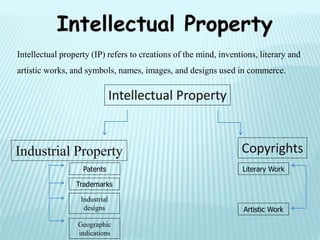
Intellectual property (IP) refers to creations of the mind, inventions, literary and
artistic works, and symbols, names, images, and designs used in commerce.
Patents
Trademarks
Industrial
designs
Geographic
indications
Literary Work
Artistic Work
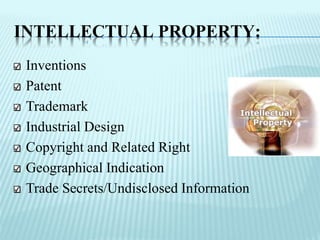
INTELLECTUAL PROPERTY:
Inventions
Patent
Trademark
Industrial Design
Copyright and Related Right
Geographical Indication
Trade Secrets/Undisclosed Information
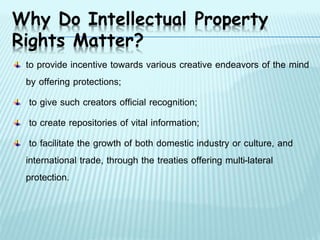
Why Do Intellectual Property
Rights Matter?
to provide incentive towards various creative endeavors of the mind
by offering protections;
to give such creators official recognition;
to create repositories of vital information;
to facilitate the growth of both domestic industry or culture, and
international trade, through the treaties offering multi-lateral
protection.
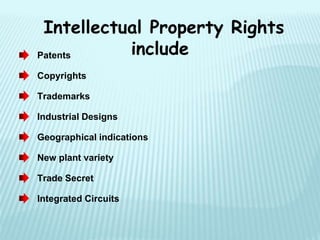
Intellectual Property Rights
includePatents
Copyrights
Trademarks
Industrial Designs
Geographical indications
New plant variety
Trade Secret
Integrated Circuits
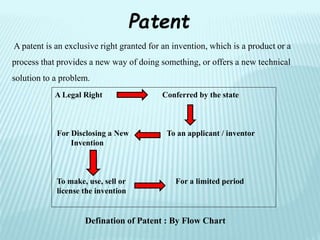
Patent
A patent is an exclusive right granted for an invention, which is a product or a
process that provides a new way of doing something, or offers a new technical
solution to a problem.
A Legal Right Conferred by the state
For Disclosing a New To an applicant / inventor
Invention
To make, use, sell or For a limited period
license the invention
Defination of Patent : By Flow Chart
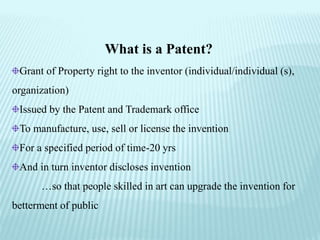
What is a Patent?
Grant of Property right to the inventor (individual/individual (s),
organization)
Issued by the Patent and Trademark office
To manufacture, use, sell or license the invention
For a specified period of time-20 yrs
And in turn inventor discloses invention
…so that people skilled in art can upgrade the invention for
betterment of public
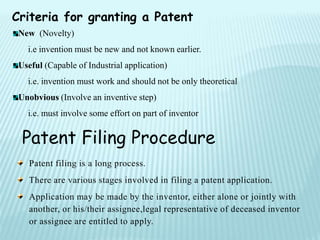
Criteria for granting a Patent
New (Novelty)
i.e invention must be new and not known earlier.
Useful (Capable of Industrial application)
i.e. invention must work and should not be only theoretical
Unobvious (Involve an inventive step)
i.e. must involve some effort on part of inventor
Patent filing is a long process.
There are various stages involved in filing a patent application.
Application may be made by the inventor, either alone or jointly with
another, or his/their assignee,legal representative of deceased inventor
or assignee are entitled to apply.
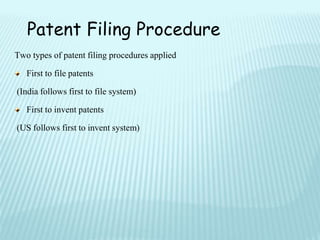
Patent Filing Procedure
Two types of patent filing procedures applied
First to file patents
(India follows first to file system)
First to invent patents
(US follows first to invent system)
Patent Filing Procedure
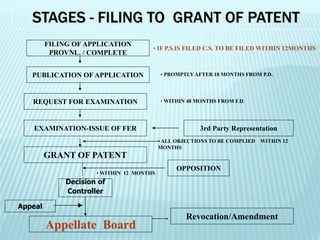
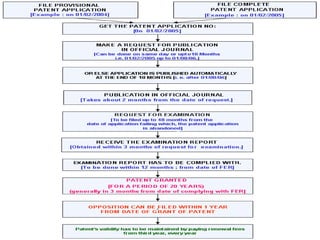
STAGES - FILING TO GRANT OF PATENT
PUBLICATION OF APPLICATION
REQUEST FOR EXAMINATION
GRANT OF PATENT
3rd Party Representation
Revocation/Amendment
OPPOSITION
• PROMPTLY AFTER 18 MONTHS FROM P.D.
• WITHIN 48 MONTHS FROM F.D.
• ALL OBJECTIONS TO BE COMPLIED WITHIN 12
MONTHS
• IF P.S.IS FILED C.S. TO BE FILED WITHIN 12MONTHS
• WITHIN 12 MONTHS
FILING OF APPLICATION
PROVNL. / COMPLETE
Decision of
Controller
EXAMINATION-ISSUE OF FER
Appeal
Appellate Board
It is a right a owner has and they can be used for commercial advantage
Domain of copyright: Protection of literary and artistic work.
Includes– writings, music, work of fine arts such as paintings and sculptures and
technology based work such as computer programs and electric database
Copyright
 Copyright protects work, i.e. expression of thought and not ideas
 No requirement for literary and artistic work should be good or have artistic
merit. It should be original
In common law countries fixation is required: a work must be written down or
recorded;
 e.g.: ballets, video record
In civilian law countries works are protected from the instance of creation,
requires proving the creation in court in case of any dispute
Term Of Copyright
ProtectionUnder Berne Convention, upto 50 years calculated from end of
year of author’s death
In EU and US the term is 70 years from the author’s death
Transfer of copyright
Economic rights can be transferred for a sum of money or royalty.
Moral rights cannot be transferred. It always remain with original
author of work
Transfer could affect all economic rights or only some of them
It could be for specific territory & for a specific duration
Economic rights: Allow owner of rights to derive any financial
reward from use of his works by others
Moral rights: allow author to take certain action to preserve the
personal link between himself and the work
Right of reproduction:
 Covers right of reproduction such as of books and
photocopying.
 Owner of rights can prevent others from making copies of his/her
work
Types Of Copyrights
Trademarks have been used to simplify the identification of goods
or services as well as their quality and value
Used to distinguish product due to commercial activities and
increased competition among companies
Trademark should be distinctive & should not be deceptive
To protect trademark, it has to be registered in trademark registry
Trademark typically identify individual enterprises as the origin or
marked goods or services
Trademark
“A trademark is any sign that individualizes
the goods of a given enterprise and
distinguishes them from the goods of its
competitors.”
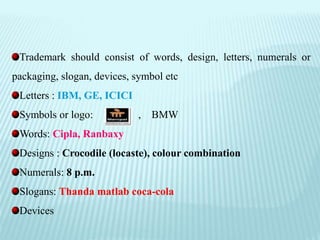
Trademark should consist of words, design, letters, numerals or
packaging, slogan, devices, symbol etc
Letters : IBM, GE, ICICI
Symbols or logo: , BMW
Words: Cipla, Ranbaxy
Designs : Crocodile (locaste), colour combination
Numerals: 8 p.m.
Slogans: Thanda matlab coca-cola
Devices
Functions Of Trade Marks
•Trademark may perform different functions. in particular they;
•Help consumers identify and distinguish products or services;
•Enable companies to differentiate between their products;
•Are a marketing tool and basis for building a brand image and reputation.
•May be licensed and provides a direct source of revenue through royalties;
•Are a crucial component of business assets.
•Encourage companies to invest in maintaining or improving quality products; and
•May be useful for obtaining finance.
1. service marks
signs that enable the consumers to distinguish between the different
services such as insurance companies, car rental firms, airlines, etc.
These signs are called service marks.
Service marks are signs that are very similar in nature to
trademarks.
Service marks can be registered, renewed and canceled in the
same way as trademarks.
2. Collective mark
Used to indicate the affiliation of enterprise using the mark
It usually belong to a group or association of enterprises.
Use is reserved to the members of the group or association
Function is to inform the public about certain particular features
of product for which collective mark is used
3. Certificate mark
It indicates goods or service in connection with which it is used
Certified by the proprietor/agency of mark in respect of origin,
mode of manufacture of goods, quality or any other characteristic
Certificate mark can be used only in accordance with the defined
standards. E.g. ISO 9000, ISI, BIS
Trademarks are territorial rights and registration is required in
countries where protection is sought
Term of trademarks is 10 years but may be renewed for unlimited
period by payment of the renewal fees
Protected subject is information lawfully within the control of a
natural person of legal person that is secret that has commercial
value because it is secret and that has been subject to reasonable
steps by the person lawfully in control of the information, to
keep it secret
A trade secret refers to data or information relating to the
business which is not generally known to the public and which
the owner reasonably attempts to keep secret and confidential
Almost any type of data, processes or information can be
referred to as trade secrets so long as it is intended to be and
kept a secret, and involves an economic interest of the owner
Trade secrets generally give the business a competitive edge
over their rivals
Protection Of Undisclosed
Information:
Trade Secret
It includes formula, pattern, compilation, programme, device,
method, technique or process
It may include new product plans, product costing, sources of
materials, accounting information, business methods, research
reports, organization structure, test data etc.
The owner has the exclusive right to use/ exploit a trade secret
as long as it remains secret
Term of trade secret could be infinite
E.g. trade secret of Coca-Cola
The typical response to keeping trade secrets secure is to use
better and more sophisticated ways to lock them up.
The only thing they don't protect against is theft by exiting
employees
Theft of these trade secrets and infringement by competitors is
a direct threat to the shareholder value of the company
Paradox of computers - computers have made it much easier to
create and steal trade secrets
A nondisclosure agreement can be used to protect any type of
trade secret
Industrial Design
A geographical indication is a sign used on goods that have a specific
geographical origin and possess qualities, reputation or
characteristics that are essentially attributable to that place of origin.
A geographical indication includes the name of the place of origin of
the goods. Agricultural products typically have qualities that derive
from their place of production and are influenced by specific local
factors, such as climate and soil. Geographical indications may be
used for a wide variety of products, whether natural, agricultural or
manufactured.
Add to the commercial value of a product and increase its
marketability.
Helps to ensure a fair return on investment.
An effective system of protection also benefits consumers and the
public at large, by promoting fair competition and honest trade
practices
Why protect industrial
design?
Geographical Indication
A geographical indication is a sign used on goods that have a
specific geographical origin and possess qualities, reputation or
characteristics that are essentially attributable to that place of
origin. Most commonly, a geographical indication includes the
name of the place of origin of the goods.
A trademark is a sign used by an enterprise to distinguish its goods and services
from those of other enterprises. It gives its owner the right to exclude others
from using the trademark. A trademark will often consist of a fanciful or
arbitrary name or device.
A geographical indication tells consumers that a product is produced in a
certain place and has certain characteristics that are due to that place of
production. It may be used by all producers who make their products in the place
designated by a geographical indication and whose products share specified
qualities. Unlike a trademark, the name used as a geographical indication will
usually be predetermined by the name of the place of production.
Diffrence b/w Geographical
Indication & Trademark
•http://www.wipo.int
•http://www.onuscertifications.com
•http://www.idsa.org
•www.uspto.gov
•www.ipindia.nic.in
•www.jpo.go.jp
•www.wto.org
Information Sources
IPR

IPR

  • 1.
    A BRIEF MEETTO INTELLECTUAL PROPERTY RIGHTS Bharti Khatumariya M.Tech Nanoscience & Technology अंतरी पेटवू ज्ञानज्योत NAAC Re-Accredited 'B' (CGPA 2.88)
  • 2.
    Intellectual property (IP)refers to creations of the mind, inventions, literary and artistic works, and symbols, names, images, and designs used in commerce. Patents Trademarks Industrial designs Geographic indications Literary Work Artistic Work
  • 3.
    INTELLECTUAL PROPERTY: Inventions Patent Trademark Industrial Design Copyrightand Related Right Geographical Indication Trade Secrets/Undisclosed Information
  • 4.
    Why Do IntellectualProperty Rights Matter? to provide incentive towards various creative endeavors of the mind by offering protections; to give such creators official recognition; to create repositories of vital information; to facilitate the growth of both domestic industry or culture, and international trade, through the treaties offering multi-lateral protection.
  • 5.
    Intellectual Property Rights includePatents Copyrights Trademarks IndustrialDesigns Geographical indications New plant variety Trade Secret Integrated Circuits
  • 6.
    Patent A patent isan exclusive right granted for an invention, which is a product or a process that provides a new way of doing something, or offers a new technical solution to a problem. A Legal Right Conferred by the state For Disclosing a New To an applicant / inventor Invention To make, use, sell or For a limited period license the invention Defination of Patent : By Flow Chart
  • 7.
    What is aPatent? Grant of Property right to the inventor (individual/individual (s), organization) Issued by the Patent and Trademark office To manufacture, use, sell or license the invention For a specified period of time-20 yrs And in turn inventor discloses invention …so that people skilled in art can upgrade the invention for betterment of public
  • 8.
    Criteria for grantinga Patent New (Novelty) i.e invention must be new and not known earlier. Useful (Capable of Industrial application) i.e. invention must work and should not be only theoretical Unobvious (Involve an inventive step) i.e. must involve some effort on part of inventor Patent filing is a long process. There are various stages involved in filing a patent application. Application may be made by the inventor, either alone or jointly with another, or his/their assignee,legal representative of deceased inventor or assignee are entitled to apply. Patent Filing Procedure
  • 9.
    Two types ofpatent filing procedures applied First to file patents (India follows first to file system) First to invent patents (US follows first to invent system) Patent Filing Procedure
  • 10.
    STAGES - FILINGTO GRANT OF PATENT PUBLICATION OF APPLICATION REQUEST FOR EXAMINATION GRANT OF PATENT 3rd Party Representation Revocation/Amendment OPPOSITION • PROMPTLY AFTER 18 MONTHS FROM P.D. • WITHIN 48 MONTHS FROM F.D. • ALL OBJECTIONS TO BE COMPLIED WITHIN 12 MONTHS • IF P.S.IS FILED C.S. TO BE FILED WITHIN 12MONTHS • WITHIN 12 MONTHS FILING OF APPLICATION PROVNL. / COMPLETE Decision of Controller EXAMINATION-ISSUE OF FER Appeal Appellate Board
  • 12.
    It is aright a owner has and they can be used for commercial advantage Domain of copyright: Protection of literary and artistic work. Includes– writings, music, work of fine arts such as paintings and sculptures and technology based work such as computer programs and electric database Copyright  Copyright protects work, i.e. expression of thought and not ideas  No requirement for literary and artistic work should be good or have artistic merit. It should be original In common law countries fixation is required: a work must be written down or recorded;  e.g.: ballets, video record In civilian law countries works are protected from the instance of creation, requires proving the creation in court in case of any dispute
  • 13.
    Term Of Copyright ProtectionUnderBerne Convention, upto 50 years calculated from end of year of author’s death In EU and US the term is 70 years from the author’s death Transfer of copyright Economic rights can be transferred for a sum of money or royalty. Moral rights cannot be transferred. It always remain with original author of work Transfer could affect all economic rights or only some of them It could be for specific territory & for a specific duration
  • 14.
    Economic rights: Allowowner of rights to derive any financial reward from use of his works by others Moral rights: allow author to take certain action to preserve the personal link between himself and the work Right of reproduction:  Covers right of reproduction such as of books and photocopying.  Owner of rights can prevent others from making copies of his/her work Types Of Copyrights
  • 15.
    Trademarks have beenused to simplify the identification of goods or services as well as their quality and value Used to distinguish product due to commercial activities and increased competition among companies Trademark should be distinctive & should not be deceptive To protect trademark, it has to be registered in trademark registry Trademark typically identify individual enterprises as the origin or marked goods or services Trademark “A trademark is any sign that individualizes the goods of a given enterprise and distinguishes them from the goods of its competitors.”
  • 16.
    Trademark should consistof words, design, letters, numerals or packaging, slogan, devices, symbol etc Letters : IBM, GE, ICICI Symbols or logo: , BMW Words: Cipla, Ranbaxy Designs : Crocodile (locaste), colour combination Numerals: 8 p.m. Slogans: Thanda matlab coca-cola Devices
  • 17.
    Functions Of TradeMarks •Trademark may perform different functions. in particular they; •Help consumers identify and distinguish products or services; •Enable companies to differentiate between their products; •Are a marketing tool and basis for building a brand image and reputation. •May be licensed and provides a direct source of revenue through royalties; •Are a crucial component of business assets. •Encourage companies to invest in maintaining or improving quality products; and •May be useful for obtaining finance.
  • 18.
    1. service marks signsthat enable the consumers to distinguish between the different services such as insurance companies, car rental firms, airlines, etc. These signs are called service marks. Service marks are signs that are very similar in nature to trademarks. Service marks can be registered, renewed and canceled in the same way as trademarks. 2. Collective mark Used to indicate the affiliation of enterprise using the mark It usually belong to a group or association of enterprises. Use is reserved to the members of the group or association Function is to inform the public about certain particular features of product for which collective mark is used
  • 19.
    3. Certificate mark Itindicates goods or service in connection with which it is used Certified by the proprietor/agency of mark in respect of origin, mode of manufacture of goods, quality or any other characteristic Certificate mark can be used only in accordance with the defined standards. E.g. ISO 9000, ISI, BIS Trademarks are territorial rights and registration is required in countries where protection is sought Term of trademarks is 10 years but may be renewed for unlimited period by payment of the renewal fees
  • 20.
    Protected subject isinformation lawfully within the control of a natural person of legal person that is secret that has commercial value because it is secret and that has been subject to reasonable steps by the person lawfully in control of the information, to keep it secret A trade secret refers to data or information relating to the business which is not generally known to the public and which the owner reasonably attempts to keep secret and confidential Almost any type of data, processes or information can be referred to as trade secrets so long as it is intended to be and kept a secret, and involves an economic interest of the owner Trade secrets generally give the business a competitive edge over their rivals Protection Of Undisclosed Information: Trade Secret
  • 21.
    It includes formula,pattern, compilation, programme, device, method, technique or process It may include new product plans, product costing, sources of materials, accounting information, business methods, research reports, organization structure, test data etc. The owner has the exclusive right to use/ exploit a trade secret as long as it remains secret Term of trade secret could be infinite E.g. trade secret of Coca-Cola
  • 22.
    The typical responseto keeping trade secrets secure is to use better and more sophisticated ways to lock them up. The only thing they don't protect against is theft by exiting employees Theft of these trade secrets and infringement by competitors is a direct threat to the shareholder value of the company Paradox of computers - computers have made it much easier to create and steal trade secrets A nondisclosure agreement can be used to protect any type of trade secret
  • 23.
    Industrial Design A geographicalindication is a sign used on goods that have a specific geographical origin and possess qualities, reputation or characteristics that are essentially attributable to that place of origin. A geographical indication includes the name of the place of origin of the goods. Agricultural products typically have qualities that derive from their place of production and are influenced by specific local factors, such as climate and soil. Geographical indications may be used for a wide variety of products, whether natural, agricultural or manufactured.
  • 24.
    Add to thecommercial value of a product and increase its marketability. Helps to ensure a fair return on investment. An effective system of protection also benefits consumers and the public at large, by promoting fair competition and honest trade practices Why protect industrial design?
  • 25.
    Geographical Indication A geographicalindication is a sign used on goods that have a specific geographical origin and possess qualities, reputation or characteristics that are essentially attributable to that place of origin. Most commonly, a geographical indication includes the name of the place of origin of the goods.
  • 26.
    A trademark isa sign used by an enterprise to distinguish its goods and services from those of other enterprises. It gives its owner the right to exclude others from using the trademark. A trademark will often consist of a fanciful or arbitrary name or device. A geographical indication tells consumers that a product is produced in a certain place and has certain characteristics that are due to that place of production. It may be used by all producers who make their products in the place designated by a geographical indication and whose products share specified qualities. Unlike a trademark, the name used as a geographical indication will usually be predetermined by the name of the place of production. Diffrence b/w Geographical Indication & Trademark
  • 27.