Intellectual Property 
Rights 
Ankit Lamba 
025
What is Intellectual Property? 
 Intellectual property refers to creations of the mind 
 Such as inventions 
 Literacy and artistic works 
 Designs and symbols 
 Names and images used in Commerce 
 IP is protected in law by, for example, Patents, Trademarks, 
Copyrights, Which enable people to earn recognition from what they 
invent or create.
How patent is Important in our Industrial 
Practice? 
 Patents provide incentives to the individuals. In particular, 
the inventors deserve recognition for their creativity and 
material reward for their marketable inventions. 
 The incentives encourage innovation, which ensures that 
the quality of human life is enhanced. 
 Protection stimulates research, which results in 
technological development
How patent is Important in our Industrial 
Practice? 
 It enables the inventors to recoup their investment for the 
money and time spent developing the ideas in Research 
and Development. 
 The use of patent documents enables future researchers 
not to reinvent the wheel.
Why registration of trademark is 
Important? 
 Exclusive legal right on your business name 
 Protects your business name and gives Remedy in the 
Court in case of any infringement. 
 A sound name in the market in the eye of a general public 
 Creates a face value among competitors 
 Gives a legal recognition to your business 
 Monopoly business name or brand name
INDIAN IPR REGIME 
 Meet international obligations 
while safeguarding national 
interests 
 Modernize; and 
 Move ahead
STRATEGY FOR IPR 
 Meet International obligations through 
Legislative changes 
 Modernize IPR Regime 
 Create Awareness
Legislative Measures 
 The Patents Act, 1970 
• Product Patent 
• Patent Term of 20 years 
• Public Health Safeguards 
• Protection to TK 
 The Trade Marks Act, 1999 
• Service Marks and Collective Marks 
• Term increased from 7 years to 10 
years
Legislative Measures 
 The Designs Act, 2000 
 The GI Act, 1999 
 The Copyrights Act, 1957 
 The Bio-Diversity Act, 2001 
 The Layouts and Integrated Circuits Act
Patents Rights 
• Patents (Amendment) ordinance was issued in 1994 
and became 
Patent (Amendment) Act,1999. 
• Patents (Second Amendment) Bill ,1999, has now 
become patent (Amendment) Act,2002. 
• Patent (Amendment) Act 2005, Product regime 
launched
Patents Rights 
• Some of the important features of the Patent (Amendment)Act,2005 are: 
a) Areas of Patentability (and exclusion)- sec3, clause g 
omitted, in clause ‘b’ and ‘c’ certain words omitted, 
additional clauses ‘j’, ‘k’, ‘l’, ‘m’ ‘n’ ‘o’ and ‘p’ 
added, ‘k’ further amended 
b) Product / Process Patent – sec 5 provided – only 
process patent in certain category, Article 27.1 of 
TRIPS – product patent in all fields of technology, 
sec 5 – chemical process – includes biochemical, 
biotechnological and microbiological process, Now 
omitted 
c) Patent Term- 20 years for all process and product 
patents, sec 53(1) – term of every patent – not 
expired, not cease to have effect -20 years
Patents Rights 
d) Contents of specification- sec 10, sub clause 4(d)- an abstract, 
requirement of making a deposit of the material, sub-clause 10.5 – a 
single inventive concept 
e) Examination and Publication- new sec 11A and 11B, sec 11A – all 
applications – not be opened till 18 months, sec 11-b : examination on 
request, within 48 months, Now 36 months 
f) Prohibition to apply for Patent outside India.- sec 39 – not to make an 
application outside India – Defense, atomic energy, apply in India, seek 
clearance 
g) Rights over importation.- right to make, use, exercise, sell or distribute – 
include importation 
h) Compulsory Licensing- sec83,84,85 and 89-95, sec 92 – grant of licence 
in national emergency, extreme urgency –public health crisis- includes 
procedures relating to AIDS and HIV, removal of three year restriction - 
CL. 
i) Use by Government and Government Agency – sec 47, sec 99-103 – 
various situations, sub sec (2) of sec 99 -omitted
Patents Rights 
j)Burden of proof concerning infringement –sec 104(A) – inserted, 
infringement of process patent – defendant – establish non-infringement. 
k)License of Right- sec 86-89 of patent Act 1970, provisions of Licence of 
Rights - dropped. 
l)Appellate Board – sec 116 the appellate Board established u/s 83 of Trade 
Mark Act 1999 – the appellate Board – patent act appeal to appellate Board 
– decision, order or direction of controller, otherwise earlier was – High 
Court. 
m)Unauthorised claims of Patent Rights – sec 120 – wrong representation 
about patented in India or patent application, fine increased from 500/- to 
10,000/-., Now Rs. 1,00,000/- 
n)Other Amendments- sec 48 –prevent third party wit no consent, sec 
107(A)(a) – protection of biodiversity and traditional knowledge.
Industrial Designs 
 The protection you receive is only 
for the appearance of the article 
and not how it works. 
 Design registration is intended to 
protect designs which have an 
industrial or commercial use. 
 Duration of protection is initially 
for 10 years and extendable for 
another term of 5 years. 
 Designs of stamps, labels, tokens, 
cards, cartoons, or parts of an article 
not sold separately, cannot be 
registered. 
 Electrical JUG
Design Examples
TRADEMARKS 
SONY OLYMPUS 
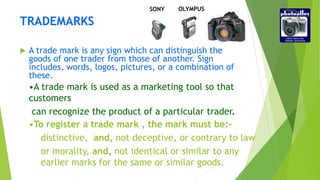
 A trade mark is any sign which can distinguish the 
goods of one trader from those of another. Sign 
includes, words, logos, pictures, or a combination of 
these. 
•A trade mark is used as a marketing tool so that 
customers 
can recognize the product of a particular trader. 
•To register a trade mark , the mark must be:- 
distinctive, and, not deceptive, or contrary to law 
or morality, and, not identical or similar to any 
earlier marks for the same or similar goods.
Law of Patents 
•Protection part 
•Enforcement part
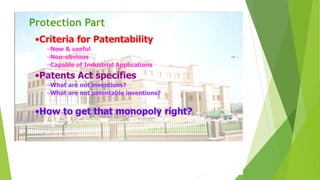
Protection Part 
•Criteria for Patentability 
–New & useful 
–Non-obvious 
–Capable of Industrial Applications 
•Patents Act specifies 
–What are not inventions? 
–What are not patentable inventions? 
•How to get that monopoly right?
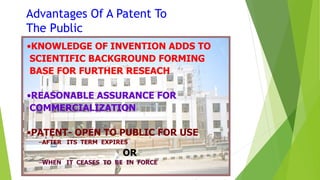
Advantages Of A Patent To 
The Public 
•KNOWLEDGE OF INVENTION ADDS TO 
SCIENTIFIC BACKGROUND FORMING 
BASE FOR FURTHER RESEACH 
•REASONABLE ASSURANCE FOR 
COMMERCIALIZATION 
•PATENT- OPEN TO PUBLIC FOR USE 
–AFTER ITS TERM EXPIRES 
OR 
–WHEN IT CEASES TO BE IN FORCE
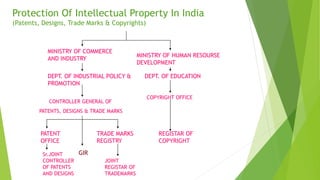
Protection Of Intellectual Property In India 
(Patents, Designs, Trade Marks & Copyrights) 
MINISTRY OF COMMERCE 
AND INDUSTRY 
Sr.JOINT 
CONTROLLER 
OF PATENTS 
AND DESIGNS 
JOINT 
REGISTAR OF 
TRADEMARKS 
MINISTRY OF HUMAN RESOURSE 
DEVELOPMENT 
DEPT. OF INDUSTRIAL POLICY & 
PROMOTION 
DEPT. OF EDUCATION 
CONTROLLER GENERAL OF 
PATENTS, DESIGNS & TRADE MARKS 
PATENT 
OFFICE 
TRADE MARKS 
REGISTRY 
COPYRIGHT OFFICE 
REGISTAR OF 
COPYRIGHT 
GIR
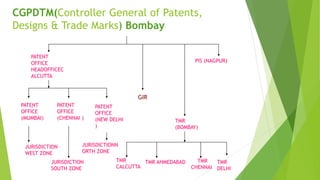
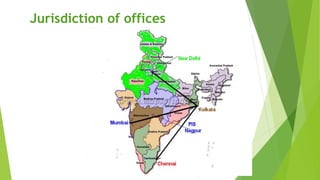
CGPDTM(Controller General of Patents, 
Designs & Trade Marks) Bombay 
PATENT 
OFFICE 
HEADOFFICEC 
ALCUTTA 
PIS (NAGPUR) 
PATENT 
OFFICE 
(MUMBAI) 
PATENT 
OFFICE 
(CHENNAI ) 
PATENT 
OFFICE 
(NEW DELHI 
) 
JURISDICTION 
WEST ZONE 
JURISDICTIONN 
ORTH ZONE 
JURISDICTION 
SOUTH ZONE 
TMR 
(BOMBAY) 
TMR AHMEDABAD TMR 
DELHI 
TMR 
CALCUTTA 
TMR 
CHENNAI 
GIR
Jurisdiction of offices
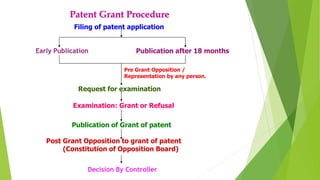
Patent Grant Procedure 
Filing of patent application 
Publication after 18 months 
Pre Grant Opposition / 
Representation by any person. 
Early Publication 
Request for examination 
Examination: Grant or Refusal 
Publication of Grant of patent 
Post Grant Opposition to grant of patent 
(Constitution of Opposition Board) 
Decision By Controller
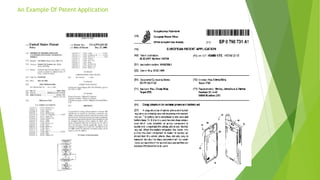
An Example Of Patent Application
Thank You

Intellectual property rights India

  • 1.
  • 2.
    What is IntellectualProperty?  Intellectual property refers to creations of the mind  Such as inventions  Literacy and artistic works  Designs and symbols  Names and images used in Commerce  IP is protected in law by, for example, Patents, Trademarks, Copyrights, Which enable people to earn recognition from what they invent or create.
  • 3.
    How patent isImportant in our Industrial Practice?  Patents provide incentives to the individuals. In particular, the inventors deserve recognition for their creativity and material reward for their marketable inventions.  The incentives encourage innovation, which ensures that the quality of human life is enhanced.  Protection stimulates research, which results in technological development
  • 4.
    How patent isImportant in our Industrial Practice?  It enables the inventors to recoup their investment for the money and time spent developing the ideas in Research and Development.  The use of patent documents enables future researchers not to reinvent the wheel.
  • 5.
    Why registration oftrademark is Important?  Exclusive legal right on your business name  Protects your business name and gives Remedy in the Court in case of any infringement.  A sound name in the market in the eye of a general public  Creates a face value among competitors  Gives a legal recognition to your business  Monopoly business name or brand name
  • 6.
    INDIAN IPR REGIME  Meet international obligations while safeguarding national interests  Modernize; and  Move ahead
  • 7.
    STRATEGY FOR IPR  Meet International obligations through Legislative changes  Modernize IPR Regime  Create Awareness
  • 8.
    Legislative Measures The Patents Act, 1970 • Product Patent • Patent Term of 20 years • Public Health Safeguards • Protection to TK  The Trade Marks Act, 1999 • Service Marks and Collective Marks • Term increased from 7 years to 10 years
  • 9.
    Legislative Measures The Designs Act, 2000  The GI Act, 1999  The Copyrights Act, 1957  The Bio-Diversity Act, 2001  The Layouts and Integrated Circuits Act
  • 10.
    Patents Rights •Patents (Amendment) ordinance was issued in 1994 and became Patent (Amendment) Act,1999. • Patents (Second Amendment) Bill ,1999, has now become patent (Amendment) Act,2002. • Patent (Amendment) Act 2005, Product regime launched
  • 11.
    Patents Rights •Some of the important features of the Patent (Amendment)Act,2005 are: a) Areas of Patentability (and exclusion)- sec3, clause g omitted, in clause ‘b’ and ‘c’ certain words omitted, additional clauses ‘j’, ‘k’, ‘l’, ‘m’ ‘n’ ‘o’ and ‘p’ added, ‘k’ further amended b) Product / Process Patent – sec 5 provided – only process patent in certain category, Article 27.1 of TRIPS – product patent in all fields of technology, sec 5 – chemical process – includes biochemical, biotechnological and microbiological process, Now omitted c) Patent Term- 20 years for all process and product patents, sec 53(1) – term of every patent – not expired, not cease to have effect -20 years
  • 12.
    Patents Rights d)Contents of specification- sec 10, sub clause 4(d)- an abstract, requirement of making a deposit of the material, sub-clause 10.5 – a single inventive concept e) Examination and Publication- new sec 11A and 11B, sec 11A – all applications – not be opened till 18 months, sec 11-b : examination on request, within 48 months, Now 36 months f) Prohibition to apply for Patent outside India.- sec 39 – not to make an application outside India – Defense, atomic energy, apply in India, seek clearance g) Rights over importation.- right to make, use, exercise, sell or distribute – include importation h) Compulsory Licensing- sec83,84,85 and 89-95, sec 92 – grant of licence in national emergency, extreme urgency –public health crisis- includes procedures relating to AIDS and HIV, removal of three year restriction - CL. i) Use by Government and Government Agency – sec 47, sec 99-103 – various situations, sub sec (2) of sec 99 -omitted
  • 13.
    Patents Rights j)Burdenof proof concerning infringement –sec 104(A) – inserted, infringement of process patent – defendant – establish non-infringement. k)License of Right- sec 86-89 of patent Act 1970, provisions of Licence of Rights - dropped. l)Appellate Board – sec 116 the appellate Board established u/s 83 of Trade Mark Act 1999 – the appellate Board – patent act appeal to appellate Board – decision, order or direction of controller, otherwise earlier was – High Court. m)Unauthorised claims of Patent Rights – sec 120 – wrong representation about patented in India or patent application, fine increased from 500/- to 10,000/-., Now Rs. 1,00,000/- n)Other Amendments- sec 48 –prevent third party wit no consent, sec 107(A)(a) – protection of biodiversity and traditional knowledge.
  • 14.
    Industrial Designs The protection you receive is only for the appearance of the article and not how it works.  Design registration is intended to protect designs which have an industrial or commercial use.  Duration of protection is initially for 10 years and extendable for another term of 5 years.  Designs of stamps, labels, tokens, cards, cartoons, or parts of an article not sold separately, cannot be registered.  Electrical JUG
  • 15.
  • 16.
    TRADEMARKS SONY OLYMPUS  A trade mark is any sign which can distinguish the goods of one trader from those of another. Sign includes, words, logos, pictures, or a combination of these. •A trade mark is used as a marketing tool so that customers can recognize the product of a particular trader. •To register a trade mark , the mark must be:- distinctive, and, not deceptive, or contrary to law or morality, and, not identical or similar to any earlier marks for the same or similar goods.
  • 17.
    Law of Patents •Protection part •Enforcement part
  • 18.
    Protection Part •Criteriafor Patentability –New & useful –Non-obvious –Capable of Industrial Applications •Patents Act specifies –What are not inventions? –What are not patentable inventions? •How to get that monopoly right?
  • 19.
    Advantages Of APatent To The Public •KNOWLEDGE OF INVENTION ADDS TO SCIENTIFIC BACKGROUND FORMING BASE FOR FURTHER RESEACH •REASONABLE ASSURANCE FOR COMMERCIALIZATION •PATENT- OPEN TO PUBLIC FOR USE –AFTER ITS TERM EXPIRES OR –WHEN IT CEASES TO BE IN FORCE
  • 20.
    Protection Of IntellectualProperty In India (Patents, Designs, Trade Marks & Copyrights) MINISTRY OF COMMERCE AND INDUSTRY Sr.JOINT CONTROLLER OF PATENTS AND DESIGNS JOINT REGISTAR OF TRADEMARKS MINISTRY OF HUMAN RESOURSE DEVELOPMENT DEPT. OF INDUSTRIAL POLICY & PROMOTION DEPT. OF EDUCATION CONTROLLER GENERAL OF PATENTS, DESIGNS & TRADE MARKS PATENT OFFICE TRADE MARKS REGISTRY COPYRIGHT OFFICE REGISTAR OF COPYRIGHT GIR
  • 21.
    CGPDTM(Controller General ofPatents, Designs & Trade Marks) Bombay PATENT OFFICE HEADOFFICEC ALCUTTA PIS (NAGPUR) PATENT OFFICE (MUMBAI) PATENT OFFICE (CHENNAI ) PATENT OFFICE (NEW DELHI ) JURISDICTION WEST ZONE JURISDICTIONN ORTH ZONE JURISDICTION SOUTH ZONE TMR (BOMBAY) TMR AHMEDABAD TMR DELHI TMR CALCUTTA TMR CHENNAI GIR
  • 22.
  • 23.
    Patent Grant Procedure Filing of patent application Publication after 18 months Pre Grant Opposition / Representation by any person. Early Publication Request for examination Examination: Grant or Refusal Publication of Grant of patent Post Grant Opposition to grant of patent (Constitution of Opposition Board) Decision By Controller
  • 24.
    An Example OfPatent Application
  • 25.