UNCLASSIFIED
UNCLASSIFIED
UNCLASSIFIED
UNCLASSIFIED
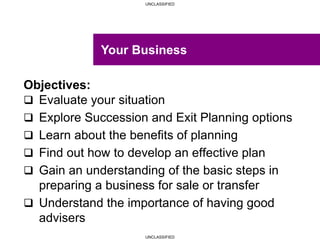
Objectives:
 Evaluate your situation
 Explore Succession and Exit Planning options
 Learn about the benefits of planning
 Find out how to develop an effective plan
 Gain an understanding of the basic steps in
preparing a business for sale or transfer
 Understand the importance of having good
advisers
Your Business
UNCLASSIFIED
UNCLASSIFIED
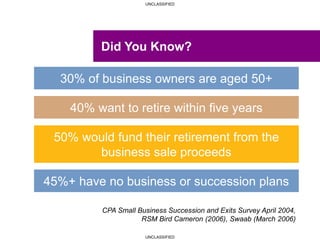
30% of business owners are aged 50+
CPA Small Business Succession and Exits Survey April 2004,
RSM Bird Cameron (2006), Swaab (March 2006)
45%+ have no business or succession plans
50% would fund their retirement from the
business sale proceeds
40% want to retire within five years
Did You Know?
UNCLASSIFIED
UNCLASSIFIED
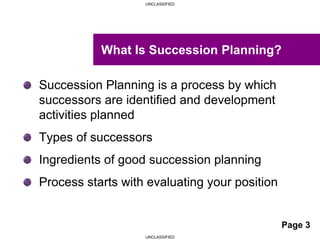
Succession Planning is a process by which
successors are identified and development
activities planned
Types of successors
Ingredients of good succession planning
Process starts with evaluating your position
What Is Succession Planning?
Page 3
UNCLASSIFIED
UNCLASSIFIED
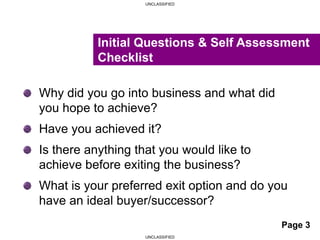
Why did you go into business and what did
you hope to achieve?
Have you achieved it?
Is there anything that you would like to
achieve before exiting the business?
What is your preferred exit option and do you
have an ideal buyer/successor?
Initial Questions & Self Assessment
Checklist
Page 3
UNCLASSIFIED
UNCLASSIFIED
Systematic approach for someone to transition
away from a business:
do on own terms, not dictated by others
maximise after tax dollars
Should be staged
Exit strategies should be included in your business
plan
Encompasses management succession, ownership
transition planning and estate planning
Exit Planning
Page 6
UNCLASSIFIED
UNCLASSIFIED
difficulty delegating
fear of change and
identity
difficulty accepting that
anyone has the skills or
capability to succeed
them
concerns about ability to
maintain lifestyle
fear of conflict over
choice of successor
concerns about treating
children fairly
fear of life after work
poorly advised
Common Reasons for Not Planning
Page 7
UNCLASSIFIED
UNCLASSIFIED
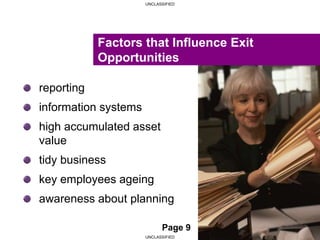
reporting
information systems
high accumulated asset
value
tidy business
key employees ageing
awareness about planning
Factors that Influence Exit
Opportunities
Page 9
UNCLASSIFIED
UNCLASSIFIED
Ensure economic independence
Provide short- and long-term success of business
Maintain family harmony
Minimise taxes
Gives control of the process and peace of mind
More profit and higher efficiency
Mitigates disruption to business if crisis occurs ie.
owner becomes incapacitated or dies
Exiting – Why Plan?
Page 10
UNCLASSIFIED
UNCLASSIFIED
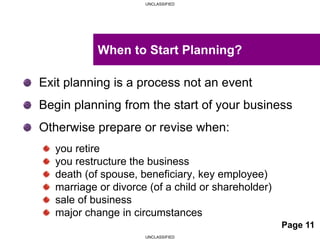
Exit planning is a process not an event
Begin planning from the start of your business
Otherwise prepare or revise when:
you retire
you restructure the business
death (of spouse, beneficiary, key employee)
marriage or divorce (of a child or shareholder)
sale of business
major change in circumstances
When to Start Planning?
Page 11
UNCLASSIFIED
UNCLASSIFIED
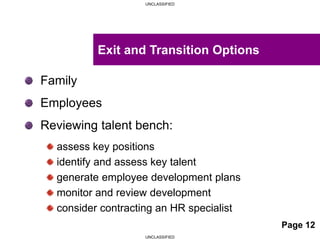
Family
Employees
Reviewing talent bench:
assess key positions
identify and assess key talent
generate employee development plans
monitor and review development
consider contracting an HR specialist
Exit and Transition Options
Page 12
UNCLASSIFIED
UNCLASSIFIED
Non family
Partnership
Merge/consolidation
More Exit and Transition Options
Page 18
UNCLASSIFIED
UNCLASSIFIED
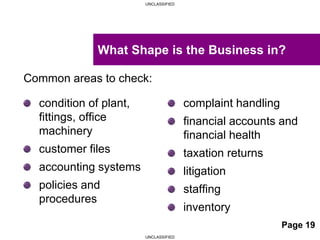
condition of plant,
fittings, office
machinery
customer files
accounting systems
policies and
procedures
complaint handling
financial accounts and
financial health
taxation returns
litigation
staffing
inventory
Common areas to check:
What Shape is the Business in?
Page 19
UNCLASSIFIED
UNCLASSIFIED
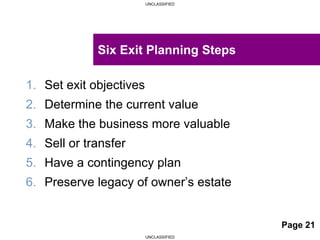
1. Set exit objectives
2. Determine the current value
3. Make the business more valuable
4. Sell or transfer
5. Have a contingency plan
6. Preserve legacy of owner’s estate
Six Exit Planning Steps
Page 21
UNCLASSIFIED
UNCLASSIFIED
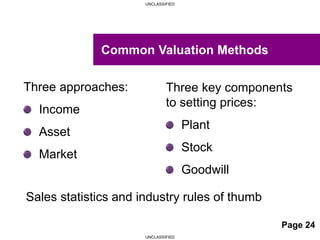
Three approaches:
Income
Asset
Market
Three key components
to setting prices:
Plant
Stock
Goodwill
Sales statistics and industry rules of thumb
Common Valuation Methods
Page 24
UNCLASSIFIED
UNCLASSIFIED
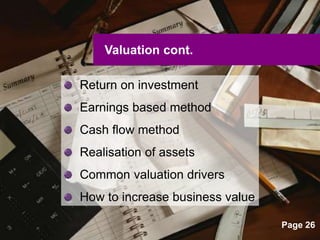
Return on investment
Earnings based method
Cash flow method
Realisation of assets
Common valuation drivers
How to increase business value
Valuation cont.
Page 26
UNCLASSIFIED
UNCLASSIFIED
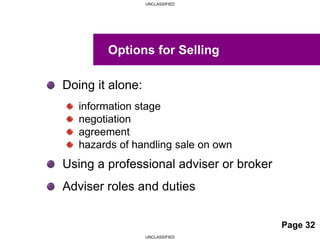
Doing it alone:
information stage
negotiation
agreement
hazards of handling sale on own
Using a professional adviser or broker
Adviser roles and duties
Options for Selling
Page 32
UNCLASSIFIED
UNCLASSIFIED
Situation 1 – Family Business –
manufacturer of specialty technical products
(page 34 of workbook)
What are the options for the parents to exit?
Situation 2 – Small Service Business
(page 35 of workbook)
Is there any problem with this approach?
Discussion of approaches and ideas
Case Studies
UNCLASSIFIED
UNCLASSIFIED
Complete
Personal
Action Plan
(page 37)
Personal Action Plan
UNCLASSIFIED
UNCLASSIFIED
Business mentors help you to identify a clear direction
for you and your business.
Business mentors can also advise you on how to:
conduct market research
price and/or cost your products or services
develop an effective marketing strategy
use other business management tools
Small Business Mentoring Service
To arrange a session with a business mentor go to:
www.sbms.org.au
UNCLASSIFIED
UNCLASSIFIED
Questions?
Thank you for attending
Visit
business.vic.gov.au/events
for more workshop information

Exiting your Business Successfully seminar