2012


© 2012 EverEdge IP.
Who are we?
 New Zealand’s largest technology and intellectual
  property commercialisation firm.
 Proprietary: Invest in and commercialise IP-rich
  technologies. Transactions include packaging, medical
  devices, software; 000,000 to 00,000,000 values.
 Advisory: Advise organisations, innovators & investors
  how to commercialise technology. Clients include
  Fortune 100 companies, 3 of 5 largest companies in NZ.

     We help our clients make money from ideas.
What do we do?
 We help organisations leverage innovation,
  technology and intellectual property to:

 Create new revenue &      Build competitive
     realise value.           advantage.

 Increase innovation &
   accelerate product    Reduce liability & risk.
     development.
Our Difference.


   World Leading      Multi-disciplinary
    Experience.            Team.


                      Independent (not a
 Hands On Practice.
                       patent attorney).
Intellectual Property 101
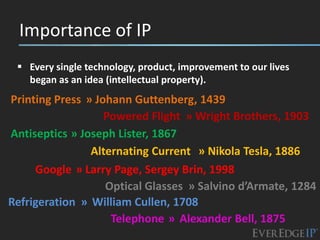
Importance of IP
  Every single technology, product, improvement to our lives
   began as an idea (intellectual property).
Printing Press » Johann Guttenberg, 1439
                   Powered Flight » Wright Brothers, 1903
Antiseptics » Joseph Lister, 1867
                Alternating Current » Nikola Tesla, 1886
     Google » Larry Page, Sergey Brin, 1998
                   Optical Glasses » Salvino d’Armate, 1284
Refrigeration » William Cullen, 1708
                    Telephone » Alexander Bell, 1875
We all have “products of the human intellect”

   Ideas
   The way we do things
   Experience
   Skills
   Wisdom
   Knowledge


               These things are not necessarily
                   “intellectual property”
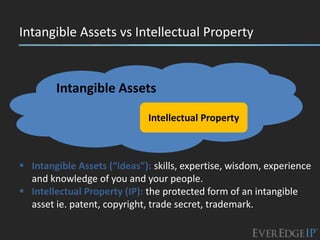
Intangible Assets vs Intellectual Property


        Intangible Assets

                              Intellectual Property


 Intangible Assets (“ideas”): skills, expertise, wisdom, experience
  and knowledge of you and your people.
 Intellectual Property (IP): the protected form of an intangible
  asset ie. patent, copyright, trade secret, trademark.
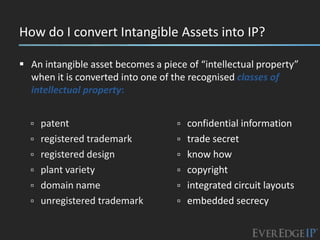
How do I convert Intangible Assets into IP?

 An intangible asset becomes a piece of “intellectual property”
  when it is converted into one of the recognised classes of
  intellectual property:


     patent                           confidential information
     registered trademark             trade secret
     registered design                know how
     plant variety                    copyright
     domain name                      integrated circuit layouts
     unregistered trademark           embedded secrecy
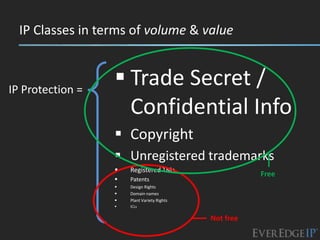
IP Classes in terms of volume & value


IP Protection =
                   Trade Secret /
                    Confidential Info
                   Copyright
                   Unregistered trademarks
                     Registered TMs
                                                        Free
                     Patents
                     Design Rights
                     Domain names
                     Plant Variety Rights
                     ICLs


                                             Not free
Myth Busting: “Patents must be valuable”


 “Patents are difficult to get so they must
       valuable & useful – right?”            
Patents not always a silver bullet

 Getting a granted patent is surprisingly easy – you can patent
  just about anything.
 However getting a commercially useful patent (broad and
  defendable) is a lot more challenging.
 For patent to be commercially useful must be completely new,
  2) not obvious in light of all publicly available technology
  anywhere in the world & 3) must cover all effective means of
  achieving desired end result.


      Patents like any other tool: used appropriately can be
  extremely valuable but can also cause a lot of damage / cost.
2. Commercialising IP
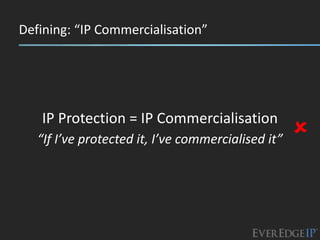
Defining: “IP Commercialisation”


   IP Protection = IP Commercialisation
   “If I’ve protected it, I’ve commercialised it”   
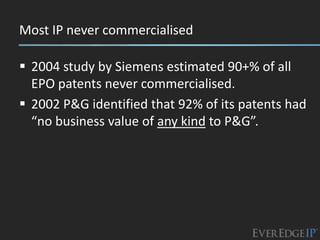
Most IP never commercialised

 2004 study by Siemens estimated 90+% of all
  EPO patents never commercialised.
 2002 P&G identified that 92% of its patents had
  “no business value of any kind to P&G”.
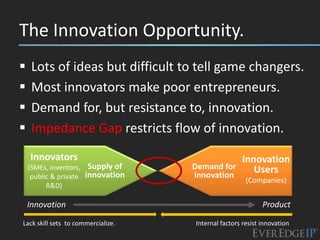
The Innovation Opportunity.
    Lots of ideas but difficult to tell game changers.
    Most innovators make poor entrepreneurs.
    Demand for, but resistance to, innovation.
    Impedance Gap restricts flow of innovation.
    Innovators                                 Innovation
    (SMEs, inventors, Supply of     Demand for    Users
     public & private innovation    innovation
                                                      (Companies)
          R&D)

    Innovation                                              Product

Lack skill sets to commercialize.   Internal factors resist innovation
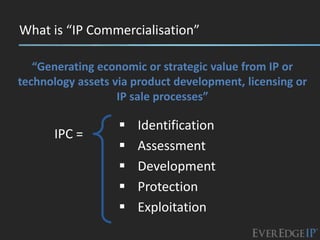
What is “IP Commercialisation”

   “Generating economic or strategic value from IP or
technology assets via product development, licensing or
                   IP sale processes”

                      Identification
      IPC =
                      Assessment
                      Development
                      Protection
                      Exploitation
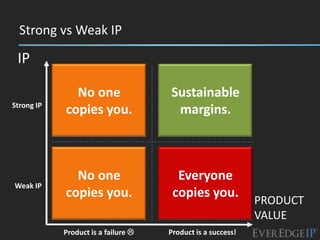
Strong vs Weak IP

 IP

              No one                 Sustainable
Strong IP
            copies you.               margins.


              No one                   Everyone
Weak IP
            copies you.               copies you.
                                                             PRODUCT
                                                             VALUE
            Product is a failure    Product is a success!
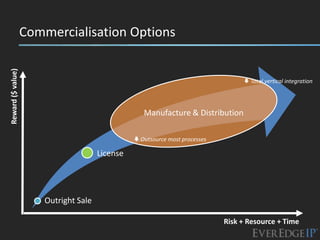
Commercialisation Options
Reward ($ value)


                                                                                    Total vertical integration


                                                    Manufacture & Distribution

                                                  Outsource most processes

                                       License


                       Outright Sale

                                                                              Risk + Resource + Time
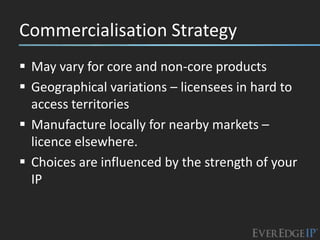
Commercialisation Strategy
 May vary for core and non-core products
 Geographical variations – licensees in hard to
  access territories
 Manufacture locally for nearby markets –
  licence elsewhere.
 Choices are influenced by the strength of your
  IP
EverEdgeIP Ltd.


                                Paul Davies
                  Director Intellectual Property
                                  EverEdgeIP Ltd
                               +64 21 119 5599
                                + 64 9 489 2331
                     p.davies@everedgeip.com
                         www.everedgeip.com

20120402 prd - generic presentation

  • 1.
  • 2.
    Who are we? New Zealand’s largest technology and intellectual property commercialisation firm.  Proprietary: Invest in and commercialise IP-rich technologies. Transactions include packaging, medical devices, software; 000,000 to 00,000,000 values.  Advisory: Advise organisations, innovators & investors how to commercialise technology. Clients include Fortune 100 companies, 3 of 5 largest companies in NZ. We help our clients make money from ideas.
  • 3.
    What do wedo?  We help organisations leverage innovation, technology and intellectual property to: Create new revenue & Build competitive realise value. advantage. Increase innovation & accelerate product Reduce liability & risk. development.
  • 4.
    Our Difference. World Leading Multi-disciplinary Experience. Team. Independent (not a Hands On Practice. patent attorney).
  • 5.
  • 6.
    Importance of IP  Every single technology, product, improvement to our lives began as an idea (intellectual property). Printing Press » Johann Guttenberg, 1439 Powered Flight » Wright Brothers, 1903 Antiseptics » Joseph Lister, 1867 Alternating Current » Nikola Tesla, 1886 Google » Larry Page, Sergey Brin, 1998 Optical Glasses » Salvino d’Armate, 1284 Refrigeration » William Cullen, 1708 Telephone » Alexander Bell, 1875
  • 7.
    We all have“products of the human intellect”  Ideas  The way we do things  Experience  Skills  Wisdom  Knowledge These things are not necessarily “intellectual property”
  • 8.
    Intangible Assets vsIntellectual Property Intangible Assets Intellectual Property  Intangible Assets (“ideas”): skills, expertise, wisdom, experience and knowledge of you and your people.  Intellectual Property (IP): the protected form of an intangible asset ie. patent, copyright, trade secret, trademark.
  • 9.
    How do Iconvert Intangible Assets into IP?  An intangible asset becomes a piece of “intellectual property” when it is converted into one of the recognised classes of intellectual property:  patent  confidential information  registered trademark  trade secret  registered design  know how  plant variety  copyright  domain name  integrated circuit layouts  unregistered trademark  embedded secrecy
  • 10.
    IP Classes interms of volume & value IP Protection =  Trade Secret / Confidential Info  Copyright  Unregistered trademarks  Registered TMs Free  Patents  Design Rights  Domain names  Plant Variety Rights  ICLs Not free
  • 11.
    Myth Busting: “Patentsmust be valuable” “Patents are difficult to get so they must valuable & useful – right?” 
  • 12.
    Patents not alwaysa silver bullet  Getting a granted patent is surprisingly easy – you can patent just about anything.  However getting a commercially useful patent (broad and defendable) is a lot more challenging.  For patent to be commercially useful must be completely new, 2) not obvious in light of all publicly available technology anywhere in the world & 3) must cover all effective means of achieving desired end result. Patents like any other tool: used appropriately can be extremely valuable but can also cause a lot of damage / cost.
  • 13.
  • 14.
    Defining: “IP Commercialisation” IP Protection = IP Commercialisation “If I’ve protected it, I’ve commercialised it” 
  • 15.
    Most IP nevercommercialised  2004 study by Siemens estimated 90+% of all EPO patents never commercialised.  2002 P&G identified that 92% of its patents had “no business value of any kind to P&G”.
  • 16.
    The Innovation Opportunity.  Lots of ideas but difficult to tell game changers.  Most innovators make poor entrepreneurs.  Demand for, but resistance to, innovation.  Impedance Gap restricts flow of innovation. Innovators Innovation (SMEs, inventors, Supply of Demand for Users public & private innovation innovation (Companies) R&D) Innovation Product Lack skill sets to commercialize. Internal factors resist innovation
  • 17.
    What is “IPCommercialisation” “Generating economic or strategic value from IP or technology assets via product development, licensing or IP sale processes”  Identification IPC =  Assessment  Development  Protection  Exploitation
  • 18.
    Strong vs WeakIP IP No one Sustainable Strong IP copies you. margins. No one Everyone Weak IP copies you. copies you. PRODUCT VALUE Product is a failure  Product is a success!
  • 19.
    Commercialisation Options Reward ($value)  Total vertical integration Manufacture & Distribution  Outsource most processes License Outright Sale Risk + Resource + Time
  • 20.
    Commercialisation Strategy  Mayvary for core and non-core products  Geographical variations – licensees in hard to access territories  Manufacture locally for nearby markets – licence elsewhere.  Choices are influenced by the strength of your IP
  • 21.
    EverEdgeIP Ltd. Paul Davies Director Intellectual Property EverEdgeIP Ltd +64 21 119 5599 + 64 9 489 2331 p.davies@everedgeip.com www.everedgeip.com

Editor's Notes

  • #17 Not that lousy per se but that would rather focus on innovation.What you guys do here is amazing but where is the real innovation? Twitter? We are capitalising teenage gossip.How come we are not permanently based on the Moon? How come we still get sick and die? Haven’t cured cancer 65 years after DNA.What you do here is amazing and what we plan to do is accelerate the process.Maybe how I have defined the problem is wrong. I basically agree with your problems about IP and I think you will see that as we progress through the presentation.