UNCLASSIFIED
UNCLASSIFIED
UNCLASSIFIED
UNCLASSIFIED
Welcome
Introduction to Seminar
What do you hope to learn in the next two hours:
Burning issues?
Topics of interest?
Opportunity to network
Have fun!
UNCLASSIFIED
UNCLASSIFIED
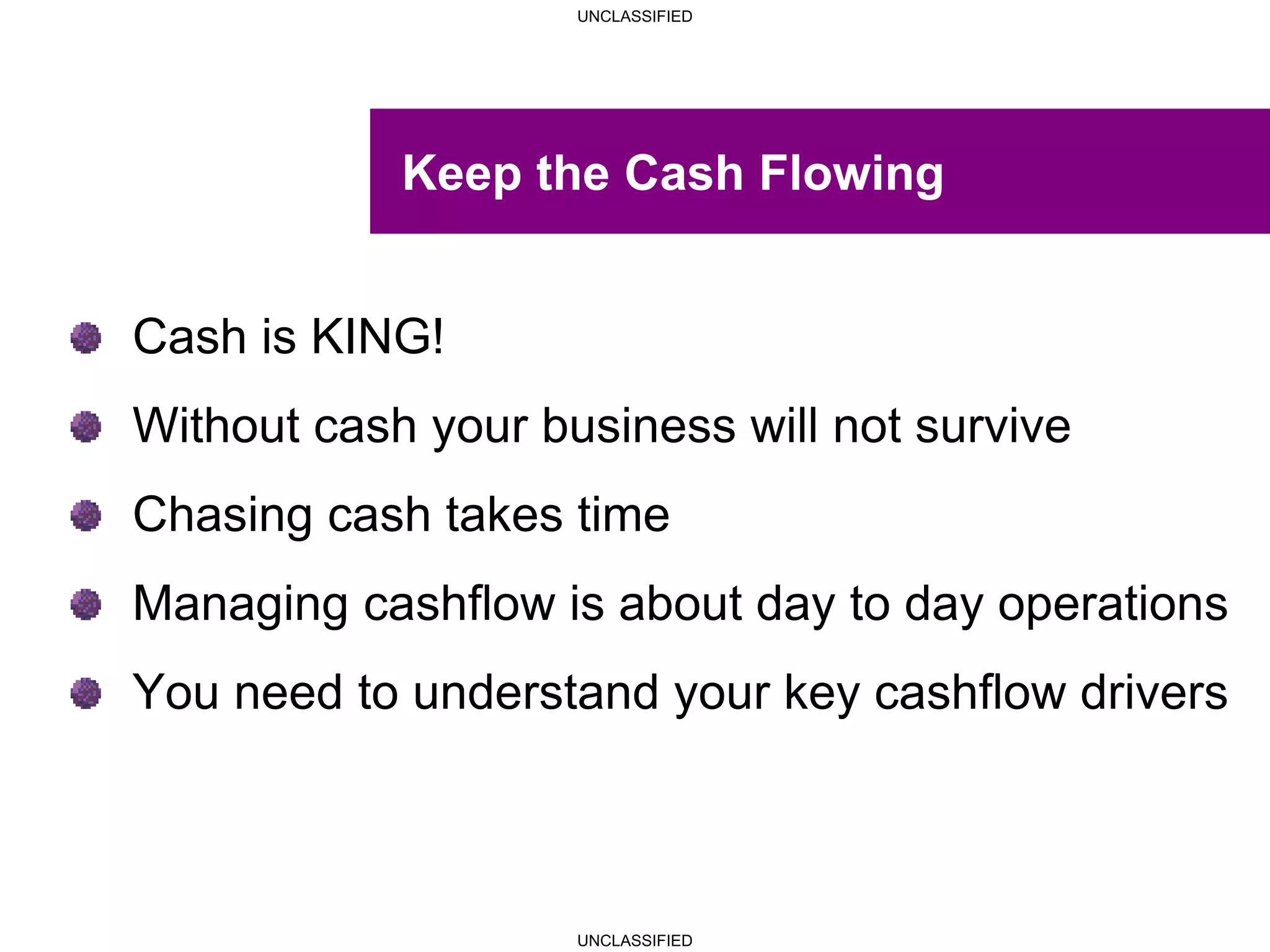
Keep the Cash Flowing
Cash is KING!
Without cash your business will not survive
Chasing cash takes time
Managing cashflow is about day to day operations
You need to understand your key cashflow drivers
UNCLASSIFIED
UNCLASSIFIED
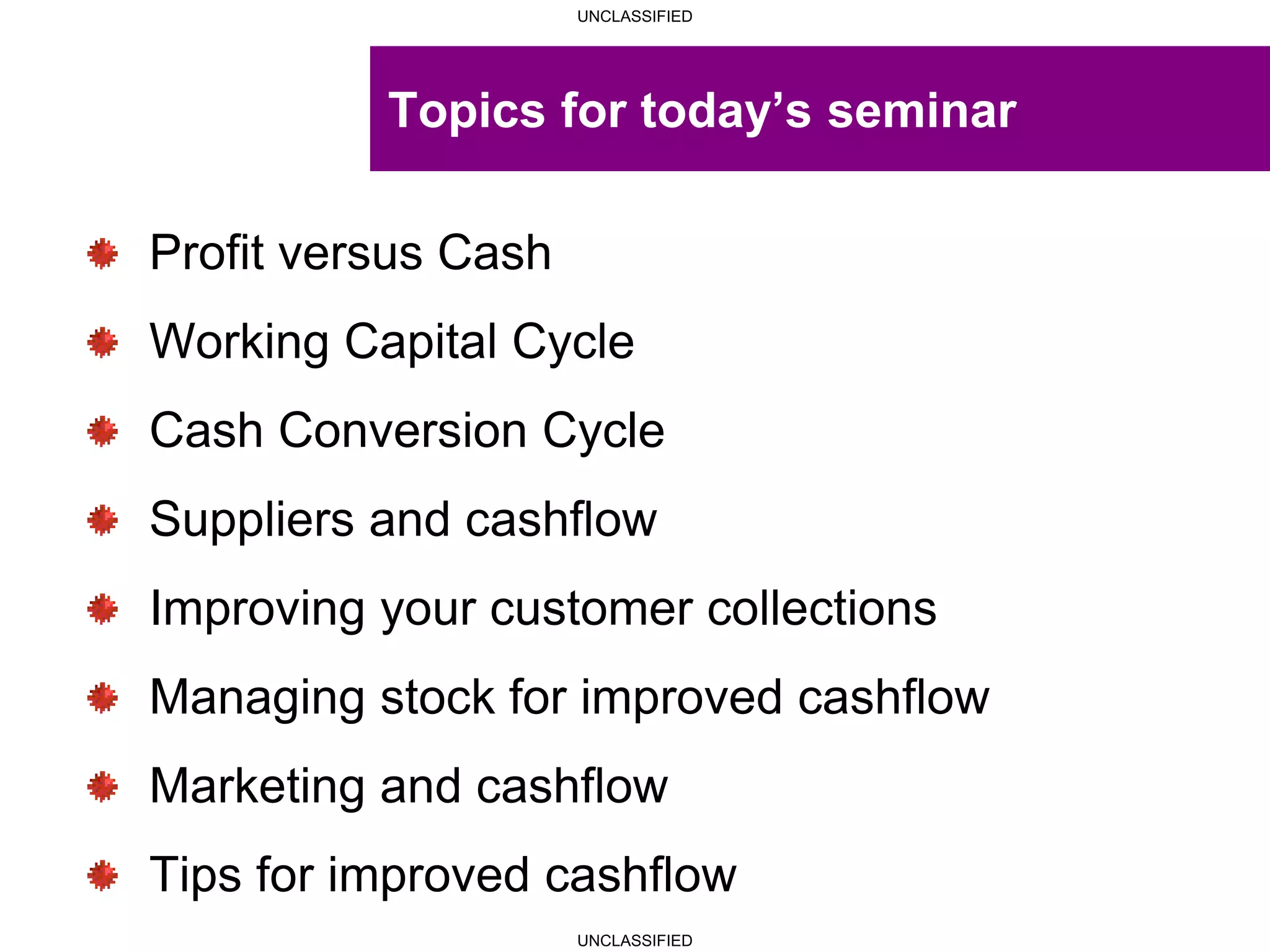
Topics for today’s seminar
Profit versus Cash
Working Capital Cycle
Cash Conversion Cycle
Suppliers and cashflow
Improving your customer collections
Managing stock for improved cashflow
Marketing and cashflow
Tips for improved cashflow
UNCLASSIFIED
UNCLASSIFIED
Profit versus Cash
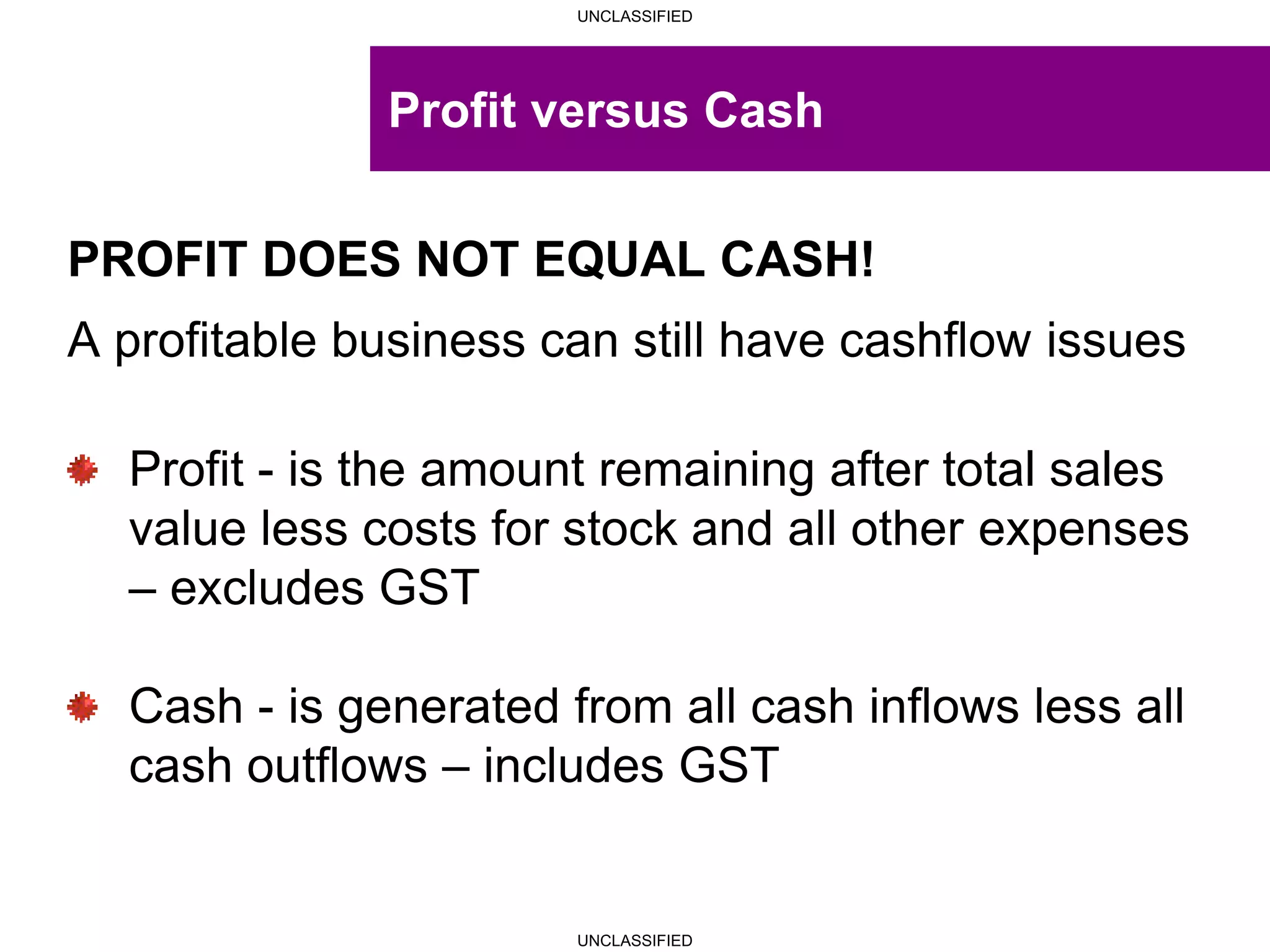
PROFIT DOES NOT EQUAL CASH!
A profitable business can still have cashflow issues
Profit - is the amount remaining after total sales
value less costs for stock and all other expenses
– excludes GST
Cash - is generated from all cash inflows less all
cash outflows – includes GST
UNCLASSIFIED
UNCLASSIFIED
Profit versus Cash
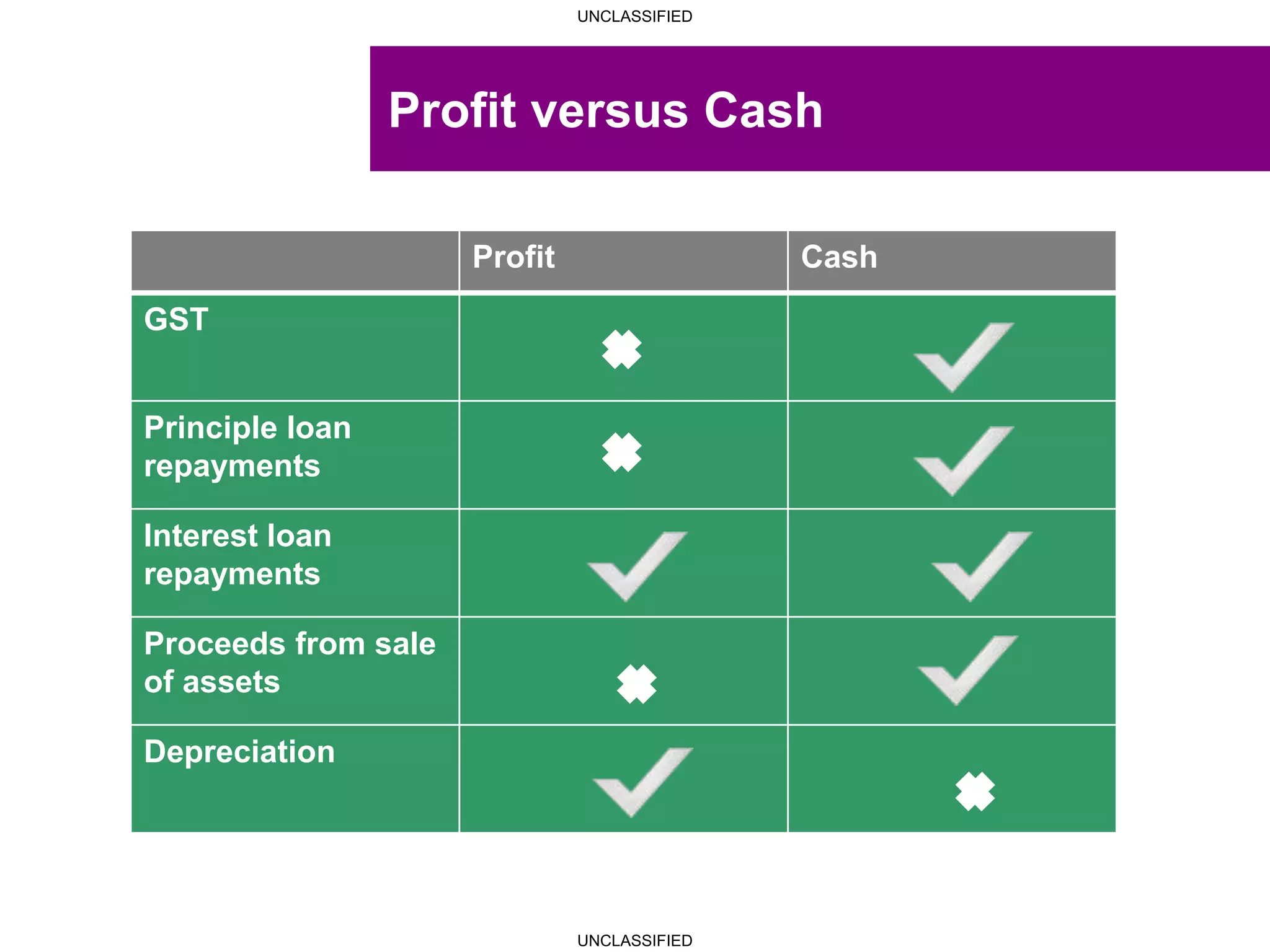
Profit Cash
GST
Principle loan
repayments
Interest loan
repayments
Proceeds from sale
of assets
Depreciation
UNCLASSIFIED
UNCLASSIFIED
Profit versus Cash
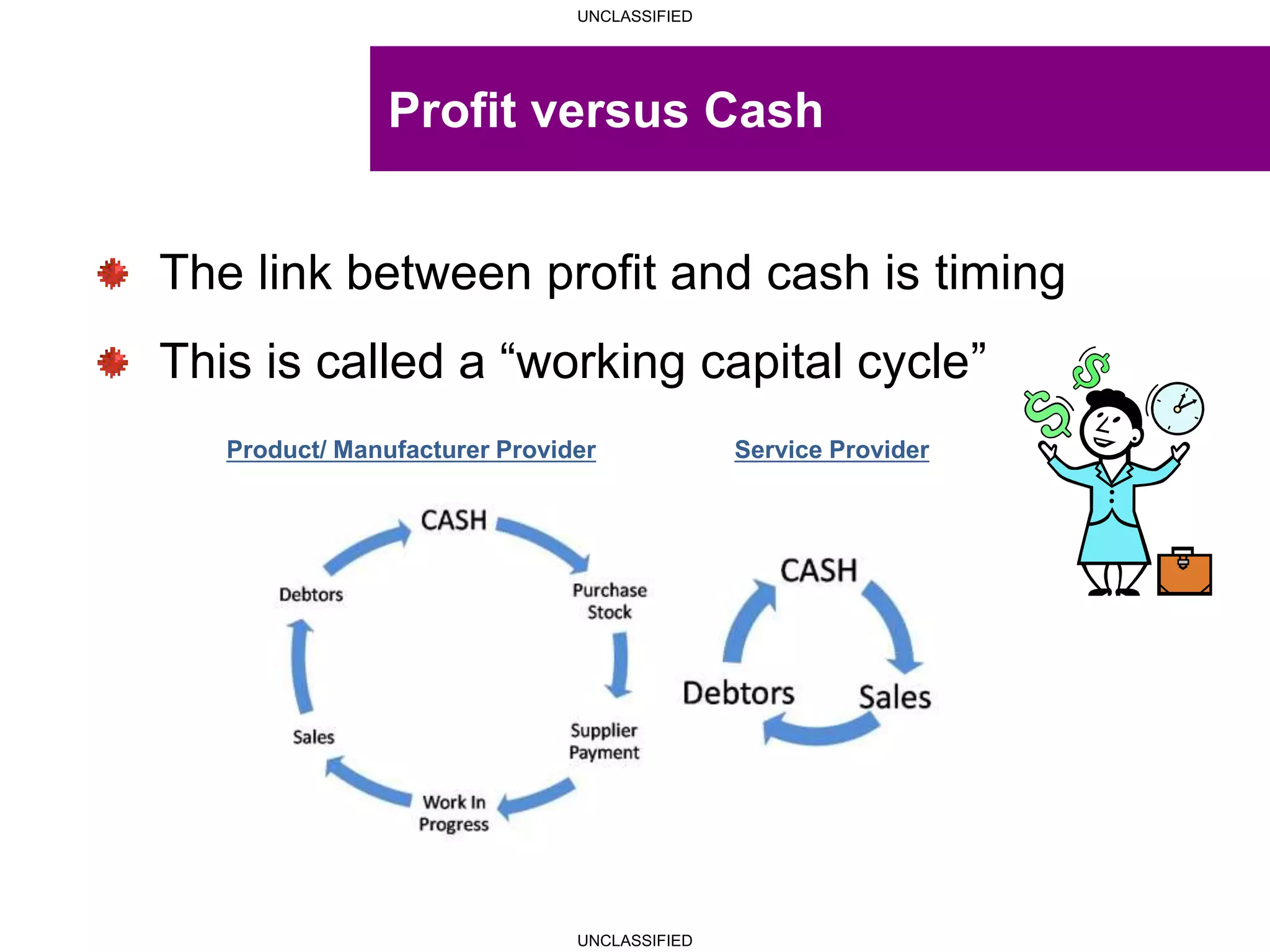
The link between profit and cash is timing
This is called a “working capital cycle”
Product/ Manufacturer Provider Service Provider
UNCLASSIFIED
UNCLASSIFIED
Profit versus Cash
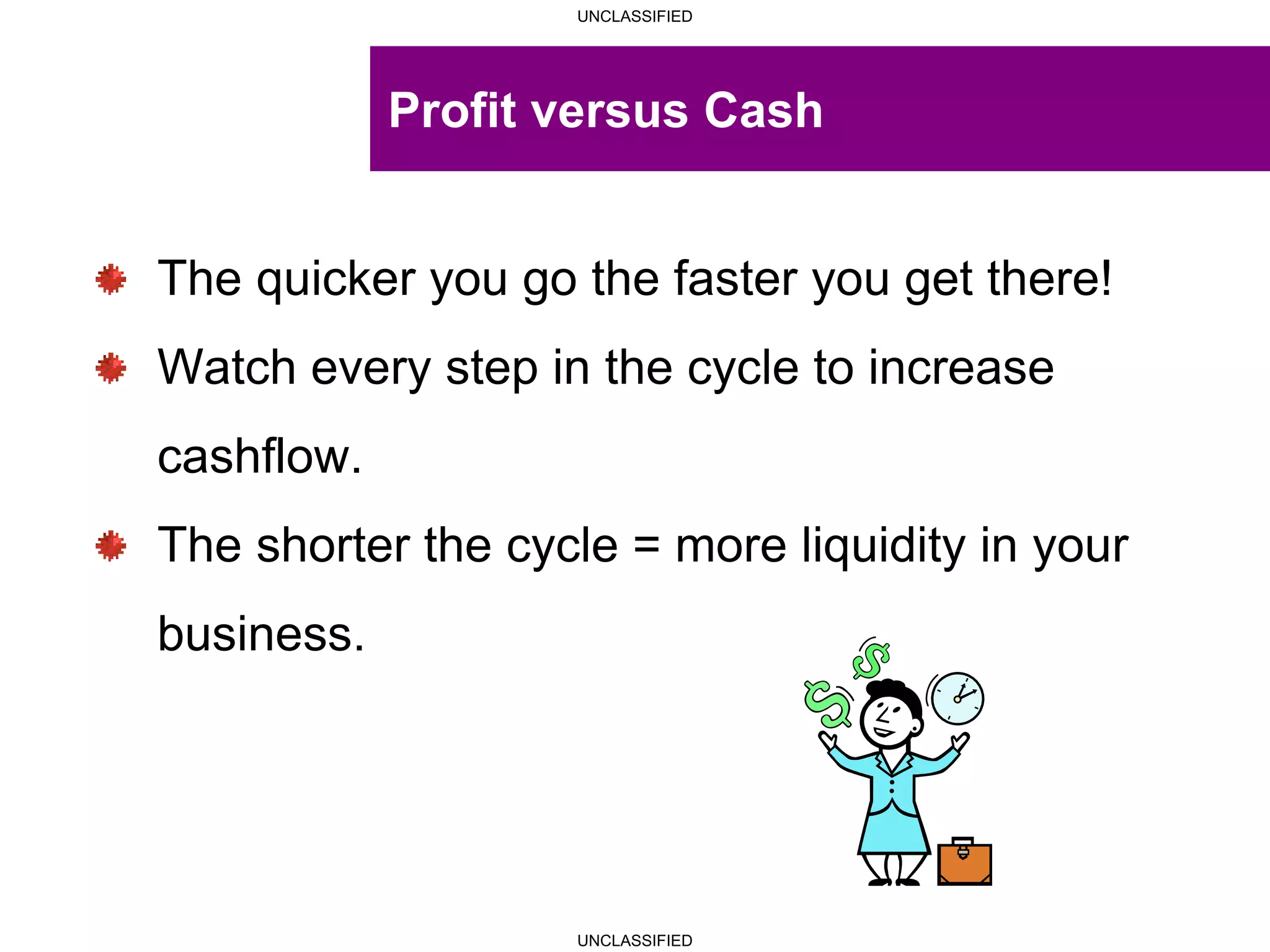
The quicker you go the faster you get there!
Watch every step in the cycle to increase
cashflow.
The shorter the cycle = more liquidity in your
business.
UNCLASSIFIED
UNCLASSIFIED
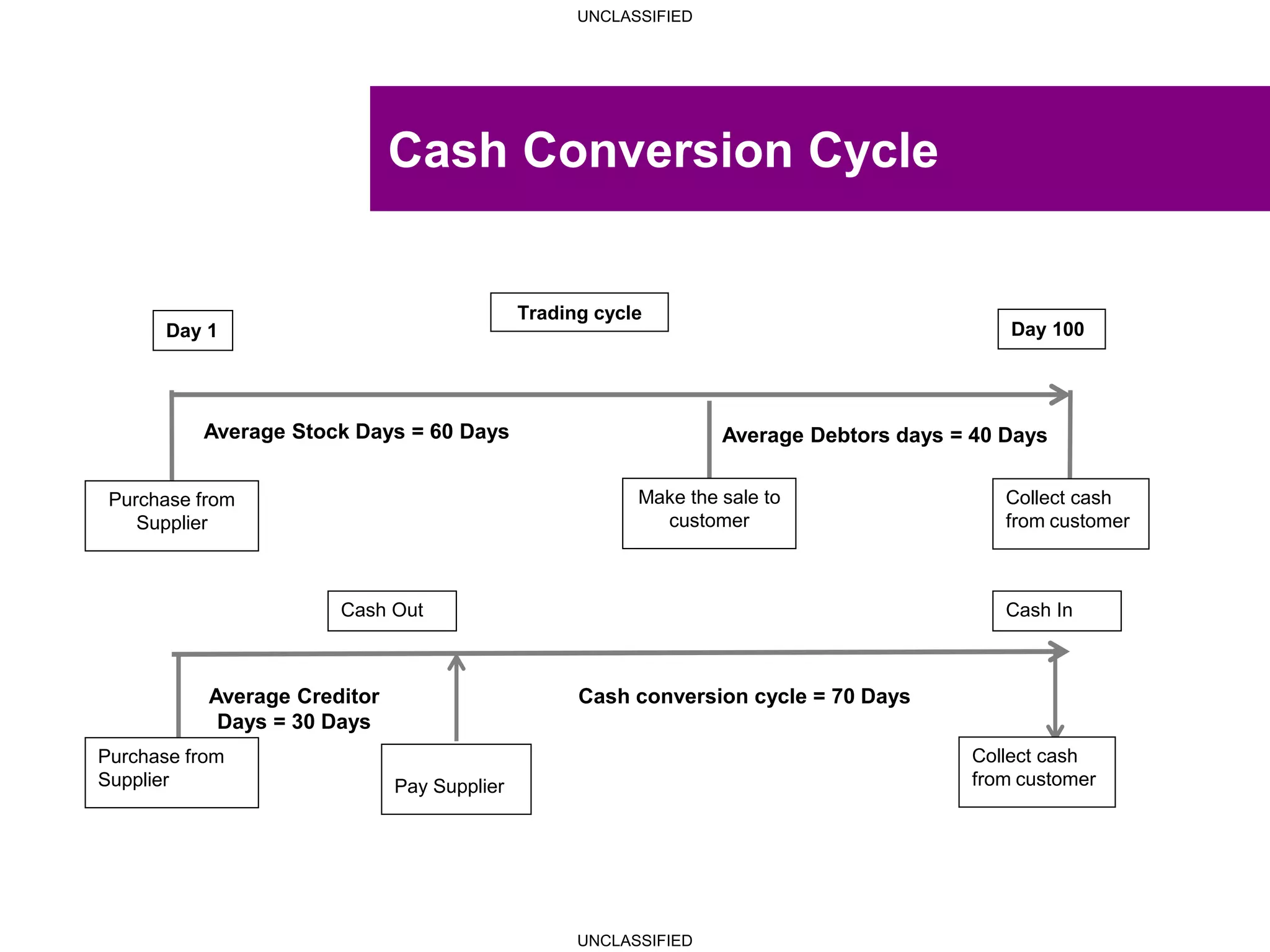
Cash Conversion Cycle
Purchase from
Supplier
Purchase from
Supplier Pay Supplier
Collect cash
from customer
Cash Out Cash In
Day 1 Day 100
Trading cycle
Make the sale to
customer
Collect cash
from customer
Average Stock Days = 60 Days Average Debtors days = 40 Days
Average Creditor
Days = 30 Days
Cash conversion cycle = 70 Days
UNCLASSIFIED
UNCLASSIFIED
Cash Conversion Cycle
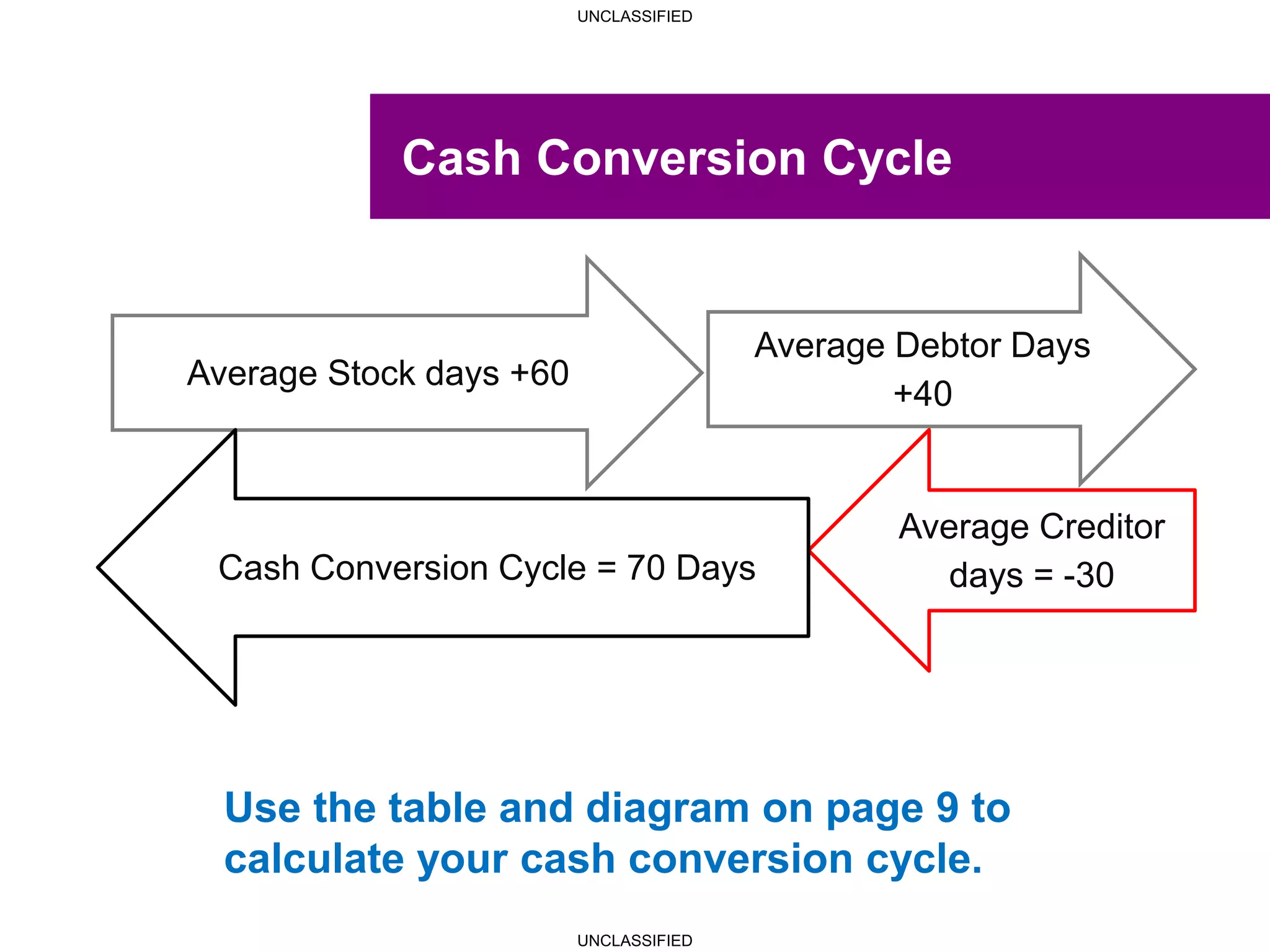
Average Stock days +60
Average Debtor Days
+40
Average Creditor
days = -30Cash Conversion Cycle = 70 Days
Use the table and diagram on page 9 to
calculate your cash conversion cycle.
UNCLASSIFIED
UNCLASSIFIED
Supplier Management
Often on start up, cash payment
Once up and running, negotiate improved terms
Make full use of terms
UNCLASSIFIED
UNCLASSIFIED
Supplier Management Hint
Setting up good management
procedures will ensure that you
get the most out of your suppliers
UNCLASSIFIED
UNCLASSIFIED
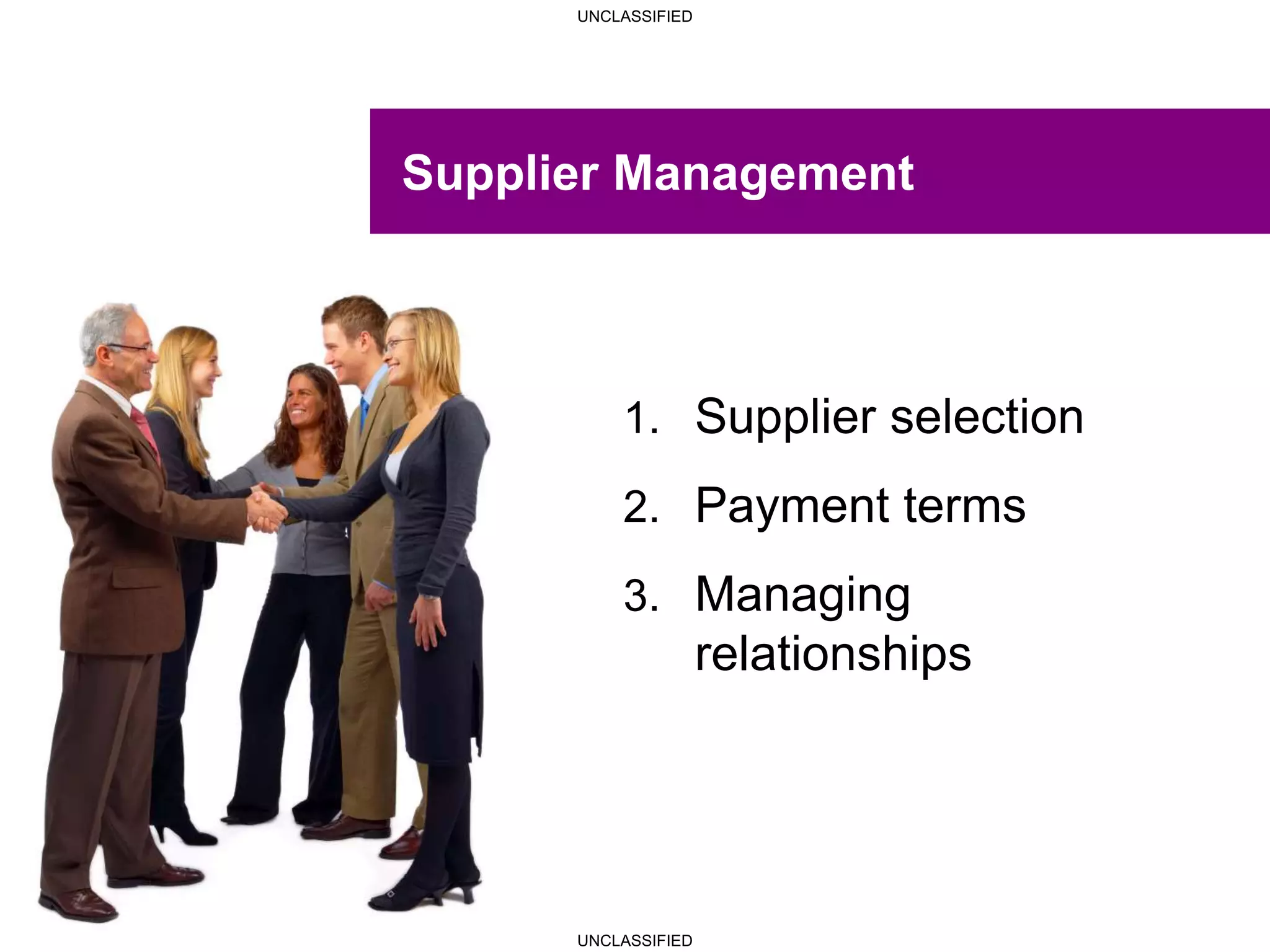
Supplier Management
1. Supplier selection
2. Payment terms
3. Managing
relationships
UNCLASSIFIED
UNCLASSIFIED
1. Supplier Selection
What is your priority from supplier?
Prepare a list of preferred suppliers
Credit check all suppliers
Regularly compare supplier pricing and service
One main supplier, ensure a back up available
UNCLASSIFIED
UNCLASSIFIED
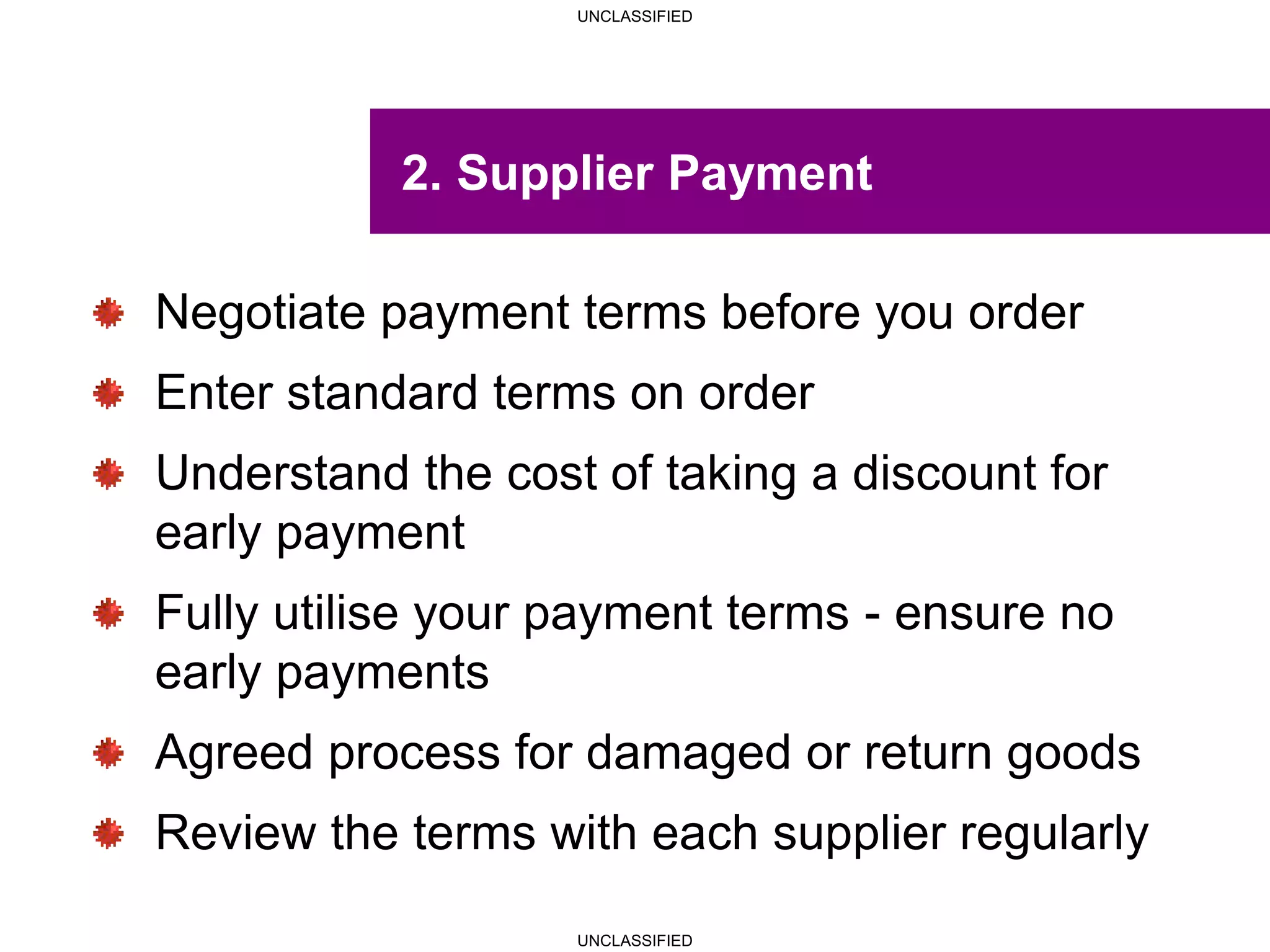
2. Supplier Payment
Negotiate payment terms before you order
Enter standard terms on order
Understand the cost of taking a discount for
early payment
Fully utilise your payment terms - ensure no
early payments
Agreed process for damaged or return goods
Review the terms with each supplier regularly
UNCLASSIFIED
UNCLASSIFIED
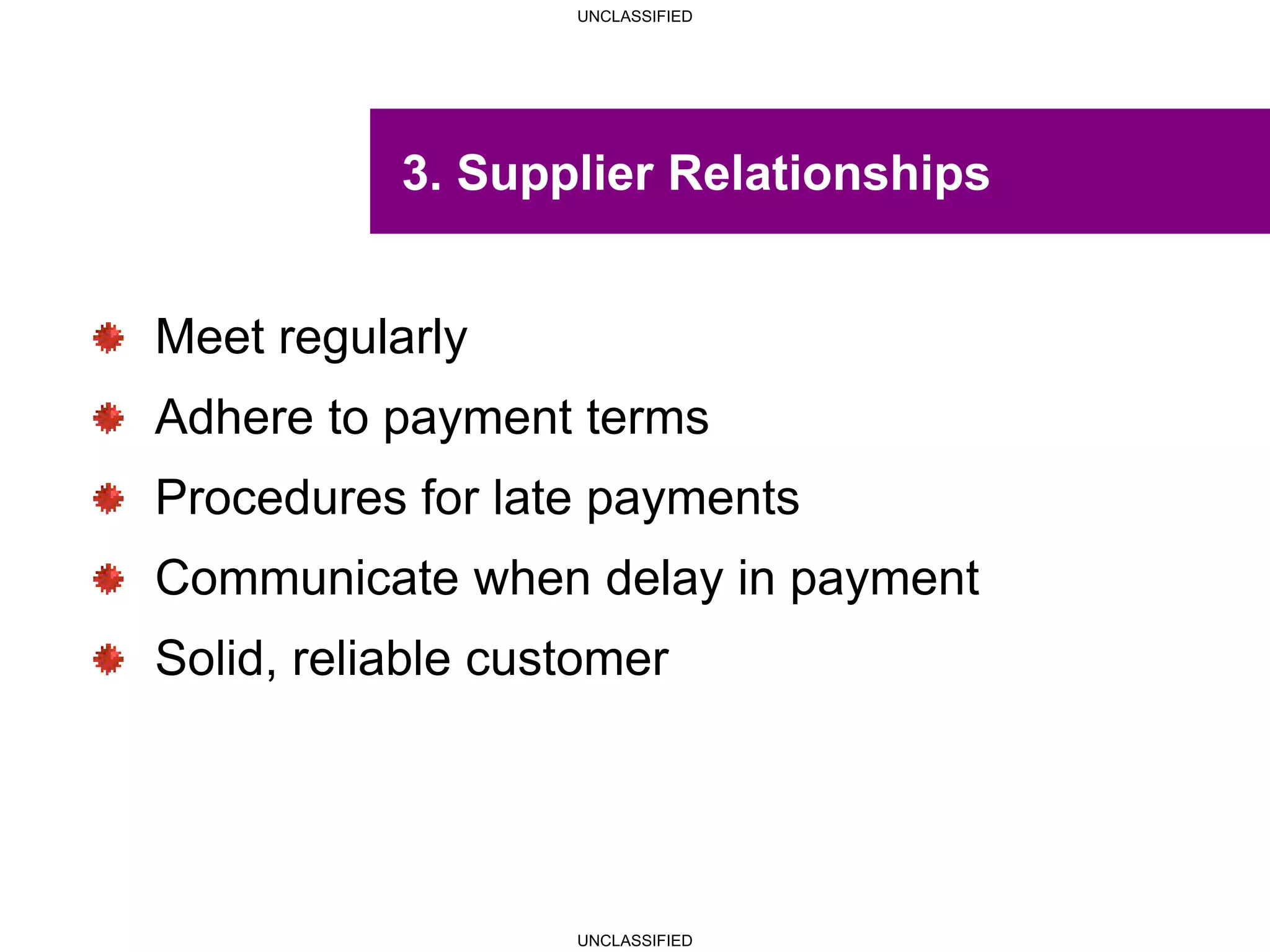
3. Supplier Relationships
Meet regularly
Adhere to payment terms
Procedures for late payments
Communicate when delay in payment
Solid, reliable customer
UNCLASSIFIED
UNCLASSIFIED
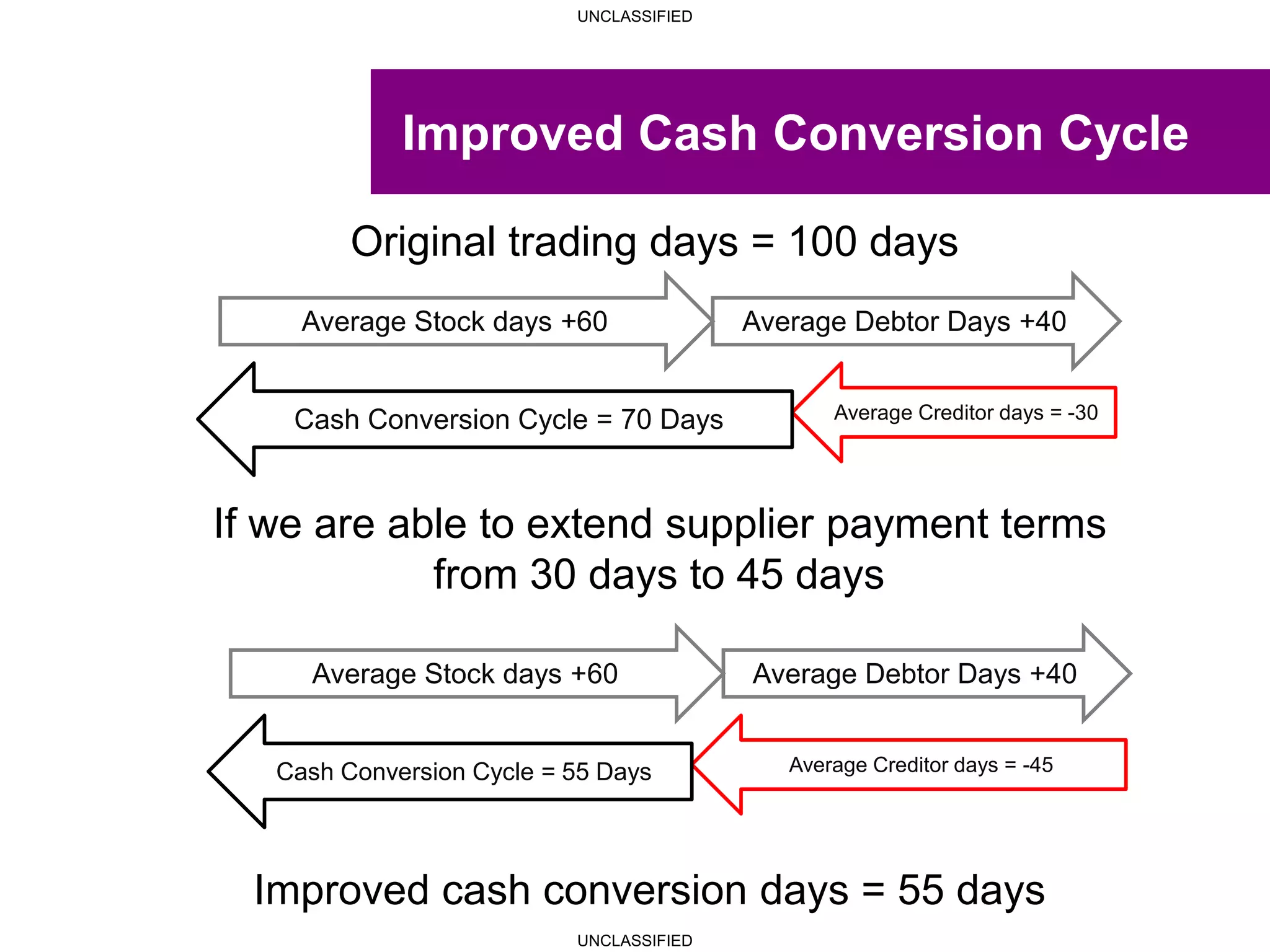
Improved Cash Conversion Cycle
Average Stock days +60 Average Debtor Days +40
Average Creditor days = -30Cash Conversion Cycle = 70 Days
Original trading days = 100 days
Improved cash conversion days = 55 days
If we are able to extend supplier payment terms
from 30 days to 45 days
Average Stock days +60 Average Debtor Days +40
Average Creditor days = -45Cash Conversion Cycle = 55 Days
UNCLASSIFIED
UNCLASSIFIED
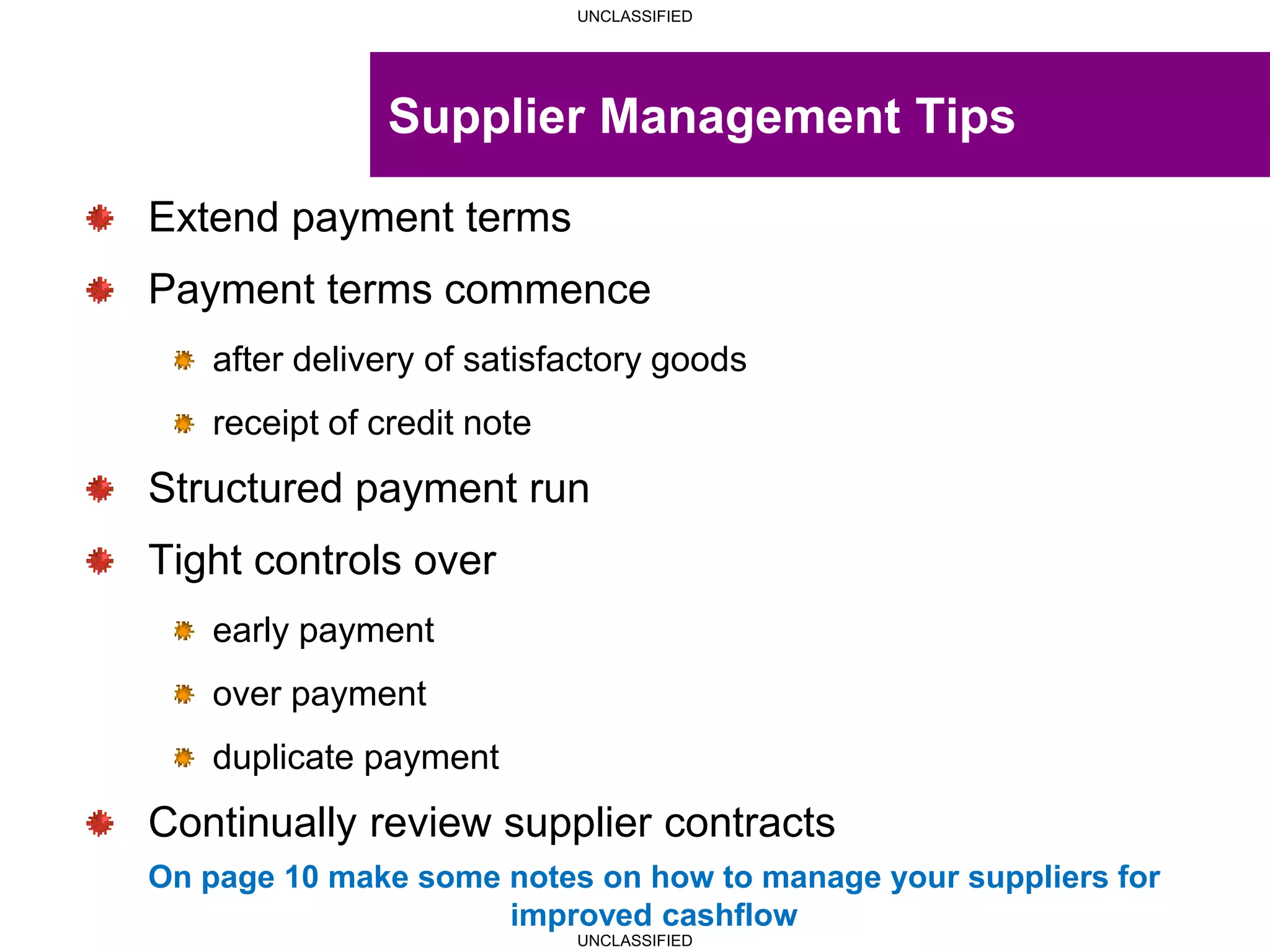
Supplier Management Tips
Extend payment terms
Payment terms commence
after delivery of satisfactory goods
receipt of credit note
Structured payment run
Tight controls over
early payment
over payment
duplicate payment
Continually review supplier contracts
On page 10 make some notes on how to manage your suppliers for
improved cashflow
UNCLASSIFIED
UNCLASSIFIED
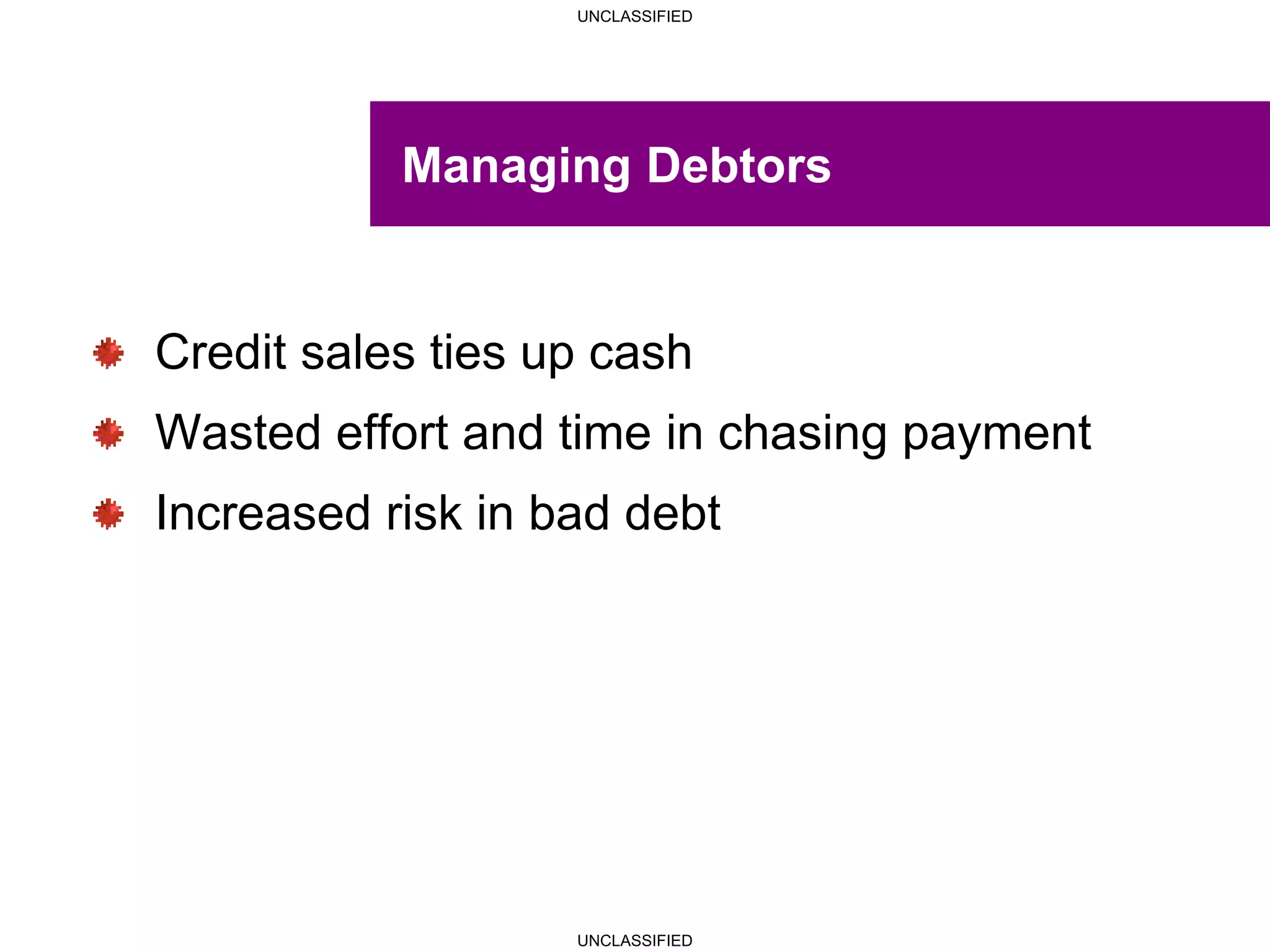
Managing Debtors
Credit sales ties up cash
Wasted effort and time in chasing payment
Increased risk in bad debt
UNCLASSIFIED
UNCLASSIFIED
Managing Debtors Hint
Ensure that you have good
procedures in place to encourage
prompt payment.
UNCLASSIFIED
UNCLASSIFIED
Managing Debtors
1. Credit controls
2. Payment terms
3. Managing customer relationships
Page 19
UNCLASSIFIED
UNCLASSIFIED
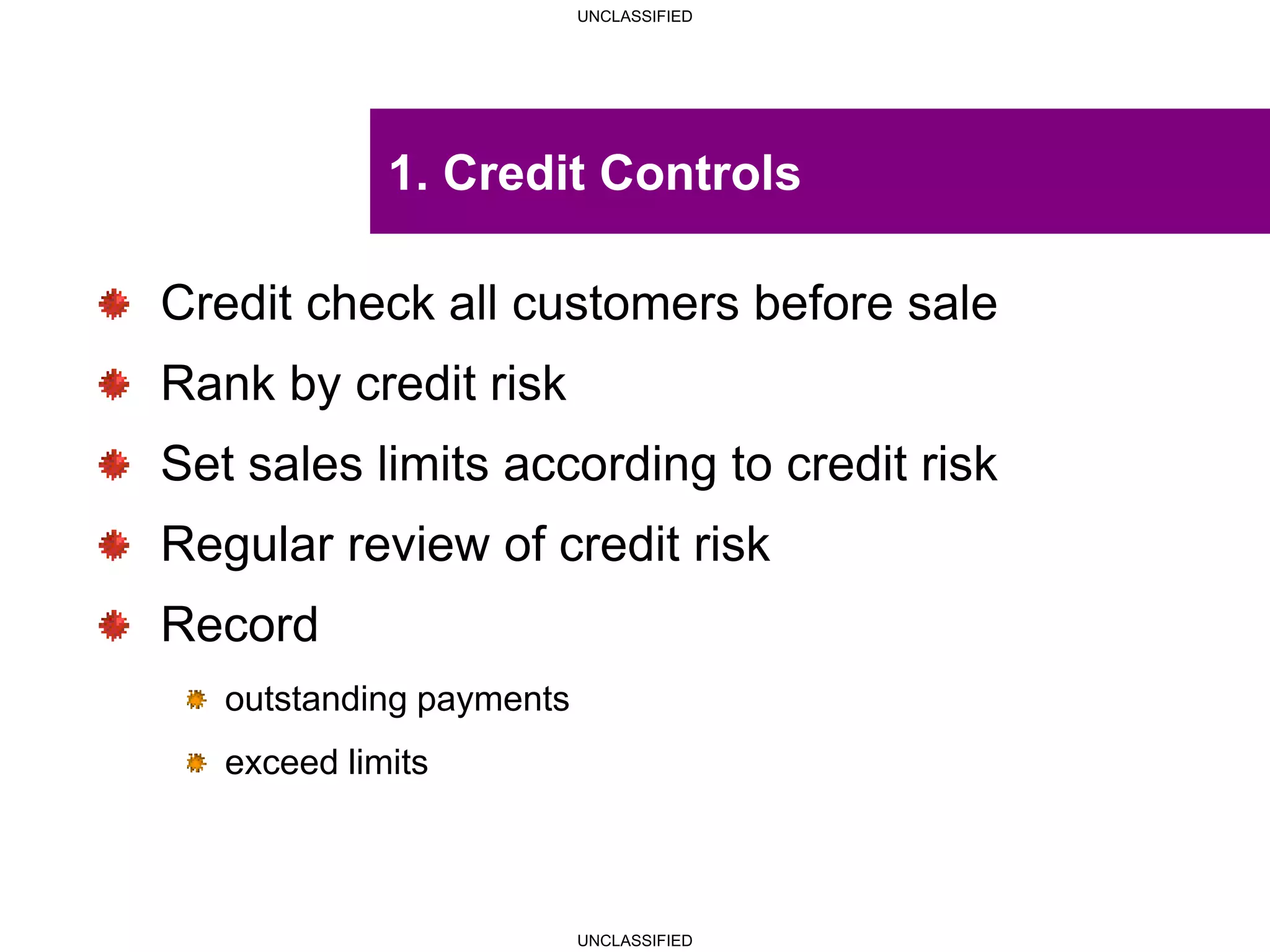
1. Credit Controls
Credit check all customers before sale
Rank by credit risk
Set sales limits according to credit risk
Regular review of credit risk
Record
outstanding payments
exceed limits
UNCLASSIFIED
UNCLASSIFIED
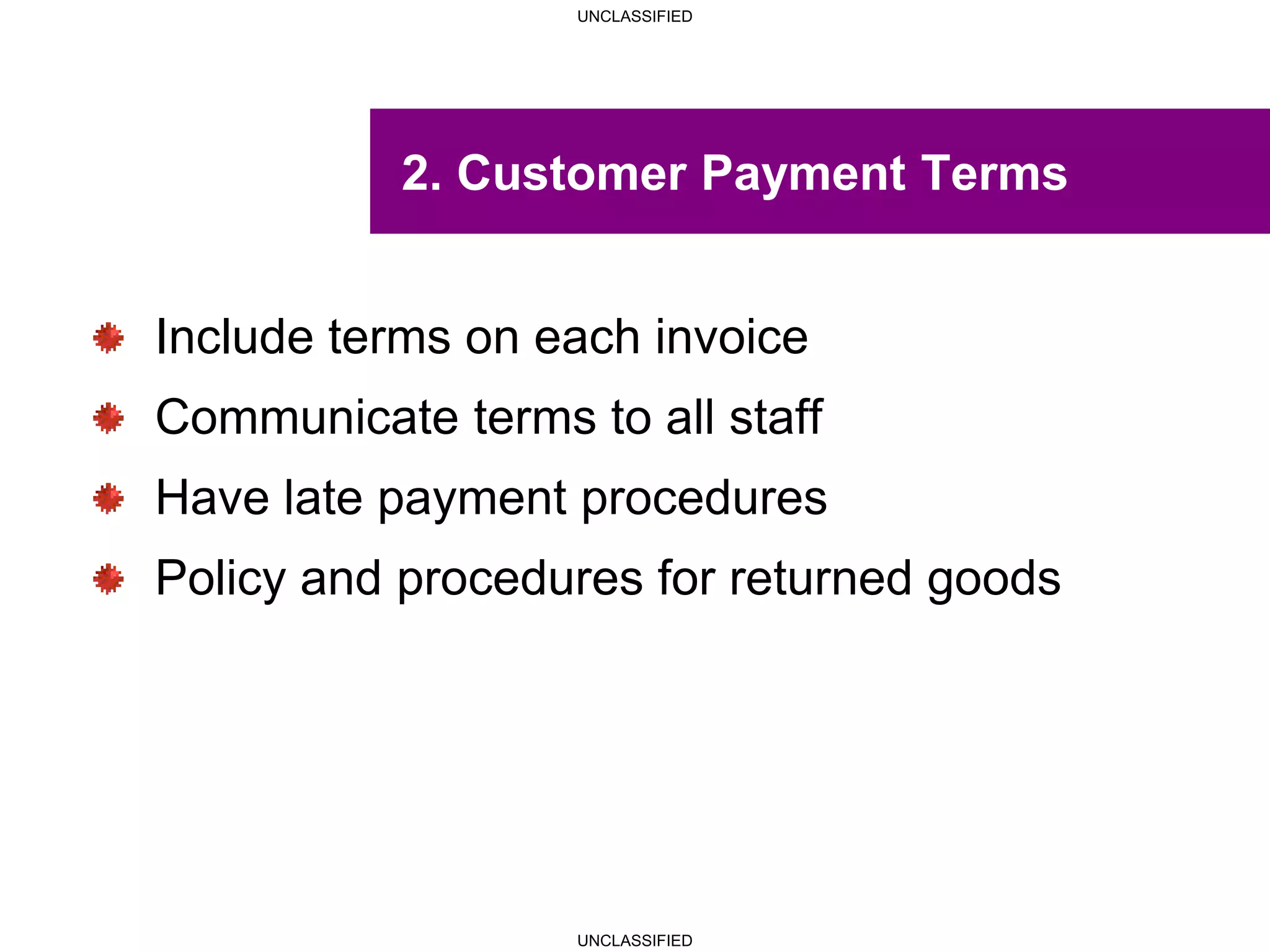
2. Customer Payment Terms
Include terms on each invoice
Communicate terms to all staff
Have late payment procedures
Policy and procedures for returned goods
UNCLASSIFIED
UNCLASSIFIED
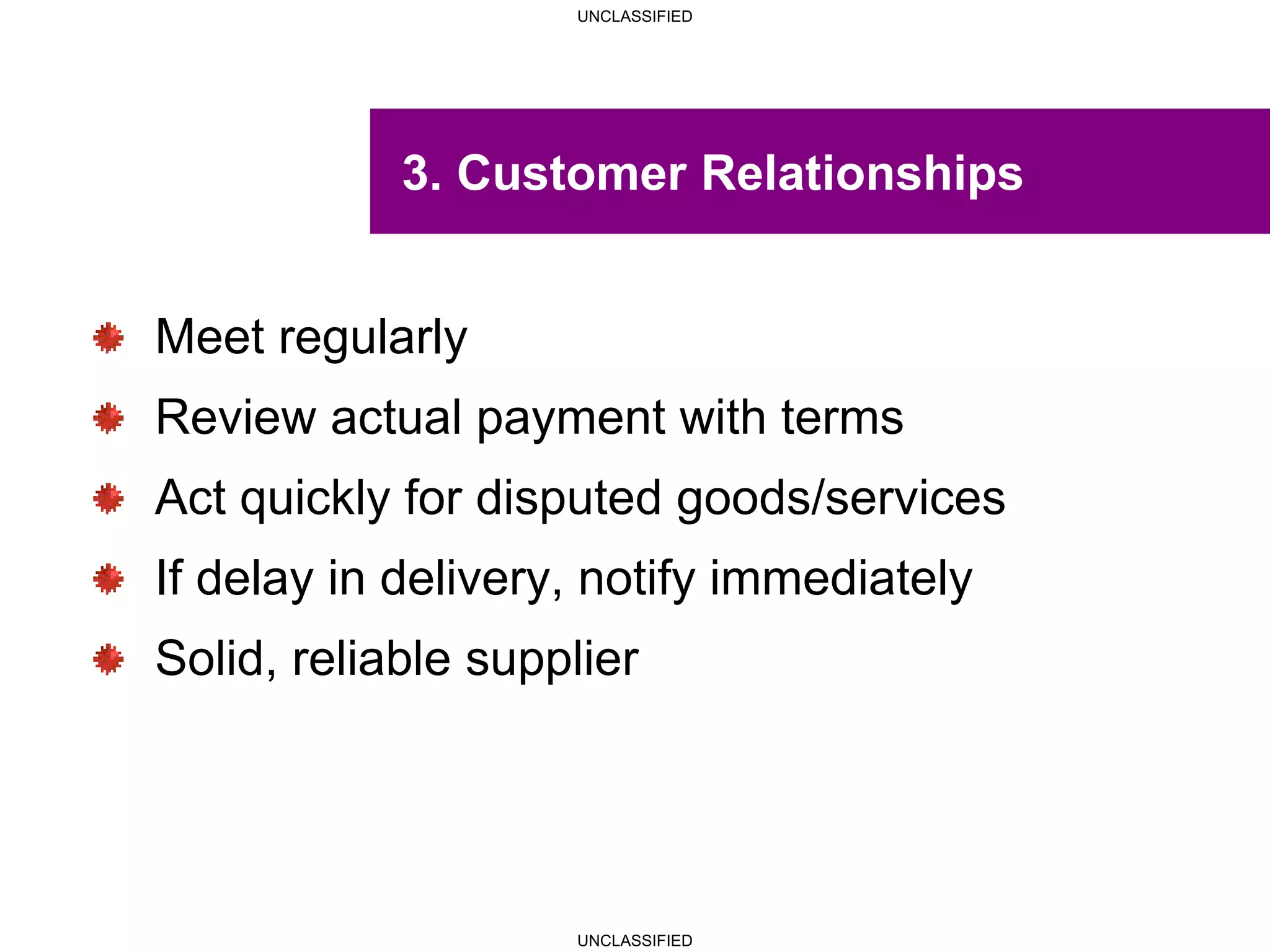
3. Customer Relationships
Meet regularly
Review actual payment with terms
Act quickly for disputed goods/services
If delay in delivery, notify immediately
Solid, reliable supplier
UNCLASSIFIED
UNCLASSIFIED
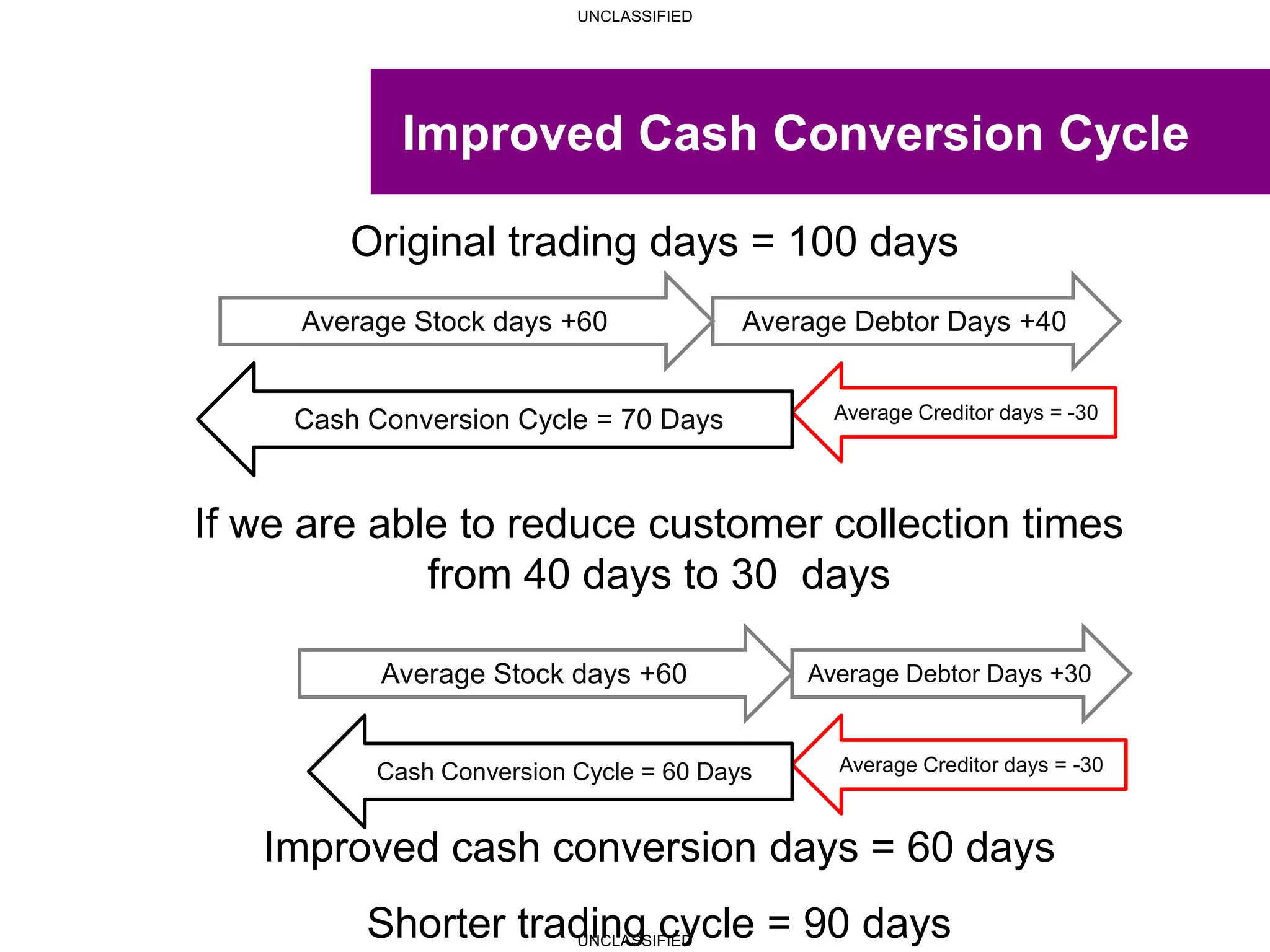
Improved Cash Conversion Cycle
Average Stock days +60 Average Debtor Days +40
Average Creditor days = -30Cash Conversion Cycle = 70 Days
Original trading days = 100 days
Improved cash conversion days = 60 days
Shorter trading cycle = 90 days
If we are able to reduce customer collection times
from 40 days to 30 days
Average Stock days +60 Average Debtor Days +30
Average Creditor days = -30Cash Conversion Cycle = 60 Days
UNCLASSIFIED
UNCLASSIFIED
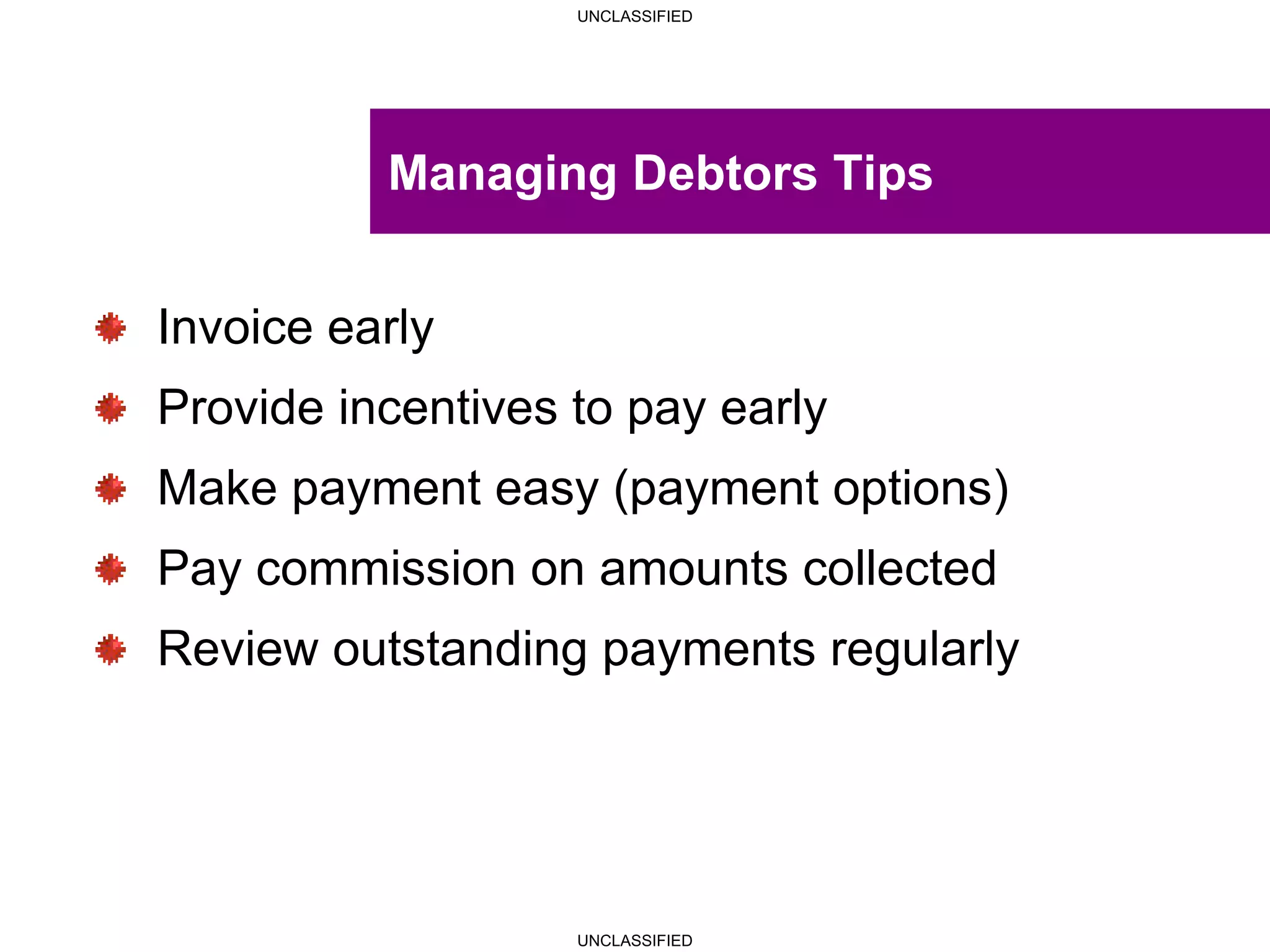
Managing Debtors Tips
Invoice early
Provide incentives to pay early
Make payment easy (payment options)
Pay commission on amounts collected
Review outstanding payments regularly
UNCLASSIFIED
UNCLASSIFIED
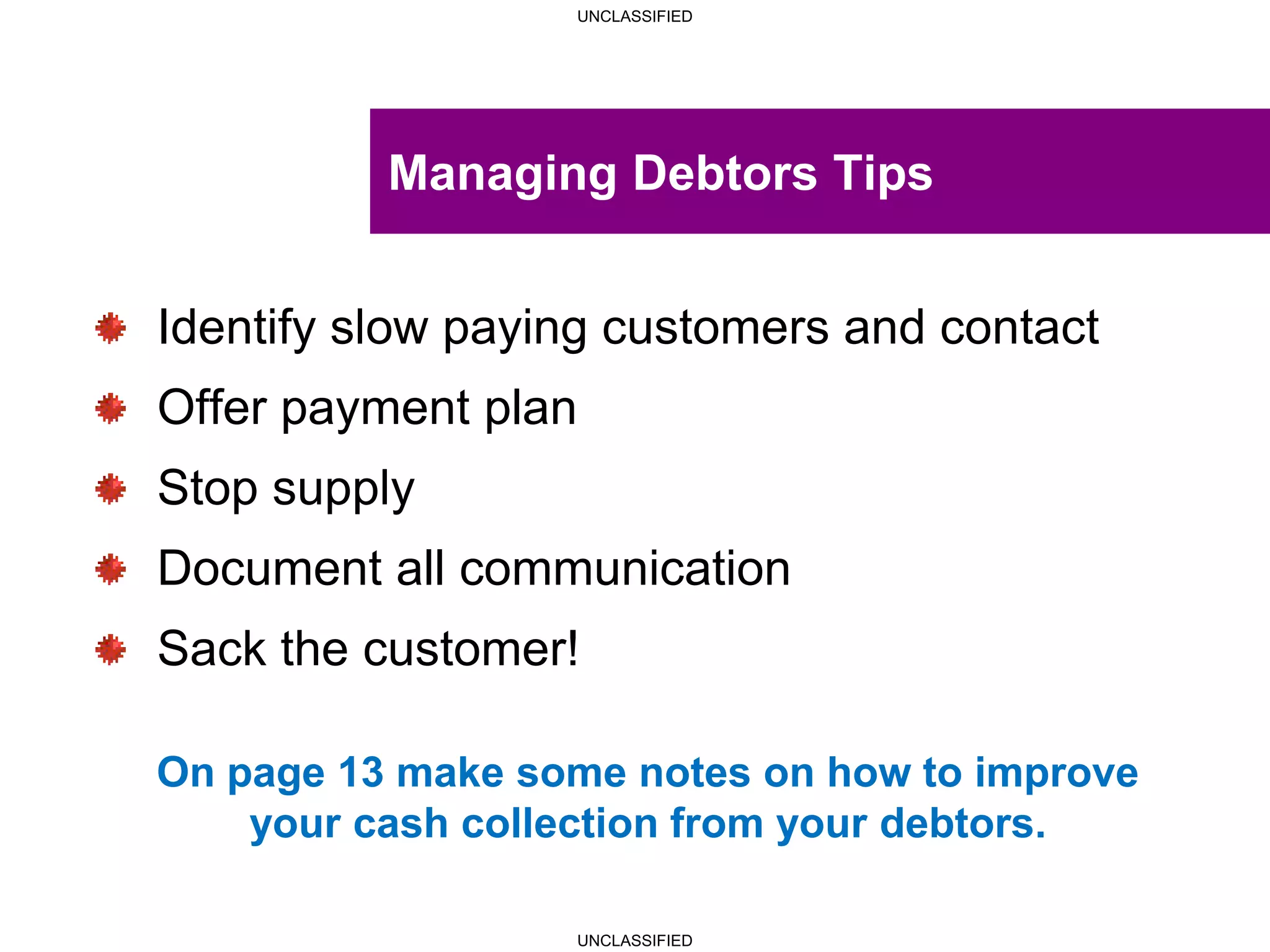
Managing Debtors Tips
Identify slow paying customers and contact
Offer payment plan
Stop supply
Document all communication
Sack the customer!
On page 13 make some notes on how to improve
your cash collection from your debtors.
UNCLASSIFIED
UNCLASSIFIED
Stock Management
Optimum level to ensure that customers
needs are met
Minimum level of excess/aged stock
Holding cost of stock
Strong controls to avoid theft
UNCLASSIFIED
UNCLASSIFIED
Stock Management Hint
Setting up good stock control
procedures will ensure that cash
is not tied up in holding stock
unnecessarily.
UNCLASSIFIED
UNCLASSIFIED
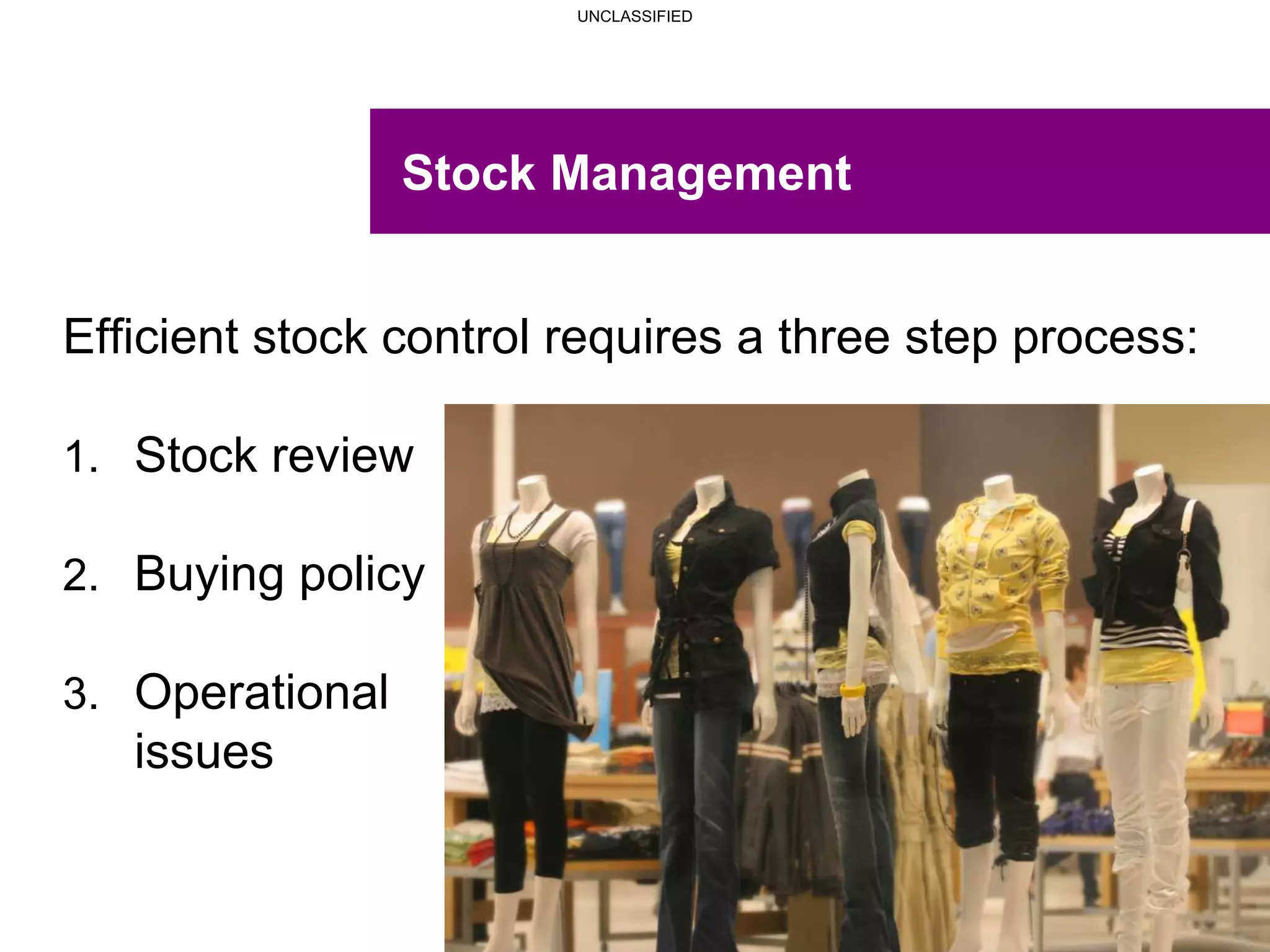
Stock Management
Efficient stock control requires a three step process:
1. Stock review
2. Buying policy
3. Operational
issues
UNCLASSIFIED
UNCLASSIFIED
1. Stock Review
Current level and value
Which are the good sellers?
Which provide the highest margin?
List slow moving, excess and aged stock
Update stock records
UNCLASSIFIED
UNCLASSIFIED
2. Buying Policy
Identify 'core' stock
Know what levels to order
Beware of discount offered
Negotiate with suppliers
UNCLASSIFIED
UNCLASSIFIED
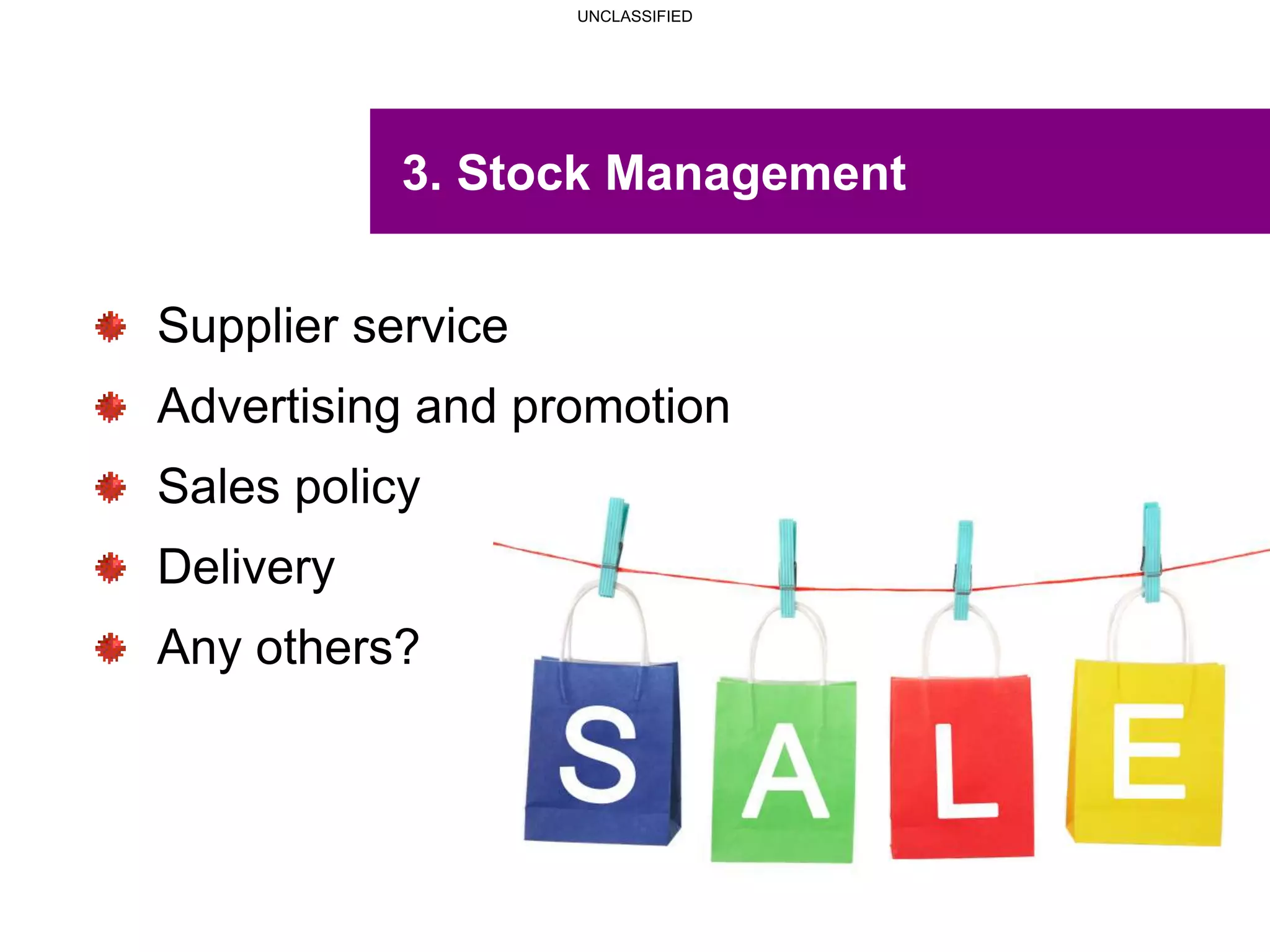
3. Stock Management
Supplier service
Advertising and promotion
Sales policy
Delivery
Any others?
UNCLASSIFIED
UNCLASSIFIED
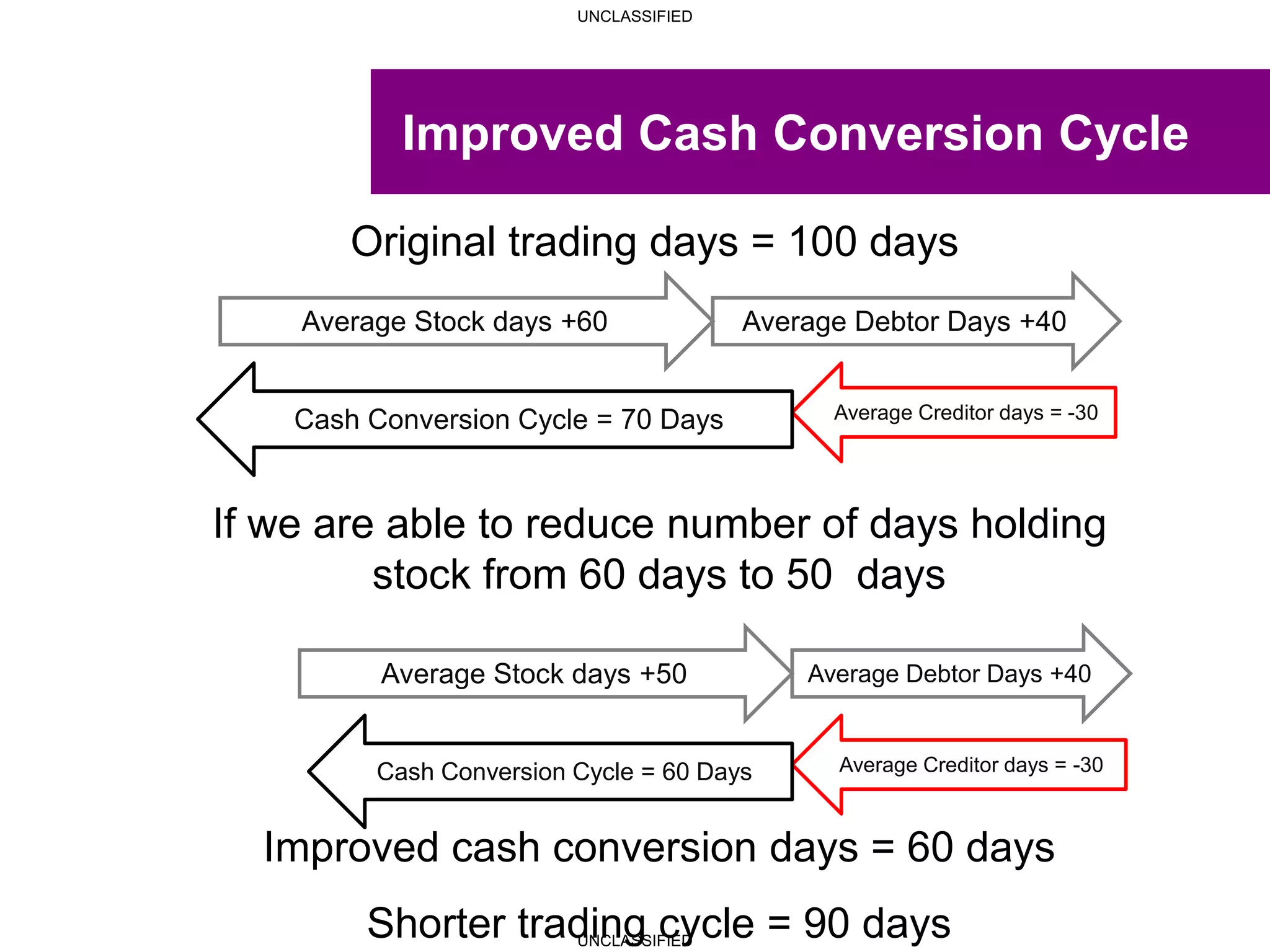
Improved Cash Conversion Cycle
Average Stock days +60 Average Debtor Days +40
Average Creditor days = -30Cash Conversion Cycle = 70 Days
Original trading days = 100 days
Improved cash conversion days = 60 days
Shorter trading cycle = 90 days
If we are able to reduce number of days holding
stock from 60 days to 50 days
Average Stock days +50 Average Debtor Days +40
Average Creditor days = -30Cash Conversion Cycle = 60 Days
UNCLASSIFIED
UNCLASSIFIED
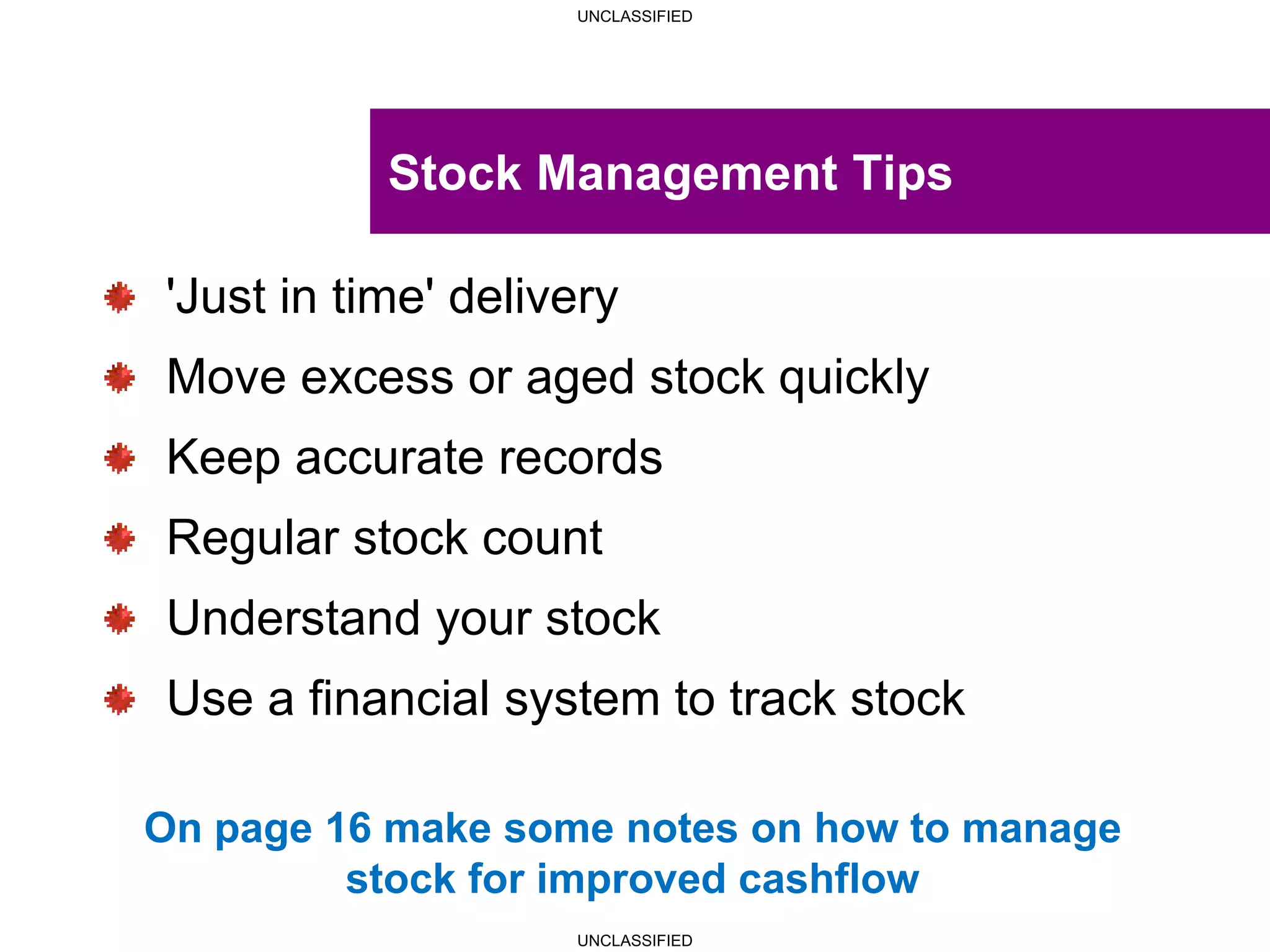
Stock Management Tips
'Just in time' delivery
Move excess or aged stock quickly
Keep accurate records
Regular stock count
Understand your stock
Use a financial system to track stock
On page 16 make some notes on how to manage
stock for improved cashflow
UNCLASSIFIED
UNCLASSIFIED
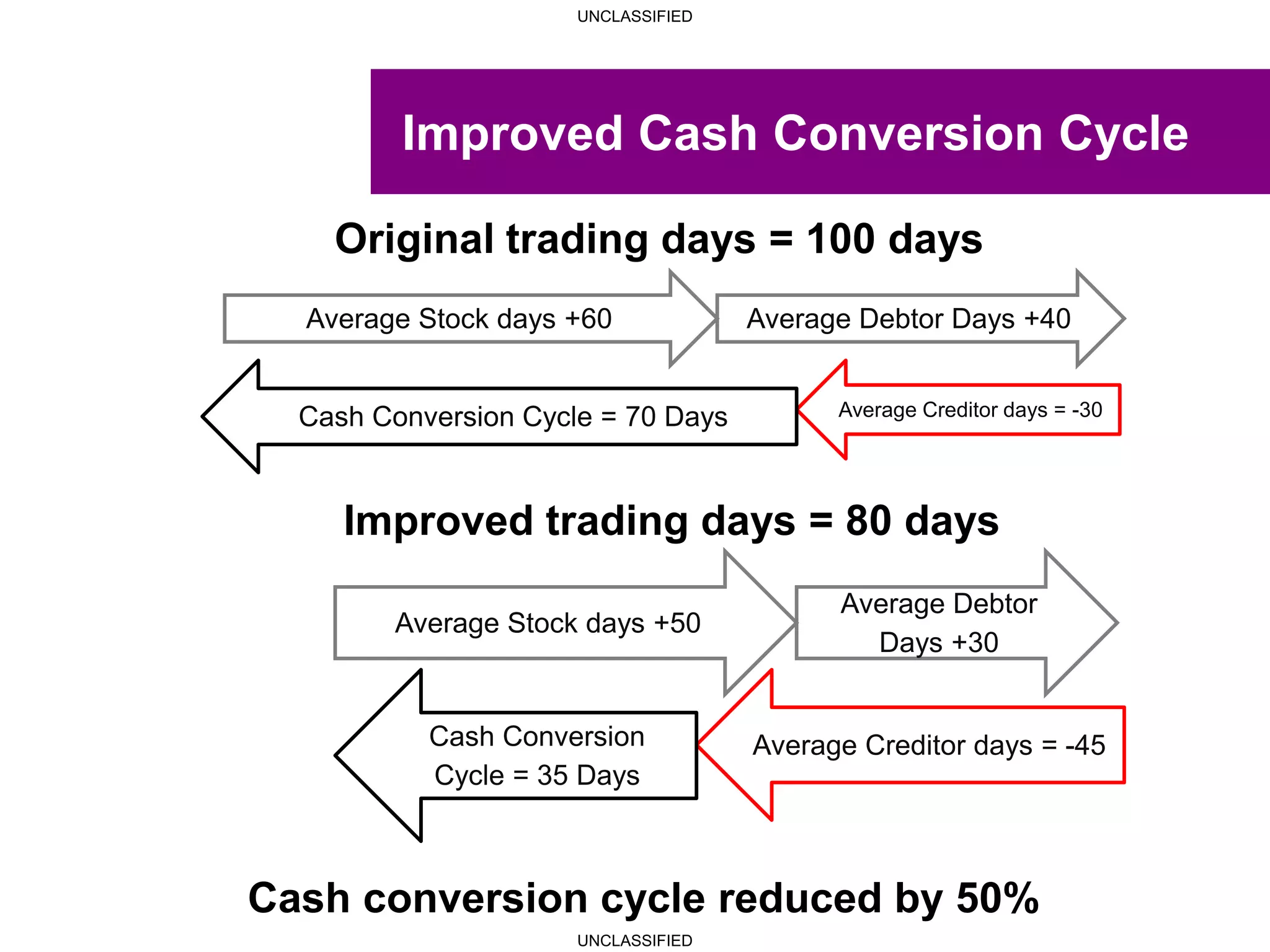
Improved Cash Conversion Cycle
Average Stock days +60 Average Debtor Days +40
Average Creditor days = -30Cash Conversion Cycle = 70 Days
Average Stock days +50
Average Debtor
Days +30
Average Creditor days = -45Cash Conversion
Cycle = 35 Days
Original trading days = 100 days
Improved trading days = 80 days
Cash conversion cycle reduced by 50%
UNCLASSIFIED
UNCLASSIFIED
Marketing and Cashflow
Improve cashflow with marketing
Know your target market
What problems are you solving?
Regular marketing
Data base
Bundle sales
UNCLASSIFIED
UNCLASSIFIED
Marketing and Cashflow
Improve cashflow with marketing
Answer every phone call
Follow up on every enquiry
Value your current customers
Have a “call to action”
Measure the success of your marketing
On page 19 make some notes on how you can use
your marketing to improve cashflow.
UNCLASSIFIED
UNCLASSIFIED
Tips for improved cashflow
Page 20 has a list of tips to improve your
cashflow.
On page 21, list 5 activities to take back to your
business to improve your cashflow.
UNCLASSIFIED
UNCLASSIFIED
Todays Top Tips
Profit does not equal cash
Cash conversion cycle is time it takes to
move through working capital cycle
Improving the management of suppliers,
customers and stock will make the cash
conversion cycle shorter
Marketing and cashflow go hand in hand
UNCLASSIFIED
UNCLASSIFIED
List 3 actions you will follow
through with as a result of this
workshop
Then
List 3 things that you’ve learned
in this seminar
List 3 actions you will follow
through with as a result of this
seminar
List 3 things that you’ve learned in
this seminar
UNCLASSIFIED
UNCLASSIFIED
Business mentors help you to identify a clear direction
for you and your business.
Business mentors can also advise you on how to:
conduct market research
work out your break-even point
price and/or cost your products or services
develop an effective marketing strategy
use other business management tools
To arrange a free mentoring session with a business mentor
complete the evaluation form and select FREE Mentoring Session
on page 2. You will then receive an email with details on claiming
your free mentoring session.
FREE mentoring session
UNCLASSIFIED
UNCLASSIFIED
Questions?
Thank you for attending
Check out
business.vic.gov.au/events
for more workshop information

Keep the Cash Flowing seminar