Welcome
Over the duration of this 2 hour seminar you will:
1. Identify the top 3 key issues and opportunities for
your business
2. Develop a clear Now and Where for your business
3. Build a One Page Business Plan
4. Learn a range of problem solving and strategy
development tools
Page 1
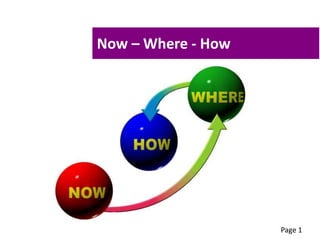
Now – Where - How
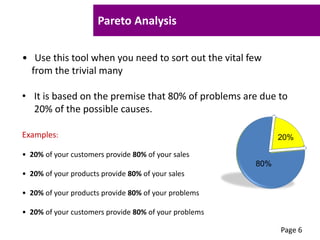
Page 1
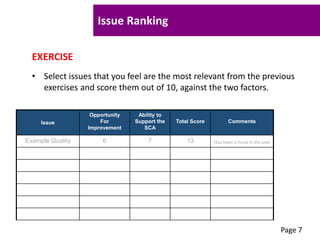
Now – Where - How
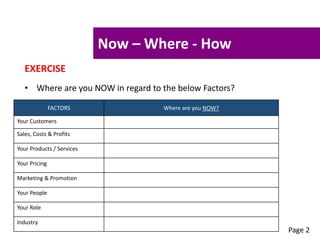
EXERCISE
• Where are you NOW in regard to the below Factors?
FACTORS Where are you NOW?
Your Customers
Sales, Costs & Profits
Your Products / Services
Your Pricing
Marketing & Promotion
Your People
Your Role
Industry
Page 2
Now – Where - How
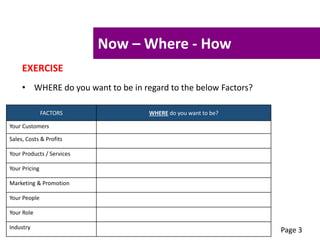
EXERCISE
• WHERE do you want to be in regard to the below Factors?
FACTORS WHERE do you want to be?
Your Customers
Sales, Costs & Profits
Your Products / Services
Your Pricing
Marketing & Promotion
Your People
Your Role
Industry
Page 3
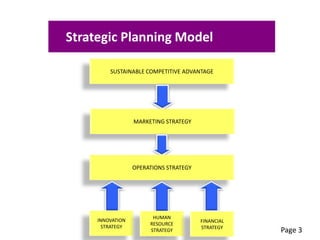
Strategic Planning Model
SUSTAINABLE COMPETITIVE ADVANTAGE
MARKETING STRATEGY
OPERATIONS STRATEGY
INNOVATION
STRATEGY
HUMAN
RESOURCE
STRATEGY
FINANCIAL
STRATEGY
Page 3
Magic Wand
If you had a Magic Wand and
you didn’t have to worry about
the how or the cost involved,
what would you change about
your business?
Page 4
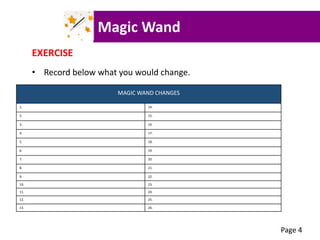
Magic Wand
EXERCISE
• Record below what you would change.
MAGIC WAND CHANGES
1. 14.
2. 15.
3. 16.
4. 17.
5. 18.
6. 19.
7. 20
8. 21.
9. 22.
10. 23.
11. 24.
12. 25.
13. 26.
Page 4
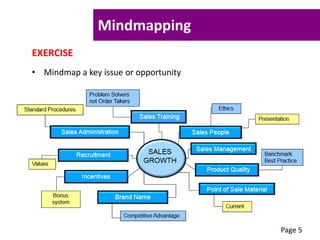
Mindmapping
EXERCISE
• Mindmap a key issue or opportunity
Page 5
Pareto Analysis
• Use this tool when you need to sort out the vital few
from the trivial many
• It is based on the premise that 80% of problems are due to
20% of the possible causes.
Examples:
• 20% of your customers provide 80% of your sales
• 20% of your products provide 80% of your sales
• 20% of your products provide 80% of your problems
• 20% of your customers provide 80% of your problems
80%
20%
Page 6
Issue Ranking
EXERCISE
• Select issues that you feel are the most relevant from the previous
exercises and score them out of 10, against the two factors.
Issue
Opportunity
For
Improvement
Ability to
Support the
SCA
Total Score Comments
Example Quality 6 7 13 Has been a focus in the past
Page 7
Force Field
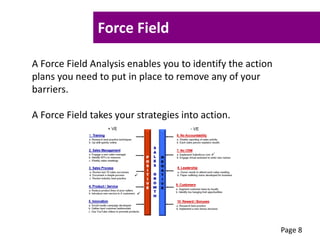
A Force Field Analysis enables you to identify the action
plans you need to put in place to remove any of your
barriers.
A Force Field takes your strategies into action.
Page 8
Force Field
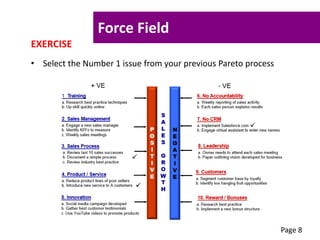
EXERCISE
• Select the Number 1 issue from your previous Pareto process
Page 8
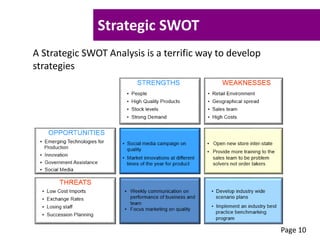
Strategic SWOT
A Strategic SWOT Analysis is a terrific way to develop
strategies
Page 10
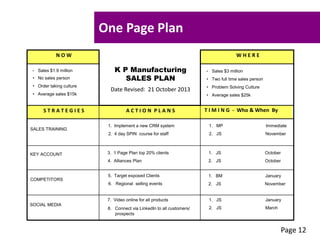
One Page Plan
T I M I N G - Who & When ByA C T I O N P L A N SS T R A T E G I E S
K P Manufacturing
SALES PLAN
Date Revised: 21 October 2013
W H E R EN O W
• Sales $1.9 million
• No sales person
• Order taking culture
• Average sales $15k
• Sales $3 million
• Two full time sales person
• Problem Solving Culture
• Average sales $25k
SALES TRAINING
KEY ACCOUNT
COMPETITORS
SOCIAL MEDIA
1. Implement a new CRM system
2. 4 day SPIN course for staff
3. 1 Page Plan top 20% clients
4. Alliances Plan
5. Target exposed Clients
6. Regional selling events
7. Video online for all products
8. Connect via LinkedIn to all customers/
prospects
1. MP Immediate
2. JS November
1. JS October
2. JS October
1. BM January
2. JS November
1. JS January
2. JS March
Page 12
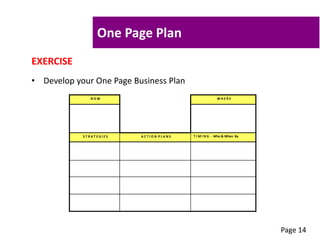
One Page Plan
EXERCISE
• Develop your One Page Business Plan
T I M I N G - Who & When ByA C T I O N P L A N SS T R A T E G I E S
W H E R EN O W
Page 14
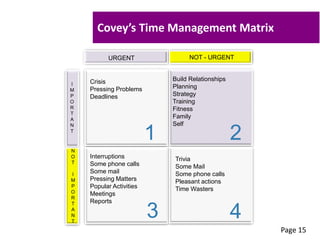
Covey’s Time Management Matrix
URGENT NOT - URGENT
Crisis
Pressing Problems
Deadlines
Build Relationships
Planning
Strategy
Training
Fitness
Family
Self
Interruptions
Some phone calls
Some mail
Pressing Matters
Popular Activities
Meetings
Reports
Trivia
Some Mail
Some phone calls
Pleasant actions
Time Wasters
1 2
3 4
I
M
P
O
R
T
A
N
T
N
O
T
I
M
P
O
R
T
A
N
T
Page 15
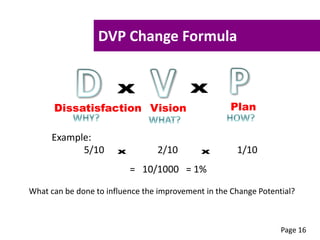
DVP Change Formula
Dissatisfaction Vision Plan
Example:
5/10 2/10 1/10
= 10/1000 = 1%
What can be done to influence the improvement in the Change Potential?
Page 16
Small Business Mentoring Service
Business mentors help you to identify a clear direction
for you and your business.
Business mentors can also advise you on how to:
conduct market research
price and/or cost your products or services
develop an effective marketing strategy
use other business management tools
To arrange a session with a business mentor go to:
www.sbms.org.au
Visit
business.vic.gov.au/events
for more workshop information
Discussions and Questions
Thank you for attending, what is your
Number 1 take home lesson?

Business Planning Basics seminar

  • 2.
    Welcome Over the durationof this 2 hour seminar you will: 1. Identify the top 3 key issues and opportunities for your business 2. Develop a clear Now and Where for your business 3. Build a One Page Business Plan 4. Learn a range of problem solving and strategy development tools Page 1
  • 3.
    Now – Where- How Page 1
  • 4.
    Now – Where- How EXERCISE • Where are you NOW in regard to the below Factors? FACTORS Where are you NOW? Your Customers Sales, Costs & Profits Your Products / Services Your Pricing Marketing & Promotion Your People Your Role Industry Page 2
  • 5.
    Now – Where- How EXERCISE • WHERE do you want to be in regard to the below Factors? FACTORS WHERE do you want to be? Your Customers Sales, Costs & Profits Your Products / Services Your Pricing Marketing & Promotion Your People Your Role Industry Page 3
  • 6.
    Strategic Planning Model SUSTAINABLECOMPETITIVE ADVANTAGE MARKETING STRATEGY OPERATIONS STRATEGY INNOVATION STRATEGY HUMAN RESOURCE STRATEGY FINANCIAL STRATEGY Page 3
  • 7.
    Magic Wand If youhad a Magic Wand and you didn’t have to worry about the how or the cost involved, what would you change about your business? Page 4
  • 8.
    Magic Wand EXERCISE • Recordbelow what you would change. MAGIC WAND CHANGES 1. 14. 2. 15. 3. 16. 4. 17. 5. 18. 6. 19. 7. 20 8. 21. 9. 22. 10. 23. 11. 24. 12. 25. 13. 26. Page 4
  • 9.
    Mindmapping EXERCISE • Mindmap akey issue or opportunity Page 5
  • 10.
    Pareto Analysis • Usethis tool when you need to sort out the vital few from the trivial many • It is based on the premise that 80% of problems are due to 20% of the possible causes. Examples: • 20% of your customers provide 80% of your sales • 20% of your products provide 80% of your sales • 20% of your products provide 80% of your problems • 20% of your customers provide 80% of your problems 80% 20% Page 6
  • 11.
    Issue Ranking EXERCISE • Selectissues that you feel are the most relevant from the previous exercises and score them out of 10, against the two factors. Issue Opportunity For Improvement Ability to Support the SCA Total Score Comments Example Quality 6 7 13 Has been a focus in the past Page 7
  • 12.
    Force Field A ForceField Analysis enables you to identify the action plans you need to put in place to remove any of your barriers. A Force Field takes your strategies into action. Page 8
  • 13.
    Force Field EXERCISE • Selectthe Number 1 issue from your previous Pareto process Page 8
  • 14.
    Strategic SWOT A StrategicSWOT Analysis is a terrific way to develop strategies Page 10
  • 15.
    One Page Plan TI M I N G - Who & When ByA C T I O N P L A N SS T R A T E G I E S K P Manufacturing SALES PLAN Date Revised: 21 October 2013 W H E R EN O W • Sales $1.9 million • No sales person • Order taking culture • Average sales $15k • Sales $3 million • Two full time sales person • Problem Solving Culture • Average sales $25k SALES TRAINING KEY ACCOUNT COMPETITORS SOCIAL MEDIA 1. Implement a new CRM system 2. 4 day SPIN course for staff 3. 1 Page Plan top 20% clients 4. Alliances Plan 5. Target exposed Clients 6. Regional selling events 7. Video online for all products 8. Connect via LinkedIn to all customers/ prospects 1. MP Immediate 2. JS November 1. JS October 2. JS October 1. BM January 2. JS November 1. JS January 2. JS March Page 12
  • 16.
    One Page Plan EXERCISE •Develop your One Page Business Plan T I M I N G - Who & When ByA C T I O N P L A N SS T R A T E G I E S W H E R EN O W Page 14
  • 17.
    Covey’s Time ManagementMatrix URGENT NOT - URGENT Crisis Pressing Problems Deadlines Build Relationships Planning Strategy Training Fitness Family Self Interruptions Some phone calls Some mail Pressing Matters Popular Activities Meetings Reports Trivia Some Mail Some phone calls Pleasant actions Time Wasters 1 2 3 4 I M P O R T A N T N O T I M P O R T A N T Page 15
  • 18.
    DVP Change Formula DissatisfactionVision Plan Example: 5/10 2/10 1/10 = 10/1000 = 1% What can be done to influence the improvement in the Change Potential? Page 16
  • 19.
    Small Business MentoringService Business mentors help you to identify a clear direction for you and your business. Business mentors can also advise you on how to: conduct market research price and/or cost your products or services develop an effective marketing strategy use other business management tools To arrange a session with a business mentor go to: www.sbms.org.au
  • 20.
    Visit business.vic.gov.au/events for more workshopinformation Discussions and Questions Thank you for attending, what is your Number 1 take home lesson?

Editor's Notes

  • #2 2 minutesWelcome attendees to the 2 hour seminar. Introduce yourself for 1-2 minutes and explain the focus of the program which is to introduce them to the business planning process and to learn a range of problem solving tools. Explain the workbook in front of them and the issues / ideas and work areas at the back of the manual.Notes:This PowerPoint presentation has been built with suggested timings as a ‘guide’ to facilitators of the program. These timings have been based on a standard two hour format with no break. We also recognise that different sized groups will require slightly different timings so again please use these timings as a guide only.The material contained within this PowerPoint uses Mindshop’s version of business tools and processes and are protected by copyright. Please only use this presentation in relation to your work with these Business Planning seminars and not for 3rd party commercial use or sending to 3rd parties without the express permission of Mindshop’s Managing Director, James Mason who can be contacted on 03 8807 0163
  • #10 8 minutes State that Mindmapping is a brainstorming technique that all attendees should be familiar with. If not, explain the tool briefly by talking through the ‘sales growth’ example in the slides provided. Now pick a burning issue or opportunity from their Magic Wand list (or that has been triggered to be thought of through that exercise) and spend 7-8 minutes Mindmapping it to demonstrate the tool.Lead into the next tool by stating “but would you have time to implement all the suggested strategies / ideas that may have dropped out of the Mindmap”?
  • #11 5 minutesLead into this section by summarising where they are now in the business improvement process. You could do this by stating they should now have clarity around their NOW, their WHERE, have started to think about the key issues in their control as to HOW (through things like Magic Wand and Mindmapping) they will get there and also touched on their competitive advantage in their market. State that in such a busy business environment it’s impossible to do all the strategies / ideas / projects on your ‘do list’ in order to get you where you want to go. Thus you need the ability to focus on the 20% of things that will provide you 80% of the benefit. This is the nature of Pareto Analysis. Now explain Pareto in the context of the previous Mindmap where you could get people coming up the front with 3 ticks each to select the 20% of actions they feel would provide 80% of the benefit. Circle the aspects of the Mindmap which has the most ticks as a simple consensus view. Now move onto Issue Ranking.
  • #12 10 minutesExplain the Issue Ranking process and the filters of opportunity for improvement and ability to support the SCA (re-state this is their competitive advantage in the market). Ask an open ended question as to why would these filters be used? Gather some feedback. Also mention that again if they felt very strongly (as many will be start-up businesses in the room) another factor such as impact on profitability was a critical element for their business, they could replace one of the filters with that. State that they can list the issues that they see are the key strategies / issues over the next 12 months to take them from WHERE they are NOW to WHERE they want to be. As an aside you may mention that a tool like Mindmapping could be used to flush out the issues.Now get them by themselves to go through the Issue Ranking exercise for 6-8 minutes to pin-point (pareto) their top few issues to get them from where they are NOW to WHERE they want to be. When they have finished go to the next slide.
  • #13 2 minutesRead the notes on the slide and explain that a Force Field is a powerful (but simple) way to drive strategies (so the key issues from your Pareto Analysis / Issue Ranking) into action.
  • #14 18 minutesStep slowly through explaining how a Force Field works using the sales growth example and then select a key issue that people would have raised from the Pareto / Issue Ranking exercise and demonstrate a fix to a REAL issue from participants and gather their input as you do the Force Field.
  • #15 8 minutesExplain the Strategic SWOT as a terrific methodology to develop strategies. Discuss how it compliments the tools already learnt and that many of the strategies developed in a SWOT would also fall into the final One Page Plan. Explain how the Strategic SWOT works by following the explanation in the manual or on the slide. Explain that post the seminar they should look to do a SWOT on their business using their workbook
  • #16 3 minutesThis now brings all the elements of the seminar together.Explain how the One Page Plan works and where elements done through-out this seminar would be used to populate the plan. Therefore explain the Now and Where are from the exercise completed around the Now – Where. The strategies would come from the Pareto / Issue Ranking exercise (or the Strategic SWOT and some other exercises) and the actions are the outcomes from doing a Force Field on each of the strategies. The timing, who and by when are then entered. This needs to be VERY clear to attendees for them to understand this tool properly.
  • #17 10 minutesGive them 8 minutes to work by themselves to pull together their One Page Plan. Explain that with such limited time that they should focus on the strategies and some actions and that the detailed timings, who and by when can come later. Gather a minute or two of feedback from participants on how they found the One Page Plan process
  • #18 3 minutesExplain very briefly the Covey Time Management Matrix which many of them may have seen over the years. Explain the tool by going quickly through each of the 4 quadrants individually and just use this slide to make the point that as they seek to implement their One Page Plan they need to make the time to change.
  • #19 5 minutesExplain the 3 elements of DVP and how the scoring process works. Run through some examples to get people thinking of what would happen for example if they had a high score for Vision but low for Dissatisfaction and Plan? (answer nothing as nothing would get done). Explain the need to have a high change potential score to ensure that again they have the motivation, plan and vision to make the changes happen (as part of implementing their One Page Plan). If you have time, get them to quickly calculate their current change potential, get them to do a quick calculation.