Document No. :: IITK-GSDMA-Fire03-V3.0
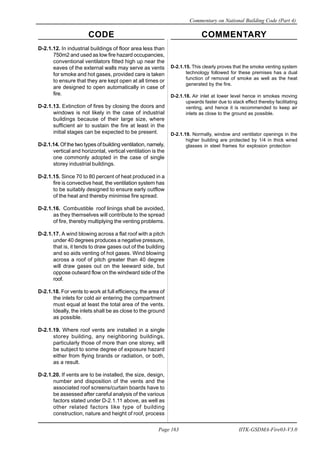
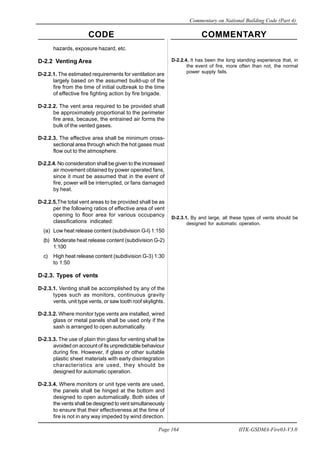
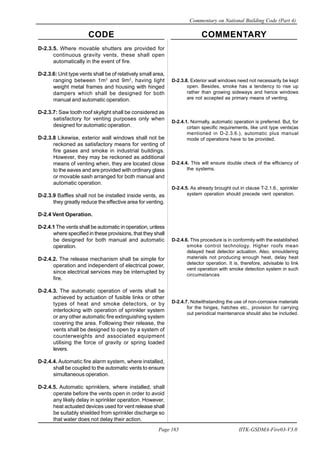
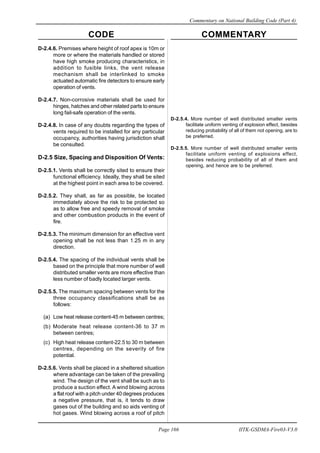
Final Report :: C - Fire Codes
IITK-GSDMA Project on Building Codes
Commentary on National Building Code
(Part 4) – Fire and Life Safety
by
G.B.Menon
Fire Adviser, Govt. of India {Retd.} Cochin
Ex-Chairman CED-22 Fire Fighting Sectional Committee
Bureau of Indian Standards.
J.N.Vakil
Asst.General Manager{Retd},TAC/GIC,Ahmedabad
Ex-Chairman CED-36 Fire Safety Sectional Committee
Bureau of Indian Standards.
• This document has been developed under the project on Building
Codes sponsored by Gujarat State Disaster Management Authority,
Gandhinagar at Indian Institute of Technology Kanpur.
• The views and opinions expressed are those of the authors and not
necessarily of the GSDMA, the World Bank, IIT Kanpur, or the Bureau
of Indian Standards.
• The Commentary is based on the Final Document of Part 4 Fire and
Life Safety, which is under print. Suggestions of the authors for certain
modifications in the Code have been forwarded to BIS separately
• Comments and feedbacks may please be forwarded to:
Prof. Sudhir K Jain, Dept. of Civil Engineering, IIT Kanpur, Kanpur
208016, email: nicee@iitk.ac.in
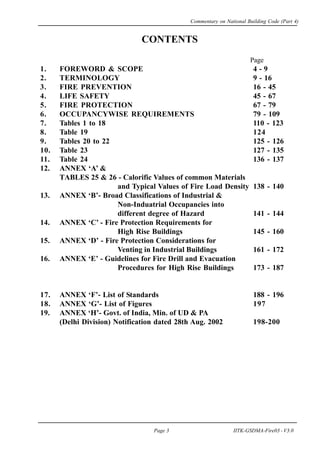
CONTENTS
Page
1. FOREWORD & SCOPE 4 - 9
2. TERMINOLOGY 9 - 16
3. FIRE PREVENTION 16 - 45
4. LIFE SAFETY 45 - 67
5. FIRE PROTECTION 67 - 79
6. OCCUPANCYWISE REQUIREMENTS 79 - 109
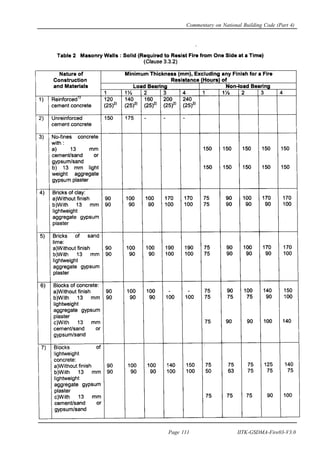
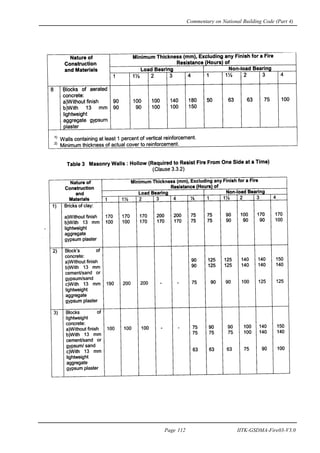
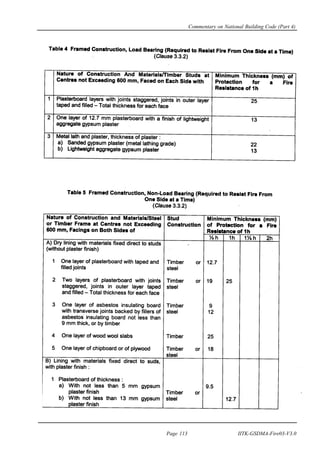
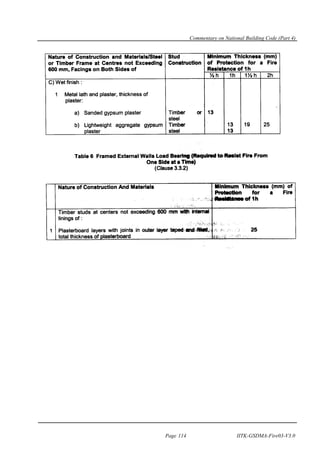
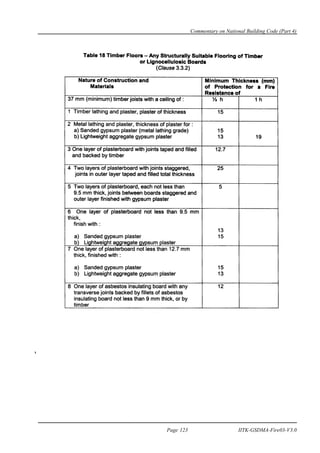
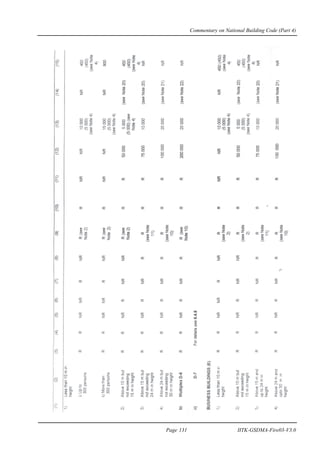
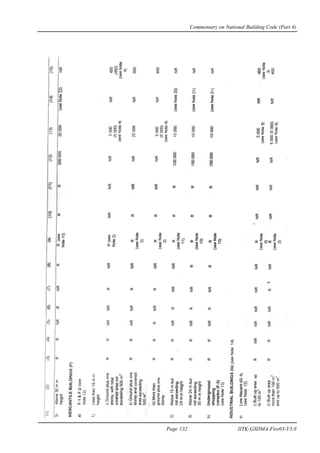
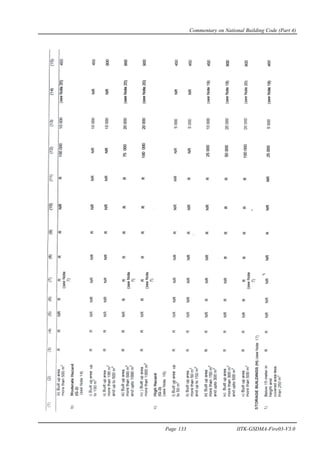
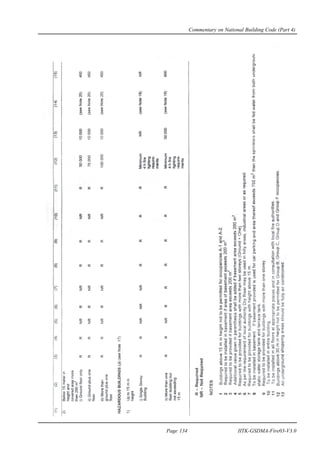
7. Tables 1 to 18 110 - 123
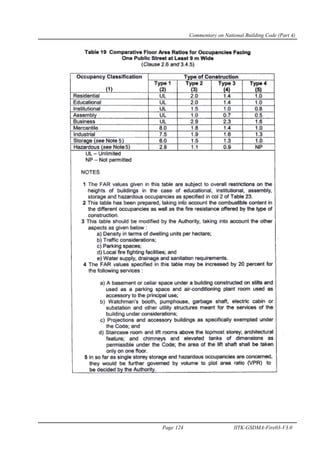
8. Table 19 124
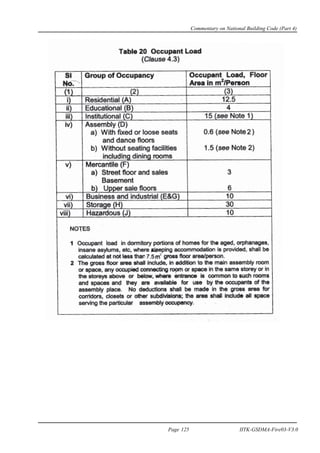
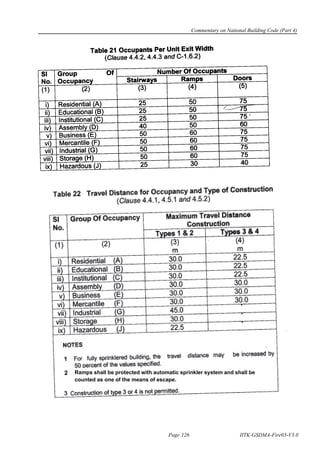
9. Tables 20 to 22 125 - 126
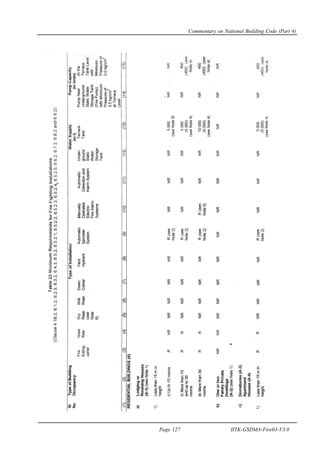
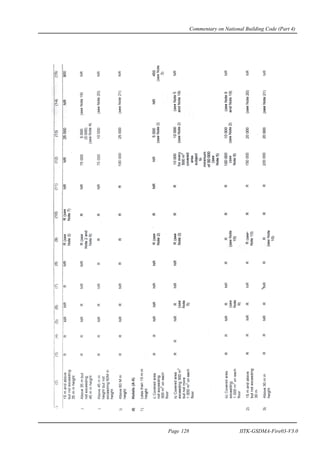
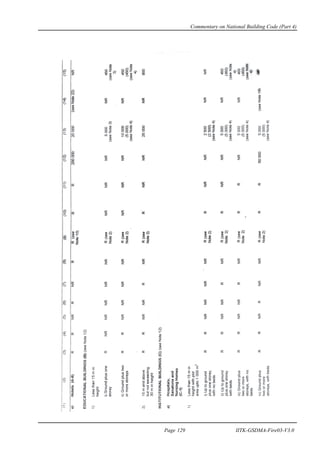
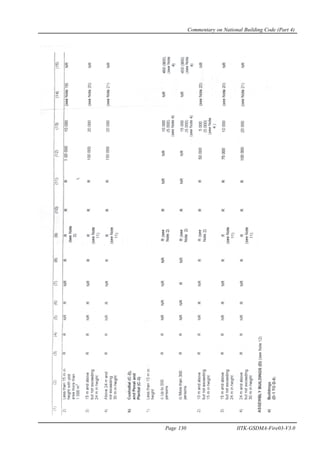
10. Table 23 127 - 135
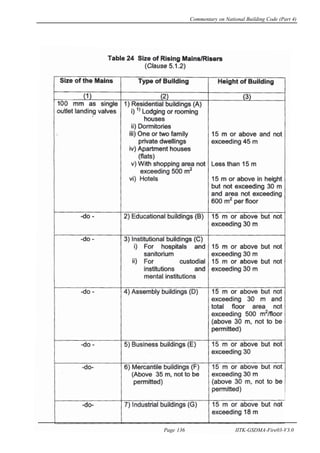
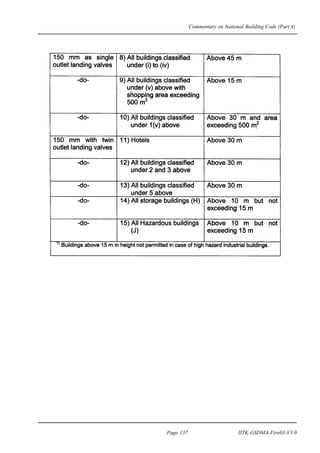
11. Table 24 136 - 137
12. ANNEX ‘A’ &
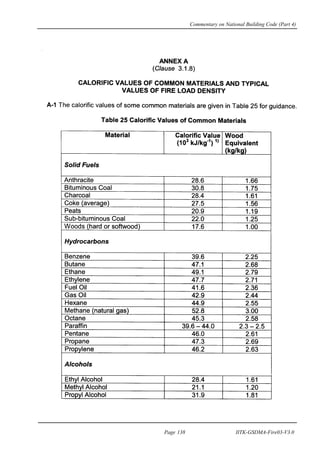
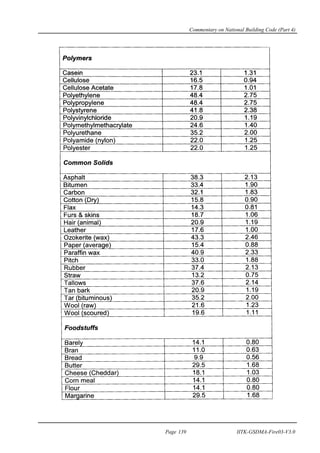
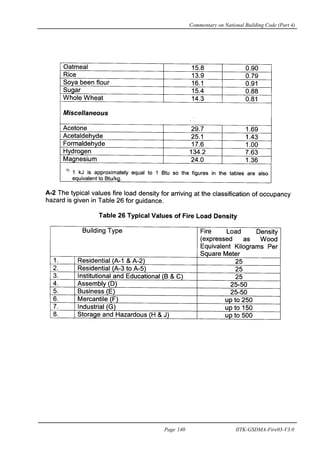
TABLES 25 & 26 - Calorific Values of common Materials
and Typical Values of Fire Load Density 138 - 140
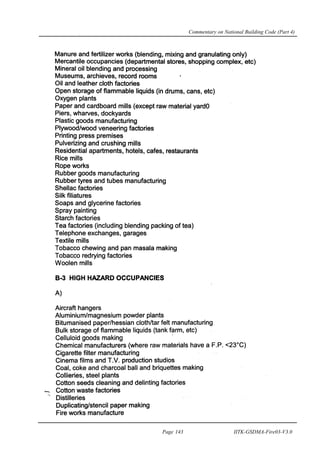
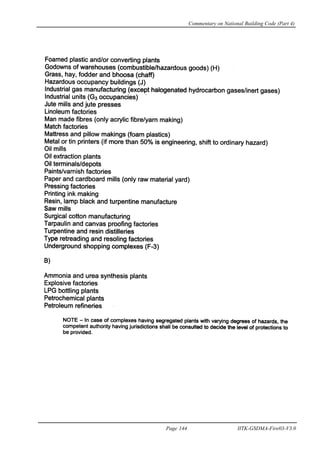
13. ANNEX ‘B’- Broad Classifications of Industrial &
Non-Induatrial Occupancies into
different degree of Hazard 141 - 144
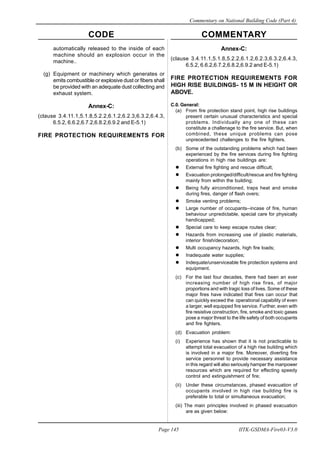
14. ANNEX ‘C’ - Fire Protection Requirements for
High Rise Buildings 145 - 160
15. ANNEX ‘D’ - Fire Protection Considerations for
Venting in Industrial Buildings 161 - 172
16. ANNEX ‘E’ - Guidelines for Fire Drill and Evacuation
Procedures for High Rise Buildings 173 - 187
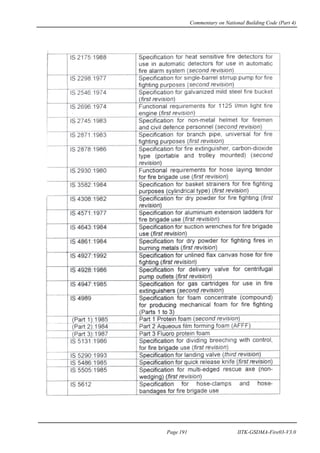
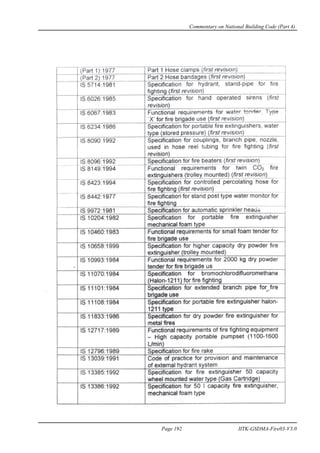
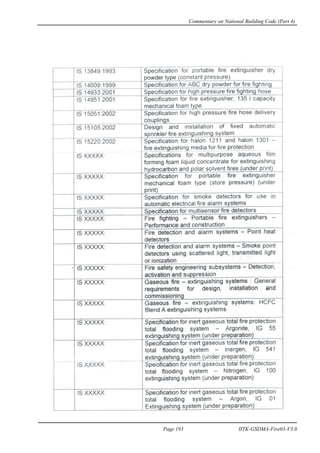
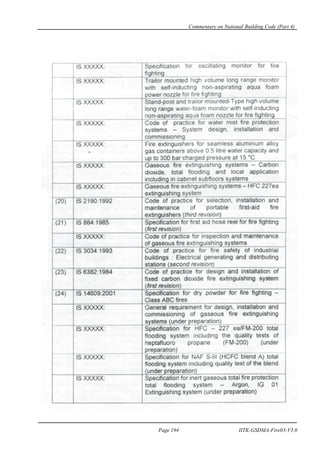
17. ANNEX ‘F’- List of Standards 188 - 196
18. ANNEX ‘G’- List of Figures 197
19. ANNEX ‘H’- Govt. of India, Min. of UD & PA
(Delhi Division) Notification dated 28th Aug. 2002 198-200
Commentary on National Building Code (Part 4)
Page 3 IITK-GSDMA-Fire03 - V3.0
NATIONAL BUILDING CODE OF INDIA
PART 4 FIRE AND LIFE SAFETY-2005
(Second Revision of SP 7-Part 4)
CODE COMMENTARY
FOREWORD
A broad overview of the contents of the Foreword (as
shown on the left), is outlined below:
(i) Part-4 of NBC deals with the requirements
necessary to minimise danger to life and property
from fire and adopts an integrated approach.
(ii) Fire Protection techniques should be based on fire
characteristics of building materials and elements of
structure, and requirements of the Code should be
adopted in toto for ensuring a fire safe design and
construction of buildings.
(iii) For this, qualified and trained fire experts have to be
closely associated with the building industry, right
from the planning and design stage of the building.
(This aspect has been strongly advocated by the
Standing Fire Advisory Council, Govt. of India also,
which is the highest policy making body for the Fire
Protection Services in the country.
(iv) While the Code prescribes only the minimum
standards of fire protection and fire safety of
buildings, both in the interests of the occupants of
the buildings and also in the public interests, nothing
in the Part prohibits adoption of higher standards.
Also, it will be necessary for all concerned to comply
with all requirements of fire safety as prescribed in
fire-related legislative provisions.
(v) Detailed coverage has been provided about the Halon
Phase-Out policy guidelines as well as the
development and adoption of the Standards on Halon
Alternatives. In fact, this subject has been dealt with
in detail under Commentary Section F-5.3. As
mentioned therein, 12 new Indian Standards on
Halon Alternatives are already under publication, as
ascertained from the BIS, and 19 existing Indian
Standards, where there are references on Halon, are
under revision/upgradation.
(vi) The final revised version of Part-4 NBC is under print
and expected to come out soon by June 2005
(according to BIS sources) The material projected
in the ‘Code’ part of this document is a reproduction
of the final revised version of NBC Part 4, which was
sent for printing, as obtained from the BIS.
FOREWORD
This part of the Code deals with safety from fire.
It specifies the demarcation of fire zones, restrictions
on construction of buildings in each fire zone,
classification of buildings based on occupancy, types
of building construction according to fire resistance of
the structural and non-structural components and other
restrictions and requirements necessary to minimise
danger to life from fire, smoke, fumes or panic before
the buildings can be evacuated. The Code recognizes
that safety of life is more than a matter of means of
exits and accordingly deals with various matters which
are considered essential to the safety of life.
Fire protection techniques have to be based on the
fire behavior characteristics of different materials and
structural elements of buildings. The activities pursued
by the occupants of buildings must also be taken into
consideration for assessing the extent of hazards, and
method should then be devised by which the hazards
could be minimised. An indefinite combination of
variables is involved in the phenomenon of fire, all of
which cannot be quantified. The requirements of this
Code should, therefore, be taken as a guide and an
engineering design approach should be adopted for
ensuring a fire safe design for buildings. It would also
be necessary for this purpose to associate qualified
and trained fire protection engineers with the planning
of buildings, so that adequate fire protection measures
could be incorporated in the building design right from
the beginning.
Absolute safety from fire is not attainable in practice.
The objective of this part is to specify measures that
will provide that degree of safety from fire which can
be reasonably achieved. The Code endeavours to avoid
requirements that might involve unreasonable
hardships or unnecessary inconvenience or interfer-
ence with normal use and occupancy of buildings, but
insists upon compliance with minimum standards for
fire safety necessary in public interest. For ensuring
compliance of fire protection equipments/installations
to the laid down quality requirements, it is desirable to
use such equipments/installation duly certified under
the BIS Certification Marks Scheme.
While providing guidelines for minimising chances of
occurrence of fire through passive fire protection
Page 4 IITK-GSDMA-Fire03 - V3.0
Commentary on National Building Code (Part 4)
CODE COMMENTARY
Page 5 IITK-GSDMA-Fire03 - V3.0
Commentary on National Building Code (Part 4)
measures, this part does not intend to cover all
aspects of general fire prevention including sources of
ignition. Nor does it cover the prevention of accidental
personal injuries during the course of normal occupancy
of buildings.
This part while recognising that panic in a building on
fire may be uncontrollable, deals with the potential panic
hazard through measures designed to prevent the
development of panic. Experience indicates that panic
seldom develops even in the presence of potential
danger, so long as occupants of buildings are moving
towards exits which they can see within a reasonable
distance and with no obstruction or undue congestion
in the path of travel. However, any uncertainty as to
location or adequacy of means of egress, the
presence of smoke or fumes and the stoppage of travel
towards the exit, such as may occur when one person
stumbles and falls on stairs, may be conducive to panic.
Danger from panic is greater when a large number of
people are trapped in a confined area.
Experience has shown that concealed spaces within a
building such as space between ceiling and false
ceiling, horizontal and vertical ducts, etc, tend to act
as flues/tunnels during a fire. Provision should,
therefore, be made to provide fire stopping within such
spaces.
Nothing in this part of the C ode shall be construed to
prohibit better types of building construction, more
exits or otherwise safer conditions than the minimum
requirements specified in this part.
Compliance with this part shall not be construed as
eliminating or reducing the necessity for other
provisions for safety of persons using a building or
structure under normal occupancy conditions. Nor shall
any provisions of this Code be construed as requiring
or permitting any addition that may be hazardous
under normal occupancy conditions.
One of the major points brought out in this part is the
limitation of heights and areas of buildings based on
fire safety of the occupants. Individual municipal
corporations are free to alter Table 19 based on local
conditions, but the ratios of areas as maintained in the
Table for different occupancies and types of
construction shall be adhered to.
Advantage has been taken of the developments,
particularly in fire resistance rating of materials,
designating types of construction in a rational manner
and relating the area limitations of different
occupancies to different types of construction.
CODE COMMENTARY
Page 6 IITK-GSDMA-Fire03 - V3.0
Commentary on National Building Code (Part 4)
Halons (halogenated hydrocarbons) which exihibit
exceptional fire fighting and explosion prevention/
suppression characteristics have been found to
possess high ozone depleting potential. They come
under Group II of Annex A of the Montreal Protocal on
Substances that Deplete the Ozone Layer, the
international environment agreement for phasing out
ozone depleting substances. Due to increasing
evidence that the ozone layer is getting depleted at a
faster rate than thought earlier, the development
countries accelerated their phase-out schedule with a
view to achieving 100 percent phase-out of halons by
1 January 1994, instead of the earlier target date of 1
January 2000 after which only essential use of halons
was allowed. For developing countries like India, the
total phase-out of halons is to be achieved by 1 Janu-
ary 2010, as per the Montreal Protocol, unless a
decision is taken in between to hasten up the
phase -out of ozone depleting substances. India,
having become a signatory to the Protocol in June 1992,
is committed to abide by the Montreal Protocol deci-
sions. In accordance with Ministry of Environment and
Forests, Government of India, Ozone Depleting
Substances(Regulations), Rules, 2000, the manufac-
ture of halon based fire extinguishers and
extinguishing systems have been phased out by
1 January 2001. Meanwhile, the practical implications
of the phasing out of the halons cover, by the large, the
following aspects:
(a) Availability of halons will be restricted;
(b) Non-standard halon extinguishers, like
aerosol type, shall not be permitted;
(c) Discharge of halons for training/testing, etc
shall not be permitted;
(d) All efforts shall be made for avoiding
minimising halon emissions at various levels
such as production, fire equipment manufac
ture, use, service and maintenance;
(e) Since ‘drop-in’ substitutes for halons are not
likely to be available on a commercial scale in
the near future, wherever possible, instead of
halon, use of suitable alternative extinguish
ing media/methods will be resorted to even ac
cepting some trade-offs, if necessary; and
(f) Halons shall be restricted for ‘essential uses’
only, for protection of critical fire, explosion, risk
areas which would otherwise result in serious
impairment of an essential service to society, or
pose an unacceptable threat to life, the
environment, or national security.
CODE COMMENTARY
Page 7 IITK-GSDMA-Fire03 - V3.0
Commentary on National Building Code (Part 4)
NOTE - Detailed instructions which will be issued by
the Government of India from time to time for
implementation of the Country Programme for the
phasing out of Ozone depleting substances (ODS) and
regarding permitting use of halons for applications till
the availability of proper substitutes, shall have to be
complied with.
The first version of this part was formulated in 1970
and first revision was brought out in 1983. Subsequently
the first revision of this part was modified in 1997
through Amendment No. 3 to 1983 version of the Code.
This modified version of this part included few tables
for the fire resistance ratings of various building com-
ponents such as walls, columns, beams and floors.
The requirements for wet riser, downcomer, automatic
sprinkler installation, high velocity (10-15 lpm/s) water
spray or foam generating system, etc, for buildings were
modified. Annex giving guidelines for selection of fire
detectors had been deleted and relevant Indian
Standards on fire alarm system and smoke detectors
had been referred. Also, Annex for determination of
fire loads and fire load density for arriving at the
classification of occupancy hazard and calorific values
of some common materials were included. Annex for
broad classification of industrial and non-industrial
occupancies into low. Moderate and high hazard, had
also been included.
As a result of implementation of this part, some useful
suggestions have emerged. This draft revision has,
therefore, been prepared to take care of the same. The
significant modifications incorporated include:
(a) The text has now been divided into the
following broad clauses :
(1) Fire Prevention - covering aspects of fire
prevention pertaining to design and
construction of buildings on passive fire
protection measures, also describing the
various types of building materials and their fire
rating.
(2) Life Safety - covering life safety provisions in
the event of fire and similar emergencies, also
addressing construction and occupancy features
that are necessary to minimise danger to life from
fire, smoke, fumes or panic.
(3 Fire Protection - Covering the significant
appurtenances and their related components
and guidelines for selecting the correct type of
equipment and installation meant for fire
protection of the building, depending upon the
classification and type of the building.
CODE COMMENTARY
Page 8 IITK-GSDMA-Fire03 - V3.0
Commentary on National Building Code (Part 4)
(b) The classification of building based on
occupancy has been elaborated, with:
(1) Starred hotels now covered as a new
subdivision A-6 under occupancy Group A
Residential.
(2) Heritage structures and archeological
monuments now covered under subdivision
D-3 occupancy Group D Assembly buildings.
(3) Mixed Assembly Occupancies-D-6 and
underground/elevated railways now covered as
a new subdivision D-7 under occupancy Group
D Assembly buildings.
(4) TV stations now covered under subdivision E-5
of occupancy Group E Business buildings.
(c) The minimum capacity of smoke exhaust
equipment has been increased to 12 air changes
per hour.
d) For the external stairs for exit requirements,
the width and treads have been increased to
1250 mm and 250 mm respectively.
e) Under the requirements for institutional
buildings the clear width of all required exits
which serve as egress from hospital or infirmary
section has been increased from 1.5 m to 2 m.
Also, provision of patient -lift has been included.
f) Due cognizance of halon phase out
programme has been taken, while specifying
provisions in this draft with respect to fire
protection using fire extinguishers/systems.
1. SCOPE
This part covers the requirements for fire
prevention, life safety and fire protection of
buildings. The code specifies construction,
occupancy and protection features that are
necessary to minimise danger to life and property
from fire.
2. TERMINOLOGY
2.0. For purpose of this part, the following definitions
shall apply.
2.1. Automatic Fire Detection and Alarm
System:
Fire Alarm system comprising components for
automati cally detecting a fire, initiating an alarm
of fire and initiating other actions as appropriate.
Note:- This system may also include manual fire alarm
call points.
2.2. Automatic Sprinkler System:
A system of water pipes fitted with sprinkler
heads at suitable intervals and heights and
designed to actuate automatically, control and
extinguish a fire by discharge of water.
NATIONAL BUILDING CODE OF INDIA
PART 4 FIRE AND LIFE SAFETY-2005
(Second Revision of SP 7-Part 4)
CODE COMMENTARY
F2. TERMINOLOGY
F2.1. Automatic Fire Detection and Alarm
System
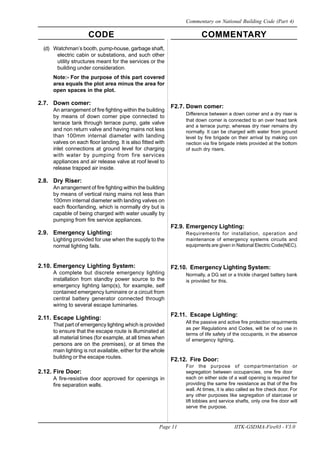
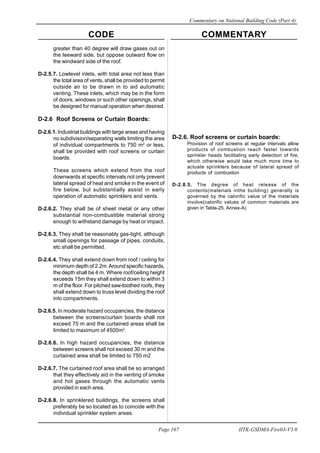
a) Partial coverage by this system is not desirable.
The detectors have to be properly installed,
maintained and tested to ensure adequate fire
protection. Both audible and visual alarms are used
to alert the occupants through a central control
panel.
Fig-01(a) Typical Automatic Fire Alarm System.
(Fig-01(b) is given under clause F4.18.)
b) “ The initiation of other actions” as stated in the
defenition, is achieved by interfacing of other control
devices in the building, like elevator control, fire door
control, HVAC systems control etc. of the fire alarm
systems. NFPA 72 requires that all fire protection
systems in a protected premises, be connected to
the fire alarm system.
F2.2. Automatic Sprinkler System:
a) Automatic sprinklers have the unique properties of
automatic detection of fire (since they incorpor te
thermo-sensitive devices), control and extin-
guishment of fire by automatically releasing
water of activation in specific patterns and quanti-
ties over designated areas. The system has come
to be universally recognised as the most effective
fire protection installation for the building/premises,
which need protection. Large area, high rise,
assembly,hotels, warehouses, manufacturing facili-
ties and such other buildings, will benefit substan-
tially by its provision. The fact that sprinkler system
sounds the fire alarm alerting the occupants of a fire
condition, and since sprinkler discharge can con-
Page 9 IITK-GSDMA-Fire03 - V3.0
Commentary on National Building Code (Part 4)
CODE COMMENTARY
Page 10 IITK-GSDMA-Fire03 - V3.0
Commentary on National Building Code (Part 4)
2.3. Building:
Any structure for whatsoever purpose and of
whatsoever materials constructed and
every part thereof whether used as human
habitation or not and includes foundations, plinth,
walls, floors, roofs, chimneys, plumbing and
building services, fixed platform, varandah,
balcony, cornice or projection, part of a building
or anything affixed thereto or any wall enclosing
or intended to enclose any land or space and
signs and outdoor display structures. Tents,
Shamianahs, tarpaulin shelters, etc, erected for
temporary and ceremonial occasions with the
permission of the Authority shall not be
considered as building
2.4. Building, Height of:
The vertical distance measured in the case of
flat roofs, from the average level of the ground
around and contiguous to the building to the
terrace of the last livable floor of the building
adjacent to the external wall; and in the case of
pitched roof up to the point where the external
surface of the outer wall intersects the finished
surface of the sloping roof, and in the case of
gables facing the road, the mid point between
the eaves level and the ridge. Architectural
features serving no other function except that of
decoration, shall be excluded for the purpose of
measuring heights.
2.5. Combustible Material:
The material which either burns itself or adds
heat to a fire. When tested for non-combustibility
in accordance with accepted standard [F(1)]
2.6. Covered Area:
Ground area covered by building immediately
above the plinth level. The area covered by the
following in the open places is excluded from
covered area (see Table 19) (given at the end)
(a) Garden, rockery, well and well structures, plant
nursery, water-pool, swimming pool (if un
covered), platform round a tree, tank, fountain,
bench, Chabutara with open top and unenclosed
on sides by walls and the like;
(b) Drainage culvert, conduit, catch-pit, gully pit,
chamber, gutter and the like;
(c) Compound wall, gate, un-storeyed porch and
portion, slide, swing, uncovered staircases, ramp
areas covered by Chajja and the like; and
trol, suppress and even extinguish a fire, contrib-
utes largely to life safety as well.
b) However, sprinkler system fails to serve their
intended purpose, if they are put to non-automatic
mode.
F2.3 Building:
a) The defenition of building as given in Parts 2, 3 & 4
of NBC is self explanatory.
Note: For information only:- The defenition of building is
quite elastic in various International Codes. In all American
Codes (including Uniform Fire Code 2003, International
Building Code 2003) the defenition adopted is: “Any struc-
ture used or intended for supporting or sheltering any use
or occupancy”. A reference to a building includes part of the
building also.
b) A building need not necessarly be inhabited. Tempo
rary structures need not be construed as buildings.
F2.4. Building, Height of:
It is to be mentioned that building height has been
given various defenitions in different local Building
Regulations and Codes. The defenition adopted in
Parts 2, 3 & 4 of NBC is a widely accepted one, and
generally in conformity with international practice.
F2.6. Covered Area:
Areas excluded from covered area calculations
should be taken special note of, particularly during
completion of relevent documents and reports.
CODE COMMENTARY
Page 11 IITK-GSDMA-Fire03 - V3.0
Commentary on National Building Code (Part 4)
(d) Watchman’s booth, pump-house, garbage shaft,
electric cabin or substations, and such other
utility structures meant for the services or the
building under consideration.
Note:- For the purpose of this part covered
area equals the plot area minus the area for
open spaces in the plot.
2.7. Down comer:
An arrangement of fire fighting within the building
by means of down comer pipe connected to
terrace tank through terrace pump, gate valve
and non return valve and having mains not less
than 100mm internal diameter with landing
valves on each floor landing. It is also fitted with
inlet connections at ground level for charging
with water by pumping from fire services
appliances and air release valve at roof level to
release trapped air inside.
2.8. Dry Riser:
An arrangement of fire fighting within the building
by means of vertical rising mains not less than
100mm internal diameter with landing valves on
each floor/landing, which is normally dry but is
capable of being charged with water usually by
pumping from fire service appliances.
2.9. Emergency Lighting:
Lighting provided for use when the supply to the
normal lighting fails.
2.10. Emergency Lighting System:
A complete but discrete emergency lighting
installation from standby power source to the
emergency lighting lamp(s), for example, self
contained emergency luminaire or a circuit from
central battery generator connected through
wiring to several escape luminaries.
2.11. Escape Lighting:
That part of emergency lighting which is provided
to ensure that the escape route is illuminated at
all material times (for example, at all times when
persons are on the premises), or at times the
main lighting is not available, either for the whole
building or the escape routes.
2.12. Fire Door:
A fire-resistive door approved for openings in
fire separation walls.
F2.7. Down comer:
Difference between a down comer and a dry riser is
that down comer is connected to an over head tank
and a terrace pump; whereas dry riser remains dry
normally. It can be charged with water from ground
level by fire brigade on their arrival by making con
nection via fire brigade inlets provided at the bottom
of such dry risers.
F2.9. Emergency Lighting:
Requirements for installation, operation and
maintenance of emergency systems circuits and
equipments are given in National Electric Code(NEC).
F2.10. Emergency Lighting System:
Normally, a DG set or a trickle charged battery bank
is provided for this.
F2.11. Escape Lighting:
All the passive and active fire protection requirments
as per Regulations and Codes, will be of no use in
terms of life safety of the occupants, in the absence
of emergency lighting.
F2.12. Fire Door:
For the purpose of compartmentation or
segregation between occupancies, one fire door
each on either side of a wall opening is required for
providing the same fire resistance as that of the fire
wall. At times, it is also called as fire check door. For
any other purposes like segregation of staircase or
lift lobbies and service shafts, only one fire door will
serve the purpose.
CODE COMMENTARY
Page 12 IITK-GSDMA-Fire03 - V3.0
Commentary on National Building Code (Part 4)
2.13. Fire Exit:
A way out leading to an escape route. Having
panic bar hardware provided on the door
2.14. Fire Lift:
The lift installed to enable fire services personnel
to reach different floors with minimum deley,
having such features as required in accordance
with this Part.
2.15. Fire Load:
Calorific energy, of the whole contents contained
in a space, including the facing of the walls,
partition, floors and ceilings.
2.16. Fire Load Density:
Fire load divided by floor area.
2.17. Fire Resistance Rating:
The time that a material or construction will
withstand the standard fire exposure as
determined by fire test done in accordance with
the standard methods of fire tests of materials/
structures.
2.18. Fire Resistance:
Fire resistance is a property of an element of
building construction and is the measure of its
ability to satisfy for a stated period some or all
of the following criteria:
(a) Resistance to collapse
(b) Resistance to penetration of flame and hot
gases, and
(c) Resistance to temperature rise on the
unexposed face up to a maximum of 180o
C and
/ or average temperature of 150o
C
2.19. Fire Separation:
The distance in meters measured from the
external wall of the building concerned to the
external wall of any other building on the site, or
from other site, or from the opposite side of street
or other public space to the building for the
purpose of preventing the spread of fire.
F2.13. Fire Exit:
This can either be a doorway or even a horizontal
exit. For means of egress, please refer to 2.27.
F2.14. FireLift :
This lift can be used even by building occupants
except during fire emergencies. This is a lift de
signed to have additional protection with controls to
enable it to be used under the direct control of the
fire service during fires.
F2.15. Fire Load:
It is the measure of the maximum heat that will be
released if all the combustibles in a fire area burn. It
is expressed in kJ/kg (one kJ is apprx. equal to
1 btu). Inclusion of wall linings, wooden or
combustible partitions, floors and ceilings in the
defenition, should be taken special note of.
F2.17. Fire Resistance Rating:
Information Note.A/F2.17 (for information only)
A.1 Fire Resistance Rating is at times referred to as
“Fire Endurance Rating” also. While the actual time
is recorded in the nearest integral minuites, fire
resistance ratings are given in standard intervals. The
usual fire resistance ratings for all types of structural
members doors and windows are 15 mins., 30 mins.,
45 mins., 1hr., 11/2 hrs., 2 hrs., 3 hrs. and 4 hrs.
A.2 However, in actual practice several factors affect the
standard fire resistance specified; Eg:
i) The amount of combustible material per unit of
floor area in various types of buildings (the fire load
density);
ii) The height of the top floor above ground, which
has a bearing of ease of escape (evacuation) and
fire fighting operations, and consequences should
large scale collapse occur.
iii) Occupancy types, which again reflects the speed
of evacuation;
(iv) The existence of basements, since basement
fires may lead to accumulation of smoke and heat
build up, which may, in turn, affect the duration of fire
as well as make fire fighting difficult;
(v) The number of storeys in the building; if a single
storey, escape is direct and structural failure is
unlikely.
CODE COMMENTARY
Page 13 IITK-GSDMA-Fire03 - V3.0
Commentary on National Building Code (Part 4)
2.20. Fire separating wall:
The wall provides complete separation of one
building from another or part of a building from
another or part of a building from an other part
of the same building to prevent any
communication of fire or heat transmission to
wallitself which may cause or assist in the
combustion of materials on the side opposite to
that portion which may be on fire.
2.21. Fire Stop:
A fire resistant material or construction having
a fire resistance rating of not less than the
separating elements installed in concealed
spaces or between structural elements of a
building to prevent the spread/propagation of fire
and smoke through walls, ceilings and the like
as per the laid down criteria.
Information Note. No.B/2.18.
The fire resistance of an element is the time in
minutes from the start of the test until failure occurs
under any one of the criteria set out in 2.18(a),
(b) or (c). viz.,
(a) Resistance to collapse(stability)
(b) Resistance to penetration of flame(integrity)
(c) Resitance to temp. rise on unexposed face(insulation)
For example:
A test result showing: stability-120; integrity-120;
insulation-15, would mean that a specimen failed in
respect of insulation after 15min. but complied with
the other two criteria for at least 120min.
F2.20. Fire separating wall:
They have minimum fire resistance of 4-hrs.
Combustible materials on the other side of the fire
seperating wall can be segregated before the wall
collapses, and the fire enters the segregated
compartment. This reduces the overall damage and
material losses.
F2.21. Fire Stop:
(a) This is actually a seal provided to close the opening
or imperfection of fit or design between elements or
components to eleminate the possibility of fire and
smoke passing through them. These fire stops fill
the openings around penetrating items such as cable
trays, conduits, ducts, pipes etc. through the wall or
floor openings. (fig. 5 at page 32)
(b) Provision of non combustible “sleeving” is also
resorted to as an alternative to proprietary seals for
penetration of pipes of lead, aluminium, aluminium
alloy, fibre cement or UPVC upto a specified
nominal internal diameter.
Information Note ‘C’/ 2.21 (for information
only)
C.1 Proprietary fire stopping and sealing systems which
have been shown by test to maintain the fire
resistance of the wall or other elements, are
available and may be used. Other fire stopping
materials include:
cement mortar
gypsum-based plaster
cement or gypsum vermiculite/perlite mixes
glass fibre, crushed rock, blast furnuace slag, or
ceramic based products (with or without resin
binders), and
intumescent mastics
C.2 These may be used in situations appropriate to the
particular material. Not all of them will be suitable in
every situation.
CODE COMMENTARY
Page 14 IITK-GSDMA-Fire03 - V3.0
Commentary on National Building Code (Part 4)
F2.22. Fire Tower
These are applicable for multi-storeyed buildings(over
8 storeys or 24m in height) and are considered as
the safest escape route.
F2.24. Floor Area Ratio (FAR)
This is also referred to as Floor Space Index(FSI).
The comparative floor area ratios of various occu-
pancies with explanatory notes are given in Table
19. The FAR values are subject to modification by
the local authorities on justifiable grounds.
F2.25. High Rise Building :
For measurement of heights of buildings please
refer to defenition of ‘Building, Height of’ under 2.4.
Definition of high rise buildings given in this Code is
of great importance because it has to be ideally
adopted by all Building Codes in all the states of
India.
F2.26. Horizontal Exit:
(a) Horizontal exits are particularly useful during fire
emergencies in hospitals (health care occupancies)
for evacuation of bedridden patients or patients
suffering from immobility. Adjoining compartments
into which horizontal evacuation is done should also
have a floor area sufficient to accommodate
evacuees from the adjoining compartment.
(b) Sometimes, progressive horizontal evacuation may
also have to be adopted depending on the emergency
situation and the facilities available(fig 13 at page 51)
F2.27. Means of Egress:
(a) The definition given here is quite simple, easy to
understand and covers the basic requirements. This
is the terminology used in USA also. In certain other
conuntries like UK, it is referred to as “Means of
Escape” or “Means of Exit”. Means of Egress in
buildings constitutes perhaps the most important
component of the National Building Code as a whole,
in so far as life safety of the occupants is concerned.
F2.28. Occupancy or Use Group:
It is to be noted that in the case of mixed occupancy,
the actual occupancy classification of the building or
premises will be on the basis of the principal
occupancy class. The occupancy shall be deemed
to inculude subsidiary or ancillary occupancies which
are contingent on it. As per NBC, the term
“alteration” of the building includes “a change from
one occupancy to another or a structural change”
(NBC page 1-2
)
F2.30 & Pressurisation & Pressurisation Level
2.22. Fire Tower:
An enclosed staircase which can only be
approached from the various floors through
landings or lobbies separated from both the floor
areas and the staircase by fire-resisting doors,
and open to the outer air.
2.23. Fire Resisting Wall
A fire resistance rated wall, having protected
openings, which restricts the spread of fire and
extends continuously from the foundation to at
least 1 m above the roof.
2.24. Floor Area Ratio:
The quotient obtained by dividing the total
covered area (plinth area) of all floors by the
area of the plot;
FAR = Total covered area of all floors
Plotarea
2.25. High Rise Building:
For the purpose of this Part, all buildings 15m
and above in height shall be considered as high
rise buildings.
2.26. Horizontal Exit:
An arrangement which allows alternative egress
from a floor area to another floor at or near the
same level in an adjoining building or an adjoining
part of same bulding with adequate fire
separation.
2.27. Means of Egress:
A continuous and unobstructed way of travel
from any point in a building or structure to a place
of comparative safety.
2.28. Occupancy or or Use Group:
The principal occupancy for which a building or
a part of a building is used or intended to be
used. For the purpose of classification of a
buliding according to the occupancy, an
occupancy shall be deemed to include subsidiary
occupancies which are contingent upon it.
2.29. Plinth Area:
The built-up covered area measured at the floor
level of the basement or of any storey.
2.30. Pressurization:
The establishment of a pressure difference
across a barrier to protect a stairway, lobby
escape route, or room of a bulding from smoke
penetration.
CODE COMMENTARY
Page 15 IITK-GSDMA-Fire03 - V3.0
Commentary on National Building Code (Part 4)
2.31. Pressurization Level:
The pressure difference between the pressurised
space and the area served by the pressurised
escape route, expressed in pascals(Pa)
2.32. Roof Exits:
A means of escape on to the roof of a building
where the roof has access to it from the ground.
The exit shall have adeqate cut-off within the
building from staircase below.
2.33.Site Plot:
A parcel (piece) of land enclosed by definite
boundaries.
2.34. Stack Pressure:
Pressure difference caused by a temperature
difference creating an air movement within a
duct, chimney or enclosure.
2.35. Travel Distance:
The distance to be travelled from any point in a
building to a protected escape route, external
escape route or final exit.
F2.31. The technique adopted is to create a higher
pressure in an escape route by mechanical
ventilation, thus preventing the ingress of smoke
a n d
toxic gases into the protected area. The most
common method is by use of centrifugal or axial
f a n s
driven by an electric motor. The basic design
considerations are:
(a) The pressure required in the escape route and
the leakage paths. To be effective, the system should
operate when required at a higher pressure than that
developed by the fire and weather conditions.
F2.32. Roof Exits
Under certain circumstances when the other normal
means of exit provided inside the building like stair
cases become smoke logged, roof exits will be the
only means of escape.
F2.34. Stack Pressure
Smoke moves from an area of higher pressure to
one of lower pressure. Pressure differences may be
caused by buoyancy from the fire, stack effect, wind
and forces from building heating, ventilating and
air-conditioning systems. In tall buildings, these
factors are complicated by the stack effect, which
is the vertical natural air movement from the building
caused by the differences in temperature and
densities between the inside and outside air. This
stack effect plays a vital role in smoke movement.
Fig. 2 Smoke Movement and Stack Effect
in a Multi-Storey Building.
F2.35. Travel Distance:
Safe exit for the occupants in a building on fire,
requires a safe path of escape from the fire in the
shortest possible time. This path, which should be
as short as possible, and easily negotiable, should
be ready for use in case of emergency.
CODE COMMENTARY
Page 16 IITK-GSDMA-Fire03 - V3.0
Commentary on National Building Code (Part 4)
2.36. Ventilation:
Supply of outside air into, or the removal of inside
air from an enclosed space.
2.37. Venting Fire
The process of inducing heat and smoke to leave
a building as quickly as possible by such paths
so that lateral spread of fire and heat is checked,
fire fighting operations are facilitated and
minimum fire damage is caused.
2.38. Volume to Plot Area Ratio (VPR)
The ratio of volume of building measured in
cubic metres to the area of the plot measured
in square metres and expressed in metres.
2.39. Wet Riser
An arrangement for fire fighting within the
building by means of vertical rising mains of not
less than 100 mm diameter with landing valves
on each floor/landing for fire fighting purposes
and permanently charged with water from a
pressurised supply.
Note:- For definition of other terms, reference shall be
made to good practice, Annex-F 2
3. FIRE PREVENTION
3.1. Classification of Buildings Based on
Occupancy.
3.1.1.General Classification:
All buildings, whether existing or hereafter
erected, shall be classified according to the use
or the character of occupancy in one of the
following groups:
Group A Residential
Group B Educational
Group C Institutional
Group D Assembly
Group E Business
Group F Mercantile
Group G Industrial
Group H Storage
Group J Hazardous
3.1.1.1. Minor occupany incidental to operations in
another type of occupancy shall be considered
as part of the main occupancy, and shall be
classified under the relevant Group for the main
occupancy.
Example of buildings in each Group are given in
3.1.2 to 3.1.10
F2.36. Ventilation:
This is more important for people awaiting
evacuation to sustain their lives. This is an impor
tant requirement in building design and construc
tion for replacement of stale, noxious or contami
nated air inside, with clean air from outside. This
can be achieved either through natural or mechani
cal means.
F2.37. Venting Fire
It deals with removal of heat and smoke from
building to facilitate fire fighting and evacuation
efforts. Smoke logging and mushrooming of hot
gases can be prevented, or at least minimised, by
early venting. This prevents the pre-heating of other
areas by convection, thereby restricting the spread
of fire.
F2.39. Wet Riser
Difference between this and a dry riser, is that wet
risers are permanently charged with water by a fire
pump from a permanent water supply (which can
either be an underground water tank or an elevated
water tank at the terrace), whereas, the dry riser has
to be fed with water by fire brigade after their arrival.
Landing valves are nothing but internal hydrants
fitted with standard instantaneous female couplings
and may be of single or double outlet types.
F3. FIRE PREVENTION
To start with, it will be relevant to make a reference
to the 4th para under FORWARD regarding
FIRE PREVENTION Coverage in this part.
F3.1. Classification of Buildings based on
Occupany
Occupancy classification of buildings as per the
International standards are also by and large similar
to this.
For information only:
According to Building Regulations of UK, they are
known as “Purpose Groups” instead of occupancies.
However, it will be a matter of interest to note that
“Historical Buildings” (which includes Heritage and
Archaeological monuments), because of their
national/international importance and the
irreplaceable high value of these special structures
and their contents, are grouped under a separate
occupancy class in a few other International
Standards, due to the following reasons:
(i) they may be situated in isolated locations where fire
service cover may not be easily available:
(ii) their unusual fire hazard potential in some cases;
(iii) easy susceptibility to fire of combustible structural
elements and contents due to age, disuse and
deterioration;
(iv) they also may be subject to rehabilitation by way of
repairs, renovations, modifications etc;
CODE COMMENTARY
Page 17 IITK-GSDMA-Fire03 - V3.0
Commentary on National Building Code (Part 4)
3.1.2.Group A Residential Buildings:
These shall include any building in which
sleeping accommodation is provided for normal
residential purpose with or without cooking or
dinning or both facilities, except any building
classified under Group C.
Buildings and structures under Group A shall be
further subdivided as follows:
Subdivision A-1 Lodging or Rooming houses
Subdivision A-2 One or two-family private dwellings
Subdivision A-3 Dormitories
Subdivision A-4Apartment houses (flats)
SubdivisionA-5 Hotels
Subdivision A - 6 Hotels (Starred)
(a) Subdivision A-1-Lodging or rooming houses:
These shall include any building or group of
buildings under the same management, in which
separate sleeping accommodation for a total of
not more than 40 persons (beds), on transient
or permanent basis, with or without dining
facilities but without cooking facilities for
individuals is provided. This includes inns, clubs,
motels and guest houses.
A lodginng or rooming house shall be classified
as a dwelling in subdivision A-2 if no room in
any of its private dwelling units is rented to more
than three persons.
(b) Subdivision A-2-One or Two family private
dwellings: These shall include any private
dwelling which is occupied by members of one
or two families and has total sleeping
accommodation for not more than 20 persons.
If rooms in a private dwelling are rented to
outsiders, these shall be for acommodating not
more than three persons per room.
If sleeping accommodation for more than 20
persons is provided in any one residential
building, it shall be classified as a buildng in
subdivision A-1,A-3 or A-4, as the case may be.
(c) SubdivisionA-3 -Dormitories:
These shall include any building in which group
sleeping accommodation is provided, with or
without dining facilities for persons who are not
members of the same family, in one room or a
series of associated rooms, under joint
occupancy and single management; for
example, school and college dormitories,
students’, and other hostels and military
barracks.
(d) SubdivisionA-4-Apartment Houses (flats):
These shall include any building or structure in
which living quarters are provided for three or
(v) a majority of these historic buildings do not have
even the basic fire protection measures incorporated
into them;
(vi) since many of the provisions in the local Building
Codes may not be in a position to be implemented in
their case, they require special assessment, adopting
true fire engineering principles.
(vii) In this Code, Heritage and Archeological Monuments
have been included under Subdivision D-3 in Group
D - Assembly Buildings
F3.1.2. Group A-Residential Buildings:
Main criteria for being classified under this category
is that it must provide sleeping accommodation.
Inclusion of hotels and star hotels in this Group,
should be taken special note of;
(a) Sub Division A-1 Lodging or Rooming Houses:
Lodging houses under this category accommodats
40 or less persons and provide sleeping
accommodation to them in which not more than 3
persons are accommodated in a room.
If number of persons exceed 40, these are to be
grouped under A-5.
(b) Sub Division A-2-One or Two Family Private
Dwellings:
These are small residential complexes, housing not
more than 20 persons where no room is rented out
to more than 3 persons, and where not more than
one or two families live.
Building housing three or more families, are to be
grouped under A-4.
(c) Sub Divsion A-3 - Dormitories:
These include students’ and other hostels and military
barracks.
(d) Sub Divsion A-4-Apartment Houses (Flats):
The criteria for being grouped under this is three or
more families living in one apartment house.
(e) Sub Divsion A-5-Hotels:
The main criteria for being grouped under this is that
they must accommodate more than 40 people.
Even inns, motels, clubs or guest houses also come
under this category. There is an Indian Standard,
IS13716-1993 “Fire Safety in Hotels - Code of
practice”, according to which buildings under the
same management, in which more than 15 persons
are provided with sleeping accommodation, are taken
as hotels.
(f) Sub Divsion A-6 - Hotels (starred):
This is a new sub division, which has been included
in the present revision.
Information Note: D/F3.1.2 (For information only)
In this context, it is worth mentioning that Government
of India, Dept. of Tourism, had issued a Notification
No. HRACC(1)2000 dated 24/3/2003, containing
revised classification norms for hotels in Star
categories.
CODE COMMENTARY
Page 18 IITK-GSDMA-Fire03 - V3.0
Commentary on National Building Code (Part 4)
more families, living independently of each other
and with independent cooking facilities; for eg.,
apartment houses, mansions and chawls.
(e) Subdivision A-5 Hotels:
These shall include any building or a group of
buildings under single management, in which
sleeping accommodation, with or without dining
facilities, for hotels classified up to 4 star
category.
(f) Subdivision A-6 Hotels (starred)-These shall
include the hotels duly approved by the
concerned authorities as Five Star and above
Hotels.
3.1.3.Group B: Educational buildings:
These shall include any building used for school,
college, other training institutions or day-care
purposes involving assembly for instruction,
education or recreation for not less than 20
students.
Buildings and structures under Group B shall
be further subdivided as follows:
Subdivision B-1:
Schools up to senior secondary level
Subdivision B-2:
All other/training institutions
(a) Subdivision B-1. Schools upto Senior Secondary
Level :
This subdivision shall include any building
or group of buildings under single management
which is used for students not less than 20 in
number.
(b) Subdivision B-2. All Others/Training Institutions:
This subdivision shall include any building or a
group of buildings under single management
which is used for students not less than 100 in
number.
In case of temporary buildings/structures which
are utilised for educational purposes, the
provisions of 3.2.5.3 shall apply. If residential
accommodation is provided in the schools/
institutions, that portion of the occupancy shall
be classified as a building in subdivision A-3.
The hotel classifications will be in the following
categories:
(i) Star Hotels: 5 star Deluxe, 5-star, 4 star, 3-star 2-star
and 1-star
(ii) Heritage Hotels: Heritage Grand, Heritage Classic
and Heritage.
According to the above Notification, for classification
of project approvals in the 5-Star Deluxe, 5-star,
4-star and all the 3 heritage categories, the
application along with the requisite fees are to
be sent to Dept. of Tourism, Govt. of India, HO in
New Delhi, and for the 3-star, 2-star and 1-star
categories, the application along with the requisite
fees are to be sent to the Regional Directors, Indian
Tourism Offices concerned.
Detailed checklist for various facilities and services
required for each star category as well as the
procedure for application etc. are given in the same
Notification.
Hotels will qualify for classification as Heritage Hotels
provided a minimum 50% of the floor area was built
before 1935, and no substantial change has been
made in the facade.
F3.1.3Group B Educational Buildings:
Schools with students less than 20 do not come
under Group B
(a) Sub Division B-1 Schools upto Senior Secondary
Level:
Number of students in this group is between 20 and
100. This also includes nurseries, kindergarten
schools etc.
(b) Sub Division B-2- All others /Training Institutions:
This also covers all types of training institutions
including defence, para-militry, police, fire service,
administration and such other professional/technical
training institutions under one single management.
Number of students in this group is 100 and more.
Fire and life safety hazards in the training
establishments coming under this sub division will
obviously be more than those under Sub Division
B-1.
For requirements in regard to fire and life safety for
schools housed in temporary structures, please refer
to IS 8758-1993, ‘Recommentations for fire
precautionary measures in the construction of
temporary structures and pandals’. The life and
fire hazard potential in such temperory structures are
very high, and such premises should not be utilised
as educational buildings.
After the recent tragic School building fire in
Kumbhakonam, Tamil Nadu, on 16th July 2004 which
resulted in the death of 93 children and injuring
several more, strict instructions have been issued by
Central as well as State Govt. authorities prohibiting
the use of temporary structures for educational
purposes.
CODE COMMENTARY
Page 19 IITK-GSDMA-Fire03 - V3.0
Commentary on National Building Code (Part 4)
3.1.4.Group C Institutional Buildings:
These shall include any buildings or part thereof,
which is used for purposes such as medical or
other treatment or care of persons suffering from
physical or mental illness, disease or infirmity,
care of infants, convalescents or aged persons
and for penal or correctional detention in which
the liberty of the inmates is restricted. Institutional
buildings ordinarily provide sleeping
accommodation for the occupants.
Buildings and structures under Group C shall be
further subdivided as follows:
Subdivision C-1 Hospitals and Sanatoria
Subdivision C-2 Custodial institutions
Subdivision C-3 Penal and Mental institutions
(a) Subdivision C-1 Hospitals and Sanatoria-This
subdivision shall include any building or group
of buildings under single management, which is
used for housing persons suffering from physical
limitations because of health or age, for example,
hospitals, infirmaries, sanatoria and nursing
homes.
(b) Subdivision C-2 Custodial institutions:
This subdivision shall include any building or
group of buildings under single management,
which is used for the custody and care of
persons, such as children, convalescents and
the aged; for example, homes for the aged and
infirm, convalescent homes and orphanages.
(c) Subdivision C-3 Penal and mental institutions:
The subdivision shall include any building or a
group of buildings under single management,
which is used for housing persons under
restraint, or who are detained for penal or
corrective purposes, in which the liberty of the
inmates is restricted, for eg., jails, prisons, mental
hospitals, mental sanatoria and reformatories.
3.1.5.Group D Assembly Buildings:
These shall include any building or part of
building, where number of persons not less than
50 congregate or gather for amusement,
recreation, social, religious, patriotic, civil, travel
and similar purposes; for example, theatres,
motion picture houses, assembly halls, auditoria,
exhibition halls, museums, skating rinks,
gymnasiums, restaurants, places of worship,
dance halls, club rooms, passenger stations and
terminals of air, surface and marine public
transportation services, recreation piers and
stadia, etc.
Buildings under Group D shall be further
subdivided as follows:
F3.1.4. Group C-Institutional Buildings:
Main occupancies here are used for medical care,
child care, home for the aged, and as jails and mental
asylum homes.
The common feature in all these, is that liberty of
inmates is restricted.
(a) Sub Division C-1 Hospitals & Sanatoria:
This is an important group covering a wide range of
health care institutions.
(b) Sub Division C-2 Custodial Institutions:
Childrens’ homes and homes for the aged are
grouped under C-2.
(c) Sub-Division C-3 Penal & Mental Institutions:
Jails, prisons, mental hospitals etc, are grouped
under this category.
F3.1.5. Group D-Assembly Buildings:
(a) The governing criteria for a building to be classified
under Assembly buildings is congregation of 50 or
more people in a common place;
(b) Since an Assembly occupancy can involve the safety
of a large number of people, running to even several
thousands, the density of the occupant population
as well as the nature of the seating arrangements
present the major safety problems. No other
occupancy experiences occupant loads of such
density;
(c) Such high occupant densities produce problems in
the physical movement and behaviour of the
occupants, the capacity of the exits, the maintenance
of adequate aisles of adequate width, and also the
promptness and method of alerting occupants in
case of emergency;
(d) Another important factor is the unfamiliarity of the
crowd of occupants generally with the layout of the
premises,exit locations, escape paths etc.;
(e) Besides, Assembly occupancies such as theatres.
concert halls, night clubs and some restaurants
usually function in near-total darkness;
(f) All the above factors have the necessary potential to
lead to panic conditions, which can not only seriously
hamper the orderly egress of the crowd from the
Assembly premises, but can also result in
enhancing the casualty figures drastically;
(g) Safe exit or evacuation of occupants from a building
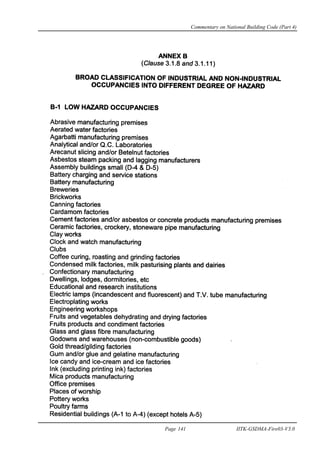
requires a safe path of escape from the fire or other
hazardous environment. A good means of egress
design, especially for Assembly occupancies or
assembly areas, is a challenging task even for well
qualified and experienced architects, which call for
a high level of understanding of human factors,
especially reaction of people in life-sustaining
emergencies, movement of a crowd of people on
level surfaces, on stairs, ramps, narrow aisles etc.,
exit width approaches, flow rate densities, apart
from all the active fire protection measures required
for ensuring prompt alerting as well as safe
evacuation of the occupant crowd.
CODE COMMENTARY
Page 20 IITK-GSDMA-Fire03 - V3.0
Commentary on National Building Code (Part 4)
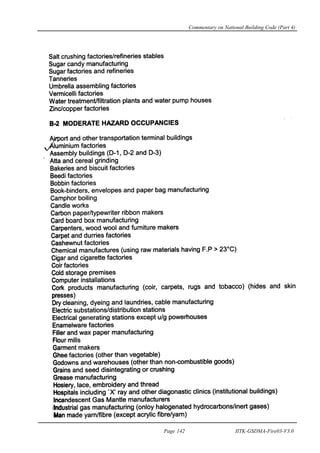
Subdivision D-1: Buildings having a theatrical or
motion picture or any other stage and fixed seats
for over 1000 persons.
Subdivision D-2: Buildings having theatrical or
motion picture or any other stage and fixed seats
up-to 1000 persons.
Subdivision D-3: Buildings without a permanent
stage having accommodation for 300 or more
persons but no permanent seating arrangement.
Subdivision D-4: Buildings without a permanent
stage having accommodation for less than 300
persons with no permanent seating arrangement.
Subdivision D5: All other structures including
temporary structures designed for assembly of
people not covered by sub divisions D1 to D4, at
ground level.
Subdivision D-6: Buildings having mixed
occupancies providing facilities such as
shopping, cinema theatres, and restaurants.
Subdivision D-7 All other structures, elevated or
underground, for assembly of people not covered
by subdivisions D-1 to D-6.
(a) Subdivision D-1:
This subdivision shall include any building
primarily meant for theatrical or operatic
performances and exhibitions and which has
raised stage, proscenium curtain, fixed or
portable scenery or scenery loft, lights, motion
picture houses, mechanical appliances or other
theatrical accessories and equipment, and which
is provided with fixed seats for over 1000
persons.
(b) Subdivision D-2:
This subdivision shall include any building
primarily meant for use as described for
subdivision D-1, but with fixed seats up to
1000 persons.
(c) Subdivision D-3:
This subdivision shall include any building, its
lobbies, rooms and other spaces connected
thereto, primarily intended for assembly of
people, but which has no theatrical stage or
permanent theatrical and / or cinematographic
accessories and has accommodation for 300
persons or more; for eg., dance halls, night clubs,
halls for incidental picture shows, dramatic,
theatrical or educational presentation, lectures
or other similar purposes having no theatrical
stage except a raised platform and used without
permanent seating arrangement, art galleries
exhibition halls, community halls, passenger
terminals and heritage and archeological
monuments.
F3.1.5.
Sub Division D-1: This sub-division includes
comparatively large size buildings or part buildings
catering for assembly of over 1000 persons,
where fixed seats are provided.
Note: (for information only): It will be of interest to know
that according to Uniform Fire Code (NFPA-1-2003), in
Assembly occupancies having occupant loads exeeding
1000, trained crowd managers/supervisors are required to
be provided, except for Assembly occupancies for religious
worships, for crowds not exeeding 2000. Also, in the same
Uniform Fire Code, seats in the Assembly occupancies
accommodating more than 200 persons are required to be
securely fastened to the floor except where such fastening
is impracticable as in the case of restaurants, night clubs,
dance halls etc.
Sub Division D-3
It is heartening to note that Heritage and
Archaeological monuments have been included under
this Sub Division in this edition. However, considering their
national/international importance, irreplaceable high
value of their structures and contents, and the obligatory
need for their preservation, it is felt these historical
monuments should have been considered as a separate
occupancy class, as is the generally accepted
international practice. These special buildings and
structures, because of their normally isolated location,
age, peculiar type of construction and highly combustible
materials, contents and decorative materials, present
unique fire protection challenges. They, therefore,
demand a thoroughly imaginative and innovative
performances-based approach for design and installation
of fire protection and life safety systems, if they are to
be saved from the ravages of fire as had been the
experience the world over.
It is imperative that the authorities concerned are
fully aware of the above requirements, and take
appropriate actions for their preservation well in time.
Sub Division D-4:
Apart from the difference in the number of seats in
groups D-3 and D-4, sub division D-4 is less
hazardous than D-3.
Sub Division D-5:
(a) These are outdoor occupancies or temporary
structures like circus tents, where a large number of
people gather for a short duration. The life hazards
in such occupancies are high.
Since subdivision D-5 includes “any building or
structure, permanent or temporary meant for
Assembly of people”, the scope of their application
is quite wide, and warrants strict and close scrutiny
by Code implementation authorities.
(b) From past and continuing experience, it is an
established and alarming fact that Assembly
CODE COMMENTARY
Page 21 IITK-GSDMA-Fire03 - V3.0
Commentary on National Building Code (Part 4)
(d) Subdivision D-4:
This subdivision shall include any building
primarily intended for use as described in
subdivision D-3, but with accommodation for less
than 300 persons with no permanent seating
arrangements.
(e) Subdivision D-5:
This subdivision shall include any building or
structure, permanent or temporary, meant for
assembly of people not covered by subdivisions
D-1 to D-4; for eg.,grandstands, stadia,
amusement park structures, reviewing stands
and circus tents.
(f) Subdivision D-6:
This subdivision shall include any building for
assembly of people provided with multiple
services/facilities like shopping, cinema theatres
and restaurants, for eg., multiplexes
(g) Subdivision D-7:
The subdivision shall include any building or
structure permanent or temporary meant for
assembly of people not covered by D-1 to D-6,
for eg., underground or elevated railways.
3.1.6.Group E Business Buildings:
These shall include any building or part of a
building which is used for transaction of business
(other than that covered by group F and part of
buildings covered by 3.1.1.1) for keeping
of accounts and records and similar purpose,
professional establishments, service facilities,
etc. city halls, town halls, court houses and
libraries shall be classified in this group so far
as the principal function of these is transaction
of public business and keeping of books and
records.
Business buildings shall be further sub-classified
as follows:
Subdivision E-1: Offices, banks, professional
establishments like offices of architects,
engineers, doctors, lawyers and police stations;
Subdivision E-2: Laboratories, research
establishments, libraries and test houses;
Subdivision E-3: Computer installationa;
Subdivision E-4: Telephone exchanges;
Subdivision E-5: Broadcasting stations and T.V
stations
3.1.7.Group F Mercantile Buildings:
These shall include any building or part of a
building, which is used as shops, stores, market,
for display and sale of merchandise, either
wholesale or retail,
occupancies of temporary types, whcih are erected
in large numbers and constructed of varied
combustible materials in rural and urban areas in
our country at all times of the year, for social, religious,
political, recreational, commercial etc. congregations
of people, have the worst record of loss of lives due
to major fires. It has also been established that these
heavy death tolls have been due to flagrant violations
of the fire and life safety norms for such structures
and pandals. This is an area which calls for more
strict control and supervision on the part of Code
enforcement authorities.
Sub Division D-6: This is a new subdivision which includes
Mixed Occupancies known generally as ‘Multiplexes’
which abound in several fire and life hazards. More
details on Multiplexes can be seen under F. 3.1.11
and F.3.4.7.
Sub Division D-7: This is also a new addition in this Code
which includes underground or elevated rail
systems which have their own distinct fire and life
hazards
CODE COMMENTARY
Page 22 IITK-GSDMA-Fire03 - V3.0
Commentary on National Building Code (Part 4)
Mercantile buildings shall be further sub
classified as follows:
Subdivision F-1:
Shops, stores, departmental stores, markets,
with area up to 500 m2
;
Subdivision F-2:
Shops, stores, departmental stores, markets,
with area more than 500 m2
.
Subdivision F-3:
Underground shopping centres. Storage and
service facilities incidental to the sale of
merchandise and located in the same building
shall be included under this group.
3.1.8. Group G Industrial Buildings:
These shall include any building or part of a
building or structure, in which products or
materials of all kinds and properties are
fabricated, assembled, manufactured or
processed; for example, assembly plants,
industrial laboratories, dry cleaning plants, power
plants, generating units, pumping stations,
fumigation chambers, laundries, buildings or
structures in gas plant, refineries, dairies and
saw-mills etc.
Building under Group G shall be further
subdivided as follows:
Subdivision G-1:
Buildings used for low hazard industries.
Subdivision G-2:
Buildings used for moderate hazard industries.
Subdivision G-3:
Building used for high hazard industries.
The hazard of occupancy, for the purpose of the
code shall be the relative danger of the start and
spread of fire, the danger of smoke or gases
generated, the danger of explosion or other
occurrences potenitally endangering the lives
and safety of the occupants of buildings.
Hazard of occupancy shall be determined by the
authority on the basis of the fire loads of the
contents, and the processes or operations
conducted in the building, provided, however,
that where the combustibility of the building, the
flame spread rating of the interior finish or other
features of the building or structure are such as
to involve a hazard greater than the occupancy
hazard, the greater degree of hazard shall
govern the classification.
For determination of fire loads and fire load
density for arriving at the classification of
occupancy hazard, guidance regarding the
calorific values of some common materials, is
given at Annex-A.
F3.1.6. Group E: Business Buildings:
lnclusion of Broadcasting and TV stations,
Telephone Exchanges, Test Houses, City
Halls,Town Halls, Laboratories and Research
Establishments, Courts and Libraries in this Group,
needs to be specially noted.
F3.1.7
(a) Hazards of shopping centres increase with their
size,as evacuation of occupants and fire fighting
become more difficult in large departmental stores.
Underground shopping centres are considerd still
more hazardous, because of difficulties in smoke
extraction and fire fighting efforts. Also, evacuation
becomes difficult as there is hardly any access for
natural sun light in basements, and electricity is
normally turned off in case of a fire.
(b) In some of the international standards, apart from
area of the building, number of storeys is also taken
as a factor for reckoning sub divisions.
F3.1.8 Group G Industrial Buildings:
Eg. Buildings housing G-1 industries may need to
comply with Group G-2 requirements if combustible
interior finish materials are used, thereby increasing
fire load of the building.
In case of mixed occupancies, housing G-1, G-2 &
G-3 industries together, in the absence of partition
walls and double fire doors between occupancies, it
will be necessary to design the entire building on the
basis of G-3 requirements.
(a) Sub Division G-1:
This covers Low Hazard industries like Engineering
Workshops, Ceramic factories etc.
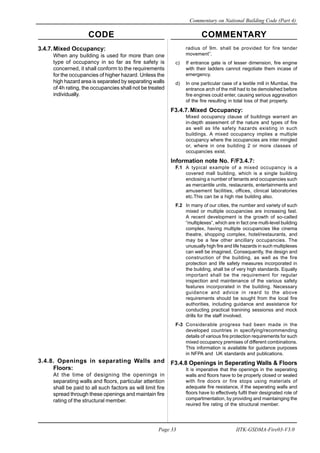
Fig. 3 Layout of a typical Engineering Workshop, showing
compartmentation/segregation of a hazardous area like paint
shop.
(b) Sub Division G-2:
This covers Moderate Hazard industries like
Aluminium factories, Cold Storages, Electric
Generating Stations etc.
CODE COMMENTARY
Page 23 IITK-GSDMA-Fire03 - V3.0
Commentary on National Building Code (Part 4)
(c) Sub Division G-3:
This covers High Hazard industries like Cotton
Waste factories, Explosive factories, Fire Works
manufacture, Petroleum Refineries, Oil Installations
etc.
(d) The Bureau of Indian Standards, under its Fire Safety
Sectional Committee, CED-36, had formulated
several Indian Standards on Codes of practices on
Fire Safety of various industries prescribing detailed
guidelines on fire safety and fire protection
requirements for such industries.(given in Annex-F)
F3.1.8. Fire load:
Fire load is the measure of the maximum heat that
would be released if all combustibles in a given fire
area, burn. The calorific value is the heat of
combustion of a material or substance. In a typical
building, the fire load includes combustible contents,
interior finish and structural elements. Fire load in a
building has a significant influence in the severity,
rate of fire spread and duration of fire subject to
prevailing ventilation conditions.
F3.1.9. Group H Strorage Buildings:
(a) The fire load in this occupancy class will vary
according to the type of material(s) stored. In these
types of occupancies, generally material hazards are
more than life hazards.
(b) It is possible that materials of various fire hazard
characteristics may be stored in the same
building in which case, proper segregation and
compartmentation is required to be ensured.
(c) Inclusion of storage of animals, marine terminals,
aircraft hangars and grain elevators in this group,
should be taken special note of;
(d) These become special risks during non-working
hours, because generally they remain unoccupied
A broad classification of indutrial and non-
industrial occupancies into low, moderate and
high hazard classes is given at Annex B, for
guidance. Any occupancy not covered in
Annex-B, shall be classified in the most
appropriate class depending on the degree of
hazard.
Where different degrees of hazard of occupancy
exist in different parts of building,the most
hazardous of those shall govern the classification
for the purpose of this Code, except in cases
where hazardous areas are segregated or
protected as specified in the Code.
(a) Subdivision G-1: This subdivision shall include
any building in which the contents are of such
comparative low combustibility and the industrial
processes or operations conducted therein are
of such a nature that there are hardly any
possibilities for any self-propagating fire to occur
and the only consequent danger to life and
property may arise from panic, fumes or smoke,
or fire from some external source.
(b) Subdivision G-2: This subdivision shall include any
building in which the contents or industrial
processes or operations conducted therein are
liable to give rise to a fire which will burn with
moderate rapidity or result in other hazardous
situation and may give off a considerable volume
of smoke, but from which neither toxic fumes nor
explosions are to be feared in the event of fire.
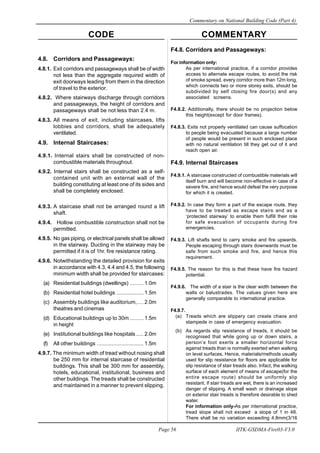
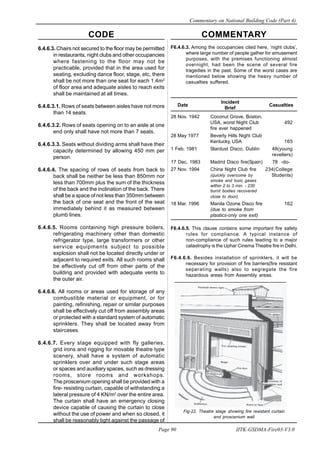
(c) Subdivision G-3: This subdivision shall include
any building in which the contents or industrial
processes or operations conducted therein are
liable to give rise to a fire which will burn with
extreme rapidity or result in other hazardous
situation, or from which poisonous fumes or
explosions are to be feared in the event of fire.
For fire safety in petroleum and fertilizer plant,
good practice [F.3] may be referred.
3.1.9. Group H Storage Buildings:
These shall include any building or part of a
building used primarily for the storage or
sheltering (including servicing, processing or
repairs incidental to storage) of goods, ware or
merchandise (except those that involve highly
combustible or explosive products or materials),
vehicles or animals; for eg., warehouses, cold
storage, freight depots, transit sheds, store
houses, truck and marine terminals, garages,
hangars, grain elevators , barns and stables.
Storage properties are characterised by the
presence of relatively small number of persons in
proportion to the area. Any new use which
increases the number of occupants to a figure
comparable with other classes of occupancy,
CODE COMMENTARY
Page 24 IITK-GSDMA-Fire03 - V3.0
Commentary on National Building Code (Part 4)
during this period;
(e) Therefore, installation of fire alarm systems and
sprinklers in such occupancies can be of great
advantage.
F3.1.10. Group J Hazardous Buildings:
(a) Hazardous Buildings involve highly combustible,
those susceptible to spontaneous combustion and
explosive materials which are dangerous from fire
and life safety considerations;
(b) Toxic, poisonous and corrosive fumes are injurious
to human health and may prove fatal also;
(c) Fire and life safety deals with proteciton of both
human lives and property, and hence the buildings
storing, handling, manufacturing or processing
hazardous materials are placed in this group of
buildings posing the highest hazard;
(d) As per Public Liability Insurance Act, owners of these
industries are required to take out a Compulsory
Liability Insurance Policy with Insurers in India,
whereby surrounding population/community at
large, are compensated if they are affected by a leak,
fire or explosion in these industries.
F3.1.11.In many of our major cities, Multiple occupancies,
or what are commonly known as “Multiplexes” have
come up, which are buildings having independant
occupancies like Shopping Centre, Cinema,
Restaurants etc., simultaneously in one building
complex. These multiple occupancies contain high
fire and life hazard potential, and hence call for
stringent fire prevention and fire protection
measures, which should engage due attention and
care from the local authorities concerned.
F3.1.12
(a) This most important aspect is often overlooked many
a times inadvertently, but with serious
consequences.
(b) If new occupancy is more hazardous than the old
one, the building must be made to comply with
requrements of the new occupancy.
(c) As is the international practice, as well as in our
metro cities like Delhi and Mumbai, mandatory
provisions should be included in all local Building
Bye-laws/Urban Development Control Regulations,
to the effect that the owner or the occupier shall apply
in writing to the local authorities concerned for any
alteration, modification, extension etc, of the building
along with necessary drawings, specifications etc.,
and obtain necessary clearance for the same from
the authorities concerned.
F3.1.14.Similarly, after completion of the work also, a
Completion Certificate should be countersigned by
the designated authorities after inspection.
shall change the classification of the building to
that of the new use; for eg., hangars used for
assembly purposes, warehouses used for office
purposes, garage buildings used for
manufacturing, etc.
3.1.10. Group J Hazardous Buildings:
These shall include any building or part of a
building, which is used for the storage, handling,
manufacture or processing of highly combustible
or explosive materials or products which are liable
to burn with extreme rapidity and (or) which may
produce poisonous fumes or explosions on
storage/handling, manufacturing or processing.
These include highly corrosive, toxic or noxious
alkalis, acids or other liquids or chemicals
producing flames, fumes and explosive,
poisonous, irritant or corrosive gases; and
materials producing explosive mixtures of dust
which result in the division of matter into fine
particles subject to spontaneous ignition.
Examples of buildings in this class are those
buildings which are used for :
(a) Storage under pressure of more than 0.1 N/mm2
and in quantities exceeding 70m3
, of acetylene,
hydrogen, illuminating and natural gases,
ammonia, chlorine, phosgene, sulphur dioxide,
carbon dioxide, methyloxide and all gases subject
to explosion, fume or toxic hazard, cryogenic
gases, etc.
(b) Storage and handling of hazardous and highly
flammable liquids, liquifiable gases like LPG,
rocket propellants, etc.
(c) Storage and handling of hazardous and highly
flammable or explosive materials, other than
liquids; and
(d) Manufacture of artificial flowers, synthetic
leather, ammunition, explosives and fireworks.
NOTE- A list of hazardous substances giving quantities,
for which or exceeding which owners handling
such substances are required to be covered
under the -Public Liability Insurance Act, has
been notified under Govt of India, Ministry of
Environment and Forest Notification No.GSR
347 (E) dated 01 August 1996.
3.1.11. Any building not covered by Annex B
or 3.1.8. shall be classified in the group which
most nearly resembles its existing or proposed
use.
3.1.12. Where change in the occupancy of any building
places it in a different group or in a different
subdivision of the same group, such building
shall be made to comply with the requirements
of the code for the new group or its subdivision.
CODE COMMENTARY
Commentary on National Building Code (Part 4)
25
Page 25 IITK-GSDMA-Fire03-V3.0
3.1.13. Where the new occupancy of a building is less
hazardous, based on life and fire risk, than its
existing occupancy, it shall not be necessary to
conform to the requirements of the Code for the
old group or its subdivisions.
3.1.14. A certificate of occupancy shall be necessary,
as required under Part 2 Administration, before
any change is effected in the character of
occupancy of any building.
3.2. Fire Zones:
3.2.1. Demarcation:
The city or area under jurisdiction of the authority
shall, for the purpose of the Code, be
demarcated into distinct Zones, based on fire
hazards inherent in the buildings and structures
according to occupancy (see 3.1), which shall
be called as ‘Fire Zones’.
3.2.2. Number and Designation of Fire Zones:
3.2.2.1. The number of fire zones in a city or area under
the jurisdiction of the authority depends upon the
existing layout, types of building construction(see
3.3), classification of existing buildings based on
occupancy(see 3.1) and expected future
development of the city or area. In large cities or
areas, three fire Zones may be necessary, while
in smaller ones, one or two may be adequate.
3.2.2.2 The fire zones shall be made use of in land use
development plan and shall be designated as
follows:
(a) Fire Zone No. 1,
(b) Fire Zone No. 2, and
(c) Fire Zone No.3
3.2.2.2.1. Fire Zone No. 1:
This shall comprise areas having residential
(Group A), educational (Group B), institutional
(Group C),assembly (Group D), small business
(Subdivision E-l) and retail mercantile (Group f)
buildings or areas which are under development
for such occupancies.
3.2.2.2.2. Fire Zone No.2:
This shall comprise business (subdivision E-2
to E-5) and industrial buildings (Subdivision
G-1 and G-2), except high hazard industrial
buildings (Subdivision G-3) or areas which are
under development for such occupancies.
3.2.2.2.3. Fire Zone 3.
This shall comprise areas having high hazard
industrial buildings (subdivision G-3), Storage
F3.2 Fire Zones:
F3.2.2.2.1. Fire Zone No.1:
Occupancies listed under Fire Zones 2 & 3 cannot
be allowed in Fire Zone No.1.
F3.2.2.2.2 Fire Zone No.2
Occupancies listed under Fire Zones 1& 3 cannot be
allowed in Fire Zone No.2
F3.2.2.2.3 Fire Zone No.3
Occupancies listed under Fire Zones 1 & 2 cannot
be allowed in Fire Zone No.3
CODE COMMENTARY
Commentary on National Building Code (Part 4)
26
Page 26 IITK-GSDMA-Fire03-V3.0
F3.2.5.1. Temporary Buildings or Structures:
(a) These structures are themselves so hazardous that
they cannot be allowed under Fire Zone No.3, which
is reserved for high hazard industrial & storage
buildings
(b) As mentioned earlier under 3.1.5(e) & (f), from past
and continuing experience, it is an established and
alarming fact that temporary structures and buildings
of various types and sizes are erected in large
numbers in urban and rural areas in our country.
They are constructed from a variety of combustible
and hazardous materials throughout the year for
social, religious, political, recreational, commercial
etc congregations of people, and number of them
get involved in major fires causing heavy loss of
lives. These tragic incidents had happened as a
result of gross violation of the safety norms
prescribed for such temporary structures and
pandals.
F3.2.6.3. Buildings used for hazardous industrial and
storage occupancies need better construction to take
care of their inherent hazards, and hence this
requirement
F3.2.7 Restrictions on existing buildings:
(a) The first part of this sub clause regarding
non-requirement of Code compliance for the existing
buildings, is highlighted in many of our local Building
Codes/Regulations, whereas the latter part of the
clause implying compliance of the Code
(NBC Part IV), even for existing buildings which
are hazardous or unsafe, which is repeated under
sub clause 3.8 of Part II Administration of NBC, is
either diluted, ignored or omitted in many of them.
(b) Besides, the term “existing building” is defined in
many Codes/Regulations as buildings which had
existed prior to the date of enforcement of the Code/
Regulation concerned. As and when these Codes/
Regulations undergo revision, the definition of
existing building remains the same although the
date of enforcement gets shifted to a subsequent
date. The end result had been that the so called
“existing buildings” which enjoy the benefit of
exemptions from several important provisions of the
Code/Regulation including fire and life safety
provisions, continue to do so, thereby not only
making the Code enforcement process difficult but,
more importantly, adding to the number of hazardous
and unsafe buildings in the area, which are
dangerous to human life, health, property and public
welfare.
(c) To avoid the perpetuation of such unsatisfactory and
precarious conditions, it is imperative that the
following correctional steps are implemented by all
concerned authorities:
(i) A suitable date may have to be identified for
notification of the applicability of the Code/
Regulation(cut -off date for applicability), which has
to be adhered to even when the Code/Regulation
concerned gets revised. This is what has been done
buildings(Group H) and buildings for hazardous
uses (Group J) or areas which are under
development for such occupancies.
3.2.3. Change in the Fire Zone Boundaries:
When the boundaries of any Fire Zone are
changed, or when it is intended to include other
areas or types of occupancies in any Fire Zone,
it shall be done by following the same procedure
as for promulgating new rules or ordinances or
both.
3.2.4.Overlapping Fire Zones:
3.2.4.1. When any building is so situated that it extends
to more than one Fire Zone, it shall be deemed
to be in the Fire Zone in which the major portion
of the building or structure is situated.
3.2.4.2. When any building is so situated that it extends
equally to more than one fire zone, it shall be
deemed to be in the fire zone having more
hazardous occupancy buildings.
3.2.5. Temporary Buildings or Structures:
3.2.5.1.Temporary buildings and structures shall be
permitted only in Fire Zones No. 1 and 2 as the
case may be, according to the purpose for which
these are to be used, by special permit from the
Authority for a limited period subject to such
conditions as may be imposed in the permit.
3.2.5.2. Such buildings and temporary structures shall
be completely removed on the expiry of the
period specified in the permit.
3.2.5.3 Adequate fire precautionary measures in the
construction of temporary structures and
PANDALS shall be taken in accordance with
good practice Annexe-F (4).
3.2.6 Restrictions on the Type of Construction
for New Buildings:
3.2.6.1 Buildings erected in Fire Zone No.l shall conform
to construction of Type 1,2,3 or 4.
3.2.6.2 Buildings erected in Fire Zone No.2 shall
conform to construction of Type 1, 2 or 3.
3.2.6.3 Buildings erected in Fire Zone No.3 shall
conform to construction of Type 1, or 2.
3.2.7. Restrictions on Existing Buildings:
The existing buildings in any fire zone shall not
be required to comply with the requirement of
the Code unless these are altered, or in the
opinion of the Authority such building constitutes
a hazard to the safety of the adjacent property
or the occupants of the building itself or is an
unsafe building. In the event of alteration, it shall
be necessary to obtain permission of the
Authority for such alteration consistent with fire
CODE COMMENTARY
Commentary on National Building Code (Part 4)
27
Page 27 IITK-GSDMA-Fire03-V3.0
in the case of Delhi Building Bye-laws, which clearly
stated that all buildings constructed after 2nd March
1987, have to follow the Delhi Building Bye-laws 1983,
and the old buildings are governed by Delhi Fire
Services Act where they have to incorporate12 basic
fire protection requirements.
(ii) The existing buildings and structures should be
inspected for fire and life safety requirements and
the provisions of the Code made applicable to them
where any one of the following conditions exist:
a change of use or occupancy of the building
structure;
renovations/modifications, reconstruction or additions
have been made;
the building/structure has been re-located;
the building is found lacking in basic requirements of
fire and life safety measures;
the building/structure is considered unsafe and a
threat to life, health and welfare of the occupants
and (or) members of the public.
(d) Unsafe Building:
In this connection, it is mentioned that very clear and
stringent instructions as to how the authorities
concered should deal with “unsafe buildings” in their
jurisdiction are contained in Part 2, Administration of
NBC. This clause even includes provisions for giving
Notice to Owner/Occupier, as well as for actions to
be taken by the authority in the event of disregard of
Notice by the Owner/Occupier.
Considering the importance of the contents of this
clause, which will contribute substantially to the
upgradation of fire and life safety standards,
especially in the urban areas in our country, the same
is reproduced below for information and guidance:
Clause 15 of Part 2, NBC -UNSAFE BUILDING
“15.1.All unsafe buildings shall be considered to constitue
danger to public safety and shall be restored by
repairs or demolished or dealt with as otherwise
directed by the Authority.”
“15.2. Examination of unsafe building:
The Authority shall examine or cause to be examined
every building reported to be unsafe or damaged,
and shall make a written record of such examination.”
“15.3. Notice to Owner/Occupier:
Whenever the Authority finds any building or portion
thereof to be unsafe, it shall, in accordance with
established procedure for legal notice give to the
owner and occupier of such building written notices
stating the defects thereof. This notice shall require
the owner or the occupier within a stated time either
to complete specified repairs or improvements or to
demolish and remove the building or portion thereof.”
“15.3.1. The Authority may direct in writing that the building
which in his opinion is dangerous, or has no provision
for exit if caught fire, shall be vacated immediately
or within the period specified for the purpose;
CODE COMMENTARY
Commentary on National Building Code (Part 4)
28
Page 28 IITK-GSDMA-Fire03-V3.0
provided that the Authority concerned shall keep a
record of the reasons for such action with him.
If any person does not comply with the orders of
vacating a building, the Authority may direct the police
to remove the person from the building and the police
shall comply with the orders.
“15.4. Disregard of Notice:
Incase the owner or occupier fails, neglects, or
refuses to comply with the notice to repair or to
demolish the said building or portion theirof, the
Authority shall cause the danger to be removed
whether by demolishing or repair of the building, or
portion thereof or otherwise.”
“15.5. Cases of Emergency:
In case of emergency, which, in the opinion of the
Authority involves imminent danger to human life or
health, the decision of the Authority shall be final.
The Authority shall forthwith or with such notice as
may be possible, promptly cause such building or
portion thereof to be rendered safe or removed. For
this purpose, the Authority may at once enter such
structures or land on which it stands, or abutting land
or structure, with such assistance and such cost as
may be deemed necessary. The Authority may also
get the adjacent structures vacated and protect the
public by an appropriate fence or such other means
as may be necessary.”
“15.6. Costs:
Costs incurred under 15.4 & 15.5 shall be charged
to the owner of the premises involved. Such costs
shall be charged on the premises in respect of which
or for the benefit of which the same have been
incurred and shall be recoverable as provided under
the laws(See Note).
Note: The cost may be in the form of arrears of taxes.”
Information Note No. E/F3.2.7 (For information
only)
E.1 What has been mentioned above, has been the
international practice also.
As per NFPA 5000-2003, Unsafe Buildings are those
which are:
(i) deficient in means of egress;
(ii) has a potential hazard from fire or natural or
man-made threats;
(iii) dangerous to human life or public welfare by reasons
of illegal or improper use, occupancy or maintenance;
(iv) non compliance with the provisions of the applicable
Codes;
(v) Significantly damaged by fire or explosion or other
natural or man-made cause;
(vi) incomplete buildings for which building permits have
expired;
(vii) buildings having deteriorated structural elements or
partially destroyed buildings;
(viii) unsanitary buildings
CODE COMMENTARY
Commentary on National Building Code (Part 4)
29
Page 29 IITK-GSDMA-Fire03-V3.0
F3.3.1 General:
a) IS: 1809-1979 deals with methods of testing
structural members of different material for their fire
safety. For fire resistance ratings required for various
structural and non-structural members to be used
for different classes of construction, please refer to
Tables 2-18 (given at the end).
b) The fire resistance (also described as “fire
endurance”) is the time duration the member or
assembly can withstand the fire test without failure.
The usual fire resistance ratings for structural
assemblies, members, doors etc. are: 1/2 hr., 1hr.,
2hrs., 3hrs. & 4 hrs. A 1hr. rating indicates that the
assembly/member can withstand the standard test
for minimum 1hr. without failure by any one of the
failure crieteria listed in the fire test protocol (as given
under 2.18. For eg., A test result showing:
Stability - 120
Integrity - 120 (See Note below)
Insulation - 15
would mean that a specimen failed in respect of
insulation after 15 mins., but complied with the other
2 criteria for atleast 120 mins.
Note: (for information only)
These were the 3 criteria originally adopted from
BS 476 Part 8. However, BS 4422 Part-2, which was
subsequently published, replaced these 3 terms with:
(i) resistance to collapse (for stablility)
(ii) resistance to flame penetration (for integrity)
(iii) resistance to excessive temperature rise on the
unexposed face (for insulation).
(c) Building design and construction concepts and
practices, besides ensuring the safety of buildings
against the effects of fire outbreaks, have also to
cater to the structural stability requirements of
earthquake resistance (especially in earthquake
prone zones) as well as to wind loads. These are
adequately covered in Part VI, NBC, “Structural
Design”, and other relevant Indian Standards.
(d) Apart from the above, special requirements with
regard to design and construction of certain building
components to provide a “barrier free environment”
in public buildings, so as to facilitate more easy
access, movement and use of physically challenged/
disabled persons, are also to be ensured. Detailed
guidelines on these aspects are contained in
Annex-E of Part-III of NBC, “Development Control
Rules and General Building Requirements”. A copy
of Govt. of India Ministry of UD and PA(Delhi Division)
Notification dated 28th August 2002 incorporating
suitable modifications to Delhi Building Byelaws 1983
in this regard, is given at Annex-H for information and
guidance.
hazard (see Part 2 Administration).
Alterations/Modifications/Renovations shall be
accomplished so as to ensure conformity with
all the safety requirements of the new buildings.
Such alterations shall not inanyway bring down
the level of fire and life safety below that which
existed earlier. Any addition or alterations or
construction of cubicles or partitioning for floor
area exceeding 500 m2
for all high rise buildings
shall be with approval of local fire authority.
3.3 Types of Construction:
3.3.1 General:
The design of any building and the type of
materials used in its construction are important
factors in making the building resistant to a
complete bum-out and in preventing the rapid
spread of fire, smoke and fumes, which may
otherwise contribute to the loss of lives and
property.
The fire resistance of a building or its structural
and non-structural elements is expressed in
hours against a specified fire load which is
expressed in kcal/m2
, and against a certain
intensity of fire. The fire-resistance test for
structural elements shall be done in accordance
with good practice [F(5)]. For the purpose of the
code, the types of construction according to fire
resistance shall be classified into four
categories, namely, Type-1 construction,
Type - 2 construction, Type 3 construction and
Type 4 construction. The fire resistance ratings
for various types of construction for structural
and non-structural members shall be as given
in Table 1. (given at the end).
For buildings 15m in height or above non-
combustible materials should be used for
construction and the internal walls of staircase
enclosures should be of brick work or reinforced
concrete or any other material of construction
with minimum of 2h rating. The walls for the
chimney shall be of Type-1 and Type-2
CODE COMMENTARY
Commentary on National Building Code (Part 4)
30
Page 30 IITK-GSDMA-Fire03-V3.0
F3.3.2. Even at the cost of repetition, uses of these Tables
2-18 need special mention as follows:
to assess the stability of building damaged by fire;
before declaring a building damaged by fire which
has undergone repairs, as safe.
F3.3.3 Steel Construction:
(a) Unprotected structural steel loses its strength at high
temperatures. Often, a temperature of 1100o
F(593o
C)
is taken as the critical temperature of the structural
steel at which temperature it loses about two thirds
of its strength. Unprotected light weight sections, such
as those found in trusses and open-web joints, can
collaplse even after 5 to 10 mins. exposure in major
fires.
(b) Encasement of structural steel member has been a
very common and satisfactory method of insulating
steel to increase its fire resistance. Encasement of
structural steel members can be done utilising
concrete, lath and plaster, gypsum board or sprayed
mineral fibres. Another method is by installing
“membrane barriers” or sheet steel membrane
seals”.
Fig. 04. Steel work affected by fire.
F3.4. General Requirements of all individual
Occupancies:
F3.4.1. General:
Three main hazards, those of fire, smoke or fumes
and panic from which human life and property are to
be saved, need to be particularly noted. The whole
of Part 4 NBC aims to tackle these problems in case
of a fire emergency.
F3.4.2 Exceptions and Deviations:
a) Exceptions and deviations to the general provisions
of fire and life safety requirements for individual
occupancies are given in the following classes of
occupancies:
6.2- Educational Buildings
6.3-Institutional Buildings
6.4-Assmbly Buildings
6.5- Business Buildings
6.6-Mercantile Buildings
6.7-Industrial Buildings
construction depending on whether the gas
temperature is above 200o
C or less.
3.3.2. It is required that an element / component shall
have the requisite fire resistance rating when
tested in accordance with the accepted standard
[4(1)]. The Tables 2 to 18 provide available data
regarding fire resistance ratings of various building
components such as walls, columns, beams and
floors. Fire damage assessment, post fire
structural safety assessment of various structural
elements of the building and adequacy of the
structural repairs can be done by the fire
resistance ratings mentioned in the Tables.
3.3.3. Steel Construction:
Load bearing steel beams and columns of
buildings having total covered area of 500m2
and
above shall be protected against failure/ collapse
of structure in case of fire. This could be
achieved by use of appropriate methodology
using suitable fire resistance rated materials
along with suppression system (C-Table 14,
Table 15 and also accepted standards [F(5)].
3.4. General Requirements of All individual
Occupancies:
3.4.1.General:
All buildings shall satisfy certain requirements
which contribute, individually and collectively,
to the safety of life from fire, smoke, fumes and
panic arising from these or similar causes. There
are, however, certain general principles and
common requirements which are applicable to
all or most of the occupancies.
3.4.2 Exceptions and deviations:
Exceptions and deviations to the general
provisions of requirements of individual
occupancies are given as applicable to each type
of occupancy in 6.1 to 6.9 In case of practical
difficulty or to avoid unnecessary hardship,
without sacrificing reasonable safety, the
authority may grant exemptions from the Code.
CODE COMMENTARY
Commentary on National Building Code (Part 4)
31
Page 31 IITK-GSDMA-Fire03-V3.0
6.8-Storage Buildings
b) In so far as Part 4 of NBC is concerned, these
exceptions and deviations wherever specified, have
been included after due care and thought to take
into account particularly the change(s) in the use or
utilisation on the part of the occupancy, like a
basement.
c) Over and above the exceptions and deviations in all
the 7 classes of occupancies, “Additional
Precautions” as necessary in each of the classes
have been specified. These provide useful
information and guidance for the proper
implementation of the Code provisions.
d) However the second part of this sub clause
empowering the Authority for granting ‘exemptions’
from the Code provisions has more often been
misused in so far as the implementation of the local
Codes and Regulations are concerned. This has
invariably been due to the pressure and influence
exerted by vested interests over the Authorities
concerned.
(e) There had been some judicial interventions also to
nullify certain unjustified and irrational exemptions
granted by State Govts/ Local Authorities. For
instance, in August 2000, the Supreme Court had
quashed some 62 Govt. Orders issued by Tamil Nadu
Govt. between 1/7/1971 and 29/1/1998 under
Section 113 under the Tamil Nadu Town & Country
Planning Act 1971, granting exemptions to a large
number of buildings from the 1971 Act provisions,
including illegal constructions.
F3.4.3. Occupation of Buildings Under
Construction:
(a) Detailed Instructions on “Safety Against Fire and Fire
Protection for Buildings under Construction” are given
in Part-7 “Constructional Practices and Safety” under
NBC, which is also currently under revision. Besides,
useful guidance material is also available in IS:13416
Part 5 1994 “Recommentations and Preventive
Measures against Hazards in Work places Part-5
Fire Protection”
(b) This is a very important requirement to be followed
in case of buildings under construction.
Classification of buildings under construction or
repairs gets temporarly downgraded because of
opening up of walls, roofs etc.
F3.4.4 Maximum Height:
Maximum height restrictions of buildings are primarily
governed by the class of occupancy. They are given
under notes of Table-23.(given at the end) The same
information is repeated below:
Buildings above 15m. : Not permitted for
occupancies A1, A2, G3, Groups H & J
Buildings above 30 m: Not permitted for Groups B,
C, D & F
Buildings above 18 m: Not permitted for G-1 &
G-2 Occupancies.
Buildings above 60 m: Not permitted for A3 & A4
Occupancies.
3.4.3.Occupation of Buildings under
Construction:
3.4.3.1.Abuilding or portion of building may be occupied
during construction, repairs, alterations or
additions, only if all means of exit and fire
protection measures are in place and
continuously maintained for the occupied part
of the building.
3.4.3.2. A high rise building during construction shall
be provided with the following fire protection
measures, which shall be maintained in good
working condition at all the times:
a) Dry riser of minimum 100mm diameter pipe with
hydrant outlets on the floors constructed with a
fire service inlet to boost the water in the dry
riser and maintenance should be as per the
requirements laid down in good practice [F(6)].
b) Drums filled with water of 2000 liters capacity
with two fire buckets on each floor;
c) A water storage tank of minimum 20000 liters
capacity, which may be used for other
construction purposes also.
3.4.4. Maximum Height:
Every building shall be restricted in its height
above the ground level and the number of storeys,
depending upon its occupancy and the type of
construction.The height shall be measured as
specified in Part 3 Development Control Rules
and General Building Requirements. The
maximum permissible height for any combination
of occupancy and types of construction should
be necessarily be related to the width of street
fronting the building, or floor area ratios and the
local fire fighting facilities available. For fire
protection requirements of high rise buildings.
Annex ‘C’ may be referred.
CODE COMMENTARY
Commentary on National Building Code (Part 4)
32
Page 32 IITK-GSDMA-Fire03-V3.0
No height restrictions for buildings in A5, A6 &
Group E
F3.4.6 Open Spaces
In Part-3 NBC clause 5 deals with community open
spaces and aminities, clause 6 with requirements of
plots, and clause 8 with open spaces within a plot.
Some of the salient data specified in these clauses
are appended below for information and guidance:
“Clause 5 Part 3 NBC-Community Open Spaces
and Amenities.
“In Residential and Commerical Zones, the following
minimum provisions shall be made for community
open spaces(for recreational purposes):
(a) 15% of the area of the lay-out; or
(b) 0.3 to 0.4 ha/1000 persons; for low income housing
the open spaces shall be 0.3ha/1000 persons.
In Industrial Zone: In all industrial plots measuring
1000m2
or more in area, 10% of the total area shall
be provided”.
“5.5 Other amenities:
For all types of educational institutions, minimum
areas for the institutional buildings, residential
accommodation, playfield area, area for the institution
etc., have been spelt out based on student strength;
For LPG godowns, one gas godown for 40000 to
50000 population has been prescribed;
Similarly, the scales for Petrol Pumps have been
given;
One Fire Staion or Sub Fire Station within 1km to
3kms. for every 200,000 population has been
prescribed with the following requirements;
Area for Fire Station with essential residential
accommodation-1.00 ha;
Area for Sub Fire Station with essential residential
accommodation - 0.60 ha”.
F3.4.6.1.
(a) The details of means of access for building/plot are
given under clause-4 of Part-3 NBC.
(b) Apart from the requirements given under (a), (b), (c)
& (d) here, the additional requirements given under
clause 4.6 of Part-3 are:
“The approach to the building and open spaces on
all its sides upto 6m width and the layout of the same
shall be done in consultation with the Chief Fire
Officer of the city, and the same shall be of hard
surface capable of taking the mass of fire engine
weighing upto 45 tonnes. The said open space shall
be kept free of obstructions and shall be motorable”.
“The main entrance to the plot shall be of adequate
width to allow easy access to the fire engine and in
no case shall it measure less than 6 m.......
If the main entrance at the boundary wall is built over,
the minimum clearance shall be 4.5m. A turning
3.4.5. Floor Area Ratio:
The comparative floor area ratios for different
occupancies and types of construction are
given in Table-19 (see also part 3 Development
Control Rules and General Building
Requirements).
3.4.5.1. Each portion of a building, which is separated
by one or more continuous fire resisting walls,
having a fire resistance of not less than 2 h.,
extending from the foundation to 1 m above the
roof at all points, may be considered to be a
separate building for the calculation of maximum
permissible height and the floor area, provided
openings, if any, in the separating wall are also
protected by fire assemblies of not less than
2 h.
3.4.6. Open Spaces:
The open spaces around or inside a building shall
conform to the requirements of Part-3
Development Control Rules and General
Building Requirements.
3.4.6.1. For high rise buildings, the following additional
provisions of means of access to the building
shall be ensured (see Part 3 Development
Control Rules and General Building
Requirements):
(a) The width of the main street on which the
building abuts shall not be less than 12m and
one end of this street shall join another street
not less than 12m in width;
(b) The road shall not terminate in a dead end;
except in the case of residential building, up to
a height of 30m.
(c) The compulsory open spaces around the
building shall not be used for parking; and
(d) Adequate passageway and clearances required
for fire fighting vehicles to enter the premises shall
be provided at the main entrance; the width of
such entrance shall be not less than 4.5 m. If an
arch or covered gate is constructed, it shall have
a clear head-room of not less than 5m.
CODE COMMENTARY
Commentary on National Building Code (Part 4)
33
Page 33 IITK-GSDMA-Fire03-V3.0
3.4.7.Mixed Occupancy:
When any building is used for more than one
type of occupancy in so far as fire safety is
concerned, it shall conform to the requirements
for the occupancies of higher hazard. Unless the
high hazard area is separated by separating walls
of 4h rating, the occupancies shall not be treated
individually.
radius of 9m. shall be provided for fire tender
movement”.
c) If entrance gate is of lesser dimension, fire engine
with their ladders cannot negotiate them incase of
emergency.
d) In one particular case of a textile mill in Mumbai, the
entrance arch of the mill had to be demolsihed before
fire engines could enter, causing serious aggravation
of the fire resulting in total loss of that property.
F3.4.7.Mixed Occupancy:
Mixed occupancy clause of buildings warrant an
in-depth assesment of the nature and types of fire
as well as life safety hazards existing in such
buildings. A mixed occupancy implies a multiple
occupancy where the occupancies are inter mingled
or, where in one building 2 or more classes of
occupancies exist.
Information note No. F/F3.4.7:
F.1 A typical example of a mixed occupancy is a
covered mall building, which is a single building
enclosing a number of tenants and occupancies such
as mercantile units, restaurants, entertainments and
amusement facilities, offices, clinical laboratories
etc.This can be a high rise building also.
F.2 In many of our cities, the number and variety of such
mixed or multiple occupancies are increasing fast.
A recent development is the growth of so-called
“multiplexes”, which are in fact one multi-level building
complex, having multiple occupancies like cinema
theatre, shopping complex, hotel/restaurants, and
may be a few other ancillary occupancies. The
unusually high fire and life hazards in such multiplexes
can well be imagined. Consequently, the design and
construction of the building, as well as the fire
protection and life safety measures incorporated in
the building, shall be of very high standards. Equally
important shall be the requirement for regular
inspection and maintenance of the various safety
features incorporated in the building. Necessary
guidance and advice in reard to the above
requirements should be sought from the local fire
authorities, including guidance and assistance for
conducting practical tranining sessionss and mock
drills for the staff involved.
F-3 Considerable progress had been made in the
developed countries in specifying/recommending
details of various fire protection requirements for such
mixed occupancy premises of different combinations.
This information is available for guidance purposes
in NFPA and UK standards and publications.
F3.4.8 Openings in Seperating Walls & Floors
It is imperative that the openings in the seperating
walls and floors have to be properly closed or sealed
with fire doors or fire stops using materials of
adequate fire resistance, if the seperating walls and
floors have to effectively fulfil their designated role of
compartmentation, by providing and maintainging the
reuired fire rating of the structural member.
3.4.8. Openings in separating Walls and
Floors:
At the time of designing the openings in
separating walls and floors, particular attention
shall be paid to all such factors as will limit fire
spread through these openings and maintain fire
rating of the structural member.
CODE COMMENTARY
Commentary on National Building Code (Part 4)
34
Page 34 IITK-GSDMA-Fire03-V3.0
Fig. 05. Use of Fire Stops (i) and Fire Doors (ii)
or closing openings in seperating walls.
F3.4.8.1. In case the opening size exceeds 5.6m2
, fire
resisting doors designed to protect them need to be
adequately strengthend. Normally doors with larger
panel areas, tend to buckle in fire conditions.
F3.4.8.4. Vertical opening:
a) In a building fire vertical openings like stairs and lift
shafts acts as flues or chimneys conveying flames
hot gases and smoke vertically and serve as channels
for easy spread to the upper levels. Hence, the need
for enclosure or protection of such vertical shafts to
prevenet fire spread to other areas and floors served
by them.
3.4.8.1. For types 1 to 3 construction, a doorway or
opening in a separating wall on any floor shall be
limited to 5.6 m2
in area with a maximum height/
width of 2.75 m . Every wall opening shall be
protected with fire-resisting doors having the fire
rating of not less than 2h in accordance with
accepted standard [F(7)]. All openings in the
floors shall be protected by vertical enclosures
extending above and below such openings, the
walls of such enclosures and all openings therein
being protected with a fire-resisting assembly as
specified in 3,4.9.
3.4.8.2. For Type 4 construction, openings in the
separating walls or floors shall be fitted with
2 hr fire-resisting assemblies.
3.4.8.3. Openings in walls or floors which are necessary
to be provided to allow passages of all building
services like cables, electrical wirings, telephone
cables, plumbing pipes etc. shall be protected
by enclosure in the form of ducts/ shafts having
a fire resistance of not less than 2 hr. The
inspection door for electrical shaft/ducts shall be
not less than 2hrs. and for other services shafts/
ducts, the same shall have fire resistance not
less than 1hr. Medium and low voltage wiring
running in shafts/ducts, shall either be armoured
type or run through metal conduits. Further, the
space between the conduits pipes and the walls/
slabs shall be filled in by a filler material having
fire resistance rating of not less than one hour.
Note:- In case of buildings where it is necessary to lower
or lift heavy machinery or goods from one floor to
the other, it may be necessary to provide larger
openings in the floor. Such openings shall be
provided with removable covers which shall have
the same strength and fire resistance as the floor.
3.4.8.4. Vertical Opening:
Every vertical opening between the floors of a
building shall be suitably enclosed or protected,
as necessary, to provide the following:
a) Reasonable safety to the occupants while using
the means of egress by preventing spread of fire,
smoke, or fumes through vertical openings from
floor to floor to allow occupants to complete their
use of the means of egress. Further, it shall be
ensured to provide a clear height of 2100mm in
the passage/ escape path of the occupants.
(b) Limitation of damage to the building and
its contents.
CODE COMMENTARY
Commentary on National Building Code (Part 4)
35
Page 35 IITK-GSDMA-Fire03-V3.0
Fig. 06. Protected Shafts (i) Staircase Shaft (ii) Lift Shaft
(iii & iv) Shaft for vent ducts
b) Door openings at every floor level leading to
staircases or lifts/lift lobbies should be protected by
single fire doors for safe evacuation of occupants in
case of fire emergency.
F3.4.9. Fire stop or enclosure of openings:
Total areas of windows and door openings in external
walls of a building should not exceed 75% of wall
area for stability of structure and for reducing
exposure hazards to adjoining property.
F3.4.10 Electrical Installations:
Since faulty or non-standard electrical installations
account for over 25% of fire outbreak in buildings, it
is highly essential that provisions contained in IS 1646
of 1997, “Code of Practice for Fire Safety of Buildings
(General): Electrical Installations” and the other
references quoted are scrupulously complied with. It
is also equally important that these installations are
periodically inspected and maintained, to ensure
perfect serviceability at all times.
F3.4.11.1. Any system of mechanical ventelation should
be designed to ensure that in a fire the air movement
in the building is directed away from the protected
escape routes and exits, or that the system is closed
down as necessary.
F3.4.11.4. Centralised air-conditioning system can
engulf the entire building, i.e., all its floors, as fire
can easily spread via airconditioning ducts and
airconditioning plants via supply and return air ducts.
It is, therefore recommented that seperate
airconditioning plants be provided for each of the
floors.
3.4.9. Fire Stop or Enclosure Of Openings:
Where openings are permitted, they shall not
exceed three-fourth the area of the wall in case
of an external wall, and they shall be protected
with fire resisting assemblies or enclosure,
having a fire resistance equal to that of the wall
or floor in which these are situated. Such
assemblies and enclosures shall also be
capable of preventing the spread of smoke or
fumes through the openings so as to facilitate
the safe evacuation of building in case of a fire
{see also accepted standard [F(8)].
3.4.10. Electrical installations:
For requirements regarding electrical
installations from the point of view of fire safety,
reference may be made to good practice [F(9)]
(see also NBC Part-8 Building Services, Section
2 Electrical and allied installations).
3.4.11. Air-conditioning and Ventilation:
Air- conditioning and Ventilation requirements
of different rooms or areas in any occupancy
shall be as given in Part-8 Building Services,
Section 1 Lighting and Ventilation, and
Section 3 Air-conditioning, Heating and
Mechanical Ventilation.
3.4.11.1. Air-conditioning and Ventilation System shall
be so installed and maintained as to minimise
the danger of spread of fire, smoke or fumes
from one floor to other from outside to any
occupied building or structure (See C.1.17).
3.4.11.2. Air-conditioning and ventilating systems
circulating air to more than one floor or fire area
shall be provided with dampers designed to close
automatically in case of fire, and thereby
preventing spread of fire or smoke and shall be
in accordance with the accepted standards
[F(10)]. Such a system shall also be provided
with automatic controls to stop fans in case of
fire, unless arranged to remove smoke from a
fire, in which case these shall be designed to
remain in operation.
3.4.11.3. Air-conditioning system serving large places
of assembly (over 1000 persons), large
departmental stores or hotels with over 100 rooms
in a single block shall be provided with effective
means for preventing circulation of smoke through
the system in case of a fire in air filters or from
other sources drawn into the systems, and shall
have smoke sensitive devices for actuation in
accordance with the accepted standards [F(12)].
3.4.11.4. From the fire safety point of view, it shall be
necessary to provide separate air handling units
for the various floors so as to avoid the hazards
CODE COMMENTARY
Commentary on National Building Code (Part 4)
36
Page 36 IITK-GSDMA-Fire03-V3.0
arising from spread of fire and smoke through
the air-conditioning ducts. The requirements of
air-conditioning ducts shall be in accordance
with good practice.[F (11)]
3.4.11.5. For normal operation, air changes schedule
shall be as given in Part-8 Building Services,
section 3 Air-conditioning, heating and
mechanical ventilation.
3.4.12. Smoke Venting:
3.4.12.1 Smoke venting facilities for safe use of exits
in windowless buildings, underground
structures, large area factories, hotels and
assembly buildings (including cinema halls) shall
be automatic in action, with manual controls in
addition.
3.4.12.2. Natural draft smoke venting shall utilise roof
vents or vents in walls at or near the ceiling
level; such vents shall be normally open, or, if
closed, shall be designed for automatic opening
in case of fire, by release of smoke sensitive
devices.
3.4.12.3. Where smoke venting facilities are Installed
for purposes of exit safety, these shall be
adequate to prevent dangerous accumulation
of smoke during the period of time necessary
to evacuate the areas served, using available
exit facilities with a margin of safety to allow for
unforeseen contingencies. It is recommended
that smoke exhaust equipment should have a
minimum capacity of 12 air changes per hour.
Where mechanical venting is employed, it shall
be fire safe.
3.4.12.4. The discharge apertures of all natural draft
smoke vents shall be so arranged as to be
readily accessible for opening by Fire Service
personnel.
3.4.12.5. Power operated smoke exhausting systems
shall be substituted for natural draft vents only
F3.4.12. Smoke Venting:
(a) In a fire, smoke, heat and toxic gases build up over
time to create untenable conditions for human
survival. This critical time can be as short as two or
three mins.
(b) It has been the expereince that the primary hazards
to humans in a building fire have been from smoke
and toxic gases.
Nearly three fourths of all building related fire deaths
are from inhalation of the smoke and toxic gases
produced in fires rather than from exposure to flame
or heat.
(c) Smoke venting, therefore, plays an important role in
achieving fire and life safety objectives in buildings
by facilitating fire fighting, by preventing fire spread,
to reduce life and material hazards from smoke and
heat, and also to improve conditions for fire fighting.
(d) Fire or smoke vents fitted on roofs of buildings help
to vent the products of combustion when there is a
fire. They are generally automatic in operation and
fitted to single storey buildings like industrial,
commercial, storage or assembly premises.
(Figures of a typical roof venting system, along with
components are given below):
Fig. 07. Smoke movement in buildings.
Fig. 08. Effect of venting on flames beneath a ceiling.
CODE COMMENTARY
Commentary on National Building Code (Part 4)
37
Page 37 IITK-GSDMA-Fire03-V3.0
Fig. 10. A twin-door roof vent operated by a fusible link.
Fig. 11. Fireman’s over-ride control for testing operation of
fire vent installation, or for manual operation, when desired
The operation of the roof vents can be by:
(i) making the vents out of polythene-based plastic
(thermo-plastic) material, which melts and falls away
at a relatively low temperature of approx. 300o
C in a
fire; or
Fig. 09. Automatic Fire Vents on the roof of a warehouse
CODE COMMENTARY
Commentary on National Building Code (Part 4)
38
Page 38 IITK-GSDMA-Fire03-V3.0
(ii) by using heat or smoke detectors for automatic vent
control. The simplest and most common method of
detection used is the fusible link.
e) In order that the roof venting system is effective, it is
essential that there are facilities for sufficient air inlets
(f) Infact, it is necessary that the area of air inlets shall
be atleast equal to the total area of the roof inlets.
(g) For premises housing goods which cause smoky
fires, a higher ratio will be desirable. In some cases
of ‘smouldering’ fires, it may be necessary to open
the fire vents even before the temperature set for
automatic operation of the vents. This is achieved by
provision of ‘Fireman’s Override Controls’ at suitable
locations.
(h) Automatic fire venting through use of roof vents is
not generally applicable in multi-storey buildings. In
such buildings, specially designed mechanical
ventilation systems (making use of ‘exhaust’
ventilation, ‘plenum’ ventilation and ‘balanced’
ventilation ‘methodologies’) or pressurisation
methods have to be resorted to.
(i) Any system of mechanical ventilation should be
designed to ensure that in a fire, the air movement
in the building is directed away from the protected
escape routes or exits, or the system (or a section of
it) is closed down.
F3.4.12.4. Natural draft vent discharge control equipment
must be made accessible to Fire Brigade personnel
for venting out fire and smoke, so that fire fighting
evacuation becomes easy. Such vents are normally
provided above staircases and lift enclosure roofs
and/or in their external walls.
F3.4.12.5 It is not understood as to why this requirement of
special permission of the authority is included here.
F3.4.13 Heating:
(a) Heating systems, appliances and associated
equipments are among the most common causes of
fires in buildings, as they generally operate at
temperatures above the Ignition Temperature of
many common materials.
(b) For all practical purposes, heating system can
comprise of two types: (i) direct systems or (ii) indirect
systems.
(c) Each type of fuel and heating system components is
associated with its potential fire hazards.
(d) Apart from the heating system, portable heaters,
which are commonly used, also constitute a fire
hazard, especially when they are overturned.
(e) Besides, all portable heaters should be equipped with
an automatic shut-off that activates when the unit is
tilted or turned-over.
by specific permission of the authority.
3.4.13. Heating:
Installation of chimney and heating apparatus
shall be in accordance with good practice
[F(13)7].
CODE COMMENTARY
Commentary on National Building Code (Part 4)
39
Page 39 IITK-GSDMA-Fire03-V3.0
F3.4.14. Additional Precautions:
(a) The special aspects mentioned herein are mostly
those affecting life safety of occupants. These
aspects have been dealt with in more details under
each particular occupancy concerned also.
(b) Services like boilers, substations, DG rooms, A/c
plants, kitchens etc., which provide support to
occupancies in high rise buildings are normally
located in basements.
(c) Similarly, many a time, an occupancy normally used
for residence or shop, when partly used as a godown,
assumes altogether different proportions from fire
safety point of view, and needs to be dealt with
differently as will be seen later on in this Code.
F3.4.15. Surface Interior Finishes:
(a) Building interior finishes, particularly wall and ceiling
linings, play a vital role in the fire growth and
eventually in the fire size. Interior finishes or linings,
also provide a large unbroken surface over which
flame spreads. The flame from the interior finish may
release sufficient thermal energy for the formation
of a hot gas layer which may become thick, attaining
a temperature around 600o
C, and starts descenting
from the top. At this stage, all the combustible
contents as well as the furnishings in the room may
simultaneously get ignited, which is known as
“flash-over” or full fire involvement. This can happen
even in a few minutes.
Fig. 12. Effects of Wall Linings (Interior Finish) on fire-with
‘flash over’ potential
(as explained in 3.4.15.(a) above)
(b) Use of combustible interior finishes (interior linings)
such as low density fibre board ceilings, wood
panneling, textile wall coverings, vinyl wall coverings,
cellular polyurethane and polystyrene materials, and
combustible floor coverings, had resulted in several
heavy death toll fires in the past.
Information Note No. G/F3.4.15. (for
information only)
G.1. Interior finish affects the fire in four ways: (i) It affects
the rate of heat build-up to a ‘flash-over’ condition
(ii) It contributes to flame spread over the surface,
(iii) It adds to the intensity of fire by contributing
additional fuel, and (iv) It produces toxic gases and
smoke that adds to life hazard and property damage.
The fourth factor is the most important since it affects
occupant life safety seriously.
3.4.14 Additional precautions:
In addition to the factors covered by 3.4.2 to
3.4.12 there are certain aspects, applicable to
particular occupancies only, which may affect the
spread of fumes and thus the safe evacuation of
the building in case of fire. Some such aspects
are:
(a) Interior finish and decoration;
(b) seating aisles, railings, turnstiles and revolving
doors in places of assembly;
(c) Service equipment and storage facilities in
buildings other than storage buildings; and
(d) Hazards on stage, in waiting spaces, projection
booths, etc, in theatres and cinemas.
3.4.15. Surface Interior Finishes:
3.4.15.1. The use of combustible surface finishes on
walls (including facade of the building) and
ceilings affects the safety of occupants of a
building. Such finishes tend to spread the fire
even though the structural elements may be
adequately fire resistant, serious danger to life
may result. It is therefore essential to take
adequate precautions to minimise spread of
flame on such walls, facade of building and
ceiling surfaces.
The finishing materials used for various surfaces
and decor shall be such that it shall not generate
toxic smoke/fumes.
3.4.15.2. The susceptibility to fire of various types of
wall surfaces is determined in terms of the rate
of spread of flame. Based on the rate of spread
of flame, surfacing material shall be considered
as divided into four classes as follows (see also
good practice [F(14)].
Class 1 surfaces of very low flame spread
Class 2 Surfaces of low flame spread
Class 3 Surfaces of medium flame spread
Class 4 Surfaces of rapid flame spread
3.4.15.3. The uses for which surface materials falling
into various classes shall be adopted in building
construction are given below:
Smoke & Hot Gases Layer
FLAMES IN SMOKE &
HOT GASES PLUME
SOLID FUEL DECOMPOSING
CODE COMMENTARY
Commentary on National Building Code (Part 4)
40
Page 40 IITK-GSDMA-Fire03-V3.0
G.2. Interior finish has been considered to be the primary
cause for the heavy loss of lives in the following major
fire tragedies in the world:
Date Place Deaths
(i) 28 Nov 1942 Coconut Grove
Night Club, Boston, USA 492
(ii) 1 Nov 1970 St. Laurent Night Club,
France 146
(iii) 25 Dec. 1971 Hotel Fire, Seoul, Korea 165
(iv) 2 Aug 1973 Summerland Leisure
Centre, Isle of Man,
England 50
(v) 1 Feb 1974 Sao Paulo, Brazil 227
(vi) 14 Nov 1977 Flippines Hotel, Manila
Philippines 47
(vii) 28 May 1977 Beverly Hills Night Club
Kentucky, USA 165
(viii) 1 Feb 1981 Stardust Disco, Dublin 48
(ix) 27 Nov. 1994 Night club, China 234
(x) 18 March 1996 Ozone Disco, Manila 162
G.3. In the above listed major fires,besides interior finish,
which was the principal factor, one or more of other
factors like design deficiencies, unenclosed
staircases, delayed response, and lack of training
also contributed to the calamities.
F3.4.15.2. (Rate of Spread of Flame):
(a) What is given here is the Classification ratings for
interior finish/wall and ceiling lining materials based
on the rate of spread of flame as specified in
IS: 12777:1989, ‘Method for Classification of Flame
Spread of Products’. The test prescribed in this IS is
based on the improved test method developed in
U.K. However, in this Standard, only the rate of flame
spread, one of the factors which contribute to fire
growth is determined.
(b) In this connection, the concluding sub-clause 10.1
(k) of IS 12777:1989 is significant, which says, “The
test report shall include the following.....(k) The
statement: “The test results relate only to the
behaviour of the tested specimens of the product
under the particular conditions of the test, and they
are not intended to be the sole criterion for assessing
the potential fire hazard of the product in one”
(e) In fact, the potential fire hazard of the product or the
material(s) used in interior finish, or wall, ceiling and
floor linings envisages all the following factors:
(i) rate of flame spread (rate of burning);
(ii) rate of generation of heat flux (rate of heat release);
(iii) rate of smoke release; (covering smoke optical
density, rate of smoke release and total smoke
release);
(iv) rate of toxic gases release; and
Class-1 Class-2 Class-3
May be May be used in May be used
used in anysituation, only in living
any except on walls, rooms and bed
situation facade of the rooms (but not
building,staircase in rooms on the
and corridors roof) and only
as a lining to
solid walls and
partitions; not
on staircases
or corridors or
facade of the
building.
Note- Panelling (lining) shall be permitted in a limited
area. It shall not be permitted in a vestibule.
CODE COMMENTARY
Commentary on National Building Code (Part 4)
41
Page 41 IITK-GSDMA-Fire03-V3.0
(v) potential room fire growth contribution.
(d) To test or determine the fire hazard potential of any
product or material used in interior finish, it will be
necessary to evaluate or conduct appropriate tests
for all the above mentioned factors pertaining to the
product or material. Then only the assesment
whether the particular product or material can be
safely applied for use in the designated area (escape
route, corridor etc.) can be reckoned as a correct
conclusion.
Information Note No. H/F3.4.15.2(for information
only)
H.1. In so far as the Indian scenario is concerned, at
present, the only test for evaluating the fire potential
of a material used for ‘interior finish’ is the test for
rate of flame spread, as laid down in IS-12777-1989,
which is only one of the five factors enumerated
above. As a matter of fact, it is only rational to expect
that tests for evaluation of the smoke and toxic gases
releases will also be included on priority, since these
are the prime factors which have been instrumental
in causing more loss of lives in a building or a confined
fire.
H.2. It is relevant that a mention about this requirement
has been made under clause 18.2 of IS-1642-1989,
“Fire Safety of Buildings(General): Details of
Conbstruction-Code of Practice”, which reads like
this: “........Any materials used for various surfaces
and decor should be such that the flame spread rating
should not be more than the values given in 18.3 to
18.6, and in addition, should not generate toxic
smoke/fumes”. However, the methods for evaluation
of these parameters (or the tests for assesment) are
yet to be incorporated in our standards.
H.3. U.K. Practice:
Wall and Ceiling Linings (same as interior finish),
including Classification of Linings are covered under
Section-7 and Appendix A of Approved Document
B-2000 edition of U.K. Building Regulations, which
has come into force from 1st July 2000. Under this,
it has been mentioned that..............‘Two properties
of lining materials that influence fire spread are the
rate of flame spread over the surface when it is
subjected to intense radiant heating, and the rate at
which the lining material gives off heat when burning.
The guidance in this Document provides for control
of internal fire spread through control of these
properties. This Document does not give guidance
on other properties such as the generation of
smoke and fumes”.
H.4. The classification normally adopted for the surface
linings for walls and ceilings range from 1, 2 & 3.
However, the highest product performance
classification for lining materials is Class 0, on fullfilling
certain specific requirements, although Class 0 is not
a classification identified in any British Standard test.
H.5. The principal British Standard dealing with various
types of tests on building materials is BS 476: Fire
Tests on Building Materials and Structures. This main
BS has 24 different Parts, each one being an
independant Standard by itself, concerning various
CODE COMMENTARY
Commentary on National Building Code (Part 4)
42
Page 42 IITK-GSDMA-Fire03-V3.0
tests and methods on different fire related properties
on vast range of building materials.
H.6. As mentioned earlier, the classifications for surface
spread of flame of products are-1,2,3 or 4 with Class-
1 being the highest (this is as per Indian Standard
also).
According to the U.K. Document, a ‘thermoplastic’
material means any synthetic polymeric material
which has a softening point below 200o
C if tested to
BS 2782 Part-1.
H.7. USA Practice:
As per NFPA 101, Life Safety Code, ‘interior finishes’
are the exposed interior wall, ceiling and floor
surfaces of a building. Any wall covering of minimum
1/28 inch thick must be treated as an interior finish.
H.8. The first NFPA Code for fire testing of interior wall
finishes was adopted in 1955, which was NFPA 255,
Method of Testing Surface Burning Charecteristics
of Building Materials. The test method adopted in
NFPA 255(same as ASTME-84, and UL-723
standards) is the well-known Steiner Tunnel Test,
which had been the standard test for interior wall
finishes ever since it was first developed by the
Underwriters Laboratories Inc., in the early 1940s.
The smoke density and the flame spread rate are
recorded in this test.
H.9. With the development of ‘carpeted walls’ (because
of their acoustic properties and durability), these
materials were increasingly being used for lining the
walls and ceilings, besides ofcourse, the normal use
as floor coverings. However, a series of major Hotel
fires occurred in the US in the beginnings of eighties,
where the main factors contributing to the fire spread
were the highly combustible plastic decorative trim
and mirrored plastic ceiling panels and highly
combustible carpeting on the walls and ceilings.
H.10. As a sequel to the fresh fire experience, focus was
diverted to the concept of ‘heat release’ rather than
‘flame spread’. This led to the development of NFPA
265, Fire Tests for Evaluating Room Fire Growth-
Contribution of Textile Wall Coverings, which adopted
a full scale Room Corner Test for interior finish textile
material, which was more representative of actual
field installations. But, smoke generation property
was excluded. However, this drawback was also
eliminated in the 1998 edition of NFPA 265 which
incorporated tests for measurement of smoke optical
density, rate of smoke release and also total smoke
release. This was a unique feature which was not
available in many other international standards.
H.11 Subsequently, NFPA286, ‘Fire Tests for Evaluating
Contribution of Wall and Ceiling Interior Finish to
Room Fire Growth’, a more comprehensive Code was
adopted in 2000 to cover a wide range of fire
performance charecteristics of interior finish materials
in an enclosure or room. It can determine the
potential extent to which the interior finish
materials contribute to fire growth in a room,
including the heat and smoke released, the
CODE COMMENTARY
Commentary on National Building Code (Part 4)
43
Page 43 IITK-GSDMA-Fire03-V3.0
combustion products released, and the potential
for fire spread beyond the room.
H.12. The fire performance of textile wall coverings is
addressed specifically in NFPA 265, ‘Standard
Methods of Fire Tests for Evaluating Room Fire
Growth Contribution of Textile Wall Coverings”. Some
interior finish materials such as expanded vinyl wall
coverings are required to be tested in the same
manner as textile wall coverings.
H.13. In USA the change-over from the old Steiner Tunnel
Test to the new Room Corner Test has brought about
revolutionary changes in the upgradation of life and
fire safety standards in so far as interior finishes are
concerned.
H.14. Several IS on Thermal Insulation Materials,
including Rigid Polyurethane (PUR) and
Polyisocyanurate (PIR) foams, rigid phenolic foams
etc., are given in Part-5, Buildings Materials, NBC.
Here again, another IS, viz., IS-13286-1992,
‘Methods of Test for Surface Spread of Flame for
Thermal Insulation Materials’ is also mentioned.
The types of interior finish/internal lining materials
presently in use are numerous, and include such
common materials like gypsum, plaster, wall board,
wood, plywood panels, particle boards, fibrous ceiling
tiles, plastics and a variety of wall coverings.
Collectively, these serve several functions: aesthetic,
acoustic and insulating, and also as protection against
wear and abrasion.
H.15.Thermally thin products, such as wood panelling
6.5 mm(1/4 in)thick or less, will tend to spread flame
more rapidly when the panelling is installed over
studs or strips with air space rather than would be
the case if installed over a solid subtrate.
H.16. Sprayed-on cellular or foam plastics used for
insulation or decorative effects may rapidly spread
flames. The use of such products should be permitted
only if the fire behaviour can be substantiated under
actual fire conditions.
H.17. Specimen thickness can also affect flame spread.
Thinner sections of the same material often will spread
flame more rapidly. For instance, flame spread rate
remains constant for acrylic (polymythyl methacrylate)
with a thickness greater than approx.10mm(3/8 in).
Decreasing thickness increases the rate of flame
spread for acrylic. NFPA 101, Life Safety Code,
specifies use of the NFPA253 Flooring Radiant Panel
Test for floor coverings in exits and corridoors of
certain occupancies.
F3.4.15.4. Materials of the class-4 flame spread are the
worst ones for use in buildings, and hence their use
is to be strictly prohibited unless they are given proper
fire retardant treatment.
F3.4.15.5. This is equally true for false ceilings and false
floors also.
3.4.15.4. Materials of Class 4 which include untreated
wood fibre boards may be used with due fire
retardant treatment as ceiling lining, provided the
ceiling is at least, 2.4 m from the top surface of
the floor below, and the wall surfaces conform to
requirements of class [see Note under 3.4.15.3].
Class 4 materials shall not be used in kitchens,
corridors and staircases. Some materials contain
bitumen and, in addition to risk from spread of
fire, emit dense smoke on burning; such
materials shall be excluded from use under these
conditions, and shall also not be used for
construction of ceiling where the plenum is used
for return air in air-conditioned buildings [see also
5.1.7(m)].
3.4.15.5. When frames, walls, partitions or floors are
lined with combustible materials, the surfaces
on both sides of the materials shall conform to
the appropriate class, because there is
considerable danger from fire starting and rapidly
spreading within the concealed cavity unknown
to the occupants whose escape may be
hampered thereby. For detailed information on
materials and details of construction with their
fire resistance rating, reference may be made to
good practice [F(15)].
CODE COMMENTARY
Commentary on National Building Code (Part 4)
44
Page 44 IITK-GSDMA-Fire03-V3.0
Wall linings and floor coverings of combustible
nature aggravate fires which are already raging, and
hence such wall linings and floor covering materials
must be made to conform to Class-1 flame spred
characteristics.
F3.4.16. Glazing:
These come under the broad classification of ‘glazed
elements’.
Information Note No.I /F3.4.16. (for information
only)
(i) As per U.K. standards, there is no restriction on the
use or amount of glass, where the relevant
performances can be met in terms of integrity and
insulation (except for some restrictions on the use of
glass in fire fighting stairs and lobbies).
(ii) In NFPA 5000-2003, ‘glazing’ is defined as glass or
transparent or translucent plastic sheet used in
windows, doors, sky lights or curtain walls. This
includes even decorative glass, and not necessarly
functional.
(iii) For fire door and fire window assemblies, the total
glazing area shall not exceed 35% of wall. In USA
glass walls are permitted for atriums under automatic
sprinkler protection.
(iv) Nowadays, fire resistant glass, providing fire
resistance even upto 2 to 3 hrs., are available in the
market. Glass or glazing is used extensively in
building construction. Hence, there is scope for
inclusion of more clauses of a regulatory nature for
this material in Part-4 NBC.
(v) If the supporting frame work to hold wired glasses is
of combustible nature, eg. of wood, the support would
be lost in case of a fire at a very early stage, and the
wired glasses would fall off defeating the very purpose
for which they are provided.
F3.4.16.4. If the opening protected is more than 5m2
the
glass loses its fire resisting property. It will give way
soon, nullifying the very purpose for which it is
installed.
3.4.16. Glazing:
3.4.16.1. Building of Types 1 to 4 construction shall
employ one of the two types of glazing described
in 3.4.16.2 and 3.4.16.3 except that Type 4
construction may have the alternative of
hardwood sashes or frames or both.
3.4.16.2. Wired glass shall comply with the following
requirements:
(a) Wired Glass- The wired glass shall be of
minimum half hour fire resistance rating.
(b) Sashes and Frames- The Sashes or Frames or
both shall be entirely of iron or other suitable metal
such as stainless steel, securely bolted or keyed
into the wall, except in case of panels in internal
doors.
(c) Setting of Glass- The panels of glass shall be
set in rebates or grooves not less than
6.0mm in width or depth, with due allowance
for expansion, and shall be secured by hard
metal fastenings to the sashes or frames
independently of any cement or putty used for
weather proofing purposes.
3.4.16.3. Electro-copper glazing shall comply with the
following requirements:
(a) Electro copper glazing-The electro-copper
glazing shall be of minimum half hour fire
resistance rating.
(b) Sashes and Frames - The sashes or frames or
both shall be entirely of iron or other hard metal,
securely bolted or keyed into the wall, except
when in panels in internal doors.
(c) Fixing of Sectional lights - The sectional lights
shall be set in rebate or grooves not less than
6.5mm in width or depth, with due allowance for
expansion and shall be secured by hard metal
fastenings to the sashes or frames
independently of any lead, cement or putty used
for weather-proofing purposes.
3.4.16.4. Maximum permissible area shall be 5m2
for
protection by wired glass or electro copper
glazing.
3.4.16.5. Casement:
Hard metal casements, not exceeding 0.8m2
fitted with wired glass or electro-copper glazing
in accordance with 3.4.16.2 and 3.4.16.3,
secured to the frames by hard metal hinges not
more than 600mm apart and by fastening at top,
centre and bottom shall be permissible.
CODE COMMENTARY
Commentary on National Building Code (Part 4)
45
Page 45 IITK-GSDMA-Fire03-V3.0
F3.4.17.1 Half an hour is the minimum fire resistance
that is expected of a reasonably good building
element.
F3.4.19. If this is not observed, glasses will shatter and fly
off in case of a fire, injuring pedestrians passing by
on the surrounding streets.
F4. LIFE SAFETY:
4.1 GENERAL:
For ensuring the life safety of occupants from a fire,
the following are the requirements in general:
(i) Provision of adequate No. of properly designed,
unobstructed means of exit of adequate capacity
which are available at all times;
(ii) Availability of alternate means of exit for use, if the
already chosen one is inaccessible due to fire, heat,
smoke and toxic gases;
(iii) Protection of the entire rescue path against fire, heat,
smoke and toxic gases during the egress time based
on occupant load, travel distance and exit capacity;
(iv) Adoption of compartmentation and all other adequate
passive fire protection measures to ensure the safe
egress/evacuation of the occupants in case of fire;
(v) Provision of adequate and reliable fire alarm systems
in the building to alert the occupants;
(vi) Provision of refuge areas where total evacuation of
occupants is not contemplated;
(vii) Adequate illumination and marking of the means of
egress;
(viii) Formulation, organisation and practice of effective
evacuation drill procedures.
These requirements are covered in the various
provisions enumerated undre clause 4.2, General
Exit Requirements.
F4.2 General Exit Requirements:
F4.2.1 Here, the various elements constituting the Means
of Exit/Means of Egress/Means of Escape have been
mentioned. However, the main three distinct
constituents of Means of Egress are generally
recognised as (i) the exit access, (ii) the exit and
(iii) the exit discharge, which are brought out clearly
in sub clause 4.2.3 of the Code.
F4.2.2.
(a) In case of failure of electricity, lifts and escalators
tend to suddenly stop in between floors creating
chaotic conditions. This is the reason why generally
lifts and escalators are not advised to be used as
exits.
(b) Also, if lifts are not properly fire seperated by fire
resistant shafts/lift lobbies and fire doors at every
entrance, they create a stack effect carrying the fire
from floor to floor.
(c) Generally, lifts and escalators are not to be used as
3.4.17. Skylights:
3.4.17.1.Wired glass for skylights or monitor lights shall
comply with the following requirements:
a) Wired Glass for skylights or Monitor Lights- The
wired glass for skylights or monitor lights shall
be of minimum half hour fire resistance rating.
(b) Frames and Glazing- The frames shall be
continuous and divided by bars spaced at not
more than 700 mm centres. The frames and bars
shall be of iron or other hard metal and supported
on the curb either of metal or of wood covered
with sheet metal. The toughened glass shall be
secured by hard metal fastenings to the frame
and bars independently of any lead, cement or
putty used for weather-proofing purposes.
3.4.18 Louvers:
Louvers wherever provided shall be of minimum
half hour fire resistance rating.
3.4.19. Glass of facade for high rise buildings etc. shall
be of minimum one hr. fire resistance rating.
4.LIFE SAFETY
4.1 GENERAL:
Every building shall be so constructed,
equipped, maintained and operated as to avoid
undue danger to life and safety of the occupants
from fire, smoke, fumes or panic during the time
period necessary for escape.
4.2 General Exit Requirements:
4.2.1 An exit may be a doorway, corridor; passage-
way(s) to an internal staircase, or external
staircase, or to a verandah or terrace(s), which
have access to the street, or to the roof of a
building or a refuge area.An exit may also include
a horizontal exit leading to an adjoining building
at the same level.
4.2.2. Lifts and escalators shall not be considered as
exits.
4.2.3. Every exit, exit access or exit discharge shall
be continuously maintained free of all
obstructions or impediments to full use in the
case of fire or other emergency.
CODE COMMENTARY
Commentary on National Building Code (Part 4)
46
Page 46 IITK-GSDMA-Fire03-V3.0
exits because there is always the danger of
occupants getting trapped in lifts which get
immobilised due to fire or due to electrical failure.
(d) Use of lifts for evacuation under certain
emergency conditions - (Ref. Annex - E of this Code)
Under Annex-E, ‘Guidelines for Fire Drill and
Evacuation Procedures for High Rise Buildings’,
provision exists for consideration of using elevators
for emergency evacuation (Ref. E-9.3.3.(f), which
reads as follows -
‘(f) In the event that stairways serving fire floor and/
or floors above are unusable due to contamination or
cut off by fire and/or smoke or that several floors
above fire involve large numbers of occupants who
must be evacuated, considera- tion may be given to
using elevators in accordance with the following:
(1) If the elevators servicing his floor also service the
fire floor, they shall not be used. However, elevators
may be used if there is more than one bank of
elevators, and he is informed from the Fire Command
Station that one bank is unaffected by the fire.
(2) If elevators do not service the fire floor and their
shafts have no openings on the fire floor, they may
be used, unless directed otherwise.
(3) Elevators manned by trained building personnel or
firemen may also be used.
(4) In the absence of serviceable elevator, the Fire
Warden shall select the safest stairway to use for
evacuation on the basis of the location of the fire
and any information received from the Fire
Command Station. The Fire Warden shall check
the environment in the stairs prior to entry for
evacuation. If it is affected by smoke, alternative
stair shall be selected, and the Fire Command
Station notified
(5) The Fire Warden shall keep the Fire Command
Station informed of the means being employed for
evacuation by the occupants of his floor.’
The above instructions list out the various
emergency conditions under which use of elevators
for evacuation can be resorted to.
Similarly emergency evacuation of physically
challenged persons by use of elevators has been
advocated under E-9.3.5. also.
These points are quite pertinent to note. Hence, the
word ‘normally’ may be added under 4.2.2.
Information Note No. J/F4.2.2.(for information
only)
Lift Evacuation Strategy-Modern Trends
J.1. Building Codes throughout the world had all along
CODE COMMENTARY
Commentary on National Building Code (Part 4)
47
Page 47 IITK-GSDMA-Fire03-V3.0
been advocating the traditional ‘evacuation by stairs’
policy in fire affected buildings, especially, for high
rise buildings. Years of experience have brought to
focus certain facts arising from the use of staircases
for evacuation in high rise buildings:
Even normally healthy persons are liable to feel
fatigued after about 5min. of going down stairs.
(Research done in Hong Kong found that people
begin to suffer fatigue when they have climbed down
about 18 storeys or so).
Such fatigue can lead to the person getting dizzy, or
slipping on the stairs, etc.
Research has found that it takes about 12 to 14 mins.
to get down to the ground level using stairs from the
42nd floor of a high rise building, provided the travel
is performed without a break.
From buildings over 100 storeys in height, evacuees
may need about 5 to 6 rest stops while coming down
from the topmost floor to the ground level. Hence,
including the time spent for the rest stops, it may
take approx. about 40 to 45 min. for any one to reach
the ground level from the top storey, which prolonged
duration is not acceptable from any point of view.
J.2. After the 11 Sept. 2001, WTC incident, many felt that
had adequate Emergency Escape Lifts(EELs) were
available at WTC, perhaps many more lives could
have been saved.
J.3. Past experience combined with research studies
conducted during the last two decades, has led to
the development of a new concept of ‘Emergency
Elevator Evacuation System’ in the developed
countries.
J.4. Incidentally, British Standard, BS 5588. ‘Fire
Precautions in the Design, Construction and Use of
Buildings, Part-5 Code of Practice for Fire fighting
Stairs and Lifts’, as well as Part-8, ‘Code of Practice
for Means of Escape for Disabled People’ recommend
the use of lifts/elevators in fire situations for
evacuation of disabled persons, and also for fire
fighters’ use during fire fighting operations. The BS,
as well as NFPA Codes, recommend the use of lifts
under emergency situations, with provisions for
special protection measures for this lift against fire,
smoke and heat, plus provisions for fail-safe standby
electrical power for operation of lifts, reliable
two-way communication system for the lift cars and
lift lobbies with fire control room etc. Further, an
emergency lift control procedure is required to be
developed for adoption in case of fire emergency.
J.5. The elevator lobby for Emergency Evacuation
Lifts(EELs) should have a capacity of not less than
50% of the occupant load of the area served by the
lobby. The lobby spaces should also include 1 or 2
wheel chair space of 76cm x 122cm(30 in x 48 in) for
each 50 persons of the total occupant load served
by that lobby. The EELs should be provided with fire
fighters’ emergency operation devices also.
J.6. The new concept is becoming increasingly popular
in many advanced countries.
CODE COMMENTARY
Commentary on National Building Code (Part 4)
48
Page 48 IITK-GSDMA-Fire03-V3.0
J.7. Incidentally, this new method has been incorporated
in the design of the present-day tallest building in the
world, ie., Petronas Twin Towers in Kuala Lumpur,
Malaysia. Some of the main features of the
emergency evacuation lift strategy incorporated in
this super high rise building are:
The twin towers have 29 double deck elevators,
(each having a capacity of 22 persons) out of which
certain double deck lifts are designed as fire lifts;
The ‘sky lobbies’ on levels 41 & 42 will serve as
refuge floors and staging area for egress from the
upper levels(upto 80 storeys);
The shuttle lifts(double decker lifts) provide express
service between sky lobbies and ground levels;
Pressurisation of sky lobbies;
All lifts will be available for use in a phased evacuation
mode in an emergency. Fire lifts are provided with
emergency power supplies also.
F4.2.3. Exit access, exit itself, and the exit discharge are
the three primary constituents of Means of Egress
F4.2.4. For number of exits required please see 4.6
F4.2.6. Even if adequate exits are provided at the initial
stage, often at the time of renovation/alteration,
knowingly or unknowingly, people do not give same
attention to exit requirements. In view of the above
this requirement assumes great significance.
F4.2.7.
(a) These are some basic means of egress
requirements for all high rise buildings. More details
of these requirements appear subsequently.
(b) Normal colour used for exits is green. Illumination
of exits and exit route signs, even when electricity is
turned off, is very important to ensure orderly
evacuation of occupants without chaos.
F4.2.8. All escape routes should have adequate artificial
lighting (with values not less than 10 lux or one ft.
candle at floor level) which should illuminate the
entire route even if the main supply fails. This should
cover all portions of exit access, exits and exit
discharge.
Required illumination shall be arranged so that the
failure of any single lighting unit will not result in an
illumination level of less than 2 lux(0.2 ft. candle).
F4.2.10 All exits must lead to ground level in open space.
People escaping from areas filled with fire and
smoke will be all anxiety to reach open air where
they can breath normally and become tension-free
at the earliest.
4.2.4. Every building meant for human occupancy shall
be provided with exits sufficient to permit safe
escape of occupants, in case of fire or other
emergency.
4.2.5. In every building or structure, exits shall comply
with the minimum requirements of this Part,
except those not accessible for general public
use.
4.2.6. No building shall be so altered as to reduce the
number, width or protection of exits to less than
that required.
4.2.7. Exits shall be clearly visible and the route to reach
such exits shall be clearly marked and signs
posted to guide the occupants of the floor
concerned. Signs shall be illuminated and wired
to independent electrical circuits on an alternative
source of supply. The sizes and colour of the
exit signs shall be in accordance with good
practice [F(16)]. The colour of the exit signs shall
be green.
Note:- This provision shall not apply to A-2 & A-4
occupancies less than 15m in height.
4.2.8. The floors of areas covered for the means of exits
shall be illuminated to values not less than 1 ft
candle (10 lux) at floor level. In auditoriums,
theatres, concert halls and such other places of
assembly, the illumination of floor exit/access
may be reduced during period of performances
to values not less than 1/5 ft candle (2 lux) .
4.2.9. Fire doors with 2 hour fire resistance shall be
provided at appropriate places along the escape
route and particularly at the entrance to lift lobby
and stairwell, where a funnel or flue effect may
be created inducing an upward spread of fire, to
prevent spread of fire and smoke.
4.2.10. All exits shall provide continuous means of
egress to the exterior of a building or to an exterior
open space leading to a street.
4.2.11 Exits shall be so arranged that they may be
reached without passing through another
occupied unit.
CODE COMMENTARY
Commentary on National Building Code (Part 4)
49
Page 49 IITK-GSDMA-Fire03-V3.0
F4.3 Occupant Load:
(a) Occupant load in a building or area is an important
factor for determination of the number of exits required
as well as for capacities of exits.
(b) The total capacity of the means of egress for any
storey, balcony or other occupied space shall be
sufficient for the occupant load thereof. The occupant
load as arrived at from Table 20(at the end) is just
for normal guidance and not to be taken as a firm
requirement, since an unforseen hazard might occur
when an unusually large crowd is present.
Information Note No. K/F4.3 (for information
only)
K.1 The occupant load in any building or portion of it
shall be at least the number determined by dividing
the floor area assigned to that use by the occupant
load factor(floor area in m2
/ person) indicated in Table
20. According to this Table, the occupant load factor
or floor area in m2
/ person varies between the
highest value of 0.6 m2
/ person for Assembly
occupancy(D) with fixed/loose seats, dance floors
etc., and 30 m2
/ person for Storage occupancy(H).
K.2. Where fixed seating arrangements exist, as in
theatres, conventions, lecture/entertainment/social
functions etc. halls, certain problems do arise in the
case of handicapped persons or people who require
assistance for evacuation in the event of fire or other
emergency. Likewise, unpredictable situations
leading to panic, and sometimes to tripping down and
stampede, may result in Assembly occupancies which
have no fixed seating. Similar tragedies involving
heavy casualties are possible (and had happend
also) in huge Assembly gatherings in the open as in
religious festivals and melas(Kumbh melas, for
instance).
K.3. U.K. Practice:
K.3.1. Detailed legislative requirements and guidance
materials in respect of Means of Escape are
contained in U.K. Approved Document B(The
Building Regulations 2000).
K.3.2. In these Regulations, the ‘occupant load’ is
referred to as ‘occupant capacity’. The occupant
capacity of a room, storey, building or part of building
is defined as:
(a) the maximum number of persons it is designed to
hold; or
(b) the number calculated by dividing the area of room
or storey(s)(m2
)by a floor space factor(m2
per person)
as stipulated in a designated Table(note: Area
‘excludes stair enclosures, lifts, sanitary
accommodation and any other fixed part of the
building or structure).
K.3.3. The floor space factors(same as occupant load
factor as in our case), (m2
/person), in respect of
certain types of occupancies, are as below:
4.3. Occupant Load:
For determining the exits required, the number
of persons within any floor area or the occupant
load shall be based on the actual number of
occupants, but in no case less than that
specified in Table 20. (given at the end)
4.3.1.Mezzanine.
The occupant load of a mezzanine floor
discharging to a floor below shall be added to
that floor occupancy and the capacity of the exits
shall be designed for the total occupancy load
thus established.
Notes:- (Under Table-20)
1. Occupant load in dormitory portions of homes
for the aged, orphanages, insane asylums, etc.,
where sleeping accommodation is provided, shall
be calculated at not less than 7.5 m2
gross floor
area per person.
2. The gross floor area shall include, in addition to
the main assembly room or space, any occupied
connecting room or space in the same storey or
in the storeys above or below, where entrance is
common to such rooms and spaces, and they
are available for use by the occupants of the
assembly place. No deductions shall be made
in the gross area for corridors, closets or other
sub divisions; the area shall include all space
serving the particular assembly occupancy.
CODE COMMENTARY
Commentary on National Building Code (Part 4)
50
Page 50 IITK-GSDMA-Fire03-V3.0
Floor space factor (m2
/ person)
a) Standing spectator areas, bars without
seating and similar refreshment areas 0.3
b) Amusement arcade, Assembly hall
Dance hall, Pop Concert hall etc. 0.5
c) Concourse, Shopping Mall etc. 0.7
d) Committee Room, Conference Room etc. 1.0
e) Exhibition hall or Film/TV/Radio etc. Studio 1.5
f) Office 6.0
g) Kitchen/Library 7.0
h) Storage and Warehousing 30.0
Note: Alternatives to using the floor space factor values as
given above are:
(i) may be determind by adopting actual data taken from
similar premises;
(ii) the occupant capacity may be taken as the number
of fixed seats provided;
(iii) in all appropriate cases, the data should reflect the
average occupant density at a peak time of the year.
K.4. USA Practice:
K.4.1. Several NFPA Codes like Life Safety Code
(NFPA-101), Means of Egress Code(NFPA-101B),
Building Construction and Safety Code(NFPA-5000-
2003), Uniform Fire Code(NFPA-1-2003), besides
International Building Code-2003 etc. have laid down
detailed provisions and guidance for various factors
relating to Means of Egress,Including Occupant Load.
K.4.2. Here also, it is stipulated that the occupant load in
any building or portion thereof, shall be atleast the
number determined by dividing the floor area
assigned to that use by the occupant load factor for
that use as specified in the designated Table.
K.4.3. The occupant load factor(m2
/person) in respect of
certain types of occupancies, as specified in NFPA
Codes is as shown below:
CODE COMMENTARY
Commentary on National Building Code (Part 4)
51
Page 51 IITK-GSDMA-Fire03-V3.0
Occupant load factor (m2
/ person)
a) Assembly use
a.1 Concentrated use, without fixed seating 0.65
a.2 Less concentrated use -do- 1.4
a.3 Bench-type seating 1person/45.7
linear cm
a.4 Casinos and similar gaming areas 1.0
b) Educational use
b.1 Class rooms 1.9
b.2 Shops, Laboratories etc. 4.6
c) Health Care use
c.1 Inpatient treatment departments 22.3
d) Residential use
d.1 Hotels and Dormitories 18.6
d.2 Apartment Buildings 18.6
e) Business use 9.3
f) Storage use NA
g) For waiting spaces, on the basis of
1 person for each 0.2 m2
of waiting
space area, exits shall be provided
Notes:
i) Where the occupant load of an Assembly occupancy
is greater than 6000, a life safety evaluation shall be
performed;
ii) Where exits serve more than one storey, the
occupant load of each storey considered individually
shall be permitted to be used in computing the
capacity of the exits at that storey.
F4.3.1 Not only the area of auditorium but areas of all related
utilities should be counted, like toilets, stairs,
passages, lifts and waiting hall.
F4.4 Capacities of Exits:
F4.4.1.
(a) Exit capacity is usually computed on the basis of
unit of exit width which, as per Part-4 NBC, is
reckoned as 50cms(approx. 20 inches).
(b) The number of exits required for any occupancy is
also arrived at based on this unit of exit width, on the
assumption that body width of a normal person is
50cm and that much of minimum width is required for
one person while passing through an escape route
including stair cases, doors etc., which are
components of means of egress or escape route.
(c) The Note is persumably based on studies
conducted by the Grading Committee in UK on
evacuation times taken in actual fires. The time 21/2
minutes was taken as the time necessary for the
total evacuation of one storey to a protected stair
way and not to a final exit.
4.4. Capacities of Exits.
4.4.1. The unit of the exit width, used to measure the
capacity of any exits shall be 500mm. A clear
width of 250mm shall be counted as an additional
half unit. Clear widths less than
250 mm shall not be counted for exit width.
Note:- The total occupants from a particular floor must
evacuate within 2.5 minutes for Type-1
construction, 1 1/2 min for Type-2 construction
and 1min for Type-3 construction. Size of the exit
door/exit-way shall be calculated accordingly
keeping in view the travel distance as per Table
22 (Given at the end).
4.4.2. Occupants per unit exit width shall be in
accordance with Table 21(Given at the end).
CODE COMMENTARY
Commentary on National Building Code (Part 4)
52
Page 52 IITK-GSDMA-Fire03-V3.0
(d) The occupants per unit exit width to achieve this time
for evacuation of total occupants from a floor will range
from 25 to 50 persons for stairways. The reduction in
the evacuation time to 11/2
minutes for Type-2
construction and 1 minute for Type-3 construction is
obviously because of the reduced fire resistance
capability of these type of constructions, which
necessitates more speedy evacuation of occupants
to a place of safety.
(e) In the case of high rise buildings, the time needed to
evacuate just the floors immediately at risk to a final
exit, will be much longer.
Information Note No. L/F4.4(for information
only):
L.1. The unit of exit width is based on the ‘body ellipse’
concept, which was used in other countries for
developing design of pedestrian systems. Studies
show that most adult men measure less than approx.
520 mm(20.7 inches) accross the shoulder. The ‘body
ellipse’ equals about 0.21m2
(2.3 sq.ft.) which is an
average person’s maximum practical standing
capacity of space.
L.2. The design and capacity of passage ways, stair ways,
doors and other components in the means of egress
are related to the physical dimensions of the human
body. People have a normal tendency to avoid bodily
contact with others, especially while on the move.
The movement of persons results in a swaying motion
which varies with individuals, and also depending on
whether the movement is on level surfaces, on stairs
or in dense crowds. During movement on stairs or in
dense crowds, the total body sway may reach almost
100mm(4 in) In theory. This indicates that a total width
of about 760mm (30 in) would be required to
accommodate a single file of persons going up or
down stairs.
L.3. London Transport Board had undertaken a research
project on the movement of persons, and some of
the conclusions from their Research Report No.95
will be of interest in this present context, which are
listed below:
(a) crowding people into spaces less than 3 sq.ft.
(0.28m2
) per person under non-emergency
conditions may create a hazard;
(b) under the psychological stresses during a fire, such
crowding could contribute to crowd pressures
resulting in injuries;
(c) on level surface, an average walking speed of 250
ft./min.(76m/min.) is attained under free-flow
conditions, with 25 sq.ft. (2.3 m2
)of space available
per person;
(d) speeds below 145 ft./min. (44m/min.) show
shuffling, which restricts motion, leading to a jam
point with one person every 2 sq.ft.(0.18 m2
);
(e) restricted movement on escape route under fire
conditions can lead to non-adaptive behaviour of
occupants, especially when there is more than one
person every 3 sq.ft.(0.28m2
);
(f) flow rates are directly proportional to width for exit
CODE COMMENTARY
Commentary on National Building Code (Part 4)
53
Page 53 IITK-GSDMA-Fire03-V3.0
ways over 4 ft. (1.2m) wide. It can be 50% greater in
short passages less than 10 ft. (3.05m) than through
a long passage of same width;
(g) travel down stairways (of over 1.2m width) was
determined at 21 persons/min./ft. (0.3m) of width,
whereas upward travel was reduced to 19 persons/
min./ft. of width;
(h) proper egress design permits all occupants to reach
a safe place before they are endangered by fire,
smoke or heat;
(i) a 32 in(813mm) doorway is considered the minimum
width to accommodate a person in a wheel chair.
L.4 U.K. Practice:
(a) The width of escape routes and exits depends on
the number of persons required to use them. The
Table given below provides guidelines for arriving at
the widths of escape routes and exits for maximum
number of persons.
Maximum No. of persons Min. width(mm)
50 750
110 850
220 1050
more than 220 5 per person
b) The total number of persons which 2 or more available
exits can accommodate is found by adding the
maximum no: of persons for each exit width.
For eg., 3 exits, each 850mm wide, will accommodate
3 x 110=330 persons.
F4.4.3 Horizontal exit allowance:
This increase is permissible since evacuation through
horizontal exits is easier, overall travel distance is
less, is less cumbersome and more importantly, less
time consuming. This is particularly suitable for
adoption in hospitals. The concept of progressive
horizontal evacuation allows progressive horizontal
escape to be made into adjoining compartments or
sub divisions of compartments. The object is to
provide a place of relative safety nearby from which
further evacuation can be made if necessary.
Fig. 13. Prograssive Horizontal Evacuation
F4.5 Arrangements of Exits:
Travel distance is measured by way of the shortest
route. If there is fixed seating or other fixed
obstructions, it should be along the centre line of the
seatways and gangways. If it includes a stair, it should
be along the pitch line on the centre line of travel.
4.4.3. Horizontal exit allowance:
When horizontal exit is provided in buildings of
mercantile, storage, industrial, business and
assembly occupancies, the capacity per storey
per unit width of exit of stairways in Table-21 may
be increased by 50% and in buildings of
institutional occupancies it may be increased by
100%.
4.5. Arrangement of Exits:
4.5.1. Exits shall be so located that the travel distance
on the floor shall not exceed the distance given
in Table-22.
4.5.2. The travel distance to an exit from the dead end
of a corridor shall not exceed half the distance
specified in Table-22, except in assembly and
institutional occupancies in which case it shall
not exceed 6m.
CODE COMMENTARY
Commentary on National Building Code (Part 4)
54
Page 54 IITK-GSDMA-Fire03-V3.0
F4.5.2. A dead end is an extension of a corridor beyond an
exit or an access to exits that forms a pocket in which
occupants may get trapped. Those who happen to
reach a dead end have to return back to reach the
exit which delays escape time. It will be desirable to
have a fire door in between normal corridor and the
dead end portion.
Fig. 14. Dead End Corridors.
F4.5.3.The intention is to ensure that even if one exit route
becomes unusable due to fire or other emergency
conditions, the other exits can be used for
evacuation.
Reg. Note 2:
Basements do not receive natural light unlike upper
floors and become pitch dark in the absence of
electricity. Electricity is usually turned off immediately
on detection of a fire. To facilitate speedy evacution
of people, travel distance recommended for
basements are normally half than those for upper
floors.
F4.6.2. These are just minimum requirements. The actual
means of egress requrements, including staircases,
for these types of occupancies have to be carefully
assessed taking into account several factors like
occupant load, type of occupancy, fire load density
of the occupancy etc.
F4.7.1 Words, ‘continuous’ and ‘protected means of
egress’ are significant.
At the end of an exit route a person must be able to
find himself in open air without entering another
occupied area enroute.
The word ‘protected’ implies that the entire escape
route must be made fire and smoke free by providing
fire resistant and smoke resistant doors for
staircases and lift shafts, and pressurisation thereof.
F4.7.2. The width of a door(or doorway) is the clear width
when the door is fully opened(upto 90o
). For
determining minimum door width, the door leaf width
shall be used unless clear width is specified.
4.5.3. Whenever more than one exit is required for any
room, space or floor of a building, exits shall be
placed as remote from each other as possible
and shall be arranged to provide direct access in
separate directions from any point in the area
served.
Notes:- (Under Table 22):
1. For fully sprinklered building, the travel distance
may be increased by 50% of the values specified;
2. Ramps shall be protected with automatic
sprinkler system and shall be counted and one
of the means of escape;
3. Construction of type 3 or 4 is not permitted.
4.6. Number of Exits:
4.6.1 General:
The general requirements of number of exits shall
supplement the requirement of different
occupancies in 6.1 to 6.9.
4.6.2 .All buildings, which are 15m in height or above,
and all buildings used as educational, assembly,
institutional, industrial, storage and hazardous
occupancies and mixed occupancies with any
of the aforesaid occupancies, having area more
than 500m2
on each floor shall have a minimum
of two staircases. They shall be of enclosed type;
at-least one of them shall be on external walls of
buildings and shall open directly to the exterior
interior open space or to an open place of safety.
Further, the provision or otherwise of alternative
staircases shall be subject to the requirements
of travel distance being complied with.
4.7 Doorways:
4.7.1. Every exit doorway shall open into an enclosed
stairway or a horizontal exit of a corridor or
passageway providing continuous and protected
means of egress.
4.7.2. No exit doorway shall be less than1000mm in
width except assembly buildings where door
width shall be not less than 2000mm. Doorways
shall be not less than 2000mm in height.
CODE COMMENTARY
Commentary on National Building Code (Part 4)
55
Page 55 IITK-GSDMA-Fire03-V3.0
Fig. 15 (a) Minimum Clear Width-Door
Fig. 15 (b) Minimum Clear Width (Door) with permitted
obstructions
F4.7.3.Exit doors should be hung to open in the
direction of escape, to open not less than 90o
, but
should in no way reduce the effective width of any
escape route.
F4.7.4 In case there is level difference between the staircase
landing and the feeding floor, not only it may create
difficulty in fully opening the door, but may lead to
falls and injuries to occupants in case of emergency
evacuation.
F4.7.5. Locked exit doors in case of an emergency can cause
stampede and kill quite a few people and hence
exits must not be locked. Fastenings, if any, used
should be of simple type that can be easily operated.
F4.7.6. If mirrors are installed, it adds to confusion and
chaos in case of emergency evacuation of people.
4.7.3 Exit doorways shall open outwards, that is, away
from the room, but shall not obstruct the travel
along any exit. No door, when opened, shall
reduce the required width of stairway of landing
to less than 900mm. Overhead or sliding doors
shall not be installed.
Note- In the case of buildings where there is a central
corridor, the doors of rooms shall open inwards
to permit smooth flow of traffic in the corridor.
4.7.4. Exit door shall not open immediately upon a flight
of stairs. A landing equal to at least the width of
the door shall be provided in the stairway at each
doorway. The level of landing shall be the same
as that of the floor which it serves.
4.7.5. Exit doorways shall be operable from the side
which they serve without the use of a key.
4.7.6. Mirrors shall not be placed in exit doors to avoid
confusion regarding the direction of exit.
CODE COMMENTARY
Commentary on National Building Code (Part 4)
56
Page 56 IITK-GSDMA-Fire03-V3.0
F4.8. Corridors and Passageways:
For information only:
As per international practice, if a corridor provides
access to alternate escape routes, to avoid the risk
of smoke spread, every corridor more than 12m long,
which connects two or more storey exits, should be
subdivided by self closing fire door(s) and any
associated screens.
F4.8.2. Additionally, there should be no projection below
this height(except for door frames).
F4.8.3. Exits not properly ventilated can cause suffocation
to people being evacuated because a large number
of people would be present in such enclosed place
with no natural ventilation till they get out of it and
reach open air.
F4.9. Internal Staircases
F4.9.1. A staircase constructed of combustible materials will
itself burn and will become non-effective in case of a
severe fire, and hence would defeat the very purpose
for which it is created.
F4.9.2. In case they form a part of the escape route, they
have to be treated as escape stairs and as a
‘protected stairway’ to enable them fulfill their role
for safe evacuation of occupants during fire
emergencies.
F4.9.3. Lift shafts tend to carry smoke and fire upwards.
People escaping through stairs downwards must be
safe from such smoke and fire, and hence this
requirement.
F4.9.5. The reason for this is that these have fire hazard
potential.
F4.9.6. The width of a stair is the clear width between the
walls or balustrades. The values given here are
generally comparable to international practice.
F4.9.7.
(a) Treads which are slippery can create chaos and
stampede in case of emergency evacuation.
(b) As regards slip resistance of treads, it should be
recognised that while going up or down stairs, a
person’s foot exerts a smaller horizontal force
against treads than is normally exerted when walking
on level surfaces. Hence, materials/methods usually
used for slip resistance for floors are applicable for
slip resistance of stair treads also. Infact, the walking
surface of each element of means of escape(for the
entire escape route) should be uniformly slip
resistant. If stair treads are wet, there is an increased
danger of slipping. A small wash or drainage slope
on exterior stair treads is therefore desirable to shed
water.
For information only-As per international practice,
tread slope shall not exceed a slope of 1 in 48.
There shall be no variation exceeding 4.8mm(3/16
4.8. Corridors and Passageways:
4.8.1. Exit corridors and passageways shall be of width
not less than the aggregate required width of
exit doorways leading from them in the direction
of travel to the exterior.
4.8.2. Where stairways discharge through corridors
and passageways, the height of corridors and
passageways shall be not less than 2.4 m.
4.8.3. All means of exit, including staircases, lifts
lobbies and corridors, shall be adequately
ventilated.
4.9. Internal Staircases:
4.9.1. Internal stairs shall be constructed of non-
combustible materials throughout.
4.9.2. Internal stairs shall be constructed as a self-
contained unit with an external wall of the
building constituting at least one of its sides and
shall be completely enclosed.
4.9.3. A staircase shall not be arranged round a lift
shaft.
4.9.4. Hollow combustible construction shall not be
permitted.
4.9.5. No gas piping, or electrical panels shall be allowd
in the stairway. Ducting in the stairway may be
permitted if it is of 1hr. fire resistance rating.
4.9.6. Notwithstanding the detailed provision for exits
in accordance with 4.3, 4.4 and 4.5, the following
minimum width shall be provided for staircases:
(a) Residential buildings (dwellings) ......... 1.0m
(b) Residential hotel buildings .................. 1.5m
(c) Assembly buildings like auditorium,.... 2.0m
theatres and cinemas
(d) Educational buildings up to 30m ......... 1.5m
in height
(e) Institutional buildings like hospitals..... 2.0m
(f) All other buildings ............................... 1.5m
4.9.7. The minimum width of tread without nosing shall
be 250 mm for internal staircase of residential
buildings. This shall be 300 mm for assembly,
hotels, educational, institutional, business and
other buildings. The treads shall be constructed
and maintained in a manner to prevent slipping.
CODE COMMENTARY
Commentary on National Building Code (Part 4)
57
Page 57 IITK-GSDMA-Fire03-V3.0
in) in the width(depth) and also in the height of
adjacent risers, and the tolerance between the
largest and smallest riser(or tread) shall not exceed
9.5mm (3/8in) in any flight.
F4.9.8. The riser height shall be measured as the vertical
distance between tread nosings.
Fig. 16 . Measurement of Tread depth (width)
F4.9.10. Normally the maximum height of a tall person in
our country can be taken as 2m. The clearance of
2.2m ensures the people would not get hurt in their
heads when they are getting out of a fire affected
building in an emergency.
(a) The headroom on stairs shall be measured vertically
above a plane parallel to and tangent with the most
forward projection of the stair tread.
(j) Illuminated exit signs in staircases, if damaged
mechanically by moving furniture etc., defeat the very
purpose for which they are provided.
(k) Floor indicator boards help people getting down the
stairs to know on which floor they are, and how far
they are from the ground level where they will be safe
from the fire. This also helps in reducing
psychological pressure on them whilst being
evacuated in case of a fire emergency.
(m) In case of basement fire there is more likelihood of
smoke accumulation. To minimise the possibility of
smoke spread to the upper floors, these precautions
are necessary.
4.9.8. The maximum height of riser shall be 190mm for
residential buildings, and 150mm for other
buildings, and the number shall be limited to
15 per flight.
4.9.9. Handrails shall be provided at a height of 1000
mm to be measured from the base of the middle
of the treads to the top of the handrails.
Balusters/Railing shall be provided such that tbe
width of stair case does not reduced (See
Fig. 1).
Fig-1
4.9.10. The number of people in between floor landings
in staircase shall not be less than the population
on each floor for the purpose of design of
staircase. The design of staircase shall also take
into account the following:
(a) The minimum headroom in a passage under the
landing of a staircase and the staircase shall be
2.2m.
(b) For buildings 15m in height or more, access to
main staircase shall be through a fire / smoke
check door of minimum 2-hr. fire resistance
rating. Fire resistance rating may be reduced to
1hr. for residential buildings, except hotels and
starred hotels.
(c) No living space, store or other fire risk shall open
directly into the staircase or staircases.
(d) External exit door of staircase enclosure at ground
level shall open directly to the open spaces or
through a draught lobby, if necessary.
(e) The main and external staircases shall be
continuous from ground floor to the terrace level.
(f) No electrical shafts /AC ducts or gas pipes, etc,
shall pass through or open in the staircases, Lifts
shall not open in staircase.
(g) No combustible material shall be used for
decoration/wall panelling in the staircase.
(h) Beams/Columns and other building features
shall not reduce the head room/ width of the
staircase.
(j) The exit sign with arrow indicating the way to the
escape route shall be provided at a suitable height
from the floor level on the wall, and shall be
illuminated by electric light connected to corridor
circuits. All exit way marking signs should be
flush with the wall and so designed that no
mechanical damage shall occur to them due to
moving of furniture or other heavy equipments.
Further, all landings of floor shall have floor
(width)
(width)
(width)
CODE COMMENTARY
Commentary on National Building Code (Part 4)
58
Page 58 IITK-GSDMA-Fire03-V3.0
Information note no. M/4.9.(for information
only)
M.1 An important aspect of means of escape in
multi-storeyed buildings is the availability of a
sufficient number of adequatedly sized and protected
escape stairs. In high rise and other special buildings,
provisions for access for the fire service may have
to be made for which some escape stairs may also
need to serve as fire fighting stairs.
M.2. In mixed occupancies, it will be necessary to
consider the effect of one risk on another. A fire in a
shop or office could have serious consequencies
on a hotel use in the same building. In such cases
completely seperate routes of escape should be
provided from each different occupancy in the
building.
M.3. U.K. Scenario(some interesting features).
M.3.1. The minimum width of stairs will depend on the
number of stairs provided, and whether the escape
strategy is based on (i)simultaneous evacuation
of building or part of the building or (ii)phased
evacuation of building(as in high rise buildings).
M.3.2. Simultaneous Evacuation:
(a) In a building designed for simultaneous evacuation,
the escape stairs should have the capacity for all
floors to be evacuated simultaneously. In calculating
the width of the stairs, account is taken of the number
of people temporarily housed in the stairways during
the evacuation.
(b) Where two or more stairs are provided, it should be
assumed that one of them might not be available
due to fire or smoke, and it is therefore necessary to
ensure that the capacity of the remaining stair(s) is
adequate for the number of persons who have to
escape.
(c) Where simultaneous evacuation is to be used, the
capacity of the stairs of widths from 1000mm to
1800mm increases proportionately for the number
of floors served. For eg.,
No. of Storeys Maximum No. of Persons
served by a stair of width
1000mm 1400mm 1800mm
2 .......................... 190 ................335 .................435
6 .......................... 350 ................555 .................735
10 .......................... 510 ................775 .............. 1035
Notes: (i) Stairs with a rise of more than 30m should not be
wider than 1400mm unless provided with a central
hand rail (ii) Stairs wider than 1800mm should be
provided with a central hand rail.
M.3.3 Phased Evacuation: (a) Phased evacuation is
normally resorted to in the event of a major fire
outbreak in a high rise building. The first people to
indicating boards prominently indicating the
number of floor as per bye-laws. The floor
indication board shall be placed on the wall
immediately facing the flight of stairs and nearest
to the landing. It shall be of size not less than
0.5 m x 0.5 m.
(k) Individual floors shall be prominently indicated
on the wall facing the staircases.
(m) In case of single staircase it shall terminate at
ground floor level and the access to the basement
shall be by a separate staircase. The second
staircase may lead to basement levels provided
the same is separate at ground level by ventilated
lobby with discharge points to two different ends
through enclosures.
CODE COMMENTARY
Commentary on National Building Code (Part 4)
59
Page 59 IITK-GSDMA-Fire03-V3.0
be evacuated in this case are the handicapped
persons or those with reduced mobility, and those
most immediately affected by the fire, viz., those on
the floor on fire and on the floor just above.
Subsequently, depending on the need, two floors at
a time, can be evacuated. This method is adopted
for certain types of buildings, and where supporting
facilties such as fire alarm systems designed for
phased evacuation, are provided and maintained.
M.3.4. (i) Every internal escape stair should be a protected
stairway(i.e., it should be within a fire resistant
enclosure);
(ii) Escae stairs need to have a satisfactory standard of
fire protection if they are to fulfil their role as areas of
relative safety during evacuation;
(iii) A protected lobby should be provided between an
escape stairway and a place of special fire hazard.
The lobby should have not less than 4m2
permenant
ventilation, or protected from the ingress of smoke
by a mechanical smoke control system.
(iv) A lift well may be included in a protected stairway.
F5.3.5. Fire fighting shafts:
(a) Buildings more than 18m in height, or with a
basement of more than 10m below grade, should be
provided with a fire fighting shaft. This is a protected
shaft having facilities like fire fighting lifts, fire
fighting stairs and fire fighting lobbies. These fire
fighting shafts are designed to facilitate access of
fire fighting personnel into high rise and other special
hazard buildings. This facility enables the fire fighting
personnel to reach the fire and conduct fire fighting
operations without delay and in an efficient mannor.
Fig. 17 Protected Shaft
Fig. 18 Fire Fighting Shaft
CODE COMMENTARY
Commentary on National Building Code (Part 4)
60
Page 60 IITK-GSDMA-Fire03-V3.0
M.4. USA Scenario:
Some of the features are outlined below:
M.4.1. Any door in a means of egress shall be side-hinged
or pivoted-swinging type. The forces required to fully
open any door manually in a means of egress shall
not be more than 67 N(15lbf) to release the latch,
133N(30lbf) to set the door in motion, and 67N(15lbf)
to open the door to the minimum required width.
Doors shall be arranged to be opened readily from
the egress side whenever the building is occupied.
M.4.2. Every stair enclosure door shall permit re-entry into
the interior of the building or an automatic release
shall be provided to unlock all stair enclosure doors
to permit re-entry on actuation of the building fire
alarm system.
M.4.3. Assembly, Educational and Day Care occupancies
having an occupant load of 100 or more persons are
required to be provided with approved panic or fire
exit hardware. A horizontal force not exceeding
67N(15lbf) should actuate the cross bar or push pad
and latches.
M.4.4.
(i) Standard stairs shall have a minimum width of
1120mm(44 in) and 915mm(36 in) when total
occupant load of all storeys is fewer than 50.
(ii) Stair treads and landings shall be solid, without
perforations, and free of projections or lips that could
trip stair users. If not vertical, risers shall be permitted
to slope under the tread at an angle of not more
than 30o
from vertical, and the permitted projection
of the nosing shall not exceed 38mm(11/2
in). Tread
slope shall not exceed 1 in 48. There shall be no
variation exceeding 4.8mm(3/16 in) in depth of
adjacent treads or in the height of adjacent risers.
M.4.5. All inside stairs serving as an exit or exit component
shall be enclosed.
M.4.6. Escalators and Moving Walks shall not constitute a
part of the required means of egress.
M.4.7. Fire escape stairs shall not constitute any of the
required means of egress.
M.4.8. Elevators shall be capable of orderly shut downs
during earthquakes.
M.4.9. Handrails shall be provided within 760mm
(30 in) of all portions of the required egress width
of stairs and ramps.
F4.10. Pressurisation of staircases (Protected
Escape Routes)
a) The characteristics of smoke movements in tall
buildings are different than in low buildings. In low
buildings, smoke removal and venting practices are
resorted to for combatting the smoke hazard. In high
rise buildings the problem is further complicated by
the stack effect, influence of external wind forces and
4.10. Pressurisation Of Staircases (Protected
Escape Routes)
4.10.1.Though in normal building design, compart-
mentation plays a vital part in limiting the spread
of fire, smoke will readily spread to adjacent
spaces through the various leakage openings
in the compartment enclosure, such as cracks,
openings around pipes, ducts, airflow grills and
doors, as perfect sealing of all these openings is
not possible. It is smoke and toxic gases, rather
than flame that will initially obstruct the free
movement of occupants of the building through
the means of escape(escape routes). Hence the
exclusion of smoke and toxic gases from the
protected routes is of great importance.
CODE COMMENTARY
Commentary on National Building Code (Part 4)
61
Page 61 IITK-GSDMA-Fire03-V3.0
the forced air movement caused by the building air
handling equipment.
(b) Although to some extent building compartmentation
barriers such as walls, partitions, floors and
doors(including smoke control door assemblies)
provide some degree of smoke protection to areas
remote from fire scene, there will be a certain amount
of smoke leakage through these barriers. This is
apparent from the fact that as per BS476, for fire doors
a maximum smoke leakage limit of
3m3
/m/hr. is allowed.
(c) The common smoke management methods adopted
for control of smoke hazards in building fires
are-compartmentation, dilution(smoke removal,
smoke exhaust or smoke extraction), air flow, smoke
buoyancy and pressurisation.
(d) The pressurisation systems most commonly used are
pressurised stairwells(which is extended to the entire
protected escape route) and zoned smoke control.
Elevator smoke control is not common.
(e) The three major design concerns with pressurised
stairwells are: (i) varying pressure differences that
occur over the stairwell height, (ii) large pressure
fluctuations caused by doors being opened and
closed and (iii) location of supply air inlets and fans.
(f) For information only: It will be of interest to know
that the pressuristion levels as prescribed in this
Code is generally in conformity with those prescribed
in BS 5588, Part-4:1998, Code of Practice for Smoke
Control using Pressure Differentials.
As per US Standards (NFPA-5000-2003) the values
are (i) design pressure difference across the barrier
of not less than 0.05 in. water column(12.5Pa) in
sprinklered building, or 0.10 in. water column(25Pa)
in non-sprinklered buildings, and shall be capable of
maintaining these pressure differentials under likely
conditions of stack effect or wind.
For both mechanical ventilation and pressurised
enclosure systems, the activation of the systems
shall be initiated by a smoke detector installed in an
approved location within 10ft.(3m) of the entrance to
the smoke proof enclosure.
F4.10.5. Fires circulate through air-conditioning system in
which air acts as carrier of fire, sometimes engulfing
more than one floor or compartment of a building
and hence this requirement.
4.10.2. Pressurisation is a method adopted for protected
escape routes against ingress of smoke,
especially in high-rise buildings.In pressurisation
air injected into the staircases, lobbies or
corridors, to raise their pressure in adjacent parts
of the building .As a result, ingress of smoke or
toxic gases into the escape routes will be
prevented. The Pressurisation of staircases
shall be adopted for High Rise Buildings and
buildings having mixed occupancy/
multiplexes having covered area more than
500 m2.
4.10.3. The pressure difference for staircases shall
be as under:
Building Pressure
Height Difference
Reduced Emergency Operation
operation (Stage 2 of a 2-Stage
(Stage 1 or a System of Single Stage
2-stage systewm system)
(Pa) (Pa)
Less than 8 50
15m or above 15 50
If possible, the same levels shall be used for
lobbies and corridors, but levels slightly lower
may be used for these spaces if desired The
difference in pressurisation levels between
staircase and lobbies (or corridors) shall not be
greater than 5 Pa.
4.10.4. Pressurisation system may be of two types:
(a) Single-stage, designed for operation only in the
event of emergency, and
(b) Two-stage, where normally a level of
pressurisation is maintained in the protected
escape routes, and an increased level of
pressurisation can be brought into operation in
an emergency.
4.10.5 The normal air-conditioning system and the
pressurisation system shall be treated as integral
one, especially for a two stage system. When
the emergency pressurisation is brought into
action, the following changes in the normal air-
conditioning system shall be effected.
(iii) there is no danger of spread of smoke to other
floors by the path of the extraction system which
can be ensured by keeping the extraction fans
running.
CODE COMMENTARY
Commentary on National Building Code (Part 4)
62
Page 62 IITK-GSDMA-Fire03-V3.0
F4.10.6.This helps in actuating a staircase pressurisation
system as soon as a fire is detected which facilitates
safe evacuation of occupants.
F4.11. External Stairs:
It has to be remembered that external stairs serve
only as an alternative of means of escape in addition
to the main means of escape provided inside the
building.
Unless they are enclosed, for very tall buildings, say
exceeding 8 to 10 storeys, the use of these open
(or partly open), external stairs may not be practicable
and advisible for use for children and persons who
are aged, infirm and those who are afraid of
heights(those who are susceptible to vertigo)
Information Note No. N/F4.11(for information
only)
N.1. Stairs can serve as exit access, exit or exit discharge.
Whether inside the building or otuside building, when
used as an exit they must be in a proper fire resistant
enclosure(or protected enclosure).
N.2.USA Practice: As per NFPA Codes, outside
(external) stairs are permitted on following conditions:-
(i) They should ‘lead to roofs of other sections of a
building or an adjoining building where the
construction is fire resistive, and there is a continuous
and safe means of egress from the roof’;
(ii) They should be ‘arranged to avoid any impedements
to the use of the stairs by persons having a fear of
high places. For stairs more than 3 storeys in height,
any arrangements intended to meet these
requirements shall be not less than 4ft.(1.2m) in
height’.
(iii) They should be ‘seperated from the interior of the
building by construction with the fire resistance rating
required for enclosed stairs with fixed or self closing
opening protectives’.
(iv) ‘All openings below an outside stair shall be protected
with an assembly having not less than a 3/4 hr. fire
protection rating’.
(v) ‘Outside stairs and landings shall be designed to
minimise water accumilation on their surfaces’.
(to be protected from weather);
(vi) They should be ‘not less than 50% open on one side,
and should be arranged to restrict the accumulation
of smoke’.
N.3. U.K. Trends:
N.3.1. In the 80s, the general concept was, ‘unenclosed
external escape routes are not generally permitted in
new buildings, but may be the only practicable
means of affording alternative means of escape from
existing premises’.
N.3.2. As per Approved Document-B, for Flats and
Maisonettes, ‘if the building(or part of the building) is
served by a single access stair, that stair may be
(a) Any re-circulation of air shall be stopped and all
exhaust air vented to atmosphere;
(b) Any air supply to spaces/areas other than escape
routes shall be stopped;
c) The exhaust system may be continued provided:
(i) the positions of the extraction grills permit a
general air flow away from the protected escape
route entry;
(ii) the construction of the ductwork and fans is such
that, it will not be rendered inoperable by hot
gases and smoke; and
4.10.6. The pressurisation system can be
interconnected with the automatic / manual fire
alarm system for actuation.
4.10.7. It will be desirable to have all the staircases in
a building pressurised, if pressurisation system
is to be resorted to. The use of pressurised and
Wherever a pressurised staircase is to be
connected to an unpressurised area, the
two areas shall be segregated.
4.11. External Stairs:
An external staircase is desirable to be
provided for high-rise buildings.
External stairs, when provided shall comply with
the following:
4.11.1. External stairs shall always be kept in sound
operable conditions.
4.11.2. All external stairs shall be directly connected to
the ground.
4.11.3. Entrance to the external stairs shall be separate
and remote from the internal staircase..
4.11.4. Care shall be taken to ensure that no wall
opening or window opens on to or close to an
external stairs
4.11.5. The route to the external stairs shall be free of
obstructions at all times.
4.11.6. The external stairs shall be constructed of non-
combustible materials, and any doorway leading
to it shall have the required fire resistance.
4.11.7. No external staircase, used as a fire escape,
shall be inclined at an angle greater than 45o
from
the horizontal.
4.11.8. External stairs shall have straight flight not less
CODE COMMENTARY
Commentary on National Building Code (Part 4)
63
Page 63 IITK-GSDMA-Fire03-V3.0
external, if it (i) serves a floor not more than 6m above
the ground level, and (ii)meets the other required
provisions’.
N.3.3. (a) For other buildings, ‘If more than one escape
route is available from a storey (or part of a building),
some of the escape routes from that storey or part of
the building may be by way of an external escape
stair, provided that:
(i) There is at least one internal escape stair from every
part of each storey (excluding plant areas);
(ii) In the case of an Assembly and Recreational
abuilding, the route is not intended for use by
members of the public; or
(iii) In the case of an institutional building, the route serves
only office or residential staff accommodation;
(iv) All doors giving access to the stair should be
fire-resisting and self-closing, except that a
fire-resisting door is not required at the head of any
stair leading downwards where there is only one exit
from the building on to the top landing;
(v) Any part of the external envelope of the building within
1800mm of (and 9m vertically below), the flights and
landings of an external escape stair should be of fire
resisting construction, except that the 1800mm
dimension may be reduced to 1100mm above the
top level of the stair if it is not a stair up from a
basement to ground level;
(vi) Any stair more than 6m in vertical extent is protected
from the effects of adverse weather conditions.
F4.11.4. Flames can leap out of such doors and windows
in external walls of affected building hampering
evacuation and fire fighting operations and hence this
requirement.
F4.11.6. Staircases made of combustible material like wood
will itself burn in case of a severe fire losing the very
purpose for which it was erected and hence this
requirement.
F4.11.7. Angle greater than 45o
makes climbing down from
stairs difficult, especially for aged and infirm people
and children.
F4.11.9. Too tall or too short handrails lose their utility when
compared with height of average users. Too wide a
gap between balusters may cause accidents like
children slipping through them.
F4.11.10. A spiral staircase when used for evacuating people
from upper floors to ground levels may cause vertigo
to users, and hence this requirement.
than 1250 mm wide with 250 mm treads and
risers not more than 190mm. The number of risers
shall be limited to 15 per flight
4.11.9 Handrails shall be of height not less than 1000mm
and not exceeding 1200 mm. There shall be
provisions of balusters with maximum gap of 150
mm.
4.11.10 The use of spiral staircase shall be limited to
low occupant load and to a building not exceeding
9 m in height.
A spiral stair case shall not be less than 1500
mm in diameter and shall be designed to give
adequate head room.
4.11.11. Unprotected steel frame staircase will not be
accepted as means of escape. However, steel
staircase in an enclosed fire rated compartment
of 2hrs. will be accepted as means of escape.
CODE COMMENTARY
Commentary on National Building Code (Part 4)
64
Page 64 IITK-GSDMA-Fire03-V3.0
F4.12. Horizontal Exits:
Horizontal exits are to be treated as any other exit
and hence are required to be fire and smoke free for
safe evacuation of occupants.
F4.12.3.Being revised to reconcile with C-1-11
F4.12.4.Ramps are preferred over steps because people
in a hurry to get evacuated may fall one over another
and cause stampede over steps.
F4.12.5. Operation from both sides is required since the
very purpose for which stairs are provided gets lost
if they are locked either from inside or from outside.
F4.13.1. Fire towers are normally recommended for very
tall buildings where normal means of escape
become ineffective due to rapid spread of fire or
smoke to upper floors which are sometimes at a
height which are even beyond reach of the tall ladders
used by fire brigade.
4.12. Horizontal Exits:
4.12.1 The width of horizontal exit shall be same as
for the exit door ways.
4.12.2 A horizontal exit shall be equipped with at-least
one fire/ smoke door of minimum one hour fire
resistance of self closing type. Further, it is
required to have direct connectivity to the fire
escape staircase for evacuation.
4.12.3. For buildings more than 24m in height, refuge
area of 15m2
or an area equivalent to 0.3m2
per
person to accommodate the occupants of two
consecutive floors, whichever is higher, shall be
provided as under.
The refuge area shall be provided on the
periphery of the floor or preferably on a
cantilever projection and open to air at least on
one side protected with suitable railings.
a) For floors above 24m and up to 39m, one refuge
area on the floor immediately above 24 m.
b) For floors above 39m, one refuge area on the
floor immediately above 39m and so on after
every 15m. Refuge area provided in excess of
the requirements shall be counted towards FAR.
Note- Residential flats in multi-stoeyed building with
balcony need not be provided with refuge area.
However, flats without balcony shall provide refuge
area as given above.
4.12.4. Where there is a difference in level between
connected areas for horizontal exits, ramps, not
more than 1 in 10 m slope shall be provided;
steps shall not be used.
4.12.5. Doors in horizontal exits shall be operable at
all times from both sides.
4.13. FIRE TOWER.
Fire towers are the preferred type of escape
route for storeyed buildings and these shall be
considered as the safest route for escape. Their
number, location and size shall depend on the
building concerned and its associated escape
routes.
4.13.1 In high rise buildings with over 8 storeys or
24m in height, at-least one required means of
egress shall preferably be a fire tower.
4.13.2 The fire towers shall be constructed of walls with
a two hr. fire resistance rating without openings
other than the exit doorways, with platforms,
landings and balconies having the same tire
resistance rating.
CODE COMMENTARY
Commentary on National Building Code (Part 4)
65
Page 65 IITK-GSDMA-Fire03-V3.0
F4.14. Ramps:
F4.14.2. Ramps with slopes greater than those
recommended render them difficult to be used,
particularly by elderly people and children, and
hence this requirement.
F4.14.3. People in a hurry to escape from fire and smoke
whilst using ramps which are slippery, are likely to
fall and cause chaos and hamper speedy evacuation
efforts, and hence this requirement.
In fact, this requirement can be usefully adopted for
all ramp surfaces.
For information only: To be considered safe, exit ramps
must have a very gradual slope, especially so
because they are meant for disabled people also.
As per international practice, the slope for walking
surfaces in the means of egress should not exceed
1 in 20 (which is the same criteria stipulated for ramps
meant for use by phisically handicapped people,
which applies to all buildings and facilities used by
the public according to Annex E of Part-3 of NBC)
and the maximum slope for ramps in means of
egress stipulated in NFPA and other Codes is 1 in
12, and maximum rise for a single ramp is
30in(76cm). Ramps in means of egress are
required to be enclosed or protected. Further, they
must have landings located at the top, at the bottom
and at doors opening into the ramp.
F4.15. Fire lifts:
F4.15.1 The general requirements for lifts are given later in
this Part-4, under C-1.5, and also under Section-5,
Part-8, NBC.
For fire fighting operations in high rise buildings, it
will be almost impossible for fire fighters to carry their
equipments to the upper floors of a tall building without
the use of lift, which is much easier and quicker than
carrying them up through stairs.
F4.15.2. In case of fire, firemen can commandeer the lift for
their exclusive use. A switch in a glass fronted box
marked ‘Fireman’s Switch’ placed at ground level
and by operation of this switch firemen can recall
the lift if it is in normal operation and utilise the lift for
their use.
4.15.3. In a major fire in a high rise building, fire fighting
operations will involve large number of fire
appliances and manpower, besides being
prolonged. Under such circumstances, good fire
ground communication facilities between the fire
scene and Control Room are essential for ensuring
operational efficiency.
F4.16. Emergency and escape lighting:
F4.6.1.In a building fire, in the early stages itself, the main
electric supply to the building may fail or get put off,
4.14. Ramps
4.14.1. Ramps shall comply with all the applicable
requirements of stairways regarding enclosure
capacity and limiting dimensions except where
specified in 6.1 to 6.9 for special uses and
occupancies..
4.14.2. The slope of a ramp shall not exceed 1 in 10.
In certain cases steeper slopes may be
permitted but in no case greater than 1 in 8.
4.14.3. For all slopes exceeding 1 in 10 wherever the
use is such as to involve danger of slipping, the
ramp shall be surfaced with approved
non-slipping material.
4.15. Fire Lifts
4.15.1. Where applicable, fire lifts shall be provided with
a minimum capacity for 8 passengers and fully
automated with emergency switch on ground
level. In general, buildings 15m in height or above
shall be provided with fire lifts.
4.15.2. In case of fire, only firemen or any member of
fire service shall operate the fire lift. In normal
course, lifts may be used by other persons.
4.15.3. Each fire lift shall be equipped with suitable
intercommunication equipment for commu-
nicating with the control room on the ground
floor of the building.
4.15.4. The number and location of fire lifts in a building
shall be decided after taking into consideration
various factors like building population, floor area,
compartmentation etc.
4.16. Emergency and escape lighting:
4.16.1. Emergency lighting shall be powered from a
source independent of that supplying the normal
lighting, (See good practice [4(17)].
(a) Indicating clearly and unambiguously the
escape routes;
(b) Providing adequate illumination along such routes
to allow safe movement of persons towards and
through the exits;
(c) Ensuring that fire alarm call points and fire fighting
equipments provided along the escape routes can
be readily located.
4.16.2. The horizontal luminance at floor level on the
centerline of an escape route shall be not less
than 10 lux. In addition, for escape routes
up-to 2m wide, 50% of the route width shall be lit
CODE COMMENTARY
Commentary on National Building Code (Part 4)
66
Page 66 IITK-GSDMA-Fire03-V3.0
besides the smoke generation from the fire further
accentuating the obscuration of light.
Compliance of requirements under this clause not
only facilitates safe and faster evacuation of
occupants but facilitates speedy reactions to
mobilisation of fire fighting force and their operations.
F4.16.2. These values for illumination have been arrived at
after practical tests at approved laboratories.
For information only: As per NFPACodes, the floors within
the escape route are required to be illuminated to
values of minimum 1ft. candle(10 lux) measured at
the floor.Also, failure of any single lighting unit should
not result in an illumination level of less than 0.2 ft.
candle(2lux) in any designated area.
F4.16.3. The moment the normal lights go off, occupants
may be plunged in darkness making them
disoriented and the time needed for adaptation to
the lower level of lighting may be too long. During
this short interval, any attempt made by the occupants
to move out in case of an emergency like fire, may
lead to accidents. Hence, it is essential that the
emergency lights, come on as quickly as possible.
F4.16.4. Escape lighting is required to provide adequate
ilumination for the entire escape route, to indicate the
locations where emergency fire protection
equipments are installed as well as to illuminate the
exit and safety signs.
F4.16.6. If they are installed too close above the floor any
one passing below them while carrying load can
damage them and cause short circuits resulting in
electrical fires.
F4.16.8. Plastic or acrylic covers of luminaires are generally
of combustible nature and can add fuel to the fire
causing short circuit and hence must be
discouraged. Only metal covers should be used for
lighting luminaires.
F4.16.9. Infact, the entire emergency lighting installation,
including the cables, shall have the required fire
resistance so that they remain unaffected by fire.
F4.16.10. Electricity is normally switched off as soon as a
fire is detected to avoid short circuit.
1hr. 30. min. is assumed as a reasonable period of
time within which evacuation of occupants in the
building can be effected, and to bring the fire situation
under control.
This is the reason while emergency lights should
provide cover for at least 90 min.
F4.16.11. This is a common essential requirement for all
the fire protection and safety equipment installations
in the building.
to a minimum of 5 lux.
4.16.3. The emergency lighting shall be provided to be
put on within one second of the failure of the
normal lighting supply.
4.16.4. Escape lighting luminaries should be sited to
cover the following locations:
(a) Near each intersection of corridors,
(b) At each exit door,
(c) Near each change of direction in escape route,
(d) Near each staircase so that each flight of stairs
receives direct light,
(e) Near any other change of floor level,
(f) Outside each final exit and close to it,
(g) Near each fire alarm call point,
(h) Near fire fighting equipment, and
(j) To illuminate exit and safety signs as required
by the enforcing authority.
Note- For the purpose of this clause near is normally
considered to be within 2m measured horizontally.
4.16.5. Emergency lighting systems shall be designed
to ensure that a fault or failure in any one
lummaire does not further reduce the
effectiveness of the system.
4.16.6. The luminaries shall be mounted as low as
possible, but at-least 2m above the floor level.
4.16.7. Signs are required at all exits, emergency exits
and escape routes, which should comply with
the graphic requirements of the relevant Indian
standards.
4.16.8. Emergency lighting luminaires and their fittings
shall be of non-flammable type.
4.16.9. It is essential that the wiring and installation of
the emergency lighting systems are of high
quality so as to ensure their perfect serviceability
at all times.
4.16.10. The emergency lighting system shall be
capable of continuous operation for a minimum
durationof1hourand30minutesevenforsmallest
premises.
4.16.11.The emergency lighting system shall be well
maintained by periodical inspections and tests
so as to ensure their perfect serviceability at
all times.
CODE COMMENTARY
Commentary on National Building Code (Part 4)
67
Page 67 IITK-GSDMA-Fire03-V3.0
F4.17. Illumination of means of exit:
F4.17.1.The various requirements spelt out here shall
enable the emergency lighting system to provide the
required illumination automatically in the event of
any interruption of normal lighting.
F4.18. Fire detection and warning:
In any fire, the first few minutes are very crucial. Fires
are best tackled in their initial stages when they are
small, or else they grow in exponential proportion
causing large scale damage. This is where fire alarm
system can play a very crucial role. Automatic fire
detection and alarm systems are designed for
automatically detecting any fire outbreak and for
alerting the occupants of the building by raising
audible and (or) visual alarms.
Normally, the control and indicating equipment
operating the fire alarm system which conveys the
alarm to a central control room which provides help
in taking necessary help for fighting fire either using
in-house facilities or by promptly calling the fire
brigade.
Fig-01(b) Automatic Fire Detection and Alarm System
with Control and Indicator Panel
F4.18.1. The types of fire detectors for use in automatic fire
alarm system referred to in these IS include heat
detectors, smoke detectors, point heat detectors and
multi-sensor fire detectors. Apart from the above,
radiation(flame) detectors, of infra-red and Ultra-vio-
let types, are also used for automatic fire alarm
systems.
F5. FIRE PROTECTION
F5.1. Fire Extinguishers/Fixed Fire Fighting
Installations
F5.1.1. The requirements of various first aid fire fighting
equipment as well as other fire protection measures,
equipment and systems or installations for different
occupancies and premises depend on the nature,
4.17. Illumination of means of exit:
Staircase and corridor lights shall conform to
the following:
(a) The staircase and corridor lighting shall be on
separate circuits and shall be independently
connected so that it could be operated by one
switch installation on the ground floor easily
accessible to fire fighting staff at any time,
irrespective of the position of the individual control
of the light points, if any. It should be miniature
circuit breaker type of switch so as to avoid
replacement of fuse in case of crises;
(b) Staircase and corridor lighting shall also be
connected to alternative supply. The alternative
source of supply may be provided by battery
continuously trickle charged from the electric
mains; and
(c) Suitable arrangements shall be made by installing
double throw switches to ensure that the lighting
installed in the staircase and the corridor does
not get connected to two sources of supply
simultaneously. Double throw switch shall be
installed in the service room for terminating the
stand by supply.
4.18. Fire Detection and Warning
In buildings of such size, arrangement or
occupancy where a fire may not itself provide
adequate warning to occupants, automatic fire
detection and alarm facilities shall be provided,
where necessary, to warn occupants early of the
existence of fire, so that they may escape, and
to facilitate the orderly conduct of fire exit drills.
4.18.1. The fire detection system shall be in
accordance with accepted standards [F(17)].
Guidelines for selection of various types of fire
detectors for different occupancies and their
installation and maintenance shall be in
accordance with [F(18)].
4.18.2. The requirements of fire detection and alarm
systems are covered for each occupancy in
Table-23(given at the end) and under 6.1 to 6.9.
Attention is also drawn to such requirements in
case of high rise buildings (15 m or more in
height) as given in Annex C.
5 FIRE PROTECTION
5.1. Fire Extinguishers/Fixed Fire Fighting
Installations:
5.1.1. All buildings depending upon the occupancy, use
and height shall be protected by fire
extinguishers, wet riser, down comer, automatic
sprinkler installation, high / medium velocity water
spray, foam, gaseous or dry powder systems in
CODE COMMENTARY
Commentary on National Building Code (Part 4)
68
Page 68 IITK-GSDMA-Fire03-V3.0
size and complexity of the fire and life safety hazards
involved. A critical evaluation/assessment of these
requirements will be necessary for provision of these
equipments and systems in the buildings
concerned.
F5.1.2. (a) Table-23(given at the end) gives comprehensive
details of minimum requirements of a variety of fire
protection equipment, systems and ancillary
requirements of water supplies for fire fighting,
pumps etc., (active fire protection measures) for
buildings coming under the entire range of
occupancy classification of buildings covering all 9
Groups and 28 Subdivisions.
(b) It serves as an extremely valuable ready reckoner
for reference and guidance for all the users of the
Code. In fact, it can even be reckoned as the
‘synopsis’ of Part-4 of NBC in so far as active fire
protection measures required for a building is
concerned.
(c) Perhaps, it may also be true to mention that in so far
as fire protection for a building is concerned,
Table-23 in Part-4 NBC is the most frequently referred
to pages in the whole of NBC, during planning,
design, construction and inspection stages of a
building under any Occupancy Group.
(d) Further, another interesting fact worthy of mention in
this context is that in no other International Building
Code/Fire Protection Code has a similar attempt been
made so far for projecting the entire gamut of fire
protection equipment and systems to be installed in
buildings under various types of occupancies, in a
comprehensive tabulated form. Hence, Table-23 in
Part-4 NBC is a unique and valuable reference
material for guidance and compliance, and its
importance in the broader objective of upgradation
of builing fire safety standards cannot be over-
emphasised.
F5.1.3. Ideal distance for fire seperation between buildings
should be taken as 15m.
While a sprinkler system protects a building from
internal fire, ‘drenchers’, which are provided on roofs
and over windows protect the building from radiant
heat and exposure to fire in adjacent premises by
providing a curtain of water over the roof, wall, and
windows of the exposed building.
(See overleaf for figure of
drencher system)
accordance with provisions of
5.1.2 to 5.1.9.
5.1.2. These fire extinguishers/fixed installations
shall be in accordance with accepted standards
F(20). The typical requirements of fire
extinguishers/wet risers/down comers,
installation and capacity of water storage tanks
and fire pumps, etc shall be as specified in
Table-23(given at the end). The requirements
regarding size of mains /risers shall be as given
in Table-24(given at the end).The typical
arrangements of down comer and wet riser
installations are shown in figure 2 and figure 3.
The wet risers shall be designed for zonal
distribution ensuring that unduly high pressures
are not developed in risers and hose pipes.
(Fig-2)
(Fig-3)
5.1.3. In situations where one occupancy is provided
with all the required fire protection arrangements
but due to proximity of unprotected buildings
around causing exposure hazard to the
protected building, the protected building walls
facing the unprotected building shall be made
of the requisite fire resistance rated materials,
or alternatively provided with water curtain/
drencher system which can be actuated when
necessary.
(Table 23-at the end)
CODE COMMENTARY
Commentary on National Building Code (Part 4)
69
Page 69 IITK-GSDMA-Fire03-V3.0
Fig-19 - Typical Drencher System for
exposure protection of building
F5.1.4.First aid fire fighting equipment generally consist of
fire extinguishers, fire buckets, hose-reels etc. which
are readily available in the premises and can be
operated even by occupants of the building to tackle
fires in the incipient stage.
Periodical inspection and maintenance of these first
aid fire fighting equipment, including fire
extinguishers, is very important. Fire extinguishers
must be subjected to hydostatic pressure tests as
per the frequency prescribed in the relevant Indian
Standard, IS 2190-1992. Only ISI marked
extinguishers should be installed and their type,
capacity and make should comply with the
requirements of IS:2190-1992.
F5.1.5. Where fires are not large enough to warrant use of
hydrants, but are beyond the extinguishing capability
of portable fire extinguishers or are prolonging fires,
hose reels come handy to tackle such fires without
undue water damage.
Most of the minor fires involving paper, cloth and
such other carbonaceous materials(Class-A fires) can
be extinguished by suitable portable fire extinguishers
or hose reels. As can be seen in Table-23 in certain
occupancy class of buildings which are below 15m
in height, with large floor areas or greater amount of
fire risks, hose-reels are authorised.
F5.1.6. Static Water Storage Tanks:
The capacity of the underground static water tanks
for building fire fighting purposes, as prescribed in
Table 23 of Part-4 NBC, had been a controversial
item many a time, the objections originating mostly
from builders, architects and users. With the chronic
shortage of water(even for drinking purposes) all
over our country, providing adequate water supplies
for fire fighting is a major problem to be addressed.
Unlike in other developed countries, where well
maintained hydrant water mains are available in all
cities and towns, we do not have such reliable hydrant
water mains even in our metropolitan cities, not to
speak of towns. This being so, the only other sources
5.1.4. First aid fire fighting appliances shall be provided
and installed in accordance with good practice
[F(20)]. The fire fighting equipments and
accessories to be installed in building for use in
fire fighting shall be in accordance with accepted
standards contained in [F(20)] and shall be
maintained periodically so as to ensure their
perfect serviceability at ail times.
5.1.5. In addition to wet riser or down comer first aid
hose reels shall be installed on all the floors of
buildings of 15m in height or more, and shall be
in accordance with accepted standards [F(21)].
The first aid hose reel shall be connected directly
to the riser/ down-comer main and diameter of
the hose reel shall not be less than 19 mm.
5.1.6.Static Water Storage Tanks:
A satisfactory supply of water for the purpose
of fire fighting shall always be available in the
form of underground/terrace level static storage
tank with capacity specified with arrangements
for replenishment by means of alternative source
of supply at the rate of 1000 litres per minute for
underground static tank. When this is not
practicable, the capacity of static storage tank(s)
shall be increased proportionately in
consultation with the local fire brigade.
The static storage water supply required for the
above mentioned purpose shall entirely be
accessible to the fire engines of the local fire
service. Provision of suitable no: of manholes shall
be made available for inspection, repairs,
insertion of suction hoses etc. The covering slab
shall be able to withstand the vehicular load of
45 tonnes equally divided as a four point load
when the slab forms a part of pathway/driveway.
The domestic suction tank connected to the
static water storage tank shall have an overflow
capable of discharging 2250 litres per minute to
a visible drain point from which by a separate
conduit, the overflow shall be conveyed to a storm
water drain .
(a) To prevent stagnation of water in the static water
storage tank, the suction tank of the domestic
water supply shall be fed only through an overflow
arrangement to maintain the level therein at the
minimum specified capacity
(See Fig.6)
(b) The static water storage tank shall be provided
with a fire brigade collecting head with 4 nos:
63 mm diameter (2 nos: 63mm diameter for
pump with capacity 14001/min.) instantaneous
male inlets arranged in a valve box at a suitable
CODE COMMENTARY
Commentary on National Building Code (Part 4)
70
Page 70 IITK-GSDMA-Fire03-V3.0
point at street level and connected to the static
tank by a suitable fixed pipe not less than 150mm
in diameter to discharge water into the tank when
required at the rate of 2250 litres per minute, if
tank is in the basement or not approachable for
the fire engines.
(See Fig.6)
5.1.7 Automatic Sprinklers:
Automatic sprinklers shall be installed in :
(a) Basements used as car parks or storage
occupancy if the area exceeds 200m2
;
(b) Multi-level basements, covered upper floors
used as car parks, and for housing essential
services ancillary to a particular occupancy or
for storage occupancy, excluding any area to
be used for substation, A/C plant and DG set;
(c) Any room or other compartment of a building
exceeding 1125 m2
in area, except as in (g) (See
Note-1), if so advised by local authority;
(d) Departmental stores or shops , if the aggregate
covered area exceeds 500m2
;
(e) All non -domestic floors of mixed occupancy
which constitute a hazard and are not provided
with staircases independent of the remainder of
the buildings;
(f) Godowns and warehouses, as considered
necessary;
(g) On all floors of the buildings other than
residential and educational buildings, if the
height of the building exceeds 15m (45m in case
of group housing and apartments) (See Note-1);
(h) Dressing rooms, scenery docks, stages and
stage basements of theatres;
(j) In hotels, hospitals, industries, (low and
moderatehazard), mercantile buildings, of height
15m and above;
(k) In hotels below 15m, if covered area at each
floor is more than 1000m2
;
(m) False ceiling voids exceeding 800mm in height
(See Note-2) and;
(n) Canteen provided in upper floors of D-1 and D-2
occupancies shall be sprinklered.
NOTES-
1. It is desirable that all high-rise buildings should
be fully sprinklered irrespective of their height and
occupancy. If selective sprinklering is adopted,
there is real danger of a fire starting on one of the
lower unsprinklered floors gathering momentum,
spreading upwards from floor to floor through the
available for taking water for fire fighting purposes
are the underground static water tanks provided for
the buildings(as per scales prescribed in Table-23
of Part-4 NBC), and the Water Tenders of various
types available with the local Fire Brigades.
In a major high rise building/warehouse fire,
enormous quantities of water will be required for fire
fighting which may last for several hours, with
anything from 25-40 fire appliances working. Under
these circumstances, until and unless a better
alternative like a well designed city fire hydrant mains
system is avilable, it will not be advisible to consider
any reduction in the underground static water
storage tank capacities, as prescribed in Table-23
Part-4 NBC, in the interests of public fire safety.
To illustrate the requirement for increasing the
capacity of static storage tanks, as prescribed in the
last sentence of the first para under 5.1.6.... If the
capacity of a tank specified for a particular occupancy
in Table-23 is 1,00,000 ltr., and a pump of 2,250 lpm
are prescribed, and if the inflow is practically nil, the
capacity of fire water tank has to be increased to
1,00,000 + 2,250 x 60 = 2,35,000 ltr., for 60 min. fire
fighting operations utilising the water from the
underground static water tank, and the pump working
at maximum output level.
Many a times Snorkel vehicles of the Fire Service
have to be parked in the open spaces around high
rise buildings for fire fighting operations. It is therefore
necessary that the slab over fire water reservoir as
well as the approach path are able to take the full
load of such vehicles. 45 tonnes indicated here is the
normal average gross vehicle weight of the heaviest
fire fighting appliance like a Snorkel, Turn table
ladder(TTL), etc.
Static water tank can be used for hardly an hour long
fire fighting. It needs to be replenished with fresh
water to enable it to supply water for fire fighting
lasting for a few hours. It is, therefore, important to
provide fire brigade inlet connections for these tanks
whereby Water Tenders of fire brigade can replenish
water used from these tanks from nearby water
sources.
F5.1.7. Automatic Sprinklers:
General:
(a) A sprinkler system is designed to check a fire in the
initial stages and not to cope with a developed fire.
A developed fire, beyond the scope of sprinklers,
is tackled effectively by fire service intervention.
In fact, it is essential that the work of fire service
should supplement the automatic action of the
sprinkler system to ensure that all pockets of fire are
dealt with and that the water to the sprinkler system
is not turned off until the fire service officer incharge
gives instructions to that effect;
CODE COMMENTARY
Commentary on National Building Code (Part 4)
71
Page 71 IITK-GSDMA-Fire03-V3.0
Fig-20. Layout of a typical Sprinkler Installation
(b) When parts of buildings contain materials and
processes for which water would be unsuitable as
an extinguishing medium, these portions of the
building can be isolated from the rest of the building
by fire barriers(fire resistant walls, floors, doors,
partitions etc.);
(c) Sprinklers are of great benefit for ensuring life safety
of occupants of building also, since sprinkler
discharge helps substantially to control and extinguish
the fire in the early stages itself, thereby diminishing
the life hazard to the occupants. It has been reported
that in buildings where sprinkler systems have been
installed the chances of fatal occupant casualties and
property losses per fire are reduced to about
two-thirds, compared to buildings where sprinklers
have not been installed;
(d) When sprinklers do not produce satisfactory results,
the reasons usually involve one or more of the
following: (i) partial, antiquated, poorly maintained or
inappropriate systems; (ii) explosions or flash fires
that overpower the system before it can react; and
(iii) fires very close to people who can be killed before
a system can react;
(e) If properly designed, installed and maintained,
sprinkler systems remain among the best options for
providing cost-effective lilfe safety and property
protection;
(f) A sprinkler installation is planned on the basis of a
design point. This means the maximum number of
spriklers that may be operated at one time in case of
fire. Though an installation may have 500 or even
1000 sprinklers, the design point may be only 25. This
means the installation is capable of dealing with a
fire where upto 25 sprinkler heads are operated.
(g) In our country also, TAC and Insurance Companies
encourage the installation of sprinkler systems in
buildings by giving substantial reduction in insurance
unsprinklered floors and reaching the first
sprinklered floor as a fully developed fire. ln such
an event, the sprinklers can be rendered
useless or ineffective.
2. Use of false ceiling voids for storage or as
return air plenums should be discouraged.
3. For areas having very high ceiling height and
other special function areas, where automatic
sprinklers cannot be provided, appropriate
sprinklers / provisions shall be provided
inconsultation with local fire authorities.
CODE COMMENTARY
Commentary on National Building Code (Part 4)
72
Page 72 IITK-GSDMA-Fire03-V3.0
premiums(even upto 50%) for buildings so
equipped.
(h) International experience: (i) An analysis conducted
in UK of a large number of fires in sprinkler-protected
premises, provided the following statistics:
55% of fires were extinguished by the operation
of two or less sprinkler heads;
80% of fires were extinguished by the operation
of eight or less sprinkler heads;
90% of fires were extinguished by the operation
of eighteen or less sprinkler heads;
Sprinkler coverage for fire protection of occupancies
has full legislative as well as insurance support.
(ii) A statistical report released by NFPA for a 10 year
period reveals;
55% of fires were controlled and extinguished by
the operation of three sprinklers;
80% of fires were controlled and extinguished by
the operation of eight sprinklers;
94% of fires were controlled and extinguished by
the operation of twenty one to twenty five
sprinklers.
A fire, which has already developed as a large fire,
in an adjoining unspriklered area, crossing over to
sprinklered area is too large for sprinkler installation
to cope up with, and thereby operates a large number
of sprinklers rendering the sprinkler system of no
consequence because it is not designed to cope with
sucha a large fire load.
Segregation of sprinklered areas by placing fire
barriers(walls, floors and firedoors with required fire
resistance rating) so that fire in an unsprinklered area
is prevented from spreading to sprinklered areas.
F5.1.7.
(a) & (b) - cars contain substantial amount of petrol and
enough flammable material warranting sprinkler
protection.
(c) This is to adequately cope with the extra fire load
likely to be present in such large areas.
(d) Mercantile occupancies invariably have large fire
hazard potential and hence sprinkler protection is a
sine qua non.
(e) Existing Mixed Occupancy Buildings, particularly of
the ‘Multiplex’ type, do have assorted fire hazards
which pose serious life hazard when the constituent
occupancies do not have independent stairways. In
such existing buildings sprinkler protection is the
only answer to achieve some degree of fire and life
safety protection.
Besides, basements in high rise buildings,
particularly in star hotels, are often used for housing
various utilities like boilers, A/c plant rooms,
workshops, car parks and other hazardous
occupancies and hence must be sprinklered.
CODE COMMENTARY
Commentary on National Building Code (Part 4)
73
Page 73 IITK-GSDMA-Fire03-V3.0
(f) Apart from the high fire load densities in these
occupancies, godowns and warehouses are normally
sparsely occupied. Since hardly anyone will be
present most of the time, particularly during night
hours, automatic detection and suppresion of fires in
the initial 5 to 10 min. is very vital, and hence it is
important to provide sprinklers in these areas.
(g) In tackling fires in such very tall buildings, external
fire fighting is out of question, and fixed fire protection
systems installed inside the building like wet risers,
landing valves, hose-reels etc. invariably will be
inadequate as well as time consuming for effectively
dealing with a major fire situation, and that too, after
the arrival of the fire service on the scene, which can
entail delay. On the other hand, sprinkler system when
available, can tackle the fire effectively and promptly
in the incipient stages itself.
(h) Only these high risk areas need sprinkler protection.
(j) If these types of occupancy buildings exceed 15m in
height, then they have to be sprinklered.
(k) In so far as hotels are concerned, even one storey
hotels having large areas need sprinkler protection
for maintaining high levels of fire and life safety, as
per International standards.
(m) False cielings which are greater than 800mm in
height are usually used for A/c return air system and
storage of materials etc. pose hidden hazards which
cannot be detected by sprinklers below them.
Standards for sprinkler system stipulate extension
of the system to cieling and under-flow voids
exceeding 800mm in height, whether they are utilised
for any purpose or not.
CODE COMMENTARY
Commentary on National Building Code (Part 4)
74
Page 74 IITK-GSDMA-Fire03-V3.0
F5.1.8 Automatic High Velocity Water Spray
System:
High Velocity Water Spray System is used for
extinguishment of fires involving flammable liquids
with Flash Point exceeding 65o
C and heavier than
water like transformer oils.
Fig-21. High Velocity Water Spray System for
Transformer Fire Protection.
Fixed high velocity water spray system designed to
discharge a flow of 10 lpm/m2
, are stipulated for fire
protection for oil fired transformers with oil capacity
of 2000 ltr. and above, fires in oil systems in Turbo
Generators etc. Since the water is discharged in the
form of broken spray droplets, there is no danger of
electrical shock.
F5.1.9. Fixed Foam Installation:
Oil fires cannot be extinguished using normal water
since many oils tend to float on water. Such fires
may often be carried to far off places through drains
also.
Foam is the most suitable extinguishing agent to be
used on oil fires.
Foam extinguishes oil fires by providing a foam
blanket over the surface of the burning flamable oils,
thereby reducing vapour formation(starvation) and
also cutting off air from the burning liquid surface
(smothering or blanketing). Certain amount of cooling
also takes place.
Foam is generally classified in two ways:
(a) By expansion:
The three types of foam by expansion are:
(i) Low expansion foam--expansion upto 20
(ii) Medium expansion foam--expansion from 50 to
250/500
(iii) High expansion foam--expansion upto 500 to 1000
Fixed low expansion foam systems are the most
commonly used for fire protection in oil installations,
refineries, aircraft fire fighting etc. Medium expansion
foam is more often used with portable foam making
branches and are suitable for spill fires etc. due to
5.1.8 Automatic High Velocity water Spray or
Emulsifying System
Automatic High Velocity water Spray or
Emulsifying System shall be provided for
protection of indoor oil cooled transformers as
applicable in accordance with C-1.16 and good
practice [F (22)].
5.1.9 Fixed Foam Installation:
Fixed foam generating system shall be provided
for protection of oil storage area for boilers with
its ancillary storage of furnace oils in the
basement. Fixed foam installations can be low,
medium or high expansion types, which can
cover fire risks in oil storage areas generally. High
expansion foams are used for cable tunnels and
other confined areas.
CODE COMMENTARY
Commentary on National Building Code (Part 4)
75
Page 75 IITK-GSDMA-Fire03-V3.0
greater coverage. High expansion foam systems are
suitable for fires in confined areas like ship holds,
cable tunnels, mines and also for fires in LNG and
other cryogenic liquids.
(b) Foam is also known by the different types of
costituents from which it is made. The main
types are:
Protein Foam(P)
Fluoro-Protein Foam(FP)
Aqueous Film Forming Foam(AFFF)
Film Forming Fluoro Protein Foam(FFFP)
Alchohol Resistant Foam(ARF, Suitable for Polar
solvents/water miscible liquids).
F5.1.10. Carbondioxide gas is not a life supporting agent
and hence is unsuitable for areas which are normally
occupied by human beings. CO2
extinguishing agent
systems are generally used in confined spaces and
are suitable for electrical hazards like Transformers,
OCBs, Turbo generators, Alternators etc. Record
rooms/safes, Railway locos, Flamable liquids etc.
There are two types of CO2
fire extinguishing system:
(i) High pressure system(850 psi or 88.6 bars at 21o
C)
(ii) Low pressure system (300 psi or 20.7 bars
at
_
18o
C).The method of application of the CO2
systems can be (i)Total flooding (ii)Local application
(iii)Hand hose lines or (iv) Mobile supply.
(A seperate comprehensive clause on Halon
Alternatives will be included by BIS, based on the
Committee proceedings of the Fire Fighting
Sectional Committees, CED-22 of BIS).
F5.1.11.In case of fire, first reaction is to put off electrical
supply. Marking of fire equipment locations by
luminous signs help in locating them easily even in
darkness.
F5.2. Fire Detection/Extinguishing Systems:
The need for Automatic Fire Alarm(AFA) Systems for
protection of occupancies is well explained here as
well as under 4.18.
It is actually the key element among the fire protection
features of any building. If properly specified,
designed, manufactured, installed, maintained, tested
and used, anAFA system helps to significanly reduce
losses in lives and properties in occupancies.
F5.2.1. Addressable Analog(Inteligent), Fire Detection
System is a modern development which uses
advanced technology as compared to conventional
system. The ‘addressable’ extends the Data
Gathering Panels(DGP) concept to each individual
detector. This enables precise location of alarm to be
known and the supervision of the detection system
is automatic. Alarm verification reduces false alarms.
The ‘Addressable Analog’ (or ‘Intelligent’) is an
extension of the Addressable system. Each device
has a unique address and establishes a two way
communication with the control panel.
5.1.10. Carbon Dioxide Fire Extinguishing
System:
Fixed Carbon dioxide Fire Extinguishing
installation shall be provided in accordance with
good practice [F(23)] on premises where water
or foam cannot be used for fire extinguishing
because of special nature of the contents of the
buildings/areas to be protected. For some special
fire risks/essential applications, carbon dioxide
may not be suitable and it may be necessary to
provide BCF (Bromochlorodifluoro methane)-
Halon 1211 or BTM (Bromochloro
trifluoromethane) - Halon130l or some other
identified substitutes.
However, the use of Halons shall be discouraged
as Halons are Ozone Depleting Substances
(ODS) and their use is being phased out
throughout the world.
5.1.11. Fire fighting equipment shall be suitably located
and clearly marked by luminous signs.
Note* This provision shall not apply to occupancies
A-2 and A-4 less than 15m in height.
5.2. Fire detection /extinguishing systems:
In buildings of such size, arrangement or
occupancy where a fire may not itself provide
adequate warning to occupants, automatic fire
detection and alarm facilities shall be provided,
where necessary, to warn occupants early of the
existence of fire, so that they may escape and
facilitate the orderly conduct of fire exit drills.
5.2.1. Fire detection/extinguishing systems shall be in
accordance with accepted standards[F(17)].
Guidelines for selection of various types of fire
detectors for different occupancies shall be in
accordance with good practice [F(18)].
Addressable analogue fire detection system shall
be preferred.
5.2.2. The requirements of fire detection and alarm
systems are also covered for each occupancy
in 6.1 to 6.9; and for high rise buildings (15m or
more in height) in Annex-C.
CODE COMMENTARY
Commentary on National Building Code (Part 4)
76
Page 76 IITK-GSDMA-Fire03-V3.0
The more important advantages of the addressable
Analog(Intelligent) system are:
The precise location of alarm is known;
Point location of sensors by type;
Reduction in false alarm and verification of an alarm;
Ability to interface with existing conventional fire alarm
systems and also with other fire protection systems
like Sprinklers, Smoke control, and also with other
building facilities systems like air conditioning,
heating etc.;
Cable Economics;
Convensional systems require more frequent
maintenance.
For India, with diverse weather and environmental
conditions, and where proper upkeep and
maintenance of the fire alarm systems is
questionable, Addressable Analog System holds out
much promise.
F5.3. Halon Alternatives:
Information Note No. O/F5.3(for information
only)
O.1 The National Policy on phase-out of Ozone
Depleting Substances(ODS), including Halons,
under the Montreal Protocol, has been notified under
the Country Programme formulated and published
by Govt. of India, Ministry of Environment and
Forests(MOEF) in Sept. 1993.
O.2. As stipulated in the Country Programme document,
Bureau of Indian Standards(BIS) had formed one
Halon Alternatives Steering Committee, CED-22P for
formulation of new Indian Standards on Halon
Alternatives and related subjects, and for revision of
the relevent IS. The Executive Committee of Montreal
Protocol had approved a Project costing US $ 88,000-
for preparation and introduction of Indian Standards
on Halon Alternatives. The Project is being executed
through UNDP, MOEF, Govt. of India and BIS. The
Steering Committee, CED 22P of BIS, has been
entrusted with the actual work for formulation of new
IS on Halon Alternatives and for revision / upgradation
of existing IS.
O.3. The Steering Committee, CED 22P, had accordingly
identified about 12 new subjects for IS on Halon
Alternatives, and had also identified 19 existing IS
for revision/upgradation.
The new Standards as well as the updated ones are
under publication by BIS. It is understood from BIS
that these have already been published.
O.4. The 12 new IS on HalonAlternatives, which are under
process of publication by BIS are:
(i) Gaseous Fire Extinguishing Systems--General
Requirements for design, Installation and
Commissioning;
5.3 Fire Extinguisher / Extinguishing
systems using Halon Alternatives:
Provisions for certain fire extinguishers and
extinguishing systems for fire protection which
may be used as halon alternatives , shall be in
accordance with [F(24)]Annex-F.
CODE COMMENTARY
Commentary on National Building Code (Part 4)
77
Page 77 IITK-GSDMA-Fire03-V3.0
(ii) Inert Gaseous Total Fire Protection(Total flooding)
Systems--Inergen, Argonite, Nitrogen, Argon;
(iii) HFC-227 ea (FM-200) Total Flooding System;
(iv) NAF S-III(HCFC Blend A) Total Flooding System;
(v) Water Mist Fire Protection Systems;
(vi) Specification for Powdered Aerosol System;
(vii) Gaseous Fire Extinguishing System--Regular
Maintenance;
(viii) Methods for Tests for determining fire extinguishing
and inerting concentration for flammable liquids and
gases;
(ix) Specification for Halon 1211 and Halon 1301 for
essential use(ISO 7201-1:1989)
(x) Code of Practice for Safe Handling and Transfer
Procedures of Halon 1301 and 1211;
(xi) Carbondioxide systems, including high and low
pressure and incabinet sub floor system;
(xii) Fire Protection-Fire Extinguising Media,
Carbondioxide-Quality Assurance Test For Fire
Extinguishing CO2
Gas.
O.5. International Scenario:
O.5.1. In developed countries like USA, National
Standards on Halon Alternatives have already been
published. NFPA published NFPA-2001, which is the
Standard on Clean Agent Fire Extinguishing Systems.
The relevant Table showing the agents addressed in
2000 Edition of NFPA-2001 is reproduced below:
The NFPA-2001 covers all aspects of the HAs like
applicablity, use and limitations, safety, hazards to
CODE COMMENTARY
Commentary on National Building Code (Part 4)
78
Page 78 IITK-GSDMA-Fire03-V3.0
personnel, components and system design,
inspection, maintenance, testing and training,
marine systems, tests etc.
O.5.2. Similar new Standards have been published by
British Standards Institute and Standards Australia
and few other countries, besides International
Standards Organisation(ISO).
The Gaseous Fire Extinguishing Systems for which
ISO has published Standards are listed below:
(See next page)
O.5.3. Halons Technical Options Committee(HTOC) under
the United Nations Environment Programme (UNEP)
is the nodal International Body dealing with all
subjects connected with Halon Phase-out and Halon
Alternatives. This expert body issues exhaustive
guide lines on these subjects which are meant for
global application, guidance and implementation.
CODE COMMENTARY
Commentary on National Building Code (Part 4)
79
Page 79 IITK-GSDMA-Fire03-V3.0
F6. OCCUPANCYWISE REQUIREMENTS
F6.1. Requirements of Residential Buildings:
(Group A)
F6.1.1. This is necessary since total exit capacity of means
of escape requirement has to be sufficient for the
occupant load for the floor below plus those of
mezzanine and balcony.
F6.1.3. Exit Facilities:
This is generally covered under 6.1.1.
F6.1.3.1.It has to be remembered that unlike Sub division
A-2, which are essentially family private dwellings,
Sub division A-1 covers rented transient or
permenant accommodation like clubs, guest
houses etc., where more number of safe and
protected exits to cater to smaller groups of
individuals are necessary.
6. OCCUPANCYWISE REQUIREMENTS
6.1. Requirements of Residential Buildings
(Group A)
6.1.1 In addition to the general requirements for the
type of construction and occupancy group
specified in 3.4 and the exit requirements given
in 4, the requirements 6.1.2. to 6.1.4.10 shall be
complied with. The capacity of any open
mezzanine or balcony shall be added to the
capacity of the floor below for the purpose of
determining exit capacity.
6.1.2. Fire detection/extinguishing system:
The requirements for occupancy sub-divisionsA-
l to A-5 as specified in Table 23 andAnnex C (for
High Rise Buildings) shall apply.
6.1.3.Exit Facilities:
The capacity of any open mezzanine or balcony
shall be added to the capacity of the floor for the
purpose of determining the exit capacity.
6.1.3.1. In addition to requirements specified for
occupancy sub-division A-2, the following shall
be provided for occupancy sub division A-l :
HALONALTERNATIVESTABLE (ISO)
Listed Extinguishants
Extingulshant Chemical Formula Trade Name Standard
CF3
I Trifluoroiodomethane CF3
I Trodide ISO 14520-2
FC-2-1-8 Perfluoropropane CF3
CF2
CF3
CEA 308 ISO 14520-3
FC-3-1-10 Perfluorobutane C4
F10
CEA 410 ISO 14520-4
FC-5-1-14 Perfluorohexane CF3
(CF2
)4
CF3
CEA 614 ISO 14520-5
HCFC BlendA plus NAF S-III ISO 14520-6
HCFC-123 Dichlorotrifluoroethane CHCI2
CF3
HCFC-22 Chlorodifluoromethane CHCIF2
HCFC-124 Chlorotetrafluoroethane CHCIFCF3
Isopropenyl-1-
Methylcyclohexane C10
H16
HCFC 124 Chlorotetrafluoroethane CHCIFCF3
FE-241 ISO 14520-7
HFC 125 Pentafluoroethane CHF2
CF3
FE-25 ISO 14520-8
HFC 227ea Heptafluoropropane CF3
CHFCF3
FM-200 ISO 14520-9
HFC 23 Trifluoromethane CHF3
FE-13 ISO 14520-10
HFC 236ta Hexafluoropropane CF3
CH2
CF3
FE-36 ISO 14520-11
G-01 Argon Ar Argotec ISO 14520-12
G-100 Nitrogen N2
ISO 14520-13
G-55 Nitrogen (50%) N2
Argonite ISO 14520-14
Argon (50%) Ar
CODE COMMENTARY
Commentary on National Building Code (Part 4)
80
Page 80 IITK-GSDMA-Fire03-V3.0
F6.1.3.2. Emphasis is laid on the need for at least two
means of exit for every occupied room so as to
ensure safe exit discharge to the open.
The last portion is ruling out the renting out of attics
etc. which are without proper means of access/exit
These precautions are needed to ensure speedy
and safe means of escape in case of fire or other
emergency. They also cover the basic preventive
measures to safeguard against forced, accidental
or self-inflicted confinement in rooms and closets.
F6.1.3.3. Since this involves group living, and sleeping
accommodtion, which includes students’ hostels,
these minimum means of exit facilities are essential.
(a) Every sleeping room above the street floor
shall have access to two separate means of
exits, at least one of which shall consist of an
enclosed interior stairway, or a fire escape or
horizontal exit all so arranged as to provide a
safe path of travel to the outside of the building
without traversing any corridor or space exposed
to an unprotected vertical opening.
6.1.3.2. For occupancy sub-division A-2 of more than
two rooms, every occupied room, excluding areas
used solely for storage shall have at least two
means of exits, at least one of which shall be a
door or a stairway providing a means of
unobstructed travel to the outside of building or
street or grade level. No room or space shall be
occupied which is accessible only by a ladder,
folding stairs or through a trap door.
The following further provisions shall be made:
(a) All locking devices, which would impede or
prohibit exit, such as chain type bolts, limited
opening sliding type locks and burglar locks,
which are not dis-engaged easily by
quick-releasing catches, shall be prohibited. All
closet door latches shall be such that even
children can open the doors from inside. All
bathroom door locks or fasteners shall be
designed to permit the opening of the locked or
closed door from the outside in an emergency
with use of a special key.
6.1.3.3. For occupancy sub-division A-3, the
following provisions shall apply:
(a) All dormitories shall have exits so arranged that
from any sleeping room or open dormitory
sleeping area, there shall be access to two
separate and distinct exits in different directions
with no common path of travel unless the room
or space is subject to occupancy by not more
than 10 persons and has a door opening directly
to the outside of the building at street or grade
level, or to an outside stairway in which case
one means of exit may be accepted.
6.1.3.4. For occupancy sub-division A-4, the following
provisions shall apply :
(a) Every individual living unit covered by occupancy
sub-division A-4 shall comply with requirement
for occupancy subdivision A-2 in respect of exits.
(b) Every living unit shall have access to at least
two separate exits, which are remote from each
other and are reached by travel in different
directions, except that a common path of travel
may be permitted for the first 6 m (that is a dead
end corridor up to 6 m long may be permitted)
CODE COMMENTARY
Commentary on National Building Code (Part 4)
81
Page 81 IITK-GSDMA-Fire03-V3.0
provided that single exit may be permitted under
any of the conditions given under (c).
(c) Any part of building lower than the grade level
shall have direct accessibility from outside
(d) At least half of required exits shall discharge
direct to the outside of the buildings; any other
exit shall be same as required for hotels.
6.1.3.5. For occupancy sub-divisions A-5 and A-6, the
following provisions shall apply:
(a) Not less than two exits, as remote from each
other as practicable, shall be accessible from
every floor, including basements occupied for
hotel purpose, except as a single exit as
permitted in (b)below. Exits and ways of access
thereto shall be arranged that they are
accessible in at least two different directions
from every point in any open area, or from any
room door.
(b) Any room or section with an outside door at street
or grade level may have such outside door as
single exit, provided no part of the room or area
is more than 15 m from the door measured along
the natural path of travel.
(c) Provision of panic bars shall be provided in the
exits.
6.1.3.5.1. Where stairways or other exits serve two or
more upper floors, the same stairway or other
exit required to serve any one upper floor may
also serve other upper floors, except that no
inside open stairway or ramp may serve as a
required egress facility from more than one floor
[ see good practice [F(26)].
6.1.3.6. Basement Exits:
6.1.3.6.1 Basement occupied for hotel purposes shall
have exits arranged in accordance with 6.1.3.5.
6.1.3.6.2 . Basement exits shall be sufficient to provide
for the capacity of the basement as determined
in accordance with 6.1.1. In no case shall there
be less than two independent basement exits.
Basement or sub-basements not open to the
public and used only for heating equipment,
storage and service operations (other than
kitchens, which are considered part of the hotel
occupancy) shall have exits appropriate to the
actual occupancy, in accordance with other
applicable provisions of the code, in case of
mixed occupancy where there may be doubt as
to which other section is applicable, such
basements shall have exits determined on the
basis of lesser exit capacity.
F6.1.3.5. (a) What is important is that the minimum number
of two stairways stipulated for these occupancies
have to be of enclosed type.
F6.1.3.6. Basement exits:
Because of their situation, basement stairways are
more likely to be filled with smoke and heat than
stairs in ground and upper storeys.
The basic principle that basement should be served
by two seperate independent stairs should be strictly
adhered to.
CODE COMMENTARY
Commentary on National Building Code (Part 4)
82
Page 82 IITK-GSDMA-Fire03-V3.0
F6.1.4. Additional Precautions:
F6.1.4.1. Accidents, some of them even fatal, had happend
due to careless storage of flammable liquids in house
hold occupancies. Particular care has to be taken to
avoid storage of low flash point flammable liquid
like petrol in residential accommodation.
F6.1.4.2. Kitchen exhaust ducts are hazardous since they
convey hot and flammable gases and vapours.
F6.1.4.6. In addition they must have the required fire
resistance also(should have a proper fire door)
F6.1.4.7. The seperator wall must have 4 hour fire resistance
with proper fire doors and ceiling/fire stops for the
openings.
F6.1.4.8. Either such rooms should be located at least
6m away from the main building or should be
segregated from the main building by fire resistant
seperating walls of 4 hrs. fire resistance.
6.1.4 Additional Precautions:
6.1.4.1. Flammable liquids for household purposes shall
be kept in tightly stoppered or sealed containers.
For the limits of quantities of flammable liquids
to be allowed in various occupancies, reference
may be made to appropriate regulations.
6.1.4.2 . No stove or combustion heater shall be located
directly under or immediately at the foot of stairs
or otherwise so located as to block escape in
case of malfunctioning of the stove or heater.
6.1.4.3. All kitchen exhaust fans, where provided, shall
be fixed to an outside wall or to a duct of non-
combustible material, which leads directly to the
outside. The ducts must not pass through areas
having combustible materials.
6.1.4.4. All wiring shall be done in accordance with
Part 8 Building services, Section-2 Electrical
installations, good practice [F(9)] and National
Electric Code.
6.1.4.5. Where television is installed, all outdoor
antennae shall be properly grounded and
protected from lightning (see part 8 Building
services, section 2 Electrical installations).
6.1.4.6. Doors leading to rooms in which flammable
liquids are stored or used shall be as in 4.7. Such
assembly shall be self closing and shall be
posted with a sign on each side of the door in 25
mm high block letters stating-‘FIRE DOOR -
KEEP CLOSED’.
6.1.4.7 Where a boiler room is provided or a central
heating plant is installed, which uses solid or
liquid fuel, it shall be separated from rest of the
building by a separation wall with all openings
protected as in 3.4.7. and 3.4.8.
6.1.4.8. Rooms containing high pressure boilers,
refrigerating machinery, transformers or other
service equipment subject to possible explosion
shall not be located directly under or adjacent
to exits. All such rooms shall be effectively cut
off from other parts of the building and shall be
provided with adequate vents to the outside air.
6.1.4.9. All rooms or areas of high hazard in addition to
those herein before mentioned, shall be
segregated or shall be protected as may be
directed by the enforcing Authority where, in the
opinion of the enforcing Authority, fire, explosion
or smoke therefrom is likely to interfere with safe
egress from the building.
6.1.4.10. For detailed information regarding fire safety
requirements for hazardous petroleum products,
reference may be made to the Petroleum Act,
1934 and the Rules thereof.
CODE COMMENTARY
Commentary on National Building Code (Part 4)
83
Page 83 IITK-GSDMA-Fire03-V3.0
F6.2. Requirements of Eductional Buildings:
F6.2.2. Examples of hazardous occupancies are boiler
rooms, transformer rooms, A/c plants, DG rooms,
chemical stores etc.
In addition, it also implies that educational buildings
shall not be a part of Mixed Occupancies, where other
hazardous occupancy may also co-exist.
F6.2.4. Exit Facilities:
This clause emphasises the co-relation between
occupant load and exit capacity.
F6.2.4.1. Being educational buildings, due care has to be
taken about travel distance, number of exits, exit
widths etc. Besides, this will ensure that atleast one
staircase will be available for evacuation, if the others
become unusable due to fire.
F6.2.4.3. Such a provision is very important for evacuation
of class rooms, particularly those used by small
children, or else such children can be trapped in fire/
smoke in case of a fire emergency.
F6.2.5.3. Provisions of 6.1.4.7. pertain to erection of suitable
fire barriers (fire resistant walls/partitions etc. of 4
hr. fire resistanc) between A/c plant, Boiler room,
Transformer room etc. and the main lobby.
F6.2.6.2. & F6.2.6.3. Wherever combustible materials like
wood, plywood etc. are used, they should be
rendered fire resistant by fire retardant treatment.
6.2. Requirements of Educational Buildings.
6.2.1 In addition to the general requirements specified
in 3.4 for the type of construction and occupancy
group and the exit requirements given in 6.2.2
to 6.2.6.3 shall be complied with.
6.2.2. Buildings intended for educational occupancy
shall not be used for any hazardous occupancy.
6.2.3 Fire Detection/ Extinguishing System
The requirements for occupancy sub-divisions
B-l and B-2 as specified in Table 23 and Annex
C (for high rise buildings) shall apply.
6.2.4 Exit Facilities.
The capacity of any open mezzanine or balcony
shall be added to the capacity of the floor for
the purpose of determining the exit capacity.
In addition to the provisions in 4, the following
shall be provided:
6.2.4.1. Exits, in accordance with 4 shall be so
arranged that at least two separate exits are
available in every floor area. Exits shall be as
remote from each other as practicable and so
arranged that there are no pockets or dead ends
of appreciable size in which occupants may be
trapped.
6.2.4.2. Every room with a capacity of over 45 persons
in area shall have at least two door ways.
6.2.4.3. Exterior doors shall be operated by panic bars
or some other panic hardware device, except
that doors leading from classrooms directly to
the outside may be equipped with the same type
of lock as is used on classroom doors leading to
corridor, with no provision whatsoever for locking
against egress from the classroom.
6.2.5. Additional precautions:
6.2.5.1. Storage of volatile flammable liquids shall be
prohibited and the handling of such liquids shall
be restricted to science laboratories only.
6.2.5.2 Each laboratory building shall be provided with
an approved outside gas shut off valve
conspicuously marked .The detailed require
ments regarding safe use of gas shall conform
to Part 9 NBC Plumbing Services, Section 3 Gas
Supply.
6.2.5.3. All exterior openings in a boiler room or rooms
containing central heating equipment if located
below opening in another storey or if less than
CODE COMMENTARY
Commentary on National Building Code (Part 4)
84
Page 84 IITK-GSDMA-Fire03-V3.0
F6.3. Requirements of Institutional Buildings
(Group C):
F6.3.3. Exit Facilities:
F6.3.3.1. A smoke barrier is a continuous protected structure
or partition designed for restricting the movement of
smoke.
This clause emphasises the need for facilities for
transfer of patients from one section of a floor to
another section of the same floor that is seperated
by a fire barrier in such a manner that patients
confined to beds can be transferred with the beds,
thereby getting the patience evacuated from a fire
and smoke threatening area.
3m from other doors or windows of the same
building, shall be protected by a fire assembly as
in 3.4.8. Such assemblies shall be fixed,
automatic or self closing. Provisions of 6.1.4.7
shall also apply to this group of occupancy.
6.2.6 Exception and Deviation:
6.2.6.1. Gymnasiums, indoor stadium and similar
occupancies may have floors/ running tracks of
wood, cinder, synthetic or unprotected steel or
iron.
6.2.6.2. In gymnasiums and in multi-purpose school
rooms having an area not greater than 300 m2
,
25 mm nominal tight tongue and grooved or 20
mm plywood wall covering may be used in the
inner side in lieu of fire resistant plaster.
6.2.6.3. Abuilding, which will have only the ground floor
and is accessible to not more than 20 pupils at
any time, may be used for school purposes with
the following exception as required.
(a) Exterior walls or parts of walls which are less
than 900 mm from adjacent property lines shall
have no openings therein.
b) Class rooms may have only one exit not less
than 900 mm wide.
6.3 Requirements of Institutional Buildings
(Group C).
6.3.1. In addition to the general requirements specified
in 3.4 for the type of construction and occupancy
group and the exit requirements given in 4, the
requirements given in 6.3.2 to 6.3.5 shall be
complied with.
6.3.2. Fire Detection/Extinguishing system:
The requirements for occupancy sub-divisions
as specified in Table 23 and Annex C (for high
rise buildings) shall apply.
6.3.3 Exit Facilities:
In addition to provisions of 4, the following
requirements shall be complied with.
6.3.3.1 In buildings or sections occupied by bed-ridden
patients where the floor area is over 280 m2,
facilities shall be provided to move patients in
hospital beds to the other side of a smoke barrier
from any part of such building or section not
directly served by approved horizontal exits or
exits from the first floor (Floor-2) of a building to
CODE COMMENTARY
Commentary on National Building Code (Part 4)
85
Page 85 IITK-GSDMA-Fire03-V3.0
F6.3.3.3. The reference quoted here is IS: 4963-1987,
‘Recommendations for Buildings and Facilities for
the Physically Handicapped’. Besides this, detailed
provisions are given in Annex-E of Part-3 NBC,
‘Special Requirements for Planning of Public
Buildings meant for use of Physically Handicapped’
also.
F6.3.3.4. Elevators if not properly designed can prove to be
a deterrant in evacuation process. They can stop in
between floors if electricity fails. In any case patients
on trolleys must be able to be transported using
patient lift as they can only accommodate stretcher
trolleys.
For information only: As per International practice,
for evacuation of patients as well as disabled
persons and wheel chair patients, elevators are
used normally as well as during emergencies.
However stringent provisions for ensuring safe
operation of the elevators even during failure of the
main supply by providing fool proof standby power
supply arrangements, two way communication
facilities in the elevator cars etc. exist.
F6.3.3.6. A fire door can be made to slide automatically over
a sliding rail or to close automatically over an opening
which it protects using a fusible link and a
counter-weight arrangement.
F6.3.3.7. The staff employed in such institutions need to be
given continuous training in evacuation drills in case
of fire emergency.
F6.3.3.8. If guards are not present on duty and there is a
fire, the inmates who are locked cannot escape
because of locks on their cells. This could lead to
loss of life which could have been easily avoided.
There had been some tragic incidents in the past
causing heavy loss of lives due to non-observance
of such safety precautions. To cite one case which
happend on 6th August 2001 in Tamil Nadu state:
Of the 43 mentally ill persons kept chained in an
improvised Mental Asylum(a thatched structure),
28 died in an early morning fire which originated
from a fallen K-oil chimney lamp. There were no
other personnel around and within 10 min. the entire
structure was gutted. The fire service on arrival
recovered 28 chained charred bodies. The rest were
either sent to hospital with burns or escaped.
F6.3.3.9. The incident just narrated above will bear ample
testimony to the casual, callous and negative
approach of the authorities concerned on such
serious issues involving life safety of confined
inmates in such institutional occupancies.
the outside.
6.3.3.2 Not less than two exits of one or more of the
following types shall be provided for every floor,
including basements, of every building or section:
(a) Doors leadng directly outside the building;
(b) Stairways;
(c) Ramps;
(d) Horizontal Exits and;
(e) Fire tower.
6.3.3.3. All required exits that serve as egress from
hospital or infirmary sections shall be not less
than 2m in clear width including patient bedroom
doors to permit transportation of patients on
beds, litters or mattresses. The minimum width
of corridors serving patients bed rooms in
buildings shall be 2400 mm. For detailed
information on recommendations for buildings
and facilities for the physically handicapped
reference may be made to good practice [F(26)].
6.3.3.4. Elevators constitute a desirable supplementary
facility, but are not counted as required exits.
Patient lift shall also be provided with enough
room for transporting a stretcher trolley.
6.3.3.5. Any area exceeding 500 m2
shall be divided
into compartments by fire resistant walls.
6.3.3.6. Doors in fire resistant walls shall be so installed
that these may normally be kept in open position,
but will close automatically. Corridor door
openings in smoke barriers shall be not less than
2000 mm in width. Provision shall also be made
for double swing single/ double leaf type doors.
6.3.3.7 Exits and other features for penal and mental
institutions, and custodial institutions shall be
the same as specified for hospitals, in so far as
applicable. Reliable means shall be provided to
permit the prompt release of inmates from any
locked section in case of fire or other emergency.
6.3.3.8. Wherever any inmates are confined in any
locked rooms or spaces, adequate guards or
other personnel shall be continuously on duty or
immediately available to provide for release of
inmates or for such other action as may be
indicated in case of fire or other emergency.
6.3.3.9. No building constructed in whole or in part of
combustible materials shall be used to confine
inmates in cells or sleeping quarters, unless
automatic sprinkler protection is provided.
CODE COMMENTARY
Commentary on National Building Code (Part 4)
86
Page 86 IITK-GSDMA-Fire03-V3.0
F6.3.5. These are important Code provisions which need
to be brought to the notice of concerned Prison,
Reformatory, Mental Asylum etc. authorities for
implementation.
For information only: NFPA Life Safety Code(NFPA-
101) and Means of Egress Code(NFPA-101-B)
stipulate provision of approved ‘delayed egress locks’
and ‘entrance and egress access control systems’
as well as ‘panic hardware’ and ‘fire exit hardware’
for special occupancies.
F6.4.2. It goes without saying that Mixed Occupancies having
Assembly Occupancy as one of the constituent,
should have high standards of fire prevention, fire
protection and life safety measures and such
occupancies are predominently life hazard
occupancies. This concept should be given due
consideration all through the planning, design,
construction, inspection and maintenance stages.
F6.4.3. Fire Detection/Extinguishing System:
Canteens in auditoriums pose substantial fire and
life safety hazards and are not recommended to be
located in the basements. In any case they must be
sprinklerd to take care of any fire hazard
6.3.310. All buildings or sections of building in penal
and mental institutions used for manufacturing,
storage or office purposes shall have exits in
accordance with the provisions of the code for
those occupancies.
6.3.4. Additional precautions:
6.3.4.1. No combustible material of any kind shall be
stored or used in any building or section thereof
used for institutional occupancy, except as
necessary to normal occupancy and use of the
building.
6.3.4.2. Bare minimum quantities of flammable
materials such as chloroform, ethyl alcohol,
spirit, etc shall be allowed to be handled or
stored. The handling of such liquids shall not
be permitted by unauthorized persons. Bulk
storage of these items, shall be governed by
relevant rules and safe practices.
6.3.5.Exceptions and Deviations.
It is recognized that in institutions or part of
buildings housing various types of psychiatric
patients, or used as penal and mental
institutions, it is necessary to maintain locked
doors and barred windows; and to such extent
the necessary provisions in other sections of the
code requiring the keeping of exits unlocked may
be waived. It is also recognized that certain type
of psychiatric patients are not capable of seeking
safety without adequate guidance. In buildings
where this situation prevails, reliable means for
the rapid release of occupants shall be provided,
such as remote control of locks to keys
commonly used by attendants.
6.4 Requirements of Assembly Buildings
(Group D)
6.4.1. In addition to the general requirements specified
in 3.4 for type of construction and occupancy
group and the exit requirements given in 4, the
requirements given in 6.4.2 to 6.4.7.4 shall be
complied with.
6.4.2. Mixed occupancy:
Places of assembly in buildings of other
occupancy, such as ball rooms in hotels,
restaurants in stores and assembly rooms in
schools, shall be so located, separated or
protected as to avoid any undue danger to the
occupants of the place of assembly from a fire
originating in the other occupancy or smoke there
from.
6.4.3 Fire Detection Extinguishing system
The requirements for occupancy sub-division D-
l to D-5 as specified in Table 23 and Annex C
CODE COMMENTARY
Commentary on National Building Code (Part 4)
87
Page 87 IITK-GSDMA-Fire03-V3.0
F6.4.4.3. Being Reviewed:
F6.4.4.5. Turnstiles as well as Revolving doors restrict the
free movement of persons and hence should not be
permitted in means of egress for any type of
occupancy.
F6.4.4.6. This is in conformity with International practice
also. It is necessary to ensure that the waiting spaces
should not in any way obstruct the normal means of
egress. In fact, an exactly similar provision exists in
NFPA Codes also(NFPA-5000-2003).
For information only:
(a) The unit area of 1 person for each 0.3m2 waiting
space area’ is actually meant for provision of exits
for the persons in the waiting area. In the explanatory
notes given in the NFPA Codes, it has been clarified
that where standing room is permitted(in case of
over crowd) the capacity of the standing area should
have the undermentioned criteria:
(i) It should be determined on the basis of 5 ft.2
(0.46m2
)
per person;
(ii) It should have its capacity added to the seating
capacity in determining egress requirements;
(iii) It should be located to the rear of the seating area;
(iv) It should be assigned “standing-room-only tickets”
according to the area designated for the purpose.
(b) A few major cinema/theatre fires which had
happened in the world are listed below:
Date
Incident
Casualties
Brief
30 Dec. 1903 Iroquois Theatre fire
Chicago, US 602
19 Aug. 1978 Abadan Cinema fire,
Iran(sabotage) 430
Feb.1983 Tuticorin, T.Nadu Cinema fire 64
8 Feb. 1989 Premier Film Studio fire 49+100
Mysore injured
8 Dec. 1994 Kalamreji Cinema hall 525
North China fire School Children
13 June 1997 Uphar Cinema fire 59+
N. Delhi 200 injured
24 Sept. 1999 Cinema Complex 75+
Indonesia Several injured
Note: The worst fire in a single building occurred in a theatre
in Canton, China in 1845, when 1670 people got killed.
(for high rise building) shall apply.
Note- Canteens shall not be provided in basements. If
provided in the upper floors, it shall be
sprinklered.
6.4.4 Exit facilities:
6.4.4.1. Every place of assembly, every tier of balcony,
and every individual room used as a place of
assembly shall have exits sufficient to provide
for the total capacity thereof as determined
inaccordance with 4. Door width for assembly
buildings shall not be less than 2000 mm.
6.4.4.1.1. Every place of assembly of subdivision
D-1 shall have at least four separate exits as
remote from each other as practicable.
6.4.4.1.2. Every place of assembly, of subdivision
D-2, shall have at least two seperate exits as
remote from each other as practicable and if of
capacity over 600 atleast 3 exitis shall be
provided with each exits not less than 2000mm
width.
6.4.4.2. Clear aisles not less than 1,2m in width shall
be formed at right angles to the line of seating in
such number and manner that no seat shall be
more than seven seats away from an aisle. Rows
of seats opening to an aisle at one end only shall
have not more than seven seats. Under the
conditions, where all these aisles do not directly
meet the exit doors, cross-aisles shall be provided
parallel to the line of seating so as to provide
direct access to the exit, provided that not more
than one cross aisle for every 10 rows shall be
required. The width of cross-aisles shall be
minimum of 1 m. Steps shall not be placed in
aisles to overcome differences in levels, unless
the gradient exceeds 1 in 10.
6.4.4.3. The fascia of boxes, balconies and galleries
shall have substantial railings not less than
1000mm high above the floor. The railings at end
of aisles extending to the fascia shall be not less
than 1100mm high for the width of the aisle or
1200mm high at the foot of steps.
6.4.4.4. Cross aisles except where the backs of seats
on the front of the aisle project 600mm or more
above the floor of the aisle shall be provided
with railings not less than 900mm high.
6.4.4.5. No turnstiles or other devices to restrict the
movement of persons shall be installed in any
place of assembly in such a manner as to
interfere in any way with the required exit
CODE COMMENTARY
Commentary on National Building Code (Part 4)
88
Page 88 IITK-GSDMA-Fire03-V3.0
facilities.
6.4.4.6. In theatres and similar places of public assembly
where persons are admitted to the building at a
time when seats are not available for them are
allowed to wait in a lobby or similar place until
seats are available, such use of lobby or similar
space shall not encroach upon the required clear
width of exits. Such waiting shall be restricted to
areas separated from the exit ways by substantial
permanent partitions or fixed rigid railing not less
than 105cm high. Exits shall be provided for such
waiting spaces on the basis of 1 person for each
0.3 m2 of waiting space area. Such exits shall
be in addition to exits specified for the main
auditorium area and shall conform in construction
and arrangement to the general rules of exit given
above.
6.4.4.7.No display or exhibit shall be so installed or
operated as to interfere in any way with access
to any required exit, or with any required exit
sign.
All displays or exhibits of combustible material
or construction and all booths and temporary
construction in connection therewith shall be so
limited in combustibility or protected as to avoid
any undue hazard of fire which might endanger
occupants before they have opportunity to use
the available exits, as determined by the authority.
6.4.4.8. Places of assembly in buildings of other
occupancy may use exits common to the place
of assembly and the other occupancy, provided
the assembly area and the other occupancy are
considered separately, and each has exits
sufficient to meet the requirements of the code.
6.4.4.9. Exits shall be sufficient for simultaneous
occupancy of both the places of assembly and
other parts of the building, unless authority
determines that the simultaneous occupancy will
not occur.
6.4.4.10. For any place of assembly under subdivision
D-1, at least half the required means of exit shall
lead directly outdoors or through exit ways
completely separated from exits serving other
parts of the building.
6.4.4.11. For detailed information regarding cinema
buildings, reference may be made to good
practice [F(27)].
F6.4.4.7. Modern day tendency in multiplexes is to display
big hoardings in the entrance lobbies to attract
attention of audiences visiting them. It is however
equally important that they should be installed clear
of all exits and exit signs to facilitate proper
evacuation of people in case of a fire emergency.
CODE COMMENTARY
Commentary on National Building Code (Part 4)
89
Page 89 IITK-GSDMA-Fire03-V3.0
F6.4.4.9. The commentary given earlier under F6.4.2. holds
good here also.
F6.4.5. Lighting:
(a) & (b) India, being a country where open flaming lamps
are not only commonly used for all types of social
and religious functions, but are objects of daily
worship also(besides the observance of festival of
lights etc.), these fire safety and fire precautionary
requirements are to be scrupulously implemented by
all concerned. This assumes extra importantance in
the context of certain major fire outbreaks which had
happend due to flouting of these basic fire safety
measures.
(c) This being a liberal clause, extreme care is essential
on the part of all concerned to ensure that no mishap
occurs due to any oversight on the observance on
safety precautions.
F6.4.6. Additional Precautions:
F6.4.6.1. Decoration materials and stage settings of
combustible nature have been the cause of several
theatre fires which have resulted in total losses.
In this context this requirement assumes greater
importance.
6.4.5 Lighting:
No open flame lighting devices shall be used in
any place of assembly, except in the following
cases:
(a) Where necessary for ceremonial purposes, the
enforcing authority may permit open flame lighting
under such restrictions as are necessary to avoid
danger or ignition of combustible materials or
injury to occupants.
(b) Candles may be used on restaurant tables if
securely supported on non combustible bases
and so located as to avoid danger of ignition of
combustible materials.
(c) Open flame devices may be used on stages
where they are a necessary part of theatrical
performance, provided adequate precautions ,
satisfactory to the authority are taken to prevent
ignition of combustible materials.
6.4.6 Additional Precautions:
6.4.6.1. The decoration of places of assembly shall be
of non-flammable materials. Fabrics and papers
used for such purpose shall be treated with an
effective flame retardant material. Stage settings
made of combustible materials shall likewise be
treated with fire retardant materials of class 1
flame spread.
6.4.6.2. Seats in places of assembly, accommodating
more than 300 persons, shall be securely
fastened to the floor, except as permitted in
6.4.6.3. All seats in balconies and galleries shall
be securely fastened to the floor, except that in
nailed-in enclosures like boxes with level floors
and having not more than 14 seats the seats
need not be fastened.
CODE COMMENTARY
Commentary on National Building Code (Part 4)
90
Page 90 IITK-GSDMA-Fire03-V3.0
F6.4.6.3. Among the occupancies cited here, ‘night clubs’,
where large number of people gather for amusement
purposes, with the premises functioning almost
overnight, had been the scene of several fire
tragedies in the past. Some of the worst cases are
mentioned below showing the heavy number of
casualties suffered.
Date
Incident
Casualties
Brief
28 Nov. 1942 Coconut Grove, Boston,
USA, worst Night Club 492
fire ever happened
28 May 1977 Beverly Hills Night Club
Kentucky, USA 165
1 Feb. 1981 Stardust Disco, Dublin 48(young
revellers)
17 Dec. 1983 Madrid Disco fire(Spain) 78 -do-
27 Nov. 1994 China Night Club fire 234(College
(quickly overcome by Students)
smoke and toxic gases
within 2 to 3 min. - 230
burnt bodies recovered
close to door).
18 Mar. 1996 Manila Ozone Disco fire 162
(due to smoke from
plastics-only one exit)
F6.4.6.5. This clause contains some important fire safety
rules for compliance. A typical instance of
non-compliance of such rules leading to a major
catastrophy is the Uphar Cinema Theatre fire in Delhi.
F6.4.6.6. Besides installation of sprinklers, it will be
necessary for provision of fire barriers(fire resistant
seperating walls) also to segregate the fire
hazardous areas from Assembly areas.
Fig-22. Theatre stage showing fire resistant curtain
and proscenium wall
6.4.6.3. Chairs not secured to the floor may be permitted
in restaurants, night clubs and other occupancies
where fastening to the floor may not be
practicable, provided that in the area used for
seating, excluding dance floor, stage, etc, there
shall be not more than one seat for each 1.4m2
of floor area and adequate aisles to reach exits
shall be maintained at all times.
6.4.6.3.1. Rows of seats between aisles have not more
than 14 seats.
6.4.6.3.2. Rows of seats opening on to an aisle at one
end only shall have not more than 7 seats.
6.4.6.3.3. Seats without dividing arms shall have their
capacity determined by allowing 450 mm per
person.
6.4.6.4. The spacing of rows of seats from back to
back shall be neither be less than 850mm nor
less than 700mm plus the sum of the thickness
of the back and the inclination of the back. There
shall be a space of not less than 350mm between
the back of one seat and the front of the seat
immediately behind it as measured between
plumb lines.
6.4.6.5. Rooms containing high pressure boilers,
refrigerating machinery other than domestic
refrigerator type, large transformers or other
service equipments subject to possible
explosion shall not be located directly under or
adjacent to required exits. All such rooms shall
be effectively cut off from other parts of the
building and provided with adequate vents to
the outer air.
6.4.6.6. All rooms or areas used for storage of any
combustible material or equipment, or for
painting, refinishing, repair or similar purposes
shall be effectively cut off from assembly areas
or protected with a standard system of automatic
sprinklers. They shall be located away from
staircases.
6.4.6.7. Every stage equipped with fly galleries,
grid irons and rigging for movable theatre type
scenery, shall have a system of automatic
sprinklers over and under such stage areas
or spaces and auxiliary spaces, such as dressing
rooms, store rooms and workshops.
The proscenium opening shall be provided with a
fire- resisting curtain, capable of withstanding a
lateral pressure of 4 KN/m2
over the entire area.
The curtain shall have an emergency closing
device capable of causing the curtain to close
without the use of power and when so closed, it
shall be reasonably tight against the passage of
CODE COMMENTARY
Commentary on National Building Code (Part 4)
91
Page 91 IITK-GSDMA-Fire03-V3.0
F6.4.6.8. This relates to the provision of automatic roof vents
over the stage roofs in theatres for smoke venting.
F6.4.6.11. For details on smoke and fire venting please
refer to clause D-2.
F6.4.7. Exception and Deviation: This clause is
under revision.
F6.4.8. This is a new section included in the Code. It is felt
that in the first instance a separate Indian Standard
on Code of Practice on this subject should have
been published before incorporation of the detailed
fire protection recommendations in the Code. Detailed
comments on this have been forwardedseparately.
(Please see Comments on NBC Part 4, Part B)
smoke.
6.4.6.8. The stage roof of every theatre using movable
scenery or having a motion picture screen of
highly combustible construction shall have a
ventilator or ventilators in or above it, operable
from the stage floor by hand and also opening
by fusible links or some other approved automatic
heat/smoke actuated device, to give a free
opening equal to at least one-eighth the area of
the floor of the stage.
6.4.6.9. The proscenium wall of every theatre using
movable scenery or decorations shall have
exclusive of the proscenium opening, not more
than two openings entering the stage, each not
to exceed 2 m2 and fitted with self-closing fire
resistant doors.
6.4.6.10 Every place of assembly in which projection of
motion pictures by light is made shall have the
projection apparatus enclosed in a fire-resisting
fixed booth in accordance with good practice
[F(27)], except that such booth shall not be
required where no nitrocellulose motion picture
film is used.
6.4.6.11 Automatic smoke vents actuated by smoke
detectors shall be installed above the auditorium
or theatres, including motion picture houses,
with vent area equal to not less than 3.1/3% of
the floor area of the auditorium, including the floor
areas of all balconies, galleries, boxes and tiers.
It may be desirable to provide a large number of
small vents rather than a small number of large
vents.
6.4.7. Exception and Deviation:
6.4.7.1. Where boilers or central heating plants using
liquid or solid fuels are located at grade level,
these shall be separated from the remainder of
the building by a separating wall with openings
protected as in 3.4.7 & 3.4.8.
6.4.7.2 Gymnasiums, indoor stadiums and similar
occupancies may have floors/ running tracks
of wood, cinder, synthetic or un-protected steel
or iron.
6.4.7.3. The underside of continuous steel deck
grandstands when erected outdoors need not be
fire protected when occupied for public toilets.
6.4.8. Fire Protection and Fire Fighting System for
Metro Stations
6.4.8.1. Wet riser system
Main and diesel fire pump of 1 800 LPM capacity
CODE COMMENTARY
Commentary on National Building Code (Part 4)
92
Page 92 IITK-GSDMA-Fire03-V3.0
to be provided to support 3 to 4 hydrants at a
time. Jockey pump capacity shall be 180 LPM.
Where it is possible to extend reliable DG supply
to the fire pump room without routing through
the station building, the provision of diesel pump
can be dispensed with and instead, two electric
pumps may be provided out of which at least
one should have DG backup. The jockey pump
should also have DG back up.
6.4.8.2. Internal hydrant
The internal hydrant is proposed to be provided
with 2 number RRL hose pipes of 38 mm dia
with 63 mm standard instantaneous coupling
along with associated branch pipes and cabinet
and a first aid hose reel of 25 mm dia, length 45
m and fitted with 6.5 mm nozzle.
Two internal hydrants are proposed to be
provided on each platform in such a way so that
most of the platform is covered by hose.
However, in case of necessity, the hose pipes
from other hose cabinets can be utilized for
extending the length of fire hose pipe for fire
fighting, if need be. At the concourse level
minimum two hydrants will be provided. In
station where the concourse is split into two
halves at least one hydrant is to be provided in
each half of the concourse. Further, in case the
area is more than 2000 sqm, an additional first
aid hose-reel point shall be provided for every
additional 1000sqm.
In addition, hydrants shall be provided in
commercial areas also.
One hydrant shall be provided at entry of each
station at ground floor for providing the coverage
to the parking area.
6.4.8.3. Sprinklers
Sprinklers are required to be provided only in the
commercial areas, if any, in the station. The
commercial areas will be segregated from the
station area through 2h fire rated walls & doors.
Additional sprinklers pumps are not required, as
two pumps already provided for hydrant system
will take care of the sprinkler flow requirements
However, if such commercial areas in the
premises of stations are in isolated building
separate from the station building then the
provision of sprinkler pump and water tank
capacities shall be as per NBC. The water
storage and pumps may however be common.
6.4.8.4. Detectors
Detectors are required to be provided only in
areas there are false ceiling, the detectors
should be provided both above and below fals
CODE COMMENTARY
Commentary on National Building Code (Part 4)
93
Page 93 IITK-GSDMA-Fire03-V3.0
ceiling giving due consideration to depth of false
ceiling/flooring. However, in concourse the
detectors below false ceiling may not be
effective due to heights/cross ventilation and
therefore may not be provided in other areas,
because of high heights and cross-ventilations,
detectors will not be effective and hence therefore
can be dispensed A conventional detection
system will suffice at a normal station.
6.4.8.5. Manual call box
Manual call box should be provided at a central
place on each platform (near emergency
plunger) and at least two on the concourse, on
each sidewall. When the concourse in two halves
there should be one manual call box on each
side.
6.4.8.6. Manual panel gas flooding
Electric panels should have provision of manual
gas flooding. Alternatively panels can be
provided with linear heat sensing tubes with Co2
cylinder. This required to be provided only in
main power panels i.e. HT panel, main LT panel,
main LT distribution board and essential power
panels and other such major panels.
6.4.8.7. External area of the station
A two way/four way Fire Brigade inlet to be
provided at ground level on each rising main for
hydrants/sprinklers.
The ‘Draw Off Connection’ shall be provided on
the underground tank for fire brigade.
6.4.8.8. Water tank capacity
Capacity of fire tanks at stations without any
commercial development (Beverage stall/ATM/
Florist/Book stalls up to total 250 sqm excluded)
shall be 50,000 litres.
However, at stations having commercial
development, the fire tank capacity shall be
100,000 litres.
6.4.8.9. Portable fire extinguishers
For the purpose of standardization, the following
portable extinguishers are recommended.
i) Water CO2
type 9 litres
ii) CO2 fire extinguishers 4.5 kg
They shall be provided in various areas as detailed
hereunder
CODE COMMENTARY
Commentary on National Building Code (Part 4)
94
Page 94 IITK-GSDMA-Fire03-V3.0
Sl No. Item Numbers & Location
(1) (2) (3)
PLATFORM
1. Internal Hydrants Two at each platform
The hydrants at two
platform may be
staggered for
maximum coverage
2. Manual call box One on each
platform preferably
near emergency
plunger
3. Portable One set of Water CO2
Extinguishers and CO2
type on
each platform at a
central area
CONCOURSE
1. Internal Hydrants Two at each
Concourse. When
Concourse is in two
parts then each part
should have at least
one hydrant.
2. Additional first aid Additional first aid
reel point reel point for every
additional 1000 sqm,
if the area is more
than 2000 sqm.
Similarly, if the
Concourse is in two
parts then additional
first aid reel point for
every additional 1000
sqm, if the area of the
part is more than
1000 sqm.
3. Manual call box Two at each
Concourse. When
Concourse is in two
parts then each part
should have at least
one.
4. Portable Two sets at each
Extinguishers Concourse. When
Concourse is in two
parts then each part
should have at least
one set.
5. Detectors Above false ceiling
where depth of false
ceiling is greater than
800 mm. Required in
Commercial areas
CODE COMMENTARY
Commentary on National Building Code (Part 4)
95
Page 95 IITK-GSDMA-Fire03-V3.0
also.
EQUIPMENT ROOM AREAS
1. Inernal Hydrants/ The requirement shall
first aid reel point get covered with
platform/concourse.
Additional first aid
reel point may be
provided, if required.
2. Manual call box One at a central
place. When the
equipment rooms are
in two / more parts
then each part should
have one.
(1) (2) (3)
3. Portable One set for each
Extinguishers room
4. Detectors Above & below false
ceiling and below
floor giving due
consideration to
depth of false ceiling/
floor
5. Response indicator To be provided
6. Panel gas flooding To be provided for HT
panel, main LT panel,
main LT distribution
board and Essential
power panels and
other such major
panels.
EXTERNALAREAS
1. Hydrants One at ground floor
at each entry to
station near
staircase/DG room.
2. Two/four way fire To be provided for
brigade inlet each riser / sprinkler
riser.
3. Fire brigade Draw To be provided on
off connection water tank
6.5. Requirements of Business Buildings
(Group-E):
6.5.1. In addition to the general requirements specified
in 3.4 for type of construction and occupancy
group and exit requirements given in 4, the
requirements given in 6.5.2 to 6.5.5 shall be
complied with.
6.5.2 Fire detection / Extinguishing system:
The requirements for occupancy sub-divisions as
specified in Table-23 andAnnex-C (For High rise
Buildings) shall apply.
6.5.2.1. Occupancy subdivision E-1(Except Office
CODE COMMENTARY
Commentary on National Building Code (Part 4)
96
Page 96 IITK-GSDMA-Fire03-V3.0
Buildings)
Details of Fire Detection /
Occupancy Extinguishing System
E-1 Automatic fire alarm system
{good practice [F(17)] and
[F(18)], and Table 23}
6.5.2.2 Occupancy Subdivision E-2
Details of Occupancy Fire Detection/Extinguishing
System
a) Laboratory with FixedAutomatic CO2
fire
delicate instruments extinguishing system or
automatic fire alarm system
{good practice [F(18)] and
[F(23)] and Table 23}
b) Solvent storage Automatic foam installation
and / or flammable or Automatic CO2
fire
liquid extinguishing system
6.5.2.3. Occuapancy Subdivision E-3
Details of Occupancy Fire Detection/Extinguishing
System
a) Area of computer Automatic fire alarm system
installations {good practice [F(17)] and
[F(18)] and Table 23} any
suitable halon alternative
fire extinguishing system
(see 5.3) or any other
suitable fire extinguishing
installation {see also [F(28)]
b) Space under false Automatic fire alarm system
ceiling (floor) {good practice [F(17)] and
[F(18)], and Table 23}
c) Space above false Automatic fire alarm system
ceiling and below {good practice [F(17)] and
false floor [F(18)], and Table 23}
d) Electrical switch Automatic fire alarm system
board {good practice [F(17)] and
[F(18)] and Table 23} and
CO2
fire extinguishing
installation
6.5.2.4 Occupancy Subdivision E-4
Details of Occupancy Fire Detection/
Extinguishing System
Telephone exchanges Any suitable halon
alternative fire
extinguishing system (see
CODE COMMENTARY
Commentary on National Building Code (Part 4)
97
Page 97 IITK-GSDMA-Fire03-V3.0
5.3) and/or automatic
sprinkler system as per
requirement (see also
Table 23)
6.5.2.5. Occupancy Subdivision E-5
Details of Occupancy Fire Detection/Extinguishing
System
Broadcasting stations Automatic fire alarm sysem
based on smoke detectors
and sprinkler system (see
also Table 23)
6.5.3. Exit Facilities
Following requirements shall be complied with
in addition.
6.5.3.1. In case of mezzanines or balconies open to
the floor below, or other unprotected vertical
openings between floors, the population of the
mezzanine or other subsidiary floor for level shall
be added to that of the main floor the purpose
of determining the required exits, provided,
however, that in no case shall the total number
of exit units be less than that required if all vertical
openings were enclosed.
6.5.3.2. Not less than two exits shall be provided for
every floor, including basements occupied for
office purposes or uses incidental thereto.
6.5.4. Additional Requirements:
6.5.4.1 The handling and use of gasoline, fuel oil and
other flammable liquids shall not be permitted,
unless such use and handling complies with
appropriate regulation.
6.5.4.2. Every boiler room or room containing a central
heating plant using solid or liquid fuel shall be
separated from the rest of the building by a
separating wall. Every boiler room or room
containing a central heating plant, which burns
gas as a fuel shall be adequately separated from
the rest of the building.
6.5.5. Exception and deviation.
6.5.5.1. Basements used only for storage, heating or
any other service equipment shall conform to
exit requirements for Group H occupancies in
all respects.
CODE COMMENTARY
Commentary on National Building Code (Part 4)
98
Page 98 IITK-GSDMA-Fire03-V3.0
6.6 Requirements of Mercantile Buildings
(Group F).
6.6.1 In addtion to the general requirements
specified in 3.4 for type of construction and
occupancy and the exit reqirements given
in 4, the requirements given in 6.6.1.1 to
6.6.5 shall be compiled with.
6.6.1.1. Mixed Occupancy
No dwelling unit shall have its sole means of exit
through any mercantile occupancy in the same
building except in the case of a single family unit
where the family operates the store.
6.6.2. Fire Detection/Extinguishing System
The requirements for occupancy sub-divisions F-
1 to F-3 as specified in Table 23 andAnnex C(for
high rise buildings) shall apply
6.6.3. Exit Facilities
In addition to the provisions of 4, the following
requirements shall be complied with.
6.6.3.1. In the case of mezzanines or balconies open
to the floor below, or other unprotected vertical
openings between floors, the population or areas
of the mezzanine or other subsidiary floor level
shall be added to that of the main floor for the
purpose of determining the required exits,
provided, however, that in no case shall the total
number of exit units be less than that required if
all vertical openings were enclosed.
6.6.3.2. At least two separate exits shall be accessible
from every part of every floor, including
basements; such exits shall be as remote from
each other as practicable and so arranged as
to be reached by different paths of travel in
different directions, except that a common path
of travel may be permitted for the first 15m from
any point.
6.6.4. Additional Precautions
6.6.4.1. Requirements specified in 6.5.4.1. shall be
applicable to all Group F occupancies also.
6.6.4.2. Hazardous areas of mercantile occupancies
shall be segregated or protected suitably.
6.6.4.3. In self-service stores, no check out stand or
associated railings or barriers shall obstruct exits
or required aisles or approaches thereto.
6.6.4.4. Open-air mercantile operations, such as
open-air markets, gasoline filling stations,
roadside stands for the sale of a farm produce
and other outdoor mercantile operations shall be
F6.6. Requirements of Mercantile Buildings
(Group F):
F6.6.1.1. Mixed Occupancies of this nature are quite
hazardous and quite a few fire incidents had occurred
in different cities/towns in India and abroad in such
premises causing fatalities, especially in big
Departmental Stores.
F6.6.3. Occupancies coming under Sub divisions F-
2(Departmental Stores/Supermarkets etc.) and F-
3(Underground Shopping Complexes) are extra fire
prone, as borne out of practical experience. To
illustrate this point, some of the major tragedies
which had occurred in such premises are listed
below:
Date
Incident
Casualties
Brief
22 May. 1967 Department Store fire, 311 died and
Brussels 400 injured
(unenclosed stairways
and plenty of higly
flammable plastic
materials)
24 Feb. 1972 Andraus Dept. Store
Sao Paulo, Brazil 20
23 Nov. 1973 Taiyo Dept. Store,
Japan 100
20 March 1994 Bogor Dept. Store
(Indonesia) 77died+25 injured
27 June 1995 5 storey Dept. Store 100 dead and
S. Korea 900 injured.
(Bldg. crowded with
shoppers collapsed
following gas
explosion)
F6.6.4. Additional Precautions:
F6.6.4.2. This calls for an in-depth survey/assesment of the
risks involved and subsequent selection of the
appropriate fire protection measures.
F6.6.4.3. This clause implies non-use of barriers like
turnstiles which constitute a hindrance to free exit
discharge.
F6.6.4.4. In our cities and towns, the practice of holding
‘weekly markets’ in the open is quite popular. The
safety precautions enumerated under this clause
are quite essential and compliance of these should
be monitored by the licencing authorities.
F6.6.4.5. Apart from ‘over-roof’ mercantile operations,
mercantile units do function in basements and sub
basements levels also in our cities. These below
grade shop complexes are quite fire hazardous and
warrants due fire protection messures, like
mandatory sprinkler protection.
CODE COMMENTARY
Commentary on National Building Code (Part 4)
99
Page 99 IITK-GSDMA-Fire03-V3.0
so arranged and conducted as to maintain free
and unobstructed ways of travel at all times to
permit prompt escape from any point of danger
in case of fire or other emergency, but no dead-
ends in which persons might be
trapped due to display stands, adjoining
buildings, fences, vehicles or other obstructions.
6.6.4.5. If mercantile operations are conducted in roofed
over areas, these shall be treated as mercantile
buildings, provided canopies over individual small
stands to protect merchandise from the weather
shall not be construed to constitute buildings for
the purpose of code.
6.6.5. Exception and deviation
Any mercantile occupancy, where goods of a
highly hazardous nature are pre-dominant, shall
be considered under Group-J occupancy for the
purpose of the Code.
6.7. Requirements Of Industrial buildings
(Group G):
6.7.1. In addition to the general requirements specified
in 3.4 for the type of construction and occupancy
group and the exit requirements given in 4, the
requirements given in 6.7.2 to 6.7.5 shall be
complied with.
6.7.2.Fire Detection/ Extinguishing system:
The requirements for occupancy sub-divisions G-
l to G-3 as specified in Table 23 andAnnexC (for
high rise building) shall apply.
6.7.3 Exit Facilities:
F6.7. Requirements of Industrial Buildings
(Group G)
General:
(a) Industrial occupancies cover a broad spectrum of
industries of general purpose, utility, and manu-
facturing types. They include factories, power plants,
refineries, Defence industries etc. For hazard
assesment of industrial occupancies, the primary
factors to be considered are building design,
construction, nature, fire load potential and quantity
of raw materials, fire and explosion hazards potential
of processes involved and the fire hazard potential
of products(storage, handling and transportation risk
of different chemicals). As compared to other
occupancies, this Group of occupancies calls for
deeper knowledge and understanding of various
branches of engeneering technology for the design,
construction, operation and maintenance of the
broad range of industrial occupancies which vary
very widely in size and fire risks. There are small
scale industries located in small sheds employing
only a few persons, and there are big industries
which are spread over hundreds of acres employing
thousands of persons.
(b) Fire hazard affects the potential for life loss and
property damage. It is important that building design,
process lay out and fire protection systems allow for
safe occupant egress in the event of fire or explosion.
(c) Since explosions are probably the cause for most
distructive industrial accidents in terms of life and
property loss, they require special attention.
Flammable dust, vapours, mist or gas presents an
explosion hazard. A carefully designed system is
needed to ensure life safety from explosive forces.
Specialised equipments designed to detect,
suppress and control damage from explosions are
available and must be utilized judiciously.
(d) The overall approach to the fire and life safety
problems in industrial premises should be to
address employees’ safety and their safe and
speedy evacuation first, and then property protection.
F6.7.1. Apart from the three distinct Sub divisions of
G-1(low hazard industries), G-2 (moderate hazard
industries), and G-3 (high hazard indusries) whose
varying degrees of fire, explosion and toxic hazard
risk have been very well explained in clause-3.1.8,
there are what are called as ‘small scale industries’.
Most of these function in mixed occupancy premises,
which also need to be brought under more strict
regulatory control of (Central/State/Local Authority)
Building Codes/Development Control Regulations,
especially in view of the fact that several serious fire
incidents had been reported in such premises.
CODE COMMENTARY
Commentary on National Building Code (Part 4)
100
Page 100 IITK-GSDMA-Fire03-V3.0
In addition to the provisions of 4, the following
requirements shall be complied with.
6.7.3.1. Not less than two exits shall be provided for
every floor or section, including basements used
for industrial purposes or uses incidental thereto.
6.7.3.2. In buildings used for aircraft assembly or other
occupancy requiring undivided floor areas so large
that the distances from points within the areas
to the nearest outside walls where exit doors
could be provided are in excess of 45 m,
requirements for distance to exits may be
satisfied by providing stairs leading to exit tunnels
or to overhead passageways. In cases where
such arrangements are not practicable, the
authority may, by special ruling, permit other exit
requirements for one storey building with
distances in excess of the maximum distances
specified in 4, if completely automatic sprinkler
protection is provided and if the heights of the
ceiling curtain boards and roof ventilation are
such as to minimize the possibility that
employees will be overtaken by the spread of fire
or smoke within 1800 mm of the floor level before
they have time to reach exits, provided, however,
that in no case may the distance of travel to reach
the nearest exit exceed 45 m where smoke
venting is required as a condition for permitting
distances of travel to exits in excess of the
maximum otherwise allowed.
6.7.3.3 Additional Precautions:
6.7.3.3.1. In any room in which volatile flammable
substances are used or stored, no device
generating a glow or flame capable of igniting
flammable vapour shall be installed or used. Such
a room shall be provided with a suitably designed
exhaust ventilation system(See Annex-D). To
ensure safety from fire due to short circuit, faulty
electrical connection or some similar cause,
proper care shall be taken in designing electrical
installations in such room (See Part-8 Building
Services Section-ii Electrical Installations)
6.7.3.3.2. The storage, use and handling of gasoline,
fuel oil and other flammable liquids shall not be
permitted in any industrial occupancy unless it
complies with regulations pertaining to Petroleum
Act, 1934 and rules there-under.
6.7.3.3.3. Every boiler room or room below the Ist floor
containing a heating plant shall be adequately
separated from the rest of the buildings.
6.7.3.3.4. For requirements regarding electrical
generating and distribution stations, reference
F6.7.2. Fire Detection/Extinguishing System:
(a) According to this Clause, it has to be borne in mind
that the requirements for fire detection/extinguishing
systems for occupancy sub divisions G-1 to G-3 will
mainly be as specified in Table-23 on account of
maximum building height restrictions for industrial
occupancy buildings in general. Only Low(G-1) and
Moderate(G-2), Hazard occupancies are permitted
upto 18m height. The maximum height limit for High
Hazard (G-3) industrial occupancy is 15m., which
means only low hazard and moderate hazard
industrial buildings will come, to some extent, under
the high-rise building class.
(b) The minimum requirements of fire protection
installations as given in Table-23 for industrial
occupancies are presumably for general purpose
industries located in urban areas. In so far as water
supplies for fire fighting are concerned, this appears
to be the perception adopted.
(c) (i) BIS themselves had formulated several IS (Codes
of Practices on Fire Safety) for several industries,
including one on Petroleum Refineries and Fertilizer
Plants, (IS:15394-2003), wherein detailed fire
protection requirements including water supplies for
fire fighting have been laid down. There is one other
IS, viz., IS 9668-1990 on Code of Practice on
Provision and Maintenance of Water Supplies for Fire
Fighting, which also contains some guidelines on
water supplies for fire fighting to be provided in
industries.
(ii) Besides, Oil Industry Safety Directorate(OISD),
Ministry of Petroleum and Chemicals, Govt. of India,
has also issued their own Standards, among others,
on (i) Fire Protection Facilities for Petroleum
Refineries/Process Plants(OISD-STD-116), (ii) Fire
Protection Facilities for Petroleum Depots and
Terminals (OISD-STD-117) and (iii) LPG Bottling Plant
Operations (OISD-STD-144), wherein detailed
requirements of water supplies for fire fighting have
been specified.
C. For information only:
A study of all the above mentioned Standards,
particularly on the issue of water supplies for fire
fighting/fire protection for Petroleum Refineries(as
a typical example) reveals the following:
(i) IS:9668-1990 (CP on Provision and Maintenance of
Water Supplies for Fire Fighting), vide Clause ‘4.2.
For Industries’ contains the undermentioned
provisions:
The guiding factor shall be to determine the number
of fire fighting jets(at an output of 600lpm) likely to
be employed in case of one major fire outbreak in
the industry.
All light hazard industries with floor area not
exceeding 1000m2
shall have water storage for fire
fighting upto 1hr. pumping capacity minimum when
using two strong water jets (each of 600lpm output).
CODE COMMENTARY
Commentary on National Building Code (Part 4)
101
Page 101 IITK-GSDMA-Fire03-V3.0
may be made to good practice [F(22)]
6.7.3.4 Exception and Deviation:
6.7.3.4.1 Basements used only for storage, heating
or other service equipment, and not subject to
industrial occupancy, shall have exits in
accordance with the requirements of Group
H occupancies.
6.7.3.4.2. The following exceptions shall apply to special
purpose industrial occupancies:
(a) Exits need be provided only for the persons
actually employed; spaces not subject to human
occupancy because of the presence of machinery
or equipment may be excluded from
consideration.
(b) Where unprotected vertical openings are
necessary to manufacturing operations, these
may be permitted beyond the limits specified
for industrial occupancy, provided every floor
level has direct access to one or more enclosed
stairways or other exits protected against
obstruction by any fire in the open areas
connected by the unprotected vertical openings
or smoke there from.
c) Industrial buildings of low and moderate hazard
are permitted only up to 18 m height.
6.7.3.4.3. The following exceptions shall apply
to High Hazard Industrial Occupancies.
(a) Exits shall be so located that it will not be
necessary to travel more than 22.5m from any
point to reach the nearest exit.
(b) From every point in every floor area, there shall
be at least 2 exits accessible in two different
directions; where floor areas are divided into
rooms, there shall be at least two ways of escape
from every room, however small, except toilet
rooms, so located that the points of access
thereto are out of or are suitably shielded from
areas of high hazard.
(c) In addition to types of exits for upper floors
specified for Group-G occupancies, slide
escapes may be used as required exits for both
new an existing building.
(d) All high hazard industrial occupancies shall have
automatic sprinkler protection or such other
protection as appropriate to the particular
hazard, including explosion venting for any area
When area exceeds 1000m2
, additional quantity at
the rate of 50% of the above shall be provided subject
to a minimum of 2hrs. pumping capacity;
For moderate hazard industries with floor area upto
1000m2
water storage for fire fighting equivalent to
minimum 2hrs. while using 4 water jets simultan-
eously. When area exeeds 1000m2
, additional
quantity@ 50% of above, subject to a minimum for 2
hrs. pumping capacity.
For high hazard industries, with floor area upto
1000m2
water storage for minimum 3hrs. fire fighting
while using 8 water jets. When area exceeds 1000
m2
, additional quantity @ 50% of above subject to
minimum 4 hrs. pumping capacity.
(ii) OISD-STD-116 for Petroleum Refineries--
requirements for fire water system stipulates the
following:
System to be designed to meet fire water flow
requirement for fighting two major fires
simultaneously.
Fire water flow calculated for purposes of cooling,
foam application, supplementary hose streams(for
oil storage tanks, LPG spheres, LPG loading
gantries, process unit etc.)
The total design fire water rate requirements work
out to 3700 m3
/hr. (37 lakh ltr.) and for minimum 4
hrs. storage requirement, it works out to (3700 m3
/
hr. x 4), 148003
/hr, or 148 lakh ltrs.
(iii) IS: 15394-2003, IS on Petroleum Refineries and
Fertilizer Plants:
Capacity of storage of fire water shall be for 4 hrs.
fire fighting at full installed pumping capacity.
In case of large size Refineries, pumping capacity to
be worked out on the basis of two major fires to be
fought simultaneously. The minimum capacity for fire
water pump output shall be 410m3
/hr/8.8Cm2
pr.(6840
lpm.)
The minimum requirement for fire fighting
installations as given in Appendix-B to the IS are
generally in conformity with the requirements as
given in
Table-23 Part-4 NBC.
F6.7.3.3. Additional Precautions:
F6.7.3.3.1
(a) Ventilators should be provided near cieling level for
lighter than air vapours, and near the floor for heavier
than air vapours like LPG.
For information only:
(b) Infact such areas where flammable vapours/gases
are present are deemed as ‘hazardous areas’
under Petroleum Rules 1976(Chapter-IV Electric
Installations), and detailed instructions on electrical
safety are given therein which have to be scrupulously
followed in such areas. In appropriate cases,
clearance from the Chief Controllor of Explosives
(Explosives Dept.) will also be necessary.
CODE COMMENTARY
Commentary on National Building Code (Part 4)
102
Page 102 IITK-GSDMA-Fire03-V3.0
subject to explosion hazard, designed to
minimise danger to occupants in case of fire or
other emergency before they have time to utilize
exits to escape.
(e) Industrial buildings of high hazard are permitted
only up to 15m in height.
6.7.4. For detailed information on fire safety of certain
(c) Whenever flammable vapours/gases are present
within their flammable limits, the slightest spark
created by the operation of electrical equipment like
switches or spark producing tools(friction sparks)
can give rise to fire or explosion. While safety from
electrical sparks can be achieved by safe electrical
equipment/apparatus as already mentioned, spark
from tools can be avoided by use of non-sparking
tools.
(d) If Petroleum liquids are stored or handled at
temperatures at or above their flash point, they should
be treated with extreme caution(as for class-1
flammable liquids). Hazardous area normally covers
an area extending upto 15m from equipment handling
flammable/combustible liquids, or 30m from
equipment handling flammable gases.
(e) The ignition energies required for ignition of a
flammable gas/vapour air mixture is as low as 0.2 to
10 milli-joules, which is below the ignition energy
created by a spark.
(f) There had been several devastating industrial fires
and explosions originated by the ignition of flammable
vapour clouds(which are known by the term,
‘Unconfined Vapour Cloud Explosions or UVCEs)
F6.7.3.3.2. The explanatory comments given above are
equally relevant here also.
F6.7.3.3.4.
(a) The importance of fire safety for electricity generating
and distribution stations cannot be over emphasised
since any fire outbreak in such occupancies may
not only completely disrupt the life of the community
as a whole, but several other industries and
enterprises depending upon them for power will also
have to be shut down.
(b) Electricity generation can be done from conventional
sources using coal, oil, gas turbines, or diesel
generating sets. Apart from above, hydro-power and
Nuclear power generation also are employed. Each
one of the types have their own fire hazards which
call for appropriate fire protection measures, for
which relevant standards exist.
F6.7.3.4.2.
(a) (i) This is with reference to calculation of exit capacities
and number of exits to be provided for the industrial
occupancy concerned (ii) Exit requirements for floors
not actually inhabited need not be same as those
for floors where persons are normally present. (iii)
Many modern hazardous processes are centrally
contolled from a control room for safety and other
reasons.
(c) These height restrictions are necessary to ensure
adequate safety of the premises.
CODE COMMENTARY
Commentary on National Building Code (Part 4)
103
Page 103 IITK-GSDMA-Fire03-V3.0
individual (specific) industrial occupancies
reference may be made to good practice [F(29)].
6.7.5. Fire protection considerations for venting industrial
occupancies shall be as in Annex D.
6.8. Requirements of storage buildings
(Group H)
F6.7.3.4.3.
(b) (i) In case of high hazard risks the development of fire
and danger of subsequent explosions is so rapid
that every room however small need to be protected
with 2 exits for safe evacuation. (ii) These escape
routes should be of fully protected types.
(c) This is as per international practice also. However
care has to be taken to comply with the following
requirements;
(i) Each slide escape shall be of an approved type;
(ii) If used as means of egress they should be rated at
a capacity of 60 persons;
(iii) Slide escapes should not constitute more than 25%
of the required egress capacity;
(iv) They shall be counted as means of egress component
only when regularly used in emergency escape drills
so that occupants are familiar with their use;
(v) Since the option of their use has been extended to
existing buildings also, necessary instructions may
have to be issued to all concerned for compliance by
authorities having jurisdiction;
(d) This sub clause covers certain important and
essential requirements of fire protection for high
hazard industrial occupancies. While sprinkler
protection has been made a general mandatory
requirement, such systems may not be suitable for
certain fire risk areas. The choice of the fire protection
system shall depend on the nature of the risk to be
covered. This again calls for an in-depth risk
evaluation even at the planning and design stages.
Every detail with regard to maintenance of adequate
safeguards against likely fire and explosion hazards
in the entire premises, covering all processes and
activities, will have to be verifed for effective
implementation.
F6.7.4. Codes of Practices on Fire Safety of about 16
industrial occupancy types are given under the
reference. One more may be added, viz., IS 15394-
2003, ‘Code of Practice on Fire Safety of Petroleum
Refineries and Fertiliser Plants’ which has been
recently published by BIS.
F6.7.5. Detailed guidelines on the subject are contained in
Annex-D.
F6.8. Requirements of Storage Buildings
(Group-H):
No other occupancy present such a wide range of
hazards, particularly as the facilities are increasing
in size and complexity of materials stored. Examples
of storage occupancies are warehouses, freight
terminals, parking garages, aircraft hangars, grain
CODE COMMENTARY
Commentary on National Building Code (Part 4)
104
Page 104 IITK-GSDMA-Fire03-V3.0
6.8.1. In addition to the general requirements specified
in 3.4 tor type of construction and occupancy
group and exit requirements given in 4, the
requirements given in 6.8,2 to 6.8.5 shall be
complied with.
elevators etc.
Large number of fires occur in storage occupancy
group mainly because of the following reasons:
(i) Storage and Hazardous groups of occupancies(H&J)
have the highest values of fire load density as
compared to other occupancies(upto 500kg/m2
),
second highest being Mercantile occupancies(upto
250kg/m2
);
(ii) The premises remain unoccupied most of the time,
and if a fire breaks out, it remains undetected for
some time, and by then it assumes serious
proportions;
(iii) Due to the same reason as stated above, by the
time fire brigade is sommoned and arrives at the
scene, the fire would have become a major one
making fire fighting operations prolonged and
difficult;
(iv) Because the godowns are invariably packed utpo
cieling/roof level, with few and inadequate aisles
between stacks, fire fighting operations are rendered
difficult;
(v) Although fire potential is quite high in such premises,
generally the level of even essential fire protection
arrangements remain far below the stipulated
minimum standards, or the existing fire protection
systems fail to operate due to bad maintenance.
Hence in the event of fire, prompt detection, control
and extinguishment, as it should be, hardly happens;
(c) From a study of several case histories of dangerous
fires in Storage Occupancies (including some cases
which had happened abroad), it has been seen that
the principal causes of outbreak of fire are:
Careless smoking
Electrical faults(bad maintenance being the main
cause)
Bad house keeping;
Spontaneous ignition(of oil/paint smeared cotton
waste thrown underneath the stacks after cleaning/
maintenance work;
External sparks(from moving locos etc.);
Welding/cutting, spray painting etc. within the building;
Use of naked lights/heaters/sigris inside the
building;
Use of highly combustible materials like cork,
expanded foam insulations(of polyurethane,
polystyrene etc.) In cold storages(although they
operate in very low temperatures ranging from-5o
C
to 20o
C), have led to major fires;
Large amounts of packing materials (including
plastic expanded foam), paper, straw etc. which are
invariably present in warehouses;
Stacking of stores, especially of combustible types,
close to the ceiling lights;
Storage of hazardous cargo also along with other
CODE COMMENTARY
Commentary on National Building Code (Part 4)
105
Page 105 IITK-GSDMA-Fire03-V3.0
6.8.2.Fire Detection/ Extinguishing system:
The requirements for occupancy group H, as
specified in Table 23 and Annex C (for high rise
building) shall apply.
Note-Automatic sprinklers are prohibited where water
reactive materials are kept. Instead automatic
fire alarm system coupled with suitable fire
extinguishing systems shall be installed.
6.8.3. Exit Facilities:
In addition to the provisions of 4, the following
requirements shall also be complied with.
6.8.3.1. Every building or structure used tor storage
and every section thereof considered separately,
shall have access to at least one exit so arranged
and located as to provide a suitable means of
escape for any person employed therein and in
any room or space exceeding 1400 m2
gross
area, or where more than 10 persons may be
normally present, at least two separate means
of exit shall be available, as remote from each
other as practicable.
6.8.3.2. Every storage area shall have access to at least
two means of exit, which can be readily opened.
This shall not be subject to locking so long as
any persons are inside and shall not depend on
power operation.
6.8.3.3 The following special provisions shall apply to
parking garages of closed or open type, above or
below ground, but not to mechanical parking
facilities where automobiles are moved into and
out of storage mechanically which are not
normally occupied by persons and thus require
no exit facilities. Where repair operations are
conducted, the exits shall comply with the
requirements of Group G occupancies in addition
to compliance with the following:
(a) Where both parking and repair operations are
conducted in the same building, the entire
building shall comply with the requirements for
Group G occupancies, unless the parking and
repair sections are effectively separated by
separation walls.
stores without proper segregation, especially in
marine and air cargo terminals;
Storage of flammable stores in ‘bonded goods’ area
of the warehouses;
Badly maintained or over-taxed sprinkler systems;
Careless hanlding of mechanical handling
equipment like EOT cranes, Forklift trucks etc.;
Failure to carry out regular closing hour checks;
Arson.
F6.8.2. Fire Detection/Extinguishing System:
The design of the sprinkler system which is
commonly recommended for storage occupancy
should be compatible with the materials stored and
with the storage heights.
Apart from automatic sprinkler system, the following
types of automatic extinguishing systems are also
available for installation. Any suitable type among
them can be selected depending on the type of risk
to be protected:
(i) Automatic gaseous extinguishing system using CO2
/
approved Halon alternatives;
(ii) Dry Chemical System;
(iii) Automatic Foam Extinguishing System;
(iv) Automatic Inert Gas System;
(v) Automatic Water Spray System;
(vi) Automatic Water Mist System;
These systems can either be of the total flooding
type or local application type.
6.8.3. Exit Facilities:
The point to be borne in mind while planning and
designing the exit facilities for a Storage Occupancy
is the fact that in this type of occupancy the occupant
load will be much less, and clear escape routes
from all locations of the occupancy will be difficult to
plan
F6.8.3.2. Exits which are kept locked should be openable
by means of double-latch locking arrangement which
is operable both from inside as well as outside to
avoid people getting trapped inside a closed godown.
F6.8.3.3. (a) This is because repair operations which involve
specialised equipment and tools and other facilities
virtually constitute a seperate industrial premises
and hence being a mixed occupancy, should be
deemed as an industrial occupancy of G-1 or G-2
type.
(d) Modern trend is to provide multi storeyed parking
with a spiral ramp leading to upper floors;
CODE COMMENTARY
Commentary on National Building Code (Part 4)
106
Page 106 IITK-GSDMA-Fire03-V3.0
(b) Every floor of every closed parking garage shall
have access to at least two separate means of
exit, so arranged that from any point in the garage
the paths of travel to the two means of exit shall
be in different directions, except that a common
path of travel may be permitted for the first 15 m,
from any point.
(c) On the street floor, at least two separate exit
doors shall be provided, except that any opening
for the passage of automobiles may serve as a
means of exit, provided no door or shutter is
installed thereon. Street floor exits in closed
garages shall be so arranged that no point in the
area is more than 30 m from the nearest exit.
The distance may be increased to 45m in the
case of garages protected by automatic
sprinklers, distance being measured along the
natural path of travel.
(d) On floors above the street, at least two means
of exit shall be provided, one of which shall be an
enclosed stairway. The other means of egress
may be a second exit of any of the types. In a
ramp type garage with open ramps not subject
to closure, the ramp may serve as the second
means of exit.
(e) Upper floor exits in closed garages shall be so
arranged that no point in the area shall be more
than 30m from the nearest exit other than a ramp
on the same floor level. The distance may be
increased to 45m in the case of garages
protected by automatic sprinklers.
(f) On floors below the street (either basement or
outside underground garages) at least two exits
shall be provided, not counting any automobile
ramps, except that for garages extending to only
one floor level below the street, a ramp leading
direct to the outside may constitute one required
means of exit. In garages below street level, exits
shall be so arranged that no part of the area shall
be more than 30 m from the nearest stair exit.
g) If any gasoline pumps are located within any
closed parking garage, exits shall be so located
that travel away from gasoline pump in any
direction shall lead to an exit; with no dead-end
in which occupants might be trapped by fire or
explosion at any gasoline pump. Such exit shall
lead to the outside of the building on the same
level, or downstairs. No upward travel shall be
permitted unless direct outside exits are available
from that floor and any floor below (as in the case
of a basement garage where the grade is one
storey or more lower at the rear than at the
street).
(f) The exit facilities prescribed here are similar to those
in underground car parks, commonly found in starred
hotels, cinema complexes and Assembly buildings;
(g) This situation is certainly hazardous, and hence the
need for ensuring safe means of escape for the
occupants, which aspect has been adequately taken
care of in this clause;
However, special attention is needed for taking extra
care of the additional fire safety precautions including
adequate normal ventilation as well as smoke
extraction arrangements necessary because of the
location of the Petrol pump facility within the closed
car park area.
F6.8.3.4.Aircraft Hangars:
(i) The aircraft fuel tanks cannot be completely emptied
before the aircraft is moved into the aircraft hangar.
Hence, large quantities of flammable liquids and
thier vapours pose an ever present danger of fire
and exlosion in a hangar. Besides, many
maintenance servicing procedures involve use of
highly flammable liquids;
(ii) Large areas required for parking of large size
commercial aircraft inside a hangar also compel
extended travel distances to reach exits. Hence,
careful planning is necessary by designing means
of exits for aircraft hangar;
(iii) Since aircraft hangars cover large areas with wide
ranging hazards, it will be necessary for proper
segregation of the hazardous activities.
(iv) The prsence of such multiple hazards call for design
and installation of the best types of fire protection
systems and equipment also.
F6.8.3.6. Grain Elevators:
General:
(i) Grain Elevators are usually constructed of concrete
or steel, and rarely of wood also. Handling grains
generates some dust, and dust explosions are the
primary hazard in these occupancies. They pose
serious life hazards also, because of the inherent
fire and explosion hazards;
(ii) In many dust explosions, the primary and only means
of escape from the upper parts of the elevator may
get destroyed or damaged, trapping workers on top
of the structures.
CODE COMMENTARY
Commentary on National Building Code (Part 4)
107
Page 107 IITK-GSDMA-Fire03-V3.0
6.8.3.4. Exits from aircraft hangars (storage or servicing
areas) shall be provided at intervals of not more
than 45 m on all exterior walls of aircraft hangars.
There shall be a minimum of two exits serving
each aircraft storage or servicing areas. Horizontal
exits through interior fire walls shall be provided
at intervals of not more than 30 m. ‘Dwarf or
Smash’ doors accommodating aircraft may be
used to comply with these requirements.All doors
designated as exits shall be kept unlocked in
the direction of exit travel while the area is
occupied.
6.8.3.5. Exits from mezzanine floors in aircraft storage
or servicing areas shall be so arranged that the
maximum travel to reach the nearest exits from
any point on the mezzanine shall not exceed
22.5 m. Such exits shall lead directly to a
properly enclosed stairwell discharging directly
to the exterior or to a suitably cut-off area or to
outside fire escape stairs.
6.8.3.6. The following special provisions shall apply to
grain elevators:
(a) There shall be at least one stair tower from
basement to first floor and from the first floor to
the top floor of workhouse which is enclosed in a
dust-tight non-combustible shaft.
(b) Non-combustible doors of self-closing type shall
be provided at each floor landing,
(c) An exterior fire escape of the stair or basket
ladder type shall be provided from the roof of the
workshop to ground level or the roof of an adjoining
annexe with access from all floors above the first.
(d) An exterior fire escape of either the stair or basket
ladder type shall be provided from the roof of each
storage annexe to ground level
6.8.4 Additional Precautions:
Requirements specified in 6.7.3.3 shall apply to
Group H occupancies also.
6.8.5. Exceptions and Deviations:
Every area used for the storage of hazardous
commodities shall have an exit within 22.5 m of
any point in the area where persons may be
present, or 35m where automatic sprinkler
protection is provided.
6.9. Requirements of Buildings For
Hazardous Uses (Group J)
6.9.1 ln addition to the general requirements
specified in 3.4 for type of construction
and occupancy group and the exit
requirements given in 4,the require-
Fig-23. Modern Multiple Grain Silo, with elevator conveyor
serving all storage silos.
(a) The stair tower, which is the only one means of
egress available should be of a totally enclosed type
of minimum 2hrs. fire resistance;
(b) The doors should be proper fire doors of minimum
2hrs. fire resistance;
(c) The exterior fire escape, which serves as an alternate
means of escape, should be provided with all the
appropriate fire protection arrangements as had been
mentioned under clause-4;
(d) All working areas should have access to atleast one
stairway leading to an exit discharge point at ground
level;
(e) Those grain elevators which are provided with
underground passages beneath the silos for
conveyors should have at least two means of
egress/exit.
F6.9. Requirements of Buildings for
Hazardous Uses (Group J):
The purposes for which this group of buildings are
utilised have been clearly brought out in clause
3.1.10. of this document. What needs particular
mention is that it includes storage, handling,
manufacturing and processing of a wide range of
hazardous materials.
Hazardous material is defined as ‘a material which
may be explosive, flammable, poisonous/toxic,
corrosive, or otherwise harmful and likely to cause
death or injury’. This means that this important Group
covers a wide range of hazardous substances, which
can result in a serious life hazard, a serious fire, and
(or) explosion hazard, or a serious environmental
hazard either individually or collectively.
CODE COMMENTARY
Commentary on National Building Code (Part 4)
108
Page 108 IITK-GSDMA-Fire03-V3.0
ments given in 6.9.2 to 6.9.4shall be
complied with.
6.9.2 Fire Detection/Extinguishing system:
The requirements for occupancy Group J, as
specified in Table 23 and Annex C (For High
Rise building) shall apply.
Note- Hazardous buildings shall have vapour detectors
/explosion suppression system/automatic
sprinklers, besides hydrant system, wet risers
and automatic fire alarm system depending on
the type of fire hazard involved.
6.9.3. Exit facilities:
Requirements specified in 4 and
6.7.3.4.3 shall apply to Group J
occupancies also.
6.9.4.Additional Precautions.
The following requirements shall apply to all
Group J occupancies, as applicable.
(a) Each building where gas is employed for any
purpose shall be provided with an approved
outside gas shut-off valve conspicuously marked.
The detailed requirements regarding safe use of
gas shall conform to Part 9 NBC Plumbing
Services, Section 3 Gas supply.
(b) Each boiler room or room containing a heating
plant shall be separated for the rest of the
building by a separating wall.
(c) In any room in which volatile flammable
substances are used or stored, no device
generating a spark, glow or flame capable of
igniting flammable vapour shall be installed or
permitted unless it is enclosed in a flameproof
enclosure.
(d) The use ,handling, storage and sale of gasoline,
fuel oil and other flammable liquids shall not be
permitted in Group J occupancies unless such
use, handling, storage and sale is in accordance
with appropriate legislation in force.
(e) All openings in exterior walls except wall vents
shall be protected by a fire stop assembly as in
4 and they shall be fixed, automatic or self
closing. Wall vents having an area of not less
than 100 cm2
each shall be placed in the exterior
walls near the floor line, not more than 1800mm
horizontally apart. Each building shall be provided
with a power driven fan exhaust system of
ventilation which shall be arranged and operated
so as to produce a complete change of air in
each room every 3 minutes.
(f) Each machine in dry-cleaning establishments
6.9.4. Additional Precautions:
Breakage of gas line due to heat of fire can be
disastrous. Approaching gas control valves in a room
on fire becomes dangerous. It is therefore necessary
to shut off gas supply from a valve located outside
the building.
Such valve location should also be conspicuously
marked on external walls for locating them readily in
case of emergency.
(f) Use of explosion suppression system helps in
saving costly machinery from being destroyed and
tackling explosion at early stage.
(g) Certain dusts, besides being environmental hazard,
can cause dangerous explosions if they are allowed
to mix with air so as to reach their explosive limit,
and hence this requirement.
CODE COMMENTARY
Commentary on National Building Code (Part 4)
109
Page 109 IITK-GSDMA-Fire03-V3.0
which uses flammable liquid shall have an
adequate suitable extinguishing agent directly
connected to it, so arranged as to have the agent
Commentary on National Building Code (Part 4)
Page 110 IITK-GSDMA-Fire03-V3.0
Page 111 IITK-GSDMA-Fire03-V3.0
Commentary on National Building Code (Part 4)
Page 112 IITK-GSDMA-Fire03-V3.0
Page 113 IITK-GSDMA-Fire03-V3.0
Commentary on National Building Code (Part 4)
Page 114 IITK-GSDMA-Fire03-V3.0
Commentary on National Building Code (Part 4)
Page 115 IITK-GSDMA-Fire03-V3.0
Commentary on National Building Code (Part 4)
Page 116 IITK-GSDMA-Fire03-V3.0
Commentary on National Building Code (Part 4)
Page 117 IITK-GSDMA-Fire03-V3.0
Commentary on National Building Code (Part 4)
Page 118 IITK-GSDMA-Fire03-V3.0
Commentary on National Building Code (Part 4)
Page 119 IITK-GSDMA-Fire03-V3.0
Commentary on National Building Code (Part 4)
Page 120 IITK-GSDMA-Fire03-V3.0
Commentary on National Building Code (Part 4)
Page 121 IITK-GSDMA-Fire03-V3.0
Commentary on National Building Code (Part 4)
Page 122 IITK-GSDMA-Fire03-V3.0
Commentary on National Building Code (Part 4)
Page 123 IITK-GSDMA-Fire03-V3.0
Commentary on National Building Code (Part 4)
Page 124 IITK-GSDMA-Fire03-V3.0
Commentary on National Building Code (Part 4)
Page 125 IITK-GSDMA-Fire03-V3.0
Commentary on National Building Code (Part 4)
Page 126 IITK-GSDMA-Fire03-V3.0
Ramps shall be protected with automatic sprinkler system and shall be
counted as one of the means of escape.
Commentary on National Building Code (Part 4)
Page 127 IITK-GSDMA-Fire03-V3.0
Commentary on National Building Code (Part 4)
Page 128 IITK-GSDMA-Fire03-V3.0
Commentary on National Building Code (Part 4)
Page 129 IITK-GSDMA-Fire03-V3.0
Commentary on National Building Code (Part 4)
Page 130 IITK-GSDMA-Fire03-V3.0
Commentary on National Building Code (Part 4)
Page 131 IITK-GSDMA-Fire03-V3.0
Commentary on National Building Code (Part 4)
Page 132 IITK-GSDMA-Fire03-V3.0
Commentary on National Building Code (Part 4)
Page 133 IITK-GSDMA-Fire03-V3.0
Commentary on National Building Code (Part 4)
Page 134 IITK-GSDMA-Fire03-V3.0
Commentary on National Building Code (Part 4)
Page 135 IITK-GSDMA-Fire03-V3.0
Commentary on National Building Code (Part 4)
Page 136 IITK-GSDMA-Fire03-V3.0
Commentary on National Building Code (Part 4)
Page 137 IITK-GSDMA-Fire03-V3.0
Commentary on National Building Code (Part 4)
Page 138 IITK-GSDMA-Fire03-V3.0
Commentary on National Building Code (Part 4)
Page 139 IITK-GSDMA-Fire03-V3.0
Commentary on National Building Code (Part 4)
Page 140 IITK-GSDMA-Fire03-V3.0
Commentary on National Building Code (Part 4)
Page 141 IITK-GSDMA-Fire03-V3.0
Commentary on National Building Code (Part 4)
Page 142 IITK-GSDMA-Fire03-V3.0
Commentary on National Building Code (Part 4)
Page 143 IITK-GSDMA-Fire03-V3.0
Commentary on National Building Code (Part 4)
Page 144 IITK-GSDMA-Fire03-V3.0
CODE COMMENTARY
Commentary on National Building Code (Part 4)
145
Page 145 IITK-GSDMA-Fire03-V3.0
Annex-C:
(clause 3.4.11.1,5.1.8,5.2.2,6.1.2,6.2.3,6.3.2,6.4.3,
6.5.2, 6.6.2,6.7.2,6.8.2,6.9.2 and E-5.1)
FIRE PROTECTION REQUIREMENTS FOR
HIGH RISE BUILDINGS- 15 M IN HEIGHT OR
ABOVE.
C.0. General:
(a) From fire protection stand point, high rise buildings
present certain unusual characteristics and special
problems. Individually any one of these can
constitute a challenage to the fire service. But, when
combined, these unique problems can pose
unprecedented challenges to the fire fighters.
(b) Some of the outstanding problems which had been
experienced by the fire services during fire fighting
operations in high rise buildings are:
External fire fighting and rescue difficult;
Evacuation prolonged/difficult/rescue and fire fighting
mainly from within the building;
Being fully airconditioned, traps heat and smoke
during fires, danger of flash overs;
Smoke venting problems;
Large number of occupants--incase of fire, human
behaviour unpredictable, special care for physically
handicapped;
Special care to keep escape routes clear;
Hazards from increasing use of plastic materials,
interior finish/decoration;
Multi occupancy hazards, high fire loads;
Inadequate water supplies;
Indequate/unserviceable fire protection systems and
equipment.
(c) For the last four decades, there had been an ever
increasing number of high rise fires, of major
proportions and with tragic loss of lives. Some of these
major fires have indicated that fires can occur that
can quickly exceed the operational capability of even
a larger, well equipped fire service. Further, even with
fire resistive construction, fire, smoke and toxic gases
pose a major threat to the life safety of both occupants
and fire fighters.
(d) Evacuation problem:
(i) Experience has shown that it is not practicable to
attempt total evacuation of a high rise building which
is involved in a major fire. Moreover, diverting fire
service personnel to provide necessary assistance
in this regard will also seriously hamper the manpower
resources which are required for effecting speedy
control and extinguishment of fire;
(ii) Under these circumstances, phased evacuation of
occupants involved in high rise building fire is
preferable to total or simultaneous evacuation;
(iii) The main principles involved in phased evacuation
are as given below:
automatically released to the inside of each
machine should an explosion occur in the
machine..
(g) Equipment or machinery which generates or
emits combustible or explosive dust or fibers shall
be provided with an adequate dust collecting and
exhaust system.
Annex-C:
(clause 3.4.11.1,5.1.8,5.2.2,6.1.2,6.2.3,6.3.2,6.4.3,
6.5.2, 6.6.2,6.7.2,6.8.2,6.9.2 and E-5.1)
FIRE PROTECTION REQUIREMENTS FOR
CODE COMMENTARY
Commentary on National Building Code (Part 4)
146
Page 146 IITK-GSDMA-Fire03-V3.0
The first people to be evacuated should be those
who are immediately affected by the fire (those on
the fire floor and the floor just above the floor on fire);
Subsequently, depending on the need, occupants
of two floors at a time (above the floor on fire) can be
evacuated;
Care should also be taken to evacuate the
handicapped persons or those with reduced mobility
to safe areas like refuge areas and subsequently to
final exitways;
Supporting facilities such as specially designed fire
alarm systems should be provided and maintained;
If the building exceeds 30m. in height, the entire
building should be sprinklered.
(e) The definition of high rise building, viz., 15m in height
or above, should be read in conjunction with the
definition for ‘Building Height’ under 2.4.
For information only:
A Compendium on Major High Rise Building Fires
in the World has been compiled by Shri. G. B. Menon
Fire Adviser, Govt. of India(Retd.), which document
was released during the International seminar held
in Goa from 12 to 14 Feb, 2003. Copies are available
for a nominal price, with Gen. Secretary, National
Association of Fire Officers, Qrs. No. 305-B,
P.O. Fertiliser Nagar, VADODARA(Gujarat)-391750.
C-1 Construction:
C.1.1. Design of structural steel framework is important for
high rise buildings because bare steel members if
provided would collapse under fire conditions much
earlier than other structural elements like walls, slabs
etc. All supporting structural beams and columns of
steel should therefore be enclosed in 2in. thick
concrete or equivalent fire proofing material.
The hazards of unprotected steel involved in fire have
already been explained in detail under clause-3.3.3.
C-1.2. Interior finish materials like wall panelings, wooden
floorings, or false ceilings play equally destructive
role in aggravating loss of human lives and property
in case of fire, and hence these must conform to
class-1 flame spread characteristics.
The interior finish materials play a vital role in the fire
growth and severity of fire, besides generation of
large volumes of smoke and toxic gases seriously
affecting the life safety of the occupants.
C-1.4. Venting or pressurisation of staircases provide
smoke-free passage to people being evacuated who
face danger of suffocation by smoke inhalation.
HIGH RISE BUILDINGS- 15 M IN HEIGHT OR
ABOVE.
C-0 General
In addition to the general provisions given in this
part, the Authority may insist on suitable
protection measures (see C-l to C-ll) in a building
15m in height or above
C-1 Construction
C-1.1. All materials of construction in load bearing
elements, stairways, corridors and facades shall
be non-combustible.
C-1.2. The interior finish materials shall not have a flame
spreadability rating exceeding class
1 (see 3.4.15.2).
C-1.3. The internal wall of staircase shall be of brick or
reinforced concrete with a minimum of 2hr. fire
rating.
C-1.4. The staircase shall be ventilated to the
atmosphere at each landing with a vent at the
top; the vent opening shall be of 0.5 m2
in the
external wall and the top. If the staircase cannot
CODE COMMENTARY
Commentary on National Building Code (Part 4)
147
Page 147 IITK-GSDMA-Fire03-V3.0
C-1.5. Lifts.
For information only:
(a) As per international practice, the area of vents for the
lifts should be not less than 31/2
% of the area of each
lift car, or not less than 0.28m2
(3 ft.2
), whichever is
greater;
(b) Lift motor is the heart of the lift mechanism. Therefore,
it must be protected from any fire in the lift shaft;
(d) Not more than 4 lift cars shall be located in any single
lift bank (hoistway) enclosure. The lift shaft and lift
lobbies shall be smoke proof;
(f) Collapsible gates permit spread of smoke and hot
gases into the lift car and lift shaft, and hence shall
not be permitted;
(g) Higher pressure in lift shaft in case of fire, helps
keeping lift shafts smoke-free thereby facilitating
evacuation as well as fire fighting by the fire service;
The interconnection of the pressurisation system with
the automatic/manual fire alarm system is a basic
fire safety requirement. (Please see 4.10.6);
(j) These are basic and essential requirements even
for low rise buildings;
(k) This will facilitate fire service in their fire fighting
operations;
(m) People trapped in lifts, in case of any fire outbreak or
other emergency in the lift, should be able to
communicate with the fire control room. This will also
facilitate fire service in their fire fighting operations, if
needed;
(p) Positioning of such signs near lifts has a special
importance because normal response of an occupant
in the high rise building is to use lifts for going down;
In case of fire, use of lifts may prove dangerous unless
they are properly segregated. Their use in such
conditions is normally not advocated;
(q) (iv) By opening the hatch, fire brigade may be able to
rescue people trapped in lifts which have suddenly
stopped in case of a fire;
(q) (v) Automatic changeover from normal supply to
generator supply is very important because the
generator room may not easily be accessible in case
of a severe fire. Sometimes, the delay in manual
changeover may prove costly due to delayed
response;
(q) (viii) This helps fire brigade to locate fire lifts even in
darkness. It is quite likely that electricity may have
been switched off at the time of arrival of fire brigade.
Notes:
(i) It will be a worth while safety precaution to insist
upon a test certificate for lifts as a pre condition before
issue of NOC for a building;
be ventilated, because of location or other
reasons, a positive pressure 50Pa shall be
maintained inside. The mechanism for
pressurising the staircase shall operate
automatically with the fire alarm. The roof of the
shaft shall be 1m above the surrounding roof.
Glazing or glass bricks if used in staircase
shall have fire resistance rating of minimum
2 hours.
C-1 .5. Lifts
General requirements of lift shall be as follows:
(a) Walls of lift shaft enclosures shall have a fire rating
of 2 h ;lift shafts shall have a vent at the top, of
area not less than 0.2 m2
;
(b) Lift motor room shall be located preferably at the
top of the shaft and separated from the shaft by
the floor of the room;
(c) Landing doors in lift enclosures shall have fire
resistance of not less than 1h;
(d) The number of lifts in one row for a lift bank
shall not exceed 4 and the total number of
lifts in the bank shall not exceed 8.
A wall of 2 h. rating shall separate individual
shafs in a bank.
(e) Lift car door shall have a fire resistance rating of
half an hour;
(f) Collapsible gates shall not be permitted for lifts.
They shall have solid doors with fire resistance
of at least Ih.;
(g) If the lift shaft and lobby is in the core of the
building, a positive pressure between 25 and
30 Pa shall be maintained in the lobby, and a
positive pressure of 50 Pa shall be maintained in
the shaft. The mechanism for pressurisation shall
act automatically with the fire alarm; it shall be
possible to operate this mechanically also;
(h) Exit from the lift lobby, if located in the core of
the building , shall be through a self-closing
smoke stop door of half an hour fire resistance;
(j) Lifts shall not normally communicate with the
basement; if, however, lifts are in communi-
cation, the lift lobby of the basements shall be
pressurised as in (g), with self closing door as
in (h);
(k) Grounding switch(es), at ground floor level, shall
be provided on all the lifts to enable the fire service
to ground the lifts;
CODE COMMENTARY
Commentary on National Building Code (Part 4)
148
Page 148 IITK-GSDMA-Fire03-V3.0
(ii) It has to be ensured that the lifts are properly
maintained so that they remain available for fail safe
operation at all times.
(m) Telephone or other communication facilities shall
be provided in lift cars for buildings of 30m in
height and above. Communication system for
lifts shall be connected to fire control room for
the building;
(n) Suitable arrangements such as providing slope
in the floor of lift lobby, shall be made to prevent
water used during fire fighting etc, from entering
the lift shafts;
(p) A sign shall be posted and maintained on every
floor at or near the lift indicating that in case of
fire, occupants shall use the stairs unless
instructed otherwise. The sign shall also contain
a plan for each floor showing the locations of
the stairways. Alternate source of power supply
shall be provided for all the lifts through a
manually operated changeover switch.
(q) Fire Lifts
Following details shall apply for a fire lift:
(i) To enable fire services personnel to reach the
upper floors with the minimum delay , one fire
lift per 1200 m2 of floor area shall be provided,
and shall be available for the exclusive use of the
firemen in an emergency;
(ii) The lift shall have a floor area of not less than 1.4
m2
. It shall have loading capacity of not less than
545 kg (8 persons lift) with automatic closing
doors of minimum 0.8 m width;
(iii) The electric supply shall be on a separate service
from electric supply mains in a building and the
cables run in a route safe from fire, that is, within
the lift shaft. Lights and fans in the elevators having
wooden paneling or sheet steel construction shall
be operated on 24 volt supply;
(iv) Fire lift should be provided with a ceiling hatch
for use in case of emergency, so that when the
car gets stuck up, it shall be easily openable;
(v) In case of failure of normal electric supply, it shall
automatically changeover to alternate supply.
For apartment houses, this changeover of
supply could be done through manually operated
changeover switch. Alternatively, the lift shall be
so wired that in case of power failure, it comes
down at the ground level and comes to stand-
still with door open.
(vi) The operation of fire lift should be by a simple
toggle or two -button switch situated in
glass-fronted box adjacent to the lift at the
entrance level. When the switch is on, landing
call points will become inoperative and the lift
CODE COMMENTARY
Commentary on National Building Code (Part 4)
149
Page 149 IITK-GSDMA-Fire03-V3.0
will be on car control only or on a priority control
device. When the switch is off, the lift will return
to normal working, when this lift can be used by
the occupants in normal times.
(viii) The words ‘Fire Lift’ shall be conspicuously
displayed in fluorescent paint on the lift landing
doors at each floor level.
(ix) The speed of the fire lift shall be such that it can
reach the top floor from ground level within one
minute.
C-1.6 Basements
C-1.6.1. Each basement shall be separately ventilated.
Vents with cross sectional area (aggregate) not
less than 2.5 % of the floor area spread evenly
around the perimeter of the basement shall be
provided in the form of grills, breakable
stallboard lights, pavement lights or by way of
shafts. Alternatively, a system of air inlets shall
be provided at basement floor level and smoke
outlets at basement ceiling level. Inlets and
extracts shall be terminated at ground level with
stallboard or pavement lights as before, but
ducts to convey fresh air to the basement floor
level will have to be laid. Stallboard and pavement
lights should be in positions easily accessible
to the tire brigade and clearly marked ‘SMOKE
OUTLET’ OR ‘AIR INLET’ with an indication of
areas served at or near the opening.
C-1.6.2. The staircase of basements shall be of enclosed
type having fire resistance of not less than 2 hours
and shall be situated at the periphery of the
basement to be entered at ground level only from
the open air and in such positions that smoke
from any fire in the basement shall not obstruct
any exit serving the ground and upper storeys of
the building. It shall communicate with basement
through a lobby provided with fire resisting self
closing doors of one hour resistance. For travel
distance refer 4.5. If the travel distance exceeds
as given in Table 21, additional staircases shall
be provided at proper places .
C-1.6.3. In multistorey basements, intake ducts may
serve all basement levels, but each basement
level and basement compartment shall have
separate smoke outlet duct or ducts. Ducts so
provided shall have the same fire resistance
rating as the compartment itself. Fire rating
may be taken as the required smoke
extraction time for smoke extraction ducts.
C-l.6.4. Mechanical extractors for smoke venting system
from lower basement levels shall also be
provided, The system shall be of such design as
CODE COMMENTARY
Commentary on National Building Code (Part 4)
150
Page 150 IITK-GSDMA-Fire03-V3.0
C-1.6.4.4. Ventilating ducts, if made of steel or other metal
may fail in case of a fire and defeat the very purpose
for which they are made.
C-1.6.5. Occupancies which are prohibited from being
located in basements are either of high risk category,
or an Assembly occupancy, making their evacuation
in case of fire difficult due to smoke logging and
also possible impediments to fire fighting
operations.
C-1.8. Compartmentation is seldom attempted in modern
buildings due to several operational as well as
aesthetic considerations on the part of builders,
users etc. However, this is a very important
requirement from fire safety point of view, for effective
confinement and control of fire and preventing the
fire spreading to adjacent areas.
C-1.8.1 Many a time, damage caused by water used in fire
fighting has proved costlier than the fire damage
itself, possibly because of the nature of the materials
involved. It is therefore important that they have proper
drainage arrangements in all the areas of the
building. Similarly, it is equally important to have non
combustible drain pipes for obvious reasons.
to operate on actuation of heat/smoke sensitive
detectors or sprinklers, if installed, and shall
have a considerably superior performance
compared to the standard units. It shall also
have an arrangement to start it manually.
C-1.6.4.1. Mechanical extractors shall have an internal
locking arrangement, so that extractors shall
continue to operate and supply fans shall stop
automatically with the actuation of fire detectors.
C-1.6.4.2. Mechanical extractors shall be designed to
permit 30 air changes per hour in case of fire or
distress call. However, for normal operation, air
changes schedule shall be as given in 3.4.11.5.
C-l.6.4.3. Mechanical extractors shall have an
alternative source of supply;
C-l.6.4.4 Ventilating ducts shall be integrated with the
structure and made out of brick masonry or
reinforced cement concrete as far as possible,
and when this duct crosses the transformer area
or electrical switchboard, fire dampers shall be
provided.
C-1.6.5. Use of basements for kitchen working on
gas fuel shall not be permitted unless
air- conditioned.
The basement shall not be permitted below the
ward block of a hospital/nursing home unless it
is fully sprinklered.
Building services such as electrical
substations, boiler rooms in basements
shall comply with the provisions of I.E. Act/
Rules.
C-1.6.6 If cut-outs are provided from basements to the
upper floors or to the atmospheres, all sides of
cut out openings in the basements shall be
protected by sprinkler heads at close spacing
so as to form a water curtain in the event of a
fire.
C-1.7. Operable windows on external walls shall be
fitted with such locks that can be opened by a
fireman’s axe.
C-1.8. All floors shall be compartmented with area not
exceeding 750 m2
by a separation wall with 2 h
fire rating. For floors with sprinklers the area may
be increased by 50 percent. In long building,
the fire separation walls shall be at distances
not exceeding 40 m. For departmental stores,
shopping centers and basements, the area may
be reduced to 500 m2
for compartmentation.
CODE COMMENTARY
Commentary on National Building Code (Part 4)
151
Page 151 IITK-GSDMA-Fire03-V3.0
C-1.9. Natural venting of service shafts helps in smoke
disposal thus making fire fighting and rescue
operations easier.
C-1.10. Refuse chutes which are used for collection and
disposal of the waste from the various floors
constitute a potential source of fire due to
accumulation of combustible waste. Their location
in staircase and a/c shafts can pose grave hazards
due to chimney effect of fire. Provision of fire resistant
doors at every floor level helps prevention of fire
spread from floor to floor. Fires are thereby contained
to floor of origin.
C-1.12.
(a) Sealing of electrical ducts at every floor by proper
sealing materials having adequate fire resistance,
helps preventing spread of fires through electrical
cables. Their insulation is flammable and capable
of producing intense smoke which hampers fire
fighting/rescue efforts.
(b) Electrical ducts, if used for other services, can pose
great hazard to those services in case of a short
circuit and fire. Conversely, running gas lines in these
ducts can pose danger to electrical services in case
of gas fires.s.
(c) It is imperative to have properly labelled master
switches for each of the emergency services in the
emergency panel (which is to be energised both by
the normal supply as well as the generated supply)
for easy identification and ease of operations.
(e) Electrical fires caused by short circuits can spread
very fast through false ceilings if they are of
combustible nature. They would only add fuel to the
fire.s.
(g) Due to continuous use, meter rooms tend to heat
up, and there are chances of short circuits in the
mains if they are not well maintained. In any case
they should not be located in staircases where fires
can spread very fast vertically to all floors due to stack
effect.
Where this is not possible, the spacing of the
sprinklers shall be suitably reduced. When
reducing the spacing of sprinklers, care should
be taken to prevent spray from one sprinkler
impeding the performance of an adjacent sprinkler
head
C-1.8.1. It is essential to make provisions for drainage
of any such water from all floors to prevent or
minimise water damage of the contents. The drain
pipes should be provided on the external wall for
drainage of water from all floors. On large area
floors several such pipes may be necessary
which should be spaced 30 m apart. Care shall
be taken to ensure that the construction of the
drain pipe does not allow spread of fire/smoke
from floor to floor.
C1.9. Service Ducts/Shafts.
(a) Service ducts and shafts shall be enclosed by
walls of 2 h, and doors of 1 h, fire rating. All such
ducts/shafts shall be property sealed and fire
stopped at all floor levels.
(b) A vent opening at the top of the service shaft
shall be provided having between one-fourth and
one-half of the area of the shaft.
C-1.10 Refuse chutes shall have opening at least 1 m
above roof level for venting purpose and they
shall have an enclosure wall of non-combustible
material with fire resistance of not less than 2
hours. They shall not be located within the
staircase enclosure or service shafts, or air-
conditioning shafts. Inspection panel and doors
shall be tight fitting with 1hr fire resistance; the
chutes should be as far away as possible from
exits.
C-1.11 RefugeArea
Provisions contained in 4.12.3 shall apply for
all high- rise buildings except multi-family
dwellings where refuge area of not less than 15
m2
shall be provided on external walls
C-1.12. Electrical services shall conform to the
following:
(a) The electric distribution cable/wiring shall be laid
in a separate duct. The duct shall be sealed at
every floor with non-combustible materials having
the same fire resistance as that of the duct. Low
and medium voltage wiring running in shaft and
in false ceiling shall run in separate conduits.
(b) Water mains, telephone lines, intercom lines, gas
pipes or any other service line shall not be laid in
the duct for electrical cables; use of bus ducts/
solid rising mains instead of cables is preferred.
CODE COMMENTARY
Commentary on National Building Code (Part 4)
152
Page 152 IITK-GSDMA-Fire03-V3.0
(c) Separate circuits for fire fighting pumps, lifts,
staircases, corridor lighting and blowers for
pressurising system shall be provided directly
from the main switch gear panel and these circuits
shall be laid in separate conduit pipes, so that
fire in one circuit will not affect the others. Such
circuits shall be protecting at origin in an
automatic circuit breaker with its no-volt coil
removed. Master switches controlling essential
service circuits shall be clearly labelled.
(d) The inspection panel doors and any other opening
in the shaft shall be provided with air tight fire
doors having fire resistance of not less than 1h.
(e) Medium and low voltage wiring running in shafts,
and within false ceiling shall run in metal conduit.
Any 230 V wiring for lighting or other services,
above false ceiling, shall have 660 V grade
insulation. The false ceiling, including all fixtures
used for its suspension, shall be of
non-combustible material and shall provide
adequate fire resistant to the ceiling in order to
prevent spread of fire across ceiling, reference
may be made to good practice [F(29)];
(f) An independent and well ventilated electrical
service room shall be provided on the ground level
or first basement with direct access from outside
or from the corridor for the purpose of termination
of electric supply from the licensees* service and
alternative supply cables. The doors provided for
the service room shall have fire resistance of not
less than 2 hours.
Note: If service room is located at the first basement, it
should have automatic fire extinguishing system.
(g) If the licensees agree to provide meters on upper
floors , the licensees’ cables shall be segregated
from consumers’ cables by providing a partition
in the duct. Meter rooms on upper floors shall
not open into staircase enclosures and shall be
ventilated directly to open air outside; and
(h) Suitable circuit breakers shall be provided at the
appropriate points.
C-1.13 Gas supply shall conform to the following:
(a) Town gas/ L.P.Gas supply pipes - Where gas
pipes are run in buildings, the same shall be
run in separate shafts exclusively for this
purpose and these shall be on external walls,
away from the staircases. There shall no
interconnection of this shaft with the rest of the
floors, LPG distribution pipes shall always be
below the false ceiling. The length of these pipes
shall be as short as possible. In the case of
kitchen cooking range area, apart from providing
hood, covering the entire cooking range the
C-1.13.
(a) Running of town gas/LPG pipes in separate shafts
help in containing gas fires. If town gas/LPG pipes
are run above false ceiling, disastrous
consequencies may result from possible fire
outbreaks above false ceiling, which can spread very
fast through these ducts and ceiling void. If oil
vapours escape from fume hoods which are already
at high temperatures, chances of fires flashing
across hoods cannot be ruled out.
(b) Fires in kitchen fume hoods can prove very costly
because of use of LPG and their exhaust system
which helps in rapid spread of fire. This hazard is of
prime importance in starred hotels where kitchen
fires are common. Providing fixed fire fighting
systems for kitchen hoods are therefore essential.
CODE COMMENTARY
Commentary on National Building Code (Part 4)
153
Page 153 IITK-GSDMA-Fire03-V3.0
exhaust system should be designed to take care
of 30 m3
per minute per m2
of hood protected
area. It should have grease filters using metallic
grill to trap oil vapours escaping into the fume
hood.
Note - For detailed information on gas pipe installations,
reference may be made to Part 9 Plumbing
Services, Section 3 Gas supply.
(b) All wiring in fume hoods shall be of fiber glass
insulation. Thermal detectors shall be installed
into fume hoods of large kitchens for hotel,
hospitals, and similar areas located in high- rise
buildings. Arrangements shall be made for
automatic tripping of the exhaust fan in case of
fire. If LPG is used, it shall be shut off. The
voltage shall be 24 v or 100 v dc operated with
external rectifier. The valve shall be of the hand
re-set type and shall be easily accessible. The
hood shall have manual facility for steam or
carbon dioxide gas injection, depending on duty
condition;
(C) Gas meters shall be housed in a suitably
constructed metal cupboard located in a well
ventilated space, keeping in view the fact that
LPG is heavier than air and town gas is lighter
than air.
C-1.14 Illumination of Means of Exit
Staircase and corridor lights shall conform to
the following (see 4.16 and 4.17 for additional
details):
(a) The staircase and corridor lighting shall be on
separate circuits and shall be independently
connected so that it could be operated by one
switch installation on the ground floor easily
accessible to fire fighting staff at any time
irrespective of the position of the individual
control of the light points, if any . It should be of
miniature circuit breaker type of switch so as to
avoid replacement of fuse in case of crisis;
(b) Staircase and corridor lighting shall also be
connected to alternative supply. The alternative
source of supply may be provided by battery
continuously trickle charged from the electric
mains:
(c) Suitable arrangements shall be made by installing
double throw switches to ensure that the lighting
installed in the staircase and the corridor does
not get connected to two sources of supply
continuously. Double throw switch shall be
installed in the service room for terminating the
stand-by supply.
(d) Emergency lights shall be provided in the staircase
C-1.14.
(a) One control switch at the ground level will help in
putting on emergency lights for prompt illumination
of escape routes. Miniature circuit breakers avoid
frequent fuse replacement.
Location of MCBs at ground level facilitate their
accessibility to fire brigade personnel immediately
on their arrival.
(d) Staircases and corridors constitute the commonly
used components of means of escape in fire
emergencies. It is therefore necessary to keep them
well illuminated at all times, whether main supply is
on or not, to avoid chaos and ensure smooth
evacuation of trapped persons.
C-1.15. On detection of fire, the first normal reaction is to
switch off the main electric supply, to prevent fire
spread by possible short circuit etc. It is however
important to keep all emergency services going which
are essential for evacuation and fire fighting
operation. Therefore, to have a standby generator
supply which comes on automatically is a prime
requirement so as to maintain all essential
emergency services.
CODE COMMENTARY
Commentary on National Building Code (Part 4)
154
Page 154 IITK-GSDMA-Fire03-V3.0
and corridor.
(e) All wires and other accessories used for
emergency light shall have fire retardant
property
C-1.15 A stand-by electric generator shall be installed
to supply power to staircase and corridor lighting
circuits, fire lifts, the stand-by fire pump,
pressurisation fans and blowers, smoke
extraction and damper systems in case of failure
of normal electric supply. The generator shall be
capable of taking starting current of alt the
machines and circuits stated above
simultaneously. If the stand-by pump is driven
by diesel engine, the generator supply need not
be connected to the main electrical pump.
Where parallel HV/LV supply from a separate
sub-station is provided with appropriate
transformer for emergency, the provision of
generator may be waived in consultation with
the Authority.
C-1.16 Transformers shall conform to the following:
(a) A sub-station or a switch-station with oil filled
equipment shall not be located in the building.
The substation structure shall have separate fire
resisting walls/surroundings and shall necessarily
be located at the periphery of the flow having
separate access from fire escape staircase. The
outside walls, ceiling, flow, opeinings including
doors and windows to the substation area shall
be provided with a fire resisting door of 2hr. fire
rating. Direct access to the transformer room
shall be provided, preferably from outside the fire
escape staircase.
(b) The substation area needs to be maintained at
negative air pressure and area in substation
shall not be used as storage / dump areas.
(c) When housed inside the building, the
transformer shall be of dry type and shall be cut
off from the other portion of premises by walls /
doors / cut out having fire resistance rating
of 4 hrs.
C-1.17Air-conditioning shall conform to the following:
(a) Escape routes like staircases, common corridors,
lift lobbies, etc, shall not be used as return air
passage;
(b) The ducting shall be constructed of substantial
gauge metal in accordance with good practice
[F(30)];
(c) Wherever the ducts pass through fire walls or
floors, opening around the ducts shall be sealed
with materials having fire resistance rating
C-1.16.
(a) Being reviewed in line with the Indian Electricity Act/
Rules, NEC and IS: 1646-1997.
(e) In case of fire and subsequent rupture of
transformers, it becomes difficult to tackle
transformer fires. If transformers are located above
ground level, there is a danger from over flowing of
the burning fuel to the floors below and even to the
drains.
(f) In case of transformer fires a soakpit is required for
collection of the oil draining out at a safe distance,
thereby removing the fuel from the fire scene.
C-1.17.
(a) Fires circulating through return air ducts can hamper
escapes/evacuation of occupants through
staircases, and hence this requirement.
(c) Small gaps between a/c ducts and walls/floors
through which they pass can provide an easy path
for fire to pass from one area to another, and hence
this requirement.
(d) Use of metallic ducts is the accepted and safer
method for conveying return air instead of using the
ceiling void as plenum. In fact there is an IS on this
subject.
(f) Any combustible insulating material will aggravate
the fire hazard in case of any fire passing through
the ducts.
(k) Shutting down of the Air Handling Units(AHUs) on
operation of automatic fire alarm system ensures that
fire does not get circulated via a/c ducts and also
restricts fire spread to other areas.
(p) This is a basic fire safety requirement which has to
be scrupulously enforced.
CODE COMMENTARY
Commentary on National Building Code (Part 4)
155
Page 155 IITK-GSDMA-Fire03-V3.0
of the compartment;
(d) Where duct crosses a compartment which is fire
rated, the ducts shall be fire rated for same fire
rating. Further depending upon services passing
around the duct work, which may get affected in
case of fire temperature rising the ducts shall be
insulated;
(e) As far as possible metallic ducts shall be used
even for the return air instead of space above
the false ceiling;
(f) Where plenum is used for return air passage,
ceiling and its fixtures shall be of non-combustible
material;
(g) The materials used for insulating the duct system
(inside or outside) shall be of
non-combustible materials. Glass wool shall not
be wrapped or secured by any material of
combustible nature;
(h) Areas more than 750 m2
on individual floor shall
be segregated by a fire wall and automatic fire
dampers for isolation shall be provided [see (s)];
(i) Air ducts serving main floor areas, corridors, etc,
shall not pass through the staircase enclosure;
(j) The air-handling units shall be separate for each
floor and air ducts for every floor shall be
separated and in no way inter-connected with
the ducting of any other floor;
(k) If the air-handling unit serves more than one floor,
the recommendations given above shall be
complied with in addition to the conditions given
below;
(1) Proper arrangements by way of automatic fire
dampers working on smoke detector/or fusible
link for isolating all ducting at every floor from
the main riser shall be made;
(2) When the automatic fire alarm operates, the
respective air-handling units of the
air-conditioning system shall automatically be
switched off.
NOTE-Fusible link operates on heat detection system.
(m) The vertical shaft for treated fresh air shall be of
masonry construction;
(n) The air filters of the air-handling units shall be of
non-combustible materials;
(p) The air handling unit rooms shall not be used for
storage of any combustible materials;
(q) Inspection panels shall be provided in the main
trunking to facilitate the cleaning of ducts of
accumulated dust and to obtain access for
maintenance of fire dampers;
(r) No combustible material shall be fixed nearer than
CODE COMMENTARY
Commentary on National Building Code (Part 4)
156
Page 156 IITK-GSDMA-Fire03-V3.0
150 mm of any duct unless such duct is properly
enclosed and protected with non-combustible
material (glass wool or spun glass with neoprene
facing enclosed and wrapped with aluminum
sheeting) at least 3.2 mm thick which would not
readily conduct heat;
(s) Fire Dampers:
1) These shall be located in conditioned air ducts
and return air ducts/passages at the following
points:
(i) At the fire separation wall;
(ii) Where ducts/passages enter the central vertical
shaft;
(iii) Where the ducts pass through floors, and;
(iv) At the inlet of supply air duct and the return air
duct of each compartment on every floor;
(2) The dampers shall operate automatically and shall
simultaneously switch off the air-handling fans.
Manual operation facilities shall also be provided.
Note-For blowers, where extraction system and duct
accumulators are used, dampers shall be
provided.
(3) Fire/smoke dampers (for smoke extraction shafts)
for buildings more than 24 m in height:
For apartment houses -In non-ventilated lobbies
/ corridoors operated by fusible link / smoke
detectors with manual control.
For other buildings-On operation of smoke
detection system and with manual control.
4) Automatic fire dampers shall be so arranged as
to close by gravity in the direction of air
movement and to remain tightly closed on
operation of a fusible link / smoke detector.
C-1.18. Provisions of boiler and boiler rooms shall
conform to Indian Boiler Act. Further, the
following additional aspects may be taken into
account for the location of boiler room;
(a) The boilers shall not be allowed in sub
basement, but may be allowed in the basements
away from escape routes;
(b) The boilers shall be installed in a fire resisting
room of 4h fire resistance rating, and this room
shall be situated on the periphery of the
basement. Catch- pits shall be provided at the
low level;
(c) Entry to this room shall be provided with a
composite door of 2h fire resistance;
C-1.18.
(a) Boilers and such other utility services machines
should not be housed in sub basements as per the
usual accepted safety standards. They should also
be located away from escape routes so as to prevent
any obstruction to safe evacuation process.
(b) Boilers when located in a 4 hr. fire resistant enclosure
will ensure that any possible boiler explosion or fire
effects are confined to the boiler enclosure and are
not conveyed to outside. Provision of catchpit
ensures that escaping burning fuel flowing out of a
transformer on fire does not spread to other areas.
Its location on the periphery ensures its easy
isolation from other areas.
(d) Smoke extraction and ventilation become very
important in case of fires in boiler rooms which use
fuels that can generate dense smoke.
(f) This requirement attains great importance where
boilers use liquid fuels. Fires in liquid fuels which
are lighter than water can only be extinguished by
using foam extinguishing methods.
CODE COMMENTARY
Commentary on National Building Code (Part 4)
157
Page 157 IITK-GSDMA-Fire03-V3.0
(d) The boiler room shall be provided with fresh air
inlets and smoke exhausts directly to the
atmosphere;
(e) The furnace oil tank for the boiler, if located in
the adjoining room, shall be separated by fire
resistant wall of 4h rating. The entrance to this
room shall be provided with double composite
doors. Acurb of suitable height shall be provided
at the entrance in order to prevent the flow of oil
into the boiler room in case of tank rupture.
(f) Foam inlets shall be provided on the external
walls of the building near the ground level to
enable the fire services to use foam in case of
fire.
C-2. Provision of first aid fire fighting
appliances:
The first aid fire fighting equipment shall be
provided on all floors, including basements, Lift
rooms etc, in accordance with good
practice[F(20)] in consultation with the authority
C-3. Fire Alarm System:
C-3.1. All buildings with height of 15m or above shall be
equipped with manually operated electrical fire
alarm (MOEFA) system and automatic fire alarm
system in accordance with good practice [F(17)]
and [F (18)]. However, apartment building between
15m and 30 m height may be exempted from the
installation of the automatic fire alarm system
provided the local fire brigade is suitably equipped
for dealing with fire in a building of 15 m in height
or above, and in the opinion of the authority, such
building does not constitute a hazard to the safety
of the adjacent property or occupants of the
building itself.
C-2. Provision of First Aid Fire Fighting
Appliances:
The details of the scales and procedure for
deployment, selection, installation, maintenance etc.
for portable fire extinguishers are given in IS: 2190-
1992.
C-3. Fire Alarm System:
C-3.1. For provision of AFA system for apartment buildings
of height between 15m and 30m, the opinion of the
authority (Chief Fire Officer) will be implemented.
C-3.1.1. The Manual Fire Alarm(MFA) System installed in
high rise buildings will be an integrated one with the
Automatic Fire Alarm(AFA) System and the Manual
Call Point(MCP) will function as the activating device
for the manual operation of the AFA system. Manual
operation is done when any person on the floor
notices a fire before the operation of the fire detectors.
The MCPs are normally sited on the exit routes, and
in particular on the floor landings of stairways or
near the exit doors. Generally, they should be the
wall mounted type fixed at a height of 1.4m above
the floor level and preferably with a travel distance
not exceeding 30m for operation by any person on
the floor.
C-3.1.2. For information only:
It will be of interest to know that as per international
practice and trends, manual call boxes are installed
in such premises. Life safety of the occupants and
fire protection of the premises are of primary concern
to the authorities, and possibilities of random
misuse, which are of secondary concern, are
overlooked. If installation and operation of such fire
protection and life safety devices in these
occupancies could result in the saving of at least
some lives of the occupants, and minimise property
damage, the main objective of the installation of the
manual call points in the premises would be fully
achieved.
What will be necessary under these circumstances
will be to educate the young users about the need
for such safety measures in the interests of general
safety and welfare, including themselves.
CODE COMMENTARY
Commentary on National Building Code (Part 4)
158
Page 158 IITK-GSDMA-Fire03-V3.0
C-3.1.1 Manually operated electrical fire alarm system
shall be installed in the building with one or more
call boxes located at each floor. The call boxes
shall conform to good practice [F(18)] and
[F (19)]
C-3.1.2 The installation of call boxes in hostels and
such other places where these are likely to be
misused shall be avoided. Location of all boxes
in dwelling units shall preferably be inside the
building.
C-4 Lightning protection of buildings.
The lightning protection of buildings shall be
provided as given in Part 8 Building services,
section 2 Electrical Installations.
C-5 Fire Control Room.
For all buildings 15m in height and above and
apartment buildings with a height of 30m and
above, there shall be a Control Room on the
entrance floor of the building with communi-cation
system (suitable public address system) to all
floors and facilities for receiving the message from
different floors. Details of all floor plans along with
the details of fire fighting equipment and
installations shall be displayed in the fire control
room. The fire control room shall also have
facilities to detect the fire on any floor through
indicator boards connection; fire detection and
alarm systems on all floors. The fire staff in charge
of the fire control room shall be responsible for
maintenance of the various services and the fire
fighting equipment and installations in co-
ordination with security, electrical and civil staff
of the building.
C-6 Fire Officer for Hotels, Business and
Mercantile Buildings with height more
than 30m.
C-6.1 A qualified fire officer with experience of not less
than 3 years shall be appointed who will be
available on the premises.
C-6.2. The fire officer shall,
(a) Maintain the fire fighting equipment in good
working condition at all times
(b) Prepare fire orders and fire operational plans and
get them promulgated,
(c) Impart regular training to occupants of the buildings
C-5. Fire Control Room:
(a) Detailed instructions about the facilities to be
provided in this Fire Control Room(also known as
Control Centre /Control Centre Room) are given
under clause-10 of IS:2189-1999, ‘Selection,
Installation and Maintenance of Automatic Fire
Detection and Alarm System-Code of Practice’
(b) The main features of this room, as given in the IS,
are:
(i) It should have an area of 16m2
to 20m2
, preferably on
ground floor;
(ii) The Control and Indicating Equipment(Control Panel
of the AFA system), power supply units and the fire
protection ancillary panels(for automatic sprinkler
system or other fixed fire protection system etc.)
should be installed in the room;
(iii) It should have intercom and direct telephone
facilities. Where possible, a direct hot line to local
fire brigade should be provided;
(iv) It should have a mimic panel of the premises
protected and details of all the fire protection systems
installed;
(v) The room should be air-conditioned and should have
emergency lighting system.
C-6. Fire Officer for Hotels, Business and
Mercantile Buildings with height more
than 30m.
Any advice in this regard can be sought from the local
fire chief.
The need for professionalism in fire fighting field can
hardly be over emphasised.
C-6.2. Fire fighting equipment being seldom used except for
fighting actual fires, their maintenance is often
neglected. Besides having best equipment in their
perfect working order, it is equally important to have
trained man power to use them. More over, it is
essential that the occupants are made fully
conversant with the actions to be taken in case of fire
as well as for speedy and orderly evacuation.
Proper liaison with local fire brigade would ensure
that they are familiar with the risks in the building and,
further, it would be for mutual benefit. This is very
important because fires which are not tackled in the
initial 5 min. attain dangerous proportions soon after.
CODE COMMENTARY
Commentary on National Building Code (Part 4)
159
Page 159 IITK-GSDMA-Fire03-V3.0
in the use of fire fighting equipments provided on
the premises, and keep them informed about the
fire emergency evacuation plan,
(d) Keep proper liaison with city fire brigade, and
(e) Ensure that all fire precautionary measures are
observed at all times.
Note: Competent authority having jurisdiction may insist
on compliance of the above rules in case of
buildings having very large areas even if the height
is less than 30m.
C-7. Housekeeping
To eliminate fire hazards, good house keeping,
both inside and outside the building, shall be
strictly maintained by the occupants and the
owner of the building.
C-8. Fire drills and fire orders:
Fire notices/ orders shall be prepared to fulfill
the requirements of fire fighting and evacuation
from the buildings in the event of emergency. The
occupants shall be made thoroughly conversant
with their actions in the event of emergency by
C-7: House keeping:
Good house keeping boils down to regular upkeep
of the premises, keeping things in their places and
regular waste disposal. Good house keeping
reflects good management style and a strong desire
to follow fire prevention practices.
C-8. Fire drills and fire orders:
(a) Fire orders: is a document containing instructions/guide
lines on fire safety/fire prevention rules for the
premises. It also contains details of the actions to be
taken in case of fire by the occupants, their duties
and responsibilities, important telephone numbers etc.
Copies of these fire orders are distributed to all
concerned for their information and compliance
(b) Fire drills: While promulgation and dissemination of fire
orders is important, it is equally important to ensure
that all occupants are made fully conversant with
actions to be taken in case of fire by periodically
making them practice the action procedure through
mock drills. More details about the fire drills are given
inAnnex-E.
C-9. Compartmentation:
(i) Compartmentation, or installation of fire barriers at
appropriate places, in the building is one of the well
established principles which is widely followed for a
fire safe design of a building for structure.
(ii) Fires on one or two floors, or when spread over a
large floor area, are extremely difficult to control and
extinguish by manual fire fighting methods. Building
designs with unprotected vertical openings, like open
stairwells, large floor areas without separation walls,
a/c duct work without dampers etc. provide avenues
for fire spread vertically as well as side ways. Fire
figting operations become difficult and prolonged
as the fire propagation continues upwards as well
as horizontally.
(iii) Judicious compartmentation of a building, which is
considered as a primary method among passive fire
protection measures, helps to achieve the following:
Confine a fire to its place of origin;
Prevent a growing fire from spreading to other areas;
Segregate a space that has a higher fire or life hazard
than the surrounding area;
Limit the size of the fire, thereby limiting the smoke
generation and also facilitate fire suppression;
To protect high value or critical areas or operations
from a fire in the surrounding area (Eg: Computer
rooms, control rooms, safe vaults, records room etc.)
CODE COMMENTARY
Commentary on National Building Code (Part 4)
160
Page 160 IITK-GSDMA-Fire03-V3.0
displaying fire notices at vantage points and also
through regular training. Such notices should be
displayed prominently in broad lettering.
For guidelines for fire drills and evacuation
procedures for high rise building, see Annex E.
C-9. Compartmentation:
The building shall be suitably compartment alised
so that fire/ smoke remains confined to the area
where fire incident has occurred and does not
spread to the remaining part of the building.
C-10. Helipad:
(a) Requirement of helipad is important for very tall
buildings because conventional evacuation of
occupants through staircases becomes impractical
and at times results in fatigue to the aged and
children.
International experience:
There had been several cases of major high rise
building fires when many persons had collected on
the roofs of the burning buildings because of non
availability of staircases for escape due to smoke
accumulation in the escape route. In many such cases
they were rescued from the roof tops using helicopter
sorties. Some of the outstanding cases are mentioned
below:
Date Place Remarks
24 Feb. 1972 Andraus Bldg. Roof used as
Sao Paulo, Brazil heliport. A shuttle
(24 storeys) service of 11
helicopters used
to rescue over 350
persons from the
roof.
01 Feb. 1974 Joelma Bldg. 72 persons rescued
Sao Paulo, Brazil by helicopters
(21 storeys)
25 Dec. 1971 Hotel, Seoul, 6 rescued by
S. Korea helicopters
21 Mar. 1981 Office Bldg., Helicopters rescued
Santiago, Chile several
(35 storeys)
6 June, 1983 Office Bldg., 6 rescued by
Gopala Towers helicopters
Delhi(14 storeys)
31 Dec, 1986 Dupont Plaza Hotel Helicopter rescued
Puerto Rico several
(20 storeys)
4 May, 1988 Office Bldg., 8 rescued by
California, US helicopters
(62 storeys)
20 Nov. 1996 Office Bldg., Several were
Hong Kong rescued by
(16 storeys) helicopters
CODE COMMENTARY
Commentary on National Building Code (Part 4)
161
Page 161 IITK-GSDMA-Fire03-V3.0
C-10 Helipad:
For high rise buildings above 60 m in height,
provision for helipad should be made.
C-11. Materials for Interior Decoration/
Furnishing:
The use of materials which are combustible in
nature and may spread toxic fume/gases should
not be used for interior decoration/furnishing etc.
ANNEX-D:
(Clauses 6.7.3.3. land 6.75)
FIRE PROTECTION CONSIDERATIONS
FOR VENTING IN INDUSTRIAL BUILDINGS.
D-1 APPLICATIONAND SCOPE
D-1.l. The provisions given below are applicable only to
single storey industrial buildings (factories and
storage buildings) covering large floor areas
without subdividing/ separating walls which are
usually designed to meet modern production
methods.
D-1.2. The requirements of fire and explosion venting of
industrial buildings, as dealt with in this section,
fall under two categories :
(a) Smoke and fire venting, and
(b) Explosion relief vents
D-2. SMOKE AND FIRE VENTING
D-2.1. The basic considerations for formulating the
design and other requirements for smoke and
fire vents are as given in D-2.1.1 to D-2.1.20.
D-2.1.1. The smoke and hot combustion products from
a fire, being lighter than the surrounding air, tend
to rise and on reaching the roof or ceiling spread
out (mushroom) on all sides and form a layer
which floats on top of the cold air beneath. In the
absence of vents, this layer becomes
progressively deeper until the whole building is
filled with hot smoky gases. The time consumed
for this to happen may be only a few minutes,
depending on variables like, type of materials on
fire, process/ storage conditions involved, etc.
D-2.1.2. The hot gases at the roof level moved by
convection currents contribute to rapid lateral
spread of fire.
D-2.I.3 The provision of property designed and suitably
located vents in adequate number helps the
Annex-D:
FIRE PROTECTION CONSIDERATIONS FOR
VENTING IN INDUSTRIAL BUILDINGS:
D-1.1. This is a very important point to be kept in mind. The
regulations hereunder do not apply to multi storey
buildings
D-2.1.4. This clause emphasises the need for the vents to
be designed for automatic opertation which is
necessary for prompt and speedy venting of the
smoke and hot gases.
CODE COMMENTARY
Commentary on National Building Code (Part 4)
162
Page 162 IITK-GSDMA-Fire03-V3.0
speedy removal of smoke and hot gases, thereby
preventing spread of fire, besides reducing risks
of explosion of unburnt gases and reducing
damage to the contents and structure of the
building by heat and smoke .In addition, they
facilitate fire fighting operations, and minimise
personal hazards to the firemen.
D-2.1.4 The time taken for accumulation of smoke and
hot gases within a building on fire being very short,
the venting devices installed shall be designed
to operate in the early stage of the fire, and must
be automatic so as to ensure speed and efficiency
in their operation.
D-2.1.5 The smoke and fire venting system shall be
designed in such a manner as to keep the
temperature of the combustion products from
the fire as low as possible, preferably below
approx. 150 o
C;
D-2.1.6.Automatic venting systems are comple-
mentary to the fire extinguishing systems, and
automatic sprinklers, where provided, should
operate before the operation of the vents;
otherwise, venting may delay sprinkler
operation.
D-2.1.7. It is easier to vent a building of smoke than
clear it of smoke once it has been filled.
D-2.1.8. Venting is particularly desirable in large area
industrial buildings or warehouses, windowless
buildings, underground structures or in areas
housing hazardous operations. Automatic fire
vents shall be provided for all industrial
occupancies (including storage building)
classified as medium hazard or above having
floor areas exceeding 750 m2 , irrespective of
whether they are compartmentalised or not.
D-2.1.9. These provisions do not cover other aspects of
ventilation (or lighting) designed for regulation of
temperature within a building for personal comfort
or meeting process needs.
D-2.1.10. Similarly, fire and smoke venting requirements
as given hereunder are also not applicable to
multi-storey buildings, as their requirements are
different and more complex.
D-2.1.11. It is difficult to determine precise venting
requirements on account of the many variables
involved. For instance, the rate of combustion
varies appreciably according to the nature, shape,
size and packaging of the combustible materials
as well as the size, height and disposition of the
stacks of materials.
D-2.1.5. In other words, the operating temperature of the
vents should be below 150o
C(say, between 120o
C
to 130o
C)
D-2.1.6. This is a very important point to be kept in mind
while selecting sprinkler heads. The actuation
temperature of the sprinklers must be lower than those
of fusible links operating the vents.
The issue whether in such premises the sprinklers
should operate before the vents, or the vents should
operate before sprinkler operation, had been a
prolonged controversial issue among the fire
experts. However, practical experience of the fifre
services supports the directive contained in this
clause.
D-2.1.7. The earlier the smoke can be cleared, the better.
D-2.1.8. Venting of underground structures like metro rails,
platforms etc., need special attention as it involves
several human lives. Similar is the case of ordinary
and high hazard industrial risks because fire and
explosion potentials are higher in these premises.
These are important guide lines worthy of practical
implementation.
Fig. 24.
Benefits of Fire Venting
D-2.1.10. Smoke venting and smoke control techniques
adopted for multi-storeyed buildings are mostly
dependent on HVAC systems and fans and controls,
unlike the smoke venting procedures followed for
single storey buildings.
CODE COMMENTARY
Commentary on National Building Code (Part 4)
163
Page 163 IITK-GSDMA-Fire03-V3.0
D-2.1.12. In industrial buildings of floor area less than
750m2 and used as low fire hazard occupancies,
conventional ventilators fitted high up near the
eaves of the external walls may serve as vents
for smoke and hot gases, provided care is taken
to ensure that they are kept open at all times or
are designed to open automatically in case of
fire.
D-2.1.13. Extinction of fires by closing the doors and
windows is not likely in the case of industrial
buildings because of their large size, where
sufficient air to sustain the fire at least in the
initial stages can be expected to be present.
D-2.1.14. Of the two types of building ventilation, namely,
vertical and horizontal, vertical ventilation is the
one commonly adopted in the case of single
storey industrial buildings.
D-2.1.15. Since 70 to 80 percent of heat produced in a
fire is convective heat, the ventilation system has
to be suitably designed to ensure early outflow
of the heat and thereby minimise fire spread.
D-2.1.16. Combustible roof linings shall be avoided,
as they themselves will contribute to the spread
of fire, thereby multiplying the venting problems.
D-2.1.17. A wind blowing across a flat roof with a pitch
under 40 degrees produces a negative pressure,
that is, it tends to draw gases out of the building
and so aids venting of hot gases. Wind blowing
across a roof of pitch greater than 40 degree
will draw gases out on the leeward side, but
oppose outward flow on the windward side of the
roof.
D-2.1.18. For vents to work at full efficiency, the area of
the inlets for cold air entering the compartment
must equal at least the total area of the vents.
Ideally, the inlets shall be as close to the ground
as possible.
D-2.1.19. Where roof vents are installed in a single
storey building, any neighboring buildings,
particularly those of more than one storey, will
be subject to some degree of exposure hazard
either from flying brands or radiation, or both,
as a result.
D-2.1.20. If vents are to be installed, the size, design,
number and disposition of the vents and the
associated roof screens/curtain boards have to
be assessed after careful analysis of the various
factors stated under D-2.1.11 above, as well as
other related factors like type of building
construction, nature and height of roof, process
D-2.1.15. This clearly proves that the smoke venting system
technology followed for these premises has a dual
function of removal of smoke as well as the heat
generated by the fire.
D-2.1.18. Air inlet at lower level hence in smokes moving
upwards faster due to stack effect thereby facilitating
venting, and hence it is recommended to keep air
inlets as close to the ground as possible.
D-2.1.19. Normally, window and ventilator openings in the
higher building are protected by 1/4 in thick wired
glasses in steel frames for explosion protection
CODE COMMENTARY
Commentary on National Building Code (Part 4)
164
Page 164 IITK-GSDMA-Fire03-V3.0
hazards, exposure hazard, etc.
D-2.2 Venting Area
D-2.2.1. The estimated requirements for ventilation are
largely based on the assumed build-up of the
fire from the time of initial outbreak to the time
of effective fire fighting action by fire brigade.
D-2.2.2. The vent area required to be provided shall
be approximately proportional to the perimeter
fire area, because, the entrained air forms the
bulk of the vented gases.
D-2.2.3. The effective area shall be minimum cross-
sectional area through which the hot gases must
flow out to the atmosphere.
D-2.2.4. No consideration shall be given to the increased
air movement obtained by power operated fans,
since it must be assumed that in the event of
fire, power will be interrupted, or fans damaged
by heat.
D-2.2.5.The total vent areas to be provided shall be as
per the following ratios of effective area of vent
opening to floor area for various occupancy
classifications indicated:
(a) Low heat release content (subdivision G-l) 1:150
(b) Moderate heat release content (subdivision G-2)
1:100
c) High heat release content (subdivision G-3) 1:30
to 1:50
D-2.3. Types of vents
D-2.3.1. Venting shall be accomplished by any of the
types such as monitors, continuous gravity
vents, unit type vents, or saw tooth roof skylights.
D-2.3.2. Where monitor type vents are installed, wired
glass or metal panels shall be used only if the
sash is arranged to open automatically.
D-2.3.3. The use of plain thin glass for venting shall be
avoided on account of its unpredictable behaviour
during fire. However, if glass or other suitable
plastic sheet materials with early disintegration
characteristics are used, they should be
designed for automatic operation.
D-2.3.4. Where monitors or unit type vents are used,
the panels shall be hinged at the bottom and
designed to open automatically. Both sides of
the vents shall be designed to vent simultaneously
to ensure that their effectiveness at the time of
fire is not in any way impeded by wind direction.
D-2.2.4. It has been the long standing experience that, in
the event of fire, more often than not, the normal
power supply fails.
D-2.3.1. By and large, all these types of vents should be
designed for automatic operation.
CODE COMMENTARY
Commentary on National Building Code (Part 4)
165
Page 165 IITK-GSDMA-Fire03-V3.0
D-2.3.5. Where movable shutters are provided for
continuous gravity vents, these shall open
automatically in the event of fire.
D-2.3.6: Unit type vents shall be of relatively small area,
ranging between 1m2
and 9m2
, having light
weight metal frames and housing with hinged
dampers which shall be designed for both
manual and automatic operation.
D-2.3.7: Saw tooth roof skylight shall be considered as
satisfactory for venting purposes only when
designed for automatic operation.
D-2.3.8 Likewise, exterior wall windows shall not be
reckoned as satisfactory means for venting of
fire gases and smoke in industrial buildings.
However, they may be reckoned as additional
means of venting when, they are located close
to the eaves and are provided with ordinary glass
or movable sash arranged for both manual and
automatic operation.
D-2.3.9 Baffles shall not be installed inside vents, as
they greatly reduce the effective area for venting.
D-2.4 Vent Operation.
D-2.4.1 The vents shall be automatic in operation, unless
where specified in these provisions, that they shall
be designed for both manual and automatic
operation.
D-2.4.2. The release mechanism shall be simple for
operation and independent of electrical power,
since electrical services may be interrupted by
fire.
D-2.4.3. The automatic operation of vents shall be
achieved by actuation of fusible links or other
types of heat and smoke detectors, or by
interlocking with operation of sprinkler system
or any other automatic fire extinguishing system
covering the area. Following their release, the
vents shall be designed to open by a system of
counterweights and associated equipment
utilising the force of gravity or spring loaded
levers.
D-2.4.4. Automatic fire alarm system, where installed,
shall be coupled to the automatic vents to ensure
simultaneous operation.
D-2.4.5. Automatic sprinklers, where installed, shall
operate before the vents open in order to avoid
any likely delay in sprinkler operation. However,
heat actuated devices used for vent release shall
be suitably shielded from sprinkler discharge so
that water does not delay their action.
D-2.3.8. Exterior wall windows need not necessarily be kept
open. Besides, smoke has a tendency to rise up
rather than growing sideways and hence windows
are not accepted as primary means of venting.
D-2.4.1. Normally, automatic operation is preferred. But, for
cirtain specific requirements, like unit type vents(as
mentioned in D-2.3.6.), automatic plus manual
mode of operations have to be provided.
D-2.4.4. This will ensure double check of the efficiency of
the systems.
D-2.4.5. As already brought out in clause T-2.1.6., sprinkler
system operation should precede vent operation.
D-2.4.6. This procedure is in conformity with the established
smoke control technology. Higher roofs mean
delayed heat detector actuation. Also, smouldering
materials not producing enough heat, delay heat
detector operation. It is, therefore, advisable to link
vent operation with smoke detection system in such
circumstances
D-2.4.7. Notwithstanding the use of non-corrosive materials
for the hinges, hatches etc., provision for carrying
out periodical maintenance should also be included.
CODE COMMENTARY
Commentary on National Building Code (Part 4)
166
Page 166 IITK-GSDMA-Fire03-V3.0
D-2.4.6. Premises where height of roof apex is 10m or
more or where the materials handled or stored
have high smoke producing characteristics, in
addition to fusible links, the vent release
mechanism shall be interlinked to smoke
actuated automatic fire detectors to ensure early
operation of vents.
D-2.4.7. Non-corrosive materials shall be used for
hinges, hatches and other related parts to ensure
long fail-safe operation of the vents.
D-2.4.8. In case of any doubts regarding the types of
vents required to be installed for any particular
occupancy, authorities having jurisdiction shall
be consulted.
D-2.5 Size, Spacing and Disposition Of Vents:
D-2.5.1. Vents shall be correctly sited to ensure their
functional efficiency. Ideally, they shall be sited
at the highest point in each area to be covered.
D-2.5.2. They shall, as far as possible, be located
immediately above the risk to be protected so
as to allow free and speedy removal of smoke
and other combustion products in the event of
fire.
D-2.5.3. The minimum dimension for an effective vent
opening shall be not less than 1.25 m in any
direction.
D-2.5.4. The spacing of the individual vents shall be
based on the principle that more number of well
distributed smaller vents are more effective than
less number of badly located larger vents.
D-2.5.5. The maximum spacing between vents for the
three occupancy classifications shall be as
follows:
(a) Low heat release content-45 m between centres;
(b) Moderate heat release content-36 to 37 m
between centres;
(c) High heat release content-22.5 to 30 m between
centres, depending on the severity of fire
potential.
D-2.5.6. Vents shall be placed in a sheltered situation
where advantage can be taken of the prevailing
wind. The design of the vent shall be such as to
produce a suction effect. A wind blowing across
a flat roof with a pitch under 40 degrees produces
a negative pressure, that is, it tends to draw
gases out of the building and so aids venting of
hot gases. Wind blowing across a roof of pitch
D-2.5.4. More number of well distributed smaller vents
facilitate uniform venting of explosion effect, besides
reducing probability of all of them not opening, are to
be preferred.
D-2.5.5. More number of well distributed smaller vents
facilitate uniform venting of explosions effect,
besides reducing probability of all of them and
opening, and hence are to be preferred.
CODE COMMENTARY
Commentary on National Building Code (Part 4)
167
Page 167 IITK-GSDMA-Fire03-V3.0
greater than 40 degree will draw gases out on
the leeward side, but oppose outward flow on
the windward side of the roof.
D-2.5.7. Lowlevel inlets, with total area not less than
the total area of vents, shall be provided to permit
outside air to be drawn in to aid automatic
venting. These inlets, which may be in the form
of doors, windows or such other openings, shall
be designed for manual operation when desired.
D-2.6 Roof Screens or Curtain Boards:
D-2.6.1. Industrial buildings with large areas and having
no subdivision/separating walls limiting the area
of individual compartments to 750 m2
or less,
shall be provided with roof screens or curtain
boards.
These screens which extend from the roof
downwards at specific intervals not only prevent
lateral spread of heat and smoke in the event of
fire below, but substantially assist in early
operation of automatic sprinklers and vents.
D-2.6.2. They shall be of sheet metal or any other
substantial non-combustible material strong
enough to withstand damage by heat or impact.
D-2.6.3. They shall be reasonably gas-tight, although
small openings for passage of pipes, conduits,
etc shall be permitted.
D-2.6.4. They shall extend down from roof / ceiling for
minimum depth of 2.2m.Around specific hazards,
the depth shall be 4 m. Where roof/ceiling height
exceeds 15m they shall extend down to within 3
m of the floor. For pitched saw-toothed roofs, they
shall extend down to truss level dividing the roof
into compartments.
D-2.6.5. In moderate hazard occupancies, the distance
between the screens/curtain boards shall not
exceed 75 m and the curtained areas shall be
limited to maximum of 4500m2
.
D-2.6.6. In high hazard occupancies, the distance
between screens shall not exceed 30 m and the
curtained area shall be limited to 750 m2
D-2.6.7. The curtained roof area shall be so arranged
that they effectively aid in the venting of smoke
and hot gases through the automatic vents
provided in each area.
D-2.6.8. In sprinklered buildings, the screens shall
preferably be so located as to coincide with the
individual sprinkler system areas.
D-2.6. Roof screens or curtain boards:
Provision of roof screens at regular intervals allow
products of combustion reach faster towards
sprinkler heads facilitating early detection of fire,
which otherwise would take much more time to
actuate sprinklers because of lateral spread of
products of combustion
D-2.8.5. The degree of heat release of the
contents(materials inthe building) generally is
governed by the calorific value of the materials
involve(calorific values of common materials are
given in Table-25, Annex-A)
CODE COMMENTARY
Commentary on National Building Code (Part 4)
168
Page 168 IITK-GSDMA-Fire03-V3.0
D-3 EXPLOSION RELIEF VENTS
D-3.1. Industrial premises where combustible dusts can
accumulate or where flammable gases, vapours
or mists in explosive concentrations may be
present are constantly exposed to explosion
hazards. Pressures developed by such
explosions may be of the order of
7 x 10⁵
Pa and ordinary buildings will not be able
to withstand the shock of such pressures.
Hence, such buildings require explosion relief
vents for preventing structural damage.
D-3.2. Basic principle/consideration:
D-3.2.1. Most ordinary building walls will not withstand
a sustained internal pressure as great as 6.9 x
103
Pa. Hence, explosion relief vents for buildings
must be designed to operate at pressures well
below those at which the building walls will fail.
D-3.2.2. There is a rise in pressure during an explosion
within an enclosure even with open,
unobstructed vents, and any delay in opening
the venting devices increases that pressure.
D-3.2.3. Structural damage can be minimised by locating
hazardous operations or equipment outside
buildings and cut off from other operations by a
pressure resisting wall. Such isolated processes
or equipment shall be housed in single-storey
buildings properly vented and a device provided
at the inlet of the collector which will prevent an
explosion from blowing back through the duct
work into the building.
D-3.2.4. Where highly hazardous operations cannot be
located outside of main buildings they shall be
segregated by pressure resisting walls and each
such unit shall be ventilated outdoors. External
walls may be of heavy construction if equipped
with suitable vents or high weight panels which
blow out easily.
D-3.2.5. Operations or equipment involving explosion
hazards shall not be permitted in basements or
areas partially below grade.
D-3.2.6. Fire can be expected to follow an explosion
in most occupancies, therefore any fixed fire
extinguishing equipment, like sprinklers, if
installed, shall be such that only minimum
damage is caused to it.
D-3.2.7. For a given material, the finer the particle size
of the dust, the more violent is the explosion.
Some materials, such as aluminum powder,
hydrogen, and acetylene, are difficult to vent
effectively due to the rapid rate of pressure rise.
D-3.2. Basic principle/consideration:
If vents are not designed properly, in case of
explosion the walls supporting the structure would
collapse, bringing down the whole structure.
D-3.2.5. Venting of explosions in basements is almost
impossible. If an explosion occurs in the basement
it can weaken the whole structure beyond repairs, if
not bring it down.
D.3.2.6 If sprinkler system is affected because of an
explosion, it will be rendered useless for fighting the
fire that ensues explosion. It is therefore necessary
to protect sprinkler installation against the explosion
damage.
D-3.2.7. A special note needs to be taken for dusts like
magnesium, titanium, circonium and metal hydrides
which react and ignite with common inert gases like
nitrogen and carbondioxide because these are the
gases which are also used for fire fighting.
Special extinguishing methods need to be employed
for such material.
D-3.2.8. This means that with larger vents explosion
pressures reduced and with smaller vents they
increase.
D-3.2.10. This means that the thicker the diaphragm, it will
take more time to rupture than a thinner diaphragm,
for the same purpose.
D-3.4.16. The principle adopted for provision of the
explosion relief vents is, lighter the construction(of
the building), the greater should be the relief vent
area provided
CODE COMMENTARY
Commentary on National Building Code (Part 4)
169
Page 169 IITK-GSDMA-Fire03-V3.0
Some slow burning materials, such as coal dust
in a confined space, may do much damage
because of longer duration of their presence.
Some dusts, such as magnesium, titanium,
zirconium and metal hydrides may react with
water and ignite in some common inert gases,
such as nitrogen and carbon dioxide.
D-3.2.8. The maximum explosion pressure in a vented
structure decreases as the size of the vent
increases, but is independent of the rupturing
pressure of the diaphragm.
D-3.2.9. The most effective vent for the release of
explosion pressures is an unobstructed vent
opening.
D-3.2.10. Pressure required to rupture diaphragms of
the same area and material directly varies with
the thickness of the material.
D-3.2.11. The slower the rate of pressure rise, the more
easily can the explosion be vented.
D-3.2.12 The degree of venting required is directly
proportional to the degree of explosion hazard.
D-3.2.13 Experience has shown that most explosions
of dusts, vapors and gases do not involve a large
part of the total volume of the enclosure, and
frequently occur near the upper or lower limits
of the explosive range. Consequently, such
explosions are relatively weak compared with
the optimum.
D-3.2.14. Rectangular unrestricted vents are as effective
as square vents of equal area.
D-3.3. Types Of Explosion Relief Vents.
D-3.3.1. The explosion relief vents snail be any one or
more of the following types, depending on
individual requirements as assessed by the
Authority. Open or unobstructed vents, louvers,
open roof vents, hanger type doors, building doors,
windows, roof or wall panels or movable fixed
sash.
D-3.3.2. The effect of external wind pressure of suction
on these devices shall be taken into considera
tion while designing and selecting the type of
vents, since wind pressures may reach over 2 x
105
Pa in severe wind storms.
D-3.3.3. The type of vent for explosion relief for any
occupancy shall be selected with life safety as
the primary aim followed by minimum damage
to property.
D-3.3.4. Where large hanger type doors or metal
CODE COMMENTARY
Commentary on National Building Code (Part 4)
170
Page 170 IITK-GSDMA-Fire03-V3.0
curtain doors in side walls are used as vents care
shall be taken to ensure that they are kept wide
open during operations.
D-3.3.5. Where weather hoods are used to cover roof
vents they shall be as light as possible and
attached so as to enable them to be blown off
quickly when an explosion occurs.
D-3.3.6. Doors and windows when used as explosion
vents shall be installed to swing outwards. Doors
shall have friction, spring or magnetic latches that
will function automatically to permit the door to
open under slight internal pressure.
D-3.3.7. Movable sash shall be of top or bottom hinged
or protected type. These shall be equipped with
a latch or friction device to prevent accidental
opening due to wind action or intrusion. Such
latches or locks shall be well maintained.
D-3.3.8. Fixed sash shall be set in place with very light
wall anchorages, or, if right, shall be securely
fitted and glazed with plastic panes in plastic
putty.
D-3.3.9. where the process is such that the whole of
the building or a room may be desirable to
arrange for a lightly constructed wall or roof to
collapse and thus avert the worst effects of an
explosion.
D-3.4 Design, size and Disposition of vents.
D-3.4.1 The required area of explosion vents shall
ordinarily depend on the expected maximum
intensity of an explosion in the occupancy, the
strength of the structure, the type of vent closure
and other factors.
D-3.4.2 Venting shall be planned in such a manner as
to prevent injury to personnel and damage to
exposures. In congested locations, substantial
ducts or diverters shall be provided to direct the
blast.
D-3.4.3 when ductwork is used, the ducts shall be of
sufficient strength to withstand the maximum
expected explosion pressure.
D-3.4.4 Where explosions are likely within duct and
piping system, they shall be vented by Ihe use
of suitable diaphragms designed to blow out at
a predetermined pressure. There shall be no
physical connection between ductwork system
for more than one collector.
CODE COMMENTARY
Commentary on National Building Code (Part 4)
171
Page 171 IITK-GSDMA-Fire03-V3.0
D-3.4.5. In large structures, the position of vents shall
be relative to the point of origin of explosion, when
it can be determined.
D-3.4.6. Where relatively slow explosions involving coal
dust, chlorinated solvents, etc, are involved, light,
hinged swinging panels may be preferred to
diaphragm type of vents.
D-3.4.7. Obstructions of any kind blocking the vents
from the risk covered shall be avoided, particularly
where risks of rapid violent explosions are present.
D-3.4.8. Counter weights add to the inertia of the vents
and so shall be avoided.
D-3.4.9. Various relieving devices, including devices
actuated by detonators, shall start to open at as
low a pressure as possible. They shall be of light
construction, so that full opening can be quickly
attained.
D-3.4.10. Vents shall be of such size and design as to
prevent rupture of the protected device or
apparatus.
D-3.4.11. Skylights or monitors with movable sash that
will open outwards, or fixed sash containing
panes of glass or plastic that will blow out readily
under pressure from within, can be used to
supplement wall vents or windows, provided
resistance to their displacement or opening is
kept as low as consistent with the requirements
for structural strength.
D-3.4.12. Flexible plastic sheets when used for vent
closures shall be installed in slotted frames in
such a way that pressure from within bulges the
sheet and releases them from the holding frame.
D-3.4.13. Fragile sheets made of plastic, when used
for vent closures, shall be thin sheets that will
crack or rupture under less pressure than single
strength glass. For this reason use of trans
parent or translucent plastic sheets is more
advantageous instead of glass in window sash.
D-3.4.14. If closed vents are used they shall be larger
in area than unenclosed vents to provide
equivalent explosion pressure relief.
D-3.4.15. Small enclosures, such as machines, shall
be vented more generously than buildings,
because if an explosion occurs in a machine,
its entire volume may be involved.
D-3.4.16. Vents for the protection of buildings and
equipment shall be installed on the following
CODE COMMENTARY
Commentary on National Building Code (Part 4)
172
Page 172 IITK-GSDMA-Fire03-V3.0
basis:
D-3.4.16.1. Small enclosures of less than 30m3
,
machines and ovens of light construction:
1000 cm2
for each 0.3m3
to 0.9 m3
;
D-3.4.16.2. For small enclosures of more substantial
construction having reasonably high bursting
strength: 1000 cm2 for each 0,9 m3;
D-3.4.16.3. Fairly large enclosures of 30 to 700 m3,
such as bins, silos, rooms, storage tanks, etc:
1000 cm2 for each 0.9 m3 to 1.5 m3. In these
cases attempt shall be made to the extent
possible to predict the likely point of origin of the
explosion in relation to the vent.
D-3.4.16.4. Large rooms and buildings over 700 m3
containing hazardous equipment comprising a
small fraction of the entire volume
(a) For heavy reinforced concrete, walls: 100 cm2
for 2.25 m3.
(b) For light reinforced concrete, brick or wood
construction: 1000 cm2 for each 1.65 m3 to 2.25
m3.
(c) For lightweight construction such as prefabri
cated panels: 1000 cm2 for each 1.5 m3 to
1.65 m3.
D-3.4.16.5. Large rooms or building over 700 m3
containing hazardous equipment comprising a
large part of the entire volume of a room or building
shall be vented as generously as possible 1000
cm2 for each 0.3 m3 to 1.05 m3.
D-3.4.16.6. In order to obtain these ratios, the size of
the building or room must be limited. For some
hazardous materials, such as hydrogen,
acetylene, carbon disulphide, etc, these limits
are extremely low.
D-3.4.17. Emphasis shall always be placed on
segregating hazardous areas by means of
firewalls or separating walls to prevent spread
of fire.
D-3.4.18. Interior walls of light construction, such as
tile, shall be avoided in hazardous locations,
since they cause injuries to personnel in the event
of an explosion.
CODE COMMENTARY
Commentary on National Building Code (Part 4)
173
Page 173 IITK-GSDMA-Fire03-V3.0
ANNEXE
(Clause C-8)
GUILDLINES FOR FIRE DRILL AND EVACUATION
PROCEDURES FOR HIGH RISE BUILDINGS
(ABOVE 15m IN HEIGHT)
E-1 . INTRODUCTION:
In case of fire in a high rise building, safe
evacuation of its occupants may present serious
problems unless a plan for orderly and systematic
evacuation is prepared in advance and all
occupants are well drilled in the operation of such
plan. These guidelines are intended to assist
them in this task.
E-2. ALARMS
Any person discovering fire, heat or smoke shall
immediately report such condition to the fire
brigade, unless he has personal knowledge that
such a report has been made. No person shall
make, issue, post or maintain any regulation or
order, written or verbal, that would require any
person to take any unnecessary delaying action
prior to reporting such condition to the fire brigade.
E-3. DRILLS:
E-3.1. Fire drills shall be conducted, in accordance with
the fire safety plan, at least once every three
months for existing buildings during the first two
years. Thereafter, fire drills shall be conducted
at least once every six months.
E-3.2. All occupants of the building shall participate in
the fire drill. However, the occupants of the
building, other than building service employees,
are not required to leave the floor or use the exits
during the drill.
E-3.3. A written record of such drills shall be kept on
the premises for a three years period and shall
be readily available for Fire Brigade inspection.
E-4. SIGNS AND PLANS:
Annex-E
GUIDE LINES FOR FIRE DRILL AND EVACUATION
PROCEDURESFORHIGHRISEBUILDINGS(ABOVE
15m IN HEIGHT)
General:
It is mentioned here for information that these
Guidelines have been adopted from US
practice(NFPA Codes)
E-1. Introduction:
Generally it is the responsibility of the management
of the building(possibly, the Fire Officer, as
mentioned under C-6) to prepare and promulgate
these guidelines for the Fire Drills. The ultimate aim
for this exercise is for ensuring the life safety of the
occupants of the premises, which is the
responsibility of the management/owner/occupier.
E-2. The intention is that local Fire Brigade should be
informed about the fire outbreak without any delay.
E-3. Drills:
E-3.1. If the fire drills are regularly conducted at a minimum
frequency of three months for the initial 2yrs., the
occupants would have by then become adequately
conversant with their assigned duties and role,
according to the Emergency Plan. Hence, the
frequency of the fire drills after the initial 2 years. could
be reduced to once in 6 months subsequently.
However, the practical experience of many of our Fire
Chiefs have been that these guidelines and
instructions are at the most explained to the building
occupants by the representative of the management
(possibly by the Fire Office for the premises), but the
Fire Drills, or the ‘mock fire practices,’ are seldom
carried out, due to several practical difficulties.
E-3.3. If records are not maintained properly, it becomes
difficult to convince the authorities at the time of their
inspection. Maintenance of such records gives
immense psychological advantage to the occupants
while dealing with the authorities concerned.
CODE COMMENTARY
Commentary on National Building Code (Part 4)
174
Page 174 IITK-GSDMA-Fire03-V3.0
E-4.1. Signs at Lift Landings:
A sign shall be posted and maintained in a
conspicuous place on every floor at or near the
lift landing in accordance with the requirements,
indicating that in case of fire, occupants shall
use the stairs unless instructed otherwise. The
sign shall contain a diagram showing the location
of the stairways except that such diagram may
be omitted., provided signs containing such
diagram are posted in conspicuous places on
the respective floor.
A sign shall read “IN CASE OF FIRE, USE
STAIRS UNLESS INSTRUCTED OTHER
WISE”. The lettering shall be at least 12.5 mm
block letters in red and white background. Such
lettering shall be properly spaced to provide good
legibility. The sign shall be at least 250 mm x
300mm, where the diagram is also incorporated
in it, and 62.5 mm x 250 mm where the diagram
is omitted. In latter case, the diagram sign shall
be at least 200 mm x 300 mm. The sign shall be
located directly above a call-button and squarely
attached to the wall or partition. The top of the
sign shall not be above 2 m from ihe floor level.
E-4.2. Floor Numbering Signs:
A sign shall be posted and maintained within
each stair enclosure on every floor, indicating
the number of the floor, in accordance with the
requirements given below:
The numerals shall be of bold type and at least
75 mm high. The numerals and background shall
be in contrasting colours. The sign shall be
securely attached to the stair side of the door.
E-4.3. Stair and Elevator Identification Signs:
Each stairway and each elevator back shall be
identified by an alphabetical letter. A sign
indicating the letter of identification shall be
posted and maintained at each elevator landing
and on the side of the stairway door from which
egress is to be made, in accordance with the
requirements given below.
The lettering on the sign shall be at least 75 mm
high, of bold type and of contrasting colour from
the background. Such signs shall be securely
attached.
E-4.4 Stair Re-Entry Signs:
A sign shall be posted and maintained on each
floor within each stairway and on the occupancy
side of the stairway where required, indicating
whether re-entry is provided into the building and
the floor where such re-entry is provided, in
CODE COMMENTARY
Commentary on National Building Code (Part 4)
175
Page 175 IITK-GSDMA-Fire03-V3.0
accordance with the requirements given below:
The lettering and numerals of the signs shall be
at least 12.5 mm high of bold type. The lettering
and background shall be of contrasting colours
and the signs shall be securely attached
approximately 1.5 m above the floor level.
E-4.5. Fire command station shall be provided with floor
plan of the building and other pertinent information
relative to the service equipment of the building.
E-5. FIRE SAFETY PLAN
E-5.1. A format for the Fire Safety Plan shall be as
given in C-8 & E-8.
E-5.2. The applicable parts of the approved Fire Safety
Plan shall be distributed to all tenants of the
building by the building management when the
Fire Safety Plan has been approved by the Fire
Authority.
E-5.3. The applicable parts of the approved Fire Safety
Plan shall then be distributed by the tenants to
all their employees and by the building
management to all their building employees.
E-5.4. Where the owner of the building is also an
occupant of the building, he shall be responsible
for the observance of these rules and the Fire
Safety Plan in the same manner as a tenant.
E-5.5. In the event there are changes from conditions
existing at the time the Fire Safety Plan for the
building was approved, and the changes are such
so as to require amending the Fire Safety Plan,
within 30 days after such changes, an amended
Fire Safety Plan shall be submitted to the fire
brigade for approval.
E-6. FIRE COMMAND STATION:
A Fire Command Station shall be established in
the lobby of the building on the entrance floor.
Such Command Station shall be adequately
E-4.5. The Fire Command Station mentioned here, as well
as under E-6, is referring to the fire control room,
requirements of which, where given in clause C-5.
Availabity of the floor plan and details of service
equipment in the fire command station, which is
located at the lobby level, helps Fire Brigade in getting
familiar with the building layout immediately on their
arrival.
E-5.2. Making of an Emergency Plan is one thing, and its
implementation another. It is to be implemented by
the occupants of the premises and hence it is
important that the Plan contents are made known to
all concerned in advance. It helps to obtain their
organised response in toto in case of practice drills
and in actual emergency.
E-5.3. These provisions have been made keeping in mind
the evacuation plan requirements of a high rise
building,coming under Business
Occupancy.(utilised as offices of various
organisations)
E-6. Fire Command Station:
The reference here is to the fire control room covered
under C-5.
Location of the fire command station at the lobby
level only helps to keep it relatively safe from any fire
on the upper floors and also for easy accessibility.
The need for adequate illumination of command
station by emergency lighting need not be over
emphasised because, in case of a fire, the first
reaction of people around is to put off the normal
electric supply.
E-7. Communications and Fire Alarm:
Transmission of a fire alarm by means of a manual
call point or an automatic fire alarm system to a
central command station will be immensely useful
to reduce the time gap between the initiation of the
fire and the commencement of actual fire fighting
operation
CODE COMMENTARY
Commentary on National Building Code (Part 4)
176
Page 176 IITK-GSDMA-Fire03-V3.0
illuminated.
E-7. COMMUNICATION & FIRE ALARM
A means of communication and fire alarm for use
during fire emergencies shall be provided and
maintained by the owner or person in charge of
the building.
E-8. FIRE SAFETY PLAN FORMAT:
E-8.1. Building Address
Street and Pin Code Number.
Telephone Number............
E-8.2. Purpose and Objective
E-8.2.1. Purpose:
To establish method of systematic, safe and
orderly evacuation of an area or building by its
occupants in case of fire or other emergency, in
the least possible time, to a safe area by the
nearest safe means of egress; also the use of
such available fire appliances (including sounding
of alarms) as may have been provided for
controlling or extinguishing fire and safeguarding
of human life.
E-8.2.2. Objective
To provide proper education as a part of
continuing employee indoctrination through a
continuing written programme for all occupants,
to ensure prompt reporting of fire, and response
of fire alarms as designated, and the immediate
initiation of fire safety procedures to safeguard
life and to contain fire until the arrival of the Fire
Brigade.
E-8.3. Fire Safety Director:
a) Name
b) Regularly assigned employment-Title
c) Regularly assigned location
(d) How is he notified when at regular location?
e) How is he notified when not at regular location?
f) Normal working hours
g) Duties of Fire Safety Director- (seeE-9.1)
E-8.4. Deputy Fire Safety Director
(a) Name
(b) Regularly assigned employment-Title
(c) Regularly assigned location
(d) How is he notified when at regular location?
(e) How is he notified when not at regular location?
(f) Normal Working hours
E-8.2.2. Objective:
The objectives of the Plan have been made amply
clear here.
E-8.3. These designations (Fire Safety Director, Fire
Wardens etc.) are only assigned to appropriate
persons designated by the building management,
or by the heads of respective organisations/offices
working in the building.
Telephone numbers (including mobile phone
numbers) could also be indicated against each.
CODE COMMENTARY
Commentary on National Building Code (Part 4)
177
Page 177 IITK-GSDMA-Fire03-V3.0
(g) Duties of Deputy Fire Safety Director(See-E-9.2)
E-8.5. Fire Wardens and Deputy Fire
Wardens
(a) Are their names on Organisation Charts for each
floor and/ or tenancy?
(b) Submit typical completed Organization Chart for
Fire Drill and Evacuation Assignment.
(c) Duties of Fire Wardens and Deputy Fire Wardens-
(See E-9.3).
E-8.6. Building Evacuation Supervisor
(a) Name
(b) Regularly assigned employment-Title
(c) Regularly assigned location
(d) How is he notified when at regular location?
(e) How is he notified when not at regular location?
(f) Normal working hours
(g) Duties of Building Evacuation Supervisor
(seeE-9.4)
E-8.7. Fire Party
(a) Submit a completed Organization Chart for Fire
Parties naming person in charge, and his title in
the building.
(b) Indicate standards of selection from building
employees based on background and
availability
(c) How are they notified
(d) How are they notified when they are not at their
regular locations?
(e) Means of responding
(f) Duties of each member of Fire Party-(see
E-9.5)
E-8.8 Occupants Instructions
Distribution of instructions to all tenants, tenant’s
employees and building employees (see E-9.6)
E-8.9. Evacuation Drills
(a) Frequency of drills
(b) How conducted?
(c) Participation? Who participated? How?
(d) Controls and supervision
(e) Recording of details of drills
CODE COMMENTARY
Commentary on National Building Code (Part 4)
178
Page 178 IITK-GSDMA-Fire03-V3.0
E-8.10. Fire command station
(a) Location
(b) Requirements
(1) Adequate illumination
(2) Adequate communication to mechanical
equipment room and elevator control room on
each floor;
(3) Copy of Fire Safety Plan
(4) Copy of Building Information Form
(5) Representative floor plans showing location
of signs, floor remote station, communication
etc.
E-8.11. Signs:
(a) Signs at elevator landings, floor diagrams
(b) Floor numbering
(c) Stairway identification
(d) Elevator identification
(e) Stair re-entry
E-8.12. Fire prevention and Fire Protection
Programme - (see E-9,7)
E-8.13. Building information Form-(see-E-9.8)
R-8.14. Representative Floor Plan-(see E-9.9)
E-8.15. Fire Safety Plan Prepared by- (see E-
9.10)
(a) Date when prepared
(b) Date when revised
E-9. DUTIES
E-9.1. Fire Safety Director’s Duties
E-9.1.1. Be familiar with the written Fire Safety Plan
providing for fire drill and evacuation procedure
in accordance with orders on the subject.
E-9.1.2. Select qualified building service employees for
a Fire Party and organize, train and supervise
such Fire Brigade.
E-9.1.3. Be responsible for the availability and state of
readiness of the Fire Party.
E-9.1.4. Conduct fire and evacuation drills.
CODE COMMENTARY
Commentary on National Building Code (Part 4)
179
Page 179 IITK-GSDMA-Fire03-V3.0
E-9.1.5. Be responsible for the designation and training
of a Fire Warden for each floor, and sufficient
Deputy Fire Wardens for each tenancy in
accordance with orders on the subject.
E-9.1.6. Be responsible for a daily check for the
availability of the Fire Wardens and see that
up-to-date organization charts are posted.
Note- if the number of fire wardens and Deputy Fire
Wardens in the building is such that it is
impractical to individually contact each one daily,
a suggested method to satisfy the requirements
is to make provisions for the Fire Warden, or a
Deputy Fire Warden in the absence of the Fire
Warden, to notify the Fire Safety Director when
the Fire Warden or required number of deputy
Fire Wardens are not available. In order to
determine the compliance by the Fire Warden
and Deputy Fire Wardens, when this method is
used, the Fire Safety Director shall make a spot
check of several different floors each day.
E-9.1.7. Notify the owner or some other person having
charge of the building when any designated
individual is neglecting his responsibilities
contained in the Fire Safety Plan. The owner or
the other person in-charge of the building shall
bring the matter to the attention of the firm
employing the individual. If the firm fails to correct
the condition, the Fire Department shall bring the
matter to the attention of the firm employing the
individual. If the firm fails to correct the condition,
the Fire Department shall be notified by the owner/
person in charge of the building.
E-9.1.8. In the event of fire, shall report to the Fire
Command Station to supervise, provide for and
coordinate the following:
(a) Ensure that the Fire Department has been notified
of any fire or lire alarm.
(b) Manning of the Fire Command station.
(c) Direction of evacuating procedures as provided
in the Fire Safety plan.
(d) Reports on conditions on fire floor for information
of Fire Department on their arrival
(e) Advice the Fire Department Officer in charge in
the operation of the Fire Command Station.
CODE COMMENTARY
Commentary on National Building Code (Part 4)
180
Page 180 IITK-GSDMA-Fire03-V3.0
E-9.1.9. Be responsible for the training and activities of
the Building Evacuation Supervisor.
E-9.2. Deputy Fire Safety Director’s Duties
E-9.2.1. Subordinate to the Fire Safety Director.
E-9.2.2. Perform duties of Fire Safety Director in his
absence.
E-9.3. Fire Wardens and Deputy Fire Wardens
Duties.
The tenant or tenants of each floor shall, upon
request of the owner or person in charge of
building, make responsible and dependable
employees available for designation by the Fire
Safety Director as Fire Warden and Deputy Fire
Wardens.
E-9.3.1. Each floor of the building shall be under the
direction of a designated Fire Warden for the
evacuation of occupants in the event of fire. He
shall be assisted in his duties by the Deputy Fire
Wardens.ADeputy Fire Warden shall be provided
for each tenancy. When the floor area of a
tenancy exceeds 700 m2
of occupiable space, a
Deputy Fire Warden shall be assigned for each
700 m2
or part thereof.
E-9.3.2. Each Fire Warden and Deputy Fire Warden
shall be familiar with the Fire Safety Plan, the
location of exits and the location and operation
of any available fire alarm system.
E-9.3.3. In the event of fire, or fire alarm the Fire Warden
shall ascertain the location of fire, and direct
evacuation of the floor in accordance with
directions received and the following guidelines:
a) The most critical areas for immediate evacuation
are the fire floor and floors immediately above.
Evacuation from the other floors shall be instituted
when the instructions from the Fire Command
Station or conditions indicate such action.
Evacuation shall be via uncontaminated stairs.
The Fire Warden shall try to avoid stairs being
used by the Fire Department. If this is not
possible, he shall try to attract the attention of
the Fire Department Personnel before such
personnel open the door to the fire floor.
(b) Evacuation to two or more levels below the fire
floor is generally adequate. He shall keep the
Fire Command Station informed regarding his
location.
CODE COMMENTARY
Commentary on National Building Code (Part 4)
181
Page 181 IITK-GSDMA-Fire03-V3.0
(c) Fire Wardens and their Deputies shall see that
all occupants are notified of the fire, and that they
proceed immediately to execute the Fire Safety
Plan.
(d) The Fire Warden on the fire floor shall, as soon
as practicable, notify the Fire Command Station
of the particulars.
(e) Fire Wardens on floors above the fire shall, after
executing the Fire Safety Plan, notify the Fire
Command Station of the means being used for
evacuation and any other particulars.
(f) In the event that stairways serving fire floor and/
or floors above are unusable due to contamination
or cut off by fire and/or smoke or that several
floors above fire involve large numbers of
occupants who must be evacuated, considera-
tion may be given to using elevators in
accordance with the following:
(1) If the elevators servicing his floor also service the
fire floor, they shall not be used. However,
elevators may be used if there is more than one
bank of elevators, and he is informed from the
Fire Command Station that one bank is
unaffected by the fire.
(2) If elevators do not service the fire floor and their
shafts have no openings on the fire floor, they
may be used, unless directed otherwise.
(3) Elevators manned by trained building personnel
or firemen may also be used.
(4) In the absence of serviceable elevator, the Fire
Warden shall select the safest stairway to use
for evacuation on the basis of the location of
the fire and any information received from the Fire
Command Station. The Fire Warden shall check
the environment in the stairs prior to entry for
evacuation. If it is affected by smoke, alternative
stair shall be selected, and the Fire Command
Station notified
(5) The Fire Warden shall keep the Fire Command
Station informed of the means being employed
for evacuation by the occupants of his floor.
(g) Ensure that an alarm has been transmitted
E-9.3.4. Organization Chart for Fire Drill and
Evacuation Assignment
A chart designating employees and their
assignments shall be prepared and posted in a
conspicuous place in each tenancy and on each
CODE COMMENTARY
Commentary on National Building Code (Part 4)
182
Page 182 IITK-GSDMA-Fire03-V3.0
floor of a tenancy that occupies more than one
floor and a copy shall be in the possession of
the Fire Safety Director.
E-9.3.5. Have available an updated listing of all personnel
with physical disabilities who cannot use stairs
unaided. Make arrangements to have these
occupants assisted in moving down the stairs to
two or more levels below fire floor. If it is necessary
to move such occupants to a still lower level
during the fire, move them down the stairs to the
uppermost floor served by an uninvolvcd elevator
bank and then remove the street floor by elevator.
Where resistance is required for such evacuation,
notify Fire Safety Director.
E-9.3.6.. Provide for Fire Warden identification during
fire drills and fires, such as using armband, etc.
E-9.3.7. Ensure that all persons on the floor are notified
of fire and all are evacuated to safe areas.
A search must be conducted in the lavatories to
ensure all are out. Personnel assigned as
searchers can promptly and efficiently perform
this duty.
E-9.3.8. Check availability of applicable personnel on
Organization Chart and provide for substitute
when the position on a chart is not covered.
E-9.3.9. After evacuation, perform a head count to
ensure that all regular occupants known to have
occupied the floor have been evacuated.
E-9.3.10. When alarm is received, the Fire Warden
shall remain at a selected position in the civinity
of the communication station on the floor, in
order to maintain communication with the Fire
Command Station and to receive and give
instruction.
E-9.4. Building Evacuation Supervisor’s
Duties.
A building Evacuation supervisor is required at
all times other than normal working or business
hours when there are occupants in the building
and there is no Fire Safety Director on duty in
the building.
E-9.4.1. He should be capable of directing the evacuation
of the occupants as provided by the Fire Safety
Plan.
CODE COMMENTARY
Commentary on National Building Code (Part 4)
183
Page 183 IITK-GSDMA-Fire03-V3.0
E-9.5. Fire Party Duties.
On receipt of an alarm for fire the Fire Party shall:
(a) Report to the floor below the fire to assist in
evacuation and provide information to the Fire
Command Station.
(b) After evacuations of fire floor, endeavor to control
spread of fire by closing doors, etc.
(c) Attempt to control the fire until arrival of the Fire
Department, if the fire is small and conditions do
not pose a personal threat.
(d) Leave one member on the floor below the fire to
direct the Fire Department to the fire location and
to inform them of conditions.
(e) On arrival of the Fire Department, the Fire Party
shall report to the Fire Command Station for
additional instructions,
(f) Have a member designated as runner, who shall
know the location of the nearest telephone, and
be instructed in its use. Such member shall
immediately upon receipt of information that there
is a fire or evidence of fire, go to the telephone,
transmit an alarm and await the arrival of the Fire
Department and direct such department to the
fire.
NOTE- A chart designating employees and their
assignments shall be prepared.
E-9.6. Occupant’s Instructions:
(a) The applicable parts of the approved Fire Safety
Plan shall be distributed to all tenants of the
building by the building management when the
Fire Safety Plan has been approved by the Fire
Commissioner.
(b) The applicable parts of the approved Fire Safety
Plan shall then be distributed by the tenants to
all their employees and by the building manage
ment to all their building employees.
(c) All occupants of the building shall participate and
cooperate in carrying out the provisions of the
Fire Safety Plan.
E-9.4.2. During fire emergencies, the primary
responsibility of the Building Evacuation
Supervisor shall be to man the Fire Command
Station, and the direction and execution of the
evacuation as provided in the Fire Safety Plan.
The Building Evacuation Supervisor’s training and
related activities shall be under the direction of
the Fire Safety Director in accordance with these
rules, and the Fire Safety Plan, Such activities
shall be subject to Fire Department Control.
CODE COMMENTARY
Commentary on National Building Code (Part 4)
184
Page 184 IITK-GSDMA-Fire03-V3.0
E-9.7. Fire Prevention and Fire Protection
Programme
(a) A plan for periodic formal inspections of each floor
area, including exit facilities, fire extinguishers
and house keeping shall be developed. Acopy of
such plan be submitted.
(b) Provision shall be made for the monthly testing
of communication and alarm systems.
E-9.8. Building Information Form
It shall include the following information :
(a) Building address......... Pin Code...
(b) Owner or person in-charge of building -Name,
Address and Telephone Number.
(c) Fire Safety Director and Deputy Fire Safety
Director’s Name and Telephone number.
(d) Certificate of occupancy. Location where posted,
or duplicate attached.
(e) ...Height, area, class of construction.
(f) Number type and location of fire stairs and/ or fire
towers.
(g) Number, type, location of horizontal exits or other
areas of refuge
(h) Number, type, location and operation of elevators
and escalators.
(j) Interior fire alarms, or alarms to central stations.
(k) Communications systems and/or Walkie talkie,
telephones etc.
(m) Standpipe system: Size and location of risers,
gravity or pressure tank, fire pump, location of
siamese connections, name of employee
responsible with certificate of qualification and
number of certificate.
(n) Sprinkler system: Name of employee with
Certificate of Fitness and Certificate Number.
Primary and secondary water supply, fire pump
and areas protected.
CODE COMMENTARY
Commentary on National Building Code (Part 4)
185
Page 185 IITK-GSDMA-Fire03-V3.0
p) Special extinguishing system, if any, its
location components and operation.
q) Average number of persons normally
employed in building, Daytime and Night time
r) Average number of handicapped people in
building; location Daytime and Night time
s) Number of persons normally visiting the building;
Daytime and Nighttime.
t) Service equipment such as
(1) Electric Power; Primary, Auxiliary
(2) Lighting: Normal, Emergency: type and location
(3) Heating: type, fuel, location of heating unit.
(4) Ventilation-With fixed windows, emergency means
of exhausting heat and smoke;
(5) Air conditioning systems-Brief introduction of the
system, including ducts and floors serviced;
(6) Refuse storage and disposal
(7) Fire Fighting Equipment and appliances, other than
standpipe and sprinkler system.
(8) Other pertinent building equipment.
(u) Alteration and repair operations, if any. and the
protective and preventive measures necess
ary to safeguard such operations with attention
to torch operations.
(w) Storage and use of flammable solids, liquids and/
or gases.
(y) SpeciaI occupancies in the building and the
proper protection and maintenance thereof.
E.g. Places of public assembly, studios and
theatrical occupancies.
E-9.9. Representative floor plan
A floor plan representative of the majority of the
floor designs of the entire building, shall be at
the command post, in the main lobby, under the
authority of Fire Safety Director. One copy of the
representative floor plan shall be submitted to
the Fire Department with the Fire Safety Plan.
CODE COMMENTARY
Commentary on National Building Code (Part 4)
186
Page 186 IITK-GSDMA-Fire03-V3.0
E-9.10. Fire Safety plan
In planning, evaluate the individual floor layouts,
the population of floors, the number and kind of
exits, the zoning of the floor by area and
occupants. Determine the movement of traffic by
the most expeditious route to an appropriate exit
and alternative route for each zone, since under
fire conditions one or more exits may not be
usable. This format is to be used in the
preparation of the Fire Safety Plan. Nothing
contained in this Fire Safety Plan format is to be
construed as all inclusive. All rules and other
requirements are to be fully complied with.
E-9.11. Personal Fire Instruction Card
All the occupants of the building shall be given a
Personal Fire Instruction Card giving the details
of the floor plan and exit routes along with the
instruction to be followed in the event of fire. A
typical Fire Instruction Card shall be as follows:
PERSONAL FIRE INSTRUCTION CARD
SEAL
NAME OF THE ORGANISATLION
ADDRSS OFTHE ORGANISATION
NAME :
DESIGNATION:
FLOOR NO.
DATE:
FIRE WARDEN
INSTRUCTIONS:
FOR YOUR OWN SAFETY YOU SHOULD KNOW
1. Two push button Fire Alarm boxes are provided
per floor. You should read the operating
instructions.
2. You should read the operating instructions on
the body of the fire extinguishers provided on your
floor.
3. Nearest Exit from your Table is at.....
4. Your assembly point on ground floor (check
with your Fire/Dy. Fire warden.)
CODE COMMENTARY
Commentary on National Building Code (Part 4)
187
Page 187 IITK-GSDMA-Fire03-V3.0
5 FOR YOUR OWN PROTECTION YOU
SHOULD REPORT TO YOUR FIRE/DY.FIRE
WARDEN.
(a) If any Exit door/route is obstructed by loose
materials, goods, boxes etc.
(b) If any staircase door, lift lobby door does not close
automatically, or does not close completely.
(c) If any push button fire alarm point , or fire
extinguisher is obstructed, damaged or
apparently out of order.
TF YOU DISCOVER A FIRE
1. Break the glass of the nearest push button Fire
alarm and push the button..
2. Attack the fire with the extinguishers provided
on your floor. Take guidance from your Wardens.
3. Evacuate if your warden asks you to do so.
IF YOU HEAR EVACCUATION
INSTRUCTIONS
1. Leave the floor immediately by the nearest
staircase
2. Report to your Warden, at your predetermined
assembly point outside the building.
3. Do not try to use lifts.
4. Do not go to cloak room.
5. Do not run or shout.
6. Do not stop to collect personal belongings,
7. Keep the lift lobby and staircase doors shut..
YOUR ASSEMBLY POINT IS........
ANNEX - F
List of relevant Indian Standards
Commentary on National Building Code (Part 4)
Page 188 IITK-GSDMA-Fire03-V3.0
Commentary on National Building Code (Part 4)
Page 189 IITK-GSDMA-Fire03-V3.0
Commentary on National Building Code (Part 4)
Page 190 IITK-GSDMA-Fire03-V3.0
Commentary on National Building Code (Part 4)
Page 191 IITK-GSDMA-Fire03-V3.0
Commentary on National Building Code (Part 4)
Page 192 IITK-GSDMA-Fire03-V3.0
Commentary on National Building Code (Part 4)
Page 193 IITK-GSDMA-Fire03-V3.0
Commentary on National Building Code (Part 4)
Page 194 IITK-GSDMA-Fire03-V3.0
Commentary on National Building Code (Part 4)
Page 195 IITK-GSDMA-Fire03-V3.0
COMMENTARY
The following six IS have been repeated twice in the above Annex. They are:
1. IS 11360 - 1985 ..... Specification for Smoke Detectors
2. IS 12777 - 1989 ..... Flame Spread of Products-Classification
3. IS 2175 - 1988 ..... Specification for Heat Detectors
4. IS 884 - 1985 ..... First-aid Hose Reels
5. IS 3034 - 1993 ..... CP - Electrical Generating & Distributing Stations
6. IS 13716 - 1993 ..... CP for Fire Safety in hotels
Note: BIS may decide as to which one of the duplicate entries has to be deleted.
Commentary on National Building Code (Part 4)
Page 196 IITK-GSDMA-Fire03-V3.0
LIST OF FIGURES
FIGURES PAGE
Fig. 01(a) Typical Automatic Fire Alarm System. 07
Fig. 01(b) Automatic Fire Detection and Alarm System
with Control and Indicator Panel 66
Fig. 02 Smoke Movement and Stack Effect
in a Multi-Storey Building. 13
Fig. 03 Layout of a typical Engineering Workshop, showing
compartmentation/segregation of a hazardous area like paint shop. 20
Fig. 04 Steel work affected by fire. 28
Fig. 05 Use of Fire Stops (i) and Fire Doors (ii)
or closing openings in seperating walls. 32
Fig. 06 Protected Shafts (i) Staircase Shaft (ii) Lift Shaft
(iii & iv) Shaft for vent ducts 32
Fig. 07 Smoke movement in buildings. 34
Fig. 08 Effect of venting on flames beneath a ceiling. 34
Fig. 09 Automatic Fire Vents on the roof of a warehouse 35
Fig. 10 A twin-door roof vent operated by a fusible link. 35
Fig. 11 Fireman’s over-ride control for testing operation of
fire vent installation, or for manual operation, when desired 36
Fig. 12 Effects of Wall Linings (Interior Finish) on fire-with
‘flash over’ potential (as explained in 3.4.15.(a) above) 37
Fig. 13 Prograssive Horizontal Evacuation 51
Fig. 14 Dead End Corridors. 51
Fig. 15 (a) Minimum Clear Width-Door
Fig. 15 (b) Minimum Clear Width (Door) with permitted obstructions 52
Fig. 16 Measurement of Tread depth (width) 55
Fig. 17 Protected Shaft 57
Fig. 18 Fire Fighting Shaft 57
Fig. 19 Typical Drencher System for exposure protection of building 68
Fig. 20 Layout of a typical Sprinkler Installation 70
Fig. 21 High Velocity Water Spray System for
Transformer Fire Protection. 72
Fig. 22 Theatre stage showing fire resistant curtain
and proscenium wall 90
Fig. 23 Modern Multiple Grain Silo, with elevator conveyor
serving all storage silos. 102
Fig. 24 Benefits of Fire Venting 122
Acknowledgement: The figures mentioned above have been adopted courtesy foreign
Manuals / Books as indicated below:
HMSO Manual of Firemanship Book 9: Figures 1(a), 1(b), 9, 10, 11, 19, 20, 21, 24
HMSO Manual of Firemanship Book 8: Figures 3, 4, 5, 6, 22
HMSO Manual of Firemanship Book 6C: Figure 23
HMSO BRE Aspects of Fire Protection in Buildings: Figures 2, 7, 8
UK Approved Document B: Figures 13, 14, 17, 18
NFPA 5000: Figures 15(a), 15(b), 16
ANNEX-G
Commentary on National Building Code (Part 4)
Page 197 IITK-GSDMA-Fire03-V3.0
ANNEX-H
Commentary on National Building Code (Part 4)
Page 198 IITK-GSDMA-Fire03-V3.0
Commentary on National Building Code (Part 4)
Page 199 IITK-GSDMA-Fire03-V3.0
Commentary on National Building Code (Part 4)
Page 200 IITK-GSDMA-Fire03-V3.0

commentry on nbc part 4

  • 1.
    Document No. ::IITK-GSDMA-Fire03-V3.0 Final Report :: C - Fire Codes IITK-GSDMA Project on Building Codes Commentary on National Building Code (Part 4) – Fire and Life Safety by G.B.Menon Fire Adviser, Govt. of India {Retd.} Cochin Ex-Chairman CED-22 Fire Fighting Sectional Committee Bureau of Indian Standards. J.N.Vakil Asst.General Manager{Retd},TAC/GIC,Ahmedabad Ex-Chairman CED-36 Fire Safety Sectional Committee Bureau of Indian Standards.
  • 2.
    • This documenthas been developed under the project on Building Codes sponsored by Gujarat State Disaster Management Authority, Gandhinagar at Indian Institute of Technology Kanpur. • The views and opinions expressed are those of the authors and not necessarily of the GSDMA, the World Bank, IIT Kanpur, or the Bureau of Indian Standards. • The Commentary is based on the Final Document of Part 4 Fire and Life Safety, which is under print. Suggestions of the authors for certain modifications in the Code have been forwarded to BIS separately • Comments and feedbacks may please be forwarded to: Prof. Sudhir K Jain, Dept. of Civil Engineering, IIT Kanpur, Kanpur 208016, email: nicee@iitk.ac.in
  • 3.
    CONTENTS Page 1. FOREWORD &SCOPE 4 - 9 2. TERMINOLOGY 9 - 16 3. FIRE PREVENTION 16 - 45 4. LIFE SAFETY 45 - 67 5. FIRE PROTECTION 67 - 79 6. OCCUPANCYWISE REQUIREMENTS 79 - 109 7. Tables 1 to 18 110 - 123 8. Table 19 124 9. Tables 20 to 22 125 - 126 10. Table 23 127 - 135 11. Table 24 136 - 137 12. ANNEX ‘A’ & TABLES 25 & 26 - Calorific Values of common Materials and Typical Values of Fire Load Density 138 - 140 13. ANNEX ‘B’- Broad Classifications of Industrial & Non-Induatrial Occupancies into different degree of Hazard 141 - 144 14. ANNEX ‘C’ - Fire Protection Requirements for High Rise Buildings 145 - 160 15. ANNEX ‘D’ - Fire Protection Considerations for Venting in Industrial Buildings 161 - 172 16. ANNEX ‘E’ - Guidelines for Fire Drill and Evacuation Procedures for High Rise Buildings 173 - 187 17. ANNEX ‘F’- List of Standards 188 - 196 18. ANNEX ‘G’- List of Figures 197 19. ANNEX ‘H’- Govt. of India, Min. of UD & PA (Delhi Division) Notification dated 28th Aug. 2002 198-200 Commentary on National Building Code (Part 4) Page 3 IITK-GSDMA-Fire03 - V3.0
  • 4.
    NATIONAL BUILDING CODEOF INDIA PART 4 FIRE AND LIFE SAFETY-2005 (Second Revision of SP 7-Part 4) CODE COMMENTARY FOREWORD A broad overview of the contents of the Foreword (as shown on the left), is outlined below: (i) Part-4 of NBC deals with the requirements necessary to minimise danger to life and property from fire and adopts an integrated approach. (ii) Fire Protection techniques should be based on fire characteristics of building materials and elements of structure, and requirements of the Code should be adopted in toto for ensuring a fire safe design and construction of buildings. (iii) For this, qualified and trained fire experts have to be closely associated with the building industry, right from the planning and design stage of the building. (This aspect has been strongly advocated by the Standing Fire Advisory Council, Govt. of India also, which is the highest policy making body for the Fire Protection Services in the country. (iv) While the Code prescribes only the minimum standards of fire protection and fire safety of buildings, both in the interests of the occupants of the buildings and also in the public interests, nothing in the Part prohibits adoption of higher standards. Also, it will be necessary for all concerned to comply with all requirements of fire safety as prescribed in fire-related legislative provisions. (v) Detailed coverage has been provided about the Halon Phase-Out policy guidelines as well as the development and adoption of the Standards on Halon Alternatives. In fact, this subject has been dealt with in detail under Commentary Section F-5.3. As mentioned therein, 12 new Indian Standards on Halon Alternatives are already under publication, as ascertained from the BIS, and 19 existing Indian Standards, where there are references on Halon, are under revision/upgradation. (vi) The final revised version of Part-4 NBC is under print and expected to come out soon by June 2005 (according to BIS sources) The material projected in the ‘Code’ part of this document is a reproduction of the final revised version of NBC Part 4, which was sent for printing, as obtained from the BIS. FOREWORD This part of the Code deals with safety from fire. It specifies the demarcation of fire zones, restrictions on construction of buildings in each fire zone, classification of buildings based on occupancy, types of building construction according to fire resistance of the structural and non-structural components and other restrictions and requirements necessary to minimise danger to life from fire, smoke, fumes or panic before the buildings can be evacuated. The Code recognizes that safety of life is more than a matter of means of exits and accordingly deals with various matters which are considered essential to the safety of life. Fire protection techniques have to be based on the fire behavior characteristics of different materials and structural elements of buildings. The activities pursued by the occupants of buildings must also be taken into consideration for assessing the extent of hazards, and method should then be devised by which the hazards could be minimised. An indefinite combination of variables is involved in the phenomenon of fire, all of which cannot be quantified. The requirements of this Code should, therefore, be taken as a guide and an engineering design approach should be adopted for ensuring a fire safe design for buildings. It would also be necessary for this purpose to associate qualified and trained fire protection engineers with the planning of buildings, so that adequate fire protection measures could be incorporated in the building design right from the beginning. Absolute safety from fire is not attainable in practice. The objective of this part is to specify measures that will provide that degree of safety from fire which can be reasonably achieved. The Code endeavours to avoid requirements that might involve unreasonable hardships or unnecessary inconvenience or interfer- ence with normal use and occupancy of buildings, but insists upon compliance with minimum standards for fire safety necessary in public interest. For ensuring compliance of fire protection equipments/installations to the laid down quality requirements, it is desirable to use such equipments/installation duly certified under the BIS Certification Marks Scheme. While providing guidelines for minimising chances of occurrence of fire through passive fire protection Page 4 IITK-GSDMA-Fire03 - V3.0 Commentary on National Building Code (Part 4)
  • 5.
    CODE COMMENTARY Page 5IITK-GSDMA-Fire03 - V3.0 Commentary on National Building Code (Part 4) measures, this part does not intend to cover all aspects of general fire prevention including sources of ignition. Nor does it cover the prevention of accidental personal injuries during the course of normal occupancy of buildings. This part while recognising that panic in a building on fire may be uncontrollable, deals with the potential panic hazard through measures designed to prevent the development of panic. Experience indicates that panic seldom develops even in the presence of potential danger, so long as occupants of buildings are moving towards exits which they can see within a reasonable distance and with no obstruction or undue congestion in the path of travel. However, any uncertainty as to location or adequacy of means of egress, the presence of smoke or fumes and the stoppage of travel towards the exit, such as may occur when one person stumbles and falls on stairs, may be conducive to panic. Danger from panic is greater when a large number of people are trapped in a confined area. Experience has shown that concealed spaces within a building such as space between ceiling and false ceiling, horizontal and vertical ducts, etc, tend to act as flues/tunnels during a fire. Provision should, therefore, be made to provide fire stopping within such spaces. Nothing in this part of the C ode shall be construed to prohibit better types of building construction, more exits or otherwise safer conditions than the minimum requirements specified in this part. Compliance with this part shall not be construed as eliminating or reducing the necessity for other provisions for safety of persons using a building or structure under normal occupancy conditions. Nor shall any provisions of this Code be construed as requiring or permitting any addition that may be hazardous under normal occupancy conditions. One of the major points brought out in this part is the limitation of heights and areas of buildings based on fire safety of the occupants. Individual municipal corporations are free to alter Table 19 based on local conditions, but the ratios of areas as maintained in the Table for different occupancies and types of construction shall be adhered to. Advantage has been taken of the developments, particularly in fire resistance rating of materials, designating types of construction in a rational manner and relating the area limitations of different occupancies to different types of construction.
  • 6.
    CODE COMMENTARY Page 6IITK-GSDMA-Fire03 - V3.0 Commentary on National Building Code (Part 4) Halons (halogenated hydrocarbons) which exihibit exceptional fire fighting and explosion prevention/ suppression characteristics have been found to possess high ozone depleting potential. They come under Group II of Annex A of the Montreal Protocal on Substances that Deplete the Ozone Layer, the international environment agreement for phasing out ozone depleting substances. Due to increasing evidence that the ozone layer is getting depleted at a faster rate than thought earlier, the development countries accelerated their phase-out schedule with a view to achieving 100 percent phase-out of halons by 1 January 1994, instead of the earlier target date of 1 January 2000 after which only essential use of halons was allowed. For developing countries like India, the total phase-out of halons is to be achieved by 1 Janu- ary 2010, as per the Montreal Protocol, unless a decision is taken in between to hasten up the phase -out of ozone depleting substances. India, having become a signatory to the Protocol in June 1992, is committed to abide by the Montreal Protocol deci- sions. In accordance with Ministry of Environment and Forests, Government of India, Ozone Depleting Substances(Regulations), Rules, 2000, the manufac- ture of halon based fire extinguishers and extinguishing systems have been phased out by 1 January 2001. Meanwhile, the practical implications of the phasing out of the halons cover, by the large, the following aspects: (a) Availability of halons will be restricted; (b) Non-standard halon extinguishers, like aerosol type, shall not be permitted; (c) Discharge of halons for training/testing, etc shall not be permitted; (d) All efforts shall be made for avoiding minimising halon emissions at various levels such as production, fire equipment manufac ture, use, service and maintenance; (e) Since ‘drop-in’ substitutes for halons are not likely to be available on a commercial scale in the near future, wherever possible, instead of halon, use of suitable alternative extinguish ing media/methods will be resorted to even ac cepting some trade-offs, if necessary; and (f) Halons shall be restricted for ‘essential uses’ only, for protection of critical fire, explosion, risk areas which would otherwise result in serious impairment of an essential service to society, or pose an unacceptable threat to life, the environment, or national security.
  • 7.
    CODE COMMENTARY Page 7IITK-GSDMA-Fire03 - V3.0 Commentary on National Building Code (Part 4) NOTE - Detailed instructions which will be issued by the Government of India from time to time for implementation of the Country Programme for the phasing out of Ozone depleting substances (ODS) and regarding permitting use of halons for applications till the availability of proper substitutes, shall have to be complied with. The first version of this part was formulated in 1970 and first revision was brought out in 1983. Subsequently the first revision of this part was modified in 1997 through Amendment No. 3 to 1983 version of the Code. This modified version of this part included few tables for the fire resistance ratings of various building com- ponents such as walls, columns, beams and floors. The requirements for wet riser, downcomer, automatic sprinkler installation, high velocity (10-15 lpm/s) water spray or foam generating system, etc, for buildings were modified. Annex giving guidelines for selection of fire detectors had been deleted and relevant Indian Standards on fire alarm system and smoke detectors had been referred. Also, Annex for determination of fire loads and fire load density for arriving at the classification of occupancy hazard and calorific values of some common materials were included. Annex for broad classification of industrial and non-industrial occupancies into low. Moderate and high hazard, had also been included. As a result of implementation of this part, some useful suggestions have emerged. This draft revision has, therefore, been prepared to take care of the same. The significant modifications incorporated include: (a) The text has now been divided into the following broad clauses : (1) Fire Prevention - covering aspects of fire prevention pertaining to design and construction of buildings on passive fire protection measures, also describing the various types of building materials and their fire rating. (2) Life Safety - covering life safety provisions in the event of fire and similar emergencies, also addressing construction and occupancy features that are necessary to minimise danger to life from fire, smoke, fumes or panic. (3 Fire Protection - Covering the significant appurtenances and their related components and guidelines for selecting the correct type of equipment and installation meant for fire protection of the building, depending upon the classification and type of the building.
  • 8.
    CODE COMMENTARY Page 8IITK-GSDMA-Fire03 - V3.0 Commentary on National Building Code (Part 4) (b) The classification of building based on occupancy has been elaborated, with: (1) Starred hotels now covered as a new subdivision A-6 under occupancy Group A Residential. (2) Heritage structures and archeological monuments now covered under subdivision D-3 occupancy Group D Assembly buildings. (3) Mixed Assembly Occupancies-D-6 and underground/elevated railways now covered as a new subdivision D-7 under occupancy Group D Assembly buildings. (4) TV stations now covered under subdivision E-5 of occupancy Group E Business buildings. (c) The minimum capacity of smoke exhaust equipment has been increased to 12 air changes per hour. d) For the external stairs for exit requirements, the width and treads have been increased to 1250 mm and 250 mm respectively. e) Under the requirements for institutional buildings the clear width of all required exits which serve as egress from hospital or infirmary section has been increased from 1.5 m to 2 m. Also, provision of patient -lift has been included. f) Due cognizance of halon phase out programme has been taken, while specifying provisions in this draft with respect to fire protection using fire extinguishers/systems.
  • 9.
    1. SCOPE This partcovers the requirements for fire prevention, life safety and fire protection of buildings. The code specifies construction, occupancy and protection features that are necessary to minimise danger to life and property from fire. 2. TERMINOLOGY 2.0. For purpose of this part, the following definitions shall apply. 2.1. Automatic Fire Detection and Alarm System: Fire Alarm system comprising components for automati cally detecting a fire, initiating an alarm of fire and initiating other actions as appropriate. Note:- This system may also include manual fire alarm call points. 2.2. Automatic Sprinkler System: A system of water pipes fitted with sprinkler heads at suitable intervals and heights and designed to actuate automatically, control and extinguish a fire by discharge of water. NATIONAL BUILDING CODE OF INDIA PART 4 FIRE AND LIFE SAFETY-2005 (Second Revision of SP 7-Part 4) CODE COMMENTARY F2. TERMINOLOGY F2.1. Automatic Fire Detection and Alarm System a) Partial coverage by this system is not desirable. The detectors have to be properly installed, maintained and tested to ensure adequate fire protection. Both audible and visual alarms are used to alert the occupants through a central control panel. Fig-01(a) Typical Automatic Fire Alarm System. (Fig-01(b) is given under clause F4.18.) b) “ The initiation of other actions” as stated in the defenition, is achieved by interfacing of other control devices in the building, like elevator control, fire door control, HVAC systems control etc. of the fire alarm systems. NFPA 72 requires that all fire protection systems in a protected premises, be connected to the fire alarm system. F2.2. Automatic Sprinkler System: a) Automatic sprinklers have the unique properties of automatic detection of fire (since they incorpor te thermo-sensitive devices), control and extin- guishment of fire by automatically releasing water of activation in specific patterns and quanti- ties over designated areas. The system has come to be universally recognised as the most effective fire protection installation for the building/premises, which need protection. Large area, high rise, assembly,hotels, warehouses, manufacturing facili- ties and such other buildings, will benefit substan- tially by its provision. The fact that sprinkler system sounds the fire alarm alerting the occupants of a fire condition, and since sprinkler discharge can con- Page 9 IITK-GSDMA-Fire03 - V3.0 Commentary on National Building Code (Part 4)
  • 10.
    CODE COMMENTARY Page 10IITK-GSDMA-Fire03 - V3.0 Commentary on National Building Code (Part 4) 2.3. Building: Any structure for whatsoever purpose and of whatsoever materials constructed and every part thereof whether used as human habitation or not and includes foundations, plinth, walls, floors, roofs, chimneys, plumbing and building services, fixed platform, varandah, balcony, cornice or projection, part of a building or anything affixed thereto or any wall enclosing or intended to enclose any land or space and signs and outdoor display structures. Tents, Shamianahs, tarpaulin shelters, etc, erected for temporary and ceremonial occasions with the permission of the Authority shall not be considered as building 2.4. Building, Height of: The vertical distance measured in the case of flat roofs, from the average level of the ground around and contiguous to the building to the terrace of the last livable floor of the building adjacent to the external wall; and in the case of pitched roof up to the point where the external surface of the outer wall intersects the finished surface of the sloping roof, and in the case of gables facing the road, the mid point between the eaves level and the ridge. Architectural features serving no other function except that of decoration, shall be excluded for the purpose of measuring heights. 2.5. Combustible Material: The material which either burns itself or adds heat to a fire. When tested for non-combustibility in accordance with accepted standard [F(1)] 2.6. Covered Area: Ground area covered by building immediately above the plinth level. The area covered by the following in the open places is excluded from covered area (see Table 19) (given at the end) (a) Garden, rockery, well and well structures, plant nursery, water-pool, swimming pool (if un covered), platform round a tree, tank, fountain, bench, Chabutara with open top and unenclosed on sides by walls and the like; (b) Drainage culvert, conduit, catch-pit, gully pit, chamber, gutter and the like; (c) Compound wall, gate, un-storeyed porch and portion, slide, swing, uncovered staircases, ramp areas covered by Chajja and the like; and trol, suppress and even extinguish a fire, contrib- utes largely to life safety as well. b) However, sprinkler system fails to serve their intended purpose, if they are put to non-automatic mode. F2.3 Building: a) The defenition of building as given in Parts 2, 3 & 4 of NBC is self explanatory. Note: For information only:- The defenition of building is quite elastic in various International Codes. In all American Codes (including Uniform Fire Code 2003, International Building Code 2003) the defenition adopted is: “Any struc- ture used or intended for supporting or sheltering any use or occupancy”. A reference to a building includes part of the building also. b) A building need not necessarly be inhabited. Tempo rary structures need not be construed as buildings. F2.4. Building, Height of: It is to be mentioned that building height has been given various defenitions in different local Building Regulations and Codes. The defenition adopted in Parts 2, 3 & 4 of NBC is a widely accepted one, and generally in conformity with international practice. F2.6. Covered Area: Areas excluded from covered area calculations should be taken special note of, particularly during completion of relevent documents and reports.
  • 11.
    CODE COMMENTARY Page 11IITK-GSDMA-Fire03 - V3.0 Commentary on National Building Code (Part 4) (d) Watchman’s booth, pump-house, garbage shaft, electric cabin or substations, and such other utility structures meant for the services or the building under consideration. Note:- For the purpose of this part covered area equals the plot area minus the area for open spaces in the plot. 2.7. Down comer: An arrangement of fire fighting within the building by means of down comer pipe connected to terrace tank through terrace pump, gate valve and non return valve and having mains not less than 100mm internal diameter with landing valves on each floor landing. It is also fitted with inlet connections at ground level for charging with water by pumping from fire services appliances and air release valve at roof level to release trapped air inside. 2.8. Dry Riser: An arrangement of fire fighting within the building by means of vertical rising mains not less than 100mm internal diameter with landing valves on each floor/landing, which is normally dry but is capable of being charged with water usually by pumping from fire service appliances. 2.9. Emergency Lighting: Lighting provided for use when the supply to the normal lighting fails. 2.10. Emergency Lighting System: A complete but discrete emergency lighting installation from standby power source to the emergency lighting lamp(s), for example, self contained emergency luminaire or a circuit from central battery generator connected through wiring to several escape luminaries. 2.11. Escape Lighting: That part of emergency lighting which is provided to ensure that the escape route is illuminated at all material times (for example, at all times when persons are on the premises), or at times the main lighting is not available, either for the whole building or the escape routes. 2.12. Fire Door: A fire-resistive door approved for openings in fire separation walls. F2.7. Down comer: Difference between a down comer and a dry riser is that down comer is connected to an over head tank and a terrace pump; whereas dry riser remains dry normally. It can be charged with water from ground level by fire brigade on their arrival by making con nection via fire brigade inlets provided at the bottom of such dry risers. F2.9. Emergency Lighting: Requirements for installation, operation and maintenance of emergency systems circuits and equipments are given in National Electric Code(NEC). F2.10. Emergency Lighting System: Normally, a DG set or a trickle charged battery bank is provided for this. F2.11. Escape Lighting: All the passive and active fire protection requirments as per Regulations and Codes, will be of no use in terms of life safety of the occupants, in the absence of emergency lighting. F2.12. Fire Door: For the purpose of compartmentation or segregation between occupancies, one fire door each on either side of a wall opening is required for providing the same fire resistance as that of the fire wall. At times, it is also called as fire check door. For any other purposes like segregation of staircase or lift lobbies and service shafts, only one fire door will serve the purpose.
  • 12.
    CODE COMMENTARY Page 12IITK-GSDMA-Fire03 - V3.0 Commentary on National Building Code (Part 4) 2.13. Fire Exit: A way out leading to an escape route. Having panic bar hardware provided on the door 2.14. Fire Lift: The lift installed to enable fire services personnel to reach different floors with minimum deley, having such features as required in accordance with this Part. 2.15. Fire Load: Calorific energy, of the whole contents contained in a space, including the facing of the walls, partition, floors and ceilings. 2.16. Fire Load Density: Fire load divided by floor area. 2.17. Fire Resistance Rating: The time that a material or construction will withstand the standard fire exposure as determined by fire test done in accordance with the standard methods of fire tests of materials/ structures. 2.18. Fire Resistance: Fire resistance is a property of an element of building construction and is the measure of its ability to satisfy for a stated period some or all of the following criteria: (a) Resistance to collapse (b) Resistance to penetration of flame and hot gases, and (c) Resistance to temperature rise on the unexposed face up to a maximum of 180o C and / or average temperature of 150o C 2.19. Fire Separation: The distance in meters measured from the external wall of the building concerned to the external wall of any other building on the site, or from other site, or from the opposite side of street or other public space to the building for the purpose of preventing the spread of fire. F2.13. Fire Exit: This can either be a doorway or even a horizontal exit. For means of egress, please refer to 2.27. F2.14. FireLift : This lift can be used even by building occupants except during fire emergencies. This is a lift de signed to have additional protection with controls to enable it to be used under the direct control of the fire service during fires. F2.15. Fire Load: It is the measure of the maximum heat that will be released if all the combustibles in a fire area burn. It is expressed in kJ/kg (one kJ is apprx. equal to 1 btu). Inclusion of wall linings, wooden or combustible partitions, floors and ceilings in the defenition, should be taken special note of. F2.17. Fire Resistance Rating: Information Note.A/F2.17 (for information only) A.1 Fire Resistance Rating is at times referred to as “Fire Endurance Rating” also. While the actual time is recorded in the nearest integral minuites, fire resistance ratings are given in standard intervals. The usual fire resistance ratings for all types of structural members doors and windows are 15 mins., 30 mins., 45 mins., 1hr., 11/2 hrs., 2 hrs., 3 hrs. and 4 hrs. A.2 However, in actual practice several factors affect the standard fire resistance specified; Eg: i) The amount of combustible material per unit of floor area in various types of buildings (the fire load density); ii) The height of the top floor above ground, which has a bearing of ease of escape (evacuation) and fire fighting operations, and consequences should large scale collapse occur. iii) Occupancy types, which again reflects the speed of evacuation; (iv) The existence of basements, since basement fires may lead to accumulation of smoke and heat build up, which may, in turn, affect the duration of fire as well as make fire fighting difficult; (v) The number of storeys in the building; if a single storey, escape is direct and structural failure is unlikely.
  • 13.
    CODE COMMENTARY Page 13IITK-GSDMA-Fire03 - V3.0 Commentary on National Building Code (Part 4) 2.20. Fire separating wall: The wall provides complete separation of one building from another or part of a building from another or part of a building from an other part of the same building to prevent any communication of fire or heat transmission to wallitself which may cause or assist in the combustion of materials on the side opposite to that portion which may be on fire. 2.21. Fire Stop: A fire resistant material or construction having a fire resistance rating of not less than the separating elements installed in concealed spaces or between structural elements of a building to prevent the spread/propagation of fire and smoke through walls, ceilings and the like as per the laid down criteria. Information Note. No.B/2.18. The fire resistance of an element is the time in minutes from the start of the test until failure occurs under any one of the criteria set out in 2.18(a), (b) or (c). viz., (a) Resistance to collapse(stability) (b) Resistance to penetration of flame(integrity) (c) Resitance to temp. rise on unexposed face(insulation) For example: A test result showing: stability-120; integrity-120; insulation-15, would mean that a specimen failed in respect of insulation after 15min. but complied with the other two criteria for at least 120min. F2.20. Fire separating wall: They have minimum fire resistance of 4-hrs. Combustible materials on the other side of the fire seperating wall can be segregated before the wall collapses, and the fire enters the segregated compartment. This reduces the overall damage and material losses. F2.21. Fire Stop: (a) This is actually a seal provided to close the opening or imperfection of fit or design between elements or components to eleminate the possibility of fire and smoke passing through them. These fire stops fill the openings around penetrating items such as cable trays, conduits, ducts, pipes etc. through the wall or floor openings. (fig. 5 at page 32) (b) Provision of non combustible “sleeving” is also resorted to as an alternative to proprietary seals for penetration of pipes of lead, aluminium, aluminium alloy, fibre cement or UPVC upto a specified nominal internal diameter. Information Note ‘C’/ 2.21 (for information only) C.1 Proprietary fire stopping and sealing systems which have been shown by test to maintain the fire resistance of the wall or other elements, are available and may be used. Other fire stopping materials include: cement mortar gypsum-based plaster cement or gypsum vermiculite/perlite mixes glass fibre, crushed rock, blast furnuace slag, or ceramic based products (with or without resin binders), and intumescent mastics C.2 These may be used in situations appropriate to the particular material. Not all of them will be suitable in every situation.
  • 14.
    CODE COMMENTARY Page 14IITK-GSDMA-Fire03 - V3.0 Commentary on National Building Code (Part 4) F2.22. Fire Tower These are applicable for multi-storeyed buildings(over 8 storeys or 24m in height) and are considered as the safest escape route. F2.24. Floor Area Ratio (FAR) This is also referred to as Floor Space Index(FSI). The comparative floor area ratios of various occu- pancies with explanatory notes are given in Table 19. The FAR values are subject to modification by the local authorities on justifiable grounds. F2.25. High Rise Building : For measurement of heights of buildings please refer to defenition of ‘Building, Height of’ under 2.4. Definition of high rise buildings given in this Code is of great importance because it has to be ideally adopted by all Building Codes in all the states of India. F2.26. Horizontal Exit: (a) Horizontal exits are particularly useful during fire emergencies in hospitals (health care occupancies) for evacuation of bedridden patients or patients suffering from immobility. Adjoining compartments into which horizontal evacuation is done should also have a floor area sufficient to accommodate evacuees from the adjoining compartment. (b) Sometimes, progressive horizontal evacuation may also have to be adopted depending on the emergency situation and the facilities available(fig 13 at page 51) F2.27. Means of Egress: (a) The definition given here is quite simple, easy to understand and covers the basic requirements. This is the terminology used in USA also. In certain other conuntries like UK, it is referred to as “Means of Escape” or “Means of Exit”. Means of Egress in buildings constitutes perhaps the most important component of the National Building Code as a whole, in so far as life safety of the occupants is concerned. F2.28. Occupancy or Use Group: It is to be noted that in the case of mixed occupancy, the actual occupancy classification of the building or premises will be on the basis of the principal occupancy class. The occupancy shall be deemed to inculude subsidiary or ancillary occupancies which are contingent on it. As per NBC, the term “alteration” of the building includes “a change from one occupancy to another or a structural change” (NBC page 1-2 ) F2.30 & Pressurisation & Pressurisation Level 2.22. Fire Tower: An enclosed staircase which can only be approached from the various floors through landings or lobbies separated from both the floor areas and the staircase by fire-resisting doors, and open to the outer air. 2.23. Fire Resisting Wall A fire resistance rated wall, having protected openings, which restricts the spread of fire and extends continuously from the foundation to at least 1 m above the roof. 2.24. Floor Area Ratio: The quotient obtained by dividing the total covered area (plinth area) of all floors by the area of the plot; FAR = Total covered area of all floors Plotarea 2.25. High Rise Building: For the purpose of this Part, all buildings 15m and above in height shall be considered as high rise buildings. 2.26. Horizontal Exit: An arrangement which allows alternative egress from a floor area to another floor at or near the same level in an adjoining building or an adjoining part of same bulding with adequate fire separation. 2.27. Means of Egress: A continuous and unobstructed way of travel from any point in a building or structure to a place of comparative safety. 2.28. Occupancy or or Use Group: The principal occupancy for which a building or a part of a building is used or intended to be used. For the purpose of classification of a buliding according to the occupancy, an occupancy shall be deemed to include subsidiary occupancies which are contingent upon it. 2.29. Plinth Area: The built-up covered area measured at the floor level of the basement or of any storey. 2.30. Pressurization: The establishment of a pressure difference across a barrier to protect a stairway, lobby escape route, or room of a bulding from smoke penetration.
  • 15.
    CODE COMMENTARY Page 15IITK-GSDMA-Fire03 - V3.0 Commentary on National Building Code (Part 4) 2.31. Pressurization Level: The pressure difference between the pressurised space and the area served by the pressurised escape route, expressed in pascals(Pa) 2.32. Roof Exits: A means of escape on to the roof of a building where the roof has access to it from the ground. The exit shall have adeqate cut-off within the building from staircase below. 2.33.Site Plot: A parcel (piece) of land enclosed by definite boundaries. 2.34. Stack Pressure: Pressure difference caused by a temperature difference creating an air movement within a duct, chimney or enclosure. 2.35. Travel Distance: The distance to be travelled from any point in a building to a protected escape route, external escape route or final exit. F2.31. The technique adopted is to create a higher pressure in an escape route by mechanical ventilation, thus preventing the ingress of smoke a n d toxic gases into the protected area. The most common method is by use of centrifugal or axial f a n s driven by an electric motor. The basic design considerations are: (a) The pressure required in the escape route and the leakage paths. To be effective, the system should operate when required at a higher pressure than that developed by the fire and weather conditions. F2.32. Roof Exits Under certain circumstances when the other normal means of exit provided inside the building like stair cases become smoke logged, roof exits will be the only means of escape. F2.34. Stack Pressure Smoke moves from an area of higher pressure to one of lower pressure. Pressure differences may be caused by buoyancy from the fire, stack effect, wind and forces from building heating, ventilating and air-conditioning systems. In tall buildings, these factors are complicated by the stack effect, which is the vertical natural air movement from the building caused by the differences in temperature and densities between the inside and outside air. This stack effect plays a vital role in smoke movement. Fig. 2 Smoke Movement and Stack Effect in a Multi-Storey Building. F2.35. Travel Distance: Safe exit for the occupants in a building on fire, requires a safe path of escape from the fire in the shortest possible time. This path, which should be as short as possible, and easily negotiable, should be ready for use in case of emergency.
  • 16.
    CODE COMMENTARY Page 16IITK-GSDMA-Fire03 - V3.0 Commentary on National Building Code (Part 4) 2.36. Ventilation: Supply of outside air into, or the removal of inside air from an enclosed space. 2.37. Venting Fire The process of inducing heat and smoke to leave a building as quickly as possible by such paths so that lateral spread of fire and heat is checked, fire fighting operations are facilitated and minimum fire damage is caused. 2.38. Volume to Plot Area Ratio (VPR) The ratio of volume of building measured in cubic metres to the area of the plot measured in square metres and expressed in metres. 2.39. Wet Riser An arrangement for fire fighting within the building by means of vertical rising mains of not less than 100 mm diameter with landing valves on each floor/landing for fire fighting purposes and permanently charged with water from a pressurised supply. Note:- For definition of other terms, reference shall be made to good practice, Annex-F 2 3. FIRE PREVENTION 3.1. Classification of Buildings Based on Occupancy. 3.1.1.General Classification: All buildings, whether existing or hereafter erected, shall be classified according to the use or the character of occupancy in one of the following groups: Group A Residential Group B Educational Group C Institutional Group D Assembly Group E Business Group F Mercantile Group G Industrial Group H Storage Group J Hazardous 3.1.1.1. Minor occupany incidental to operations in another type of occupancy shall be considered as part of the main occupancy, and shall be classified under the relevant Group for the main occupancy. Example of buildings in each Group are given in 3.1.2 to 3.1.10 F2.36. Ventilation: This is more important for people awaiting evacuation to sustain their lives. This is an impor tant requirement in building design and construc tion for replacement of stale, noxious or contami nated air inside, with clean air from outside. This can be achieved either through natural or mechani cal means. F2.37. Venting Fire It deals with removal of heat and smoke from building to facilitate fire fighting and evacuation efforts. Smoke logging and mushrooming of hot gases can be prevented, or at least minimised, by early venting. This prevents the pre-heating of other areas by convection, thereby restricting the spread of fire. F2.39. Wet Riser Difference between this and a dry riser, is that wet risers are permanently charged with water by a fire pump from a permanent water supply (which can either be an underground water tank or an elevated water tank at the terrace), whereas, the dry riser has to be fed with water by fire brigade after their arrival. Landing valves are nothing but internal hydrants fitted with standard instantaneous female couplings and may be of single or double outlet types. F3. FIRE PREVENTION To start with, it will be relevant to make a reference to the 4th para under FORWARD regarding FIRE PREVENTION Coverage in this part. F3.1. Classification of Buildings based on Occupany Occupancy classification of buildings as per the International standards are also by and large similar to this. For information only: According to Building Regulations of UK, they are known as “Purpose Groups” instead of occupancies. However, it will be a matter of interest to note that “Historical Buildings” (which includes Heritage and Archaeological monuments), because of their national/international importance and the irreplaceable high value of these special structures and their contents, are grouped under a separate occupancy class in a few other International Standards, due to the following reasons: (i) they may be situated in isolated locations where fire service cover may not be easily available: (ii) their unusual fire hazard potential in some cases; (iii) easy susceptibility to fire of combustible structural elements and contents due to age, disuse and deterioration; (iv) they also may be subject to rehabilitation by way of repairs, renovations, modifications etc;
  • 17.
    CODE COMMENTARY Page 17IITK-GSDMA-Fire03 - V3.0 Commentary on National Building Code (Part 4) 3.1.2.Group A Residential Buildings: These shall include any building in which sleeping accommodation is provided for normal residential purpose with or without cooking or dinning or both facilities, except any building classified under Group C. Buildings and structures under Group A shall be further subdivided as follows: Subdivision A-1 Lodging or Rooming houses Subdivision A-2 One or two-family private dwellings Subdivision A-3 Dormitories Subdivision A-4Apartment houses (flats) SubdivisionA-5 Hotels Subdivision A - 6 Hotels (Starred) (a) Subdivision A-1-Lodging or rooming houses: These shall include any building or group of buildings under the same management, in which separate sleeping accommodation for a total of not more than 40 persons (beds), on transient or permanent basis, with or without dining facilities but without cooking facilities for individuals is provided. This includes inns, clubs, motels and guest houses. A lodginng or rooming house shall be classified as a dwelling in subdivision A-2 if no room in any of its private dwelling units is rented to more than three persons. (b) Subdivision A-2-One or Two family private dwellings: These shall include any private dwelling which is occupied by members of one or two families and has total sleeping accommodation for not more than 20 persons. If rooms in a private dwelling are rented to outsiders, these shall be for acommodating not more than three persons per room. If sleeping accommodation for more than 20 persons is provided in any one residential building, it shall be classified as a buildng in subdivision A-1,A-3 or A-4, as the case may be. (c) SubdivisionA-3 -Dormitories: These shall include any building in which group sleeping accommodation is provided, with or without dining facilities for persons who are not members of the same family, in one room or a series of associated rooms, under joint occupancy and single management; for example, school and college dormitories, students’, and other hostels and military barracks. (d) SubdivisionA-4-Apartment Houses (flats): These shall include any building or structure in which living quarters are provided for three or (v) a majority of these historic buildings do not have even the basic fire protection measures incorporated into them; (vi) since many of the provisions in the local Building Codes may not be in a position to be implemented in their case, they require special assessment, adopting true fire engineering principles. (vii) In this Code, Heritage and Archeological Monuments have been included under Subdivision D-3 in Group D - Assembly Buildings F3.1.2. Group A-Residential Buildings: Main criteria for being classified under this category is that it must provide sleeping accommodation. Inclusion of hotels and star hotels in this Group, should be taken special note of; (a) Sub Division A-1 Lodging or Rooming Houses: Lodging houses under this category accommodats 40 or less persons and provide sleeping accommodation to them in which not more than 3 persons are accommodated in a room. If number of persons exceed 40, these are to be grouped under A-5. (b) Sub Division A-2-One or Two Family Private Dwellings: These are small residential complexes, housing not more than 20 persons where no room is rented out to more than 3 persons, and where not more than one or two families live. Building housing three or more families, are to be grouped under A-4. (c) Sub Divsion A-3 - Dormitories: These include students’ and other hostels and military barracks. (d) Sub Divsion A-4-Apartment Houses (Flats): The criteria for being grouped under this is three or more families living in one apartment house. (e) Sub Divsion A-5-Hotels: The main criteria for being grouped under this is that they must accommodate more than 40 people. Even inns, motels, clubs or guest houses also come under this category. There is an Indian Standard, IS13716-1993 “Fire Safety in Hotels - Code of practice”, according to which buildings under the same management, in which more than 15 persons are provided with sleeping accommodation, are taken as hotels. (f) Sub Divsion A-6 - Hotels (starred): This is a new sub division, which has been included in the present revision. Information Note: D/F3.1.2 (For information only) In this context, it is worth mentioning that Government of India, Dept. of Tourism, had issued a Notification No. HRACC(1)2000 dated 24/3/2003, containing revised classification norms for hotels in Star categories.
  • 18.
    CODE COMMENTARY Page 18IITK-GSDMA-Fire03 - V3.0 Commentary on National Building Code (Part 4) more families, living independently of each other and with independent cooking facilities; for eg., apartment houses, mansions and chawls. (e) Subdivision A-5 Hotels: These shall include any building or a group of buildings under single management, in which sleeping accommodation, with or without dining facilities, for hotels classified up to 4 star category. (f) Subdivision A-6 Hotels (starred)-These shall include the hotels duly approved by the concerned authorities as Five Star and above Hotels. 3.1.3.Group B: Educational buildings: These shall include any building used for school, college, other training institutions or day-care purposes involving assembly for instruction, education or recreation for not less than 20 students. Buildings and structures under Group B shall be further subdivided as follows: Subdivision B-1: Schools up to senior secondary level Subdivision B-2: All other/training institutions (a) Subdivision B-1. Schools upto Senior Secondary Level : This subdivision shall include any building or group of buildings under single management which is used for students not less than 20 in number. (b) Subdivision B-2. All Others/Training Institutions: This subdivision shall include any building or a group of buildings under single management which is used for students not less than 100 in number. In case of temporary buildings/structures which are utilised for educational purposes, the provisions of 3.2.5.3 shall apply. If residential accommodation is provided in the schools/ institutions, that portion of the occupancy shall be classified as a building in subdivision A-3. The hotel classifications will be in the following categories: (i) Star Hotels: 5 star Deluxe, 5-star, 4 star, 3-star 2-star and 1-star (ii) Heritage Hotels: Heritage Grand, Heritage Classic and Heritage. According to the above Notification, for classification of project approvals in the 5-Star Deluxe, 5-star, 4-star and all the 3 heritage categories, the application along with the requisite fees are to be sent to Dept. of Tourism, Govt. of India, HO in New Delhi, and for the 3-star, 2-star and 1-star categories, the application along with the requisite fees are to be sent to the Regional Directors, Indian Tourism Offices concerned. Detailed checklist for various facilities and services required for each star category as well as the procedure for application etc. are given in the same Notification. Hotels will qualify for classification as Heritage Hotels provided a minimum 50% of the floor area was built before 1935, and no substantial change has been made in the facade. F3.1.3Group B Educational Buildings: Schools with students less than 20 do not come under Group B (a) Sub Division B-1 Schools upto Senior Secondary Level: Number of students in this group is between 20 and 100. This also includes nurseries, kindergarten schools etc. (b) Sub Division B-2- All others /Training Institutions: This also covers all types of training institutions including defence, para-militry, police, fire service, administration and such other professional/technical training institutions under one single management. Number of students in this group is 100 and more. Fire and life safety hazards in the training establishments coming under this sub division will obviously be more than those under Sub Division B-1. For requirements in regard to fire and life safety for schools housed in temporary structures, please refer to IS 8758-1993, ‘Recommentations for fire precautionary measures in the construction of temporary structures and pandals’. The life and fire hazard potential in such temperory structures are very high, and such premises should not be utilised as educational buildings. After the recent tragic School building fire in Kumbhakonam, Tamil Nadu, on 16th July 2004 which resulted in the death of 93 children and injuring several more, strict instructions have been issued by Central as well as State Govt. authorities prohibiting the use of temporary structures for educational purposes.
  • 19.
    CODE COMMENTARY Page 19IITK-GSDMA-Fire03 - V3.0 Commentary on National Building Code (Part 4) 3.1.4.Group C Institutional Buildings: These shall include any buildings or part thereof, which is used for purposes such as medical or other treatment or care of persons suffering from physical or mental illness, disease or infirmity, care of infants, convalescents or aged persons and for penal or correctional detention in which the liberty of the inmates is restricted. Institutional buildings ordinarily provide sleeping accommodation for the occupants. Buildings and structures under Group C shall be further subdivided as follows: Subdivision C-1 Hospitals and Sanatoria Subdivision C-2 Custodial institutions Subdivision C-3 Penal and Mental institutions (a) Subdivision C-1 Hospitals and Sanatoria-This subdivision shall include any building or group of buildings under single management, which is used for housing persons suffering from physical limitations because of health or age, for example, hospitals, infirmaries, sanatoria and nursing homes. (b) Subdivision C-2 Custodial institutions: This subdivision shall include any building or group of buildings under single management, which is used for the custody and care of persons, such as children, convalescents and the aged; for example, homes for the aged and infirm, convalescent homes and orphanages. (c) Subdivision C-3 Penal and mental institutions: The subdivision shall include any building or a group of buildings under single management, which is used for housing persons under restraint, or who are detained for penal or corrective purposes, in which the liberty of the inmates is restricted, for eg., jails, prisons, mental hospitals, mental sanatoria and reformatories. 3.1.5.Group D Assembly Buildings: These shall include any building or part of building, where number of persons not less than 50 congregate or gather for amusement, recreation, social, religious, patriotic, civil, travel and similar purposes; for example, theatres, motion picture houses, assembly halls, auditoria, exhibition halls, museums, skating rinks, gymnasiums, restaurants, places of worship, dance halls, club rooms, passenger stations and terminals of air, surface and marine public transportation services, recreation piers and stadia, etc. Buildings under Group D shall be further subdivided as follows: F3.1.4. Group C-Institutional Buildings: Main occupancies here are used for medical care, child care, home for the aged, and as jails and mental asylum homes. The common feature in all these, is that liberty of inmates is restricted. (a) Sub Division C-1 Hospitals & Sanatoria: This is an important group covering a wide range of health care institutions. (b) Sub Division C-2 Custodial Institutions: Childrens’ homes and homes for the aged are grouped under C-2. (c) Sub-Division C-3 Penal & Mental Institutions: Jails, prisons, mental hospitals etc, are grouped under this category. F3.1.5. Group D-Assembly Buildings: (a) The governing criteria for a building to be classified under Assembly buildings is congregation of 50 or more people in a common place; (b) Since an Assembly occupancy can involve the safety of a large number of people, running to even several thousands, the density of the occupant population as well as the nature of the seating arrangements present the major safety problems. No other occupancy experiences occupant loads of such density; (c) Such high occupant densities produce problems in the physical movement and behaviour of the occupants, the capacity of the exits, the maintenance of adequate aisles of adequate width, and also the promptness and method of alerting occupants in case of emergency; (d) Another important factor is the unfamiliarity of the crowd of occupants generally with the layout of the premises,exit locations, escape paths etc.; (e) Besides, Assembly occupancies such as theatres. concert halls, night clubs and some restaurants usually function in near-total darkness; (f) All the above factors have the necessary potential to lead to panic conditions, which can not only seriously hamper the orderly egress of the crowd from the Assembly premises, but can also result in enhancing the casualty figures drastically; (g) Safe exit or evacuation of occupants from a building requires a safe path of escape from the fire or other hazardous environment. A good means of egress design, especially for Assembly occupancies or assembly areas, is a challenging task even for well qualified and experienced architects, which call for a high level of understanding of human factors, especially reaction of people in life-sustaining emergencies, movement of a crowd of people on level surfaces, on stairs, ramps, narrow aisles etc., exit width approaches, flow rate densities, apart from all the active fire protection measures required for ensuring prompt alerting as well as safe evacuation of the occupant crowd.
  • 20.
    CODE COMMENTARY Page 20IITK-GSDMA-Fire03 - V3.0 Commentary on National Building Code (Part 4) Subdivision D-1: Buildings having a theatrical or motion picture or any other stage and fixed seats for over 1000 persons. Subdivision D-2: Buildings having theatrical or motion picture or any other stage and fixed seats up-to 1000 persons. Subdivision D-3: Buildings without a permanent stage having accommodation for 300 or more persons but no permanent seating arrangement. Subdivision D-4: Buildings without a permanent stage having accommodation for less than 300 persons with no permanent seating arrangement. Subdivision D5: All other structures including temporary structures designed for assembly of people not covered by sub divisions D1 to D4, at ground level. Subdivision D-6: Buildings having mixed occupancies providing facilities such as shopping, cinema theatres, and restaurants. Subdivision D-7 All other structures, elevated or underground, for assembly of people not covered by subdivisions D-1 to D-6. (a) Subdivision D-1: This subdivision shall include any building primarily meant for theatrical or operatic performances and exhibitions and which has raised stage, proscenium curtain, fixed or portable scenery or scenery loft, lights, motion picture houses, mechanical appliances or other theatrical accessories and equipment, and which is provided with fixed seats for over 1000 persons. (b) Subdivision D-2: This subdivision shall include any building primarily meant for use as described for subdivision D-1, but with fixed seats up to 1000 persons. (c) Subdivision D-3: This subdivision shall include any building, its lobbies, rooms and other spaces connected thereto, primarily intended for assembly of people, but which has no theatrical stage or permanent theatrical and / or cinematographic accessories and has accommodation for 300 persons or more; for eg., dance halls, night clubs, halls for incidental picture shows, dramatic, theatrical or educational presentation, lectures or other similar purposes having no theatrical stage except a raised platform and used without permanent seating arrangement, art galleries exhibition halls, community halls, passenger terminals and heritage and archeological monuments. F3.1.5. Sub Division D-1: This sub-division includes comparatively large size buildings or part buildings catering for assembly of over 1000 persons, where fixed seats are provided. Note: (for information only): It will be of interest to know that according to Uniform Fire Code (NFPA-1-2003), in Assembly occupancies having occupant loads exeeding 1000, trained crowd managers/supervisors are required to be provided, except for Assembly occupancies for religious worships, for crowds not exeeding 2000. Also, in the same Uniform Fire Code, seats in the Assembly occupancies accommodating more than 200 persons are required to be securely fastened to the floor except where such fastening is impracticable as in the case of restaurants, night clubs, dance halls etc. Sub Division D-3 It is heartening to note that Heritage and Archaeological monuments have been included under this Sub Division in this edition. However, considering their national/international importance, irreplaceable high value of their structures and contents, and the obligatory need for their preservation, it is felt these historical monuments should have been considered as a separate occupancy class, as is the generally accepted international practice. These special buildings and structures, because of their normally isolated location, age, peculiar type of construction and highly combustible materials, contents and decorative materials, present unique fire protection challenges. They, therefore, demand a thoroughly imaginative and innovative performances-based approach for design and installation of fire protection and life safety systems, if they are to be saved from the ravages of fire as had been the experience the world over. It is imperative that the authorities concerned are fully aware of the above requirements, and take appropriate actions for their preservation well in time. Sub Division D-4: Apart from the difference in the number of seats in groups D-3 and D-4, sub division D-4 is less hazardous than D-3. Sub Division D-5: (a) These are outdoor occupancies or temporary structures like circus tents, where a large number of people gather for a short duration. The life hazards in such occupancies are high. Since subdivision D-5 includes “any building or structure, permanent or temporary meant for Assembly of people”, the scope of their application is quite wide, and warrants strict and close scrutiny by Code implementation authorities. (b) From past and continuing experience, it is an established and alarming fact that Assembly
  • 21.
    CODE COMMENTARY Page 21IITK-GSDMA-Fire03 - V3.0 Commentary on National Building Code (Part 4) (d) Subdivision D-4: This subdivision shall include any building primarily intended for use as described in subdivision D-3, but with accommodation for less than 300 persons with no permanent seating arrangements. (e) Subdivision D-5: This subdivision shall include any building or structure, permanent or temporary, meant for assembly of people not covered by subdivisions D-1 to D-4; for eg.,grandstands, stadia, amusement park structures, reviewing stands and circus tents. (f) Subdivision D-6: This subdivision shall include any building for assembly of people provided with multiple services/facilities like shopping, cinema theatres and restaurants, for eg., multiplexes (g) Subdivision D-7: The subdivision shall include any building or structure permanent or temporary meant for assembly of people not covered by D-1 to D-6, for eg., underground or elevated railways. 3.1.6.Group E Business Buildings: These shall include any building or part of a building which is used for transaction of business (other than that covered by group F and part of buildings covered by 3.1.1.1) for keeping of accounts and records and similar purpose, professional establishments, service facilities, etc. city halls, town halls, court houses and libraries shall be classified in this group so far as the principal function of these is transaction of public business and keeping of books and records. Business buildings shall be further sub-classified as follows: Subdivision E-1: Offices, banks, professional establishments like offices of architects, engineers, doctors, lawyers and police stations; Subdivision E-2: Laboratories, research establishments, libraries and test houses; Subdivision E-3: Computer installationa; Subdivision E-4: Telephone exchanges; Subdivision E-5: Broadcasting stations and T.V stations 3.1.7.Group F Mercantile Buildings: These shall include any building or part of a building, which is used as shops, stores, market, for display and sale of merchandise, either wholesale or retail, occupancies of temporary types, whcih are erected in large numbers and constructed of varied combustible materials in rural and urban areas in our country at all times of the year, for social, religious, political, recreational, commercial etc. congregations of people, have the worst record of loss of lives due to major fires. It has also been established that these heavy death tolls have been due to flagrant violations of the fire and life safety norms for such structures and pandals. This is an area which calls for more strict control and supervision on the part of Code enforcement authorities. Sub Division D-6: This is a new subdivision which includes Mixed Occupancies known generally as ‘Multiplexes’ which abound in several fire and life hazards. More details on Multiplexes can be seen under F. 3.1.11 and F.3.4.7. Sub Division D-7: This is also a new addition in this Code which includes underground or elevated rail systems which have their own distinct fire and life hazards
  • 22.
    CODE COMMENTARY Page 22IITK-GSDMA-Fire03 - V3.0 Commentary on National Building Code (Part 4) Mercantile buildings shall be further sub classified as follows: Subdivision F-1: Shops, stores, departmental stores, markets, with area up to 500 m2 ; Subdivision F-2: Shops, stores, departmental stores, markets, with area more than 500 m2 . Subdivision F-3: Underground shopping centres. Storage and service facilities incidental to the sale of merchandise and located in the same building shall be included under this group. 3.1.8. Group G Industrial Buildings: These shall include any building or part of a building or structure, in which products or materials of all kinds and properties are fabricated, assembled, manufactured or processed; for example, assembly plants, industrial laboratories, dry cleaning plants, power plants, generating units, pumping stations, fumigation chambers, laundries, buildings or structures in gas plant, refineries, dairies and saw-mills etc. Building under Group G shall be further subdivided as follows: Subdivision G-1: Buildings used for low hazard industries. Subdivision G-2: Buildings used for moderate hazard industries. Subdivision G-3: Building used for high hazard industries. The hazard of occupancy, for the purpose of the code shall be the relative danger of the start and spread of fire, the danger of smoke or gases generated, the danger of explosion or other occurrences potenitally endangering the lives and safety of the occupants of buildings. Hazard of occupancy shall be determined by the authority on the basis of the fire loads of the contents, and the processes or operations conducted in the building, provided, however, that where the combustibility of the building, the flame spread rating of the interior finish or other features of the building or structure are such as to involve a hazard greater than the occupancy hazard, the greater degree of hazard shall govern the classification. For determination of fire loads and fire load density for arriving at the classification of occupancy hazard, guidance regarding the calorific values of some common materials, is given at Annex-A. F3.1.6. Group E: Business Buildings: lnclusion of Broadcasting and TV stations, Telephone Exchanges, Test Houses, City Halls,Town Halls, Laboratories and Research Establishments, Courts and Libraries in this Group, needs to be specially noted. F3.1.7 (a) Hazards of shopping centres increase with their size,as evacuation of occupants and fire fighting become more difficult in large departmental stores. Underground shopping centres are considerd still more hazardous, because of difficulties in smoke extraction and fire fighting efforts. Also, evacuation becomes difficult as there is hardly any access for natural sun light in basements, and electricity is normally turned off in case of a fire. (b) In some of the international standards, apart from area of the building, number of storeys is also taken as a factor for reckoning sub divisions. F3.1.8 Group G Industrial Buildings: Eg. Buildings housing G-1 industries may need to comply with Group G-2 requirements if combustible interior finish materials are used, thereby increasing fire load of the building. In case of mixed occupancies, housing G-1, G-2 & G-3 industries together, in the absence of partition walls and double fire doors between occupancies, it will be necessary to design the entire building on the basis of G-3 requirements. (a) Sub Division G-1: This covers Low Hazard industries like Engineering Workshops, Ceramic factories etc. Fig. 3 Layout of a typical Engineering Workshop, showing compartmentation/segregation of a hazardous area like paint shop. (b) Sub Division G-2: This covers Moderate Hazard industries like Aluminium factories, Cold Storages, Electric Generating Stations etc.
  • 23.
    CODE COMMENTARY Page 23IITK-GSDMA-Fire03 - V3.0 Commentary on National Building Code (Part 4) (c) Sub Division G-3: This covers High Hazard industries like Cotton Waste factories, Explosive factories, Fire Works manufacture, Petroleum Refineries, Oil Installations etc. (d) The Bureau of Indian Standards, under its Fire Safety Sectional Committee, CED-36, had formulated several Indian Standards on Codes of practices on Fire Safety of various industries prescribing detailed guidelines on fire safety and fire protection requirements for such industries.(given in Annex-F) F3.1.8. Fire load: Fire load is the measure of the maximum heat that would be released if all combustibles in a given fire area, burn. The calorific value is the heat of combustion of a material or substance. In a typical building, the fire load includes combustible contents, interior finish and structural elements. Fire load in a building has a significant influence in the severity, rate of fire spread and duration of fire subject to prevailing ventilation conditions. F3.1.9. Group H Strorage Buildings: (a) The fire load in this occupancy class will vary according to the type of material(s) stored. In these types of occupancies, generally material hazards are more than life hazards. (b) It is possible that materials of various fire hazard characteristics may be stored in the same building in which case, proper segregation and compartmentation is required to be ensured. (c) Inclusion of storage of animals, marine terminals, aircraft hangars and grain elevators in this group, should be taken special note of; (d) These become special risks during non-working hours, because generally they remain unoccupied A broad classification of indutrial and non- industrial occupancies into low, moderate and high hazard classes is given at Annex B, for guidance. Any occupancy not covered in Annex-B, shall be classified in the most appropriate class depending on the degree of hazard. Where different degrees of hazard of occupancy exist in different parts of building,the most hazardous of those shall govern the classification for the purpose of this Code, except in cases where hazardous areas are segregated or protected as specified in the Code. (a) Subdivision G-1: This subdivision shall include any building in which the contents are of such comparative low combustibility and the industrial processes or operations conducted therein are of such a nature that there are hardly any possibilities for any self-propagating fire to occur and the only consequent danger to life and property may arise from panic, fumes or smoke, or fire from some external source. (b) Subdivision G-2: This subdivision shall include any building in which the contents or industrial processes or operations conducted therein are liable to give rise to a fire which will burn with moderate rapidity or result in other hazardous situation and may give off a considerable volume of smoke, but from which neither toxic fumes nor explosions are to be feared in the event of fire. (c) Subdivision G-3: This subdivision shall include any building in which the contents or industrial processes or operations conducted therein are liable to give rise to a fire which will burn with extreme rapidity or result in other hazardous situation, or from which poisonous fumes or explosions are to be feared in the event of fire. For fire safety in petroleum and fertilizer plant, good practice [F.3] may be referred. 3.1.9. Group H Storage Buildings: These shall include any building or part of a building used primarily for the storage or sheltering (including servicing, processing or repairs incidental to storage) of goods, ware or merchandise (except those that involve highly combustible or explosive products or materials), vehicles or animals; for eg., warehouses, cold storage, freight depots, transit sheds, store houses, truck and marine terminals, garages, hangars, grain elevators , barns and stables. Storage properties are characterised by the presence of relatively small number of persons in proportion to the area. Any new use which increases the number of occupants to a figure comparable with other classes of occupancy,
  • 24.
    CODE COMMENTARY Page 24IITK-GSDMA-Fire03 - V3.0 Commentary on National Building Code (Part 4) during this period; (e) Therefore, installation of fire alarm systems and sprinklers in such occupancies can be of great advantage. F3.1.10. Group J Hazardous Buildings: (a) Hazardous Buildings involve highly combustible, those susceptible to spontaneous combustion and explosive materials which are dangerous from fire and life safety considerations; (b) Toxic, poisonous and corrosive fumes are injurious to human health and may prove fatal also; (c) Fire and life safety deals with proteciton of both human lives and property, and hence the buildings storing, handling, manufacturing or processing hazardous materials are placed in this group of buildings posing the highest hazard; (d) As per Public Liability Insurance Act, owners of these industries are required to take out a Compulsory Liability Insurance Policy with Insurers in India, whereby surrounding population/community at large, are compensated if they are affected by a leak, fire or explosion in these industries. F3.1.11.In many of our major cities, Multiple occupancies, or what are commonly known as “Multiplexes” have come up, which are buildings having independant occupancies like Shopping Centre, Cinema, Restaurants etc., simultaneously in one building complex. These multiple occupancies contain high fire and life hazard potential, and hence call for stringent fire prevention and fire protection measures, which should engage due attention and care from the local authorities concerned. F3.1.12 (a) This most important aspect is often overlooked many a times inadvertently, but with serious consequences. (b) If new occupancy is more hazardous than the old one, the building must be made to comply with requrements of the new occupancy. (c) As is the international practice, as well as in our metro cities like Delhi and Mumbai, mandatory provisions should be included in all local Building Bye-laws/Urban Development Control Regulations, to the effect that the owner or the occupier shall apply in writing to the local authorities concerned for any alteration, modification, extension etc, of the building along with necessary drawings, specifications etc., and obtain necessary clearance for the same from the authorities concerned. F3.1.14.Similarly, after completion of the work also, a Completion Certificate should be countersigned by the designated authorities after inspection. shall change the classification of the building to that of the new use; for eg., hangars used for assembly purposes, warehouses used for office purposes, garage buildings used for manufacturing, etc. 3.1.10. Group J Hazardous Buildings: These shall include any building or part of a building, which is used for the storage, handling, manufacture or processing of highly combustible or explosive materials or products which are liable to burn with extreme rapidity and (or) which may produce poisonous fumes or explosions on storage/handling, manufacturing or processing. These include highly corrosive, toxic or noxious alkalis, acids or other liquids or chemicals producing flames, fumes and explosive, poisonous, irritant or corrosive gases; and materials producing explosive mixtures of dust which result in the division of matter into fine particles subject to spontaneous ignition. Examples of buildings in this class are those buildings which are used for : (a) Storage under pressure of more than 0.1 N/mm2 and in quantities exceeding 70m3 , of acetylene, hydrogen, illuminating and natural gases, ammonia, chlorine, phosgene, sulphur dioxide, carbon dioxide, methyloxide and all gases subject to explosion, fume or toxic hazard, cryogenic gases, etc. (b) Storage and handling of hazardous and highly flammable liquids, liquifiable gases like LPG, rocket propellants, etc. (c) Storage and handling of hazardous and highly flammable or explosive materials, other than liquids; and (d) Manufacture of artificial flowers, synthetic leather, ammunition, explosives and fireworks. NOTE- A list of hazardous substances giving quantities, for which or exceeding which owners handling such substances are required to be covered under the -Public Liability Insurance Act, has been notified under Govt of India, Ministry of Environment and Forest Notification No.GSR 347 (E) dated 01 August 1996. 3.1.11. Any building not covered by Annex B or 3.1.8. shall be classified in the group which most nearly resembles its existing or proposed use. 3.1.12. Where change in the occupancy of any building places it in a different group or in a different subdivision of the same group, such building shall be made to comply with the requirements of the code for the new group or its subdivision.
  • 25.
    CODE COMMENTARY Commentary onNational Building Code (Part 4) 25 Page 25 IITK-GSDMA-Fire03-V3.0 3.1.13. Where the new occupancy of a building is less hazardous, based on life and fire risk, than its existing occupancy, it shall not be necessary to conform to the requirements of the Code for the old group or its subdivisions. 3.1.14. A certificate of occupancy shall be necessary, as required under Part 2 Administration, before any change is effected in the character of occupancy of any building. 3.2. Fire Zones: 3.2.1. Demarcation: The city or area under jurisdiction of the authority shall, for the purpose of the Code, be demarcated into distinct Zones, based on fire hazards inherent in the buildings and structures according to occupancy (see 3.1), which shall be called as ‘Fire Zones’. 3.2.2. Number and Designation of Fire Zones: 3.2.2.1. The number of fire zones in a city or area under the jurisdiction of the authority depends upon the existing layout, types of building construction(see 3.3), classification of existing buildings based on occupancy(see 3.1) and expected future development of the city or area. In large cities or areas, three fire Zones may be necessary, while in smaller ones, one or two may be adequate. 3.2.2.2 The fire zones shall be made use of in land use development plan and shall be designated as follows: (a) Fire Zone No. 1, (b) Fire Zone No. 2, and (c) Fire Zone No.3 3.2.2.2.1. Fire Zone No. 1: This shall comprise areas having residential (Group A), educational (Group B), institutional (Group C),assembly (Group D), small business (Subdivision E-l) and retail mercantile (Group f) buildings or areas which are under development for such occupancies. 3.2.2.2.2. Fire Zone No.2: This shall comprise business (subdivision E-2 to E-5) and industrial buildings (Subdivision G-1 and G-2), except high hazard industrial buildings (Subdivision G-3) or areas which are under development for such occupancies. 3.2.2.2.3. Fire Zone 3. This shall comprise areas having high hazard industrial buildings (subdivision G-3), Storage F3.2 Fire Zones: F3.2.2.2.1. Fire Zone No.1: Occupancies listed under Fire Zones 2 & 3 cannot be allowed in Fire Zone No.1. F3.2.2.2.2 Fire Zone No.2 Occupancies listed under Fire Zones 1& 3 cannot be allowed in Fire Zone No.2 F3.2.2.2.3 Fire Zone No.3 Occupancies listed under Fire Zones 1 & 2 cannot be allowed in Fire Zone No.3
  • 26.
    CODE COMMENTARY Commentary onNational Building Code (Part 4) 26 Page 26 IITK-GSDMA-Fire03-V3.0 F3.2.5.1. Temporary Buildings or Structures: (a) These structures are themselves so hazardous that they cannot be allowed under Fire Zone No.3, which is reserved for high hazard industrial & storage buildings (b) As mentioned earlier under 3.1.5(e) & (f), from past and continuing experience, it is an established and alarming fact that temporary structures and buildings of various types and sizes are erected in large numbers in urban and rural areas in our country. They are constructed from a variety of combustible and hazardous materials throughout the year for social, religious, political, recreational, commercial etc congregations of people, and number of them get involved in major fires causing heavy loss of lives. These tragic incidents had happened as a result of gross violation of the safety norms prescribed for such temporary structures and pandals. F3.2.6.3. Buildings used for hazardous industrial and storage occupancies need better construction to take care of their inherent hazards, and hence this requirement F3.2.7 Restrictions on existing buildings: (a) The first part of this sub clause regarding non-requirement of Code compliance for the existing buildings, is highlighted in many of our local Building Codes/Regulations, whereas the latter part of the clause implying compliance of the Code (NBC Part IV), even for existing buildings which are hazardous or unsafe, which is repeated under sub clause 3.8 of Part II Administration of NBC, is either diluted, ignored or omitted in many of them. (b) Besides, the term “existing building” is defined in many Codes/Regulations as buildings which had existed prior to the date of enforcement of the Code/ Regulation concerned. As and when these Codes/ Regulations undergo revision, the definition of existing building remains the same although the date of enforcement gets shifted to a subsequent date. The end result had been that the so called “existing buildings” which enjoy the benefit of exemptions from several important provisions of the Code/Regulation including fire and life safety provisions, continue to do so, thereby not only making the Code enforcement process difficult but, more importantly, adding to the number of hazardous and unsafe buildings in the area, which are dangerous to human life, health, property and public welfare. (c) To avoid the perpetuation of such unsatisfactory and precarious conditions, it is imperative that the following correctional steps are implemented by all concerned authorities: (i) A suitable date may have to be identified for notification of the applicability of the Code/ Regulation(cut -off date for applicability), which has to be adhered to even when the Code/Regulation concerned gets revised. This is what has been done buildings(Group H) and buildings for hazardous uses (Group J) or areas which are under development for such occupancies. 3.2.3. Change in the Fire Zone Boundaries: When the boundaries of any Fire Zone are changed, or when it is intended to include other areas or types of occupancies in any Fire Zone, it shall be done by following the same procedure as for promulgating new rules or ordinances or both. 3.2.4.Overlapping Fire Zones: 3.2.4.1. When any building is so situated that it extends to more than one Fire Zone, it shall be deemed to be in the Fire Zone in which the major portion of the building or structure is situated. 3.2.4.2. When any building is so situated that it extends equally to more than one fire zone, it shall be deemed to be in the fire zone having more hazardous occupancy buildings. 3.2.5. Temporary Buildings or Structures: 3.2.5.1.Temporary buildings and structures shall be permitted only in Fire Zones No. 1 and 2 as the case may be, according to the purpose for which these are to be used, by special permit from the Authority for a limited period subject to such conditions as may be imposed in the permit. 3.2.5.2. Such buildings and temporary structures shall be completely removed on the expiry of the period specified in the permit. 3.2.5.3 Adequate fire precautionary measures in the construction of temporary structures and PANDALS shall be taken in accordance with good practice Annexe-F (4). 3.2.6 Restrictions on the Type of Construction for New Buildings: 3.2.6.1 Buildings erected in Fire Zone No.l shall conform to construction of Type 1,2,3 or 4. 3.2.6.2 Buildings erected in Fire Zone No.2 shall conform to construction of Type 1, 2 or 3. 3.2.6.3 Buildings erected in Fire Zone No.3 shall conform to construction of Type 1, or 2. 3.2.7. Restrictions on Existing Buildings: The existing buildings in any fire zone shall not be required to comply with the requirement of the Code unless these are altered, or in the opinion of the Authority such building constitutes a hazard to the safety of the adjacent property or the occupants of the building itself or is an unsafe building. In the event of alteration, it shall be necessary to obtain permission of the Authority for such alteration consistent with fire
  • 27.
    CODE COMMENTARY Commentary onNational Building Code (Part 4) 27 Page 27 IITK-GSDMA-Fire03-V3.0 in the case of Delhi Building Bye-laws, which clearly stated that all buildings constructed after 2nd March 1987, have to follow the Delhi Building Bye-laws 1983, and the old buildings are governed by Delhi Fire Services Act where they have to incorporate12 basic fire protection requirements. (ii) The existing buildings and structures should be inspected for fire and life safety requirements and the provisions of the Code made applicable to them where any one of the following conditions exist: a change of use or occupancy of the building structure; renovations/modifications, reconstruction or additions have been made; the building/structure has been re-located; the building is found lacking in basic requirements of fire and life safety measures; the building/structure is considered unsafe and a threat to life, health and welfare of the occupants and (or) members of the public. (d) Unsafe Building: In this connection, it is mentioned that very clear and stringent instructions as to how the authorities concered should deal with “unsafe buildings” in their jurisdiction are contained in Part 2, Administration of NBC. This clause even includes provisions for giving Notice to Owner/Occupier, as well as for actions to be taken by the authority in the event of disregard of Notice by the Owner/Occupier. Considering the importance of the contents of this clause, which will contribute substantially to the upgradation of fire and life safety standards, especially in the urban areas in our country, the same is reproduced below for information and guidance: Clause 15 of Part 2, NBC -UNSAFE BUILDING “15.1.All unsafe buildings shall be considered to constitue danger to public safety and shall be restored by repairs or demolished or dealt with as otherwise directed by the Authority.” “15.2. Examination of unsafe building: The Authority shall examine or cause to be examined every building reported to be unsafe or damaged, and shall make a written record of such examination.” “15.3. Notice to Owner/Occupier: Whenever the Authority finds any building or portion thereof to be unsafe, it shall, in accordance with established procedure for legal notice give to the owner and occupier of such building written notices stating the defects thereof. This notice shall require the owner or the occupier within a stated time either to complete specified repairs or improvements or to demolish and remove the building or portion thereof.” “15.3.1. The Authority may direct in writing that the building which in his opinion is dangerous, or has no provision for exit if caught fire, shall be vacated immediately or within the period specified for the purpose;
  • 28.
    CODE COMMENTARY Commentary onNational Building Code (Part 4) 28 Page 28 IITK-GSDMA-Fire03-V3.0 provided that the Authority concerned shall keep a record of the reasons for such action with him. If any person does not comply with the orders of vacating a building, the Authority may direct the police to remove the person from the building and the police shall comply with the orders. “15.4. Disregard of Notice: Incase the owner or occupier fails, neglects, or refuses to comply with the notice to repair or to demolish the said building or portion theirof, the Authority shall cause the danger to be removed whether by demolishing or repair of the building, or portion thereof or otherwise.” “15.5. Cases of Emergency: In case of emergency, which, in the opinion of the Authority involves imminent danger to human life or health, the decision of the Authority shall be final. The Authority shall forthwith or with such notice as may be possible, promptly cause such building or portion thereof to be rendered safe or removed. For this purpose, the Authority may at once enter such structures or land on which it stands, or abutting land or structure, with such assistance and such cost as may be deemed necessary. The Authority may also get the adjacent structures vacated and protect the public by an appropriate fence or such other means as may be necessary.” “15.6. Costs: Costs incurred under 15.4 & 15.5 shall be charged to the owner of the premises involved. Such costs shall be charged on the premises in respect of which or for the benefit of which the same have been incurred and shall be recoverable as provided under the laws(See Note). Note: The cost may be in the form of arrears of taxes.” Information Note No. E/F3.2.7 (For information only) E.1 What has been mentioned above, has been the international practice also. As per NFPA 5000-2003, Unsafe Buildings are those which are: (i) deficient in means of egress; (ii) has a potential hazard from fire or natural or man-made threats; (iii) dangerous to human life or public welfare by reasons of illegal or improper use, occupancy or maintenance; (iv) non compliance with the provisions of the applicable Codes; (v) Significantly damaged by fire or explosion or other natural or man-made cause; (vi) incomplete buildings for which building permits have expired; (vii) buildings having deteriorated structural elements or partially destroyed buildings; (viii) unsanitary buildings
  • 29.
    CODE COMMENTARY Commentary onNational Building Code (Part 4) 29 Page 29 IITK-GSDMA-Fire03-V3.0 F3.3.1 General: a) IS: 1809-1979 deals with methods of testing structural members of different material for their fire safety. For fire resistance ratings required for various structural and non-structural members to be used for different classes of construction, please refer to Tables 2-18 (given at the end). b) The fire resistance (also described as “fire endurance”) is the time duration the member or assembly can withstand the fire test without failure. The usual fire resistance ratings for structural assemblies, members, doors etc. are: 1/2 hr., 1hr., 2hrs., 3hrs. & 4 hrs. A 1hr. rating indicates that the assembly/member can withstand the standard test for minimum 1hr. without failure by any one of the failure crieteria listed in the fire test protocol (as given under 2.18. For eg., A test result showing: Stability - 120 Integrity - 120 (See Note below) Insulation - 15 would mean that a specimen failed in respect of insulation after 15 mins., but complied with the other 2 criteria for atleast 120 mins. Note: (for information only) These were the 3 criteria originally adopted from BS 476 Part 8. However, BS 4422 Part-2, which was subsequently published, replaced these 3 terms with: (i) resistance to collapse (for stablility) (ii) resistance to flame penetration (for integrity) (iii) resistance to excessive temperature rise on the unexposed face (for insulation). (c) Building design and construction concepts and practices, besides ensuring the safety of buildings against the effects of fire outbreaks, have also to cater to the structural stability requirements of earthquake resistance (especially in earthquake prone zones) as well as to wind loads. These are adequately covered in Part VI, NBC, “Structural Design”, and other relevant Indian Standards. (d) Apart from the above, special requirements with regard to design and construction of certain building components to provide a “barrier free environment” in public buildings, so as to facilitate more easy access, movement and use of physically challenged/ disabled persons, are also to be ensured. Detailed guidelines on these aspects are contained in Annex-E of Part-III of NBC, “Development Control Rules and General Building Requirements”. A copy of Govt. of India Ministry of UD and PA(Delhi Division) Notification dated 28th August 2002 incorporating suitable modifications to Delhi Building Byelaws 1983 in this regard, is given at Annex-H for information and guidance. hazard (see Part 2 Administration). Alterations/Modifications/Renovations shall be accomplished so as to ensure conformity with all the safety requirements of the new buildings. Such alterations shall not inanyway bring down the level of fire and life safety below that which existed earlier. Any addition or alterations or construction of cubicles or partitioning for floor area exceeding 500 m2 for all high rise buildings shall be with approval of local fire authority. 3.3 Types of Construction: 3.3.1 General: The design of any building and the type of materials used in its construction are important factors in making the building resistant to a complete bum-out and in preventing the rapid spread of fire, smoke and fumes, which may otherwise contribute to the loss of lives and property. The fire resistance of a building or its structural and non-structural elements is expressed in hours against a specified fire load which is expressed in kcal/m2 , and against a certain intensity of fire. The fire-resistance test for structural elements shall be done in accordance with good practice [F(5)]. For the purpose of the code, the types of construction according to fire resistance shall be classified into four categories, namely, Type-1 construction, Type - 2 construction, Type 3 construction and Type 4 construction. The fire resistance ratings for various types of construction for structural and non-structural members shall be as given in Table 1. (given at the end). For buildings 15m in height or above non- combustible materials should be used for construction and the internal walls of staircase enclosures should be of brick work or reinforced concrete or any other material of construction with minimum of 2h rating. The walls for the chimney shall be of Type-1 and Type-2
  • 30.
    CODE COMMENTARY Commentary onNational Building Code (Part 4) 30 Page 30 IITK-GSDMA-Fire03-V3.0 F3.3.2. Even at the cost of repetition, uses of these Tables 2-18 need special mention as follows: to assess the stability of building damaged by fire; before declaring a building damaged by fire which has undergone repairs, as safe. F3.3.3 Steel Construction: (a) Unprotected structural steel loses its strength at high temperatures. Often, a temperature of 1100o F(593o C) is taken as the critical temperature of the structural steel at which temperature it loses about two thirds of its strength. Unprotected light weight sections, such as those found in trusses and open-web joints, can collaplse even after 5 to 10 mins. exposure in major fires. (b) Encasement of structural steel member has been a very common and satisfactory method of insulating steel to increase its fire resistance. Encasement of structural steel members can be done utilising concrete, lath and plaster, gypsum board or sprayed mineral fibres. Another method is by installing “membrane barriers” or sheet steel membrane seals”. Fig. 04. Steel work affected by fire. F3.4. General Requirements of all individual Occupancies: F3.4.1. General: Three main hazards, those of fire, smoke or fumes and panic from which human life and property are to be saved, need to be particularly noted. The whole of Part 4 NBC aims to tackle these problems in case of a fire emergency. F3.4.2 Exceptions and Deviations: a) Exceptions and deviations to the general provisions of fire and life safety requirements for individual occupancies are given in the following classes of occupancies: 6.2- Educational Buildings 6.3-Institutional Buildings 6.4-Assmbly Buildings 6.5- Business Buildings 6.6-Mercantile Buildings 6.7-Industrial Buildings construction depending on whether the gas temperature is above 200o C or less. 3.3.2. It is required that an element / component shall have the requisite fire resistance rating when tested in accordance with the accepted standard [4(1)]. The Tables 2 to 18 provide available data regarding fire resistance ratings of various building components such as walls, columns, beams and floors. Fire damage assessment, post fire structural safety assessment of various structural elements of the building and adequacy of the structural repairs can be done by the fire resistance ratings mentioned in the Tables. 3.3.3. Steel Construction: Load bearing steel beams and columns of buildings having total covered area of 500m2 and above shall be protected against failure/ collapse of structure in case of fire. This could be achieved by use of appropriate methodology using suitable fire resistance rated materials along with suppression system (C-Table 14, Table 15 and also accepted standards [F(5)]. 3.4. General Requirements of All individual Occupancies: 3.4.1.General: All buildings shall satisfy certain requirements which contribute, individually and collectively, to the safety of life from fire, smoke, fumes and panic arising from these or similar causes. There are, however, certain general principles and common requirements which are applicable to all or most of the occupancies. 3.4.2 Exceptions and deviations: Exceptions and deviations to the general provisions of requirements of individual occupancies are given as applicable to each type of occupancy in 6.1 to 6.9 In case of practical difficulty or to avoid unnecessary hardship, without sacrificing reasonable safety, the authority may grant exemptions from the Code.
  • 31.
    CODE COMMENTARY Commentary onNational Building Code (Part 4) 31 Page 31 IITK-GSDMA-Fire03-V3.0 6.8-Storage Buildings b) In so far as Part 4 of NBC is concerned, these exceptions and deviations wherever specified, have been included after due care and thought to take into account particularly the change(s) in the use or utilisation on the part of the occupancy, like a basement. c) Over and above the exceptions and deviations in all the 7 classes of occupancies, “Additional Precautions” as necessary in each of the classes have been specified. These provide useful information and guidance for the proper implementation of the Code provisions. d) However the second part of this sub clause empowering the Authority for granting ‘exemptions’ from the Code provisions has more often been misused in so far as the implementation of the local Codes and Regulations are concerned. This has invariably been due to the pressure and influence exerted by vested interests over the Authorities concerned. (e) There had been some judicial interventions also to nullify certain unjustified and irrational exemptions granted by State Govts/ Local Authorities. For instance, in August 2000, the Supreme Court had quashed some 62 Govt. Orders issued by Tamil Nadu Govt. between 1/7/1971 and 29/1/1998 under Section 113 under the Tamil Nadu Town & Country Planning Act 1971, granting exemptions to a large number of buildings from the 1971 Act provisions, including illegal constructions. F3.4.3. Occupation of Buildings Under Construction: (a) Detailed Instructions on “Safety Against Fire and Fire Protection for Buildings under Construction” are given in Part-7 “Constructional Practices and Safety” under NBC, which is also currently under revision. Besides, useful guidance material is also available in IS:13416 Part 5 1994 “Recommentations and Preventive Measures against Hazards in Work places Part-5 Fire Protection” (b) This is a very important requirement to be followed in case of buildings under construction. Classification of buildings under construction or repairs gets temporarly downgraded because of opening up of walls, roofs etc. F3.4.4 Maximum Height: Maximum height restrictions of buildings are primarily governed by the class of occupancy. They are given under notes of Table-23.(given at the end) The same information is repeated below: Buildings above 15m. : Not permitted for occupancies A1, A2, G3, Groups H & J Buildings above 30 m: Not permitted for Groups B, C, D & F Buildings above 18 m: Not permitted for G-1 & G-2 Occupancies. Buildings above 60 m: Not permitted for A3 & A4 Occupancies. 3.4.3.Occupation of Buildings under Construction: 3.4.3.1.Abuilding or portion of building may be occupied during construction, repairs, alterations or additions, only if all means of exit and fire protection measures are in place and continuously maintained for the occupied part of the building. 3.4.3.2. A high rise building during construction shall be provided with the following fire protection measures, which shall be maintained in good working condition at all the times: a) Dry riser of minimum 100mm diameter pipe with hydrant outlets on the floors constructed with a fire service inlet to boost the water in the dry riser and maintenance should be as per the requirements laid down in good practice [F(6)]. b) Drums filled with water of 2000 liters capacity with two fire buckets on each floor; c) A water storage tank of minimum 20000 liters capacity, which may be used for other construction purposes also. 3.4.4. Maximum Height: Every building shall be restricted in its height above the ground level and the number of storeys, depending upon its occupancy and the type of construction.The height shall be measured as specified in Part 3 Development Control Rules and General Building Requirements. The maximum permissible height for any combination of occupancy and types of construction should be necessarily be related to the width of street fronting the building, or floor area ratios and the local fire fighting facilities available. For fire protection requirements of high rise buildings. Annex ‘C’ may be referred.
  • 32.
    CODE COMMENTARY Commentary onNational Building Code (Part 4) 32 Page 32 IITK-GSDMA-Fire03-V3.0 No height restrictions for buildings in A5, A6 & Group E F3.4.6 Open Spaces In Part-3 NBC clause 5 deals with community open spaces and aminities, clause 6 with requirements of plots, and clause 8 with open spaces within a plot. Some of the salient data specified in these clauses are appended below for information and guidance: “Clause 5 Part 3 NBC-Community Open Spaces and Amenities. “In Residential and Commerical Zones, the following minimum provisions shall be made for community open spaces(for recreational purposes): (a) 15% of the area of the lay-out; or (b) 0.3 to 0.4 ha/1000 persons; for low income housing the open spaces shall be 0.3ha/1000 persons. In Industrial Zone: In all industrial plots measuring 1000m2 or more in area, 10% of the total area shall be provided”. “5.5 Other amenities: For all types of educational institutions, minimum areas for the institutional buildings, residential accommodation, playfield area, area for the institution etc., have been spelt out based on student strength; For LPG godowns, one gas godown for 40000 to 50000 population has been prescribed; Similarly, the scales for Petrol Pumps have been given; One Fire Staion or Sub Fire Station within 1km to 3kms. for every 200,000 population has been prescribed with the following requirements; Area for Fire Station with essential residential accommodation-1.00 ha; Area for Sub Fire Station with essential residential accommodation - 0.60 ha”. F3.4.6.1. (a) The details of means of access for building/plot are given under clause-4 of Part-3 NBC. (b) Apart from the requirements given under (a), (b), (c) & (d) here, the additional requirements given under clause 4.6 of Part-3 are: “The approach to the building and open spaces on all its sides upto 6m width and the layout of the same shall be done in consultation with the Chief Fire Officer of the city, and the same shall be of hard surface capable of taking the mass of fire engine weighing upto 45 tonnes. The said open space shall be kept free of obstructions and shall be motorable”. “The main entrance to the plot shall be of adequate width to allow easy access to the fire engine and in no case shall it measure less than 6 m....... If the main entrance at the boundary wall is built over, the minimum clearance shall be 4.5m. A turning 3.4.5. Floor Area Ratio: The comparative floor area ratios for different occupancies and types of construction are given in Table-19 (see also part 3 Development Control Rules and General Building Requirements). 3.4.5.1. Each portion of a building, which is separated by one or more continuous fire resisting walls, having a fire resistance of not less than 2 h., extending from the foundation to 1 m above the roof at all points, may be considered to be a separate building for the calculation of maximum permissible height and the floor area, provided openings, if any, in the separating wall are also protected by fire assemblies of not less than 2 h. 3.4.6. Open Spaces: The open spaces around or inside a building shall conform to the requirements of Part-3 Development Control Rules and General Building Requirements. 3.4.6.1. For high rise buildings, the following additional provisions of means of access to the building shall be ensured (see Part 3 Development Control Rules and General Building Requirements): (a) The width of the main street on which the building abuts shall not be less than 12m and one end of this street shall join another street not less than 12m in width; (b) The road shall not terminate in a dead end; except in the case of residential building, up to a height of 30m. (c) The compulsory open spaces around the building shall not be used for parking; and (d) Adequate passageway and clearances required for fire fighting vehicles to enter the premises shall be provided at the main entrance; the width of such entrance shall be not less than 4.5 m. If an arch or covered gate is constructed, it shall have a clear head-room of not less than 5m.
  • 33.
    CODE COMMENTARY Commentary onNational Building Code (Part 4) 33 Page 33 IITK-GSDMA-Fire03-V3.0 3.4.7.Mixed Occupancy: When any building is used for more than one type of occupancy in so far as fire safety is concerned, it shall conform to the requirements for the occupancies of higher hazard. Unless the high hazard area is separated by separating walls of 4h rating, the occupancies shall not be treated individually. radius of 9m. shall be provided for fire tender movement”. c) If entrance gate is of lesser dimension, fire engine with their ladders cannot negotiate them incase of emergency. d) In one particular case of a textile mill in Mumbai, the entrance arch of the mill had to be demolsihed before fire engines could enter, causing serious aggravation of the fire resulting in total loss of that property. F3.4.7.Mixed Occupancy: Mixed occupancy clause of buildings warrant an in-depth assesment of the nature and types of fire as well as life safety hazards existing in such buildings. A mixed occupancy implies a multiple occupancy where the occupancies are inter mingled or, where in one building 2 or more classes of occupancies exist. Information note No. F/F3.4.7: F.1 A typical example of a mixed occupancy is a covered mall building, which is a single building enclosing a number of tenants and occupancies such as mercantile units, restaurants, entertainments and amusement facilities, offices, clinical laboratories etc.This can be a high rise building also. F.2 In many of our cities, the number and variety of such mixed or multiple occupancies are increasing fast. A recent development is the growth of so-called “multiplexes”, which are in fact one multi-level building complex, having multiple occupancies like cinema theatre, shopping complex, hotel/restaurants, and may be a few other ancillary occupancies. The unusually high fire and life hazards in such multiplexes can well be imagined. Consequently, the design and construction of the building, as well as the fire protection and life safety measures incorporated in the building, shall be of very high standards. Equally important shall be the requirement for regular inspection and maintenance of the various safety features incorporated in the building. Necessary guidance and advice in reard to the above requirements should be sought from the local fire authorities, including guidance and assistance for conducting practical tranining sessionss and mock drills for the staff involved. F-3 Considerable progress had been made in the developed countries in specifying/recommending details of various fire protection requirements for such mixed occupancy premises of different combinations. This information is available for guidance purposes in NFPA and UK standards and publications. F3.4.8 Openings in Seperating Walls & Floors It is imperative that the openings in the seperating walls and floors have to be properly closed or sealed with fire doors or fire stops using materials of adequate fire resistance, if the seperating walls and floors have to effectively fulfil their designated role of compartmentation, by providing and maintainging the reuired fire rating of the structural member. 3.4.8. Openings in separating Walls and Floors: At the time of designing the openings in separating walls and floors, particular attention shall be paid to all such factors as will limit fire spread through these openings and maintain fire rating of the structural member.
  • 34.
    CODE COMMENTARY Commentary onNational Building Code (Part 4) 34 Page 34 IITK-GSDMA-Fire03-V3.0 Fig. 05. Use of Fire Stops (i) and Fire Doors (ii) or closing openings in seperating walls. F3.4.8.1. In case the opening size exceeds 5.6m2 , fire resisting doors designed to protect them need to be adequately strengthend. Normally doors with larger panel areas, tend to buckle in fire conditions. F3.4.8.4. Vertical opening: a) In a building fire vertical openings like stairs and lift shafts acts as flues or chimneys conveying flames hot gases and smoke vertically and serve as channels for easy spread to the upper levels. Hence, the need for enclosure or protection of such vertical shafts to prevenet fire spread to other areas and floors served by them. 3.4.8.1. For types 1 to 3 construction, a doorway or opening in a separating wall on any floor shall be limited to 5.6 m2 in area with a maximum height/ width of 2.75 m . Every wall opening shall be protected with fire-resisting doors having the fire rating of not less than 2h in accordance with accepted standard [F(7)]. All openings in the floors shall be protected by vertical enclosures extending above and below such openings, the walls of such enclosures and all openings therein being protected with a fire-resisting assembly as specified in 3,4.9. 3.4.8.2. For Type 4 construction, openings in the separating walls or floors shall be fitted with 2 hr fire-resisting assemblies. 3.4.8.3. Openings in walls or floors which are necessary to be provided to allow passages of all building services like cables, electrical wirings, telephone cables, plumbing pipes etc. shall be protected by enclosure in the form of ducts/ shafts having a fire resistance of not less than 2 hr. The inspection door for electrical shaft/ducts shall be not less than 2hrs. and for other services shafts/ ducts, the same shall have fire resistance not less than 1hr. Medium and low voltage wiring running in shafts/ducts, shall either be armoured type or run through metal conduits. Further, the space between the conduits pipes and the walls/ slabs shall be filled in by a filler material having fire resistance rating of not less than one hour. Note:- In case of buildings where it is necessary to lower or lift heavy machinery or goods from one floor to the other, it may be necessary to provide larger openings in the floor. Such openings shall be provided with removable covers which shall have the same strength and fire resistance as the floor. 3.4.8.4. Vertical Opening: Every vertical opening between the floors of a building shall be suitably enclosed or protected, as necessary, to provide the following: a) Reasonable safety to the occupants while using the means of egress by preventing spread of fire, smoke, or fumes through vertical openings from floor to floor to allow occupants to complete their use of the means of egress. Further, it shall be ensured to provide a clear height of 2100mm in the passage/ escape path of the occupants. (b) Limitation of damage to the building and its contents.
  • 35.
    CODE COMMENTARY Commentary onNational Building Code (Part 4) 35 Page 35 IITK-GSDMA-Fire03-V3.0 Fig. 06. Protected Shafts (i) Staircase Shaft (ii) Lift Shaft (iii & iv) Shaft for vent ducts b) Door openings at every floor level leading to staircases or lifts/lift lobbies should be protected by single fire doors for safe evacuation of occupants in case of fire emergency. F3.4.9. Fire stop or enclosure of openings: Total areas of windows and door openings in external walls of a building should not exceed 75% of wall area for stability of structure and for reducing exposure hazards to adjoining property. F3.4.10 Electrical Installations: Since faulty or non-standard electrical installations account for over 25% of fire outbreak in buildings, it is highly essential that provisions contained in IS 1646 of 1997, “Code of Practice for Fire Safety of Buildings (General): Electrical Installations” and the other references quoted are scrupulously complied with. It is also equally important that these installations are periodically inspected and maintained, to ensure perfect serviceability at all times. F3.4.11.1. Any system of mechanical ventelation should be designed to ensure that in a fire the air movement in the building is directed away from the protected escape routes and exits, or that the system is closed down as necessary. F3.4.11.4. Centralised air-conditioning system can engulf the entire building, i.e., all its floors, as fire can easily spread via airconditioning ducts and airconditioning plants via supply and return air ducts. It is, therefore recommented that seperate airconditioning plants be provided for each of the floors. 3.4.9. Fire Stop or Enclosure Of Openings: Where openings are permitted, they shall not exceed three-fourth the area of the wall in case of an external wall, and they shall be protected with fire resisting assemblies or enclosure, having a fire resistance equal to that of the wall or floor in which these are situated. Such assemblies and enclosures shall also be capable of preventing the spread of smoke or fumes through the openings so as to facilitate the safe evacuation of building in case of a fire {see also accepted standard [F(8)]. 3.4.10. Electrical installations: For requirements regarding electrical installations from the point of view of fire safety, reference may be made to good practice [F(9)] (see also NBC Part-8 Building Services, Section 2 Electrical and allied installations). 3.4.11. Air-conditioning and Ventilation: Air- conditioning and Ventilation requirements of different rooms or areas in any occupancy shall be as given in Part-8 Building Services, Section 1 Lighting and Ventilation, and Section 3 Air-conditioning, Heating and Mechanical Ventilation. 3.4.11.1. Air-conditioning and Ventilation System shall be so installed and maintained as to minimise the danger of spread of fire, smoke or fumes from one floor to other from outside to any occupied building or structure (See C.1.17). 3.4.11.2. Air-conditioning and ventilating systems circulating air to more than one floor or fire area shall be provided with dampers designed to close automatically in case of fire, and thereby preventing spread of fire or smoke and shall be in accordance with the accepted standards [F(10)]. Such a system shall also be provided with automatic controls to stop fans in case of fire, unless arranged to remove smoke from a fire, in which case these shall be designed to remain in operation. 3.4.11.3. Air-conditioning system serving large places of assembly (over 1000 persons), large departmental stores or hotels with over 100 rooms in a single block shall be provided with effective means for preventing circulation of smoke through the system in case of a fire in air filters or from other sources drawn into the systems, and shall have smoke sensitive devices for actuation in accordance with the accepted standards [F(12)]. 3.4.11.4. From the fire safety point of view, it shall be necessary to provide separate air handling units for the various floors so as to avoid the hazards
  • 36.
    CODE COMMENTARY Commentary onNational Building Code (Part 4) 36 Page 36 IITK-GSDMA-Fire03-V3.0 arising from spread of fire and smoke through the air-conditioning ducts. The requirements of air-conditioning ducts shall be in accordance with good practice.[F (11)] 3.4.11.5. For normal operation, air changes schedule shall be as given in Part-8 Building Services, section 3 Air-conditioning, heating and mechanical ventilation. 3.4.12. Smoke Venting: 3.4.12.1 Smoke venting facilities for safe use of exits in windowless buildings, underground structures, large area factories, hotels and assembly buildings (including cinema halls) shall be automatic in action, with manual controls in addition. 3.4.12.2. Natural draft smoke venting shall utilise roof vents or vents in walls at or near the ceiling level; such vents shall be normally open, or, if closed, shall be designed for automatic opening in case of fire, by release of smoke sensitive devices. 3.4.12.3. Where smoke venting facilities are Installed for purposes of exit safety, these shall be adequate to prevent dangerous accumulation of smoke during the period of time necessary to evacuate the areas served, using available exit facilities with a margin of safety to allow for unforeseen contingencies. It is recommended that smoke exhaust equipment should have a minimum capacity of 12 air changes per hour. Where mechanical venting is employed, it shall be fire safe. 3.4.12.4. The discharge apertures of all natural draft smoke vents shall be so arranged as to be readily accessible for opening by Fire Service personnel. 3.4.12.5. Power operated smoke exhausting systems shall be substituted for natural draft vents only F3.4.12. Smoke Venting: (a) In a fire, smoke, heat and toxic gases build up over time to create untenable conditions for human survival. This critical time can be as short as two or three mins. (b) It has been the expereince that the primary hazards to humans in a building fire have been from smoke and toxic gases. Nearly three fourths of all building related fire deaths are from inhalation of the smoke and toxic gases produced in fires rather than from exposure to flame or heat. (c) Smoke venting, therefore, plays an important role in achieving fire and life safety objectives in buildings by facilitating fire fighting, by preventing fire spread, to reduce life and material hazards from smoke and heat, and also to improve conditions for fire fighting. (d) Fire or smoke vents fitted on roofs of buildings help to vent the products of combustion when there is a fire. They are generally automatic in operation and fitted to single storey buildings like industrial, commercial, storage or assembly premises. (Figures of a typical roof venting system, along with components are given below): Fig. 07. Smoke movement in buildings. Fig. 08. Effect of venting on flames beneath a ceiling.
  • 37.
    CODE COMMENTARY Commentary onNational Building Code (Part 4) 37 Page 37 IITK-GSDMA-Fire03-V3.0 Fig. 10. A twin-door roof vent operated by a fusible link. Fig. 11. Fireman’s over-ride control for testing operation of fire vent installation, or for manual operation, when desired The operation of the roof vents can be by: (i) making the vents out of polythene-based plastic (thermo-plastic) material, which melts and falls away at a relatively low temperature of approx. 300o C in a fire; or Fig. 09. Automatic Fire Vents on the roof of a warehouse
  • 38.
    CODE COMMENTARY Commentary onNational Building Code (Part 4) 38 Page 38 IITK-GSDMA-Fire03-V3.0 (ii) by using heat or smoke detectors for automatic vent control. The simplest and most common method of detection used is the fusible link. e) In order that the roof venting system is effective, it is essential that there are facilities for sufficient air inlets (f) Infact, it is necessary that the area of air inlets shall be atleast equal to the total area of the roof inlets. (g) For premises housing goods which cause smoky fires, a higher ratio will be desirable. In some cases of ‘smouldering’ fires, it may be necessary to open the fire vents even before the temperature set for automatic operation of the vents. This is achieved by provision of ‘Fireman’s Override Controls’ at suitable locations. (h) Automatic fire venting through use of roof vents is not generally applicable in multi-storey buildings. In such buildings, specially designed mechanical ventilation systems (making use of ‘exhaust’ ventilation, ‘plenum’ ventilation and ‘balanced’ ventilation ‘methodologies’) or pressurisation methods have to be resorted to. (i) Any system of mechanical ventilation should be designed to ensure that in a fire, the air movement in the building is directed away from the protected escape routes or exits, or the system (or a section of it) is closed down. F3.4.12.4. Natural draft vent discharge control equipment must be made accessible to Fire Brigade personnel for venting out fire and smoke, so that fire fighting evacuation becomes easy. Such vents are normally provided above staircases and lift enclosure roofs and/or in their external walls. F3.4.12.5 It is not understood as to why this requirement of special permission of the authority is included here. F3.4.13 Heating: (a) Heating systems, appliances and associated equipments are among the most common causes of fires in buildings, as they generally operate at temperatures above the Ignition Temperature of many common materials. (b) For all practical purposes, heating system can comprise of two types: (i) direct systems or (ii) indirect systems. (c) Each type of fuel and heating system components is associated with its potential fire hazards. (d) Apart from the heating system, portable heaters, which are commonly used, also constitute a fire hazard, especially when they are overturned. (e) Besides, all portable heaters should be equipped with an automatic shut-off that activates when the unit is tilted or turned-over. by specific permission of the authority. 3.4.13. Heating: Installation of chimney and heating apparatus shall be in accordance with good practice [F(13)7].
  • 39.
    CODE COMMENTARY Commentary onNational Building Code (Part 4) 39 Page 39 IITK-GSDMA-Fire03-V3.0 F3.4.14. Additional Precautions: (a) The special aspects mentioned herein are mostly those affecting life safety of occupants. These aspects have been dealt with in more details under each particular occupancy concerned also. (b) Services like boilers, substations, DG rooms, A/c plants, kitchens etc., which provide support to occupancies in high rise buildings are normally located in basements. (c) Similarly, many a time, an occupancy normally used for residence or shop, when partly used as a godown, assumes altogether different proportions from fire safety point of view, and needs to be dealt with differently as will be seen later on in this Code. F3.4.15. Surface Interior Finishes: (a) Building interior finishes, particularly wall and ceiling linings, play a vital role in the fire growth and eventually in the fire size. Interior finishes or linings, also provide a large unbroken surface over which flame spreads. The flame from the interior finish may release sufficient thermal energy for the formation of a hot gas layer which may become thick, attaining a temperature around 600o C, and starts descenting from the top. At this stage, all the combustible contents as well as the furnishings in the room may simultaneously get ignited, which is known as “flash-over” or full fire involvement. This can happen even in a few minutes. Fig. 12. Effects of Wall Linings (Interior Finish) on fire-with ‘flash over’ potential (as explained in 3.4.15.(a) above) (b) Use of combustible interior finishes (interior linings) such as low density fibre board ceilings, wood panneling, textile wall coverings, vinyl wall coverings, cellular polyurethane and polystyrene materials, and combustible floor coverings, had resulted in several heavy death toll fires in the past. Information Note No. G/F3.4.15. (for information only) G.1. Interior finish affects the fire in four ways: (i) It affects the rate of heat build-up to a ‘flash-over’ condition (ii) It contributes to flame spread over the surface, (iii) It adds to the intensity of fire by contributing additional fuel, and (iv) It produces toxic gases and smoke that adds to life hazard and property damage. The fourth factor is the most important since it affects occupant life safety seriously. 3.4.14 Additional precautions: In addition to the factors covered by 3.4.2 to 3.4.12 there are certain aspects, applicable to particular occupancies only, which may affect the spread of fumes and thus the safe evacuation of the building in case of fire. Some such aspects are: (a) Interior finish and decoration; (b) seating aisles, railings, turnstiles and revolving doors in places of assembly; (c) Service equipment and storage facilities in buildings other than storage buildings; and (d) Hazards on stage, in waiting spaces, projection booths, etc, in theatres and cinemas. 3.4.15. Surface Interior Finishes: 3.4.15.1. The use of combustible surface finishes on walls (including facade of the building) and ceilings affects the safety of occupants of a building. Such finishes tend to spread the fire even though the structural elements may be adequately fire resistant, serious danger to life may result. It is therefore essential to take adequate precautions to minimise spread of flame on such walls, facade of building and ceiling surfaces. The finishing materials used for various surfaces and decor shall be such that it shall not generate toxic smoke/fumes. 3.4.15.2. The susceptibility to fire of various types of wall surfaces is determined in terms of the rate of spread of flame. Based on the rate of spread of flame, surfacing material shall be considered as divided into four classes as follows (see also good practice [F(14)]. Class 1 surfaces of very low flame spread Class 2 Surfaces of low flame spread Class 3 Surfaces of medium flame spread Class 4 Surfaces of rapid flame spread 3.4.15.3. The uses for which surface materials falling into various classes shall be adopted in building construction are given below: Smoke & Hot Gases Layer Smoke & Hot Gases Layer FLAMES IN SMOKE & HOT GASES PLUME SOLID FUEL DECOMPOSING
  • 40.
    CODE COMMENTARY Commentary onNational Building Code (Part 4) 40 Page 40 IITK-GSDMA-Fire03-V3.0 G.2. Interior finish has been considered to be the primary cause for the heavy loss of lives in the following major fire tragedies in the world: Date Place Deaths (i) 28 Nov 1942 Coconut Grove Night Club, Boston, USA 492 (ii) 1 Nov 1970 St. Laurent Night Club, France 146 (iii) 25 Dec. 1971 Hotel Fire, Seoul, Korea 165 (iv) 2 Aug 1973 Summerland Leisure Centre, Isle of Man, England 50 (v) 1 Feb 1974 Sao Paulo, Brazil 227 (vi) 14 Nov 1977 Flippines Hotel, Manila Philippines 47 (vii) 28 May 1977 Beverly Hills Night Club Kentucky, USA 165 (viii) 1 Feb 1981 Stardust Disco, Dublin 48 (ix) 27 Nov. 1994 Night club, China 234 (x) 18 March 1996 Ozone Disco, Manila 162 G.3. In the above listed major fires,besides interior finish, which was the principal factor, one or more of other factors like design deficiencies, unenclosed staircases, delayed response, and lack of training also contributed to the calamities. F3.4.15.2. (Rate of Spread of Flame): (a) What is given here is the Classification ratings for interior finish/wall and ceiling lining materials based on the rate of spread of flame as specified in IS: 12777:1989, ‘Method for Classification of Flame Spread of Products’. The test prescribed in this IS is based on the improved test method developed in U.K. However, in this Standard, only the rate of flame spread, one of the factors which contribute to fire growth is determined. (b) In this connection, the concluding sub-clause 10.1 (k) of IS 12777:1989 is significant, which says, “The test report shall include the following.....(k) The statement: “The test results relate only to the behaviour of the tested specimens of the product under the particular conditions of the test, and they are not intended to be the sole criterion for assessing the potential fire hazard of the product in one” (e) In fact, the potential fire hazard of the product or the material(s) used in interior finish, or wall, ceiling and floor linings envisages all the following factors: (i) rate of flame spread (rate of burning); (ii) rate of generation of heat flux (rate of heat release); (iii) rate of smoke release; (covering smoke optical density, rate of smoke release and total smoke release); (iv) rate of toxic gases release; and Class-1 Class-2 Class-3 May be May be used in May be used used in anysituation, only in living any except on walls, rooms and bed situation facade of the rooms (but not building,staircase in rooms on the and corridors roof) and only as a lining to solid walls and partitions; not on staircases or corridors or facade of the building. Note- Panelling (lining) shall be permitted in a limited area. It shall not be permitted in a vestibule.
  • 41.
    CODE COMMENTARY Commentary onNational Building Code (Part 4) 41 Page 41 IITK-GSDMA-Fire03-V3.0 (v) potential room fire growth contribution. (d) To test or determine the fire hazard potential of any product or material used in interior finish, it will be necessary to evaluate or conduct appropriate tests for all the above mentioned factors pertaining to the product or material. Then only the assesment whether the particular product or material can be safely applied for use in the designated area (escape route, corridor etc.) can be reckoned as a correct conclusion. Information Note No. H/F3.4.15.2(for information only) H.1. In so far as the Indian scenario is concerned, at present, the only test for evaluating the fire potential of a material used for ‘interior finish’ is the test for rate of flame spread, as laid down in IS-12777-1989, which is only one of the five factors enumerated above. As a matter of fact, it is only rational to expect that tests for evaluation of the smoke and toxic gases releases will also be included on priority, since these are the prime factors which have been instrumental in causing more loss of lives in a building or a confined fire. H.2. It is relevant that a mention about this requirement has been made under clause 18.2 of IS-1642-1989, “Fire Safety of Buildings(General): Details of Conbstruction-Code of Practice”, which reads like this: “........Any materials used for various surfaces and decor should be such that the flame spread rating should not be more than the values given in 18.3 to 18.6, and in addition, should not generate toxic smoke/fumes”. However, the methods for evaluation of these parameters (or the tests for assesment) are yet to be incorporated in our standards. H.3. U.K. Practice: Wall and Ceiling Linings (same as interior finish), including Classification of Linings are covered under Section-7 and Appendix A of Approved Document B-2000 edition of U.K. Building Regulations, which has come into force from 1st July 2000. Under this, it has been mentioned that..............‘Two properties of lining materials that influence fire spread are the rate of flame spread over the surface when it is subjected to intense radiant heating, and the rate at which the lining material gives off heat when burning. The guidance in this Document provides for control of internal fire spread through control of these properties. This Document does not give guidance on other properties such as the generation of smoke and fumes”. H.4. The classification normally adopted for the surface linings for walls and ceilings range from 1, 2 & 3. However, the highest product performance classification for lining materials is Class 0, on fullfilling certain specific requirements, although Class 0 is not a classification identified in any British Standard test. H.5. The principal British Standard dealing with various types of tests on building materials is BS 476: Fire Tests on Building Materials and Structures. This main BS has 24 different Parts, each one being an independant Standard by itself, concerning various
  • 42.
    CODE COMMENTARY Commentary onNational Building Code (Part 4) 42 Page 42 IITK-GSDMA-Fire03-V3.0 tests and methods on different fire related properties on vast range of building materials. H.6. As mentioned earlier, the classifications for surface spread of flame of products are-1,2,3 or 4 with Class- 1 being the highest (this is as per Indian Standard also). According to the U.K. Document, a ‘thermoplastic’ material means any synthetic polymeric material which has a softening point below 200o C if tested to BS 2782 Part-1. H.7. USA Practice: As per NFPA 101, Life Safety Code, ‘interior finishes’ are the exposed interior wall, ceiling and floor surfaces of a building. Any wall covering of minimum 1/28 inch thick must be treated as an interior finish. H.8. The first NFPA Code for fire testing of interior wall finishes was adopted in 1955, which was NFPA 255, Method of Testing Surface Burning Charecteristics of Building Materials. The test method adopted in NFPA 255(same as ASTME-84, and UL-723 standards) is the well-known Steiner Tunnel Test, which had been the standard test for interior wall finishes ever since it was first developed by the Underwriters Laboratories Inc., in the early 1940s. The smoke density and the flame spread rate are recorded in this test. H.9. With the development of ‘carpeted walls’ (because of their acoustic properties and durability), these materials were increasingly being used for lining the walls and ceilings, besides ofcourse, the normal use as floor coverings. However, a series of major Hotel fires occurred in the US in the beginnings of eighties, where the main factors contributing to the fire spread were the highly combustible plastic decorative trim and mirrored plastic ceiling panels and highly combustible carpeting on the walls and ceilings. H.10. As a sequel to the fresh fire experience, focus was diverted to the concept of ‘heat release’ rather than ‘flame spread’. This led to the development of NFPA 265, Fire Tests for Evaluating Room Fire Growth- Contribution of Textile Wall Coverings, which adopted a full scale Room Corner Test for interior finish textile material, which was more representative of actual field installations. But, smoke generation property was excluded. However, this drawback was also eliminated in the 1998 edition of NFPA 265 which incorporated tests for measurement of smoke optical density, rate of smoke release and also total smoke release. This was a unique feature which was not available in many other international standards. H.11 Subsequently, NFPA286, ‘Fire Tests for Evaluating Contribution of Wall and Ceiling Interior Finish to Room Fire Growth’, a more comprehensive Code was adopted in 2000 to cover a wide range of fire performance charecteristics of interior finish materials in an enclosure or room. It can determine the potential extent to which the interior finish materials contribute to fire growth in a room, including the heat and smoke released, the
  • 43.
    CODE COMMENTARY Commentary onNational Building Code (Part 4) 43 Page 43 IITK-GSDMA-Fire03-V3.0 combustion products released, and the potential for fire spread beyond the room. H.12. The fire performance of textile wall coverings is addressed specifically in NFPA 265, ‘Standard Methods of Fire Tests for Evaluating Room Fire Growth Contribution of Textile Wall Coverings”. Some interior finish materials such as expanded vinyl wall coverings are required to be tested in the same manner as textile wall coverings. H.13. In USA the change-over from the old Steiner Tunnel Test to the new Room Corner Test has brought about revolutionary changes in the upgradation of life and fire safety standards in so far as interior finishes are concerned. H.14. Several IS on Thermal Insulation Materials, including Rigid Polyurethane (PUR) and Polyisocyanurate (PIR) foams, rigid phenolic foams etc., are given in Part-5, Buildings Materials, NBC. Here again, another IS, viz., IS-13286-1992, ‘Methods of Test for Surface Spread of Flame for Thermal Insulation Materials’ is also mentioned. The types of interior finish/internal lining materials presently in use are numerous, and include such common materials like gypsum, plaster, wall board, wood, plywood panels, particle boards, fibrous ceiling tiles, plastics and a variety of wall coverings. Collectively, these serve several functions: aesthetic, acoustic and insulating, and also as protection against wear and abrasion. H.15.Thermally thin products, such as wood panelling 6.5 mm(1/4 in)thick or less, will tend to spread flame more rapidly when the panelling is installed over studs or strips with air space rather than would be the case if installed over a solid subtrate. H.16. Sprayed-on cellular or foam plastics used for insulation or decorative effects may rapidly spread flames. The use of such products should be permitted only if the fire behaviour can be substantiated under actual fire conditions. H.17. Specimen thickness can also affect flame spread. Thinner sections of the same material often will spread flame more rapidly. For instance, flame spread rate remains constant for acrylic (polymythyl methacrylate) with a thickness greater than approx.10mm(3/8 in). Decreasing thickness increases the rate of flame spread for acrylic. NFPA 101, Life Safety Code, specifies use of the NFPA253 Flooring Radiant Panel Test for floor coverings in exits and corridoors of certain occupancies. F3.4.15.4. Materials of the class-4 flame spread are the worst ones for use in buildings, and hence their use is to be strictly prohibited unless they are given proper fire retardant treatment. F3.4.15.5. This is equally true for false ceilings and false floors also. 3.4.15.4. Materials of Class 4 which include untreated wood fibre boards may be used with due fire retardant treatment as ceiling lining, provided the ceiling is at least, 2.4 m from the top surface of the floor below, and the wall surfaces conform to requirements of class [see Note under 3.4.15.3]. Class 4 materials shall not be used in kitchens, corridors and staircases. Some materials contain bitumen and, in addition to risk from spread of fire, emit dense smoke on burning; such materials shall be excluded from use under these conditions, and shall also not be used for construction of ceiling where the plenum is used for return air in air-conditioned buildings [see also 5.1.7(m)]. 3.4.15.5. When frames, walls, partitions or floors are lined with combustible materials, the surfaces on both sides of the materials shall conform to the appropriate class, because there is considerable danger from fire starting and rapidly spreading within the concealed cavity unknown to the occupants whose escape may be hampered thereby. For detailed information on materials and details of construction with their fire resistance rating, reference may be made to good practice [F(15)].
  • 44.
    CODE COMMENTARY Commentary onNational Building Code (Part 4) 44 Page 44 IITK-GSDMA-Fire03-V3.0 Wall linings and floor coverings of combustible nature aggravate fires which are already raging, and hence such wall linings and floor covering materials must be made to conform to Class-1 flame spred characteristics. F3.4.16. Glazing: These come under the broad classification of ‘glazed elements’. Information Note No.I /F3.4.16. (for information only) (i) As per U.K. standards, there is no restriction on the use or amount of glass, where the relevant performances can be met in terms of integrity and insulation (except for some restrictions on the use of glass in fire fighting stairs and lobbies). (ii) In NFPA 5000-2003, ‘glazing’ is defined as glass or transparent or translucent plastic sheet used in windows, doors, sky lights or curtain walls. This includes even decorative glass, and not necessarly functional. (iii) For fire door and fire window assemblies, the total glazing area shall not exceed 35% of wall. In USA glass walls are permitted for atriums under automatic sprinkler protection. (iv) Nowadays, fire resistant glass, providing fire resistance even upto 2 to 3 hrs., are available in the market. Glass or glazing is used extensively in building construction. Hence, there is scope for inclusion of more clauses of a regulatory nature for this material in Part-4 NBC. (v) If the supporting frame work to hold wired glasses is of combustible nature, eg. of wood, the support would be lost in case of a fire at a very early stage, and the wired glasses would fall off defeating the very purpose for which they are provided. F3.4.16.4. If the opening protected is more than 5m2 the glass loses its fire resisting property. It will give way soon, nullifying the very purpose for which it is installed. 3.4.16. Glazing: 3.4.16.1. Building of Types 1 to 4 construction shall employ one of the two types of glazing described in 3.4.16.2 and 3.4.16.3 except that Type 4 construction may have the alternative of hardwood sashes or frames or both. 3.4.16.2. Wired glass shall comply with the following requirements: (a) Wired Glass- The wired glass shall be of minimum half hour fire resistance rating. (b) Sashes and Frames- The Sashes or Frames or both shall be entirely of iron or other suitable metal such as stainless steel, securely bolted or keyed into the wall, except in case of panels in internal doors. (c) Setting of Glass- The panels of glass shall be set in rebates or grooves not less than 6.0mm in width or depth, with due allowance for expansion, and shall be secured by hard metal fastenings to the sashes or frames independently of any cement or putty used for weather proofing purposes. 3.4.16.3. Electro-copper glazing shall comply with the following requirements: (a) Electro copper glazing-The electro-copper glazing shall be of minimum half hour fire resistance rating. (b) Sashes and Frames - The sashes or frames or both shall be entirely of iron or other hard metal, securely bolted or keyed into the wall, except when in panels in internal doors. (c) Fixing of Sectional lights - The sectional lights shall be set in rebate or grooves not less than 6.5mm in width or depth, with due allowance for expansion and shall be secured by hard metal fastenings to the sashes or frames independently of any lead, cement or putty used for weather-proofing purposes. 3.4.16.4. Maximum permissible area shall be 5m2 for protection by wired glass or electro copper glazing. 3.4.16.5. Casement: Hard metal casements, not exceeding 0.8m2 fitted with wired glass or electro-copper glazing in accordance with 3.4.16.2 and 3.4.16.3, secured to the frames by hard metal hinges not more than 600mm apart and by fastening at top, centre and bottom shall be permissible.
  • 45.
    CODE COMMENTARY Commentary onNational Building Code (Part 4) 45 Page 45 IITK-GSDMA-Fire03-V3.0 F3.4.17.1 Half an hour is the minimum fire resistance that is expected of a reasonably good building element. F3.4.19. If this is not observed, glasses will shatter and fly off in case of a fire, injuring pedestrians passing by on the surrounding streets. F4. LIFE SAFETY: 4.1 GENERAL: For ensuring the life safety of occupants from a fire, the following are the requirements in general: (i) Provision of adequate No. of properly designed, unobstructed means of exit of adequate capacity which are available at all times; (ii) Availability of alternate means of exit for use, if the already chosen one is inaccessible due to fire, heat, smoke and toxic gases; (iii) Protection of the entire rescue path against fire, heat, smoke and toxic gases during the egress time based on occupant load, travel distance and exit capacity; (iv) Adoption of compartmentation and all other adequate passive fire protection measures to ensure the safe egress/evacuation of the occupants in case of fire; (v) Provision of adequate and reliable fire alarm systems in the building to alert the occupants; (vi) Provision of refuge areas where total evacuation of occupants is not contemplated; (vii) Adequate illumination and marking of the means of egress; (viii) Formulation, organisation and practice of effective evacuation drill procedures. These requirements are covered in the various provisions enumerated undre clause 4.2, General Exit Requirements. F4.2 General Exit Requirements: F4.2.1 Here, the various elements constituting the Means of Exit/Means of Egress/Means of Escape have been mentioned. However, the main three distinct constituents of Means of Egress are generally recognised as (i) the exit access, (ii) the exit and (iii) the exit discharge, which are brought out clearly in sub clause 4.2.3 of the Code. F4.2.2. (a) In case of failure of electricity, lifts and escalators tend to suddenly stop in between floors creating chaotic conditions. This is the reason why generally lifts and escalators are not advised to be used as exits. (b) Also, if lifts are not properly fire seperated by fire resistant shafts/lift lobbies and fire doors at every entrance, they create a stack effect carrying the fire from floor to floor. (c) Generally, lifts and escalators are not to be used as 3.4.17. Skylights: 3.4.17.1.Wired glass for skylights or monitor lights shall comply with the following requirements: a) Wired Glass for skylights or Monitor Lights- The wired glass for skylights or monitor lights shall be of minimum half hour fire resistance rating. (b) Frames and Glazing- The frames shall be continuous and divided by bars spaced at not more than 700 mm centres. The frames and bars shall be of iron or other hard metal and supported on the curb either of metal or of wood covered with sheet metal. The toughened glass shall be secured by hard metal fastenings to the frame and bars independently of any lead, cement or putty used for weather-proofing purposes. 3.4.18 Louvers: Louvers wherever provided shall be of minimum half hour fire resistance rating. 3.4.19. Glass of facade for high rise buildings etc. shall be of minimum one hr. fire resistance rating. 4.LIFE SAFETY 4.1 GENERAL: Every building shall be so constructed, equipped, maintained and operated as to avoid undue danger to life and safety of the occupants from fire, smoke, fumes or panic during the time period necessary for escape. 4.2 General Exit Requirements: 4.2.1 An exit may be a doorway, corridor; passage- way(s) to an internal staircase, or external staircase, or to a verandah or terrace(s), which have access to the street, or to the roof of a building or a refuge area.An exit may also include a horizontal exit leading to an adjoining building at the same level. 4.2.2. Lifts and escalators shall not be considered as exits. 4.2.3. Every exit, exit access or exit discharge shall be continuously maintained free of all obstructions or impediments to full use in the case of fire or other emergency.
  • 46.
    CODE COMMENTARY Commentary onNational Building Code (Part 4) 46 Page 46 IITK-GSDMA-Fire03-V3.0 exits because there is always the danger of occupants getting trapped in lifts which get immobilised due to fire or due to electrical failure. (d) Use of lifts for evacuation under certain emergency conditions - (Ref. Annex - E of this Code) Under Annex-E, ‘Guidelines for Fire Drill and Evacuation Procedures for High Rise Buildings’, provision exists for consideration of using elevators for emergency evacuation (Ref. E-9.3.3.(f), which reads as follows - ‘(f) In the event that stairways serving fire floor and/ or floors above are unusable due to contamination or cut off by fire and/or smoke or that several floors above fire involve large numbers of occupants who must be evacuated, considera- tion may be given to using elevators in accordance with the following: (1) If the elevators servicing his floor also service the fire floor, they shall not be used. However, elevators may be used if there is more than one bank of elevators, and he is informed from the Fire Command Station that one bank is unaffected by the fire. (2) If elevators do not service the fire floor and their shafts have no openings on the fire floor, they may be used, unless directed otherwise. (3) Elevators manned by trained building personnel or firemen may also be used. (4) In the absence of serviceable elevator, the Fire Warden shall select the safest stairway to use for evacuation on the basis of the location of the fire and any information received from the Fire Command Station. The Fire Warden shall check the environment in the stairs prior to entry for evacuation. If it is affected by smoke, alternative stair shall be selected, and the Fire Command Station notified (5) The Fire Warden shall keep the Fire Command Station informed of the means being employed for evacuation by the occupants of his floor.’ The above instructions list out the various emergency conditions under which use of elevators for evacuation can be resorted to. Similarly emergency evacuation of physically challenged persons by use of elevators has been advocated under E-9.3.5. also. These points are quite pertinent to note. Hence, the word ‘normally’ may be added under 4.2.2. Information Note No. J/F4.2.2.(for information only) Lift Evacuation Strategy-Modern Trends J.1. Building Codes throughout the world had all along
  • 47.
    CODE COMMENTARY Commentary onNational Building Code (Part 4) 47 Page 47 IITK-GSDMA-Fire03-V3.0 been advocating the traditional ‘evacuation by stairs’ policy in fire affected buildings, especially, for high rise buildings. Years of experience have brought to focus certain facts arising from the use of staircases for evacuation in high rise buildings: Even normally healthy persons are liable to feel fatigued after about 5min. of going down stairs. (Research done in Hong Kong found that people begin to suffer fatigue when they have climbed down about 18 storeys or so). Such fatigue can lead to the person getting dizzy, or slipping on the stairs, etc. Research has found that it takes about 12 to 14 mins. to get down to the ground level using stairs from the 42nd floor of a high rise building, provided the travel is performed without a break. From buildings over 100 storeys in height, evacuees may need about 5 to 6 rest stops while coming down from the topmost floor to the ground level. Hence, including the time spent for the rest stops, it may take approx. about 40 to 45 min. for any one to reach the ground level from the top storey, which prolonged duration is not acceptable from any point of view. J.2. After the 11 Sept. 2001, WTC incident, many felt that had adequate Emergency Escape Lifts(EELs) were available at WTC, perhaps many more lives could have been saved. J.3. Past experience combined with research studies conducted during the last two decades, has led to the development of a new concept of ‘Emergency Elevator Evacuation System’ in the developed countries. J.4. Incidentally, British Standard, BS 5588. ‘Fire Precautions in the Design, Construction and Use of Buildings, Part-5 Code of Practice for Fire fighting Stairs and Lifts’, as well as Part-8, ‘Code of Practice for Means of Escape for Disabled People’ recommend the use of lifts/elevators in fire situations for evacuation of disabled persons, and also for fire fighters’ use during fire fighting operations. The BS, as well as NFPA Codes, recommend the use of lifts under emergency situations, with provisions for special protection measures for this lift against fire, smoke and heat, plus provisions for fail-safe standby electrical power for operation of lifts, reliable two-way communication system for the lift cars and lift lobbies with fire control room etc. Further, an emergency lift control procedure is required to be developed for adoption in case of fire emergency. J.5. The elevator lobby for Emergency Evacuation Lifts(EELs) should have a capacity of not less than 50% of the occupant load of the area served by the lobby. The lobby spaces should also include 1 or 2 wheel chair space of 76cm x 122cm(30 in x 48 in) for each 50 persons of the total occupant load served by that lobby. The EELs should be provided with fire fighters’ emergency operation devices also. J.6. The new concept is becoming increasingly popular in many advanced countries.
  • 48.
    CODE COMMENTARY Commentary onNational Building Code (Part 4) 48 Page 48 IITK-GSDMA-Fire03-V3.0 J.7. Incidentally, this new method has been incorporated in the design of the present-day tallest building in the world, ie., Petronas Twin Towers in Kuala Lumpur, Malaysia. Some of the main features of the emergency evacuation lift strategy incorporated in this super high rise building are: The twin towers have 29 double deck elevators, (each having a capacity of 22 persons) out of which certain double deck lifts are designed as fire lifts; The ‘sky lobbies’ on levels 41 & 42 will serve as refuge floors and staging area for egress from the upper levels(upto 80 storeys); The shuttle lifts(double decker lifts) provide express service between sky lobbies and ground levels; Pressurisation of sky lobbies; All lifts will be available for use in a phased evacuation mode in an emergency. Fire lifts are provided with emergency power supplies also. F4.2.3. Exit access, exit itself, and the exit discharge are the three primary constituents of Means of Egress F4.2.4. For number of exits required please see 4.6 F4.2.6. Even if adequate exits are provided at the initial stage, often at the time of renovation/alteration, knowingly or unknowingly, people do not give same attention to exit requirements. In view of the above this requirement assumes great significance. F4.2.7. (a) These are some basic means of egress requirements for all high rise buildings. More details of these requirements appear subsequently. (b) Normal colour used for exits is green. Illumination of exits and exit route signs, even when electricity is turned off, is very important to ensure orderly evacuation of occupants without chaos. F4.2.8. All escape routes should have adequate artificial lighting (with values not less than 10 lux or one ft. candle at floor level) which should illuminate the entire route even if the main supply fails. This should cover all portions of exit access, exits and exit discharge. Required illumination shall be arranged so that the failure of any single lighting unit will not result in an illumination level of less than 2 lux(0.2 ft. candle). F4.2.10 All exits must lead to ground level in open space. People escaping from areas filled with fire and smoke will be all anxiety to reach open air where they can breath normally and become tension-free at the earliest. 4.2.4. Every building meant for human occupancy shall be provided with exits sufficient to permit safe escape of occupants, in case of fire or other emergency. 4.2.5. In every building or structure, exits shall comply with the minimum requirements of this Part, except those not accessible for general public use. 4.2.6. No building shall be so altered as to reduce the number, width or protection of exits to less than that required. 4.2.7. Exits shall be clearly visible and the route to reach such exits shall be clearly marked and signs posted to guide the occupants of the floor concerned. Signs shall be illuminated and wired to independent electrical circuits on an alternative source of supply. The sizes and colour of the exit signs shall be in accordance with good practice [F(16)]. The colour of the exit signs shall be green. Note:- This provision shall not apply to A-2 & A-4 occupancies less than 15m in height. 4.2.8. The floors of areas covered for the means of exits shall be illuminated to values not less than 1 ft candle (10 lux) at floor level. In auditoriums, theatres, concert halls and such other places of assembly, the illumination of floor exit/access may be reduced during period of performances to values not less than 1/5 ft candle (2 lux) . 4.2.9. Fire doors with 2 hour fire resistance shall be provided at appropriate places along the escape route and particularly at the entrance to lift lobby and stairwell, where a funnel or flue effect may be created inducing an upward spread of fire, to prevent spread of fire and smoke. 4.2.10. All exits shall provide continuous means of egress to the exterior of a building or to an exterior open space leading to a street. 4.2.11 Exits shall be so arranged that they may be reached without passing through another occupied unit.
  • 49.
    CODE COMMENTARY Commentary onNational Building Code (Part 4) 49 Page 49 IITK-GSDMA-Fire03-V3.0 F4.3 Occupant Load: (a) Occupant load in a building or area is an important factor for determination of the number of exits required as well as for capacities of exits. (b) The total capacity of the means of egress for any storey, balcony or other occupied space shall be sufficient for the occupant load thereof. The occupant load as arrived at from Table 20(at the end) is just for normal guidance and not to be taken as a firm requirement, since an unforseen hazard might occur when an unusually large crowd is present. Information Note No. K/F4.3 (for information only) K.1 The occupant load in any building or portion of it shall be at least the number determined by dividing the floor area assigned to that use by the occupant load factor(floor area in m2 / person) indicated in Table 20. According to this Table, the occupant load factor or floor area in m2 / person varies between the highest value of 0.6 m2 / person for Assembly occupancy(D) with fixed/loose seats, dance floors etc., and 30 m2 / person for Storage occupancy(H). K.2. Where fixed seating arrangements exist, as in theatres, conventions, lecture/entertainment/social functions etc. halls, certain problems do arise in the case of handicapped persons or people who require assistance for evacuation in the event of fire or other emergency. Likewise, unpredictable situations leading to panic, and sometimes to tripping down and stampede, may result in Assembly occupancies which have no fixed seating. Similar tragedies involving heavy casualties are possible (and had happend also) in huge Assembly gatherings in the open as in religious festivals and melas(Kumbh melas, for instance). K.3. U.K. Practice: K.3.1. Detailed legislative requirements and guidance materials in respect of Means of Escape are contained in U.K. Approved Document B(The Building Regulations 2000). K.3.2. In these Regulations, the ‘occupant load’ is referred to as ‘occupant capacity’. The occupant capacity of a room, storey, building or part of building is defined as: (a) the maximum number of persons it is designed to hold; or (b) the number calculated by dividing the area of room or storey(s)(m2 )by a floor space factor(m2 per person) as stipulated in a designated Table(note: Area ‘excludes stair enclosures, lifts, sanitary accommodation and any other fixed part of the building or structure). K.3.3. The floor space factors(same as occupant load factor as in our case), (m2 /person), in respect of certain types of occupancies, are as below: 4.3. Occupant Load: For determining the exits required, the number of persons within any floor area or the occupant load shall be based on the actual number of occupants, but in no case less than that specified in Table 20. (given at the end) 4.3.1.Mezzanine. The occupant load of a mezzanine floor discharging to a floor below shall be added to that floor occupancy and the capacity of the exits shall be designed for the total occupancy load thus established. Notes:- (Under Table-20) 1. Occupant load in dormitory portions of homes for the aged, orphanages, insane asylums, etc., where sleeping accommodation is provided, shall be calculated at not less than 7.5 m2 gross floor area per person. 2. The gross floor area shall include, in addition to the main assembly room or space, any occupied connecting room or space in the same storey or in the storeys above or below, where entrance is common to such rooms and spaces, and they are available for use by the occupants of the assembly place. No deductions shall be made in the gross area for corridors, closets or other sub divisions; the area shall include all space serving the particular assembly occupancy.
  • 50.
    CODE COMMENTARY Commentary onNational Building Code (Part 4) 50 Page 50 IITK-GSDMA-Fire03-V3.0 Floor space factor (m2 / person) a) Standing spectator areas, bars without seating and similar refreshment areas 0.3 b) Amusement arcade, Assembly hall Dance hall, Pop Concert hall etc. 0.5 c) Concourse, Shopping Mall etc. 0.7 d) Committee Room, Conference Room etc. 1.0 e) Exhibition hall or Film/TV/Radio etc. Studio 1.5 f) Office 6.0 g) Kitchen/Library 7.0 h) Storage and Warehousing 30.0 Note: Alternatives to using the floor space factor values as given above are: (i) may be determind by adopting actual data taken from similar premises; (ii) the occupant capacity may be taken as the number of fixed seats provided; (iii) in all appropriate cases, the data should reflect the average occupant density at a peak time of the year. K.4. USA Practice: K.4.1. Several NFPA Codes like Life Safety Code (NFPA-101), Means of Egress Code(NFPA-101B), Building Construction and Safety Code(NFPA-5000- 2003), Uniform Fire Code(NFPA-1-2003), besides International Building Code-2003 etc. have laid down detailed provisions and guidance for various factors relating to Means of Egress,Including Occupant Load. K.4.2. Here also, it is stipulated that the occupant load in any building or portion thereof, shall be atleast the number determined by dividing the floor area assigned to that use by the occupant load factor for that use as specified in the designated Table. K.4.3. The occupant load factor(m2 /person) in respect of certain types of occupancies, as specified in NFPA Codes is as shown below:
  • 51.
    CODE COMMENTARY Commentary onNational Building Code (Part 4) 51 Page 51 IITK-GSDMA-Fire03-V3.0 Occupant load factor (m2 / person) a) Assembly use a.1 Concentrated use, without fixed seating 0.65 a.2 Less concentrated use -do- 1.4 a.3 Bench-type seating 1person/45.7 linear cm a.4 Casinos and similar gaming areas 1.0 b) Educational use b.1 Class rooms 1.9 b.2 Shops, Laboratories etc. 4.6 c) Health Care use c.1 Inpatient treatment departments 22.3 d) Residential use d.1 Hotels and Dormitories 18.6 d.2 Apartment Buildings 18.6 e) Business use 9.3 f) Storage use NA g) For waiting spaces, on the basis of 1 person for each 0.2 m2 of waiting space area, exits shall be provided Notes: i) Where the occupant load of an Assembly occupancy is greater than 6000, a life safety evaluation shall be performed; ii) Where exits serve more than one storey, the occupant load of each storey considered individually shall be permitted to be used in computing the capacity of the exits at that storey. F4.3.1 Not only the area of auditorium but areas of all related utilities should be counted, like toilets, stairs, passages, lifts and waiting hall. F4.4 Capacities of Exits: F4.4.1. (a) Exit capacity is usually computed on the basis of unit of exit width which, as per Part-4 NBC, is reckoned as 50cms(approx. 20 inches). (b) The number of exits required for any occupancy is also arrived at based on this unit of exit width, on the assumption that body width of a normal person is 50cm and that much of minimum width is required for one person while passing through an escape route including stair cases, doors etc., which are components of means of egress or escape route. (c) The Note is persumably based on studies conducted by the Grading Committee in UK on evacuation times taken in actual fires. The time 21/2 minutes was taken as the time necessary for the total evacuation of one storey to a protected stair way and not to a final exit. 4.4. Capacities of Exits. 4.4.1. The unit of the exit width, used to measure the capacity of any exits shall be 500mm. A clear width of 250mm shall be counted as an additional half unit. Clear widths less than 250 mm shall not be counted for exit width. Note:- The total occupants from a particular floor must evacuate within 2.5 minutes for Type-1 construction, 1 1/2 min for Type-2 construction and 1min for Type-3 construction. Size of the exit door/exit-way shall be calculated accordingly keeping in view the travel distance as per Table 22 (Given at the end). 4.4.2. Occupants per unit exit width shall be in accordance with Table 21(Given at the end).
  • 52.
    CODE COMMENTARY Commentary onNational Building Code (Part 4) 52 Page 52 IITK-GSDMA-Fire03-V3.0 (d) The occupants per unit exit width to achieve this time for evacuation of total occupants from a floor will range from 25 to 50 persons for stairways. The reduction in the evacuation time to 11/2 minutes for Type-2 construction and 1 minute for Type-3 construction is obviously because of the reduced fire resistance capability of these type of constructions, which necessitates more speedy evacuation of occupants to a place of safety. (e) In the case of high rise buildings, the time needed to evacuate just the floors immediately at risk to a final exit, will be much longer. Information Note No. L/F4.4(for information only): L.1. The unit of exit width is based on the ‘body ellipse’ concept, which was used in other countries for developing design of pedestrian systems. Studies show that most adult men measure less than approx. 520 mm(20.7 inches) accross the shoulder. The ‘body ellipse’ equals about 0.21m2 (2.3 sq.ft.) which is an average person’s maximum practical standing capacity of space. L.2. The design and capacity of passage ways, stair ways, doors and other components in the means of egress are related to the physical dimensions of the human body. People have a normal tendency to avoid bodily contact with others, especially while on the move. The movement of persons results in a swaying motion which varies with individuals, and also depending on whether the movement is on level surfaces, on stairs or in dense crowds. During movement on stairs or in dense crowds, the total body sway may reach almost 100mm(4 in) In theory. This indicates that a total width of about 760mm (30 in) would be required to accommodate a single file of persons going up or down stairs. L.3. London Transport Board had undertaken a research project on the movement of persons, and some of the conclusions from their Research Report No.95 will be of interest in this present context, which are listed below: (a) crowding people into spaces less than 3 sq.ft. (0.28m2 ) per person under non-emergency conditions may create a hazard; (b) under the psychological stresses during a fire, such crowding could contribute to crowd pressures resulting in injuries; (c) on level surface, an average walking speed of 250 ft./min.(76m/min.) is attained under free-flow conditions, with 25 sq.ft. (2.3 m2 )of space available per person; (d) speeds below 145 ft./min. (44m/min.) show shuffling, which restricts motion, leading to a jam point with one person every 2 sq.ft.(0.18 m2 ); (e) restricted movement on escape route under fire conditions can lead to non-adaptive behaviour of occupants, especially when there is more than one person every 3 sq.ft.(0.28m2 ); (f) flow rates are directly proportional to width for exit
  • 53.
    CODE COMMENTARY Commentary onNational Building Code (Part 4) 53 Page 53 IITK-GSDMA-Fire03-V3.0 ways over 4 ft. (1.2m) wide. It can be 50% greater in short passages less than 10 ft. (3.05m) than through a long passage of same width; (g) travel down stairways (of over 1.2m width) was determined at 21 persons/min./ft. (0.3m) of width, whereas upward travel was reduced to 19 persons/ min./ft. of width; (h) proper egress design permits all occupants to reach a safe place before they are endangered by fire, smoke or heat; (i) a 32 in(813mm) doorway is considered the minimum width to accommodate a person in a wheel chair. L.4 U.K. Practice: (a) The width of escape routes and exits depends on the number of persons required to use them. The Table given below provides guidelines for arriving at the widths of escape routes and exits for maximum number of persons. Maximum No. of persons Min. width(mm) 50 750 110 850 220 1050 more than 220 5 per person b) The total number of persons which 2 or more available exits can accommodate is found by adding the maximum no: of persons for each exit width. For eg., 3 exits, each 850mm wide, will accommodate 3 x 110=330 persons. F4.4.3 Horizontal exit allowance: This increase is permissible since evacuation through horizontal exits is easier, overall travel distance is less, is less cumbersome and more importantly, less time consuming. This is particularly suitable for adoption in hospitals. The concept of progressive horizontal evacuation allows progressive horizontal escape to be made into adjoining compartments or sub divisions of compartments. The object is to provide a place of relative safety nearby from which further evacuation can be made if necessary. Fig. 13. Prograssive Horizontal Evacuation F4.5 Arrangements of Exits: Travel distance is measured by way of the shortest route. If there is fixed seating or other fixed obstructions, it should be along the centre line of the seatways and gangways. If it includes a stair, it should be along the pitch line on the centre line of travel. 4.4.3. Horizontal exit allowance: When horizontal exit is provided in buildings of mercantile, storage, industrial, business and assembly occupancies, the capacity per storey per unit width of exit of stairways in Table-21 may be increased by 50% and in buildings of institutional occupancies it may be increased by 100%. 4.5. Arrangement of Exits: 4.5.1. Exits shall be so located that the travel distance on the floor shall not exceed the distance given in Table-22. 4.5.2. The travel distance to an exit from the dead end of a corridor shall not exceed half the distance specified in Table-22, except in assembly and institutional occupancies in which case it shall not exceed 6m.
  • 54.
    CODE COMMENTARY Commentary onNational Building Code (Part 4) 54 Page 54 IITK-GSDMA-Fire03-V3.0 F4.5.2. A dead end is an extension of a corridor beyond an exit or an access to exits that forms a pocket in which occupants may get trapped. Those who happen to reach a dead end have to return back to reach the exit which delays escape time. It will be desirable to have a fire door in between normal corridor and the dead end portion. Fig. 14. Dead End Corridors. F4.5.3.The intention is to ensure that even if one exit route becomes unusable due to fire or other emergency conditions, the other exits can be used for evacuation. Reg. Note 2: Basements do not receive natural light unlike upper floors and become pitch dark in the absence of electricity. Electricity is usually turned off immediately on detection of a fire. To facilitate speedy evacution of people, travel distance recommended for basements are normally half than those for upper floors. F4.6.2. These are just minimum requirements. The actual means of egress requrements, including staircases, for these types of occupancies have to be carefully assessed taking into account several factors like occupant load, type of occupancy, fire load density of the occupancy etc. F4.7.1 Words, ‘continuous’ and ‘protected means of egress’ are significant. At the end of an exit route a person must be able to find himself in open air without entering another occupied area enroute. The word ‘protected’ implies that the entire escape route must be made fire and smoke free by providing fire resistant and smoke resistant doors for staircases and lift shafts, and pressurisation thereof. F4.7.2. The width of a door(or doorway) is the clear width when the door is fully opened(upto 90o ). For determining minimum door width, the door leaf width shall be used unless clear width is specified. 4.5.3. Whenever more than one exit is required for any room, space or floor of a building, exits shall be placed as remote from each other as possible and shall be arranged to provide direct access in separate directions from any point in the area served. Notes:- (Under Table 22): 1. For fully sprinklered building, the travel distance may be increased by 50% of the values specified; 2. Ramps shall be protected with automatic sprinkler system and shall be counted and one of the means of escape; 3. Construction of type 3 or 4 is not permitted. 4.6. Number of Exits: 4.6.1 General: The general requirements of number of exits shall supplement the requirement of different occupancies in 6.1 to 6.9. 4.6.2 .All buildings, which are 15m in height or above, and all buildings used as educational, assembly, institutional, industrial, storage and hazardous occupancies and mixed occupancies with any of the aforesaid occupancies, having area more than 500m2 on each floor shall have a minimum of two staircases. They shall be of enclosed type; at-least one of them shall be on external walls of buildings and shall open directly to the exterior interior open space or to an open place of safety. Further, the provision or otherwise of alternative staircases shall be subject to the requirements of travel distance being complied with. 4.7 Doorways: 4.7.1. Every exit doorway shall open into an enclosed stairway or a horizontal exit of a corridor or passageway providing continuous and protected means of egress. 4.7.2. No exit doorway shall be less than1000mm in width except assembly buildings where door width shall be not less than 2000mm. Doorways shall be not less than 2000mm in height.
  • 55.
    CODE COMMENTARY Commentary onNational Building Code (Part 4) 55 Page 55 IITK-GSDMA-Fire03-V3.0 Fig. 15 (a) Minimum Clear Width-Door Fig. 15 (b) Minimum Clear Width (Door) with permitted obstructions F4.7.3.Exit doors should be hung to open in the direction of escape, to open not less than 90o , but should in no way reduce the effective width of any escape route. F4.7.4 In case there is level difference between the staircase landing and the feeding floor, not only it may create difficulty in fully opening the door, but may lead to falls and injuries to occupants in case of emergency evacuation. F4.7.5. Locked exit doors in case of an emergency can cause stampede and kill quite a few people and hence exits must not be locked. Fastenings, if any, used should be of simple type that can be easily operated. F4.7.6. If mirrors are installed, it adds to confusion and chaos in case of emergency evacuation of people. 4.7.3 Exit doorways shall open outwards, that is, away from the room, but shall not obstruct the travel along any exit. No door, when opened, shall reduce the required width of stairway of landing to less than 900mm. Overhead or sliding doors shall not be installed. Note- In the case of buildings where there is a central corridor, the doors of rooms shall open inwards to permit smooth flow of traffic in the corridor. 4.7.4. Exit door shall not open immediately upon a flight of stairs. A landing equal to at least the width of the door shall be provided in the stairway at each doorway. The level of landing shall be the same as that of the floor which it serves. 4.7.5. Exit doorways shall be operable from the side which they serve without the use of a key. 4.7.6. Mirrors shall not be placed in exit doors to avoid confusion regarding the direction of exit.
  • 56.
    CODE COMMENTARY Commentary onNational Building Code (Part 4) 56 Page 56 IITK-GSDMA-Fire03-V3.0 F4.8. Corridors and Passageways: For information only: As per international practice, if a corridor provides access to alternate escape routes, to avoid the risk of smoke spread, every corridor more than 12m long, which connects two or more storey exits, should be subdivided by self closing fire door(s) and any associated screens. F4.8.2. Additionally, there should be no projection below this height(except for door frames). F4.8.3. Exits not properly ventilated can cause suffocation to people being evacuated because a large number of people would be present in such enclosed place with no natural ventilation till they get out of it and reach open air. F4.9. Internal Staircases F4.9.1. A staircase constructed of combustible materials will itself burn and will become non-effective in case of a severe fire, and hence would defeat the very purpose for which it is created. F4.9.2. In case they form a part of the escape route, they have to be treated as escape stairs and as a ‘protected stairway’ to enable them fulfill their role for safe evacuation of occupants during fire emergencies. F4.9.3. Lift shafts tend to carry smoke and fire upwards. People escaping through stairs downwards must be safe from such smoke and fire, and hence this requirement. F4.9.5. The reason for this is that these have fire hazard potential. F4.9.6. The width of a stair is the clear width between the walls or balustrades. The values given here are generally comparable to international practice. F4.9.7. (a) Treads which are slippery can create chaos and stampede in case of emergency evacuation. (b) As regards slip resistance of treads, it should be recognised that while going up or down stairs, a person’s foot exerts a smaller horizontal force against treads than is normally exerted when walking on level surfaces. Hence, materials/methods usually used for slip resistance for floors are applicable for slip resistance of stair treads also. Infact, the walking surface of each element of means of escape(for the entire escape route) should be uniformly slip resistant. If stair treads are wet, there is an increased danger of slipping. A small wash or drainage slope on exterior stair treads is therefore desirable to shed water. For information only-As per international practice, tread slope shall not exceed a slope of 1 in 48. There shall be no variation exceeding 4.8mm(3/16 4.8. Corridors and Passageways: 4.8.1. Exit corridors and passageways shall be of width not less than the aggregate required width of exit doorways leading from them in the direction of travel to the exterior. 4.8.2. Where stairways discharge through corridors and passageways, the height of corridors and passageways shall be not less than 2.4 m. 4.8.3. All means of exit, including staircases, lifts lobbies and corridors, shall be adequately ventilated. 4.9. Internal Staircases: 4.9.1. Internal stairs shall be constructed of non- combustible materials throughout. 4.9.2. Internal stairs shall be constructed as a self- contained unit with an external wall of the building constituting at least one of its sides and shall be completely enclosed. 4.9.3. A staircase shall not be arranged round a lift shaft. 4.9.4. Hollow combustible construction shall not be permitted. 4.9.5. No gas piping, or electrical panels shall be allowd in the stairway. Ducting in the stairway may be permitted if it is of 1hr. fire resistance rating. 4.9.6. Notwithstanding the detailed provision for exits in accordance with 4.3, 4.4 and 4.5, the following minimum width shall be provided for staircases: (a) Residential buildings (dwellings) ......... 1.0m (b) Residential hotel buildings .................. 1.5m (c) Assembly buildings like auditorium,.... 2.0m theatres and cinemas (d) Educational buildings up to 30m ......... 1.5m in height (e) Institutional buildings like hospitals..... 2.0m (f) All other buildings ............................... 1.5m 4.9.7. The minimum width of tread without nosing shall be 250 mm for internal staircase of residential buildings. This shall be 300 mm for assembly, hotels, educational, institutional, business and other buildings. The treads shall be constructed and maintained in a manner to prevent slipping.
  • 57.
    CODE COMMENTARY Commentary onNational Building Code (Part 4) 57 Page 57 IITK-GSDMA-Fire03-V3.0 in) in the width(depth) and also in the height of adjacent risers, and the tolerance between the largest and smallest riser(or tread) shall not exceed 9.5mm (3/8in) in any flight. F4.9.8. The riser height shall be measured as the vertical distance between tread nosings. Fig. 16 . Measurement of Tread depth (width) F4.9.10. Normally the maximum height of a tall person in our country can be taken as 2m. The clearance of 2.2m ensures the people would not get hurt in their heads when they are getting out of a fire affected building in an emergency. (a) The headroom on stairs shall be measured vertically above a plane parallel to and tangent with the most forward projection of the stair tread. (j) Illuminated exit signs in staircases, if damaged mechanically by moving furniture etc., defeat the very purpose for which they are provided. (k) Floor indicator boards help people getting down the stairs to know on which floor they are, and how far they are from the ground level where they will be safe from the fire. This also helps in reducing psychological pressure on them whilst being evacuated in case of a fire emergency. (m) In case of basement fire there is more likelihood of smoke accumulation. To minimise the possibility of smoke spread to the upper floors, these precautions are necessary. 4.9.8. The maximum height of riser shall be 190mm for residential buildings, and 150mm for other buildings, and the number shall be limited to 15 per flight. 4.9.9. Handrails shall be provided at a height of 1000 mm to be measured from the base of the middle of the treads to the top of the handrails. Balusters/Railing shall be provided such that tbe width of stair case does not reduced (See Fig. 1). Fig-1 4.9.10. The number of people in between floor landings in staircase shall not be less than the population on each floor for the purpose of design of staircase. The design of staircase shall also take into account the following: (a) The minimum headroom in a passage under the landing of a staircase and the staircase shall be 2.2m. (b) For buildings 15m in height or more, access to main staircase shall be through a fire / smoke check door of minimum 2-hr. fire resistance rating. Fire resistance rating may be reduced to 1hr. for residential buildings, except hotels and starred hotels. (c) No living space, store or other fire risk shall open directly into the staircase or staircases. (d) External exit door of staircase enclosure at ground level shall open directly to the open spaces or through a draught lobby, if necessary. (e) The main and external staircases shall be continuous from ground floor to the terrace level. (f) No electrical shafts /AC ducts or gas pipes, etc, shall pass through or open in the staircases, Lifts shall not open in staircase. (g) No combustible material shall be used for decoration/wall panelling in the staircase. (h) Beams/Columns and other building features shall not reduce the head room/ width of the staircase. (j) The exit sign with arrow indicating the way to the escape route shall be provided at a suitable height from the floor level on the wall, and shall be illuminated by electric light connected to corridor circuits. All exit way marking signs should be flush with the wall and so designed that no mechanical damage shall occur to them due to moving of furniture or other heavy equipments. Further, all landings of floor shall have floor (width) (width) (width)
  • 58.
    CODE COMMENTARY Commentary onNational Building Code (Part 4) 58 Page 58 IITK-GSDMA-Fire03-V3.0 Information note no. M/4.9.(for information only) M.1 An important aspect of means of escape in multi-storeyed buildings is the availability of a sufficient number of adequatedly sized and protected escape stairs. In high rise and other special buildings, provisions for access for the fire service may have to be made for which some escape stairs may also need to serve as fire fighting stairs. M.2. In mixed occupancies, it will be necessary to consider the effect of one risk on another. A fire in a shop or office could have serious consequencies on a hotel use in the same building. In such cases completely seperate routes of escape should be provided from each different occupancy in the building. M.3. U.K. Scenario(some interesting features). M.3.1. The minimum width of stairs will depend on the number of stairs provided, and whether the escape strategy is based on (i)simultaneous evacuation of building or part of the building or (ii)phased evacuation of building(as in high rise buildings). M.3.2. Simultaneous Evacuation: (a) In a building designed for simultaneous evacuation, the escape stairs should have the capacity for all floors to be evacuated simultaneously. In calculating the width of the stairs, account is taken of the number of people temporarily housed in the stairways during the evacuation. (b) Where two or more stairs are provided, it should be assumed that one of them might not be available due to fire or smoke, and it is therefore necessary to ensure that the capacity of the remaining stair(s) is adequate for the number of persons who have to escape. (c) Where simultaneous evacuation is to be used, the capacity of the stairs of widths from 1000mm to 1800mm increases proportionately for the number of floors served. For eg., No. of Storeys Maximum No. of Persons served by a stair of width 1000mm 1400mm 1800mm 2 .......................... 190 ................335 .................435 6 .......................... 350 ................555 .................735 10 .......................... 510 ................775 .............. 1035 Notes: (i) Stairs with a rise of more than 30m should not be wider than 1400mm unless provided with a central hand rail (ii) Stairs wider than 1800mm should be provided with a central hand rail. M.3.3 Phased Evacuation: (a) Phased evacuation is normally resorted to in the event of a major fire outbreak in a high rise building. The first people to indicating boards prominently indicating the number of floor as per bye-laws. The floor indication board shall be placed on the wall immediately facing the flight of stairs and nearest to the landing. It shall be of size not less than 0.5 m x 0.5 m. (k) Individual floors shall be prominently indicated on the wall facing the staircases. (m) In case of single staircase it shall terminate at ground floor level and the access to the basement shall be by a separate staircase. The second staircase may lead to basement levels provided the same is separate at ground level by ventilated lobby with discharge points to two different ends through enclosures.
  • 59.
    CODE COMMENTARY Commentary onNational Building Code (Part 4) 59 Page 59 IITK-GSDMA-Fire03-V3.0 be evacuated in this case are the handicapped persons or those with reduced mobility, and those most immediately affected by the fire, viz., those on the floor on fire and on the floor just above. Subsequently, depending on the need, two floors at a time, can be evacuated. This method is adopted for certain types of buildings, and where supporting facilties such as fire alarm systems designed for phased evacuation, are provided and maintained. M.3.4. (i) Every internal escape stair should be a protected stairway(i.e., it should be within a fire resistant enclosure); (ii) Escae stairs need to have a satisfactory standard of fire protection if they are to fulfil their role as areas of relative safety during evacuation; (iii) A protected lobby should be provided between an escape stairway and a place of special fire hazard. The lobby should have not less than 4m2 permenant ventilation, or protected from the ingress of smoke by a mechanical smoke control system. (iv) A lift well may be included in a protected stairway. F5.3.5. Fire fighting shafts: (a) Buildings more than 18m in height, or with a basement of more than 10m below grade, should be provided with a fire fighting shaft. This is a protected shaft having facilities like fire fighting lifts, fire fighting stairs and fire fighting lobbies. These fire fighting shafts are designed to facilitate access of fire fighting personnel into high rise and other special hazard buildings. This facility enables the fire fighting personnel to reach the fire and conduct fire fighting operations without delay and in an efficient mannor. Fig. 17 Protected Shaft Fig. 18 Fire Fighting Shaft
  • 60.
    CODE COMMENTARY Commentary onNational Building Code (Part 4) 60 Page 60 IITK-GSDMA-Fire03-V3.0 M.4. USA Scenario: Some of the features are outlined below: M.4.1. Any door in a means of egress shall be side-hinged or pivoted-swinging type. The forces required to fully open any door manually in a means of egress shall not be more than 67 N(15lbf) to release the latch, 133N(30lbf) to set the door in motion, and 67N(15lbf) to open the door to the minimum required width. Doors shall be arranged to be opened readily from the egress side whenever the building is occupied. M.4.2. Every stair enclosure door shall permit re-entry into the interior of the building or an automatic release shall be provided to unlock all stair enclosure doors to permit re-entry on actuation of the building fire alarm system. M.4.3. Assembly, Educational and Day Care occupancies having an occupant load of 100 or more persons are required to be provided with approved panic or fire exit hardware. A horizontal force not exceeding 67N(15lbf) should actuate the cross bar or push pad and latches. M.4.4. (i) Standard stairs shall have a minimum width of 1120mm(44 in) and 915mm(36 in) when total occupant load of all storeys is fewer than 50. (ii) Stair treads and landings shall be solid, without perforations, and free of projections or lips that could trip stair users. If not vertical, risers shall be permitted to slope under the tread at an angle of not more than 30o from vertical, and the permitted projection of the nosing shall not exceed 38mm(11/2 in). Tread slope shall not exceed 1 in 48. There shall be no variation exceeding 4.8mm(3/16 in) in depth of adjacent treads or in the height of adjacent risers. M.4.5. All inside stairs serving as an exit or exit component shall be enclosed. M.4.6. Escalators and Moving Walks shall not constitute a part of the required means of egress. M.4.7. Fire escape stairs shall not constitute any of the required means of egress. M.4.8. Elevators shall be capable of orderly shut downs during earthquakes. M.4.9. Handrails shall be provided within 760mm (30 in) of all portions of the required egress width of stairs and ramps. F4.10. Pressurisation of staircases (Protected Escape Routes) a) The characteristics of smoke movements in tall buildings are different than in low buildings. In low buildings, smoke removal and venting practices are resorted to for combatting the smoke hazard. In high rise buildings the problem is further complicated by the stack effect, influence of external wind forces and 4.10. Pressurisation Of Staircases (Protected Escape Routes) 4.10.1.Though in normal building design, compart- mentation plays a vital part in limiting the spread of fire, smoke will readily spread to adjacent spaces through the various leakage openings in the compartment enclosure, such as cracks, openings around pipes, ducts, airflow grills and doors, as perfect sealing of all these openings is not possible. It is smoke and toxic gases, rather than flame that will initially obstruct the free movement of occupants of the building through the means of escape(escape routes). Hence the exclusion of smoke and toxic gases from the protected routes is of great importance.
  • 61.
    CODE COMMENTARY Commentary onNational Building Code (Part 4) 61 Page 61 IITK-GSDMA-Fire03-V3.0 the forced air movement caused by the building air handling equipment. (b) Although to some extent building compartmentation barriers such as walls, partitions, floors and doors(including smoke control door assemblies) provide some degree of smoke protection to areas remote from fire scene, there will be a certain amount of smoke leakage through these barriers. This is apparent from the fact that as per BS476, for fire doors a maximum smoke leakage limit of 3m3 /m/hr. is allowed. (c) The common smoke management methods adopted for control of smoke hazards in building fires are-compartmentation, dilution(smoke removal, smoke exhaust or smoke extraction), air flow, smoke buoyancy and pressurisation. (d) The pressurisation systems most commonly used are pressurised stairwells(which is extended to the entire protected escape route) and zoned smoke control. Elevator smoke control is not common. (e) The three major design concerns with pressurised stairwells are: (i) varying pressure differences that occur over the stairwell height, (ii) large pressure fluctuations caused by doors being opened and closed and (iii) location of supply air inlets and fans. (f) For information only: It will be of interest to know that the pressuristion levels as prescribed in this Code is generally in conformity with those prescribed in BS 5588, Part-4:1998, Code of Practice for Smoke Control using Pressure Differentials. As per US Standards (NFPA-5000-2003) the values are (i) design pressure difference across the barrier of not less than 0.05 in. water column(12.5Pa) in sprinklered building, or 0.10 in. water column(25Pa) in non-sprinklered buildings, and shall be capable of maintaining these pressure differentials under likely conditions of stack effect or wind. For both mechanical ventilation and pressurised enclosure systems, the activation of the systems shall be initiated by a smoke detector installed in an approved location within 10ft.(3m) of the entrance to the smoke proof enclosure. F4.10.5. Fires circulate through air-conditioning system in which air acts as carrier of fire, sometimes engulfing more than one floor or compartment of a building and hence this requirement. 4.10.2. Pressurisation is a method adopted for protected escape routes against ingress of smoke, especially in high-rise buildings.In pressurisation air injected into the staircases, lobbies or corridors, to raise their pressure in adjacent parts of the building .As a result, ingress of smoke or toxic gases into the escape routes will be prevented. The Pressurisation of staircases shall be adopted for High Rise Buildings and buildings having mixed occupancy/ multiplexes having covered area more than 500 m2. 4.10.3. The pressure difference for staircases shall be as under: Building Pressure Height Difference Reduced Emergency Operation operation (Stage 2 of a 2-Stage (Stage 1 or a System of Single Stage 2-stage systewm system) (Pa) (Pa) Less than 8 50 15m or above 15 50 If possible, the same levels shall be used for lobbies and corridors, but levels slightly lower may be used for these spaces if desired The difference in pressurisation levels between staircase and lobbies (or corridors) shall not be greater than 5 Pa. 4.10.4. Pressurisation system may be of two types: (a) Single-stage, designed for operation only in the event of emergency, and (b) Two-stage, where normally a level of pressurisation is maintained in the protected escape routes, and an increased level of pressurisation can be brought into operation in an emergency. 4.10.5 The normal air-conditioning system and the pressurisation system shall be treated as integral one, especially for a two stage system. When the emergency pressurisation is brought into action, the following changes in the normal air- conditioning system shall be effected. (iii) there is no danger of spread of smoke to other floors by the path of the extraction system which can be ensured by keeping the extraction fans running.
  • 62.
    CODE COMMENTARY Commentary onNational Building Code (Part 4) 62 Page 62 IITK-GSDMA-Fire03-V3.0 F4.10.6.This helps in actuating a staircase pressurisation system as soon as a fire is detected which facilitates safe evacuation of occupants. F4.11. External Stairs: It has to be remembered that external stairs serve only as an alternative of means of escape in addition to the main means of escape provided inside the building. Unless they are enclosed, for very tall buildings, say exceeding 8 to 10 storeys, the use of these open (or partly open), external stairs may not be practicable and advisible for use for children and persons who are aged, infirm and those who are afraid of heights(those who are susceptible to vertigo) Information Note No. N/F4.11(for information only) N.1. Stairs can serve as exit access, exit or exit discharge. Whether inside the building or otuside building, when used as an exit they must be in a proper fire resistant enclosure(or protected enclosure). N.2.USA Practice: As per NFPA Codes, outside (external) stairs are permitted on following conditions:- (i) They should ‘lead to roofs of other sections of a building or an adjoining building where the construction is fire resistive, and there is a continuous and safe means of egress from the roof’; (ii) They should be ‘arranged to avoid any impedements to the use of the stairs by persons having a fear of high places. For stairs more than 3 storeys in height, any arrangements intended to meet these requirements shall be not less than 4ft.(1.2m) in height’. (iii) They should be ‘seperated from the interior of the building by construction with the fire resistance rating required for enclosed stairs with fixed or self closing opening protectives’. (iv) ‘All openings below an outside stair shall be protected with an assembly having not less than a 3/4 hr. fire protection rating’. (v) ‘Outside stairs and landings shall be designed to minimise water accumilation on their surfaces’. (to be protected from weather); (vi) They should be ‘not less than 50% open on one side, and should be arranged to restrict the accumulation of smoke’. N.3. U.K. Trends: N.3.1. In the 80s, the general concept was, ‘unenclosed external escape routes are not generally permitted in new buildings, but may be the only practicable means of affording alternative means of escape from existing premises’. N.3.2. As per Approved Document-B, for Flats and Maisonettes, ‘if the building(or part of the building) is served by a single access stair, that stair may be (a) Any re-circulation of air shall be stopped and all exhaust air vented to atmosphere; (b) Any air supply to spaces/areas other than escape routes shall be stopped; c) The exhaust system may be continued provided: (i) the positions of the extraction grills permit a general air flow away from the protected escape route entry; (ii) the construction of the ductwork and fans is such that, it will not be rendered inoperable by hot gases and smoke; and 4.10.6. The pressurisation system can be interconnected with the automatic / manual fire alarm system for actuation. 4.10.7. It will be desirable to have all the staircases in a building pressurised, if pressurisation system is to be resorted to. The use of pressurised and Wherever a pressurised staircase is to be connected to an unpressurised area, the two areas shall be segregated. 4.11. External Stairs: An external staircase is desirable to be provided for high-rise buildings. External stairs, when provided shall comply with the following: 4.11.1. External stairs shall always be kept in sound operable conditions. 4.11.2. All external stairs shall be directly connected to the ground. 4.11.3. Entrance to the external stairs shall be separate and remote from the internal staircase.. 4.11.4. Care shall be taken to ensure that no wall opening or window opens on to or close to an external stairs 4.11.5. The route to the external stairs shall be free of obstructions at all times. 4.11.6. The external stairs shall be constructed of non- combustible materials, and any doorway leading to it shall have the required fire resistance. 4.11.7. No external staircase, used as a fire escape, shall be inclined at an angle greater than 45o from the horizontal. 4.11.8. External stairs shall have straight flight not less
  • 63.
    CODE COMMENTARY Commentary onNational Building Code (Part 4) 63 Page 63 IITK-GSDMA-Fire03-V3.0 external, if it (i) serves a floor not more than 6m above the ground level, and (ii)meets the other required provisions’. N.3.3. (a) For other buildings, ‘If more than one escape route is available from a storey (or part of a building), some of the escape routes from that storey or part of the building may be by way of an external escape stair, provided that: (i) There is at least one internal escape stair from every part of each storey (excluding plant areas); (ii) In the case of an Assembly and Recreational abuilding, the route is not intended for use by members of the public; or (iii) In the case of an institutional building, the route serves only office or residential staff accommodation; (iv) All doors giving access to the stair should be fire-resisting and self-closing, except that a fire-resisting door is not required at the head of any stair leading downwards where there is only one exit from the building on to the top landing; (v) Any part of the external envelope of the building within 1800mm of (and 9m vertically below), the flights and landings of an external escape stair should be of fire resisting construction, except that the 1800mm dimension may be reduced to 1100mm above the top level of the stair if it is not a stair up from a basement to ground level; (vi) Any stair more than 6m in vertical extent is protected from the effects of adverse weather conditions. F4.11.4. Flames can leap out of such doors and windows in external walls of affected building hampering evacuation and fire fighting operations and hence this requirement. F4.11.6. Staircases made of combustible material like wood will itself burn in case of a severe fire losing the very purpose for which it was erected and hence this requirement. F4.11.7. Angle greater than 45o makes climbing down from stairs difficult, especially for aged and infirm people and children. F4.11.9. Too tall or too short handrails lose their utility when compared with height of average users. Too wide a gap between balusters may cause accidents like children slipping through them. F4.11.10. A spiral staircase when used for evacuating people from upper floors to ground levels may cause vertigo to users, and hence this requirement. than 1250 mm wide with 250 mm treads and risers not more than 190mm. The number of risers shall be limited to 15 per flight 4.11.9 Handrails shall be of height not less than 1000mm and not exceeding 1200 mm. There shall be provisions of balusters with maximum gap of 150 mm. 4.11.10 The use of spiral staircase shall be limited to low occupant load and to a building not exceeding 9 m in height. A spiral stair case shall not be less than 1500 mm in diameter and shall be designed to give adequate head room. 4.11.11. Unprotected steel frame staircase will not be accepted as means of escape. However, steel staircase in an enclosed fire rated compartment of 2hrs. will be accepted as means of escape.
  • 64.
    CODE COMMENTARY Commentary onNational Building Code (Part 4) 64 Page 64 IITK-GSDMA-Fire03-V3.0 F4.12. Horizontal Exits: Horizontal exits are to be treated as any other exit and hence are required to be fire and smoke free for safe evacuation of occupants. F4.12.3.Being revised to reconcile with C-1-11 F4.12.4.Ramps are preferred over steps because people in a hurry to get evacuated may fall one over another and cause stampede over steps. F4.12.5. Operation from both sides is required since the very purpose for which stairs are provided gets lost if they are locked either from inside or from outside. F4.13.1. Fire towers are normally recommended for very tall buildings where normal means of escape become ineffective due to rapid spread of fire or smoke to upper floors which are sometimes at a height which are even beyond reach of the tall ladders used by fire brigade. 4.12. Horizontal Exits: 4.12.1 The width of horizontal exit shall be same as for the exit door ways. 4.12.2 A horizontal exit shall be equipped with at-least one fire/ smoke door of minimum one hour fire resistance of self closing type. Further, it is required to have direct connectivity to the fire escape staircase for evacuation. 4.12.3. For buildings more than 24m in height, refuge area of 15m2 or an area equivalent to 0.3m2 per person to accommodate the occupants of two consecutive floors, whichever is higher, shall be provided as under. The refuge area shall be provided on the periphery of the floor or preferably on a cantilever projection and open to air at least on one side protected with suitable railings. a) For floors above 24m and up to 39m, one refuge area on the floor immediately above 24 m. b) For floors above 39m, one refuge area on the floor immediately above 39m and so on after every 15m. Refuge area provided in excess of the requirements shall be counted towards FAR. Note- Residential flats in multi-stoeyed building with balcony need not be provided with refuge area. However, flats without balcony shall provide refuge area as given above. 4.12.4. Where there is a difference in level between connected areas for horizontal exits, ramps, not more than 1 in 10 m slope shall be provided; steps shall not be used. 4.12.5. Doors in horizontal exits shall be operable at all times from both sides. 4.13. FIRE TOWER. Fire towers are the preferred type of escape route for storeyed buildings and these shall be considered as the safest route for escape. Their number, location and size shall depend on the building concerned and its associated escape routes. 4.13.1 In high rise buildings with over 8 storeys or 24m in height, at-least one required means of egress shall preferably be a fire tower. 4.13.2 The fire towers shall be constructed of walls with a two hr. fire resistance rating without openings other than the exit doorways, with platforms, landings and balconies having the same tire resistance rating.
  • 65.
    CODE COMMENTARY Commentary onNational Building Code (Part 4) 65 Page 65 IITK-GSDMA-Fire03-V3.0 F4.14. Ramps: F4.14.2. Ramps with slopes greater than those recommended render them difficult to be used, particularly by elderly people and children, and hence this requirement. F4.14.3. People in a hurry to escape from fire and smoke whilst using ramps which are slippery, are likely to fall and cause chaos and hamper speedy evacuation efforts, and hence this requirement. In fact, this requirement can be usefully adopted for all ramp surfaces. For information only: To be considered safe, exit ramps must have a very gradual slope, especially so because they are meant for disabled people also. As per international practice, the slope for walking surfaces in the means of egress should not exceed 1 in 20 (which is the same criteria stipulated for ramps meant for use by phisically handicapped people, which applies to all buildings and facilities used by the public according to Annex E of Part-3 of NBC) and the maximum slope for ramps in means of egress stipulated in NFPA and other Codes is 1 in 12, and maximum rise for a single ramp is 30in(76cm). Ramps in means of egress are required to be enclosed or protected. Further, they must have landings located at the top, at the bottom and at doors opening into the ramp. F4.15. Fire lifts: F4.15.1 The general requirements for lifts are given later in this Part-4, under C-1.5, and also under Section-5, Part-8, NBC. For fire fighting operations in high rise buildings, it will be almost impossible for fire fighters to carry their equipments to the upper floors of a tall building without the use of lift, which is much easier and quicker than carrying them up through stairs. F4.15.2. In case of fire, firemen can commandeer the lift for their exclusive use. A switch in a glass fronted box marked ‘Fireman’s Switch’ placed at ground level and by operation of this switch firemen can recall the lift if it is in normal operation and utilise the lift for their use. 4.15.3. In a major fire in a high rise building, fire fighting operations will involve large number of fire appliances and manpower, besides being prolonged. Under such circumstances, good fire ground communication facilities between the fire scene and Control Room are essential for ensuring operational efficiency. F4.16. Emergency and escape lighting: F4.6.1.In a building fire, in the early stages itself, the main electric supply to the building may fail or get put off, 4.14. Ramps 4.14.1. Ramps shall comply with all the applicable requirements of stairways regarding enclosure capacity and limiting dimensions except where specified in 6.1 to 6.9 for special uses and occupancies.. 4.14.2. The slope of a ramp shall not exceed 1 in 10. In certain cases steeper slopes may be permitted but in no case greater than 1 in 8. 4.14.3. For all slopes exceeding 1 in 10 wherever the use is such as to involve danger of slipping, the ramp shall be surfaced with approved non-slipping material. 4.15. Fire Lifts 4.15.1. Where applicable, fire lifts shall be provided with a minimum capacity for 8 passengers and fully automated with emergency switch on ground level. In general, buildings 15m in height or above shall be provided with fire lifts. 4.15.2. In case of fire, only firemen or any member of fire service shall operate the fire lift. In normal course, lifts may be used by other persons. 4.15.3. Each fire lift shall be equipped with suitable intercommunication equipment for commu- nicating with the control room on the ground floor of the building. 4.15.4. The number and location of fire lifts in a building shall be decided after taking into consideration various factors like building population, floor area, compartmentation etc. 4.16. Emergency and escape lighting: 4.16.1. Emergency lighting shall be powered from a source independent of that supplying the normal lighting, (See good practice [4(17)]. (a) Indicating clearly and unambiguously the escape routes; (b) Providing adequate illumination along such routes to allow safe movement of persons towards and through the exits; (c) Ensuring that fire alarm call points and fire fighting equipments provided along the escape routes can be readily located. 4.16.2. The horizontal luminance at floor level on the centerline of an escape route shall be not less than 10 lux. In addition, for escape routes up-to 2m wide, 50% of the route width shall be lit
  • 66.
    CODE COMMENTARY Commentary onNational Building Code (Part 4) 66 Page 66 IITK-GSDMA-Fire03-V3.0 besides the smoke generation from the fire further accentuating the obscuration of light. Compliance of requirements under this clause not only facilitates safe and faster evacuation of occupants but facilitates speedy reactions to mobilisation of fire fighting force and their operations. F4.16.2. These values for illumination have been arrived at after practical tests at approved laboratories. For information only: As per NFPACodes, the floors within the escape route are required to be illuminated to values of minimum 1ft. candle(10 lux) measured at the floor.Also, failure of any single lighting unit should not result in an illumination level of less than 0.2 ft. candle(2lux) in any designated area. F4.16.3. The moment the normal lights go off, occupants may be plunged in darkness making them disoriented and the time needed for adaptation to the lower level of lighting may be too long. During this short interval, any attempt made by the occupants to move out in case of an emergency like fire, may lead to accidents. Hence, it is essential that the emergency lights, come on as quickly as possible. F4.16.4. Escape lighting is required to provide adequate ilumination for the entire escape route, to indicate the locations where emergency fire protection equipments are installed as well as to illuminate the exit and safety signs. F4.16.6. If they are installed too close above the floor any one passing below them while carrying load can damage them and cause short circuits resulting in electrical fires. F4.16.8. Plastic or acrylic covers of luminaires are generally of combustible nature and can add fuel to the fire causing short circuit and hence must be discouraged. Only metal covers should be used for lighting luminaires. F4.16.9. Infact, the entire emergency lighting installation, including the cables, shall have the required fire resistance so that they remain unaffected by fire. F4.16.10. Electricity is normally switched off as soon as a fire is detected to avoid short circuit. 1hr. 30. min. is assumed as a reasonable period of time within which evacuation of occupants in the building can be effected, and to bring the fire situation under control. This is the reason while emergency lights should provide cover for at least 90 min. F4.16.11. This is a common essential requirement for all the fire protection and safety equipment installations in the building. to a minimum of 5 lux. 4.16.3. The emergency lighting shall be provided to be put on within one second of the failure of the normal lighting supply. 4.16.4. Escape lighting luminaries should be sited to cover the following locations: (a) Near each intersection of corridors, (b) At each exit door, (c) Near each change of direction in escape route, (d) Near each staircase so that each flight of stairs receives direct light, (e) Near any other change of floor level, (f) Outside each final exit and close to it, (g) Near each fire alarm call point, (h) Near fire fighting equipment, and (j) To illuminate exit and safety signs as required by the enforcing authority. Note- For the purpose of this clause near is normally considered to be within 2m measured horizontally. 4.16.5. Emergency lighting systems shall be designed to ensure that a fault or failure in any one lummaire does not further reduce the effectiveness of the system. 4.16.6. The luminaries shall be mounted as low as possible, but at-least 2m above the floor level. 4.16.7. Signs are required at all exits, emergency exits and escape routes, which should comply with the graphic requirements of the relevant Indian standards. 4.16.8. Emergency lighting luminaires and their fittings shall be of non-flammable type. 4.16.9. It is essential that the wiring and installation of the emergency lighting systems are of high quality so as to ensure their perfect serviceability at all times. 4.16.10. The emergency lighting system shall be capable of continuous operation for a minimum durationof1hourand30minutesevenforsmallest premises. 4.16.11.The emergency lighting system shall be well maintained by periodical inspections and tests so as to ensure their perfect serviceability at all times.
  • 67.
    CODE COMMENTARY Commentary onNational Building Code (Part 4) 67 Page 67 IITK-GSDMA-Fire03-V3.0 F4.17. Illumination of means of exit: F4.17.1.The various requirements spelt out here shall enable the emergency lighting system to provide the required illumination automatically in the event of any interruption of normal lighting. F4.18. Fire detection and warning: In any fire, the first few minutes are very crucial. Fires are best tackled in their initial stages when they are small, or else they grow in exponential proportion causing large scale damage. This is where fire alarm system can play a very crucial role. Automatic fire detection and alarm systems are designed for automatically detecting any fire outbreak and for alerting the occupants of the building by raising audible and (or) visual alarms. Normally, the control and indicating equipment operating the fire alarm system which conveys the alarm to a central control room which provides help in taking necessary help for fighting fire either using in-house facilities or by promptly calling the fire brigade. Fig-01(b) Automatic Fire Detection and Alarm System with Control and Indicator Panel F4.18.1. The types of fire detectors for use in automatic fire alarm system referred to in these IS include heat detectors, smoke detectors, point heat detectors and multi-sensor fire detectors. Apart from the above, radiation(flame) detectors, of infra-red and Ultra-vio- let types, are also used for automatic fire alarm systems. F5. FIRE PROTECTION F5.1. Fire Extinguishers/Fixed Fire Fighting Installations F5.1.1. The requirements of various first aid fire fighting equipment as well as other fire protection measures, equipment and systems or installations for different occupancies and premises depend on the nature, 4.17. Illumination of means of exit: Staircase and corridor lights shall conform to the following: (a) The staircase and corridor lighting shall be on separate circuits and shall be independently connected so that it could be operated by one switch installation on the ground floor easily accessible to fire fighting staff at any time, irrespective of the position of the individual control of the light points, if any. It should be miniature circuit breaker type of switch so as to avoid replacement of fuse in case of crises; (b) Staircase and corridor lighting shall also be connected to alternative supply. The alternative source of supply may be provided by battery continuously trickle charged from the electric mains; and (c) Suitable arrangements shall be made by installing double throw switches to ensure that the lighting installed in the staircase and the corridor does not get connected to two sources of supply simultaneously. Double throw switch shall be installed in the service room for terminating the stand by supply. 4.18. Fire Detection and Warning In buildings of such size, arrangement or occupancy where a fire may not itself provide adequate warning to occupants, automatic fire detection and alarm facilities shall be provided, where necessary, to warn occupants early of the existence of fire, so that they may escape, and to facilitate the orderly conduct of fire exit drills. 4.18.1. The fire detection system shall be in accordance with accepted standards [F(17)]. Guidelines for selection of various types of fire detectors for different occupancies and their installation and maintenance shall be in accordance with [F(18)]. 4.18.2. The requirements of fire detection and alarm systems are covered for each occupancy in Table-23(given at the end) and under 6.1 to 6.9. Attention is also drawn to such requirements in case of high rise buildings (15 m or more in height) as given in Annex C. 5 FIRE PROTECTION 5.1. Fire Extinguishers/Fixed Fire Fighting Installations: 5.1.1. All buildings depending upon the occupancy, use and height shall be protected by fire extinguishers, wet riser, down comer, automatic sprinkler installation, high / medium velocity water spray, foam, gaseous or dry powder systems in
  • 68.
    CODE COMMENTARY Commentary onNational Building Code (Part 4) 68 Page 68 IITK-GSDMA-Fire03-V3.0 size and complexity of the fire and life safety hazards involved. A critical evaluation/assessment of these requirements will be necessary for provision of these equipments and systems in the buildings concerned. F5.1.2. (a) Table-23(given at the end) gives comprehensive details of minimum requirements of a variety of fire protection equipment, systems and ancillary requirements of water supplies for fire fighting, pumps etc., (active fire protection measures) for buildings coming under the entire range of occupancy classification of buildings covering all 9 Groups and 28 Subdivisions. (b) It serves as an extremely valuable ready reckoner for reference and guidance for all the users of the Code. In fact, it can even be reckoned as the ‘synopsis’ of Part-4 of NBC in so far as active fire protection measures required for a building is concerned. (c) Perhaps, it may also be true to mention that in so far as fire protection for a building is concerned, Table-23 in Part-4 NBC is the most frequently referred to pages in the whole of NBC, during planning, design, construction and inspection stages of a building under any Occupancy Group. (d) Further, another interesting fact worthy of mention in this context is that in no other International Building Code/Fire Protection Code has a similar attempt been made so far for projecting the entire gamut of fire protection equipment and systems to be installed in buildings under various types of occupancies, in a comprehensive tabulated form. Hence, Table-23 in Part-4 NBC is a unique and valuable reference material for guidance and compliance, and its importance in the broader objective of upgradation of builing fire safety standards cannot be over- emphasised. F5.1.3. Ideal distance for fire seperation between buildings should be taken as 15m. While a sprinkler system protects a building from internal fire, ‘drenchers’, which are provided on roofs and over windows protect the building from radiant heat and exposure to fire in adjacent premises by providing a curtain of water over the roof, wall, and windows of the exposed building. (See overleaf for figure of drencher system) accordance with provisions of 5.1.2 to 5.1.9. 5.1.2. These fire extinguishers/fixed installations shall be in accordance with accepted standards F(20). The typical requirements of fire extinguishers/wet risers/down comers, installation and capacity of water storage tanks and fire pumps, etc shall be as specified in Table-23(given at the end). The requirements regarding size of mains /risers shall be as given in Table-24(given at the end).The typical arrangements of down comer and wet riser installations are shown in figure 2 and figure 3. The wet risers shall be designed for zonal distribution ensuring that unduly high pressures are not developed in risers and hose pipes. (Fig-2) (Fig-3) 5.1.3. In situations where one occupancy is provided with all the required fire protection arrangements but due to proximity of unprotected buildings around causing exposure hazard to the protected building, the protected building walls facing the unprotected building shall be made of the requisite fire resistance rated materials, or alternatively provided with water curtain/ drencher system which can be actuated when necessary. (Table 23-at the end)
  • 69.
    CODE COMMENTARY Commentary onNational Building Code (Part 4) 69 Page 69 IITK-GSDMA-Fire03-V3.0 Fig-19 - Typical Drencher System for exposure protection of building F5.1.4.First aid fire fighting equipment generally consist of fire extinguishers, fire buckets, hose-reels etc. which are readily available in the premises and can be operated even by occupants of the building to tackle fires in the incipient stage. Periodical inspection and maintenance of these first aid fire fighting equipment, including fire extinguishers, is very important. Fire extinguishers must be subjected to hydostatic pressure tests as per the frequency prescribed in the relevant Indian Standard, IS 2190-1992. Only ISI marked extinguishers should be installed and their type, capacity and make should comply with the requirements of IS:2190-1992. F5.1.5. Where fires are not large enough to warrant use of hydrants, but are beyond the extinguishing capability of portable fire extinguishers or are prolonging fires, hose reels come handy to tackle such fires without undue water damage. Most of the minor fires involving paper, cloth and such other carbonaceous materials(Class-A fires) can be extinguished by suitable portable fire extinguishers or hose reels. As can be seen in Table-23 in certain occupancy class of buildings which are below 15m in height, with large floor areas or greater amount of fire risks, hose-reels are authorised. F5.1.6. Static Water Storage Tanks: The capacity of the underground static water tanks for building fire fighting purposes, as prescribed in Table 23 of Part-4 NBC, had been a controversial item many a time, the objections originating mostly from builders, architects and users. With the chronic shortage of water(even for drinking purposes) all over our country, providing adequate water supplies for fire fighting is a major problem to be addressed. Unlike in other developed countries, where well maintained hydrant water mains are available in all cities and towns, we do not have such reliable hydrant water mains even in our metropolitan cities, not to speak of towns. This being so, the only other sources 5.1.4. First aid fire fighting appliances shall be provided and installed in accordance with good practice [F(20)]. The fire fighting equipments and accessories to be installed in building for use in fire fighting shall be in accordance with accepted standards contained in [F(20)] and shall be maintained periodically so as to ensure their perfect serviceability at ail times. 5.1.5. In addition to wet riser or down comer first aid hose reels shall be installed on all the floors of buildings of 15m in height or more, and shall be in accordance with accepted standards [F(21)]. The first aid hose reel shall be connected directly to the riser/ down-comer main and diameter of the hose reel shall not be less than 19 mm. 5.1.6.Static Water Storage Tanks: A satisfactory supply of water for the purpose of fire fighting shall always be available in the form of underground/terrace level static storage tank with capacity specified with arrangements for replenishment by means of alternative source of supply at the rate of 1000 litres per minute for underground static tank. When this is not practicable, the capacity of static storage tank(s) shall be increased proportionately in consultation with the local fire brigade. The static storage water supply required for the above mentioned purpose shall entirely be accessible to the fire engines of the local fire service. Provision of suitable no: of manholes shall be made available for inspection, repairs, insertion of suction hoses etc. The covering slab shall be able to withstand the vehicular load of 45 tonnes equally divided as a four point load when the slab forms a part of pathway/driveway. The domestic suction tank connected to the static water storage tank shall have an overflow capable of discharging 2250 litres per minute to a visible drain point from which by a separate conduit, the overflow shall be conveyed to a storm water drain . (a) To prevent stagnation of water in the static water storage tank, the suction tank of the domestic water supply shall be fed only through an overflow arrangement to maintain the level therein at the minimum specified capacity (See Fig.6) (b) The static water storage tank shall be provided with a fire brigade collecting head with 4 nos: 63 mm diameter (2 nos: 63mm diameter for pump with capacity 14001/min.) instantaneous male inlets arranged in a valve box at a suitable
  • 70.
    CODE COMMENTARY Commentary onNational Building Code (Part 4) 70 Page 70 IITK-GSDMA-Fire03-V3.0 point at street level and connected to the static tank by a suitable fixed pipe not less than 150mm in diameter to discharge water into the tank when required at the rate of 2250 litres per minute, if tank is in the basement or not approachable for the fire engines. (See Fig.6) 5.1.7 Automatic Sprinklers: Automatic sprinklers shall be installed in : (a) Basements used as car parks or storage occupancy if the area exceeds 200m2 ; (b) Multi-level basements, covered upper floors used as car parks, and for housing essential services ancillary to a particular occupancy or for storage occupancy, excluding any area to be used for substation, A/C plant and DG set; (c) Any room or other compartment of a building exceeding 1125 m2 in area, except as in (g) (See Note-1), if so advised by local authority; (d) Departmental stores or shops , if the aggregate covered area exceeds 500m2 ; (e) All non -domestic floors of mixed occupancy which constitute a hazard and are not provided with staircases independent of the remainder of the buildings; (f) Godowns and warehouses, as considered necessary; (g) On all floors of the buildings other than residential and educational buildings, if the height of the building exceeds 15m (45m in case of group housing and apartments) (See Note-1); (h) Dressing rooms, scenery docks, stages and stage basements of theatres; (j) In hotels, hospitals, industries, (low and moderatehazard), mercantile buildings, of height 15m and above; (k) In hotels below 15m, if covered area at each floor is more than 1000m2 ; (m) False ceiling voids exceeding 800mm in height (See Note-2) and; (n) Canteen provided in upper floors of D-1 and D-2 occupancies shall be sprinklered. NOTES- 1. It is desirable that all high-rise buildings should be fully sprinklered irrespective of their height and occupancy. If selective sprinklering is adopted, there is real danger of a fire starting on one of the lower unsprinklered floors gathering momentum, spreading upwards from floor to floor through the available for taking water for fire fighting purposes are the underground static water tanks provided for the buildings(as per scales prescribed in Table-23 of Part-4 NBC), and the Water Tenders of various types available with the local Fire Brigades. In a major high rise building/warehouse fire, enormous quantities of water will be required for fire fighting which may last for several hours, with anything from 25-40 fire appliances working. Under these circumstances, until and unless a better alternative like a well designed city fire hydrant mains system is avilable, it will not be advisible to consider any reduction in the underground static water storage tank capacities, as prescribed in Table-23 Part-4 NBC, in the interests of public fire safety. To illustrate the requirement for increasing the capacity of static storage tanks, as prescribed in the last sentence of the first para under 5.1.6.... If the capacity of a tank specified for a particular occupancy in Table-23 is 1,00,000 ltr., and a pump of 2,250 lpm are prescribed, and if the inflow is practically nil, the capacity of fire water tank has to be increased to 1,00,000 + 2,250 x 60 = 2,35,000 ltr., for 60 min. fire fighting operations utilising the water from the underground static water tank, and the pump working at maximum output level. Many a times Snorkel vehicles of the Fire Service have to be parked in the open spaces around high rise buildings for fire fighting operations. It is therefore necessary that the slab over fire water reservoir as well as the approach path are able to take the full load of such vehicles. 45 tonnes indicated here is the normal average gross vehicle weight of the heaviest fire fighting appliance like a Snorkel, Turn table ladder(TTL), etc. Static water tank can be used for hardly an hour long fire fighting. It needs to be replenished with fresh water to enable it to supply water for fire fighting lasting for a few hours. It is, therefore, important to provide fire brigade inlet connections for these tanks whereby Water Tenders of fire brigade can replenish water used from these tanks from nearby water sources. F5.1.7. Automatic Sprinklers: General: (a) A sprinkler system is designed to check a fire in the initial stages and not to cope with a developed fire. A developed fire, beyond the scope of sprinklers, is tackled effectively by fire service intervention. In fact, it is essential that the work of fire service should supplement the automatic action of the sprinkler system to ensure that all pockets of fire are dealt with and that the water to the sprinkler system is not turned off until the fire service officer incharge gives instructions to that effect;
  • 71.
    CODE COMMENTARY Commentary onNational Building Code (Part 4) 71 Page 71 IITK-GSDMA-Fire03-V3.0 Fig-20. Layout of a typical Sprinkler Installation (b) When parts of buildings contain materials and processes for which water would be unsuitable as an extinguishing medium, these portions of the building can be isolated from the rest of the building by fire barriers(fire resistant walls, floors, doors, partitions etc.); (c) Sprinklers are of great benefit for ensuring life safety of occupants of building also, since sprinkler discharge helps substantially to control and extinguish the fire in the early stages itself, thereby diminishing the life hazard to the occupants. It has been reported that in buildings where sprinkler systems have been installed the chances of fatal occupant casualties and property losses per fire are reduced to about two-thirds, compared to buildings where sprinklers have not been installed; (d) When sprinklers do not produce satisfactory results, the reasons usually involve one or more of the following: (i) partial, antiquated, poorly maintained or inappropriate systems; (ii) explosions or flash fires that overpower the system before it can react; and (iii) fires very close to people who can be killed before a system can react; (e) If properly designed, installed and maintained, sprinkler systems remain among the best options for providing cost-effective lilfe safety and property protection; (f) A sprinkler installation is planned on the basis of a design point. This means the maximum number of spriklers that may be operated at one time in case of fire. Though an installation may have 500 or even 1000 sprinklers, the design point may be only 25. This means the installation is capable of dealing with a fire where upto 25 sprinkler heads are operated. (g) In our country also, TAC and Insurance Companies encourage the installation of sprinkler systems in buildings by giving substantial reduction in insurance unsprinklered floors and reaching the first sprinklered floor as a fully developed fire. ln such an event, the sprinklers can be rendered useless or ineffective. 2. Use of false ceiling voids for storage or as return air plenums should be discouraged. 3. For areas having very high ceiling height and other special function areas, where automatic sprinklers cannot be provided, appropriate sprinklers / provisions shall be provided inconsultation with local fire authorities.
  • 72.
    CODE COMMENTARY Commentary onNational Building Code (Part 4) 72 Page 72 IITK-GSDMA-Fire03-V3.0 premiums(even upto 50%) for buildings so equipped. (h) International experience: (i) An analysis conducted in UK of a large number of fires in sprinkler-protected premises, provided the following statistics: 55% of fires were extinguished by the operation of two or less sprinkler heads; 80% of fires were extinguished by the operation of eight or less sprinkler heads; 90% of fires were extinguished by the operation of eighteen or less sprinkler heads; Sprinkler coverage for fire protection of occupancies has full legislative as well as insurance support. (ii) A statistical report released by NFPA for a 10 year period reveals; 55% of fires were controlled and extinguished by the operation of three sprinklers; 80% of fires were controlled and extinguished by the operation of eight sprinklers; 94% of fires were controlled and extinguished by the operation of twenty one to twenty five sprinklers. A fire, which has already developed as a large fire, in an adjoining unspriklered area, crossing over to sprinklered area is too large for sprinkler installation to cope up with, and thereby operates a large number of sprinklers rendering the sprinkler system of no consequence because it is not designed to cope with sucha a large fire load. Segregation of sprinklered areas by placing fire barriers(walls, floors and firedoors with required fire resistance rating) so that fire in an unsprinklered area is prevented from spreading to sprinklered areas. F5.1.7. (a) & (b) - cars contain substantial amount of petrol and enough flammable material warranting sprinkler protection. (c) This is to adequately cope with the extra fire load likely to be present in such large areas. (d) Mercantile occupancies invariably have large fire hazard potential and hence sprinkler protection is a sine qua non. (e) Existing Mixed Occupancy Buildings, particularly of the ‘Multiplex’ type, do have assorted fire hazards which pose serious life hazard when the constituent occupancies do not have independent stairways. In such existing buildings sprinkler protection is the only answer to achieve some degree of fire and life safety protection. Besides, basements in high rise buildings, particularly in star hotels, are often used for housing various utilities like boilers, A/c plant rooms, workshops, car parks and other hazardous occupancies and hence must be sprinklered.
  • 73.
    CODE COMMENTARY Commentary onNational Building Code (Part 4) 73 Page 73 IITK-GSDMA-Fire03-V3.0 (f) Apart from the high fire load densities in these occupancies, godowns and warehouses are normally sparsely occupied. Since hardly anyone will be present most of the time, particularly during night hours, automatic detection and suppresion of fires in the initial 5 to 10 min. is very vital, and hence it is important to provide sprinklers in these areas. (g) In tackling fires in such very tall buildings, external fire fighting is out of question, and fixed fire protection systems installed inside the building like wet risers, landing valves, hose-reels etc. invariably will be inadequate as well as time consuming for effectively dealing with a major fire situation, and that too, after the arrival of the fire service on the scene, which can entail delay. On the other hand, sprinkler system when available, can tackle the fire effectively and promptly in the incipient stages itself. (h) Only these high risk areas need sprinkler protection. (j) If these types of occupancy buildings exceed 15m in height, then they have to be sprinklered. (k) In so far as hotels are concerned, even one storey hotels having large areas need sprinkler protection for maintaining high levels of fire and life safety, as per International standards. (m) False cielings which are greater than 800mm in height are usually used for A/c return air system and storage of materials etc. pose hidden hazards which cannot be detected by sprinklers below them. Standards for sprinkler system stipulate extension of the system to cieling and under-flow voids exceeding 800mm in height, whether they are utilised for any purpose or not.
  • 74.
    CODE COMMENTARY Commentary onNational Building Code (Part 4) 74 Page 74 IITK-GSDMA-Fire03-V3.0 F5.1.8 Automatic High Velocity Water Spray System: High Velocity Water Spray System is used for extinguishment of fires involving flammable liquids with Flash Point exceeding 65o C and heavier than water like transformer oils. Fig-21. High Velocity Water Spray System for Transformer Fire Protection. Fixed high velocity water spray system designed to discharge a flow of 10 lpm/m2 , are stipulated for fire protection for oil fired transformers with oil capacity of 2000 ltr. and above, fires in oil systems in Turbo Generators etc. Since the water is discharged in the form of broken spray droplets, there is no danger of electrical shock. F5.1.9. Fixed Foam Installation: Oil fires cannot be extinguished using normal water since many oils tend to float on water. Such fires may often be carried to far off places through drains also. Foam is the most suitable extinguishing agent to be used on oil fires. Foam extinguishes oil fires by providing a foam blanket over the surface of the burning flamable oils, thereby reducing vapour formation(starvation) and also cutting off air from the burning liquid surface (smothering or blanketing). Certain amount of cooling also takes place. Foam is generally classified in two ways: (a) By expansion: The three types of foam by expansion are: (i) Low expansion foam--expansion upto 20 (ii) Medium expansion foam--expansion from 50 to 250/500 (iii) High expansion foam--expansion upto 500 to 1000 Fixed low expansion foam systems are the most commonly used for fire protection in oil installations, refineries, aircraft fire fighting etc. Medium expansion foam is more often used with portable foam making branches and are suitable for spill fires etc. due to 5.1.8 Automatic High Velocity water Spray or Emulsifying System Automatic High Velocity water Spray or Emulsifying System shall be provided for protection of indoor oil cooled transformers as applicable in accordance with C-1.16 and good practice [F (22)]. 5.1.9 Fixed Foam Installation: Fixed foam generating system shall be provided for protection of oil storage area for boilers with its ancillary storage of furnace oils in the basement. Fixed foam installations can be low, medium or high expansion types, which can cover fire risks in oil storage areas generally. High expansion foams are used for cable tunnels and other confined areas.
  • 75.
    CODE COMMENTARY Commentary onNational Building Code (Part 4) 75 Page 75 IITK-GSDMA-Fire03-V3.0 greater coverage. High expansion foam systems are suitable for fires in confined areas like ship holds, cable tunnels, mines and also for fires in LNG and other cryogenic liquids. (b) Foam is also known by the different types of costituents from which it is made. The main types are: Protein Foam(P) Fluoro-Protein Foam(FP) Aqueous Film Forming Foam(AFFF) Film Forming Fluoro Protein Foam(FFFP) Alchohol Resistant Foam(ARF, Suitable for Polar solvents/water miscible liquids). F5.1.10. Carbondioxide gas is not a life supporting agent and hence is unsuitable for areas which are normally occupied by human beings. CO2 extinguishing agent systems are generally used in confined spaces and are suitable for electrical hazards like Transformers, OCBs, Turbo generators, Alternators etc. Record rooms/safes, Railway locos, Flamable liquids etc. There are two types of CO2 fire extinguishing system: (i) High pressure system(850 psi or 88.6 bars at 21o C) (ii) Low pressure system (300 psi or 20.7 bars at _ 18o C).The method of application of the CO2 systems can be (i)Total flooding (ii)Local application (iii)Hand hose lines or (iv) Mobile supply. (A seperate comprehensive clause on Halon Alternatives will be included by BIS, based on the Committee proceedings of the Fire Fighting Sectional Committees, CED-22 of BIS). F5.1.11.In case of fire, first reaction is to put off electrical supply. Marking of fire equipment locations by luminous signs help in locating them easily even in darkness. F5.2. Fire Detection/Extinguishing Systems: The need for Automatic Fire Alarm(AFA) Systems for protection of occupancies is well explained here as well as under 4.18. It is actually the key element among the fire protection features of any building. If properly specified, designed, manufactured, installed, maintained, tested and used, anAFA system helps to significanly reduce losses in lives and properties in occupancies. F5.2.1. Addressable Analog(Inteligent), Fire Detection System is a modern development which uses advanced technology as compared to conventional system. The ‘addressable’ extends the Data Gathering Panels(DGP) concept to each individual detector. This enables precise location of alarm to be known and the supervision of the detection system is automatic. Alarm verification reduces false alarms. The ‘Addressable Analog’ (or ‘Intelligent’) is an extension of the Addressable system. Each device has a unique address and establishes a two way communication with the control panel. 5.1.10. Carbon Dioxide Fire Extinguishing System: Fixed Carbon dioxide Fire Extinguishing installation shall be provided in accordance with good practice [F(23)] on premises where water or foam cannot be used for fire extinguishing because of special nature of the contents of the buildings/areas to be protected. For some special fire risks/essential applications, carbon dioxide may not be suitable and it may be necessary to provide BCF (Bromochlorodifluoro methane)- Halon 1211 or BTM (Bromochloro trifluoromethane) - Halon130l or some other identified substitutes. However, the use of Halons shall be discouraged as Halons are Ozone Depleting Substances (ODS) and their use is being phased out throughout the world. 5.1.11. Fire fighting equipment shall be suitably located and clearly marked by luminous signs. Note* This provision shall not apply to occupancies A-2 and A-4 less than 15m in height. 5.2. Fire detection /extinguishing systems: In buildings of such size, arrangement or occupancy where a fire may not itself provide adequate warning to occupants, automatic fire detection and alarm facilities shall be provided, where necessary, to warn occupants early of the existence of fire, so that they may escape and facilitate the orderly conduct of fire exit drills. 5.2.1. Fire detection/extinguishing systems shall be in accordance with accepted standards[F(17)]. Guidelines for selection of various types of fire detectors for different occupancies shall be in accordance with good practice [F(18)]. Addressable analogue fire detection system shall be preferred. 5.2.2. The requirements of fire detection and alarm systems are also covered for each occupancy in 6.1 to 6.9; and for high rise buildings (15m or more in height) in Annex-C.
  • 76.
    CODE COMMENTARY Commentary onNational Building Code (Part 4) 76 Page 76 IITK-GSDMA-Fire03-V3.0 The more important advantages of the addressable Analog(Intelligent) system are: The precise location of alarm is known; Point location of sensors by type; Reduction in false alarm and verification of an alarm; Ability to interface with existing conventional fire alarm systems and also with other fire protection systems like Sprinklers, Smoke control, and also with other building facilities systems like air conditioning, heating etc.; Cable Economics; Convensional systems require more frequent maintenance. For India, with diverse weather and environmental conditions, and where proper upkeep and maintenance of the fire alarm systems is questionable, Addressable Analog System holds out much promise. F5.3. Halon Alternatives: Information Note No. O/F5.3(for information only) O.1 The National Policy on phase-out of Ozone Depleting Substances(ODS), including Halons, under the Montreal Protocol, has been notified under the Country Programme formulated and published by Govt. of India, Ministry of Environment and Forests(MOEF) in Sept. 1993. O.2. As stipulated in the Country Programme document, Bureau of Indian Standards(BIS) had formed one Halon Alternatives Steering Committee, CED-22P for formulation of new Indian Standards on Halon Alternatives and related subjects, and for revision of the relevent IS. The Executive Committee of Montreal Protocol had approved a Project costing US $ 88,000- for preparation and introduction of Indian Standards on Halon Alternatives. The Project is being executed through UNDP, MOEF, Govt. of India and BIS. The Steering Committee, CED 22P of BIS, has been entrusted with the actual work for formulation of new IS on Halon Alternatives and for revision / upgradation of existing IS. O.3. The Steering Committee, CED 22P, had accordingly identified about 12 new subjects for IS on Halon Alternatives, and had also identified 19 existing IS for revision/upgradation. The new Standards as well as the updated ones are under publication by BIS. It is understood from BIS that these have already been published. O.4. The 12 new IS on HalonAlternatives, which are under process of publication by BIS are: (i) Gaseous Fire Extinguishing Systems--General Requirements for design, Installation and Commissioning; 5.3 Fire Extinguisher / Extinguishing systems using Halon Alternatives: Provisions for certain fire extinguishers and extinguishing systems for fire protection which may be used as halon alternatives , shall be in accordance with [F(24)]Annex-F.
  • 77.
    CODE COMMENTARY Commentary onNational Building Code (Part 4) 77 Page 77 IITK-GSDMA-Fire03-V3.0 (ii) Inert Gaseous Total Fire Protection(Total flooding) Systems--Inergen, Argonite, Nitrogen, Argon; (iii) HFC-227 ea (FM-200) Total Flooding System; (iv) NAF S-III(HCFC Blend A) Total Flooding System; (v) Water Mist Fire Protection Systems; (vi) Specification for Powdered Aerosol System; (vii) Gaseous Fire Extinguishing System--Regular Maintenance; (viii) Methods for Tests for determining fire extinguishing and inerting concentration for flammable liquids and gases; (ix) Specification for Halon 1211 and Halon 1301 for essential use(ISO 7201-1:1989) (x) Code of Practice for Safe Handling and Transfer Procedures of Halon 1301 and 1211; (xi) Carbondioxide systems, including high and low pressure and incabinet sub floor system; (xii) Fire Protection-Fire Extinguising Media, Carbondioxide-Quality Assurance Test For Fire Extinguishing CO2 Gas. O.5. International Scenario: O.5.1. In developed countries like USA, National Standards on Halon Alternatives have already been published. NFPA published NFPA-2001, which is the Standard on Clean Agent Fire Extinguishing Systems. The relevant Table showing the agents addressed in 2000 Edition of NFPA-2001 is reproduced below: The NFPA-2001 covers all aspects of the HAs like applicablity, use and limitations, safety, hazards to
  • 78.
    CODE COMMENTARY Commentary onNational Building Code (Part 4) 78 Page 78 IITK-GSDMA-Fire03-V3.0 personnel, components and system design, inspection, maintenance, testing and training, marine systems, tests etc. O.5.2. Similar new Standards have been published by British Standards Institute and Standards Australia and few other countries, besides International Standards Organisation(ISO). The Gaseous Fire Extinguishing Systems for which ISO has published Standards are listed below: (See next page) O.5.3. Halons Technical Options Committee(HTOC) under the United Nations Environment Programme (UNEP) is the nodal International Body dealing with all subjects connected with Halon Phase-out and Halon Alternatives. This expert body issues exhaustive guide lines on these subjects which are meant for global application, guidance and implementation.
  • 79.
    CODE COMMENTARY Commentary onNational Building Code (Part 4) 79 Page 79 IITK-GSDMA-Fire03-V3.0 F6. OCCUPANCYWISE REQUIREMENTS F6.1. Requirements of Residential Buildings: (Group A) F6.1.1. This is necessary since total exit capacity of means of escape requirement has to be sufficient for the occupant load for the floor below plus those of mezzanine and balcony. F6.1.3. Exit Facilities: This is generally covered under 6.1.1. F6.1.3.1.It has to be remembered that unlike Sub division A-2, which are essentially family private dwellings, Sub division A-1 covers rented transient or permenant accommodation like clubs, guest houses etc., where more number of safe and protected exits to cater to smaller groups of individuals are necessary. 6. OCCUPANCYWISE REQUIREMENTS 6.1. Requirements of Residential Buildings (Group A) 6.1.1 In addition to the general requirements for the type of construction and occupancy group specified in 3.4 and the exit requirements given in 4, the requirements 6.1.2. to 6.1.4.10 shall be complied with. The capacity of any open mezzanine or balcony shall be added to the capacity of the floor below for the purpose of determining exit capacity. 6.1.2. Fire detection/extinguishing system: The requirements for occupancy sub-divisionsA- l to A-5 as specified in Table 23 andAnnex C (for High Rise Buildings) shall apply. 6.1.3.Exit Facilities: The capacity of any open mezzanine or balcony shall be added to the capacity of the floor for the purpose of determining the exit capacity. 6.1.3.1. In addition to requirements specified for occupancy sub-division A-2, the following shall be provided for occupancy sub division A-l : HALONALTERNATIVESTABLE (ISO) Listed Extinguishants Extingulshant Chemical Formula Trade Name Standard CF3 I Trifluoroiodomethane CF3 I Trodide ISO 14520-2 FC-2-1-8 Perfluoropropane CF3 CF2 CF3 CEA 308 ISO 14520-3 FC-3-1-10 Perfluorobutane C4 F10 CEA 410 ISO 14520-4 FC-5-1-14 Perfluorohexane CF3 (CF2 )4 CF3 CEA 614 ISO 14520-5 HCFC BlendA plus NAF S-III ISO 14520-6 HCFC-123 Dichlorotrifluoroethane CHCI2 CF3 HCFC-22 Chlorodifluoromethane CHCIF2 HCFC-124 Chlorotetrafluoroethane CHCIFCF3 Isopropenyl-1- Methylcyclohexane C10 H16 HCFC 124 Chlorotetrafluoroethane CHCIFCF3 FE-241 ISO 14520-7 HFC 125 Pentafluoroethane CHF2 CF3 FE-25 ISO 14520-8 HFC 227ea Heptafluoropropane CF3 CHFCF3 FM-200 ISO 14520-9 HFC 23 Trifluoromethane CHF3 FE-13 ISO 14520-10 HFC 236ta Hexafluoropropane CF3 CH2 CF3 FE-36 ISO 14520-11 G-01 Argon Ar Argotec ISO 14520-12 G-100 Nitrogen N2 ISO 14520-13 G-55 Nitrogen (50%) N2 Argonite ISO 14520-14 Argon (50%) Ar
  • 80.
    CODE COMMENTARY Commentary onNational Building Code (Part 4) 80 Page 80 IITK-GSDMA-Fire03-V3.0 F6.1.3.2. Emphasis is laid on the need for at least two means of exit for every occupied room so as to ensure safe exit discharge to the open. The last portion is ruling out the renting out of attics etc. which are without proper means of access/exit These precautions are needed to ensure speedy and safe means of escape in case of fire or other emergency. They also cover the basic preventive measures to safeguard against forced, accidental or self-inflicted confinement in rooms and closets. F6.1.3.3. Since this involves group living, and sleeping accommodtion, which includes students’ hostels, these minimum means of exit facilities are essential. (a) Every sleeping room above the street floor shall have access to two separate means of exits, at least one of which shall consist of an enclosed interior stairway, or a fire escape or horizontal exit all so arranged as to provide a safe path of travel to the outside of the building without traversing any corridor or space exposed to an unprotected vertical opening. 6.1.3.2. For occupancy sub-division A-2 of more than two rooms, every occupied room, excluding areas used solely for storage shall have at least two means of exits, at least one of which shall be a door or a stairway providing a means of unobstructed travel to the outside of building or street or grade level. No room or space shall be occupied which is accessible only by a ladder, folding stairs or through a trap door. The following further provisions shall be made: (a) All locking devices, which would impede or prohibit exit, such as chain type bolts, limited opening sliding type locks and burglar locks, which are not dis-engaged easily by quick-releasing catches, shall be prohibited. All closet door latches shall be such that even children can open the doors from inside. All bathroom door locks or fasteners shall be designed to permit the opening of the locked or closed door from the outside in an emergency with use of a special key. 6.1.3.3. For occupancy sub-division A-3, the following provisions shall apply: (a) All dormitories shall have exits so arranged that from any sleeping room or open dormitory sleeping area, there shall be access to two separate and distinct exits in different directions with no common path of travel unless the room or space is subject to occupancy by not more than 10 persons and has a door opening directly to the outside of the building at street or grade level, or to an outside stairway in which case one means of exit may be accepted. 6.1.3.4. For occupancy sub-division A-4, the following provisions shall apply : (a) Every individual living unit covered by occupancy sub-division A-4 shall comply with requirement for occupancy subdivision A-2 in respect of exits. (b) Every living unit shall have access to at least two separate exits, which are remote from each other and are reached by travel in different directions, except that a common path of travel may be permitted for the first 6 m (that is a dead end corridor up to 6 m long may be permitted)
  • 81.
    CODE COMMENTARY Commentary onNational Building Code (Part 4) 81 Page 81 IITK-GSDMA-Fire03-V3.0 provided that single exit may be permitted under any of the conditions given under (c). (c) Any part of building lower than the grade level shall have direct accessibility from outside (d) At least half of required exits shall discharge direct to the outside of the buildings; any other exit shall be same as required for hotels. 6.1.3.5. For occupancy sub-divisions A-5 and A-6, the following provisions shall apply: (a) Not less than two exits, as remote from each other as practicable, shall be accessible from every floor, including basements occupied for hotel purpose, except as a single exit as permitted in (b)below. Exits and ways of access thereto shall be arranged that they are accessible in at least two different directions from every point in any open area, or from any room door. (b) Any room or section with an outside door at street or grade level may have such outside door as single exit, provided no part of the room or area is more than 15 m from the door measured along the natural path of travel. (c) Provision of panic bars shall be provided in the exits. 6.1.3.5.1. Where stairways or other exits serve two or more upper floors, the same stairway or other exit required to serve any one upper floor may also serve other upper floors, except that no inside open stairway or ramp may serve as a required egress facility from more than one floor [ see good practice [F(26)]. 6.1.3.6. Basement Exits: 6.1.3.6.1 Basement occupied for hotel purposes shall have exits arranged in accordance with 6.1.3.5. 6.1.3.6.2 . Basement exits shall be sufficient to provide for the capacity of the basement as determined in accordance with 6.1.1. In no case shall there be less than two independent basement exits. Basement or sub-basements not open to the public and used only for heating equipment, storage and service operations (other than kitchens, which are considered part of the hotel occupancy) shall have exits appropriate to the actual occupancy, in accordance with other applicable provisions of the code, in case of mixed occupancy where there may be doubt as to which other section is applicable, such basements shall have exits determined on the basis of lesser exit capacity. F6.1.3.5. (a) What is important is that the minimum number of two stairways stipulated for these occupancies have to be of enclosed type. F6.1.3.6. Basement exits: Because of their situation, basement stairways are more likely to be filled with smoke and heat than stairs in ground and upper storeys. The basic principle that basement should be served by two seperate independent stairs should be strictly adhered to.
  • 82.
    CODE COMMENTARY Commentary onNational Building Code (Part 4) 82 Page 82 IITK-GSDMA-Fire03-V3.0 F6.1.4. Additional Precautions: F6.1.4.1. Accidents, some of them even fatal, had happend due to careless storage of flammable liquids in house hold occupancies. Particular care has to be taken to avoid storage of low flash point flammable liquid like petrol in residential accommodation. F6.1.4.2. Kitchen exhaust ducts are hazardous since they convey hot and flammable gases and vapours. F6.1.4.6. In addition they must have the required fire resistance also(should have a proper fire door) F6.1.4.7. The seperator wall must have 4 hour fire resistance with proper fire doors and ceiling/fire stops for the openings. F6.1.4.8. Either such rooms should be located at least 6m away from the main building or should be segregated from the main building by fire resistant seperating walls of 4 hrs. fire resistance. 6.1.4 Additional Precautions: 6.1.4.1. Flammable liquids for household purposes shall be kept in tightly stoppered or sealed containers. For the limits of quantities of flammable liquids to be allowed in various occupancies, reference may be made to appropriate regulations. 6.1.4.2 . No stove or combustion heater shall be located directly under or immediately at the foot of stairs or otherwise so located as to block escape in case of malfunctioning of the stove or heater. 6.1.4.3. All kitchen exhaust fans, where provided, shall be fixed to an outside wall or to a duct of non- combustible material, which leads directly to the outside. The ducts must not pass through areas having combustible materials. 6.1.4.4. All wiring shall be done in accordance with Part 8 Building services, Section-2 Electrical installations, good practice [F(9)] and National Electric Code. 6.1.4.5. Where television is installed, all outdoor antennae shall be properly grounded and protected from lightning (see part 8 Building services, section 2 Electrical installations). 6.1.4.6. Doors leading to rooms in which flammable liquids are stored or used shall be as in 4.7. Such assembly shall be self closing and shall be posted with a sign on each side of the door in 25 mm high block letters stating-‘FIRE DOOR - KEEP CLOSED’. 6.1.4.7 Where a boiler room is provided or a central heating plant is installed, which uses solid or liquid fuel, it shall be separated from rest of the building by a separation wall with all openings protected as in 3.4.7. and 3.4.8. 6.1.4.8. Rooms containing high pressure boilers, refrigerating machinery, transformers or other service equipment subject to possible explosion shall not be located directly under or adjacent to exits. All such rooms shall be effectively cut off from other parts of the building and shall be provided with adequate vents to the outside air. 6.1.4.9. All rooms or areas of high hazard in addition to those herein before mentioned, shall be segregated or shall be protected as may be directed by the enforcing Authority where, in the opinion of the enforcing Authority, fire, explosion or smoke therefrom is likely to interfere with safe egress from the building. 6.1.4.10. For detailed information regarding fire safety requirements for hazardous petroleum products, reference may be made to the Petroleum Act, 1934 and the Rules thereof.
  • 83.
    CODE COMMENTARY Commentary onNational Building Code (Part 4) 83 Page 83 IITK-GSDMA-Fire03-V3.0 F6.2. Requirements of Eductional Buildings: F6.2.2. Examples of hazardous occupancies are boiler rooms, transformer rooms, A/c plants, DG rooms, chemical stores etc. In addition, it also implies that educational buildings shall not be a part of Mixed Occupancies, where other hazardous occupancy may also co-exist. F6.2.4. Exit Facilities: This clause emphasises the co-relation between occupant load and exit capacity. F6.2.4.1. Being educational buildings, due care has to be taken about travel distance, number of exits, exit widths etc. Besides, this will ensure that atleast one staircase will be available for evacuation, if the others become unusable due to fire. F6.2.4.3. Such a provision is very important for evacuation of class rooms, particularly those used by small children, or else such children can be trapped in fire/ smoke in case of a fire emergency. F6.2.5.3. Provisions of 6.1.4.7. pertain to erection of suitable fire barriers (fire resistant walls/partitions etc. of 4 hr. fire resistanc) between A/c plant, Boiler room, Transformer room etc. and the main lobby. F6.2.6.2. & F6.2.6.3. Wherever combustible materials like wood, plywood etc. are used, they should be rendered fire resistant by fire retardant treatment. 6.2. Requirements of Educational Buildings. 6.2.1 In addition to the general requirements specified in 3.4 for the type of construction and occupancy group and the exit requirements given in 6.2.2 to 6.2.6.3 shall be complied with. 6.2.2. Buildings intended for educational occupancy shall not be used for any hazardous occupancy. 6.2.3 Fire Detection/ Extinguishing System The requirements for occupancy sub-divisions B-l and B-2 as specified in Table 23 and Annex C (for high rise buildings) shall apply. 6.2.4 Exit Facilities. The capacity of any open mezzanine or balcony shall be added to the capacity of the floor for the purpose of determining the exit capacity. In addition to the provisions in 4, the following shall be provided: 6.2.4.1. Exits, in accordance with 4 shall be so arranged that at least two separate exits are available in every floor area. Exits shall be as remote from each other as practicable and so arranged that there are no pockets or dead ends of appreciable size in which occupants may be trapped. 6.2.4.2. Every room with a capacity of over 45 persons in area shall have at least two door ways. 6.2.4.3. Exterior doors shall be operated by panic bars or some other panic hardware device, except that doors leading from classrooms directly to the outside may be equipped with the same type of lock as is used on classroom doors leading to corridor, with no provision whatsoever for locking against egress from the classroom. 6.2.5. Additional precautions: 6.2.5.1. Storage of volatile flammable liquids shall be prohibited and the handling of such liquids shall be restricted to science laboratories only. 6.2.5.2 Each laboratory building shall be provided with an approved outside gas shut off valve conspicuously marked .The detailed require ments regarding safe use of gas shall conform to Part 9 NBC Plumbing Services, Section 3 Gas Supply. 6.2.5.3. All exterior openings in a boiler room or rooms containing central heating equipment if located below opening in another storey or if less than
  • 84.
    CODE COMMENTARY Commentary onNational Building Code (Part 4) 84 Page 84 IITK-GSDMA-Fire03-V3.0 F6.3. Requirements of Institutional Buildings (Group C): F6.3.3. Exit Facilities: F6.3.3.1. A smoke barrier is a continuous protected structure or partition designed for restricting the movement of smoke. This clause emphasises the need for facilities for transfer of patients from one section of a floor to another section of the same floor that is seperated by a fire barrier in such a manner that patients confined to beds can be transferred with the beds, thereby getting the patience evacuated from a fire and smoke threatening area. 3m from other doors or windows of the same building, shall be protected by a fire assembly as in 3.4.8. Such assemblies shall be fixed, automatic or self closing. Provisions of 6.1.4.7 shall also apply to this group of occupancy. 6.2.6 Exception and Deviation: 6.2.6.1. Gymnasiums, indoor stadium and similar occupancies may have floors/ running tracks of wood, cinder, synthetic or unprotected steel or iron. 6.2.6.2. In gymnasiums and in multi-purpose school rooms having an area not greater than 300 m2 , 25 mm nominal tight tongue and grooved or 20 mm plywood wall covering may be used in the inner side in lieu of fire resistant plaster. 6.2.6.3. Abuilding, which will have only the ground floor and is accessible to not more than 20 pupils at any time, may be used for school purposes with the following exception as required. (a) Exterior walls or parts of walls which are less than 900 mm from adjacent property lines shall have no openings therein. b) Class rooms may have only one exit not less than 900 mm wide. 6.3 Requirements of Institutional Buildings (Group C). 6.3.1. In addition to the general requirements specified in 3.4 for the type of construction and occupancy group and the exit requirements given in 4, the requirements given in 6.3.2 to 6.3.5 shall be complied with. 6.3.2. Fire Detection/Extinguishing system: The requirements for occupancy sub-divisions as specified in Table 23 and Annex C (for high rise buildings) shall apply. 6.3.3 Exit Facilities: In addition to provisions of 4, the following requirements shall be complied with. 6.3.3.1 In buildings or sections occupied by bed-ridden patients where the floor area is over 280 m2, facilities shall be provided to move patients in hospital beds to the other side of a smoke barrier from any part of such building or section not directly served by approved horizontal exits or exits from the first floor (Floor-2) of a building to
  • 85.
    CODE COMMENTARY Commentary onNational Building Code (Part 4) 85 Page 85 IITK-GSDMA-Fire03-V3.0 F6.3.3.3. The reference quoted here is IS: 4963-1987, ‘Recommendations for Buildings and Facilities for the Physically Handicapped’. Besides this, detailed provisions are given in Annex-E of Part-3 NBC, ‘Special Requirements for Planning of Public Buildings meant for use of Physically Handicapped’ also. F6.3.3.4. Elevators if not properly designed can prove to be a deterrant in evacuation process. They can stop in between floors if electricity fails. In any case patients on trolleys must be able to be transported using patient lift as they can only accommodate stretcher trolleys. For information only: As per International practice, for evacuation of patients as well as disabled persons and wheel chair patients, elevators are used normally as well as during emergencies. However stringent provisions for ensuring safe operation of the elevators even during failure of the main supply by providing fool proof standby power supply arrangements, two way communication facilities in the elevator cars etc. exist. F6.3.3.6. A fire door can be made to slide automatically over a sliding rail or to close automatically over an opening which it protects using a fusible link and a counter-weight arrangement. F6.3.3.7. The staff employed in such institutions need to be given continuous training in evacuation drills in case of fire emergency. F6.3.3.8. If guards are not present on duty and there is a fire, the inmates who are locked cannot escape because of locks on their cells. This could lead to loss of life which could have been easily avoided. There had been some tragic incidents in the past causing heavy loss of lives due to non-observance of such safety precautions. To cite one case which happend on 6th August 2001 in Tamil Nadu state: Of the 43 mentally ill persons kept chained in an improvised Mental Asylum(a thatched structure), 28 died in an early morning fire which originated from a fallen K-oil chimney lamp. There were no other personnel around and within 10 min. the entire structure was gutted. The fire service on arrival recovered 28 chained charred bodies. The rest were either sent to hospital with burns or escaped. F6.3.3.9. The incident just narrated above will bear ample testimony to the casual, callous and negative approach of the authorities concerned on such serious issues involving life safety of confined inmates in such institutional occupancies. the outside. 6.3.3.2 Not less than two exits of one or more of the following types shall be provided for every floor, including basements, of every building or section: (a) Doors leadng directly outside the building; (b) Stairways; (c) Ramps; (d) Horizontal Exits and; (e) Fire tower. 6.3.3.3. All required exits that serve as egress from hospital or infirmary sections shall be not less than 2m in clear width including patient bedroom doors to permit transportation of patients on beds, litters or mattresses. The minimum width of corridors serving patients bed rooms in buildings shall be 2400 mm. For detailed information on recommendations for buildings and facilities for the physically handicapped reference may be made to good practice [F(26)]. 6.3.3.4. Elevators constitute a desirable supplementary facility, but are not counted as required exits. Patient lift shall also be provided with enough room for transporting a stretcher trolley. 6.3.3.5. Any area exceeding 500 m2 shall be divided into compartments by fire resistant walls. 6.3.3.6. Doors in fire resistant walls shall be so installed that these may normally be kept in open position, but will close automatically. Corridor door openings in smoke barriers shall be not less than 2000 mm in width. Provision shall also be made for double swing single/ double leaf type doors. 6.3.3.7 Exits and other features for penal and mental institutions, and custodial institutions shall be the same as specified for hospitals, in so far as applicable. Reliable means shall be provided to permit the prompt release of inmates from any locked section in case of fire or other emergency. 6.3.3.8. Wherever any inmates are confined in any locked rooms or spaces, adequate guards or other personnel shall be continuously on duty or immediately available to provide for release of inmates or for such other action as may be indicated in case of fire or other emergency. 6.3.3.9. No building constructed in whole or in part of combustible materials shall be used to confine inmates in cells or sleeping quarters, unless automatic sprinkler protection is provided.
  • 86.
    CODE COMMENTARY Commentary onNational Building Code (Part 4) 86 Page 86 IITK-GSDMA-Fire03-V3.0 F6.3.5. These are important Code provisions which need to be brought to the notice of concerned Prison, Reformatory, Mental Asylum etc. authorities for implementation. For information only: NFPA Life Safety Code(NFPA- 101) and Means of Egress Code(NFPA-101-B) stipulate provision of approved ‘delayed egress locks’ and ‘entrance and egress access control systems’ as well as ‘panic hardware’ and ‘fire exit hardware’ for special occupancies. F6.4.2. It goes without saying that Mixed Occupancies having Assembly Occupancy as one of the constituent, should have high standards of fire prevention, fire protection and life safety measures and such occupancies are predominently life hazard occupancies. This concept should be given due consideration all through the planning, design, construction, inspection and maintenance stages. F6.4.3. Fire Detection/Extinguishing System: Canteens in auditoriums pose substantial fire and life safety hazards and are not recommended to be located in the basements. In any case they must be sprinklerd to take care of any fire hazard 6.3.310. All buildings or sections of building in penal and mental institutions used for manufacturing, storage or office purposes shall have exits in accordance with the provisions of the code for those occupancies. 6.3.4. Additional precautions: 6.3.4.1. No combustible material of any kind shall be stored or used in any building or section thereof used for institutional occupancy, except as necessary to normal occupancy and use of the building. 6.3.4.2. Bare minimum quantities of flammable materials such as chloroform, ethyl alcohol, spirit, etc shall be allowed to be handled or stored. The handling of such liquids shall not be permitted by unauthorized persons. Bulk storage of these items, shall be governed by relevant rules and safe practices. 6.3.5.Exceptions and Deviations. It is recognized that in institutions or part of buildings housing various types of psychiatric patients, or used as penal and mental institutions, it is necessary to maintain locked doors and barred windows; and to such extent the necessary provisions in other sections of the code requiring the keeping of exits unlocked may be waived. It is also recognized that certain type of psychiatric patients are not capable of seeking safety without adequate guidance. In buildings where this situation prevails, reliable means for the rapid release of occupants shall be provided, such as remote control of locks to keys commonly used by attendants. 6.4 Requirements of Assembly Buildings (Group D) 6.4.1. In addition to the general requirements specified in 3.4 for type of construction and occupancy group and the exit requirements given in 4, the requirements given in 6.4.2 to 6.4.7.4 shall be complied with. 6.4.2. Mixed occupancy: Places of assembly in buildings of other occupancy, such as ball rooms in hotels, restaurants in stores and assembly rooms in schools, shall be so located, separated or protected as to avoid any undue danger to the occupants of the place of assembly from a fire originating in the other occupancy or smoke there from. 6.4.3 Fire Detection Extinguishing system The requirements for occupancy sub-division D- l to D-5 as specified in Table 23 and Annex C
  • 87.
    CODE COMMENTARY Commentary onNational Building Code (Part 4) 87 Page 87 IITK-GSDMA-Fire03-V3.0 F6.4.4.3. Being Reviewed: F6.4.4.5. Turnstiles as well as Revolving doors restrict the free movement of persons and hence should not be permitted in means of egress for any type of occupancy. F6.4.4.6. This is in conformity with International practice also. It is necessary to ensure that the waiting spaces should not in any way obstruct the normal means of egress. In fact, an exactly similar provision exists in NFPA Codes also(NFPA-5000-2003). For information only: (a) The unit area of 1 person for each 0.3m2 waiting space area’ is actually meant for provision of exits for the persons in the waiting area. In the explanatory notes given in the NFPA Codes, it has been clarified that where standing room is permitted(in case of over crowd) the capacity of the standing area should have the undermentioned criteria: (i) It should be determined on the basis of 5 ft.2 (0.46m2 ) per person; (ii) It should have its capacity added to the seating capacity in determining egress requirements; (iii) It should be located to the rear of the seating area; (iv) It should be assigned “standing-room-only tickets” according to the area designated for the purpose. (b) A few major cinema/theatre fires which had happened in the world are listed below: Date Incident Casualties Brief 30 Dec. 1903 Iroquois Theatre fire Chicago, US 602 19 Aug. 1978 Abadan Cinema fire, Iran(sabotage) 430 Feb.1983 Tuticorin, T.Nadu Cinema fire 64 8 Feb. 1989 Premier Film Studio fire 49+100 Mysore injured 8 Dec. 1994 Kalamreji Cinema hall 525 North China fire School Children 13 June 1997 Uphar Cinema fire 59+ N. Delhi 200 injured 24 Sept. 1999 Cinema Complex 75+ Indonesia Several injured Note: The worst fire in a single building occurred in a theatre in Canton, China in 1845, when 1670 people got killed. (for high rise building) shall apply. Note- Canteens shall not be provided in basements. If provided in the upper floors, it shall be sprinklered. 6.4.4 Exit facilities: 6.4.4.1. Every place of assembly, every tier of balcony, and every individual room used as a place of assembly shall have exits sufficient to provide for the total capacity thereof as determined inaccordance with 4. Door width for assembly buildings shall not be less than 2000 mm. 6.4.4.1.1. Every place of assembly of subdivision D-1 shall have at least four separate exits as remote from each other as practicable. 6.4.4.1.2. Every place of assembly, of subdivision D-2, shall have at least two seperate exits as remote from each other as practicable and if of capacity over 600 atleast 3 exitis shall be provided with each exits not less than 2000mm width. 6.4.4.2. Clear aisles not less than 1,2m in width shall be formed at right angles to the line of seating in such number and manner that no seat shall be more than seven seats away from an aisle. Rows of seats opening to an aisle at one end only shall have not more than seven seats. Under the conditions, where all these aisles do not directly meet the exit doors, cross-aisles shall be provided parallel to the line of seating so as to provide direct access to the exit, provided that not more than one cross aisle for every 10 rows shall be required. The width of cross-aisles shall be minimum of 1 m. Steps shall not be placed in aisles to overcome differences in levels, unless the gradient exceeds 1 in 10. 6.4.4.3. The fascia of boxes, balconies and galleries shall have substantial railings not less than 1000mm high above the floor. The railings at end of aisles extending to the fascia shall be not less than 1100mm high for the width of the aisle or 1200mm high at the foot of steps. 6.4.4.4. Cross aisles except where the backs of seats on the front of the aisle project 600mm or more above the floor of the aisle shall be provided with railings not less than 900mm high. 6.4.4.5. No turnstiles or other devices to restrict the movement of persons shall be installed in any place of assembly in such a manner as to interfere in any way with the required exit
  • 88.
    CODE COMMENTARY Commentary onNational Building Code (Part 4) 88 Page 88 IITK-GSDMA-Fire03-V3.0 facilities. 6.4.4.6. In theatres and similar places of public assembly where persons are admitted to the building at a time when seats are not available for them are allowed to wait in a lobby or similar place until seats are available, such use of lobby or similar space shall not encroach upon the required clear width of exits. Such waiting shall be restricted to areas separated from the exit ways by substantial permanent partitions or fixed rigid railing not less than 105cm high. Exits shall be provided for such waiting spaces on the basis of 1 person for each 0.3 m2 of waiting space area. Such exits shall be in addition to exits specified for the main auditorium area and shall conform in construction and arrangement to the general rules of exit given above. 6.4.4.7.No display or exhibit shall be so installed or operated as to interfere in any way with access to any required exit, or with any required exit sign. All displays or exhibits of combustible material or construction and all booths and temporary construction in connection therewith shall be so limited in combustibility or protected as to avoid any undue hazard of fire which might endanger occupants before they have opportunity to use the available exits, as determined by the authority. 6.4.4.8. Places of assembly in buildings of other occupancy may use exits common to the place of assembly and the other occupancy, provided the assembly area and the other occupancy are considered separately, and each has exits sufficient to meet the requirements of the code. 6.4.4.9. Exits shall be sufficient for simultaneous occupancy of both the places of assembly and other parts of the building, unless authority determines that the simultaneous occupancy will not occur. 6.4.4.10. For any place of assembly under subdivision D-1, at least half the required means of exit shall lead directly outdoors or through exit ways completely separated from exits serving other parts of the building. 6.4.4.11. For detailed information regarding cinema buildings, reference may be made to good practice [F(27)]. F6.4.4.7. Modern day tendency in multiplexes is to display big hoardings in the entrance lobbies to attract attention of audiences visiting them. It is however equally important that they should be installed clear of all exits and exit signs to facilitate proper evacuation of people in case of a fire emergency.
  • 89.
    CODE COMMENTARY Commentary onNational Building Code (Part 4) 89 Page 89 IITK-GSDMA-Fire03-V3.0 F6.4.4.9. The commentary given earlier under F6.4.2. holds good here also. F6.4.5. Lighting: (a) & (b) India, being a country where open flaming lamps are not only commonly used for all types of social and religious functions, but are objects of daily worship also(besides the observance of festival of lights etc.), these fire safety and fire precautionary requirements are to be scrupulously implemented by all concerned. This assumes extra importantance in the context of certain major fire outbreaks which had happend due to flouting of these basic fire safety measures. (c) This being a liberal clause, extreme care is essential on the part of all concerned to ensure that no mishap occurs due to any oversight on the observance on safety precautions. F6.4.6. Additional Precautions: F6.4.6.1. Decoration materials and stage settings of combustible nature have been the cause of several theatre fires which have resulted in total losses. In this context this requirement assumes greater importance. 6.4.5 Lighting: No open flame lighting devices shall be used in any place of assembly, except in the following cases: (a) Where necessary for ceremonial purposes, the enforcing authority may permit open flame lighting under such restrictions as are necessary to avoid danger or ignition of combustible materials or injury to occupants. (b) Candles may be used on restaurant tables if securely supported on non combustible bases and so located as to avoid danger of ignition of combustible materials. (c) Open flame devices may be used on stages where they are a necessary part of theatrical performance, provided adequate precautions , satisfactory to the authority are taken to prevent ignition of combustible materials. 6.4.6 Additional Precautions: 6.4.6.1. The decoration of places of assembly shall be of non-flammable materials. Fabrics and papers used for such purpose shall be treated with an effective flame retardant material. Stage settings made of combustible materials shall likewise be treated with fire retardant materials of class 1 flame spread. 6.4.6.2. Seats in places of assembly, accommodating more than 300 persons, shall be securely fastened to the floor, except as permitted in 6.4.6.3. All seats in balconies and galleries shall be securely fastened to the floor, except that in nailed-in enclosures like boxes with level floors and having not more than 14 seats the seats need not be fastened.
  • 90.
    CODE COMMENTARY Commentary onNational Building Code (Part 4) 90 Page 90 IITK-GSDMA-Fire03-V3.0 F6.4.6.3. Among the occupancies cited here, ‘night clubs’, where large number of people gather for amusement purposes, with the premises functioning almost overnight, had been the scene of several fire tragedies in the past. Some of the worst cases are mentioned below showing the heavy number of casualties suffered. Date Incident Casualties Brief 28 Nov. 1942 Coconut Grove, Boston, USA, worst Night Club 492 fire ever happened 28 May 1977 Beverly Hills Night Club Kentucky, USA 165 1 Feb. 1981 Stardust Disco, Dublin 48(young revellers) 17 Dec. 1983 Madrid Disco fire(Spain) 78 -do- 27 Nov. 1994 China Night Club fire 234(College (quickly overcome by Students) smoke and toxic gases within 2 to 3 min. - 230 burnt bodies recovered close to door). 18 Mar. 1996 Manila Ozone Disco fire 162 (due to smoke from plastics-only one exit) F6.4.6.5. This clause contains some important fire safety rules for compliance. A typical instance of non-compliance of such rules leading to a major catastrophy is the Uphar Cinema Theatre fire in Delhi. F6.4.6.6. Besides installation of sprinklers, it will be necessary for provision of fire barriers(fire resistant seperating walls) also to segregate the fire hazardous areas from Assembly areas. Fig-22. Theatre stage showing fire resistant curtain and proscenium wall 6.4.6.3. Chairs not secured to the floor may be permitted in restaurants, night clubs and other occupancies where fastening to the floor may not be practicable, provided that in the area used for seating, excluding dance floor, stage, etc, there shall be not more than one seat for each 1.4m2 of floor area and adequate aisles to reach exits shall be maintained at all times. 6.4.6.3.1. Rows of seats between aisles have not more than 14 seats. 6.4.6.3.2. Rows of seats opening on to an aisle at one end only shall have not more than 7 seats. 6.4.6.3.3. Seats without dividing arms shall have their capacity determined by allowing 450 mm per person. 6.4.6.4. The spacing of rows of seats from back to back shall be neither be less than 850mm nor less than 700mm plus the sum of the thickness of the back and the inclination of the back. There shall be a space of not less than 350mm between the back of one seat and the front of the seat immediately behind it as measured between plumb lines. 6.4.6.5. Rooms containing high pressure boilers, refrigerating machinery other than domestic refrigerator type, large transformers or other service equipments subject to possible explosion shall not be located directly under or adjacent to required exits. All such rooms shall be effectively cut off from other parts of the building and provided with adequate vents to the outer air. 6.4.6.6. All rooms or areas used for storage of any combustible material or equipment, or for painting, refinishing, repair or similar purposes shall be effectively cut off from assembly areas or protected with a standard system of automatic sprinklers. They shall be located away from staircases. 6.4.6.7. Every stage equipped with fly galleries, grid irons and rigging for movable theatre type scenery, shall have a system of automatic sprinklers over and under such stage areas or spaces and auxiliary spaces, such as dressing rooms, store rooms and workshops. The proscenium opening shall be provided with a fire- resisting curtain, capable of withstanding a lateral pressure of 4 KN/m2 over the entire area. The curtain shall have an emergency closing device capable of causing the curtain to close without the use of power and when so closed, it shall be reasonably tight against the passage of
  • 91.
    CODE COMMENTARY Commentary onNational Building Code (Part 4) 91 Page 91 IITK-GSDMA-Fire03-V3.0 F6.4.6.8. This relates to the provision of automatic roof vents over the stage roofs in theatres for smoke venting. F6.4.6.11. For details on smoke and fire venting please refer to clause D-2. F6.4.7. Exception and Deviation: This clause is under revision. F6.4.8. This is a new section included in the Code. It is felt that in the first instance a separate Indian Standard on Code of Practice on this subject should have been published before incorporation of the detailed fire protection recommendations in the Code. Detailed comments on this have been forwardedseparately. (Please see Comments on NBC Part 4, Part B) smoke. 6.4.6.8. The stage roof of every theatre using movable scenery or having a motion picture screen of highly combustible construction shall have a ventilator or ventilators in or above it, operable from the stage floor by hand and also opening by fusible links or some other approved automatic heat/smoke actuated device, to give a free opening equal to at least one-eighth the area of the floor of the stage. 6.4.6.9. The proscenium wall of every theatre using movable scenery or decorations shall have exclusive of the proscenium opening, not more than two openings entering the stage, each not to exceed 2 m2 and fitted with self-closing fire resistant doors. 6.4.6.10 Every place of assembly in which projection of motion pictures by light is made shall have the projection apparatus enclosed in a fire-resisting fixed booth in accordance with good practice [F(27)], except that such booth shall not be required where no nitrocellulose motion picture film is used. 6.4.6.11 Automatic smoke vents actuated by smoke detectors shall be installed above the auditorium or theatres, including motion picture houses, with vent area equal to not less than 3.1/3% of the floor area of the auditorium, including the floor areas of all balconies, galleries, boxes and tiers. It may be desirable to provide a large number of small vents rather than a small number of large vents. 6.4.7. Exception and Deviation: 6.4.7.1. Where boilers or central heating plants using liquid or solid fuels are located at grade level, these shall be separated from the remainder of the building by a separating wall with openings protected as in 3.4.7 & 3.4.8. 6.4.7.2 Gymnasiums, indoor stadiums and similar occupancies may have floors/ running tracks of wood, cinder, synthetic or un-protected steel or iron. 6.4.7.3. The underside of continuous steel deck grandstands when erected outdoors need not be fire protected when occupied for public toilets. 6.4.8. Fire Protection and Fire Fighting System for Metro Stations 6.4.8.1. Wet riser system Main and diesel fire pump of 1 800 LPM capacity
  • 92.
    CODE COMMENTARY Commentary onNational Building Code (Part 4) 92 Page 92 IITK-GSDMA-Fire03-V3.0 to be provided to support 3 to 4 hydrants at a time. Jockey pump capacity shall be 180 LPM. Where it is possible to extend reliable DG supply to the fire pump room without routing through the station building, the provision of diesel pump can be dispensed with and instead, two electric pumps may be provided out of which at least one should have DG backup. The jockey pump should also have DG back up. 6.4.8.2. Internal hydrant The internal hydrant is proposed to be provided with 2 number RRL hose pipes of 38 mm dia with 63 mm standard instantaneous coupling along with associated branch pipes and cabinet and a first aid hose reel of 25 mm dia, length 45 m and fitted with 6.5 mm nozzle. Two internal hydrants are proposed to be provided on each platform in such a way so that most of the platform is covered by hose. However, in case of necessity, the hose pipes from other hose cabinets can be utilized for extending the length of fire hose pipe for fire fighting, if need be. At the concourse level minimum two hydrants will be provided. In station where the concourse is split into two halves at least one hydrant is to be provided in each half of the concourse. Further, in case the area is more than 2000 sqm, an additional first aid hose-reel point shall be provided for every additional 1000sqm. In addition, hydrants shall be provided in commercial areas also. One hydrant shall be provided at entry of each station at ground floor for providing the coverage to the parking area. 6.4.8.3. Sprinklers Sprinklers are required to be provided only in the commercial areas, if any, in the station. The commercial areas will be segregated from the station area through 2h fire rated walls & doors. Additional sprinklers pumps are not required, as two pumps already provided for hydrant system will take care of the sprinkler flow requirements However, if such commercial areas in the premises of stations are in isolated building separate from the station building then the provision of sprinkler pump and water tank capacities shall be as per NBC. The water storage and pumps may however be common. 6.4.8.4. Detectors Detectors are required to be provided only in areas there are false ceiling, the detectors should be provided both above and below fals
  • 93.
    CODE COMMENTARY Commentary onNational Building Code (Part 4) 93 Page 93 IITK-GSDMA-Fire03-V3.0 ceiling giving due consideration to depth of false ceiling/flooring. However, in concourse the detectors below false ceiling may not be effective due to heights/cross ventilation and therefore may not be provided in other areas, because of high heights and cross-ventilations, detectors will not be effective and hence therefore can be dispensed A conventional detection system will suffice at a normal station. 6.4.8.5. Manual call box Manual call box should be provided at a central place on each platform (near emergency plunger) and at least two on the concourse, on each sidewall. When the concourse in two halves there should be one manual call box on each side. 6.4.8.6. Manual panel gas flooding Electric panels should have provision of manual gas flooding. Alternatively panels can be provided with linear heat sensing tubes with Co2 cylinder. This required to be provided only in main power panels i.e. HT panel, main LT panel, main LT distribution board and essential power panels and other such major panels. 6.4.8.7. External area of the station A two way/four way Fire Brigade inlet to be provided at ground level on each rising main for hydrants/sprinklers. The ‘Draw Off Connection’ shall be provided on the underground tank for fire brigade. 6.4.8.8. Water tank capacity Capacity of fire tanks at stations without any commercial development (Beverage stall/ATM/ Florist/Book stalls up to total 250 sqm excluded) shall be 50,000 litres. However, at stations having commercial development, the fire tank capacity shall be 100,000 litres. 6.4.8.9. Portable fire extinguishers For the purpose of standardization, the following portable extinguishers are recommended. i) Water CO2 type 9 litres ii) CO2 fire extinguishers 4.5 kg They shall be provided in various areas as detailed hereunder
  • 94.
    CODE COMMENTARY Commentary onNational Building Code (Part 4) 94 Page 94 IITK-GSDMA-Fire03-V3.0 Sl No. Item Numbers & Location (1) (2) (3) PLATFORM 1. Internal Hydrants Two at each platform The hydrants at two platform may be staggered for maximum coverage 2. Manual call box One on each platform preferably near emergency plunger 3. Portable One set of Water CO2 Extinguishers and CO2 type on each platform at a central area CONCOURSE 1. Internal Hydrants Two at each Concourse. When Concourse is in two parts then each part should have at least one hydrant. 2. Additional first aid Additional first aid reel point reel point for every additional 1000 sqm, if the area is more than 2000 sqm. Similarly, if the Concourse is in two parts then additional first aid reel point for every additional 1000 sqm, if the area of the part is more than 1000 sqm. 3. Manual call box Two at each Concourse. When Concourse is in two parts then each part should have at least one. 4. Portable Two sets at each Extinguishers Concourse. When Concourse is in two parts then each part should have at least one set. 5. Detectors Above false ceiling where depth of false ceiling is greater than 800 mm. Required in Commercial areas
  • 95.
    CODE COMMENTARY Commentary onNational Building Code (Part 4) 95 Page 95 IITK-GSDMA-Fire03-V3.0 also. EQUIPMENT ROOM AREAS 1. Inernal Hydrants/ The requirement shall first aid reel point get covered with platform/concourse. Additional first aid reel point may be provided, if required. 2. Manual call box One at a central place. When the equipment rooms are in two / more parts then each part should have one. (1) (2) (3) 3. Portable One set for each Extinguishers room 4. Detectors Above & below false ceiling and below floor giving due consideration to depth of false ceiling/ floor 5. Response indicator To be provided 6. Panel gas flooding To be provided for HT panel, main LT panel, main LT distribution board and Essential power panels and other such major panels. EXTERNALAREAS 1. Hydrants One at ground floor at each entry to station near staircase/DG room. 2. Two/four way fire To be provided for brigade inlet each riser / sprinkler riser. 3. Fire brigade Draw To be provided on off connection water tank 6.5. Requirements of Business Buildings (Group-E): 6.5.1. In addition to the general requirements specified in 3.4 for type of construction and occupancy group and exit requirements given in 4, the requirements given in 6.5.2 to 6.5.5 shall be complied with. 6.5.2 Fire detection / Extinguishing system: The requirements for occupancy sub-divisions as specified in Table-23 andAnnex-C (For High rise Buildings) shall apply. 6.5.2.1. Occupancy subdivision E-1(Except Office
  • 96.
    CODE COMMENTARY Commentary onNational Building Code (Part 4) 96 Page 96 IITK-GSDMA-Fire03-V3.0 Buildings) Details of Fire Detection / Occupancy Extinguishing System E-1 Automatic fire alarm system {good practice [F(17)] and [F(18)], and Table 23} 6.5.2.2 Occupancy Subdivision E-2 Details of Occupancy Fire Detection/Extinguishing System a) Laboratory with FixedAutomatic CO2 fire delicate instruments extinguishing system or automatic fire alarm system {good practice [F(18)] and [F(23)] and Table 23} b) Solvent storage Automatic foam installation and / or flammable or Automatic CO2 fire liquid extinguishing system 6.5.2.3. Occuapancy Subdivision E-3 Details of Occupancy Fire Detection/Extinguishing System a) Area of computer Automatic fire alarm system installations {good practice [F(17)] and [F(18)] and Table 23} any suitable halon alternative fire extinguishing system (see 5.3) or any other suitable fire extinguishing installation {see also [F(28)] b) Space under false Automatic fire alarm system ceiling (floor) {good practice [F(17)] and [F(18)], and Table 23} c) Space above false Automatic fire alarm system ceiling and below {good practice [F(17)] and false floor [F(18)], and Table 23} d) Electrical switch Automatic fire alarm system board {good practice [F(17)] and [F(18)] and Table 23} and CO2 fire extinguishing installation 6.5.2.4 Occupancy Subdivision E-4 Details of Occupancy Fire Detection/ Extinguishing System Telephone exchanges Any suitable halon alternative fire extinguishing system (see
  • 97.
    CODE COMMENTARY Commentary onNational Building Code (Part 4) 97 Page 97 IITK-GSDMA-Fire03-V3.0 5.3) and/or automatic sprinkler system as per requirement (see also Table 23) 6.5.2.5. Occupancy Subdivision E-5 Details of Occupancy Fire Detection/Extinguishing System Broadcasting stations Automatic fire alarm sysem based on smoke detectors and sprinkler system (see also Table 23) 6.5.3. Exit Facilities Following requirements shall be complied with in addition. 6.5.3.1. In case of mezzanines or balconies open to the floor below, or other unprotected vertical openings between floors, the population of the mezzanine or other subsidiary floor for level shall be added to that of the main floor the purpose of determining the required exits, provided, however, that in no case shall the total number of exit units be less than that required if all vertical openings were enclosed. 6.5.3.2. Not less than two exits shall be provided for every floor, including basements occupied for office purposes or uses incidental thereto. 6.5.4. Additional Requirements: 6.5.4.1 The handling and use of gasoline, fuel oil and other flammable liquids shall not be permitted, unless such use and handling complies with appropriate regulation. 6.5.4.2. Every boiler room or room containing a central heating plant using solid or liquid fuel shall be separated from the rest of the building by a separating wall. Every boiler room or room containing a central heating plant, which burns gas as a fuel shall be adequately separated from the rest of the building. 6.5.5. Exception and deviation. 6.5.5.1. Basements used only for storage, heating or any other service equipment shall conform to exit requirements for Group H occupancies in all respects.
  • 98.
    CODE COMMENTARY Commentary onNational Building Code (Part 4) 98 Page 98 IITK-GSDMA-Fire03-V3.0 6.6 Requirements of Mercantile Buildings (Group F). 6.6.1 In addtion to the general requirements specified in 3.4 for type of construction and occupancy and the exit reqirements given in 4, the requirements given in 6.6.1.1 to 6.6.5 shall be compiled with. 6.6.1.1. Mixed Occupancy No dwelling unit shall have its sole means of exit through any mercantile occupancy in the same building except in the case of a single family unit where the family operates the store. 6.6.2. Fire Detection/Extinguishing System The requirements for occupancy sub-divisions F- 1 to F-3 as specified in Table 23 andAnnex C(for high rise buildings) shall apply 6.6.3. Exit Facilities In addition to the provisions of 4, the following requirements shall be complied with. 6.6.3.1. In the case of mezzanines or balconies open to the floor below, or other unprotected vertical openings between floors, the population or areas of the mezzanine or other subsidiary floor level shall be added to that of the main floor for the purpose of determining the required exits, provided, however, that in no case shall the total number of exit units be less than that required if all vertical openings were enclosed. 6.6.3.2. At least two separate exits shall be accessible from every part of every floor, including basements; such exits shall be as remote from each other as practicable and so arranged as to be reached by different paths of travel in different directions, except that a common path of travel may be permitted for the first 15m from any point. 6.6.4. Additional Precautions 6.6.4.1. Requirements specified in 6.5.4.1. shall be applicable to all Group F occupancies also. 6.6.4.2. Hazardous areas of mercantile occupancies shall be segregated or protected suitably. 6.6.4.3. In self-service stores, no check out stand or associated railings or barriers shall obstruct exits or required aisles or approaches thereto. 6.6.4.4. Open-air mercantile operations, such as open-air markets, gasoline filling stations, roadside stands for the sale of a farm produce and other outdoor mercantile operations shall be F6.6. Requirements of Mercantile Buildings (Group F): F6.6.1.1. Mixed Occupancies of this nature are quite hazardous and quite a few fire incidents had occurred in different cities/towns in India and abroad in such premises causing fatalities, especially in big Departmental Stores. F6.6.3. Occupancies coming under Sub divisions F- 2(Departmental Stores/Supermarkets etc.) and F- 3(Underground Shopping Complexes) are extra fire prone, as borne out of practical experience. To illustrate this point, some of the major tragedies which had occurred in such premises are listed below: Date Incident Casualties Brief 22 May. 1967 Department Store fire, 311 died and Brussels 400 injured (unenclosed stairways and plenty of higly flammable plastic materials) 24 Feb. 1972 Andraus Dept. Store Sao Paulo, Brazil 20 23 Nov. 1973 Taiyo Dept. Store, Japan 100 20 March 1994 Bogor Dept. Store (Indonesia) 77died+25 injured 27 June 1995 5 storey Dept. Store 100 dead and S. Korea 900 injured. (Bldg. crowded with shoppers collapsed following gas explosion) F6.6.4. Additional Precautions: F6.6.4.2. This calls for an in-depth survey/assesment of the risks involved and subsequent selection of the appropriate fire protection measures. F6.6.4.3. This clause implies non-use of barriers like turnstiles which constitute a hindrance to free exit discharge. F6.6.4.4. In our cities and towns, the practice of holding ‘weekly markets’ in the open is quite popular. The safety precautions enumerated under this clause are quite essential and compliance of these should be monitored by the licencing authorities. F6.6.4.5. Apart from ‘over-roof’ mercantile operations, mercantile units do function in basements and sub basements levels also in our cities. These below grade shop complexes are quite fire hazardous and warrants due fire protection messures, like mandatory sprinkler protection.
  • 99.
    CODE COMMENTARY Commentary onNational Building Code (Part 4) 99 Page 99 IITK-GSDMA-Fire03-V3.0 so arranged and conducted as to maintain free and unobstructed ways of travel at all times to permit prompt escape from any point of danger in case of fire or other emergency, but no dead- ends in which persons might be trapped due to display stands, adjoining buildings, fences, vehicles or other obstructions. 6.6.4.5. If mercantile operations are conducted in roofed over areas, these shall be treated as mercantile buildings, provided canopies over individual small stands to protect merchandise from the weather shall not be construed to constitute buildings for the purpose of code. 6.6.5. Exception and deviation Any mercantile occupancy, where goods of a highly hazardous nature are pre-dominant, shall be considered under Group-J occupancy for the purpose of the Code. 6.7. Requirements Of Industrial buildings (Group G): 6.7.1. In addition to the general requirements specified in 3.4 for the type of construction and occupancy group and the exit requirements given in 4, the requirements given in 6.7.2 to 6.7.5 shall be complied with. 6.7.2.Fire Detection/ Extinguishing system: The requirements for occupancy sub-divisions G- l to G-3 as specified in Table 23 andAnnexC (for high rise building) shall apply. 6.7.3 Exit Facilities: F6.7. Requirements of Industrial Buildings (Group G) General: (a) Industrial occupancies cover a broad spectrum of industries of general purpose, utility, and manu- facturing types. They include factories, power plants, refineries, Defence industries etc. For hazard assesment of industrial occupancies, the primary factors to be considered are building design, construction, nature, fire load potential and quantity of raw materials, fire and explosion hazards potential of processes involved and the fire hazard potential of products(storage, handling and transportation risk of different chemicals). As compared to other occupancies, this Group of occupancies calls for deeper knowledge and understanding of various branches of engeneering technology for the design, construction, operation and maintenance of the broad range of industrial occupancies which vary very widely in size and fire risks. There are small scale industries located in small sheds employing only a few persons, and there are big industries which are spread over hundreds of acres employing thousands of persons. (b) Fire hazard affects the potential for life loss and property damage. It is important that building design, process lay out and fire protection systems allow for safe occupant egress in the event of fire or explosion. (c) Since explosions are probably the cause for most distructive industrial accidents in terms of life and property loss, they require special attention. Flammable dust, vapours, mist or gas presents an explosion hazard. A carefully designed system is needed to ensure life safety from explosive forces. Specialised equipments designed to detect, suppress and control damage from explosions are available and must be utilized judiciously. (d) The overall approach to the fire and life safety problems in industrial premises should be to address employees’ safety and their safe and speedy evacuation first, and then property protection. F6.7.1. Apart from the three distinct Sub divisions of G-1(low hazard industries), G-2 (moderate hazard industries), and G-3 (high hazard indusries) whose varying degrees of fire, explosion and toxic hazard risk have been very well explained in clause-3.1.8, there are what are called as ‘small scale industries’. Most of these function in mixed occupancy premises, which also need to be brought under more strict regulatory control of (Central/State/Local Authority) Building Codes/Development Control Regulations, especially in view of the fact that several serious fire incidents had been reported in such premises.
  • 100.
    CODE COMMENTARY Commentary onNational Building Code (Part 4) 100 Page 100 IITK-GSDMA-Fire03-V3.0 In addition to the provisions of 4, the following requirements shall be complied with. 6.7.3.1. Not less than two exits shall be provided for every floor or section, including basements used for industrial purposes or uses incidental thereto. 6.7.3.2. In buildings used for aircraft assembly or other occupancy requiring undivided floor areas so large that the distances from points within the areas to the nearest outside walls where exit doors could be provided are in excess of 45 m, requirements for distance to exits may be satisfied by providing stairs leading to exit tunnels or to overhead passageways. In cases where such arrangements are not practicable, the authority may, by special ruling, permit other exit requirements for one storey building with distances in excess of the maximum distances specified in 4, if completely automatic sprinkler protection is provided and if the heights of the ceiling curtain boards and roof ventilation are such as to minimize the possibility that employees will be overtaken by the spread of fire or smoke within 1800 mm of the floor level before they have time to reach exits, provided, however, that in no case may the distance of travel to reach the nearest exit exceed 45 m where smoke venting is required as a condition for permitting distances of travel to exits in excess of the maximum otherwise allowed. 6.7.3.3 Additional Precautions: 6.7.3.3.1. In any room in which volatile flammable substances are used or stored, no device generating a glow or flame capable of igniting flammable vapour shall be installed or used. Such a room shall be provided with a suitably designed exhaust ventilation system(See Annex-D). To ensure safety from fire due to short circuit, faulty electrical connection or some similar cause, proper care shall be taken in designing electrical installations in such room (See Part-8 Building Services Section-ii Electrical Installations) 6.7.3.3.2. The storage, use and handling of gasoline, fuel oil and other flammable liquids shall not be permitted in any industrial occupancy unless it complies with regulations pertaining to Petroleum Act, 1934 and rules there-under. 6.7.3.3.3. Every boiler room or room below the Ist floor containing a heating plant shall be adequately separated from the rest of the buildings. 6.7.3.3.4. For requirements regarding electrical generating and distribution stations, reference F6.7.2. Fire Detection/Extinguishing System: (a) According to this Clause, it has to be borne in mind that the requirements for fire detection/extinguishing systems for occupancy sub divisions G-1 to G-3 will mainly be as specified in Table-23 on account of maximum building height restrictions for industrial occupancy buildings in general. Only Low(G-1) and Moderate(G-2), Hazard occupancies are permitted upto 18m height. The maximum height limit for High Hazard (G-3) industrial occupancy is 15m., which means only low hazard and moderate hazard industrial buildings will come, to some extent, under the high-rise building class. (b) The minimum requirements of fire protection installations as given in Table-23 for industrial occupancies are presumably for general purpose industries located in urban areas. In so far as water supplies for fire fighting are concerned, this appears to be the perception adopted. (c) (i) BIS themselves had formulated several IS (Codes of Practices on Fire Safety) for several industries, including one on Petroleum Refineries and Fertilizer Plants, (IS:15394-2003), wherein detailed fire protection requirements including water supplies for fire fighting have been laid down. There is one other IS, viz., IS 9668-1990 on Code of Practice on Provision and Maintenance of Water Supplies for Fire Fighting, which also contains some guidelines on water supplies for fire fighting to be provided in industries. (ii) Besides, Oil Industry Safety Directorate(OISD), Ministry of Petroleum and Chemicals, Govt. of India, has also issued their own Standards, among others, on (i) Fire Protection Facilities for Petroleum Refineries/Process Plants(OISD-STD-116), (ii) Fire Protection Facilities for Petroleum Depots and Terminals (OISD-STD-117) and (iii) LPG Bottling Plant Operations (OISD-STD-144), wherein detailed requirements of water supplies for fire fighting have been specified. C. For information only: A study of all the above mentioned Standards, particularly on the issue of water supplies for fire fighting/fire protection for Petroleum Refineries(as a typical example) reveals the following: (i) IS:9668-1990 (CP on Provision and Maintenance of Water Supplies for Fire Fighting), vide Clause ‘4.2. For Industries’ contains the undermentioned provisions: The guiding factor shall be to determine the number of fire fighting jets(at an output of 600lpm) likely to be employed in case of one major fire outbreak in the industry. All light hazard industries with floor area not exceeding 1000m2 shall have water storage for fire fighting upto 1hr. pumping capacity minimum when using two strong water jets (each of 600lpm output).
  • 101.
    CODE COMMENTARY Commentary onNational Building Code (Part 4) 101 Page 101 IITK-GSDMA-Fire03-V3.0 may be made to good practice [F(22)] 6.7.3.4 Exception and Deviation: 6.7.3.4.1 Basements used only for storage, heating or other service equipment, and not subject to industrial occupancy, shall have exits in accordance with the requirements of Group H occupancies. 6.7.3.4.2. The following exceptions shall apply to special purpose industrial occupancies: (a) Exits need be provided only for the persons actually employed; spaces not subject to human occupancy because of the presence of machinery or equipment may be excluded from consideration. (b) Where unprotected vertical openings are necessary to manufacturing operations, these may be permitted beyond the limits specified for industrial occupancy, provided every floor level has direct access to one or more enclosed stairways or other exits protected against obstruction by any fire in the open areas connected by the unprotected vertical openings or smoke there from. c) Industrial buildings of low and moderate hazard are permitted only up to 18 m height. 6.7.3.4.3. The following exceptions shall apply to High Hazard Industrial Occupancies. (a) Exits shall be so located that it will not be necessary to travel more than 22.5m from any point to reach the nearest exit. (b) From every point in every floor area, there shall be at least 2 exits accessible in two different directions; where floor areas are divided into rooms, there shall be at least two ways of escape from every room, however small, except toilet rooms, so located that the points of access thereto are out of or are suitably shielded from areas of high hazard. (c) In addition to types of exits for upper floors specified for Group-G occupancies, slide escapes may be used as required exits for both new an existing building. (d) All high hazard industrial occupancies shall have automatic sprinkler protection or such other protection as appropriate to the particular hazard, including explosion venting for any area When area exceeds 1000m2 , additional quantity at the rate of 50% of the above shall be provided subject to a minimum of 2hrs. pumping capacity; For moderate hazard industries with floor area upto 1000m2 water storage for fire fighting equivalent to minimum 2hrs. while using 4 water jets simultan- eously. When area exeeds 1000m2 , additional quantity@ 50% of above, subject to a minimum for 2 hrs. pumping capacity. For high hazard industries, with floor area upto 1000m2 water storage for minimum 3hrs. fire fighting while using 8 water jets. When area exceeds 1000 m2 , additional quantity @ 50% of above subject to minimum 4 hrs. pumping capacity. (ii) OISD-STD-116 for Petroleum Refineries-- requirements for fire water system stipulates the following: System to be designed to meet fire water flow requirement for fighting two major fires simultaneously. Fire water flow calculated for purposes of cooling, foam application, supplementary hose streams(for oil storage tanks, LPG spheres, LPG loading gantries, process unit etc.) The total design fire water rate requirements work out to 3700 m3 /hr. (37 lakh ltr.) and for minimum 4 hrs. storage requirement, it works out to (3700 m3 / hr. x 4), 148003 /hr, or 148 lakh ltrs. (iii) IS: 15394-2003, IS on Petroleum Refineries and Fertilizer Plants: Capacity of storage of fire water shall be for 4 hrs. fire fighting at full installed pumping capacity. In case of large size Refineries, pumping capacity to be worked out on the basis of two major fires to be fought simultaneously. The minimum capacity for fire water pump output shall be 410m3 /hr/8.8Cm2 pr.(6840 lpm.) The minimum requirement for fire fighting installations as given in Appendix-B to the IS are generally in conformity with the requirements as given in Table-23 Part-4 NBC. F6.7.3.3. Additional Precautions: F6.7.3.3.1 (a) Ventilators should be provided near cieling level for lighter than air vapours, and near the floor for heavier than air vapours like LPG. For information only: (b) Infact such areas where flammable vapours/gases are present are deemed as ‘hazardous areas’ under Petroleum Rules 1976(Chapter-IV Electric Installations), and detailed instructions on electrical safety are given therein which have to be scrupulously followed in such areas. In appropriate cases, clearance from the Chief Controllor of Explosives (Explosives Dept.) will also be necessary.
  • 102.
    CODE COMMENTARY Commentary onNational Building Code (Part 4) 102 Page 102 IITK-GSDMA-Fire03-V3.0 subject to explosion hazard, designed to minimise danger to occupants in case of fire or other emergency before they have time to utilize exits to escape. (e) Industrial buildings of high hazard are permitted only up to 15m in height. 6.7.4. For detailed information on fire safety of certain (c) Whenever flammable vapours/gases are present within their flammable limits, the slightest spark created by the operation of electrical equipment like switches or spark producing tools(friction sparks) can give rise to fire or explosion. While safety from electrical sparks can be achieved by safe electrical equipment/apparatus as already mentioned, spark from tools can be avoided by use of non-sparking tools. (d) If Petroleum liquids are stored or handled at temperatures at or above their flash point, they should be treated with extreme caution(as for class-1 flammable liquids). Hazardous area normally covers an area extending upto 15m from equipment handling flammable/combustible liquids, or 30m from equipment handling flammable gases. (e) The ignition energies required for ignition of a flammable gas/vapour air mixture is as low as 0.2 to 10 milli-joules, which is below the ignition energy created by a spark. (f) There had been several devastating industrial fires and explosions originated by the ignition of flammable vapour clouds(which are known by the term, ‘Unconfined Vapour Cloud Explosions or UVCEs) F6.7.3.3.2. The explanatory comments given above are equally relevant here also. F6.7.3.3.4. (a) The importance of fire safety for electricity generating and distribution stations cannot be over emphasised since any fire outbreak in such occupancies may not only completely disrupt the life of the community as a whole, but several other industries and enterprises depending upon them for power will also have to be shut down. (b) Electricity generation can be done from conventional sources using coal, oil, gas turbines, or diesel generating sets. Apart from above, hydro-power and Nuclear power generation also are employed. Each one of the types have their own fire hazards which call for appropriate fire protection measures, for which relevant standards exist. F6.7.3.4.2. (a) (i) This is with reference to calculation of exit capacities and number of exits to be provided for the industrial occupancy concerned (ii) Exit requirements for floors not actually inhabited need not be same as those for floors where persons are normally present. (iii) Many modern hazardous processes are centrally contolled from a control room for safety and other reasons. (c) These height restrictions are necessary to ensure adequate safety of the premises.
  • 103.
    CODE COMMENTARY Commentary onNational Building Code (Part 4) 103 Page 103 IITK-GSDMA-Fire03-V3.0 individual (specific) industrial occupancies reference may be made to good practice [F(29)]. 6.7.5. Fire protection considerations for venting industrial occupancies shall be as in Annex D. 6.8. Requirements of storage buildings (Group H) F6.7.3.4.3. (b) (i) In case of high hazard risks the development of fire and danger of subsequent explosions is so rapid that every room however small need to be protected with 2 exits for safe evacuation. (ii) These escape routes should be of fully protected types. (c) This is as per international practice also. However care has to be taken to comply with the following requirements; (i) Each slide escape shall be of an approved type; (ii) If used as means of egress they should be rated at a capacity of 60 persons; (iii) Slide escapes should not constitute more than 25% of the required egress capacity; (iv) They shall be counted as means of egress component only when regularly used in emergency escape drills so that occupants are familiar with their use; (v) Since the option of their use has been extended to existing buildings also, necessary instructions may have to be issued to all concerned for compliance by authorities having jurisdiction; (d) This sub clause covers certain important and essential requirements of fire protection for high hazard industrial occupancies. While sprinkler protection has been made a general mandatory requirement, such systems may not be suitable for certain fire risk areas. The choice of the fire protection system shall depend on the nature of the risk to be covered. This again calls for an in-depth risk evaluation even at the planning and design stages. Every detail with regard to maintenance of adequate safeguards against likely fire and explosion hazards in the entire premises, covering all processes and activities, will have to be verifed for effective implementation. F6.7.4. Codes of Practices on Fire Safety of about 16 industrial occupancy types are given under the reference. One more may be added, viz., IS 15394- 2003, ‘Code of Practice on Fire Safety of Petroleum Refineries and Fertiliser Plants’ which has been recently published by BIS. F6.7.5. Detailed guidelines on the subject are contained in Annex-D. F6.8. Requirements of Storage Buildings (Group-H): No other occupancy present such a wide range of hazards, particularly as the facilities are increasing in size and complexity of materials stored. Examples of storage occupancies are warehouses, freight terminals, parking garages, aircraft hangars, grain
  • 104.
    CODE COMMENTARY Commentary onNational Building Code (Part 4) 104 Page 104 IITK-GSDMA-Fire03-V3.0 6.8.1. In addition to the general requirements specified in 3.4 tor type of construction and occupancy group and exit requirements given in 4, the requirements given in 6.8,2 to 6.8.5 shall be complied with. elevators etc. Large number of fires occur in storage occupancy group mainly because of the following reasons: (i) Storage and Hazardous groups of occupancies(H&J) have the highest values of fire load density as compared to other occupancies(upto 500kg/m2 ), second highest being Mercantile occupancies(upto 250kg/m2 ); (ii) The premises remain unoccupied most of the time, and if a fire breaks out, it remains undetected for some time, and by then it assumes serious proportions; (iii) Due to the same reason as stated above, by the time fire brigade is sommoned and arrives at the scene, the fire would have become a major one making fire fighting operations prolonged and difficult; (iv) Because the godowns are invariably packed utpo cieling/roof level, with few and inadequate aisles between stacks, fire fighting operations are rendered difficult; (v) Although fire potential is quite high in such premises, generally the level of even essential fire protection arrangements remain far below the stipulated minimum standards, or the existing fire protection systems fail to operate due to bad maintenance. Hence in the event of fire, prompt detection, control and extinguishment, as it should be, hardly happens; (c) From a study of several case histories of dangerous fires in Storage Occupancies (including some cases which had happened abroad), it has been seen that the principal causes of outbreak of fire are: Careless smoking Electrical faults(bad maintenance being the main cause) Bad house keeping; Spontaneous ignition(of oil/paint smeared cotton waste thrown underneath the stacks after cleaning/ maintenance work; External sparks(from moving locos etc.); Welding/cutting, spray painting etc. within the building; Use of naked lights/heaters/sigris inside the building; Use of highly combustible materials like cork, expanded foam insulations(of polyurethane, polystyrene etc.) In cold storages(although they operate in very low temperatures ranging from-5o C to 20o C), have led to major fires; Large amounts of packing materials (including plastic expanded foam), paper, straw etc. which are invariably present in warehouses; Stacking of stores, especially of combustible types, close to the ceiling lights; Storage of hazardous cargo also along with other
  • 105.
    CODE COMMENTARY Commentary onNational Building Code (Part 4) 105 Page 105 IITK-GSDMA-Fire03-V3.0 6.8.2.Fire Detection/ Extinguishing system: The requirements for occupancy group H, as specified in Table 23 and Annex C (for high rise building) shall apply. Note-Automatic sprinklers are prohibited where water reactive materials are kept. Instead automatic fire alarm system coupled with suitable fire extinguishing systems shall be installed. 6.8.3. Exit Facilities: In addition to the provisions of 4, the following requirements shall also be complied with. 6.8.3.1. Every building or structure used tor storage and every section thereof considered separately, shall have access to at least one exit so arranged and located as to provide a suitable means of escape for any person employed therein and in any room or space exceeding 1400 m2 gross area, or where more than 10 persons may be normally present, at least two separate means of exit shall be available, as remote from each other as practicable. 6.8.3.2. Every storage area shall have access to at least two means of exit, which can be readily opened. This shall not be subject to locking so long as any persons are inside and shall not depend on power operation. 6.8.3.3 The following special provisions shall apply to parking garages of closed or open type, above or below ground, but not to mechanical parking facilities where automobiles are moved into and out of storage mechanically which are not normally occupied by persons and thus require no exit facilities. Where repair operations are conducted, the exits shall comply with the requirements of Group G occupancies in addition to compliance with the following: (a) Where both parking and repair operations are conducted in the same building, the entire building shall comply with the requirements for Group G occupancies, unless the parking and repair sections are effectively separated by separation walls. stores without proper segregation, especially in marine and air cargo terminals; Storage of flammable stores in ‘bonded goods’ area of the warehouses; Badly maintained or over-taxed sprinkler systems; Careless hanlding of mechanical handling equipment like EOT cranes, Forklift trucks etc.; Failure to carry out regular closing hour checks; Arson. F6.8.2. Fire Detection/Extinguishing System: The design of the sprinkler system which is commonly recommended for storage occupancy should be compatible with the materials stored and with the storage heights. Apart from automatic sprinkler system, the following types of automatic extinguishing systems are also available for installation. Any suitable type among them can be selected depending on the type of risk to be protected: (i) Automatic gaseous extinguishing system using CO2 / approved Halon alternatives; (ii) Dry Chemical System; (iii) Automatic Foam Extinguishing System; (iv) Automatic Inert Gas System; (v) Automatic Water Spray System; (vi) Automatic Water Mist System; These systems can either be of the total flooding type or local application type. 6.8.3. Exit Facilities: The point to be borne in mind while planning and designing the exit facilities for a Storage Occupancy is the fact that in this type of occupancy the occupant load will be much less, and clear escape routes from all locations of the occupancy will be difficult to plan F6.8.3.2. Exits which are kept locked should be openable by means of double-latch locking arrangement which is operable both from inside as well as outside to avoid people getting trapped inside a closed godown. F6.8.3.3. (a) This is because repair operations which involve specialised equipment and tools and other facilities virtually constitute a seperate industrial premises and hence being a mixed occupancy, should be deemed as an industrial occupancy of G-1 or G-2 type. (d) Modern trend is to provide multi storeyed parking with a spiral ramp leading to upper floors;
  • 106.
    CODE COMMENTARY Commentary onNational Building Code (Part 4) 106 Page 106 IITK-GSDMA-Fire03-V3.0 (b) Every floor of every closed parking garage shall have access to at least two separate means of exit, so arranged that from any point in the garage the paths of travel to the two means of exit shall be in different directions, except that a common path of travel may be permitted for the first 15 m, from any point. (c) On the street floor, at least two separate exit doors shall be provided, except that any opening for the passage of automobiles may serve as a means of exit, provided no door or shutter is installed thereon. Street floor exits in closed garages shall be so arranged that no point in the area is more than 30 m from the nearest exit. The distance may be increased to 45m in the case of garages protected by automatic sprinklers, distance being measured along the natural path of travel. (d) On floors above the street, at least two means of exit shall be provided, one of which shall be an enclosed stairway. The other means of egress may be a second exit of any of the types. In a ramp type garage with open ramps not subject to closure, the ramp may serve as the second means of exit. (e) Upper floor exits in closed garages shall be so arranged that no point in the area shall be more than 30m from the nearest exit other than a ramp on the same floor level. The distance may be increased to 45m in the case of garages protected by automatic sprinklers. (f) On floors below the street (either basement or outside underground garages) at least two exits shall be provided, not counting any automobile ramps, except that for garages extending to only one floor level below the street, a ramp leading direct to the outside may constitute one required means of exit. In garages below street level, exits shall be so arranged that no part of the area shall be more than 30 m from the nearest stair exit. g) If any gasoline pumps are located within any closed parking garage, exits shall be so located that travel away from gasoline pump in any direction shall lead to an exit; with no dead-end in which occupants might be trapped by fire or explosion at any gasoline pump. Such exit shall lead to the outside of the building on the same level, or downstairs. No upward travel shall be permitted unless direct outside exits are available from that floor and any floor below (as in the case of a basement garage where the grade is one storey or more lower at the rear than at the street). (f) The exit facilities prescribed here are similar to those in underground car parks, commonly found in starred hotels, cinema complexes and Assembly buildings; (g) This situation is certainly hazardous, and hence the need for ensuring safe means of escape for the occupants, which aspect has been adequately taken care of in this clause; However, special attention is needed for taking extra care of the additional fire safety precautions including adequate normal ventilation as well as smoke extraction arrangements necessary because of the location of the Petrol pump facility within the closed car park area. F6.8.3.4.Aircraft Hangars: (i) The aircraft fuel tanks cannot be completely emptied before the aircraft is moved into the aircraft hangar. Hence, large quantities of flammable liquids and thier vapours pose an ever present danger of fire and exlosion in a hangar. Besides, many maintenance servicing procedures involve use of highly flammable liquids; (ii) Large areas required for parking of large size commercial aircraft inside a hangar also compel extended travel distances to reach exits. Hence, careful planning is necessary by designing means of exits for aircraft hangar; (iii) Since aircraft hangars cover large areas with wide ranging hazards, it will be necessary for proper segregation of the hazardous activities. (iv) The prsence of such multiple hazards call for design and installation of the best types of fire protection systems and equipment also. F6.8.3.6. Grain Elevators: General: (i) Grain Elevators are usually constructed of concrete or steel, and rarely of wood also. Handling grains generates some dust, and dust explosions are the primary hazard in these occupancies. They pose serious life hazards also, because of the inherent fire and explosion hazards; (ii) In many dust explosions, the primary and only means of escape from the upper parts of the elevator may get destroyed or damaged, trapping workers on top of the structures.
  • 107.
    CODE COMMENTARY Commentary onNational Building Code (Part 4) 107 Page 107 IITK-GSDMA-Fire03-V3.0 6.8.3.4. Exits from aircraft hangars (storage or servicing areas) shall be provided at intervals of not more than 45 m on all exterior walls of aircraft hangars. There shall be a minimum of two exits serving each aircraft storage or servicing areas. Horizontal exits through interior fire walls shall be provided at intervals of not more than 30 m. ‘Dwarf or Smash’ doors accommodating aircraft may be used to comply with these requirements.All doors designated as exits shall be kept unlocked in the direction of exit travel while the area is occupied. 6.8.3.5. Exits from mezzanine floors in aircraft storage or servicing areas shall be so arranged that the maximum travel to reach the nearest exits from any point on the mezzanine shall not exceed 22.5 m. Such exits shall lead directly to a properly enclosed stairwell discharging directly to the exterior or to a suitably cut-off area or to outside fire escape stairs. 6.8.3.6. The following special provisions shall apply to grain elevators: (a) There shall be at least one stair tower from basement to first floor and from the first floor to the top floor of workhouse which is enclosed in a dust-tight non-combustible shaft. (b) Non-combustible doors of self-closing type shall be provided at each floor landing, (c) An exterior fire escape of the stair or basket ladder type shall be provided from the roof of the workshop to ground level or the roof of an adjoining annexe with access from all floors above the first. (d) An exterior fire escape of either the stair or basket ladder type shall be provided from the roof of each storage annexe to ground level 6.8.4 Additional Precautions: Requirements specified in 6.7.3.3 shall apply to Group H occupancies also. 6.8.5. Exceptions and Deviations: Every area used for the storage of hazardous commodities shall have an exit within 22.5 m of any point in the area where persons may be present, or 35m where automatic sprinkler protection is provided. 6.9. Requirements of Buildings For Hazardous Uses (Group J) 6.9.1 ln addition to the general requirements specified in 3.4 for type of construction and occupancy group and the exit requirements given in 4,the require- Fig-23. Modern Multiple Grain Silo, with elevator conveyor serving all storage silos. (a) The stair tower, which is the only one means of egress available should be of a totally enclosed type of minimum 2hrs. fire resistance; (b) The doors should be proper fire doors of minimum 2hrs. fire resistance; (c) The exterior fire escape, which serves as an alternate means of escape, should be provided with all the appropriate fire protection arrangements as had been mentioned under clause-4; (d) All working areas should have access to atleast one stairway leading to an exit discharge point at ground level; (e) Those grain elevators which are provided with underground passages beneath the silos for conveyors should have at least two means of egress/exit. F6.9. Requirements of Buildings for Hazardous Uses (Group J): The purposes for which this group of buildings are utilised have been clearly brought out in clause 3.1.10. of this document. What needs particular mention is that it includes storage, handling, manufacturing and processing of a wide range of hazardous materials. Hazardous material is defined as ‘a material which may be explosive, flammable, poisonous/toxic, corrosive, or otherwise harmful and likely to cause death or injury’. This means that this important Group covers a wide range of hazardous substances, which can result in a serious life hazard, a serious fire, and (or) explosion hazard, or a serious environmental hazard either individually or collectively.
  • 108.
    CODE COMMENTARY Commentary onNational Building Code (Part 4) 108 Page 108 IITK-GSDMA-Fire03-V3.0 ments given in 6.9.2 to 6.9.4shall be complied with. 6.9.2 Fire Detection/Extinguishing system: The requirements for occupancy Group J, as specified in Table 23 and Annex C (For High Rise building) shall apply. Note- Hazardous buildings shall have vapour detectors /explosion suppression system/automatic sprinklers, besides hydrant system, wet risers and automatic fire alarm system depending on the type of fire hazard involved. 6.9.3. Exit facilities: Requirements specified in 4 and 6.7.3.4.3 shall apply to Group J occupancies also. 6.9.4.Additional Precautions. The following requirements shall apply to all Group J occupancies, as applicable. (a) Each building where gas is employed for any purpose shall be provided with an approved outside gas shut-off valve conspicuously marked. The detailed requirements regarding safe use of gas shall conform to Part 9 NBC Plumbing Services, Section 3 Gas supply. (b) Each boiler room or room containing a heating plant shall be separated for the rest of the building by a separating wall. (c) In any room in which volatile flammable substances are used or stored, no device generating a spark, glow or flame capable of igniting flammable vapour shall be installed or permitted unless it is enclosed in a flameproof enclosure. (d) The use ,handling, storage and sale of gasoline, fuel oil and other flammable liquids shall not be permitted in Group J occupancies unless such use, handling, storage and sale is in accordance with appropriate legislation in force. (e) All openings in exterior walls except wall vents shall be protected by a fire stop assembly as in 4 and they shall be fixed, automatic or self closing. Wall vents having an area of not less than 100 cm2 each shall be placed in the exterior walls near the floor line, not more than 1800mm horizontally apart. Each building shall be provided with a power driven fan exhaust system of ventilation which shall be arranged and operated so as to produce a complete change of air in each room every 3 minutes. (f) Each machine in dry-cleaning establishments 6.9.4. Additional Precautions: Breakage of gas line due to heat of fire can be disastrous. Approaching gas control valves in a room on fire becomes dangerous. It is therefore necessary to shut off gas supply from a valve located outside the building. Such valve location should also be conspicuously marked on external walls for locating them readily in case of emergency. (f) Use of explosion suppression system helps in saving costly machinery from being destroyed and tackling explosion at early stage. (g) Certain dusts, besides being environmental hazard, can cause dangerous explosions if they are allowed to mix with air so as to reach their explosive limit, and hence this requirement.
  • 109.
    CODE COMMENTARY Commentary onNational Building Code (Part 4) 109 Page 109 IITK-GSDMA-Fire03-V3.0 which uses flammable liquid shall have an adequate suitable extinguishing agent directly connected to it, so arranged as to have the agent
  • 110.
    Commentary on NationalBuilding Code (Part 4) Page 110 IITK-GSDMA-Fire03-V3.0
  • 111.
    Page 111 IITK-GSDMA-Fire03-V3.0 Commentaryon National Building Code (Part 4)
  • 112.
    Commentary on NationalBuilding Code (Part 4) Page 112 IITK-GSDMA-Fire03-V3.0
  • 113.
    Page 113 IITK-GSDMA-Fire03-V3.0 Commentaryon National Building Code (Part 4)
  • 114.
    Page 114 IITK-GSDMA-Fire03-V3.0 Commentaryon National Building Code (Part 4)
  • 115.
    Commentary on NationalBuilding Code (Part 4) Page 115 IITK-GSDMA-Fire03-V3.0
  • 116.
    Commentary on NationalBuilding Code (Part 4) Page 116 IITK-GSDMA-Fire03-V3.0
  • 117.
    Commentary on NationalBuilding Code (Part 4) Page 117 IITK-GSDMA-Fire03-V3.0
  • 118.
    Commentary on NationalBuilding Code (Part 4) Page 118 IITK-GSDMA-Fire03-V3.0
  • 119.
    Commentary on NationalBuilding Code (Part 4) Page 119 IITK-GSDMA-Fire03-V3.0
  • 120.
    Commentary on NationalBuilding Code (Part 4) Page 120 IITK-GSDMA-Fire03-V3.0
  • 121.
    Commentary on NationalBuilding Code (Part 4) Page 121 IITK-GSDMA-Fire03-V3.0
  • 122.
    Commentary on NationalBuilding Code (Part 4) Page 122 IITK-GSDMA-Fire03-V3.0
  • 123.
    Commentary on NationalBuilding Code (Part 4) Page 123 IITK-GSDMA-Fire03-V3.0
  • 124.
    Commentary on NationalBuilding Code (Part 4) Page 124 IITK-GSDMA-Fire03-V3.0
  • 125.
    Commentary on NationalBuilding Code (Part 4) Page 125 IITK-GSDMA-Fire03-V3.0
  • 126.
    Commentary on NationalBuilding Code (Part 4) Page 126 IITK-GSDMA-Fire03-V3.0 Ramps shall be protected with automatic sprinkler system and shall be counted as one of the means of escape.
  • 127.
    Commentary on NationalBuilding Code (Part 4) Page 127 IITK-GSDMA-Fire03-V3.0
  • 128.
    Commentary on NationalBuilding Code (Part 4) Page 128 IITK-GSDMA-Fire03-V3.0
  • 129.
    Commentary on NationalBuilding Code (Part 4) Page 129 IITK-GSDMA-Fire03-V3.0
  • 130.
    Commentary on NationalBuilding Code (Part 4) Page 130 IITK-GSDMA-Fire03-V3.0
  • 131.
    Commentary on NationalBuilding Code (Part 4) Page 131 IITK-GSDMA-Fire03-V3.0
  • 132.
    Commentary on NationalBuilding Code (Part 4) Page 132 IITK-GSDMA-Fire03-V3.0
  • 133.
    Commentary on NationalBuilding Code (Part 4) Page 133 IITK-GSDMA-Fire03-V3.0
  • 134.
    Commentary on NationalBuilding Code (Part 4) Page 134 IITK-GSDMA-Fire03-V3.0
  • 135.
    Commentary on NationalBuilding Code (Part 4) Page 135 IITK-GSDMA-Fire03-V3.0
  • 136.
    Commentary on NationalBuilding Code (Part 4) Page 136 IITK-GSDMA-Fire03-V3.0
  • 137.
    Commentary on NationalBuilding Code (Part 4) Page 137 IITK-GSDMA-Fire03-V3.0
  • 138.
    Commentary on NationalBuilding Code (Part 4) Page 138 IITK-GSDMA-Fire03-V3.0
  • 139.
    Commentary on NationalBuilding Code (Part 4) Page 139 IITK-GSDMA-Fire03-V3.0
  • 140.
    Commentary on NationalBuilding Code (Part 4) Page 140 IITK-GSDMA-Fire03-V3.0
  • 141.
    Commentary on NationalBuilding Code (Part 4) Page 141 IITK-GSDMA-Fire03-V3.0
  • 142.
    Commentary on NationalBuilding Code (Part 4) Page 142 IITK-GSDMA-Fire03-V3.0
  • 143.
    Commentary on NationalBuilding Code (Part 4) Page 143 IITK-GSDMA-Fire03-V3.0
  • 144.
    Commentary on NationalBuilding Code (Part 4) Page 144 IITK-GSDMA-Fire03-V3.0
  • 145.
    CODE COMMENTARY Commentary onNational Building Code (Part 4) 145 Page 145 IITK-GSDMA-Fire03-V3.0 Annex-C: (clause 3.4.11.1,5.1.8,5.2.2,6.1.2,6.2.3,6.3.2,6.4.3, 6.5.2, 6.6.2,6.7.2,6.8.2,6.9.2 and E-5.1) FIRE PROTECTION REQUIREMENTS FOR HIGH RISE BUILDINGS- 15 M IN HEIGHT OR ABOVE. C.0. General: (a) From fire protection stand point, high rise buildings present certain unusual characteristics and special problems. Individually any one of these can constitute a challenage to the fire service. But, when combined, these unique problems can pose unprecedented challenges to the fire fighters. (b) Some of the outstanding problems which had been experienced by the fire services during fire fighting operations in high rise buildings are: External fire fighting and rescue difficult; Evacuation prolonged/difficult/rescue and fire fighting mainly from within the building; Being fully airconditioned, traps heat and smoke during fires, danger of flash overs; Smoke venting problems; Large number of occupants--incase of fire, human behaviour unpredictable, special care for physically handicapped; Special care to keep escape routes clear; Hazards from increasing use of plastic materials, interior finish/decoration; Multi occupancy hazards, high fire loads; Inadequate water supplies; Indequate/unserviceable fire protection systems and equipment. (c) For the last four decades, there had been an ever increasing number of high rise fires, of major proportions and with tragic loss of lives. Some of these major fires have indicated that fires can occur that can quickly exceed the operational capability of even a larger, well equipped fire service. Further, even with fire resistive construction, fire, smoke and toxic gases pose a major threat to the life safety of both occupants and fire fighters. (d) Evacuation problem: (i) Experience has shown that it is not practicable to attempt total evacuation of a high rise building which is involved in a major fire. Moreover, diverting fire service personnel to provide necessary assistance in this regard will also seriously hamper the manpower resources which are required for effecting speedy control and extinguishment of fire; (ii) Under these circumstances, phased evacuation of occupants involved in high rise building fire is preferable to total or simultaneous evacuation; (iii) The main principles involved in phased evacuation are as given below: automatically released to the inside of each machine should an explosion occur in the machine.. (g) Equipment or machinery which generates or emits combustible or explosive dust or fibers shall be provided with an adequate dust collecting and exhaust system. Annex-C: (clause 3.4.11.1,5.1.8,5.2.2,6.1.2,6.2.3,6.3.2,6.4.3, 6.5.2, 6.6.2,6.7.2,6.8.2,6.9.2 and E-5.1) FIRE PROTECTION REQUIREMENTS FOR
  • 146.
    CODE COMMENTARY Commentary onNational Building Code (Part 4) 146 Page 146 IITK-GSDMA-Fire03-V3.0 The first people to be evacuated should be those who are immediately affected by the fire (those on the fire floor and the floor just above the floor on fire); Subsequently, depending on the need, occupants of two floors at a time (above the floor on fire) can be evacuated; Care should also be taken to evacuate the handicapped persons or those with reduced mobility to safe areas like refuge areas and subsequently to final exitways; Supporting facilities such as specially designed fire alarm systems should be provided and maintained; If the building exceeds 30m. in height, the entire building should be sprinklered. (e) The definition of high rise building, viz., 15m in height or above, should be read in conjunction with the definition for ‘Building Height’ under 2.4. For information only: A Compendium on Major High Rise Building Fires in the World has been compiled by Shri. G. B. Menon Fire Adviser, Govt. of India(Retd.), which document was released during the International seminar held in Goa from 12 to 14 Feb, 2003. Copies are available for a nominal price, with Gen. Secretary, National Association of Fire Officers, Qrs. No. 305-B, P.O. Fertiliser Nagar, VADODARA(Gujarat)-391750. C-1 Construction: C.1.1. Design of structural steel framework is important for high rise buildings because bare steel members if provided would collapse under fire conditions much earlier than other structural elements like walls, slabs etc. All supporting structural beams and columns of steel should therefore be enclosed in 2in. thick concrete or equivalent fire proofing material. The hazards of unprotected steel involved in fire have already been explained in detail under clause-3.3.3. C-1.2. Interior finish materials like wall panelings, wooden floorings, or false ceilings play equally destructive role in aggravating loss of human lives and property in case of fire, and hence these must conform to class-1 flame spread characteristics. The interior finish materials play a vital role in the fire growth and severity of fire, besides generation of large volumes of smoke and toxic gases seriously affecting the life safety of the occupants. C-1.4. Venting or pressurisation of staircases provide smoke-free passage to people being evacuated who face danger of suffocation by smoke inhalation. HIGH RISE BUILDINGS- 15 M IN HEIGHT OR ABOVE. C-0 General In addition to the general provisions given in this part, the Authority may insist on suitable protection measures (see C-l to C-ll) in a building 15m in height or above C-1 Construction C-1.1. All materials of construction in load bearing elements, stairways, corridors and facades shall be non-combustible. C-1.2. The interior finish materials shall not have a flame spreadability rating exceeding class 1 (see 3.4.15.2). C-1.3. The internal wall of staircase shall be of brick or reinforced concrete with a minimum of 2hr. fire rating. C-1.4. The staircase shall be ventilated to the atmosphere at each landing with a vent at the top; the vent opening shall be of 0.5 m2 in the external wall and the top. If the staircase cannot
  • 147.
    CODE COMMENTARY Commentary onNational Building Code (Part 4) 147 Page 147 IITK-GSDMA-Fire03-V3.0 C-1.5. Lifts. For information only: (a) As per international practice, the area of vents for the lifts should be not less than 31/2 % of the area of each lift car, or not less than 0.28m2 (3 ft.2 ), whichever is greater; (b) Lift motor is the heart of the lift mechanism. Therefore, it must be protected from any fire in the lift shaft; (d) Not more than 4 lift cars shall be located in any single lift bank (hoistway) enclosure. The lift shaft and lift lobbies shall be smoke proof; (f) Collapsible gates permit spread of smoke and hot gases into the lift car and lift shaft, and hence shall not be permitted; (g) Higher pressure in lift shaft in case of fire, helps keeping lift shafts smoke-free thereby facilitating evacuation as well as fire fighting by the fire service; The interconnection of the pressurisation system with the automatic/manual fire alarm system is a basic fire safety requirement. (Please see 4.10.6); (j) These are basic and essential requirements even for low rise buildings; (k) This will facilitate fire service in their fire fighting operations; (m) People trapped in lifts, in case of any fire outbreak or other emergency in the lift, should be able to communicate with the fire control room. This will also facilitate fire service in their fire fighting operations, if needed; (p) Positioning of such signs near lifts has a special importance because normal response of an occupant in the high rise building is to use lifts for going down; In case of fire, use of lifts may prove dangerous unless they are properly segregated. Their use in such conditions is normally not advocated; (q) (iv) By opening the hatch, fire brigade may be able to rescue people trapped in lifts which have suddenly stopped in case of a fire; (q) (v) Automatic changeover from normal supply to generator supply is very important because the generator room may not easily be accessible in case of a severe fire. Sometimes, the delay in manual changeover may prove costly due to delayed response; (q) (viii) This helps fire brigade to locate fire lifts even in darkness. It is quite likely that electricity may have been switched off at the time of arrival of fire brigade. Notes: (i) It will be a worth while safety precaution to insist upon a test certificate for lifts as a pre condition before issue of NOC for a building; be ventilated, because of location or other reasons, a positive pressure 50Pa shall be maintained inside. The mechanism for pressurising the staircase shall operate automatically with the fire alarm. The roof of the shaft shall be 1m above the surrounding roof. Glazing or glass bricks if used in staircase shall have fire resistance rating of minimum 2 hours. C-1 .5. Lifts General requirements of lift shall be as follows: (a) Walls of lift shaft enclosures shall have a fire rating of 2 h ;lift shafts shall have a vent at the top, of area not less than 0.2 m2 ; (b) Lift motor room shall be located preferably at the top of the shaft and separated from the shaft by the floor of the room; (c) Landing doors in lift enclosures shall have fire resistance of not less than 1h; (d) The number of lifts in one row for a lift bank shall not exceed 4 and the total number of lifts in the bank shall not exceed 8. A wall of 2 h. rating shall separate individual shafs in a bank. (e) Lift car door shall have a fire resistance rating of half an hour; (f) Collapsible gates shall not be permitted for lifts. They shall have solid doors with fire resistance of at least Ih.; (g) If the lift shaft and lobby is in the core of the building, a positive pressure between 25 and 30 Pa shall be maintained in the lobby, and a positive pressure of 50 Pa shall be maintained in the shaft. The mechanism for pressurisation shall act automatically with the fire alarm; it shall be possible to operate this mechanically also; (h) Exit from the lift lobby, if located in the core of the building , shall be through a self-closing smoke stop door of half an hour fire resistance; (j) Lifts shall not normally communicate with the basement; if, however, lifts are in communi- cation, the lift lobby of the basements shall be pressurised as in (g), with self closing door as in (h); (k) Grounding switch(es), at ground floor level, shall be provided on all the lifts to enable the fire service to ground the lifts;
  • 148.
    CODE COMMENTARY Commentary onNational Building Code (Part 4) 148 Page 148 IITK-GSDMA-Fire03-V3.0 (ii) It has to be ensured that the lifts are properly maintained so that they remain available for fail safe operation at all times. (m) Telephone or other communication facilities shall be provided in lift cars for buildings of 30m in height and above. Communication system for lifts shall be connected to fire control room for the building; (n) Suitable arrangements such as providing slope in the floor of lift lobby, shall be made to prevent water used during fire fighting etc, from entering the lift shafts; (p) A sign shall be posted and maintained on every floor at or near the lift indicating that in case of fire, occupants shall use the stairs unless instructed otherwise. The sign shall also contain a plan for each floor showing the locations of the stairways. Alternate source of power supply shall be provided for all the lifts through a manually operated changeover switch. (q) Fire Lifts Following details shall apply for a fire lift: (i) To enable fire services personnel to reach the upper floors with the minimum delay , one fire lift per 1200 m2 of floor area shall be provided, and shall be available for the exclusive use of the firemen in an emergency; (ii) The lift shall have a floor area of not less than 1.4 m2 . It shall have loading capacity of not less than 545 kg (8 persons lift) with automatic closing doors of minimum 0.8 m width; (iii) The electric supply shall be on a separate service from electric supply mains in a building and the cables run in a route safe from fire, that is, within the lift shaft. Lights and fans in the elevators having wooden paneling or sheet steel construction shall be operated on 24 volt supply; (iv) Fire lift should be provided with a ceiling hatch for use in case of emergency, so that when the car gets stuck up, it shall be easily openable; (v) In case of failure of normal electric supply, it shall automatically changeover to alternate supply. For apartment houses, this changeover of supply could be done through manually operated changeover switch. Alternatively, the lift shall be so wired that in case of power failure, it comes down at the ground level and comes to stand- still with door open. (vi) The operation of fire lift should be by a simple toggle or two -button switch situated in glass-fronted box adjacent to the lift at the entrance level. When the switch is on, landing call points will become inoperative and the lift
  • 149.
    CODE COMMENTARY Commentary onNational Building Code (Part 4) 149 Page 149 IITK-GSDMA-Fire03-V3.0 will be on car control only or on a priority control device. When the switch is off, the lift will return to normal working, when this lift can be used by the occupants in normal times. (viii) The words ‘Fire Lift’ shall be conspicuously displayed in fluorescent paint on the lift landing doors at each floor level. (ix) The speed of the fire lift shall be such that it can reach the top floor from ground level within one minute. C-1.6 Basements C-1.6.1. Each basement shall be separately ventilated. Vents with cross sectional area (aggregate) not less than 2.5 % of the floor area spread evenly around the perimeter of the basement shall be provided in the form of grills, breakable stallboard lights, pavement lights or by way of shafts. Alternatively, a system of air inlets shall be provided at basement floor level and smoke outlets at basement ceiling level. Inlets and extracts shall be terminated at ground level with stallboard or pavement lights as before, but ducts to convey fresh air to the basement floor level will have to be laid. Stallboard and pavement lights should be in positions easily accessible to the tire brigade and clearly marked ‘SMOKE OUTLET’ OR ‘AIR INLET’ with an indication of areas served at or near the opening. C-1.6.2. The staircase of basements shall be of enclosed type having fire resistance of not less than 2 hours and shall be situated at the periphery of the basement to be entered at ground level only from the open air and in such positions that smoke from any fire in the basement shall not obstruct any exit serving the ground and upper storeys of the building. It shall communicate with basement through a lobby provided with fire resisting self closing doors of one hour resistance. For travel distance refer 4.5. If the travel distance exceeds as given in Table 21, additional staircases shall be provided at proper places . C-1.6.3. In multistorey basements, intake ducts may serve all basement levels, but each basement level and basement compartment shall have separate smoke outlet duct or ducts. Ducts so provided shall have the same fire resistance rating as the compartment itself. Fire rating may be taken as the required smoke extraction time for smoke extraction ducts. C-l.6.4. Mechanical extractors for smoke venting system from lower basement levels shall also be provided, The system shall be of such design as
  • 150.
    CODE COMMENTARY Commentary onNational Building Code (Part 4) 150 Page 150 IITK-GSDMA-Fire03-V3.0 C-1.6.4.4. Ventilating ducts, if made of steel or other metal may fail in case of a fire and defeat the very purpose for which they are made. C-1.6.5. Occupancies which are prohibited from being located in basements are either of high risk category, or an Assembly occupancy, making their evacuation in case of fire difficult due to smoke logging and also possible impediments to fire fighting operations. C-1.8. Compartmentation is seldom attempted in modern buildings due to several operational as well as aesthetic considerations on the part of builders, users etc. However, this is a very important requirement from fire safety point of view, for effective confinement and control of fire and preventing the fire spreading to adjacent areas. C-1.8.1 Many a time, damage caused by water used in fire fighting has proved costlier than the fire damage itself, possibly because of the nature of the materials involved. It is therefore important that they have proper drainage arrangements in all the areas of the building. Similarly, it is equally important to have non combustible drain pipes for obvious reasons. to operate on actuation of heat/smoke sensitive detectors or sprinklers, if installed, and shall have a considerably superior performance compared to the standard units. It shall also have an arrangement to start it manually. C-1.6.4.1. Mechanical extractors shall have an internal locking arrangement, so that extractors shall continue to operate and supply fans shall stop automatically with the actuation of fire detectors. C-1.6.4.2. Mechanical extractors shall be designed to permit 30 air changes per hour in case of fire or distress call. However, for normal operation, air changes schedule shall be as given in 3.4.11.5. C-l.6.4.3. Mechanical extractors shall have an alternative source of supply; C-l.6.4.4 Ventilating ducts shall be integrated with the structure and made out of brick masonry or reinforced cement concrete as far as possible, and when this duct crosses the transformer area or electrical switchboard, fire dampers shall be provided. C-1.6.5. Use of basements for kitchen working on gas fuel shall not be permitted unless air- conditioned. The basement shall not be permitted below the ward block of a hospital/nursing home unless it is fully sprinklered. Building services such as electrical substations, boiler rooms in basements shall comply with the provisions of I.E. Act/ Rules. C-1.6.6 If cut-outs are provided from basements to the upper floors or to the atmospheres, all sides of cut out openings in the basements shall be protected by sprinkler heads at close spacing so as to form a water curtain in the event of a fire. C-1.7. Operable windows on external walls shall be fitted with such locks that can be opened by a fireman’s axe. C-1.8. All floors shall be compartmented with area not exceeding 750 m2 by a separation wall with 2 h fire rating. For floors with sprinklers the area may be increased by 50 percent. In long building, the fire separation walls shall be at distances not exceeding 40 m. For departmental stores, shopping centers and basements, the area may be reduced to 500 m2 for compartmentation.
  • 151.
    CODE COMMENTARY Commentary onNational Building Code (Part 4) 151 Page 151 IITK-GSDMA-Fire03-V3.0 C-1.9. Natural venting of service shafts helps in smoke disposal thus making fire fighting and rescue operations easier. C-1.10. Refuse chutes which are used for collection and disposal of the waste from the various floors constitute a potential source of fire due to accumulation of combustible waste. Their location in staircase and a/c shafts can pose grave hazards due to chimney effect of fire. Provision of fire resistant doors at every floor level helps prevention of fire spread from floor to floor. Fires are thereby contained to floor of origin. C-1.12. (a) Sealing of electrical ducts at every floor by proper sealing materials having adequate fire resistance, helps preventing spread of fires through electrical cables. Their insulation is flammable and capable of producing intense smoke which hampers fire fighting/rescue efforts. (b) Electrical ducts, if used for other services, can pose great hazard to those services in case of a short circuit and fire. Conversely, running gas lines in these ducts can pose danger to electrical services in case of gas fires.s. (c) It is imperative to have properly labelled master switches for each of the emergency services in the emergency panel (which is to be energised both by the normal supply as well as the generated supply) for easy identification and ease of operations. (e) Electrical fires caused by short circuits can spread very fast through false ceilings if they are of combustible nature. They would only add fuel to the fire.s. (g) Due to continuous use, meter rooms tend to heat up, and there are chances of short circuits in the mains if they are not well maintained. In any case they should not be located in staircases where fires can spread very fast vertically to all floors due to stack effect. Where this is not possible, the spacing of the sprinklers shall be suitably reduced. When reducing the spacing of sprinklers, care should be taken to prevent spray from one sprinkler impeding the performance of an adjacent sprinkler head C-1.8.1. It is essential to make provisions for drainage of any such water from all floors to prevent or minimise water damage of the contents. The drain pipes should be provided on the external wall for drainage of water from all floors. On large area floors several such pipes may be necessary which should be spaced 30 m apart. Care shall be taken to ensure that the construction of the drain pipe does not allow spread of fire/smoke from floor to floor. C1.9. Service Ducts/Shafts. (a) Service ducts and shafts shall be enclosed by walls of 2 h, and doors of 1 h, fire rating. All such ducts/shafts shall be property sealed and fire stopped at all floor levels. (b) A vent opening at the top of the service shaft shall be provided having between one-fourth and one-half of the area of the shaft. C-1.10 Refuse chutes shall have opening at least 1 m above roof level for venting purpose and they shall have an enclosure wall of non-combustible material with fire resistance of not less than 2 hours. They shall not be located within the staircase enclosure or service shafts, or air- conditioning shafts. Inspection panel and doors shall be tight fitting with 1hr fire resistance; the chutes should be as far away as possible from exits. C-1.11 RefugeArea Provisions contained in 4.12.3 shall apply for all high- rise buildings except multi-family dwellings where refuge area of not less than 15 m2 shall be provided on external walls C-1.12. Electrical services shall conform to the following: (a) The electric distribution cable/wiring shall be laid in a separate duct. The duct shall be sealed at every floor with non-combustible materials having the same fire resistance as that of the duct. Low and medium voltage wiring running in shaft and in false ceiling shall run in separate conduits. (b) Water mains, telephone lines, intercom lines, gas pipes or any other service line shall not be laid in the duct for electrical cables; use of bus ducts/ solid rising mains instead of cables is preferred.
  • 152.
    CODE COMMENTARY Commentary onNational Building Code (Part 4) 152 Page 152 IITK-GSDMA-Fire03-V3.0 (c) Separate circuits for fire fighting pumps, lifts, staircases, corridor lighting and blowers for pressurising system shall be provided directly from the main switch gear panel and these circuits shall be laid in separate conduit pipes, so that fire in one circuit will not affect the others. Such circuits shall be protecting at origin in an automatic circuit breaker with its no-volt coil removed. Master switches controlling essential service circuits shall be clearly labelled. (d) The inspection panel doors and any other opening in the shaft shall be provided with air tight fire doors having fire resistance of not less than 1h. (e) Medium and low voltage wiring running in shafts, and within false ceiling shall run in metal conduit. Any 230 V wiring for lighting or other services, above false ceiling, shall have 660 V grade insulation. The false ceiling, including all fixtures used for its suspension, shall be of non-combustible material and shall provide adequate fire resistant to the ceiling in order to prevent spread of fire across ceiling, reference may be made to good practice [F(29)]; (f) An independent and well ventilated electrical service room shall be provided on the ground level or first basement with direct access from outside or from the corridor for the purpose of termination of electric supply from the licensees* service and alternative supply cables. The doors provided for the service room shall have fire resistance of not less than 2 hours. Note: If service room is located at the first basement, it should have automatic fire extinguishing system. (g) If the licensees agree to provide meters on upper floors , the licensees’ cables shall be segregated from consumers’ cables by providing a partition in the duct. Meter rooms on upper floors shall not open into staircase enclosures and shall be ventilated directly to open air outside; and (h) Suitable circuit breakers shall be provided at the appropriate points. C-1.13 Gas supply shall conform to the following: (a) Town gas/ L.P.Gas supply pipes - Where gas pipes are run in buildings, the same shall be run in separate shafts exclusively for this purpose and these shall be on external walls, away from the staircases. There shall no interconnection of this shaft with the rest of the floors, LPG distribution pipes shall always be below the false ceiling. The length of these pipes shall be as short as possible. In the case of kitchen cooking range area, apart from providing hood, covering the entire cooking range the C-1.13. (a) Running of town gas/LPG pipes in separate shafts help in containing gas fires. If town gas/LPG pipes are run above false ceiling, disastrous consequencies may result from possible fire outbreaks above false ceiling, which can spread very fast through these ducts and ceiling void. If oil vapours escape from fume hoods which are already at high temperatures, chances of fires flashing across hoods cannot be ruled out. (b) Fires in kitchen fume hoods can prove very costly because of use of LPG and their exhaust system which helps in rapid spread of fire. This hazard is of prime importance in starred hotels where kitchen fires are common. Providing fixed fire fighting systems for kitchen hoods are therefore essential.
  • 153.
    CODE COMMENTARY Commentary onNational Building Code (Part 4) 153 Page 153 IITK-GSDMA-Fire03-V3.0 exhaust system should be designed to take care of 30 m3 per minute per m2 of hood protected area. It should have grease filters using metallic grill to trap oil vapours escaping into the fume hood. Note - For detailed information on gas pipe installations, reference may be made to Part 9 Plumbing Services, Section 3 Gas supply. (b) All wiring in fume hoods shall be of fiber glass insulation. Thermal detectors shall be installed into fume hoods of large kitchens for hotel, hospitals, and similar areas located in high- rise buildings. Arrangements shall be made for automatic tripping of the exhaust fan in case of fire. If LPG is used, it shall be shut off. The voltage shall be 24 v or 100 v dc operated with external rectifier. The valve shall be of the hand re-set type and shall be easily accessible. The hood shall have manual facility for steam or carbon dioxide gas injection, depending on duty condition; (C) Gas meters shall be housed in a suitably constructed metal cupboard located in a well ventilated space, keeping in view the fact that LPG is heavier than air and town gas is lighter than air. C-1.14 Illumination of Means of Exit Staircase and corridor lights shall conform to the following (see 4.16 and 4.17 for additional details): (a) The staircase and corridor lighting shall be on separate circuits and shall be independently connected so that it could be operated by one switch installation on the ground floor easily accessible to fire fighting staff at any time irrespective of the position of the individual control of the light points, if any . It should be of miniature circuit breaker type of switch so as to avoid replacement of fuse in case of crisis; (b) Staircase and corridor lighting shall also be connected to alternative supply. The alternative source of supply may be provided by battery continuously trickle charged from the electric mains: (c) Suitable arrangements shall be made by installing double throw switches to ensure that the lighting installed in the staircase and the corridor does not get connected to two sources of supply continuously. Double throw switch shall be installed in the service room for terminating the stand-by supply. (d) Emergency lights shall be provided in the staircase C-1.14. (a) One control switch at the ground level will help in putting on emergency lights for prompt illumination of escape routes. Miniature circuit breakers avoid frequent fuse replacement. Location of MCBs at ground level facilitate their accessibility to fire brigade personnel immediately on their arrival. (d) Staircases and corridors constitute the commonly used components of means of escape in fire emergencies. It is therefore necessary to keep them well illuminated at all times, whether main supply is on or not, to avoid chaos and ensure smooth evacuation of trapped persons. C-1.15. On detection of fire, the first normal reaction is to switch off the main electric supply, to prevent fire spread by possible short circuit etc. It is however important to keep all emergency services going which are essential for evacuation and fire fighting operation. Therefore, to have a standby generator supply which comes on automatically is a prime requirement so as to maintain all essential emergency services.
  • 154.
    CODE COMMENTARY Commentary onNational Building Code (Part 4) 154 Page 154 IITK-GSDMA-Fire03-V3.0 and corridor. (e) All wires and other accessories used for emergency light shall have fire retardant property C-1.15 A stand-by electric generator shall be installed to supply power to staircase and corridor lighting circuits, fire lifts, the stand-by fire pump, pressurisation fans and blowers, smoke extraction and damper systems in case of failure of normal electric supply. The generator shall be capable of taking starting current of alt the machines and circuits stated above simultaneously. If the stand-by pump is driven by diesel engine, the generator supply need not be connected to the main electrical pump. Where parallel HV/LV supply from a separate sub-station is provided with appropriate transformer for emergency, the provision of generator may be waived in consultation with the Authority. C-1.16 Transformers shall conform to the following: (a) A sub-station or a switch-station with oil filled equipment shall not be located in the building. The substation structure shall have separate fire resisting walls/surroundings and shall necessarily be located at the periphery of the flow having separate access from fire escape staircase. The outside walls, ceiling, flow, opeinings including doors and windows to the substation area shall be provided with a fire resisting door of 2hr. fire rating. Direct access to the transformer room shall be provided, preferably from outside the fire escape staircase. (b) The substation area needs to be maintained at negative air pressure and area in substation shall not be used as storage / dump areas. (c) When housed inside the building, the transformer shall be of dry type and shall be cut off from the other portion of premises by walls / doors / cut out having fire resistance rating of 4 hrs. C-1.17Air-conditioning shall conform to the following: (a) Escape routes like staircases, common corridors, lift lobbies, etc, shall not be used as return air passage; (b) The ducting shall be constructed of substantial gauge metal in accordance with good practice [F(30)]; (c) Wherever the ducts pass through fire walls or floors, opening around the ducts shall be sealed with materials having fire resistance rating C-1.16. (a) Being reviewed in line with the Indian Electricity Act/ Rules, NEC and IS: 1646-1997. (e) In case of fire and subsequent rupture of transformers, it becomes difficult to tackle transformer fires. If transformers are located above ground level, there is a danger from over flowing of the burning fuel to the floors below and even to the drains. (f) In case of transformer fires a soakpit is required for collection of the oil draining out at a safe distance, thereby removing the fuel from the fire scene. C-1.17. (a) Fires circulating through return air ducts can hamper escapes/evacuation of occupants through staircases, and hence this requirement. (c) Small gaps between a/c ducts and walls/floors through which they pass can provide an easy path for fire to pass from one area to another, and hence this requirement. (d) Use of metallic ducts is the accepted and safer method for conveying return air instead of using the ceiling void as plenum. In fact there is an IS on this subject. (f) Any combustible insulating material will aggravate the fire hazard in case of any fire passing through the ducts. (k) Shutting down of the Air Handling Units(AHUs) on operation of automatic fire alarm system ensures that fire does not get circulated via a/c ducts and also restricts fire spread to other areas. (p) This is a basic fire safety requirement which has to be scrupulously enforced.
  • 155.
    CODE COMMENTARY Commentary onNational Building Code (Part 4) 155 Page 155 IITK-GSDMA-Fire03-V3.0 of the compartment; (d) Where duct crosses a compartment which is fire rated, the ducts shall be fire rated for same fire rating. Further depending upon services passing around the duct work, which may get affected in case of fire temperature rising the ducts shall be insulated; (e) As far as possible metallic ducts shall be used even for the return air instead of space above the false ceiling; (f) Where plenum is used for return air passage, ceiling and its fixtures shall be of non-combustible material; (g) The materials used for insulating the duct system (inside or outside) shall be of non-combustible materials. Glass wool shall not be wrapped or secured by any material of combustible nature; (h) Areas more than 750 m2 on individual floor shall be segregated by a fire wall and automatic fire dampers for isolation shall be provided [see (s)]; (i) Air ducts serving main floor areas, corridors, etc, shall not pass through the staircase enclosure; (j) The air-handling units shall be separate for each floor and air ducts for every floor shall be separated and in no way inter-connected with the ducting of any other floor; (k) If the air-handling unit serves more than one floor, the recommendations given above shall be complied with in addition to the conditions given below; (1) Proper arrangements by way of automatic fire dampers working on smoke detector/or fusible link for isolating all ducting at every floor from the main riser shall be made; (2) When the automatic fire alarm operates, the respective air-handling units of the air-conditioning system shall automatically be switched off. NOTE-Fusible link operates on heat detection system. (m) The vertical shaft for treated fresh air shall be of masonry construction; (n) The air filters of the air-handling units shall be of non-combustible materials; (p) The air handling unit rooms shall not be used for storage of any combustible materials; (q) Inspection panels shall be provided in the main trunking to facilitate the cleaning of ducts of accumulated dust and to obtain access for maintenance of fire dampers; (r) No combustible material shall be fixed nearer than
  • 156.
    CODE COMMENTARY Commentary onNational Building Code (Part 4) 156 Page 156 IITK-GSDMA-Fire03-V3.0 150 mm of any duct unless such duct is properly enclosed and protected with non-combustible material (glass wool or spun glass with neoprene facing enclosed and wrapped with aluminum sheeting) at least 3.2 mm thick which would not readily conduct heat; (s) Fire Dampers: 1) These shall be located in conditioned air ducts and return air ducts/passages at the following points: (i) At the fire separation wall; (ii) Where ducts/passages enter the central vertical shaft; (iii) Where the ducts pass through floors, and; (iv) At the inlet of supply air duct and the return air duct of each compartment on every floor; (2) The dampers shall operate automatically and shall simultaneously switch off the air-handling fans. Manual operation facilities shall also be provided. Note-For blowers, where extraction system and duct accumulators are used, dampers shall be provided. (3) Fire/smoke dampers (for smoke extraction shafts) for buildings more than 24 m in height: For apartment houses -In non-ventilated lobbies / corridoors operated by fusible link / smoke detectors with manual control. For other buildings-On operation of smoke detection system and with manual control. 4) Automatic fire dampers shall be so arranged as to close by gravity in the direction of air movement and to remain tightly closed on operation of a fusible link / smoke detector. C-1.18. Provisions of boiler and boiler rooms shall conform to Indian Boiler Act. Further, the following additional aspects may be taken into account for the location of boiler room; (a) The boilers shall not be allowed in sub basement, but may be allowed in the basements away from escape routes; (b) The boilers shall be installed in a fire resisting room of 4h fire resistance rating, and this room shall be situated on the periphery of the basement. Catch- pits shall be provided at the low level; (c) Entry to this room shall be provided with a composite door of 2h fire resistance; C-1.18. (a) Boilers and such other utility services machines should not be housed in sub basements as per the usual accepted safety standards. They should also be located away from escape routes so as to prevent any obstruction to safe evacuation process. (b) Boilers when located in a 4 hr. fire resistant enclosure will ensure that any possible boiler explosion or fire effects are confined to the boiler enclosure and are not conveyed to outside. Provision of catchpit ensures that escaping burning fuel flowing out of a transformer on fire does not spread to other areas. Its location on the periphery ensures its easy isolation from other areas. (d) Smoke extraction and ventilation become very important in case of fires in boiler rooms which use fuels that can generate dense smoke. (f) This requirement attains great importance where boilers use liquid fuels. Fires in liquid fuels which are lighter than water can only be extinguished by using foam extinguishing methods.
  • 157.
    CODE COMMENTARY Commentary onNational Building Code (Part 4) 157 Page 157 IITK-GSDMA-Fire03-V3.0 (d) The boiler room shall be provided with fresh air inlets and smoke exhausts directly to the atmosphere; (e) The furnace oil tank for the boiler, if located in the adjoining room, shall be separated by fire resistant wall of 4h rating. The entrance to this room shall be provided with double composite doors. Acurb of suitable height shall be provided at the entrance in order to prevent the flow of oil into the boiler room in case of tank rupture. (f) Foam inlets shall be provided on the external walls of the building near the ground level to enable the fire services to use foam in case of fire. C-2. Provision of first aid fire fighting appliances: The first aid fire fighting equipment shall be provided on all floors, including basements, Lift rooms etc, in accordance with good practice[F(20)] in consultation with the authority C-3. Fire Alarm System: C-3.1. All buildings with height of 15m or above shall be equipped with manually operated electrical fire alarm (MOEFA) system and automatic fire alarm system in accordance with good practice [F(17)] and [F (18)]. However, apartment building between 15m and 30 m height may be exempted from the installation of the automatic fire alarm system provided the local fire brigade is suitably equipped for dealing with fire in a building of 15 m in height or above, and in the opinion of the authority, such building does not constitute a hazard to the safety of the adjacent property or occupants of the building itself. C-2. Provision of First Aid Fire Fighting Appliances: The details of the scales and procedure for deployment, selection, installation, maintenance etc. for portable fire extinguishers are given in IS: 2190- 1992. C-3. Fire Alarm System: C-3.1. For provision of AFA system for apartment buildings of height between 15m and 30m, the opinion of the authority (Chief Fire Officer) will be implemented. C-3.1.1. The Manual Fire Alarm(MFA) System installed in high rise buildings will be an integrated one with the Automatic Fire Alarm(AFA) System and the Manual Call Point(MCP) will function as the activating device for the manual operation of the AFA system. Manual operation is done when any person on the floor notices a fire before the operation of the fire detectors. The MCPs are normally sited on the exit routes, and in particular on the floor landings of stairways or near the exit doors. Generally, they should be the wall mounted type fixed at a height of 1.4m above the floor level and preferably with a travel distance not exceeding 30m for operation by any person on the floor. C-3.1.2. For information only: It will be of interest to know that as per international practice and trends, manual call boxes are installed in such premises. Life safety of the occupants and fire protection of the premises are of primary concern to the authorities, and possibilities of random misuse, which are of secondary concern, are overlooked. If installation and operation of such fire protection and life safety devices in these occupancies could result in the saving of at least some lives of the occupants, and minimise property damage, the main objective of the installation of the manual call points in the premises would be fully achieved. What will be necessary under these circumstances will be to educate the young users about the need for such safety measures in the interests of general safety and welfare, including themselves.
  • 158.
    CODE COMMENTARY Commentary onNational Building Code (Part 4) 158 Page 158 IITK-GSDMA-Fire03-V3.0 C-3.1.1 Manually operated electrical fire alarm system shall be installed in the building with one or more call boxes located at each floor. The call boxes shall conform to good practice [F(18)] and [F (19)] C-3.1.2 The installation of call boxes in hostels and such other places where these are likely to be misused shall be avoided. Location of all boxes in dwelling units shall preferably be inside the building. C-4 Lightning protection of buildings. The lightning protection of buildings shall be provided as given in Part 8 Building services, section 2 Electrical Installations. C-5 Fire Control Room. For all buildings 15m in height and above and apartment buildings with a height of 30m and above, there shall be a Control Room on the entrance floor of the building with communi-cation system (suitable public address system) to all floors and facilities for receiving the message from different floors. Details of all floor plans along with the details of fire fighting equipment and installations shall be displayed in the fire control room. The fire control room shall also have facilities to detect the fire on any floor through indicator boards connection; fire detection and alarm systems on all floors. The fire staff in charge of the fire control room shall be responsible for maintenance of the various services and the fire fighting equipment and installations in co- ordination with security, electrical and civil staff of the building. C-6 Fire Officer for Hotels, Business and Mercantile Buildings with height more than 30m. C-6.1 A qualified fire officer with experience of not less than 3 years shall be appointed who will be available on the premises. C-6.2. The fire officer shall, (a) Maintain the fire fighting equipment in good working condition at all times (b) Prepare fire orders and fire operational plans and get them promulgated, (c) Impart regular training to occupants of the buildings C-5. Fire Control Room: (a) Detailed instructions about the facilities to be provided in this Fire Control Room(also known as Control Centre /Control Centre Room) are given under clause-10 of IS:2189-1999, ‘Selection, Installation and Maintenance of Automatic Fire Detection and Alarm System-Code of Practice’ (b) The main features of this room, as given in the IS, are: (i) It should have an area of 16m2 to 20m2 , preferably on ground floor; (ii) The Control and Indicating Equipment(Control Panel of the AFA system), power supply units and the fire protection ancillary panels(for automatic sprinkler system or other fixed fire protection system etc.) should be installed in the room; (iii) It should have intercom and direct telephone facilities. Where possible, a direct hot line to local fire brigade should be provided; (iv) It should have a mimic panel of the premises protected and details of all the fire protection systems installed; (v) The room should be air-conditioned and should have emergency lighting system. C-6. Fire Officer for Hotels, Business and Mercantile Buildings with height more than 30m. Any advice in this regard can be sought from the local fire chief. The need for professionalism in fire fighting field can hardly be over emphasised. C-6.2. Fire fighting equipment being seldom used except for fighting actual fires, their maintenance is often neglected. Besides having best equipment in their perfect working order, it is equally important to have trained man power to use them. More over, it is essential that the occupants are made fully conversant with the actions to be taken in case of fire as well as for speedy and orderly evacuation. Proper liaison with local fire brigade would ensure that they are familiar with the risks in the building and, further, it would be for mutual benefit. This is very important because fires which are not tackled in the initial 5 min. attain dangerous proportions soon after.
  • 159.
    CODE COMMENTARY Commentary onNational Building Code (Part 4) 159 Page 159 IITK-GSDMA-Fire03-V3.0 in the use of fire fighting equipments provided on the premises, and keep them informed about the fire emergency evacuation plan, (d) Keep proper liaison with city fire brigade, and (e) Ensure that all fire precautionary measures are observed at all times. Note: Competent authority having jurisdiction may insist on compliance of the above rules in case of buildings having very large areas even if the height is less than 30m. C-7. Housekeeping To eliminate fire hazards, good house keeping, both inside and outside the building, shall be strictly maintained by the occupants and the owner of the building. C-8. Fire drills and fire orders: Fire notices/ orders shall be prepared to fulfill the requirements of fire fighting and evacuation from the buildings in the event of emergency. The occupants shall be made thoroughly conversant with their actions in the event of emergency by C-7: House keeping: Good house keeping boils down to regular upkeep of the premises, keeping things in their places and regular waste disposal. Good house keeping reflects good management style and a strong desire to follow fire prevention practices. C-8. Fire drills and fire orders: (a) Fire orders: is a document containing instructions/guide lines on fire safety/fire prevention rules for the premises. It also contains details of the actions to be taken in case of fire by the occupants, their duties and responsibilities, important telephone numbers etc. Copies of these fire orders are distributed to all concerned for their information and compliance (b) Fire drills: While promulgation and dissemination of fire orders is important, it is equally important to ensure that all occupants are made fully conversant with actions to be taken in case of fire by periodically making them practice the action procedure through mock drills. More details about the fire drills are given inAnnex-E. C-9. Compartmentation: (i) Compartmentation, or installation of fire barriers at appropriate places, in the building is one of the well established principles which is widely followed for a fire safe design of a building for structure. (ii) Fires on one or two floors, or when spread over a large floor area, are extremely difficult to control and extinguish by manual fire fighting methods. Building designs with unprotected vertical openings, like open stairwells, large floor areas without separation walls, a/c duct work without dampers etc. provide avenues for fire spread vertically as well as side ways. Fire figting operations become difficult and prolonged as the fire propagation continues upwards as well as horizontally. (iii) Judicious compartmentation of a building, which is considered as a primary method among passive fire protection measures, helps to achieve the following: Confine a fire to its place of origin; Prevent a growing fire from spreading to other areas; Segregate a space that has a higher fire or life hazard than the surrounding area; Limit the size of the fire, thereby limiting the smoke generation and also facilitate fire suppression; To protect high value or critical areas or operations from a fire in the surrounding area (Eg: Computer rooms, control rooms, safe vaults, records room etc.)
  • 160.
    CODE COMMENTARY Commentary onNational Building Code (Part 4) 160 Page 160 IITK-GSDMA-Fire03-V3.0 displaying fire notices at vantage points and also through regular training. Such notices should be displayed prominently in broad lettering. For guidelines for fire drills and evacuation procedures for high rise building, see Annex E. C-9. Compartmentation: The building shall be suitably compartment alised so that fire/ smoke remains confined to the area where fire incident has occurred and does not spread to the remaining part of the building. C-10. Helipad: (a) Requirement of helipad is important for very tall buildings because conventional evacuation of occupants through staircases becomes impractical and at times results in fatigue to the aged and children. International experience: There had been several cases of major high rise building fires when many persons had collected on the roofs of the burning buildings because of non availability of staircases for escape due to smoke accumulation in the escape route. In many such cases they were rescued from the roof tops using helicopter sorties. Some of the outstanding cases are mentioned below: Date Place Remarks 24 Feb. 1972 Andraus Bldg. Roof used as Sao Paulo, Brazil heliport. A shuttle (24 storeys) service of 11 helicopters used to rescue over 350 persons from the roof. 01 Feb. 1974 Joelma Bldg. 72 persons rescued Sao Paulo, Brazil by helicopters (21 storeys) 25 Dec. 1971 Hotel, Seoul, 6 rescued by S. Korea helicopters 21 Mar. 1981 Office Bldg., Helicopters rescued Santiago, Chile several (35 storeys) 6 June, 1983 Office Bldg., 6 rescued by Gopala Towers helicopters Delhi(14 storeys) 31 Dec, 1986 Dupont Plaza Hotel Helicopter rescued Puerto Rico several (20 storeys) 4 May, 1988 Office Bldg., 8 rescued by California, US helicopters (62 storeys) 20 Nov. 1996 Office Bldg., Several were Hong Kong rescued by (16 storeys) helicopters
  • 161.
    CODE COMMENTARY Commentary onNational Building Code (Part 4) 161 Page 161 IITK-GSDMA-Fire03-V3.0 C-10 Helipad: For high rise buildings above 60 m in height, provision for helipad should be made. C-11. Materials for Interior Decoration/ Furnishing: The use of materials which are combustible in nature and may spread toxic fume/gases should not be used for interior decoration/furnishing etc. ANNEX-D: (Clauses 6.7.3.3. land 6.75) FIRE PROTECTION CONSIDERATIONS FOR VENTING IN INDUSTRIAL BUILDINGS. D-1 APPLICATIONAND SCOPE D-1.l. The provisions given below are applicable only to single storey industrial buildings (factories and storage buildings) covering large floor areas without subdividing/ separating walls which are usually designed to meet modern production methods. D-1.2. The requirements of fire and explosion venting of industrial buildings, as dealt with in this section, fall under two categories : (a) Smoke and fire venting, and (b) Explosion relief vents D-2. SMOKE AND FIRE VENTING D-2.1. The basic considerations for formulating the design and other requirements for smoke and fire vents are as given in D-2.1.1 to D-2.1.20. D-2.1.1. The smoke and hot combustion products from a fire, being lighter than the surrounding air, tend to rise and on reaching the roof or ceiling spread out (mushroom) on all sides and form a layer which floats on top of the cold air beneath. In the absence of vents, this layer becomes progressively deeper until the whole building is filled with hot smoky gases. The time consumed for this to happen may be only a few minutes, depending on variables like, type of materials on fire, process/ storage conditions involved, etc. D-2.1.2. The hot gases at the roof level moved by convection currents contribute to rapid lateral spread of fire. D-2.I.3 The provision of property designed and suitably located vents in adequate number helps the Annex-D: FIRE PROTECTION CONSIDERATIONS FOR VENTING IN INDUSTRIAL BUILDINGS: D-1.1. This is a very important point to be kept in mind. The regulations hereunder do not apply to multi storey buildings D-2.1.4. This clause emphasises the need for the vents to be designed for automatic opertation which is necessary for prompt and speedy venting of the smoke and hot gases.
  • 162.
    CODE COMMENTARY Commentary onNational Building Code (Part 4) 162 Page 162 IITK-GSDMA-Fire03-V3.0 speedy removal of smoke and hot gases, thereby preventing spread of fire, besides reducing risks of explosion of unburnt gases and reducing damage to the contents and structure of the building by heat and smoke .In addition, they facilitate fire fighting operations, and minimise personal hazards to the firemen. D-2.1.4 The time taken for accumulation of smoke and hot gases within a building on fire being very short, the venting devices installed shall be designed to operate in the early stage of the fire, and must be automatic so as to ensure speed and efficiency in their operation. D-2.1.5 The smoke and fire venting system shall be designed in such a manner as to keep the temperature of the combustion products from the fire as low as possible, preferably below approx. 150 o C; D-2.1.6.Automatic venting systems are comple- mentary to the fire extinguishing systems, and automatic sprinklers, where provided, should operate before the operation of the vents; otherwise, venting may delay sprinkler operation. D-2.1.7. It is easier to vent a building of smoke than clear it of smoke once it has been filled. D-2.1.8. Venting is particularly desirable in large area industrial buildings or warehouses, windowless buildings, underground structures or in areas housing hazardous operations. Automatic fire vents shall be provided for all industrial occupancies (including storage building) classified as medium hazard or above having floor areas exceeding 750 m2 , irrespective of whether they are compartmentalised or not. D-2.1.9. These provisions do not cover other aspects of ventilation (or lighting) designed for regulation of temperature within a building for personal comfort or meeting process needs. D-2.1.10. Similarly, fire and smoke venting requirements as given hereunder are also not applicable to multi-storey buildings, as their requirements are different and more complex. D-2.1.11. It is difficult to determine precise venting requirements on account of the many variables involved. For instance, the rate of combustion varies appreciably according to the nature, shape, size and packaging of the combustible materials as well as the size, height and disposition of the stacks of materials. D-2.1.5. In other words, the operating temperature of the vents should be below 150o C(say, between 120o C to 130o C) D-2.1.6. This is a very important point to be kept in mind while selecting sprinkler heads. The actuation temperature of the sprinklers must be lower than those of fusible links operating the vents. The issue whether in such premises the sprinklers should operate before the vents, or the vents should operate before sprinkler operation, had been a prolonged controversial issue among the fire experts. However, practical experience of the fifre services supports the directive contained in this clause. D-2.1.7. The earlier the smoke can be cleared, the better. D-2.1.8. Venting of underground structures like metro rails, platforms etc., need special attention as it involves several human lives. Similar is the case of ordinary and high hazard industrial risks because fire and explosion potentials are higher in these premises. These are important guide lines worthy of practical implementation. Fig. 24. Benefits of Fire Venting D-2.1.10. Smoke venting and smoke control techniques adopted for multi-storeyed buildings are mostly dependent on HVAC systems and fans and controls, unlike the smoke venting procedures followed for single storey buildings.
  • 163.
    CODE COMMENTARY Commentary onNational Building Code (Part 4) 163 Page 163 IITK-GSDMA-Fire03-V3.0 D-2.1.12. In industrial buildings of floor area less than 750m2 and used as low fire hazard occupancies, conventional ventilators fitted high up near the eaves of the external walls may serve as vents for smoke and hot gases, provided care is taken to ensure that they are kept open at all times or are designed to open automatically in case of fire. D-2.1.13. Extinction of fires by closing the doors and windows is not likely in the case of industrial buildings because of their large size, where sufficient air to sustain the fire at least in the initial stages can be expected to be present. D-2.1.14. Of the two types of building ventilation, namely, vertical and horizontal, vertical ventilation is the one commonly adopted in the case of single storey industrial buildings. D-2.1.15. Since 70 to 80 percent of heat produced in a fire is convective heat, the ventilation system has to be suitably designed to ensure early outflow of the heat and thereby minimise fire spread. D-2.1.16. Combustible roof linings shall be avoided, as they themselves will contribute to the spread of fire, thereby multiplying the venting problems. D-2.1.17. A wind blowing across a flat roof with a pitch under 40 degrees produces a negative pressure, that is, it tends to draw gases out of the building and so aids venting of hot gases. Wind blowing across a roof of pitch greater than 40 degree will draw gases out on the leeward side, but oppose outward flow on the windward side of the roof. D-2.1.18. For vents to work at full efficiency, the area of the inlets for cold air entering the compartment must equal at least the total area of the vents. Ideally, the inlets shall be as close to the ground as possible. D-2.1.19. Where roof vents are installed in a single storey building, any neighboring buildings, particularly those of more than one storey, will be subject to some degree of exposure hazard either from flying brands or radiation, or both, as a result. D-2.1.20. If vents are to be installed, the size, design, number and disposition of the vents and the associated roof screens/curtain boards have to be assessed after careful analysis of the various factors stated under D-2.1.11 above, as well as other related factors like type of building construction, nature and height of roof, process D-2.1.15. This clearly proves that the smoke venting system technology followed for these premises has a dual function of removal of smoke as well as the heat generated by the fire. D-2.1.18. Air inlet at lower level hence in smokes moving upwards faster due to stack effect thereby facilitating venting, and hence it is recommended to keep air inlets as close to the ground as possible. D-2.1.19. Normally, window and ventilator openings in the higher building are protected by 1/4 in thick wired glasses in steel frames for explosion protection
  • 164.
    CODE COMMENTARY Commentary onNational Building Code (Part 4) 164 Page 164 IITK-GSDMA-Fire03-V3.0 hazards, exposure hazard, etc. D-2.2 Venting Area D-2.2.1. The estimated requirements for ventilation are largely based on the assumed build-up of the fire from the time of initial outbreak to the time of effective fire fighting action by fire brigade. D-2.2.2. The vent area required to be provided shall be approximately proportional to the perimeter fire area, because, the entrained air forms the bulk of the vented gases. D-2.2.3. The effective area shall be minimum cross- sectional area through which the hot gases must flow out to the atmosphere. D-2.2.4. No consideration shall be given to the increased air movement obtained by power operated fans, since it must be assumed that in the event of fire, power will be interrupted, or fans damaged by heat. D-2.2.5.The total vent areas to be provided shall be as per the following ratios of effective area of vent opening to floor area for various occupancy classifications indicated: (a) Low heat release content (subdivision G-l) 1:150 (b) Moderate heat release content (subdivision G-2) 1:100 c) High heat release content (subdivision G-3) 1:30 to 1:50 D-2.3. Types of vents D-2.3.1. Venting shall be accomplished by any of the types such as monitors, continuous gravity vents, unit type vents, or saw tooth roof skylights. D-2.3.2. Where monitor type vents are installed, wired glass or metal panels shall be used only if the sash is arranged to open automatically. D-2.3.3. The use of plain thin glass for venting shall be avoided on account of its unpredictable behaviour during fire. However, if glass or other suitable plastic sheet materials with early disintegration characteristics are used, they should be designed for automatic operation. D-2.3.4. Where monitors or unit type vents are used, the panels shall be hinged at the bottom and designed to open automatically. Both sides of the vents shall be designed to vent simultaneously to ensure that their effectiveness at the time of fire is not in any way impeded by wind direction. D-2.2.4. It has been the long standing experience that, in the event of fire, more often than not, the normal power supply fails. D-2.3.1. By and large, all these types of vents should be designed for automatic operation.
  • 165.
    CODE COMMENTARY Commentary onNational Building Code (Part 4) 165 Page 165 IITK-GSDMA-Fire03-V3.0 D-2.3.5. Where movable shutters are provided for continuous gravity vents, these shall open automatically in the event of fire. D-2.3.6: Unit type vents shall be of relatively small area, ranging between 1m2 and 9m2 , having light weight metal frames and housing with hinged dampers which shall be designed for both manual and automatic operation. D-2.3.7: Saw tooth roof skylight shall be considered as satisfactory for venting purposes only when designed for automatic operation. D-2.3.8 Likewise, exterior wall windows shall not be reckoned as satisfactory means for venting of fire gases and smoke in industrial buildings. However, they may be reckoned as additional means of venting when, they are located close to the eaves and are provided with ordinary glass or movable sash arranged for both manual and automatic operation. D-2.3.9 Baffles shall not be installed inside vents, as they greatly reduce the effective area for venting. D-2.4 Vent Operation. D-2.4.1 The vents shall be automatic in operation, unless where specified in these provisions, that they shall be designed for both manual and automatic operation. D-2.4.2. The release mechanism shall be simple for operation and independent of electrical power, since electrical services may be interrupted by fire. D-2.4.3. The automatic operation of vents shall be achieved by actuation of fusible links or other types of heat and smoke detectors, or by interlocking with operation of sprinkler system or any other automatic fire extinguishing system covering the area. Following their release, the vents shall be designed to open by a system of counterweights and associated equipment utilising the force of gravity or spring loaded levers. D-2.4.4. Automatic fire alarm system, where installed, shall be coupled to the automatic vents to ensure simultaneous operation. D-2.4.5. Automatic sprinklers, where installed, shall operate before the vents open in order to avoid any likely delay in sprinkler operation. However, heat actuated devices used for vent release shall be suitably shielded from sprinkler discharge so that water does not delay their action. D-2.3.8. Exterior wall windows need not necessarily be kept open. Besides, smoke has a tendency to rise up rather than growing sideways and hence windows are not accepted as primary means of venting. D-2.4.1. Normally, automatic operation is preferred. But, for cirtain specific requirements, like unit type vents(as mentioned in D-2.3.6.), automatic plus manual mode of operations have to be provided. D-2.4.4. This will ensure double check of the efficiency of the systems. D-2.4.5. As already brought out in clause T-2.1.6., sprinkler system operation should precede vent operation. D-2.4.6. This procedure is in conformity with the established smoke control technology. Higher roofs mean delayed heat detector actuation. Also, smouldering materials not producing enough heat, delay heat detector operation. It is, therefore, advisable to link vent operation with smoke detection system in such circumstances D-2.4.7. Notwithstanding the use of non-corrosive materials for the hinges, hatches etc., provision for carrying out periodical maintenance should also be included.
  • 166.
    CODE COMMENTARY Commentary onNational Building Code (Part 4) 166 Page 166 IITK-GSDMA-Fire03-V3.0 D-2.4.6. Premises where height of roof apex is 10m or more or where the materials handled or stored have high smoke producing characteristics, in addition to fusible links, the vent release mechanism shall be interlinked to smoke actuated automatic fire detectors to ensure early operation of vents. D-2.4.7. Non-corrosive materials shall be used for hinges, hatches and other related parts to ensure long fail-safe operation of the vents. D-2.4.8. In case of any doubts regarding the types of vents required to be installed for any particular occupancy, authorities having jurisdiction shall be consulted. D-2.5 Size, Spacing and Disposition Of Vents: D-2.5.1. Vents shall be correctly sited to ensure their functional efficiency. Ideally, they shall be sited at the highest point in each area to be covered. D-2.5.2. They shall, as far as possible, be located immediately above the risk to be protected so as to allow free and speedy removal of smoke and other combustion products in the event of fire. D-2.5.3. The minimum dimension for an effective vent opening shall be not less than 1.25 m in any direction. D-2.5.4. The spacing of the individual vents shall be based on the principle that more number of well distributed smaller vents are more effective than less number of badly located larger vents. D-2.5.5. The maximum spacing between vents for the three occupancy classifications shall be as follows: (a) Low heat release content-45 m between centres; (b) Moderate heat release content-36 to 37 m between centres; (c) High heat release content-22.5 to 30 m between centres, depending on the severity of fire potential. D-2.5.6. Vents shall be placed in a sheltered situation where advantage can be taken of the prevailing wind. The design of the vent shall be such as to produce a suction effect. A wind blowing across a flat roof with a pitch under 40 degrees produces a negative pressure, that is, it tends to draw gases out of the building and so aids venting of hot gases. Wind blowing across a roof of pitch D-2.5.4. More number of well distributed smaller vents facilitate uniform venting of explosion effect, besides reducing probability of all of them not opening, are to be preferred. D-2.5.5. More number of well distributed smaller vents facilitate uniform venting of explosions effect, besides reducing probability of all of them and opening, and hence are to be preferred.
  • 167.
    CODE COMMENTARY Commentary onNational Building Code (Part 4) 167 Page 167 IITK-GSDMA-Fire03-V3.0 greater than 40 degree will draw gases out on the leeward side, but oppose outward flow on the windward side of the roof. D-2.5.7. Lowlevel inlets, with total area not less than the total area of vents, shall be provided to permit outside air to be drawn in to aid automatic venting. These inlets, which may be in the form of doors, windows or such other openings, shall be designed for manual operation when desired. D-2.6 Roof Screens or Curtain Boards: D-2.6.1. Industrial buildings with large areas and having no subdivision/separating walls limiting the area of individual compartments to 750 m2 or less, shall be provided with roof screens or curtain boards. These screens which extend from the roof downwards at specific intervals not only prevent lateral spread of heat and smoke in the event of fire below, but substantially assist in early operation of automatic sprinklers and vents. D-2.6.2. They shall be of sheet metal or any other substantial non-combustible material strong enough to withstand damage by heat or impact. D-2.6.3. They shall be reasonably gas-tight, although small openings for passage of pipes, conduits, etc shall be permitted. D-2.6.4. They shall extend down from roof / ceiling for minimum depth of 2.2m.Around specific hazards, the depth shall be 4 m. Where roof/ceiling height exceeds 15m they shall extend down to within 3 m of the floor. For pitched saw-toothed roofs, they shall extend down to truss level dividing the roof into compartments. D-2.6.5. In moderate hazard occupancies, the distance between the screens/curtain boards shall not exceed 75 m and the curtained areas shall be limited to maximum of 4500m2 . D-2.6.6. In high hazard occupancies, the distance between screens shall not exceed 30 m and the curtained area shall be limited to 750 m2 D-2.6.7. The curtained roof area shall be so arranged that they effectively aid in the venting of smoke and hot gases through the automatic vents provided in each area. D-2.6.8. In sprinklered buildings, the screens shall preferably be so located as to coincide with the individual sprinkler system areas. D-2.6. Roof screens or curtain boards: Provision of roof screens at regular intervals allow products of combustion reach faster towards sprinkler heads facilitating early detection of fire, which otherwise would take much more time to actuate sprinklers because of lateral spread of products of combustion D-2.8.5. The degree of heat release of the contents(materials inthe building) generally is governed by the calorific value of the materials involve(calorific values of common materials are given in Table-25, Annex-A)
  • 168.
    CODE COMMENTARY Commentary onNational Building Code (Part 4) 168 Page 168 IITK-GSDMA-Fire03-V3.0 D-3 EXPLOSION RELIEF VENTS D-3.1. Industrial premises where combustible dusts can accumulate or where flammable gases, vapours or mists in explosive concentrations may be present are constantly exposed to explosion hazards. Pressures developed by such explosions may be of the order of 7 x 10⁵ Pa and ordinary buildings will not be able to withstand the shock of such pressures. Hence, such buildings require explosion relief vents for preventing structural damage. D-3.2. Basic principle/consideration: D-3.2.1. Most ordinary building walls will not withstand a sustained internal pressure as great as 6.9 x 10³ Pa. Hence, explosion relief vents for buildings must be designed to operate at pressures well below those at which the building walls will fail. D-3.2.2. There is a rise in pressure during an explosion within an enclosure even with open, unobstructed vents, and any delay in opening the venting devices increases that pressure. D-3.2.3. Structural damage can be minimised by locating hazardous operations or equipment outside buildings and cut off from other operations by a pressure resisting wall. Such isolated processes or equipment shall be housed in single-storey buildings properly vented and a device provided at the inlet of the collector which will prevent an explosion from blowing back through the duct work into the building. D-3.2.4. Where highly hazardous operations cannot be located outside of main buildings they shall be segregated by pressure resisting walls and each such unit shall be ventilated outdoors. External walls may be of heavy construction if equipped with suitable vents or high weight panels which blow out easily. D-3.2.5. Operations or equipment involving explosion hazards shall not be permitted in basements or areas partially below grade. D-3.2.6. Fire can be expected to follow an explosion in most occupancies, therefore any fixed fire extinguishing equipment, like sprinklers, if installed, shall be such that only minimum damage is caused to it. D-3.2.7. For a given material, the finer the particle size of the dust, the more violent is the explosion. Some materials, such as aluminum powder, hydrogen, and acetylene, are difficult to vent effectively due to the rapid rate of pressure rise. D-3.2. Basic principle/consideration: If vents are not designed properly, in case of explosion the walls supporting the structure would collapse, bringing down the whole structure. D-3.2.5. Venting of explosions in basements is almost impossible. If an explosion occurs in the basement it can weaken the whole structure beyond repairs, if not bring it down. D.3.2.6 If sprinkler system is affected because of an explosion, it will be rendered useless for fighting the fire that ensues explosion. It is therefore necessary to protect sprinkler installation against the explosion damage. D-3.2.7. A special note needs to be taken for dusts like magnesium, titanium, circonium and metal hydrides which react and ignite with common inert gases like nitrogen and carbondioxide because these are the gases which are also used for fire fighting. Special extinguishing methods need to be employed for such material. D-3.2.8. This means that with larger vents explosion pressures reduced and with smaller vents they increase. D-3.2.10. This means that the thicker the diaphragm, it will take more time to rupture than a thinner diaphragm, for the same purpose. D-3.4.16. The principle adopted for provision of the explosion relief vents is, lighter the construction(of the building), the greater should be the relief vent area provided
  • 169.
    CODE COMMENTARY Commentary onNational Building Code (Part 4) 169 Page 169 IITK-GSDMA-Fire03-V3.0 Some slow burning materials, such as coal dust in a confined space, may do much damage because of longer duration of their presence. Some dusts, such as magnesium, titanium, zirconium and metal hydrides may react with water and ignite in some common inert gases, such as nitrogen and carbon dioxide. D-3.2.8. The maximum explosion pressure in a vented structure decreases as the size of the vent increases, but is independent of the rupturing pressure of the diaphragm. D-3.2.9. The most effective vent for the release of explosion pressures is an unobstructed vent opening. D-3.2.10. Pressure required to rupture diaphragms of the same area and material directly varies with the thickness of the material. D-3.2.11. The slower the rate of pressure rise, the more easily can the explosion be vented. D-3.2.12 The degree of venting required is directly proportional to the degree of explosion hazard. D-3.2.13 Experience has shown that most explosions of dusts, vapors and gases do not involve a large part of the total volume of the enclosure, and frequently occur near the upper or lower limits of the explosive range. Consequently, such explosions are relatively weak compared with the optimum. D-3.2.14. Rectangular unrestricted vents are as effective as square vents of equal area. D-3.3. Types Of Explosion Relief Vents. D-3.3.1. The explosion relief vents snail be any one or more of the following types, depending on individual requirements as assessed by the Authority. Open or unobstructed vents, louvers, open roof vents, hanger type doors, building doors, windows, roof or wall panels or movable fixed sash. D-3.3.2. The effect of external wind pressure of suction on these devices shall be taken into considera tion while designing and selecting the type of vents, since wind pressures may reach over 2 x 10⁵ Pa in severe wind storms. D-3.3.3. The type of vent for explosion relief for any occupancy shall be selected with life safety as the primary aim followed by minimum damage to property. D-3.3.4. Where large hanger type doors or metal
  • 170.
    CODE COMMENTARY Commentary onNational Building Code (Part 4) 170 Page 170 IITK-GSDMA-Fire03-V3.0 curtain doors in side walls are used as vents care shall be taken to ensure that they are kept wide open during operations. D-3.3.5. Where weather hoods are used to cover roof vents they shall be as light as possible and attached so as to enable them to be blown off quickly when an explosion occurs. D-3.3.6. Doors and windows when used as explosion vents shall be installed to swing outwards. Doors shall have friction, spring or magnetic latches that will function automatically to permit the door to open under slight internal pressure. D-3.3.7. Movable sash shall be of top or bottom hinged or protected type. These shall be equipped with a latch or friction device to prevent accidental opening due to wind action or intrusion. Such latches or locks shall be well maintained. D-3.3.8. Fixed sash shall be set in place with very light wall anchorages, or, if right, shall be securely fitted and glazed with plastic panes in plastic putty. D-3.3.9. where the process is such that the whole of the building or a room may be desirable to arrange for a lightly constructed wall or roof to collapse and thus avert the worst effects of an explosion. D-3.4 Design, size and Disposition of vents. D-3.4.1 The required area of explosion vents shall ordinarily depend on the expected maximum intensity of an explosion in the occupancy, the strength of the structure, the type of vent closure and other factors. D-3.4.2 Venting shall be planned in such a manner as to prevent injury to personnel and damage to exposures. In congested locations, substantial ducts or diverters shall be provided to direct the blast. D-3.4.3 when ductwork is used, the ducts shall be of sufficient strength to withstand the maximum expected explosion pressure. D-3.4.4 Where explosions are likely within duct and piping system, they shall be vented by Ihe use of suitable diaphragms designed to blow out at a predetermined pressure. There shall be no physical connection between ductwork system for more than one collector.
  • 171.
    CODE COMMENTARY Commentary onNational Building Code (Part 4) 171 Page 171 IITK-GSDMA-Fire03-V3.0 D-3.4.5. In large structures, the position of vents shall be relative to the point of origin of explosion, when it can be determined. D-3.4.6. Where relatively slow explosions involving coal dust, chlorinated solvents, etc, are involved, light, hinged swinging panels may be preferred to diaphragm type of vents. D-3.4.7. Obstructions of any kind blocking the vents from the risk covered shall be avoided, particularly where risks of rapid violent explosions are present. D-3.4.8. Counter weights add to the inertia of the vents and so shall be avoided. D-3.4.9. Various relieving devices, including devices actuated by detonators, shall start to open at as low a pressure as possible. They shall be of light construction, so that full opening can be quickly attained. D-3.4.10. Vents shall be of such size and design as to prevent rupture of the protected device or apparatus. D-3.4.11. Skylights or monitors with movable sash that will open outwards, or fixed sash containing panes of glass or plastic that will blow out readily under pressure from within, can be used to supplement wall vents or windows, provided resistance to their displacement or opening is kept as low as consistent with the requirements for structural strength. D-3.4.12. Flexible plastic sheets when used for vent closures shall be installed in slotted frames in such a way that pressure from within bulges the sheet and releases them from the holding frame. D-3.4.13. Fragile sheets made of plastic, when used for vent closures, shall be thin sheets that will crack or rupture under less pressure than single strength glass. For this reason use of trans parent or translucent plastic sheets is more advantageous instead of glass in window sash. D-3.4.14. If closed vents are used they shall be larger in area than unenclosed vents to provide equivalent explosion pressure relief. D-3.4.15. Small enclosures, such as machines, shall be vented more generously than buildings, because if an explosion occurs in a machine, its entire volume may be involved. D-3.4.16. Vents for the protection of buildings and equipment shall be installed on the following
  • 172.
    CODE COMMENTARY Commentary onNational Building Code (Part 4) 172 Page 172 IITK-GSDMA-Fire03-V3.0 basis: D-3.4.16.1. Small enclosures of less than 30m3 , machines and ovens of light construction: 1000 cm2 for each 0.3m3 to 0.9 m3 ; D-3.4.16.2. For small enclosures of more substantial construction having reasonably high bursting strength: 1000 cm2 for each 0,9 m3; D-3.4.16.3. Fairly large enclosures of 30 to 700 m3, such as bins, silos, rooms, storage tanks, etc: 1000 cm2 for each 0.9 m3 to 1.5 m3. In these cases attempt shall be made to the extent possible to predict the likely point of origin of the explosion in relation to the vent. D-3.4.16.4. Large rooms and buildings over 700 m3 containing hazardous equipment comprising a small fraction of the entire volume (a) For heavy reinforced concrete, walls: 100 cm2 for 2.25 m3. (b) For light reinforced concrete, brick or wood construction: 1000 cm2 for each 1.65 m3 to 2.25 m3. (c) For lightweight construction such as prefabri cated panels: 1000 cm2 for each 1.5 m3 to 1.65 m3. D-3.4.16.5. Large rooms or building over 700 m3 containing hazardous equipment comprising a large part of the entire volume of a room or building shall be vented as generously as possible 1000 cm2 for each 0.3 m3 to 1.05 m3. D-3.4.16.6. In order to obtain these ratios, the size of the building or room must be limited. For some hazardous materials, such as hydrogen, acetylene, carbon disulphide, etc, these limits are extremely low. D-3.4.17. Emphasis shall always be placed on segregating hazardous areas by means of firewalls or separating walls to prevent spread of fire. D-3.4.18. Interior walls of light construction, such as tile, shall be avoided in hazardous locations, since they cause injuries to personnel in the event of an explosion.
  • 173.
    CODE COMMENTARY Commentary onNational Building Code (Part 4) 173 Page 173 IITK-GSDMA-Fire03-V3.0 ANNEXE (Clause C-8) GUILDLINES FOR FIRE DRILL AND EVACUATION PROCEDURES FOR HIGH RISE BUILDINGS (ABOVE 15m IN HEIGHT) E-1 . INTRODUCTION: In case of fire in a high rise building, safe evacuation of its occupants may present serious problems unless a plan for orderly and systematic evacuation is prepared in advance and all occupants are well drilled in the operation of such plan. These guidelines are intended to assist them in this task. E-2. ALARMS Any person discovering fire, heat or smoke shall immediately report such condition to the fire brigade, unless he has personal knowledge that such a report has been made. No person shall make, issue, post or maintain any regulation or order, written or verbal, that would require any person to take any unnecessary delaying action prior to reporting such condition to the fire brigade. E-3. DRILLS: E-3.1. Fire drills shall be conducted, in accordance with the fire safety plan, at least once every three months for existing buildings during the first two years. Thereafter, fire drills shall be conducted at least once every six months. E-3.2. All occupants of the building shall participate in the fire drill. However, the occupants of the building, other than building service employees, are not required to leave the floor or use the exits during the drill. E-3.3. A written record of such drills shall be kept on the premises for a three years period and shall be readily available for Fire Brigade inspection. E-4. SIGNS AND PLANS: Annex-E GUIDE LINES FOR FIRE DRILL AND EVACUATION PROCEDURESFORHIGHRISEBUILDINGS(ABOVE 15m IN HEIGHT) General: It is mentioned here for information that these Guidelines have been adopted from US practice(NFPA Codes) E-1. Introduction: Generally it is the responsibility of the management of the building(possibly, the Fire Officer, as mentioned under C-6) to prepare and promulgate these guidelines for the Fire Drills. The ultimate aim for this exercise is for ensuring the life safety of the occupants of the premises, which is the responsibility of the management/owner/occupier. E-2. The intention is that local Fire Brigade should be informed about the fire outbreak without any delay. E-3. Drills: E-3.1. If the fire drills are regularly conducted at a minimum frequency of three months for the initial 2yrs., the occupants would have by then become adequately conversant with their assigned duties and role, according to the Emergency Plan. Hence, the frequency of the fire drills after the initial 2 years. could be reduced to once in 6 months subsequently. However, the practical experience of many of our Fire Chiefs have been that these guidelines and instructions are at the most explained to the building occupants by the representative of the management (possibly by the Fire Office for the premises), but the Fire Drills, or the ‘mock fire practices,’ are seldom carried out, due to several practical difficulties. E-3.3. If records are not maintained properly, it becomes difficult to convince the authorities at the time of their inspection. Maintenance of such records gives immense psychological advantage to the occupants while dealing with the authorities concerned.
  • 174.
    CODE COMMENTARY Commentary onNational Building Code (Part 4) 174 Page 174 IITK-GSDMA-Fire03-V3.0 E-4.1. Signs at Lift Landings: A sign shall be posted and maintained in a conspicuous place on every floor at or near the lift landing in accordance with the requirements, indicating that in case of fire, occupants shall use the stairs unless instructed otherwise. The sign shall contain a diagram showing the location of the stairways except that such diagram may be omitted., provided signs containing such diagram are posted in conspicuous places on the respective floor. A sign shall read “IN CASE OF FIRE, USE STAIRS UNLESS INSTRUCTED OTHER WISE”. The lettering shall be at least 12.5 mm block letters in red and white background. Such lettering shall be properly spaced to provide good legibility. The sign shall be at least 250 mm x 300mm, where the diagram is also incorporated in it, and 62.5 mm x 250 mm where the diagram is omitted. In latter case, the diagram sign shall be at least 200 mm x 300 mm. The sign shall be located directly above a call-button and squarely attached to the wall or partition. The top of the sign shall not be above 2 m from ihe floor level. E-4.2. Floor Numbering Signs: A sign shall be posted and maintained within each stair enclosure on every floor, indicating the number of the floor, in accordance with the requirements given below: The numerals shall be of bold type and at least 75 mm high. The numerals and background shall be in contrasting colours. The sign shall be securely attached to the stair side of the door. E-4.3. Stair and Elevator Identification Signs: Each stairway and each elevator back shall be identified by an alphabetical letter. A sign indicating the letter of identification shall be posted and maintained at each elevator landing and on the side of the stairway door from which egress is to be made, in accordance with the requirements given below. The lettering on the sign shall be at least 75 mm high, of bold type and of contrasting colour from the background. Such signs shall be securely attached. E-4.4 Stair Re-Entry Signs: A sign shall be posted and maintained on each floor within each stairway and on the occupancy side of the stairway where required, indicating whether re-entry is provided into the building and the floor where such re-entry is provided, in
  • 175.
    CODE COMMENTARY Commentary onNational Building Code (Part 4) 175 Page 175 IITK-GSDMA-Fire03-V3.0 accordance with the requirements given below: The lettering and numerals of the signs shall be at least 12.5 mm high of bold type. The lettering and background shall be of contrasting colours and the signs shall be securely attached approximately 1.5 m above the floor level. E-4.5. Fire command station shall be provided with floor plan of the building and other pertinent information relative to the service equipment of the building. E-5. FIRE SAFETY PLAN E-5.1. A format for the Fire Safety Plan shall be as given in C-8 & E-8. E-5.2. The applicable parts of the approved Fire Safety Plan shall be distributed to all tenants of the building by the building management when the Fire Safety Plan has been approved by the Fire Authority. E-5.3. The applicable parts of the approved Fire Safety Plan shall then be distributed by the tenants to all their employees and by the building management to all their building employees. E-5.4. Where the owner of the building is also an occupant of the building, he shall be responsible for the observance of these rules and the Fire Safety Plan in the same manner as a tenant. E-5.5. In the event there are changes from conditions existing at the time the Fire Safety Plan for the building was approved, and the changes are such so as to require amending the Fire Safety Plan, within 30 days after such changes, an amended Fire Safety Plan shall be submitted to the fire brigade for approval. E-6. FIRE COMMAND STATION: A Fire Command Station shall be established in the lobby of the building on the entrance floor. Such Command Station shall be adequately E-4.5. The Fire Command Station mentioned here, as well as under E-6, is referring to the fire control room, requirements of which, where given in clause C-5. Availabity of the floor plan and details of service equipment in the fire command station, which is located at the lobby level, helps Fire Brigade in getting familiar with the building layout immediately on their arrival. E-5.2. Making of an Emergency Plan is one thing, and its implementation another. It is to be implemented by the occupants of the premises and hence it is important that the Plan contents are made known to all concerned in advance. It helps to obtain their organised response in toto in case of practice drills and in actual emergency. E-5.3. These provisions have been made keeping in mind the evacuation plan requirements of a high rise building,coming under Business Occupancy.(utilised as offices of various organisations) E-6. Fire Command Station: The reference here is to the fire control room covered under C-5. Location of the fire command station at the lobby level only helps to keep it relatively safe from any fire on the upper floors and also for easy accessibility. The need for adequate illumination of command station by emergency lighting need not be over emphasised because, in case of a fire, the first reaction of people around is to put off the normal electric supply. E-7. Communications and Fire Alarm: Transmission of a fire alarm by means of a manual call point or an automatic fire alarm system to a central command station will be immensely useful to reduce the time gap between the initiation of the fire and the commencement of actual fire fighting operation
  • 176.
    CODE COMMENTARY Commentary onNational Building Code (Part 4) 176 Page 176 IITK-GSDMA-Fire03-V3.0 illuminated. E-7. COMMUNICATION & FIRE ALARM A means of communication and fire alarm for use during fire emergencies shall be provided and maintained by the owner or person in charge of the building. E-8. FIRE SAFETY PLAN FORMAT: E-8.1. Building Address Street and Pin Code Number. Telephone Number............ E-8.2. Purpose and Objective E-8.2.1. Purpose: To establish method of systematic, safe and orderly evacuation of an area or building by its occupants in case of fire or other emergency, in the least possible time, to a safe area by the nearest safe means of egress; also the use of such available fire appliances (including sounding of alarms) as may have been provided for controlling or extinguishing fire and safeguarding of human life. E-8.2.2. Objective To provide proper education as a part of continuing employee indoctrination through a continuing written programme for all occupants, to ensure prompt reporting of fire, and response of fire alarms as designated, and the immediate initiation of fire safety procedures to safeguard life and to contain fire until the arrival of the Fire Brigade. E-8.3. Fire Safety Director: a) Name b) Regularly assigned employment-Title c) Regularly assigned location (d) How is he notified when at regular location? e) How is he notified when not at regular location? f) Normal working hours g) Duties of Fire Safety Director- (seeE-9.1) E-8.4. Deputy Fire Safety Director (a) Name (b) Regularly assigned employment-Title (c) Regularly assigned location (d) How is he notified when at regular location? (e) How is he notified when not at regular location? (f) Normal Working hours E-8.2.2. Objective: The objectives of the Plan have been made amply clear here. E-8.3. These designations (Fire Safety Director, Fire Wardens etc.) are only assigned to appropriate persons designated by the building management, or by the heads of respective organisations/offices working in the building. Telephone numbers (including mobile phone numbers) could also be indicated against each.
  • 177.
    CODE COMMENTARY Commentary onNational Building Code (Part 4) 177 Page 177 IITK-GSDMA-Fire03-V3.0 (g) Duties of Deputy Fire Safety Director(See-E-9.2) E-8.5. Fire Wardens and Deputy Fire Wardens (a) Are their names on Organisation Charts for each floor and/ or tenancy? (b) Submit typical completed Organization Chart for Fire Drill and Evacuation Assignment. (c) Duties of Fire Wardens and Deputy Fire Wardens- (See E-9.3). E-8.6. Building Evacuation Supervisor (a) Name (b) Regularly assigned employment-Title (c) Regularly assigned location (d) How is he notified when at regular location? (e) How is he notified when not at regular location? (f) Normal working hours (g) Duties of Building Evacuation Supervisor (seeE-9.4) E-8.7. Fire Party (a) Submit a completed Organization Chart for Fire Parties naming person in charge, and his title in the building. (b) Indicate standards of selection from building employees based on background and availability (c) How are they notified (d) How are they notified when they are not at their regular locations? (e) Means of responding (f) Duties of each member of Fire Party-(see E-9.5) E-8.8 Occupants Instructions Distribution of instructions to all tenants, tenant’s employees and building employees (see E-9.6) E-8.9. Evacuation Drills (a) Frequency of drills (b) How conducted? (c) Participation? Who participated? How? (d) Controls and supervision (e) Recording of details of drills
  • 178.
    CODE COMMENTARY Commentary onNational Building Code (Part 4) 178 Page 178 IITK-GSDMA-Fire03-V3.0 E-8.10. Fire command station (a) Location (b) Requirements (1) Adequate illumination (2) Adequate communication to mechanical equipment room and elevator control room on each floor; (3) Copy of Fire Safety Plan (4) Copy of Building Information Form (5) Representative floor plans showing location of signs, floor remote station, communication etc. E-8.11. Signs: (a) Signs at elevator landings, floor diagrams (b) Floor numbering (c) Stairway identification (d) Elevator identification (e) Stair re-entry E-8.12. Fire prevention and Fire Protection Programme - (see E-9,7) E-8.13. Building information Form-(see-E-9.8) R-8.14. Representative Floor Plan-(see E-9.9) E-8.15. Fire Safety Plan Prepared by- (see E- 9.10) (a) Date when prepared (b) Date when revised E-9. DUTIES E-9.1. Fire Safety Director’s Duties E-9.1.1. Be familiar with the written Fire Safety Plan providing for fire drill and evacuation procedure in accordance with orders on the subject. E-9.1.2. Select qualified building service employees for a Fire Party and organize, train and supervise such Fire Brigade. E-9.1.3. Be responsible for the availability and state of readiness of the Fire Party. E-9.1.4. Conduct fire and evacuation drills.
  • 179.
    CODE COMMENTARY Commentary onNational Building Code (Part 4) 179 Page 179 IITK-GSDMA-Fire03-V3.0 E-9.1.5. Be responsible for the designation and training of a Fire Warden for each floor, and sufficient Deputy Fire Wardens for each tenancy in accordance with orders on the subject. E-9.1.6. Be responsible for a daily check for the availability of the Fire Wardens and see that up-to-date organization charts are posted. Note- if the number of fire wardens and Deputy Fire Wardens in the building is such that it is impractical to individually contact each one daily, a suggested method to satisfy the requirements is to make provisions for the Fire Warden, or a Deputy Fire Warden in the absence of the Fire Warden, to notify the Fire Safety Director when the Fire Warden or required number of deputy Fire Wardens are not available. In order to determine the compliance by the Fire Warden and Deputy Fire Wardens, when this method is used, the Fire Safety Director shall make a spot check of several different floors each day. E-9.1.7. Notify the owner or some other person having charge of the building when any designated individual is neglecting his responsibilities contained in the Fire Safety Plan. The owner or the other person in-charge of the building shall bring the matter to the attention of the firm employing the individual. If the firm fails to correct the condition, the Fire Department shall bring the matter to the attention of the firm employing the individual. If the firm fails to correct the condition, the Fire Department shall be notified by the owner/ person in charge of the building. E-9.1.8. In the event of fire, shall report to the Fire Command Station to supervise, provide for and coordinate the following: (a) Ensure that the Fire Department has been notified of any fire or lire alarm. (b) Manning of the Fire Command station. (c) Direction of evacuating procedures as provided in the Fire Safety plan. (d) Reports on conditions on fire floor for information of Fire Department on their arrival (e) Advice the Fire Department Officer in charge in the operation of the Fire Command Station.
  • 180.
    CODE COMMENTARY Commentary onNational Building Code (Part 4) 180 Page 180 IITK-GSDMA-Fire03-V3.0 E-9.1.9. Be responsible for the training and activities of the Building Evacuation Supervisor. E-9.2. Deputy Fire Safety Director’s Duties E-9.2.1. Subordinate to the Fire Safety Director. E-9.2.2. Perform duties of Fire Safety Director in his absence. E-9.3. Fire Wardens and Deputy Fire Wardens Duties. The tenant or tenants of each floor shall, upon request of the owner or person in charge of building, make responsible and dependable employees available for designation by the Fire Safety Director as Fire Warden and Deputy Fire Wardens. E-9.3.1. Each floor of the building shall be under the direction of a designated Fire Warden for the evacuation of occupants in the event of fire. He shall be assisted in his duties by the Deputy Fire Wardens.ADeputy Fire Warden shall be provided for each tenancy. When the floor area of a tenancy exceeds 700 m2 of occupiable space, a Deputy Fire Warden shall be assigned for each 700 m2 or part thereof. E-9.3.2. Each Fire Warden and Deputy Fire Warden shall be familiar with the Fire Safety Plan, the location of exits and the location and operation of any available fire alarm system. E-9.3.3. In the event of fire, or fire alarm the Fire Warden shall ascertain the location of fire, and direct evacuation of the floor in accordance with directions received and the following guidelines: a) The most critical areas for immediate evacuation are the fire floor and floors immediately above. Evacuation from the other floors shall be instituted when the instructions from the Fire Command Station or conditions indicate such action. Evacuation shall be via uncontaminated stairs. The Fire Warden shall try to avoid stairs being used by the Fire Department. If this is not possible, he shall try to attract the attention of the Fire Department Personnel before such personnel open the door to the fire floor. (b) Evacuation to two or more levels below the fire floor is generally adequate. He shall keep the Fire Command Station informed regarding his location.
  • 181.
    CODE COMMENTARY Commentary onNational Building Code (Part 4) 181 Page 181 IITK-GSDMA-Fire03-V3.0 (c) Fire Wardens and their Deputies shall see that all occupants are notified of the fire, and that they proceed immediately to execute the Fire Safety Plan. (d) The Fire Warden on the fire floor shall, as soon as practicable, notify the Fire Command Station of the particulars. (e) Fire Wardens on floors above the fire shall, after executing the Fire Safety Plan, notify the Fire Command Station of the means being used for evacuation and any other particulars. (f) In the event that stairways serving fire floor and/ or floors above are unusable due to contamination or cut off by fire and/or smoke or that several floors above fire involve large numbers of occupants who must be evacuated, considera- tion may be given to using elevators in accordance with the following: (1) If the elevators servicing his floor also service the fire floor, they shall not be used. However, elevators may be used if there is more than one bank of elevators, and he is informed from the Fire Command Station that one bank is unaffected by the fire. (2) If elevators do not service the fire floor and their shafts have no openings on the fire floor, they may be used, unless directed otherwise. (3) Elevators manned by trained building personnel or firemen may also be used. (4) In the absence of serviceable elevator, the Fire Warden shall select the safest stairway to use for evacuation on the basis of the location of the fire and any information received from the Fire Command Station. The Fire Warden shall check the environment in the stairs prior to entry for evacuation. If it is affected by smoke, alternative stair shall be selected, and the Fire Command Station notified (5) The Fire Warden shall keep the Fire Command Station informed of the means being employed for evacuation by the occupants of his floor. (g) Ensure that an alarm has been transmitted E-9.3.4. Organization Chart for Fire Drill and Evacuation Assignment A chart designating employees and their assignments shall be prepared and posted in a conspicuous place in each tenancy and on each
  • 182.
    CODE COMMENTARY Commentary onNational Building Code (Part 4) 182 Page 182 IITK-GSDMA-Fire03-V3.0 floor of a tenancy that occupies more than one floor and a copy shall be in the possession of the Fire Safety Director. E-9.3.5. Have available an updated listing of all personnel with physical disabilities who cannot use stairs unaided. Make arrangements to have these occupants assisted in moving down the stairs to two or more levels below fire floor. If it is necessary to move such occupants to a still lower level during the fire, move them down the stairs to the uppermost floor served by an uninvolvcd elevator bank and then remove the street floor by elevator. Where resistance is required for such evacuation, notify Fire Safety Director. E-9.3.6.. Provide for Fire Warden identification during fire drills and fires, such as using armband, etc. E-9.3.7. Ensure that all persons on the floor are notified of fire and all are evacuated to safe areas. A search must be conducted in the lavatories to ensure all are out. Personnel assigned as searchers can promptly and efficiently perform this duty. E-9.3.8. Check availability of applicable personnel on Organization Chart and provide for substitute when the position on a chart is not covered. E-9.3.9. After evacuation, perform a head count to ensure that all regular occupants known to have occupied the floor have been evacuated. E-9.3.10. When alarm is received, the Fire Warden shall remain at a selected position in the civinity of the communication station on the floor, in order to maintain communication with the Fire Command Station and to receive and give instruction. E-9.4. Building Evacuation Supervisor’s Duties. A building Evacuation supervisor is required at all times other than normal working or business hours when there are occupants in the building and there is no Fire Safety Director on duty in the building. E-9.4.1. He should be capable of directing the evacuation of the occupants as provided by the Fire Safety Plan.
  • 183.
    CODE COMMENTARY Commentary onNational Building Code (Part 4) 183 Page 183 IITK-GSDMA-Fire03-V3.0 E-9.5. Fire Party Duties. On receipt of an alarm for fire the Fire Party shall: (a) Report to the floor below the fire to assist in evacuation and provide information to the Fire Command Station. (b) After evacuations of fire floor, endeavor to control spread of fire by closing doors, etc. (c) Attempt to control the fire until arrival of the Fire Department, if the fire is small and conditions do not pose a personal threat. (d) Leave one member on the floor below the fire to direct the Fire Department to the fire location and to inform them of conditions. (e) On arrival of the Fire Department, the Fire Party shall report to the Fire Command Station for additional instructions, (f) Have a member designated as runner, who shall know the location of the nearest telephone, and be instructed in its use. Such member shall immediately upon receipt of information that there is a fire or evidence of fire, go to the telephone, transmit an alarm and await the arrival of the Fire Department and direct such department to the fire. NOTE- A chart designating employees and their assignments shall be prepared. E-9.6. Occupant’s Instructions: (a) The applicable parts of the approved Fire Safety Plan shall be distributed to all tenants of the building by the building management when the Fire Safety Plan has been approved by the Fire Commissioner. (b) The applicable parts of the approved Fire Safety Plan shall then be distributed by the tenants to all their employees and by the building manage ment to all their building employees. (c) All occupants of the building shall participate and cooperate in carrying out the provisions of the Fire Safety Plan. E-9.4.2. During fire emergencies, the primary responsibility of the Building Evacuation Supervisor shall be to man the Fire Command Station, and the direction and execution of the evacuation as provided in the Fire Safety Plan. The Building Evacuation Supervisor’s training and related activities shall be under the direction of the Fire Safety Director in accordance with these rules, and the Fire Safety Plan, Such activities shall be subject to Fire Department Control.
  • 184.
    CODE COMMENTARY Commentary onNational Building Code (Part 4) 184 Page 184 IITK-GSDMA-Fire03-V3.0 E-9.7. Fire Prevention and Fire Protection Programme (a) A plan for periodic formal inspections of each floor area, including exit facilities, fire extinguishers and house keeping shall be developed. Acopy of such plan be submitted. (b) Provision shall be made for the monthly testing of communication and alarm systems. E-9.8. Building Information Form It shall include the following information : (a) Building address......... Pin Code... (b) Owner or person in-charge of building -Name, Address and Telephone Number. (c) Fire Safety Director and Deputy Fire Safety Director’s Name and Telephone number. (d) Certificate of occupancy. Location where posted, or duplicate attached. (e) ...Height, area, class of construction. (f) Number type and location of fire stairs and/ or fire towers. (g) Number, type, location of horizontal exits or other areas of refuge (h) Number, type, location and operation of elevators and escalators. (j) Interior fire alarms, or alarms to central stations. (k) Communications systems and/or Walkie talkie, telephones etc. (m) Standpipe system: Size and location of risers, gravity or pressure tank, fire pump, location of siamese connections, name of employee responsible with certificate of qualification and number of certificate. (n) Sprinkler system: Name of employee with Certificate of Fitness and Certificate Number. Primary and secondary water supply, fire pump and areas protected.
  • 185.
    CODE COMMENTARY Commentary onNational Building Code (Part 4) 185 Page 185 IITK-GSDMA-Fire03-V3.0 p) Special extinguishing system, if any, its location components and operation. q) Average number of persons normally employed in building, Daytime and Night time r) Average number of handicapped people in building; location Daytime and Night time s) Number of persons normally visiting the building; Daytime and Nighttime. t) Service equipment such as (1) Electric Power; Primary, Auxiliary (2) Lighting: Normal, Emergency: type and location (3) Heating: type, fuel, location of heating unit. (4) Ventilation-With fixed windows, emergency means of exhausting heat and smoke; (5) Air conditioning systems-Brief introduction of the system, including ducts and floors serviced; (6) Refuse storage and disposal (7) Fire Fighting Equipment and appliances, other than standpipe and sprinkler system. (8) Other pertinent building equipment. (u) Alteration and repair operations, if any. and the protective and preventive measures necess ary to safeguard such operations with attention to torch operations. (w) Storage and use of flammable solids, liquids and/ or gases. (y) SpeciaI occupancies in the building and the proper protection and maintenance thereof. E.g. Places of public assembly, studios and theatrical occupancies. E-9.9. Representative floor plan A floor plan representative of the majority of the floor designs of the entire building, shall be at the command post, in the main lobby, under the authority of Fire Safety Director. One copy of the representative floor plan shall be submitted to the Fire Department with the Fire Safety Plan.
  • 186.
    CODE COMMENTARY Commentary onNational Building Code (Part 4) 186 Page 186 IITK-GSDMA-Fire03-V3.0 E-9.10. Fire Safety plan In planning, evaluate the individual floor layouts, the population of floors, the number and kind of exits, the zoning of the floor by area and occupants. Determine the movement of traffic by the most expeditious route to an appropriate exit and alternative route for each zone, since under fire conditions one or more exits may not be usable. This format is to be used in the preparation of the Fire Safety Plan. Nothing contained in this Fire Safety Plan format is to be construed as all inclusive. All rules and other requirements are to be fully complied with. E-9.11. Personal Fire Instruction Card All the occupants of the building shall be given a Personal Fire Instruction Card giving the details of the floor plan and exit routes along with the instruction to be followed in the event of fire. A typical Fire Instruction Card shall be as follows: PERSONAL FIRE INSTRUCTION CARD SEAL NAME OF THE ORGANISATLION ADDRSS OFTHE ORGANISATION NAME : DESIGNATION: FLOOR NO. DATE: FIRE WARDEN INSTRUCTIONS: FOR YOUR OWN SAFETY YOU SHOULD KNOW 1. Two push button Fire Alarm boxes are provided per floor. You should read the operating instructions. 2. You should read the operating instructions on the body of the fire extinguishers provided on your floor. 3. Nearest Exit from your Table is at..... 4. Your assembly point on ground floor (check with your Fire/Dy. Fire warden.)
  • 187.
    CODE COMMENTARY Commentary onNational Building Code (Part 4) 187 Page 187 IITK-GSDMA-Fire03-V3.0 5 FOR YOUR OWN PROTECTION YOU SHOULD REPORT TO YOUR FIRE/DY.FIRE WARDEN. (a) If any Exit door/route is obstructed by loose materials, goods, boxes etc. (b) If any staircase door, lift lobby door does not close automatically, or does not close completely. (c) If any push button fire alarm point , or fire extinguisher is obstructed, damaged or apparently out of order. TF YOU DISCOVER A FIRE 1. Break the glass of the nearest push button Fire alarm and push the button.. 2. Attack the fire with the extinguishers provided on your floor. Take guidance from your Wardens. 3. Evacuate if your warden asks you to do so. IF YOU HEAR EVACCUATION INSTRUCTIONS 1. Leave the floor immediately by the nearest staircase 2. Report to your Warden, at your predetermined assembly point outside the building. 3. Do not try to use lifts. 4. Do not go to cloak room. 5. Do not run or shout. 6. Do not stop to collect personal belongings, 7. Keep the lift lobby and staircase doors shut.. YOUR ASSEMBLY POINT IS........
  • 188.
    ANNEX - F Listof relevant Indian Standards Commentary on National Building Code (Part 4) Page 188 IITK-GSDMA-Fire03-V3.0
  • 189.
    Commentary on NationalBuilding Code (Part 4) Page 189 IITK-GSDMA-Fire03-V3.0
  • 190.
    Commentary on NationalBuilding Code (Part 4) Page 190 IITK-GSDMA-Fire03-V3.0
  • 191.
    Commentary on NationalBuilding Code (Part 4) Page 191 IITK-GSDMA-Fire03-V3.0
  • 192.
    Commentary on NationalBuilding Code (Part 4) Page 192 IITK-GSDMA-Fire03-V3.0
  • 193.
    Commentary on NationalBuilding Code (Part 4) Page 193 IITK-GSDMA-Fire03-V3.0
  • 194.
    Commentary on NationalBuilding Code (Part 4) Page 194 IITK-GSDMA-Fire03-V3.0
  • 195.
    Commentary on NationalBuilding Code (Part 4) Page 195 IITK-GSDMA-Fire03-V3.0
  • 196.
    COMMENTARY The following sixIS have been repeated twice in the above Annex. They are: 1. IS 11360 - 1985 ..... Specification for Smoke Detectors 2. IS 12777 - 1989 ..... Flame Spread of Products-Classification 3. IS 2175 - 1988 ..... Specification for Heat Detectors 4. IS 884 - 1985 ..... First-aid Hose Reels 5. IS 3034 - 1993 ..... CP - Electrical Generating & Distributing Stations 6. IS 13716 - 1993 ..... CP for Fire Safety in hotels Note: BIS may decide as to which one of the duplicate entries has to be deleted. Commentary on National Building Code (Part 4) Page 196 IITK-GSDMA-Fire03-V3.0
  • 197.
    LIST OF FIGURES FIGURESPAGE Fig. 01(a) Typical Automatic Fire Alarm System. 07 Fig. 01(b) Automatic Fire Detection and Alarm System with Control and Indicator Panel 66 Fig. 02 Smoke Movement and Stack Effect in a Multi-Storey Building. 13 Fig. 03 Layout of a typical Engineering Workshop, showing compartmentation/segregation of a hazardous area like paint shop. 20 Fig. 04 Steel work affected by fire. 28 Fig. 05 Use of Fire Stops (i) and Fire Doors (ii) or closing openings in seperating walls. 32 Fig. 06 Protected Shafts (i) Staircase Shaft (ii) Lift Shaft (iii & iv) Shaft for vent ducts 32 Fig. 07 Smoke movement in buildings. 34 Fig. 08 Effect of venting on flames beneath a ceiling. 34 Fig. 09 Automatic Fire Vents on the roof of a warehouse 35 Fig. 10 A twin-door roof vent operated by a fusible link. 35 Fig. 11 Fireman’s over-ride control for testing operation of fire vent installation, or for manual operation, when desired 36 Fig. 12 Effects of Wall Linings (Interior Finish) on fire-with ‘flash over’ potential (as explained in 3.4.15.(a) above) 37 Fig. 13 Prograssive Horizontal Evacuation 51 Fig. 14 Dead End Corridors. 51 Fig. 15 (a) Minimum Clear Width-Door Fig. 15 (b) Minimum Clear Width (Door) with permitted obstructions 52 Fig. 16 Measurement of Tread depth (width) 55 Fig. 17 Protected Shaft 57 Fig. 18 Fire Fighting Shaft 57 Fig. 19 Typical Drencher System for exposure protection of building 68 Fig. 20 Layout of a typical Sprinkler Installation 70 Fig. 21 High Velocity Water Spray System for Transformer Fire Protection. 72 Fig. 22 Theatre stage showing fire resistant curtain and proscenium wall 90 Fig. 23 Modern Multiple Grain Silo, with elevator conveyor serving all storage silos. 102 Fig. 24 Benefits of Fire Venting 122 Acknowledgement: The figures mentioned above have been adopted courtesy foreign Manuals / Books as indicated below: HMSO Manual of Firemanship Book 9: Figures 1(a), 1(b), 9, 10, 11, 19, 20, 21, 24 HMSO Manual of Firemanship Book 8: Figures 3, 4, 5, 6, 22 HMSO Manual of Firemanship Book 6C: Figure 23 HMSO BRE Aspects of Fire Protection in Buildings: Figures 2, 7, 8 UK Approved Document B: Figures 13, 14, 17, 18 NFPA 5000: Figures 15(a), 15(b), 16 ANNEX-G Commentary on National Building Code (Part 4) Page 197 IITK-GSDMA-Fire03-V3.0
  • 198.
    ANNEX-H Commentary on NationalBuilding Code (Part 4) Page 198 IITK-GSDMA-Fire03-V3.0
  • 199.
    Commentary on NationalBuilding Code (Part 4) Page 199 IITK-GSDMA-Fire03-V3.0
  • 200.
    Commentary on NationalBuilding Code (Part 4) Page 200 IITK-GSDMA-Fire03-V3.0