
![R: ‘I mean those [social inequality] things are
almost sort of subsumed into the greater issues
and it’s almost, I mean, I think you know, maybe
when, once the greater issues are dealt with I
would imagine that sort of thing would start
coming up.’
I: ‘Right, and the greater issues being?’
R: ‘User involvement in decision making and in
their own treatment.’
(Discussion with Carol)](https://image.slidesharecdn.com/commentaryonidentitiesandideologieslydialewis-140814025618-phpapp01/85/Commentary-on-identities-and-ideologies-in-the-women-s-and-service-user-survivor-movements-by-Dr-Lydia-Lewis-9-320.jpg)
![‘I used to attend a drop-in, … and they wanted to start
a women’s group. Fine, great, … [but] it escalated, and
we actually nearly demonstrated, to the whole facility
being closed to men for a whole day, so ... we got really
angry about this.… And they tried to make it right by
saying, “well you men can have your men’s only group”;
we said, “we don’t want that”. Because that’s another
issue, [for] anyone with mental illness, the lack of
relationships ... and any sort of seclusion; we wanted it
to be as normal as possible, men and women mixed.…’
(John)](https://image.slidesharecdn.com/commentaryonidentitiesandideologieslydialewis-140814025618-phpapp01/85/Commentary-on-identities-and-ideologies-in-the-women-s-and-service-user-survivor-movements-by-Dr-Lydia-Lewis-13-320.jpg)
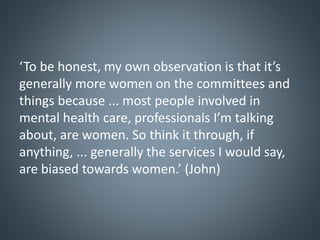
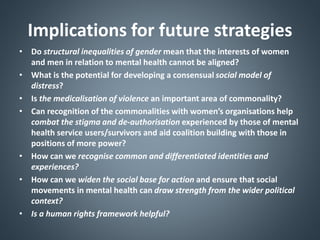

This document examines the differences and similarities between the women's movement and the service user/survivor movement relating to mental health. It discusses how they originated from different contexts, with the women's movement growing out of feminism and focusing on gender issues, while the user movement emphasized disability and poverty issues. Some key differences included views on medicalization, violence, and identities. However, there were also overlaps in seeking more holistic, person-centered services and challenging traditional power dynamics. The document considers implications for developing a social model of distress and building coalitions while recognizing both common and differentiated experiences.


