RE-CONCEPTUALISING
ADULT ORPHANS

A Scoping Literature Review
Rosaline S. Barbour
Bethany Morgan-Brett

Carol Komaromy
Michael Barbour

Death, Dying & Bereavement Study Group
Children and Death
15th November, 2013 – BSA London
rose.barbour@open.ac.uk
CHANGING DEMOGRAPHICS




>20% of 50-54 year olds had both
parents still alive
2.3% of 60-64 year olds had both
parents still alive

(Elliot & Elliot (2008) English
Longitudinal Study of Ageing, 2006
sweep) (reported in National Child
Development Study Report Now we
are Fifty)
Approaching a Scoping Review
Problems with systematic/synthesizing reviews
 Procedural/hierarchical
 Instrumental idea of relationship between research
and practice
Hammersley, M. (2013) The Myth of ResearchBased Policy and Practice, London: Sage.)
Need for widening out rather than funneling down
 Moving beyond concentration on specific research
templates
 Inclusion of other sources – such as commentaries
 Not just focusing on academic literature
Barbour, R.S., and Barbour M. (2003) “Evaluating
and synthesizing qualitative research: the need to
develop a distinctive approach”, Journal of
Evaluation in Clinical Practice, 9(2): 179-186.
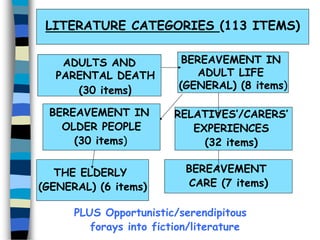
LITERATURE CATEGORIES (113 ITEMS)
ADULTS AND
PARENTAL DEATH
(30 items)

BEREAVEMENT IN
OLDER PEOPLE
(30 items)
THE ELDERLY
(GENERAL) (6 items)

BEREAVEMENT IN
ADULT LIFE
(GENERAL) (8 items)
RELATIVES’/CARERS’
EXPERIENCES
(32 items)

BEREAVEMENT
CARE (7 items)

PLUS Opportunistic/serendipitous
forays into fiction/literature
Losing a Parent as a Child /Adult








Death of parents as a normative event in
the lifecourse (for ‘adults’)?
OR ‘the very root of difficulty in grieving
for a middle-aged son or daughter’? (Moss
& Moss, 1994; Marshall, 2004)
Scoping autobiographical accounts…

McLoughlin, J. (ed.) (1994) On the Death
of a Parent, London: Virago Press
Imprecise Terminology





‘Adult Child’ - ‘Orphan???“…
When our parents die, whatever our age,
we become orphans… (Levinson, 1996)
Suspended Childhood??
Terminology – adult with one surviving
parent/two surviving parents???



On-Time’ loss of parent (Marshall, 2004)



OR (for ‘adult children’) ‘past time’?
Losing a parent/s in late mid-life
How different is this?








In late mid-life ‘adult children’ may be experiencing
multiple losses (a feature noted in relation to older
people and bereavement) where bereavement occurs
in the context of multiple and sequential losses –
‘bereavement overload’ … and grief is often
disenfranchised” (Moss & Moss, 1996: 26)
Parallels for children? (death of grandparents/great
aunts/uncles, pets, moving house/schools etc/)
‘Before-time’ Vs ‘On-Time’ loss of parent (Marshall,
2004)
OR (for ‘adult children’) ‘past time’?
Ambiguity and Loss of Parents




‘Adult orphans’ may feel liberated and able to
pursue other choices (Umberson, 2003)
Bereavement may provide freedom from ‘the
dysfunctional hold of parents’ (Petersen &
Rafuls, 2009)
Exacerbating factors for bereaved
‘adult children’



and for children?

Individuals whose parents had a lengthy period of
illness prior to death or who had dementia (Dupuis,
2002



Those bereaved by sudden death (Moss et al., 1993)



Those who had lived with their parent (Jones et al.,
2003; Khodyakov & Carr, 2009)



Daughters who had been carers (Foote et al., 1996)



Never-married daughters (Webb, 1992)



Geographical mobility (McDaniel & Clark, 2009)



Individuals in families where relationships have been
‘dysfunctional’ (Petersen & Rafuls, 2009)
Experience of ‘Adult Orphans’












There may, in effect, be a two-staged life
transition period, where adult children may
grieve for their first parent’s death in a
filtered way, through their concern or the
grief of the remaining parent; and then, on
the death of the second parent, grieve wholly
for both parents.” (Marshall, 2004: 351)
‘double grief’ (Marshall, 2004)
(childhood AND adulthood)
Disengagement from widowed parent
(Petersen & Rafuls, 2009)
Widowed parents may remarry/acquire new
partners, raising another set of issues?
(for children step brothers/sisters)
Experience of ‘Adult
Children/Orphans’








Sibling relationships may undergo strain as
siblings negotiate care for widowed
parents (Khodyakov & Carr, 2009)
Realignment of family roles (Umberson,
1995)
Birth order (of siblings) is important
(Petersen & Rafuls, 1998)
Childhood tensions may re-surface
(Khodyakov & Carr, 2009)
Tentative Conclusions
The differences between losing a parent in
childhood and in adulthood may be over-stated:
 The changes to circumstances can be similar
 Adults may be more ‘childlike’ than we imagine
 Children may be more ‘mature’, ‘prepared’
and ‘thoughtful’ than we imagine.
 Perhaps we need to re-conceptualise the
idea of ‘childhood’ –
to view it not as a discrete developmental phase
but as a resource or foundational repertoire of
emotions and responses which can be re-visited
throughout our lives.
Non-alignment of Emotions and Time





Nabokov’s ‘series of spaced flashes’
“One of the few advantages of
writing fiction in old age is that you
have been there, done it all,
experienced every decade…”
(Penelope Lively, 2013, p.19)
“I realised that childhood was there
in my mind still, but in the form of
these finite glimpses of that time,
not sequential, but co-existing…”
(Penelope Lively, 2013, p.127)
Continuing Dialogue with Parents
“I keep trying to measure the space of their
lives against the space of mine … these age
comparisons help me to understand what they
might have felt about their experiences.
Now there is a kind of retrospective
compassion and concern which I did not feel
at the time.
(Bruce Kent, 1994, p.41) (43 when mother
died, 51 when father died)
Literature References






Lively, P. (2013) Ammonites and
Leaping Fish: a Life in Time, London:
Fig Tree (an imprint of Penguin Books)
McLoughlin, J. (ed.) (1994) On the
Death of Parent, London: Virago
Press.
Segal, L. (2013) Out of Time: The
Pleasures and the Perils of Ageing,
London/New York: Verso.
Research Literature
Dupuis, S. (2002) “Understanding ambiguous loss in the context
of dementia care: adult children’s perspectives”, Journal of
Gerontological Social Work, 37(2): 93-115.
Elliott, J. et al. (2008) Now we are 50: Key findings from the
National Child Development Study. The Centre for Longitudinal
Studies, Institute of Education, University of London, London
Foote, C. et al. (1996) “When mothers of adult daughters die: a
new area of feminist practice”, Journal of Women and Social
Work, 11(2): 145-163.
Jones, D. et al. (2003) “Parental death in the lives of people with
serious mental illness”, Journal of Loss and Trauma, 8(4): 307322.
Khodyakov, D. and Carr, D. (2009) “The impact of late-life
parental death on adult sibling relationships”, Research on Aging,
31(5): 495-519.
Marshall, H. (2004) “Mid-life loss of parents”, ageing
International, 29(4): 351-367.
Research Literature (cont./…)
McDaniel, J.G. and Clark, P.G. (2009) “The new adult orphan:
issues and considerations for health care professionals”,
Journal of Gerontological Nursing, 35(12): 44-49.
Moss, M.S. et al. (1993) “Impact of an elderly mother’s death
on middle age daughters”, International Journal of Aging and
Human Development, 37(1): 1-22.
Moss, M. and Moss, S. (1996) “The impact of family deaths on
older people”, Bereavement Care, 15(3): 26-27.
Petersen, S. & Rafuls, S.E. (1998) “Receiving the sceptre: the
generational transition and impact of parent death on adults”,
Death Studies, 22(6): 493-524
Umberson, D. (1995) “marriage as support or strain – Marital
quality following the death of a parent”, Journal of Marriage
and the Family, 57(3): 709-723.
Webb, C. (1992) “Mothers and daughters – a powerful spell”,
Journal of Advanced Nursing, 17(11): 1334-1342.

Re-Conceptualising Adult Orphans: A Scoping Literature Review by Rosaline S Barbour, Carol Komaromy, Bethany Morgan-Brett and Michael Barbour

  • 1.
    RE-CONCEPTUALISING ADULT ORPHANS A ScopingLiterature Review Rosaline S. Barbour Bethany Morgan-Brett Carol Komaromy Michael Barbour Death, Dying & Bereavement Study Group Children and Death 15th November, 2013 – BSA London rose.barbour@open.ac.uk
  • 2.
    CHANGING DEMOGRAPHICS   >20% of50-54 year olds had both parents still alive 2.3% of 60-64 year olds had both parents still alive (Elliot & Elliot (2008) English Longitudinal Study of Ageing, 2006 sweep) (reported in National Child Development Study Report Now we are Fifty)
  • 3.
    Approaching a ScopingReview Problems with systematic/synthesizing reviews  Procedural/hierarchical  Instrumental idea of relationship between research and practice Hammersley, M. (2013) The Myth of ResearchBased Policy and Practice, London: Sage.) Need for widening out rather than funneling down  Moving beyond concentration on specific research templates  Inclusion of other sources – such as commentaries  Not just focusing on academic literature Barbour, R.S., and Barbour M. (2003) “Evaluating and synthesizing qualitative research: the need to develop a distinctive approach”, Journal of Evaluation in Clinical Practice, 9(2): 179-186.
  • 4.
    LITERATURE CATEGORIES (113ITEMS) ADULTS AND PARENTAL DEATH (30 items) BEREAVEMENT IN OLDER PEOPLE (30 items) THE ELDERLY (GENERAL) (6 items) BEREAVEMENT IN ADULT LIFE (GENERAL) (8 items) RELATIVES’/CARERS’ EXPERIENCES (32 items) BEREAVEMENT CARE (7 items) PLUS Opportunistic/serendipitous forays into fiction/literature
  • 5.
    Losing a Parentas a Child /Adult     Death of parents as a normative event in the lifecourse (for ‘adults’)? OR ‘the very root of difficulty in grieving for a middle-aged son or daughter’? (Moss & Moss, 1994; Marshall, 2004) Scoping autobiographical accounts… McLoughlin, J. (ed.) (1994) On the Death of a Parent, London: Virago Press
  • 6.
    Imprecise Terminology    ‘Adult Child’- ‘Orphan???“… When our parents die, whatever our age, we become orphans… (Levinson, 1996) Suspended Childhood?? Terminology – adult with one surviving parent/two surviving parents???  On-Time’ loss of parent (Marshall, 2004)  OR (for ‘adult children’) ‘past time’?
  • 7.
    Losing a parent/sin late mid-life How different is this?     In late mid-life ‘adult children’ may be experiencing multiple losses (a feature noted in relation to older people and bereavement) where bereavement occurs in the context of multiple and sequential losses – ‘bereavement overload’ … and grief is often disenfranchised” (Moss & Moss, 1996: 26) Parallels for children? (death of grandparents/great aunts/uncles, pets, moving house/schools etc/) ‘Before-time’ Vs ‘On-Time’ loss of parent (Marshall, 2004) OR (for ‘adult children’) ‘past time’?
  • 8.
    Ambiguity and Lossof Parents   ‘Adult orphans’ may feel liberated and able to pursue other choices (Umberson, 2003) Bereavement may provide freedom from ‘the dysfunctional hold of parents’ (Petersen & Rafuls, 2009)
  • 9.
    Exacerbating factors forbereaved ‘adult children’   and for children? Individuals whose parents had a lengthy period of illness prior to death or who had dementia (Dupuis, 2002  Those bereaved by sudden death (Moss et al., 1993)  Those who had lived with their parent (Jones et al., 2003; Khodyakov & Carr, 2009)  Daughters who had been carers (Foote et al., 1996)  Never-married daughters (Webb, 1992)  Geographical mobility (McDaniel & Clark, 2009)  Individuals in families where relationships have been ‘dysfunctional’ (Petersen & Rafuls, 2009)
  • 10.
    Experience of ‘AdultOrphans’       There may, in effect, be a two-staged life transition period, where adult children may grieve for their first parent’s death in a filtered way, through their concern or the grief of the remaining parent; and then, on the death of the second parent, grieve wholly for both parents.” (Marshall, 2004: 351) ‘double grief’ (Marshall, 2004) (childhood AND adulthood) Disengagement from widowed parent (Petersen & Rafuls, 2009) Widowed parents may remarry/acquire new partners, raising another set of issues? (for children step brothers/sisters)
  • 11.
    Experience of ‘Adult Children/Orphans’     Siblingrelationships may undergo strain as siblings negotiate care for widowed parents (Khodyakov & Carr, 2009) Realignment of family roles (Umberson, 1995) Birth order (of siblings) is important (Petersen & Rafuls, 1998) Childhood tensions may re-surface (Khodyakov & Carr, 2009)
  • 12.
    Tentative Conclusions The differencesbetween losing a parent in childhood and in adulthood may be over-stated:  The changes to circumstances can be similar  Adults may be more ‘childlike’ than we imagine  Children may be more ‘mature’, ‘prepared’ and ‘thoughtful’ than we imagine.  Perhaps we need to re-conceptualise the idea of ‘childhood’ – to view it not as a discrete developmental phase but as a resource or foundational repertoire of emotions and responses which can be re-visited throughout our lives.
  • 13.
    Non-alignment of Emotionsand Time    Nabokov’s ‘series of spaced flashes’ “One of the few advantages of writing fiction in old age is that you have been there, done it all, experienced every decade…” (Penelope Lively, 2013, p.19) “I realised that childhood was there in my mind still, but in the form of these finite glimpses of that time, not sequential, but co-existing…” (Penelope Lively, 2013, p.127)
  • 14.
    Continuing Dialogue withParents “I keep trying to measure the space of their lives against the space of mine … these age comparisons help me to understand what they might have felt about their experiences. Now there is a kind of retrospective compassion and concern which I did not feel at the time. (Bruce Kent, 1994, p.41) (43 when mother died, 51 when father died)
  • 15.
    Literature References    Lively, P.(2013) Ammonites and Leaping Fish: a Life in Time, London: Fig Tree (an imprint of Penguin Books) McLoughlin, J. (ed.) (1994) On the Death of Parent, London: Virago Press. Segal, L. (2013) Out of Time: The Pleasures and the Perils of Ageing, London/New York: Verso.
  • 16.
    Research Literature Dupuis, S.(2002) “Understanding ambiguous loss in the context of dementia care: adult children’s perspectives”, Journal of Gerontological Social Work, 37(2): 93-115. Elliott, J. et al. (2008) Now we are 50: Key findings from the National Child Development Study. The Centre for Longitudinal Studies, Institute of Education, University of London, London Foote, C. et al. (1996) “When mothers of adult daughters die: a new area of feminist practice”, Journal of Women and Social Work, 11(2): 145-163. Jones, D. et al. (2003) “Parental death in the lives of people with serious mental illness”, Journal of Loss and Trauma, 8(4): 307322. Khodyakov, D. and Carr, D. (2009) “The impact of late-life parental death on adult sibling relationships”, Research on Aging, 31(5): 495-519. Marshall, H. (2004) “Mid-life loss of parents”, ageing International, 29(4): 351-367.
  • 17.
    Research Literature (cont./…) McDaniel,J.G. and Clark, P.G. (2009) “The new adult orphan: issues and considerations for health care professionals”, Journal of Gerontological Nursing, 35(12): 44-49. Moss, M.S. et al. (1993) “Impact of an elderly mother’s death on middle age daughters”, International Journal of Aging and Human Development, 37(1): 1-22. Moss, M. and Moss, S. (1996) “The impact of family deaths on older people”, Bereavement Care, 15(3): 26-27. Petersen, S. & Rafuls, S.E. (1998) “Receiving the sceptre: the generational transition and impact of parent death on adults”, Death Studies, 22(6): 493-524 Umberson, D. (1995) “marriage as support or strain – Marital quality following the death of a parent”, Journal of Marriage and the Family, 57(3): 709-723. Webb, C. (1992) “Mothers and daughters – a powerful spell”, Journal of Advanced Nursing, 17(11): 1334-1342.