Capital and Accumulation:
rethinking social class for the 21st
century
Mike Savage, with Sam Friedman,
Daniel Laurison, Katharina Hecht,
Georgia Nichols
The GBCS controversy, 2013>
The BBC’s pitch
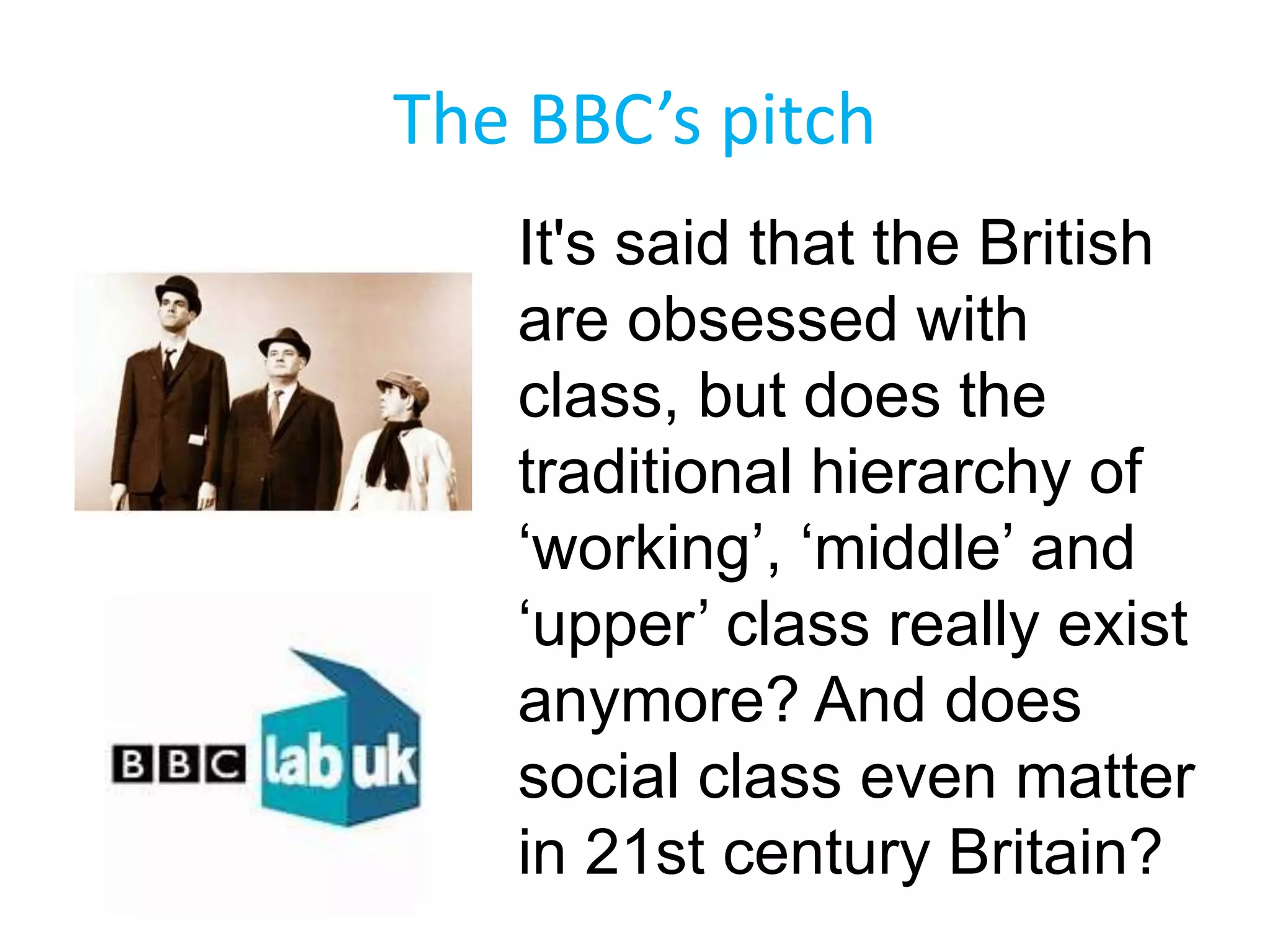
It's said that the British
are obsessed with
class, but does the
traditional hierarchy of
‘working’, ‘middle’ and
‘upper’ class really exist
anymore? And does
social class even matter
in 21st century Britain?
Three key issues
• Class is very much back in the public eye. The
idea of ‘classless society’ is clearly wrong
• But ‘old’ class divisions (middle-working) don’t
have the same energy: it is now the politics of
classification which is at stake
• Sociology is going to play a crucial role in
redefining debates about inequality in the coming
period
Piketty’s vital contribution
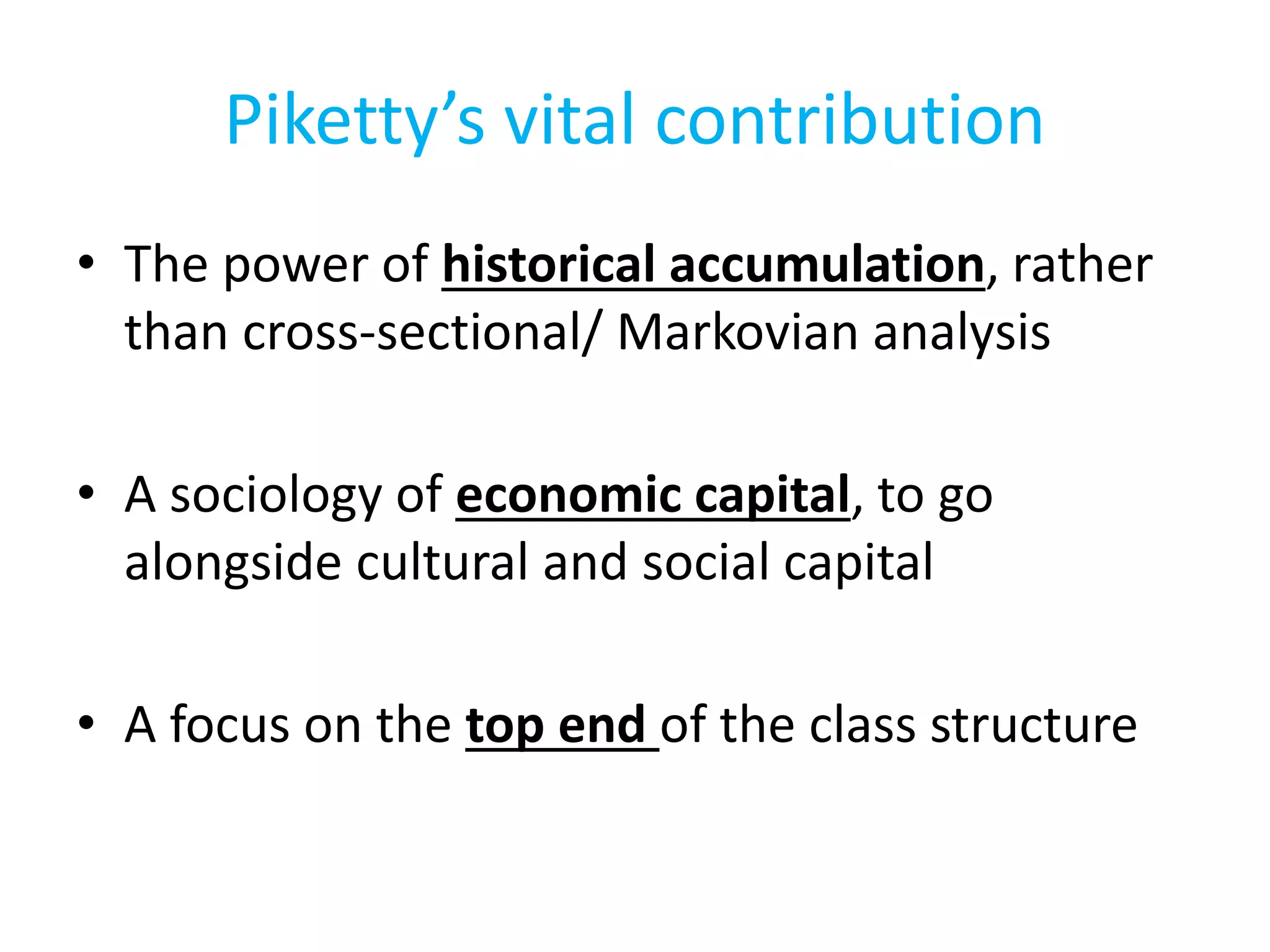
• The power of historical accumulation, rather
than cross-sectional/ Markovian analysis
• A sociology of economic capital, to go
alongside cultural and social capital
• A focus on the top end of the class structure
Wealth of UK billionaires
0
50
100
150
200
250
300
350
400
2005 2006 2007 2008 2009 2010 2011 2012 2013 2014 2015
£ billion
£ billion
Source:
Sunday
Times Rich
List
The sociological issues today…..
1. Shifting from an occupational to a ‘capital’
based model
2. The significance of inheritance and
accumulation
3. The power of mutually re-inforcing ‘Matthew
effects’ generating elite advantage.
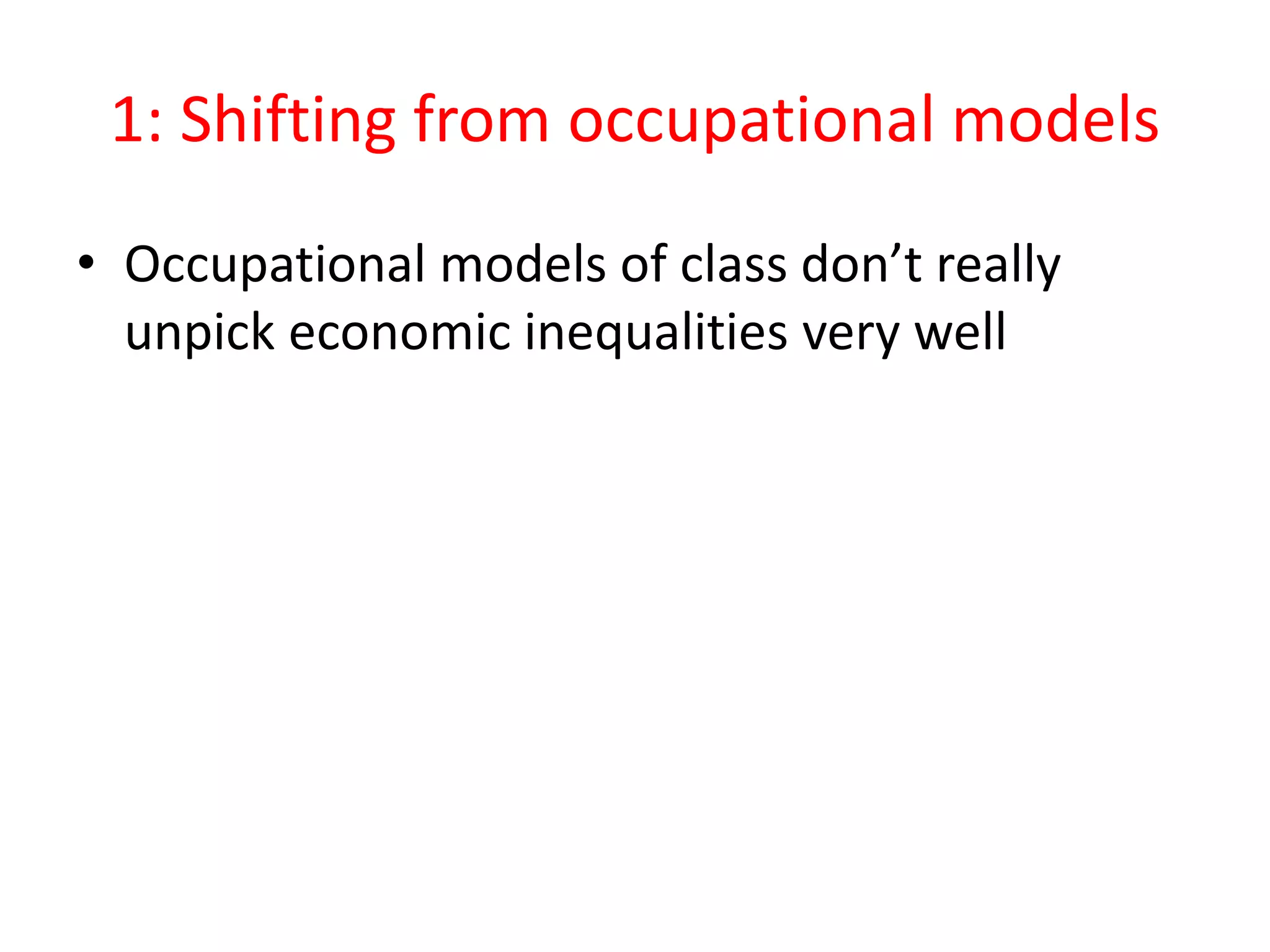
1: Shifting from occupational models
• Occupational models of class don’t really
unpick economic inequalities very well
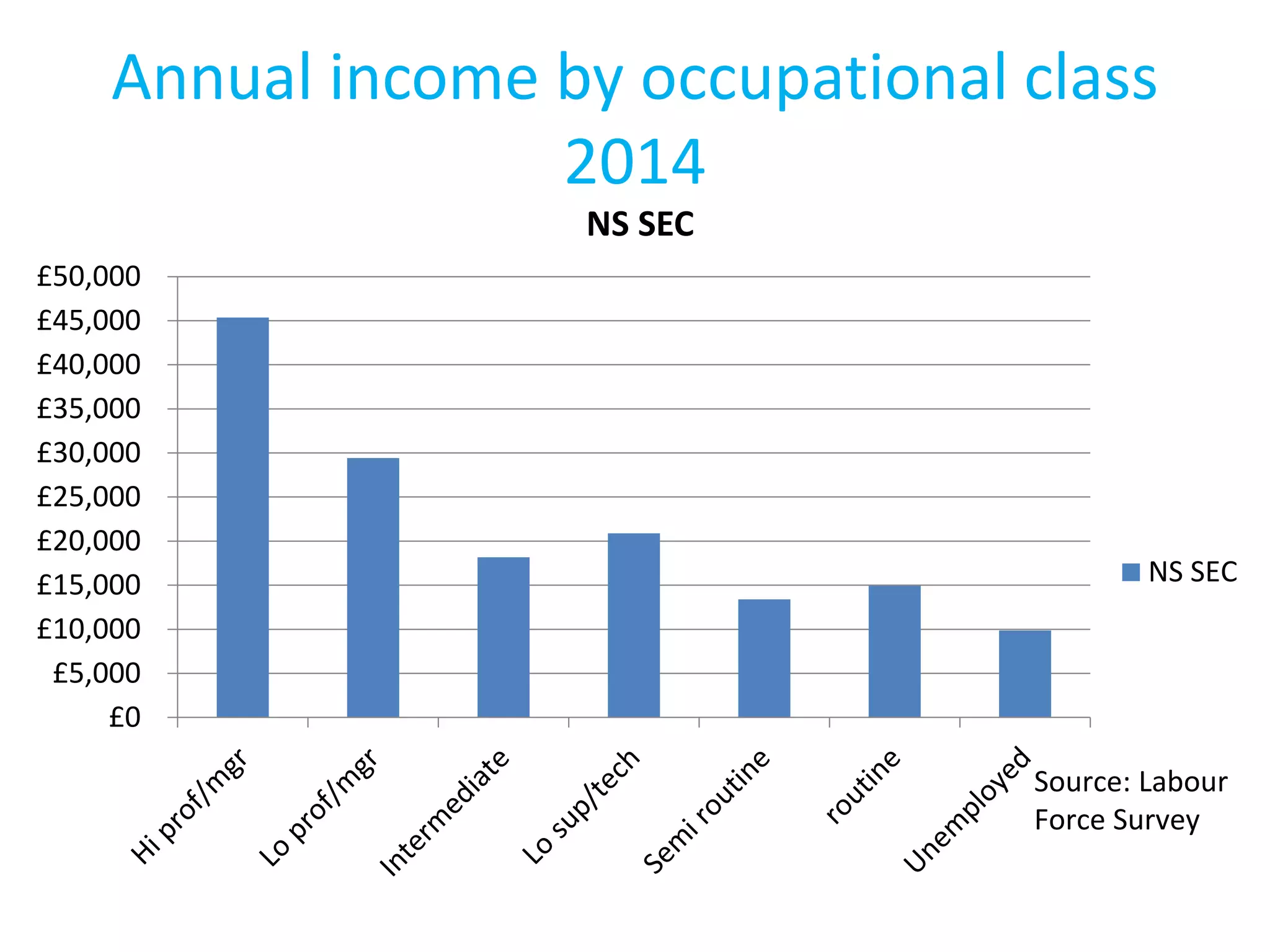
Annual income by occupational class
2014
£0
£5,000
£10,000
£15,000
£20,000
£25,000
£30,000
£35,000
£40,000
£45,000
£50,000
NS SEC
NS SEC
Source: Labour
Force Survey
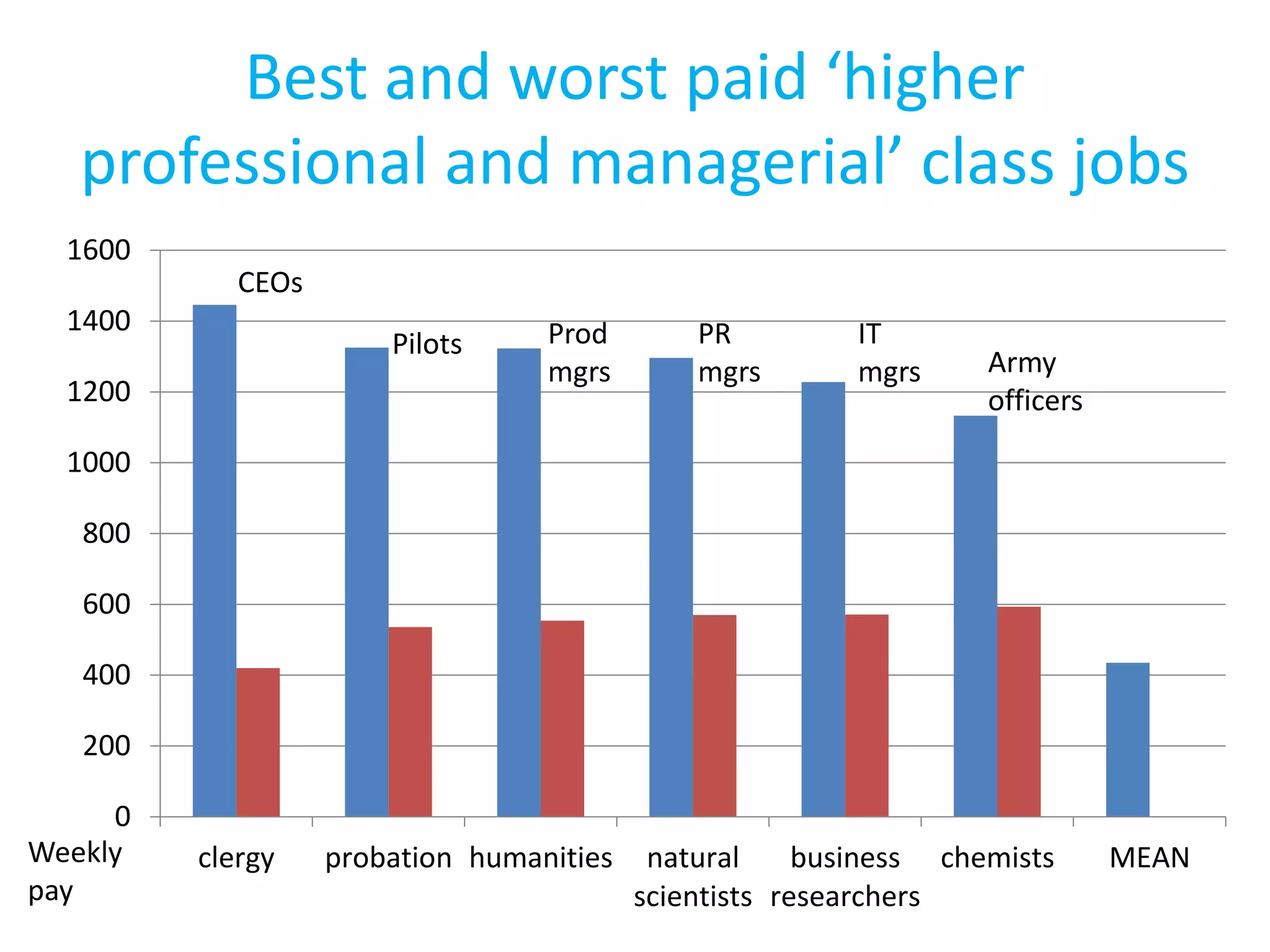
Best and worst paid ‘higher
professional and managerial’ class jobs
0
200
400
600
800
1000
1200
1400
1600
clergy probation humanities natural
scientists
business
researchers
chemists MEAN
Pilots
CEOs
Prod
mgrs
PR
mgrs
IT
mgrs Army
officers
Weekly
pay
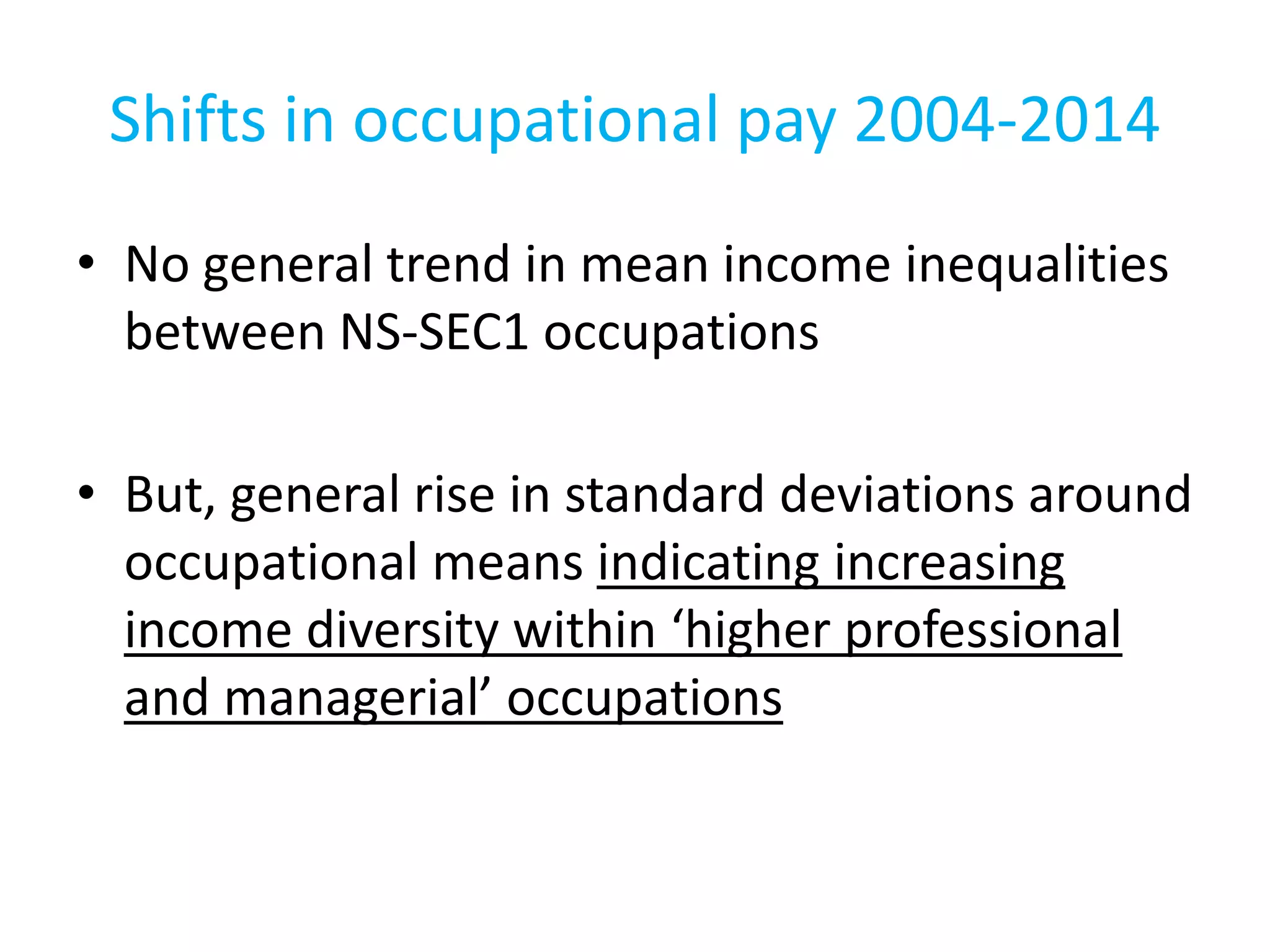
Shifts in occupational pay 2004-2014
• No general trend in mean income inequalities
between NS-SEC1 occupations
• But, general rise in standard deviations around
occupational means indicating increasing
income diversity within ‘higher professional
and managerial’ occupations
2: The power of accumulation and
inheritance
• Much of our thinking on class is premised on
current position
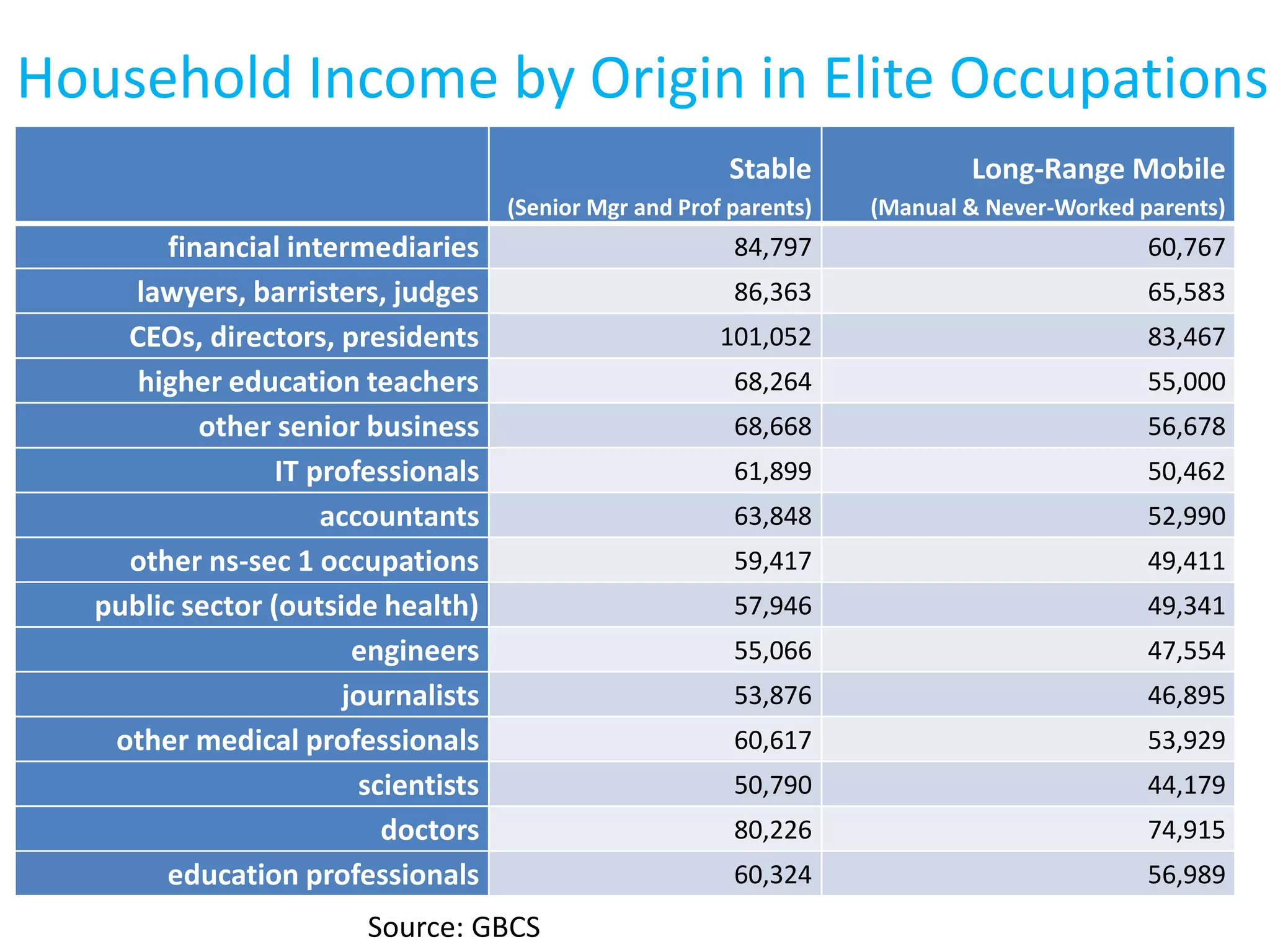
Household Income by Origin in Elite Occupations
Stable
(Senior Mgr and Prof parents)
Long-Range Mobile
(Manual & Never-Worked parents)
financial intermediaries 84,797 60,767
lawyers, barristers, judges 86,363 65,583
CEOs, directors, presidents 101,052 83,467
higher education teachers 68,264 55,000
other senior business 68,668 56,678
IT professionals 61,899 50,462
accountants 63,848 52,990
other ns-sec 1 occupations 59,417 49,411
public sector (outside health) 57,946 49,341
engineers 55,066 47,554
journalists 53,876 46,895
other medical professionals 60,617 53,929
scientists 50,790 44,179
doctors 80,226 74,915
education professionals 60,324 56,989
Source: GBCS
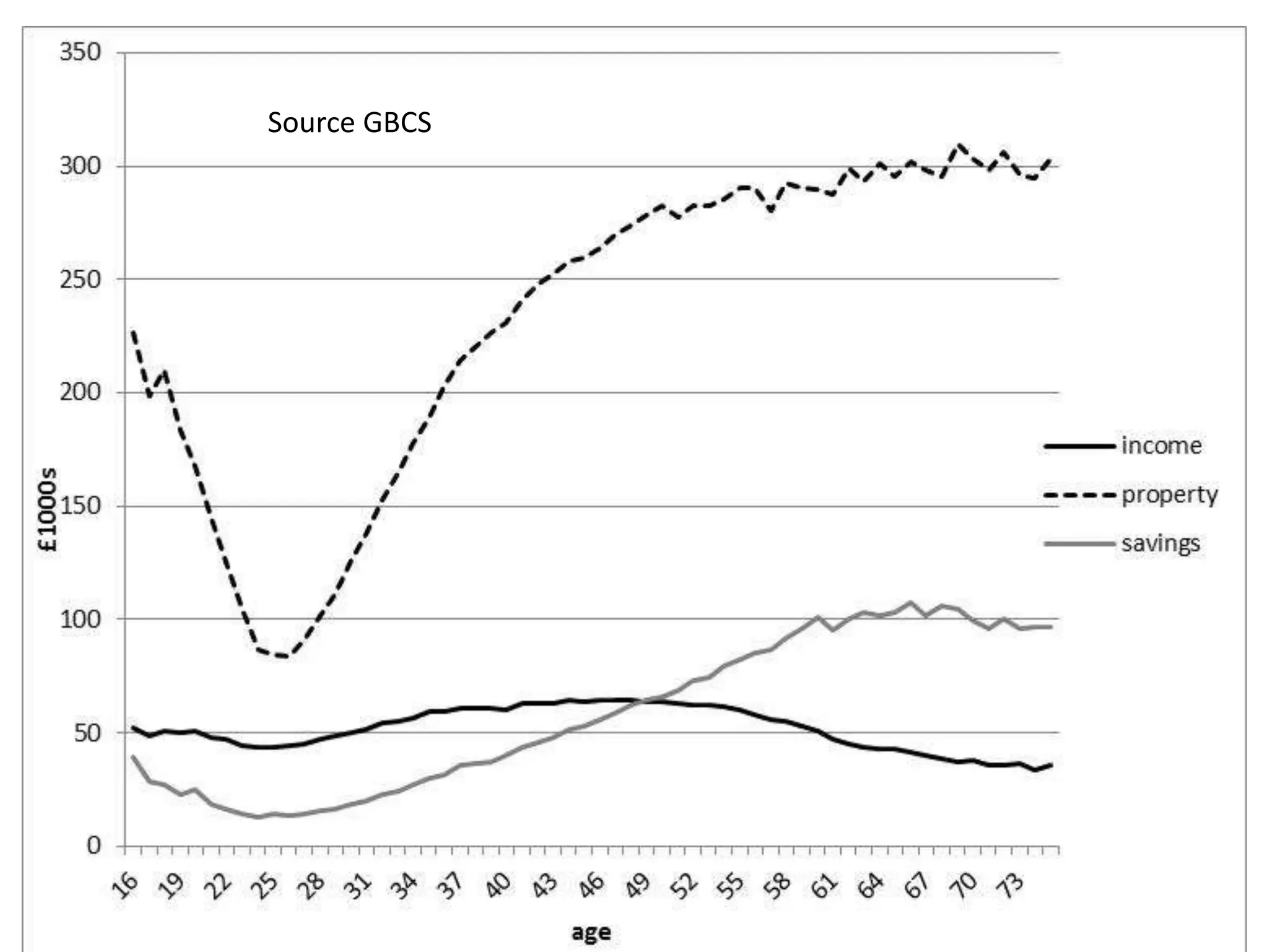
Source GBCS
Intersecting Matthew effects
• GBCS data is striking for showing extensive
‘top end’ outlier effects
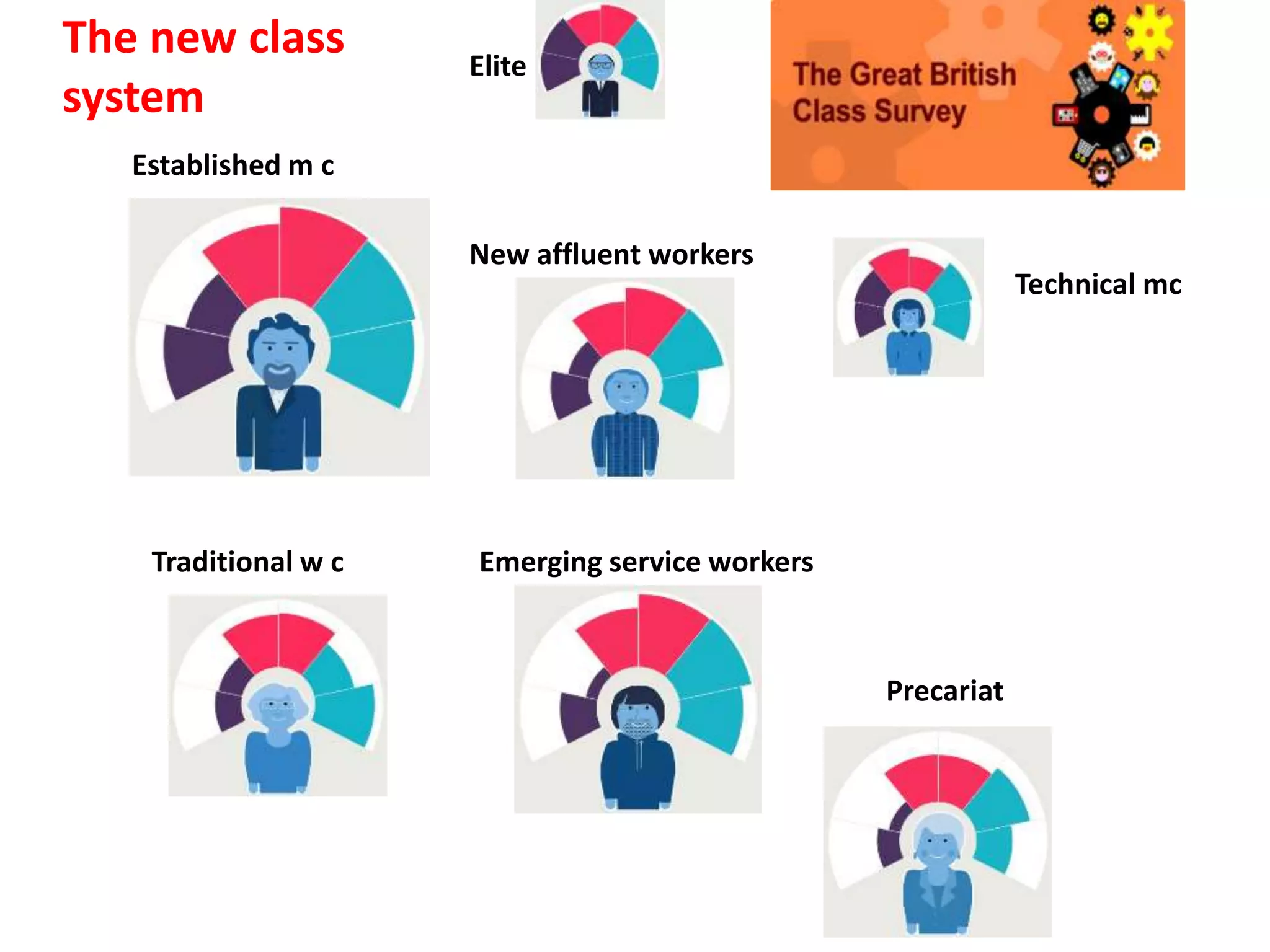
Elite
Established m c
Technical mc
New affluent workers
Traditional w c Emerging service workers
Precariat
The new class
system
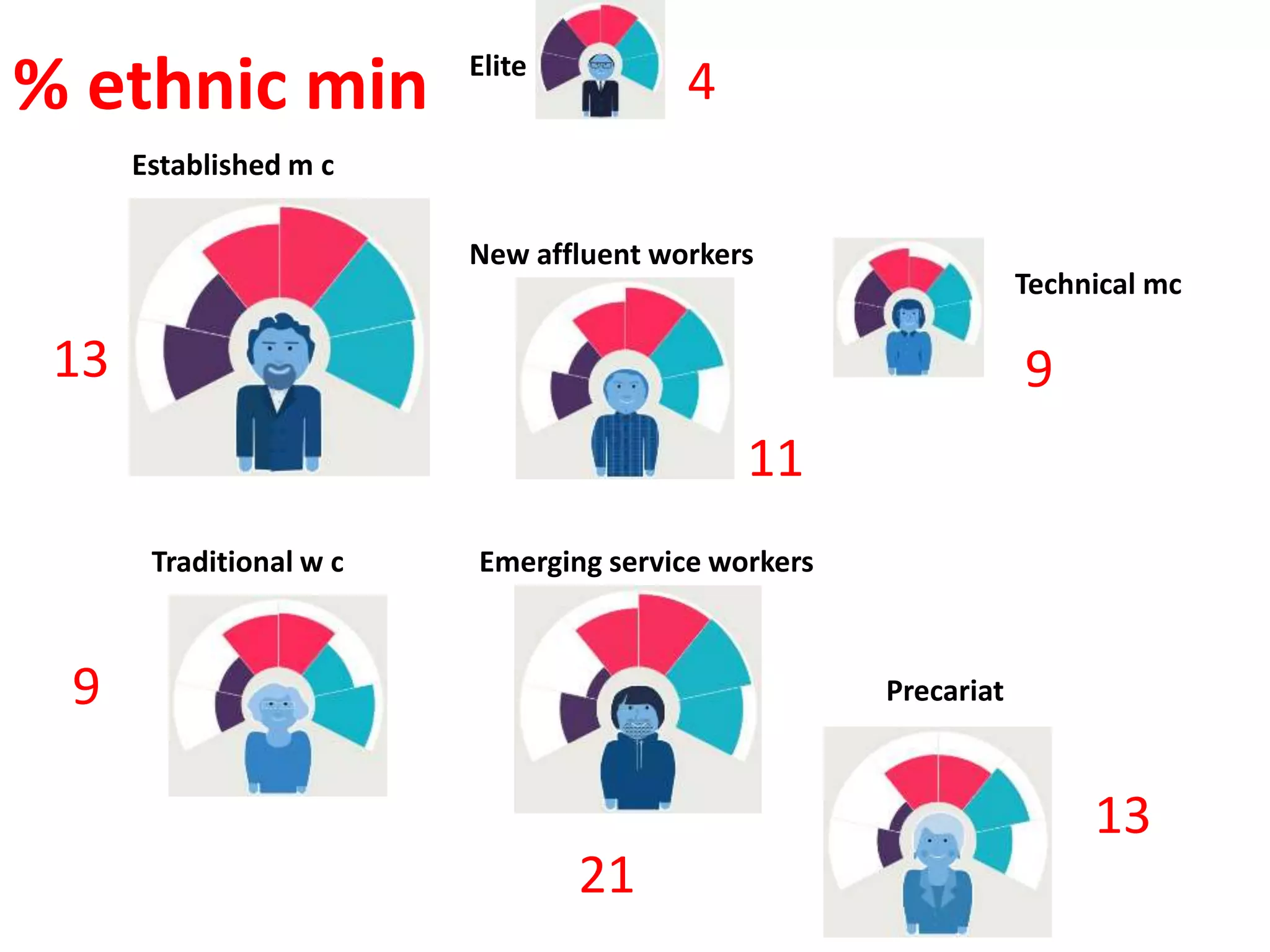
Elite
Established m c
Technical mc
New affluent workers
Traditional w c Emerging service workers
Precariat
% ethnic min 4
13
11
9
9
21
13
Elite
Established m c
Technical mc
New affluent workers
Traditional w c Emerging service workers
Precariat
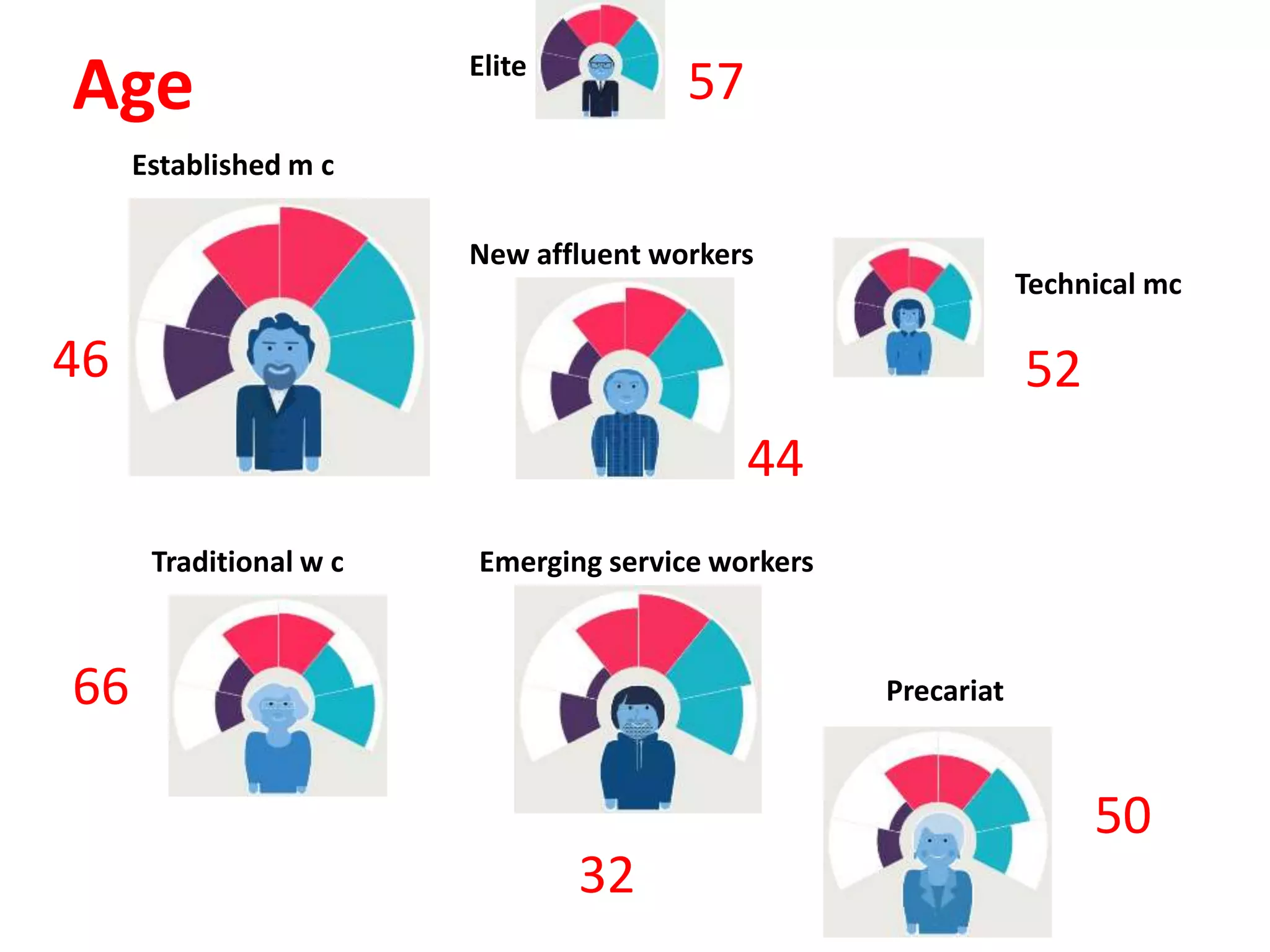
Age 57
46
44
52
66
32
50
Source: GBCS
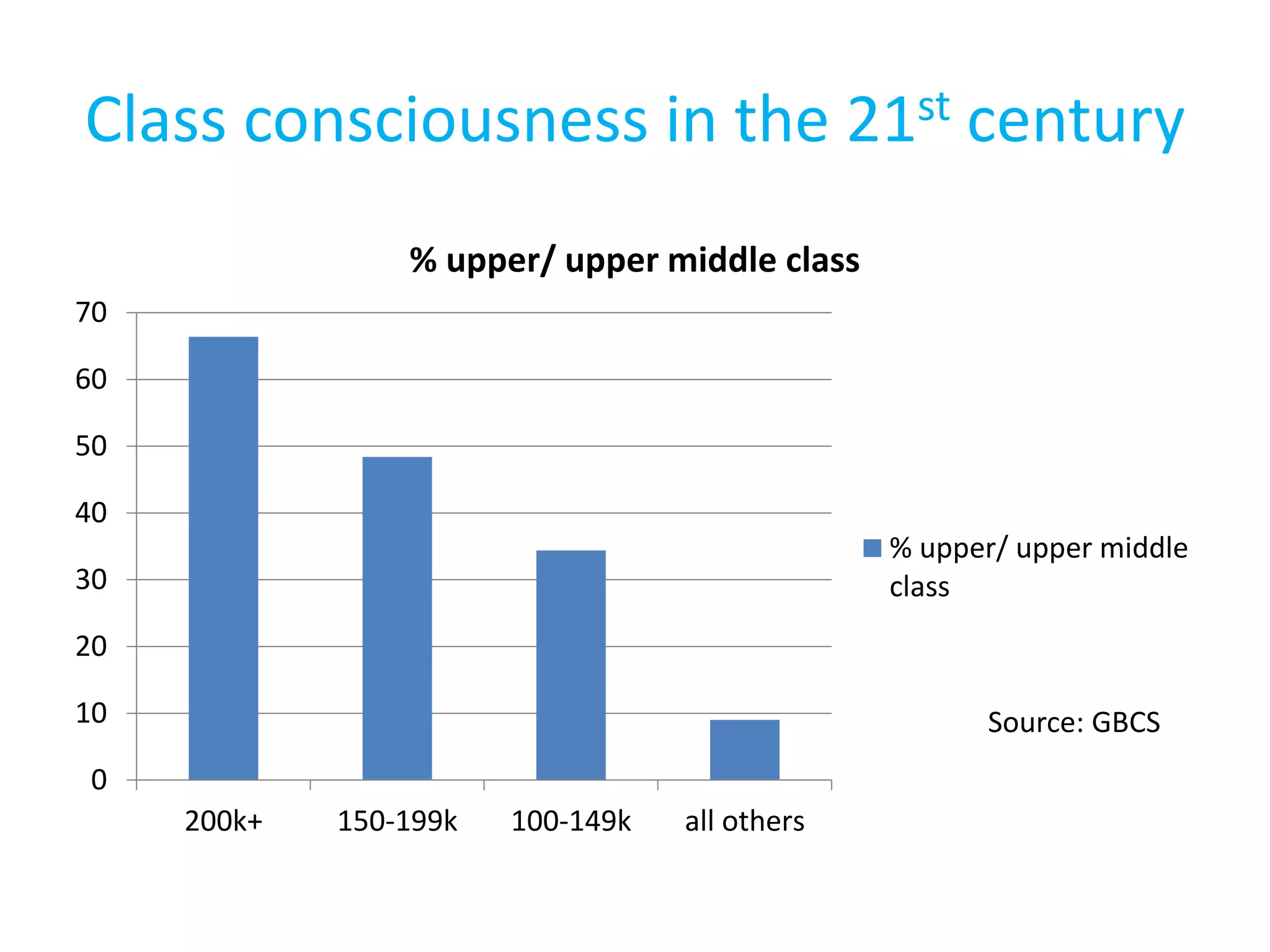
Class consciousness in the 21st century
0
10
20
30
40
50
60
70
200k+ 150-199k 100-149k all others
% upper/ upper middle class
% upper/ upper middle
class
Source: GBCS
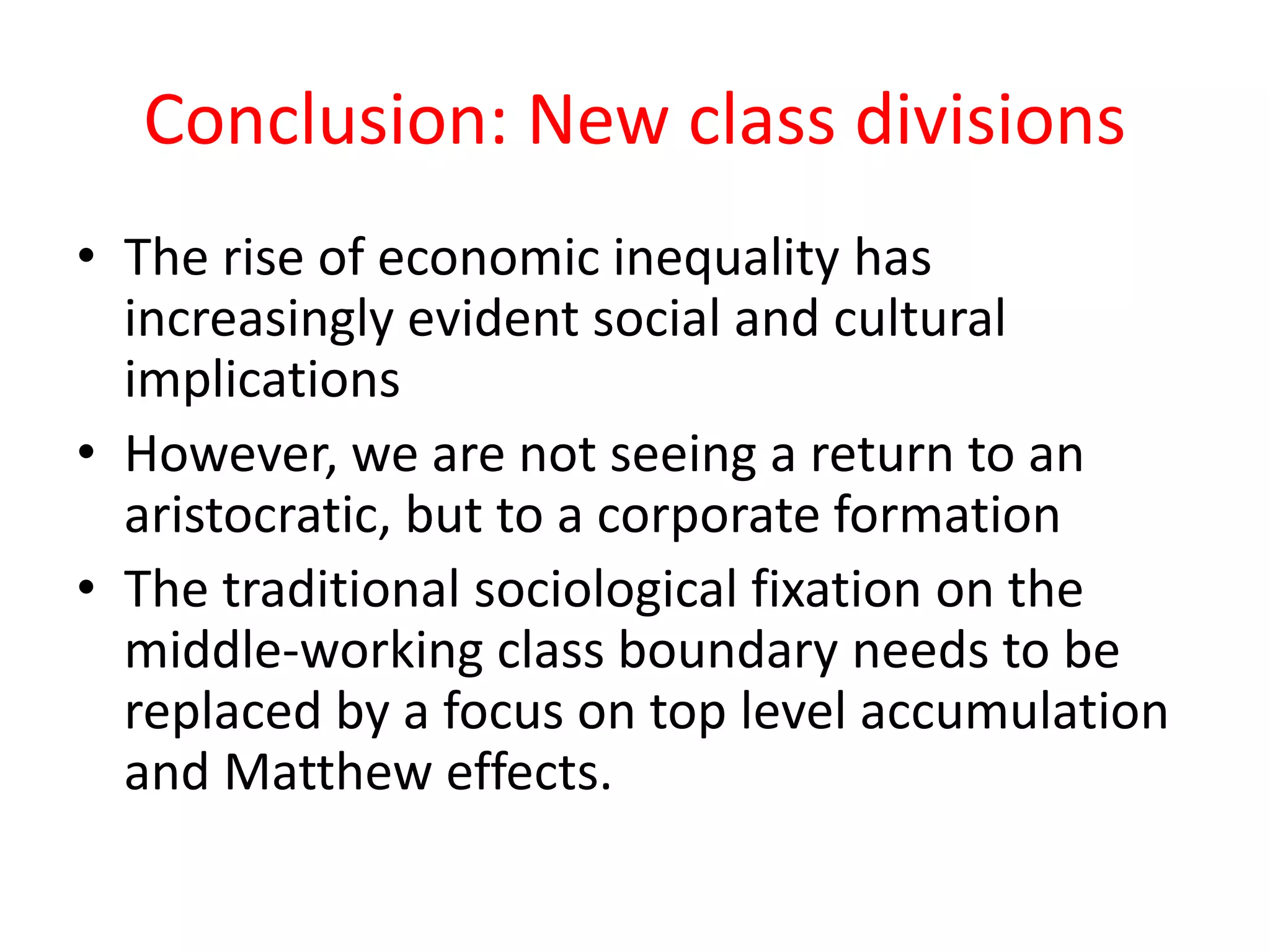
Conclusion: New class divisions
• The rise of economic inequality has
increasingly evident social and cultural
implications
• However, we are not seeing a return to an
aristocratic, but to a corporate formation
• The traditional sociological fixation on the
middle-working class boundary needs to be
replaced by a focus on top level accumulation
and Matthew effects.
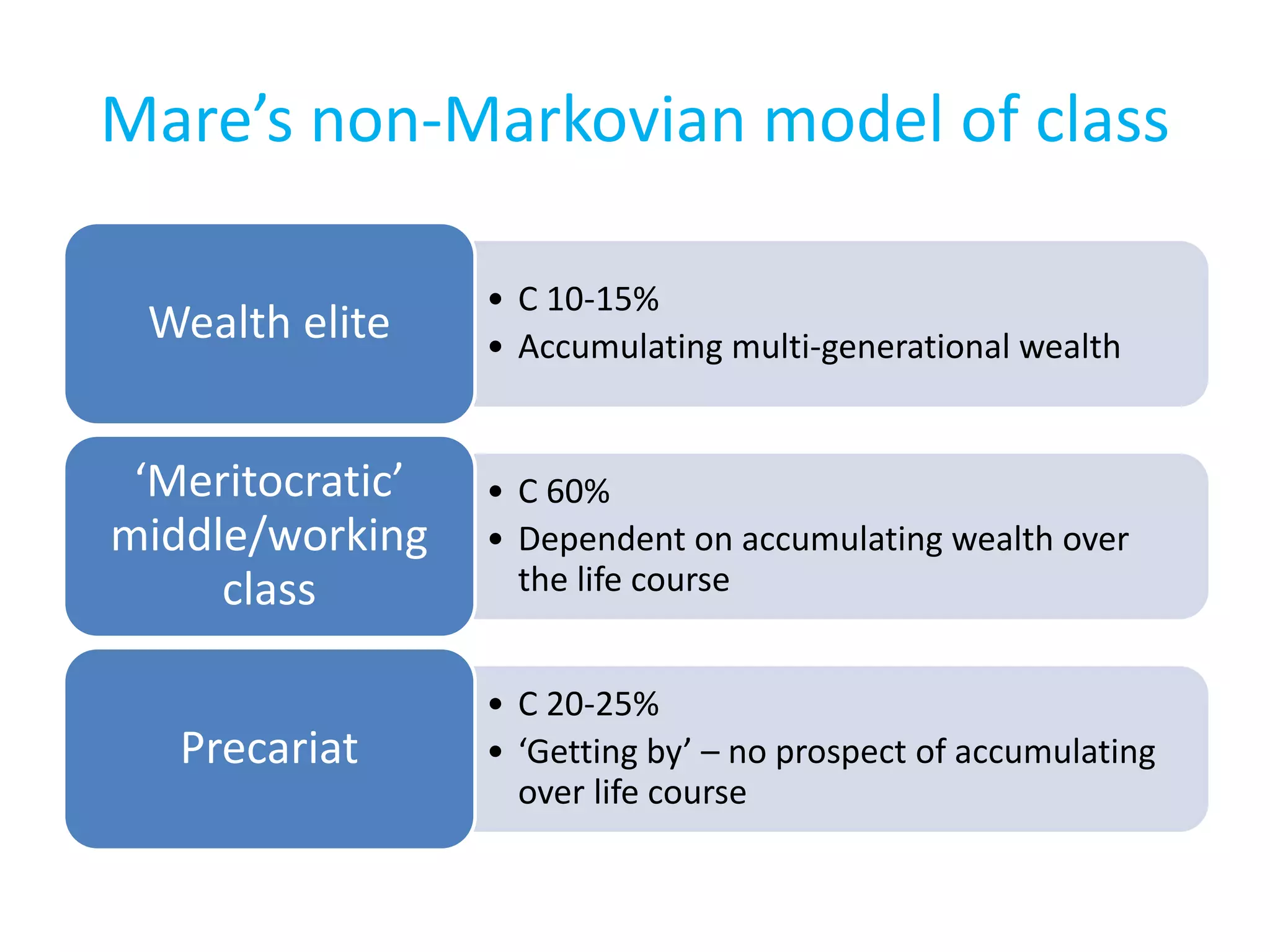
Mare’s non-Markovian model of class
• C 10-15%
• Accumulating multi-generational wealth
Wealth elite
• C 60%
• Dependent on accumulating wealth over
the life course
‘Meritocratic’
middle/working
class
• C 20-25%
• ‘Getting by’ – no prospect of accumulating
over life course
Precariat

Capital and Accumulation: rethinking social class for the 21st century by Mike Savage

  • 1.
    Capital and Accumulation: rethinkingsocial class for the 21st century Mike Savage, with Sam Friedman, Daniel Laurison, Katharina Hecht, Georgia Nichols
  • 2.
  • 3.
    The BBC’s pitch It'ssaid that the British are obsessed with class, but does the traditional hierarchy of ‘working’, ‘middle’ and ‘upper’ class really exist anymore? And does social class even matter in 21st century Britain?
  • 4.
    Three key issues •Class is very much back in the public eye. The idea of ‘classless society’ is clearly wrong • But ‘old’ class divisions (middle-working) don’t have the same energy: it is now the politics of classification which is at stake • Sociology is going to play a crucial role in redefining debates about inequality in the coming period
  • 6.
    Piketty’s vital contribution •The power of historical accumulation, rather than cross-sectional/ Markovian analysis • A sociology of economic capital, to go alongside cultural and social capital • A focus on the top end of the class structure
  • 8.
    Wealth of UKbillionaires 0 50 100 150 200 250 300 350 400 2005 2006 2007 2008 2009 2010 2011 2012 2013 2014 2015 £ billion £ billion Source: Sunday Times Rich List
  • 9.
    The sociological issuestoday….. 1. Shifting from an occupational to a ‘capital’ based model 2. The significance of inheritance and accumulation 3. The power of mutually re-inforcing ‘Matthew effects’ generating elite advantage.
  • 10.
    1: Shifting fromoccupational models • Occupational models of class don’t really unpick economic inequalities very well
  • 11.
    Annual income byoccupational class 2014 £0 £5,000 £10,000 £15,000 £20,000 £25,000 £30,000 £35,000 £40,000 £45,000 £50,000 NS SEC NS SEC Source: Labour Force Survey
  • 12.
    Best and worstpaid ‘higher professional and managerial’ class jobs 0 200 400 600 800 1000 1200 1400 1600 clergy probation humanities natural scientists business researchers chemists MEAN Pilots CEOs Prod mgrs PR mgrs IT mgrs Army officers Weekly pay
  • 13.
    Shifts in occupationalpay 2004-2014 • No general trend in mean income inequalities between NS-SEC1 occupations • But, general rise in standard deviations around occupational means indicating increasing income diversity within ‘higher professional and managerial’ occupations
  • 14.
    2: The powerof accumulation and inheritance • Much of our thinking on class is premised on current position
  • 16.
    Household Income byOrigin in Elite Occupations Stable (Senior Mgr and Prof parents) Long-Range Mobile (Manual & Never-Worked parents) financial intermediaries 84,797 60,767 lawyers, barristers, judges 86,363 65,583 CEOs, directors, presidents 101,052 83,467 higher education teachers 68,264 55,000 other senior business 68,668 56,678 IT professionals 61,899 50,462 accountants 63,848 52,990 other ns-sec 1 occupations 59,417 49,411 public sector (outside health) 57,946 49,341 engineers 55,066 47,554 journalists 53,876 46,895 other medical professionals 60,617 53,929 scientists 50,790 44,179 doctors 80,226 74,915 education professionals 60,324 56,989 Source: GBCS
  • 17.
  • 18.
    Intersecting Matthew effects •GBCS data is striking for showing extensive ‘top end’ outlier effects
  • 19.
    Elite Established m c Technicalmc New affluent workers Traditional w c Emerging service workers Precariat The new class system
  • 20.
    Elite Established m c Technicalmc New affluent workers Traditional w c Emerging service workers Precariat % ethnic min 4 13 11 9 9 21 13
  • 21.
    Elite Established m c Technicalmc New affluent workers Traditional w c Emerging service workers Precariat Age 57 46 44 52 66 32 50
  • 22.
  • 23.
    Class consciousness inthe 21st century 0 10 20 30 40 50 60 70 200k+ 150-199k 100-149k all others % upper/ upper middle class % upper/ upper middle class Source: GBCS
  • 24.
    Conclusion: New classdivisions • The rise of economic inequality has increasingly evident social and cultural implications • However, we are not seeing a return to an aristocratic, but to a corporate formation • The traditional sociological fixation on the middle-working class boundary needs to be replaced by a focus on top level accumulation and Matthew effects.
  • 25.
    Mare’s non-Markovian modelof class • C 10-15% • Accumulating multi-generational wealth Wealth elite • C 60% • Dependent on accumulating wealth over the life course ‘Meritocratic’ middle/working class • C 20-25% • ‘Getting by’ – no prospect of accumulating over life course Precariat

Editor's Notes

  • #2 Want to make the point that this is a team project and will refer to the work of colleagues where relevant
  • #3 The GBCS came out two years ago – let to massive controversy which has made me think a lot about what class is and what class does. How it groups, categorises and labels – was very unsual as an academic to be exposed to how these classifications go into public realm, create interest but also critique and wonder what this means for understanding class today
  • #4 Comment on how the GBCS was pitched as critique of ‘old’ ways of thinking about class – and the search for new kind of approaches to class…. So what did we find? What were our new arguments?
  • #5 So, for me the GBCS had three major findings which I pondered about in the immediate aftermath. But as you can see, these are as much questions as answers – pose all kinds of issues and thoughts but was left unsure how to take forward
  • #6 This is where Piketty comes in and was hugely inspiring – appeared at exactly the right time as I was reflecting on the class debates
  • #7 I am not going to engage with Piketty’s economics – others are far better placed than me. I was struck by three ways in which he offered resources to my re-thinking
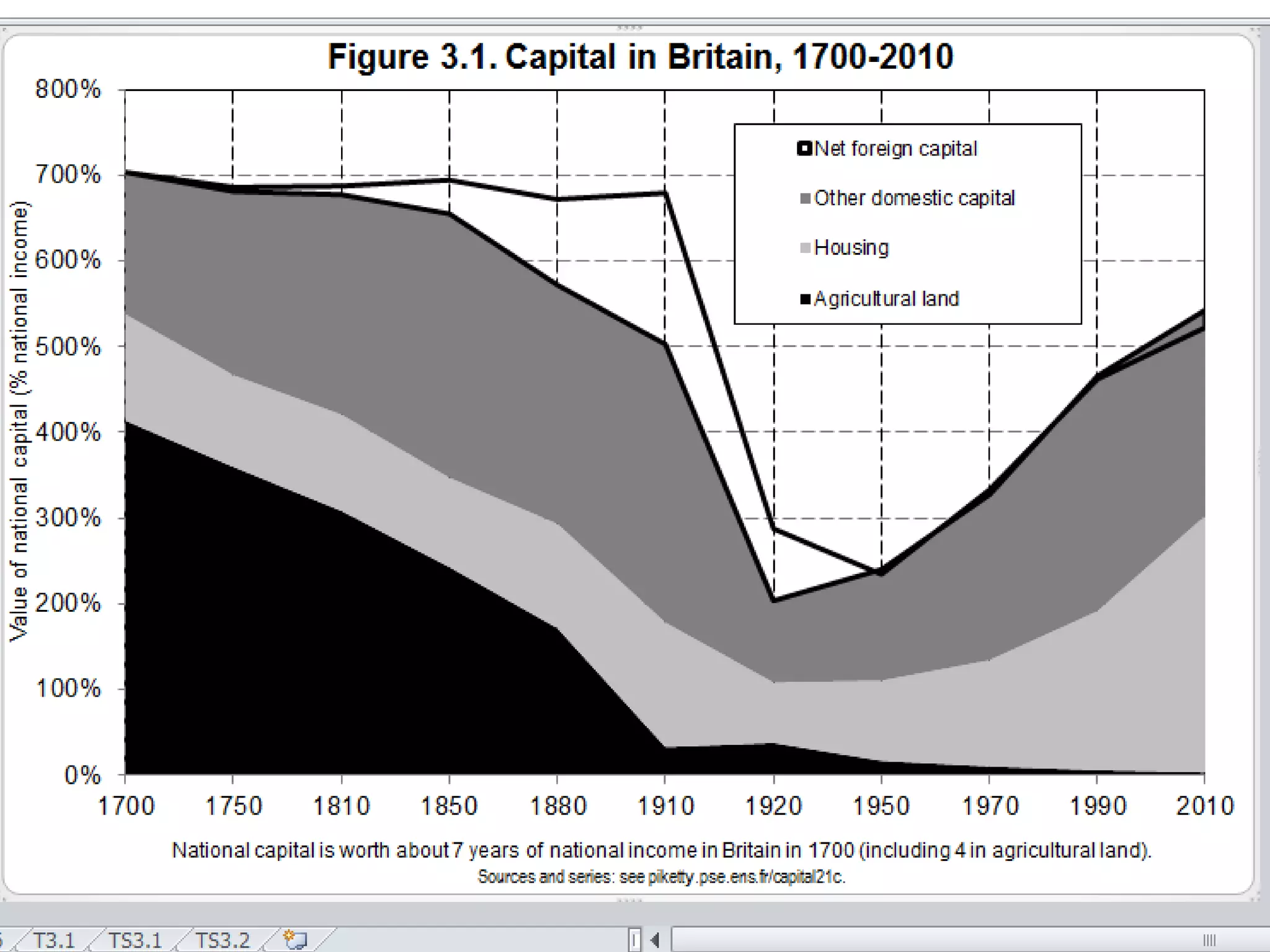
  • #8 This is the famous Piketty figure. If I had to use just one figure to represent British history over the past 300 years this would be a strong contendor. It relates accumulated historical capital as a % of current national income. In a sense it therefore allows the balance of the ‘past’ to the ‘present’ to be rendered graphically. And if we do this, we can see that the relative power of accumulated capital compared to current national income is increasing. The implication is that whereas sociologists often see today’s turbo charged neo-liberal capitalism as being about the decline of historical controls and the ‘speeding up’ – we are in fact seeing the past becoming more important with the increasing accumulated stocks of capital having greater relative weight over current income. It challenges the conceits of ‘sociological presentism’.
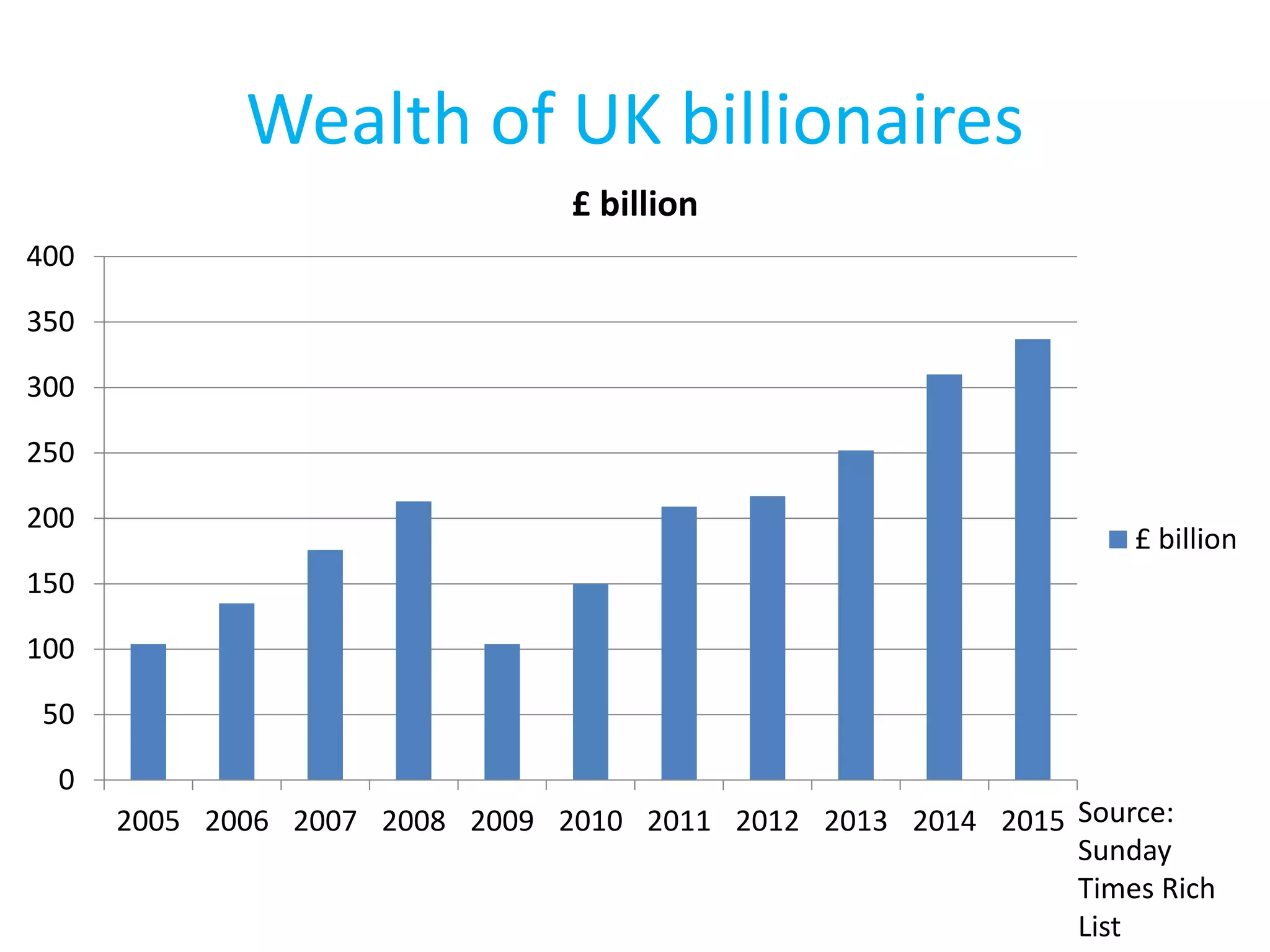
  • #9 Here is a quick indication of the power of the UK super-rich and their steady accumulative rise – with even the 2008 crash being a minor blip on the upward march
  • #10 So, how can I pull out the sociological implications of Pikettyian thinking? 1. Rather than class being your current job – which is how sociologists tend to see it – how can we see class as embedded in historical accumulation. 2. So, rather than fixing on the present situation, and then considering how past factors affect the present – we need a more embedded historical perspective in which we understand more powerfully how inheritance and accumulation work. Here I am very influenced by a brilliant article by the demographers Robert Mare who argues we need to move away from simple models of parent-child transmission and recognise the wider role of multi-dimensional and multi-generational kinship and household processes. 3. Matthew effects are about the non-linear way that processes at the top end can re-inforce each other in a way which can lead to overlapping circuits of advantage and privilege. It directs our attention not to the boundary between middle and working class, but to the dynamics at the top levels
  • #11 A capitals approach allows advantage to be seen as accumulative which avoids concepts which impose stark boundaries - such as the ‘1 per cent’ or the upper class - and focuses instead on wider ‘ecologies’ of valuation A capitals approach allows advantage to be seen as accumulative which avoids concepts which impose stark boundaries - such as the ‘1 per cent’ or the upper class - and focuses instead on wider ‘ecologies’ of valuation and c
  • #12 The point here is that the ‘highest’ occupational class ‘only’ earns 3 times as much as the lowest. It therefore is not giving a very robust handle for understanding economic inequality today. If we want to do explore economic inequality more effective we need more sophisticated tools than occupational class models
  • #13 Daniel Laurison has broken down the incomes of the best paid occupations within the top occupational class. These are the best paid, 3 times the national average income
  • #14 Daniel’s further work has shown that within most occupations there is increasing income diversity. Hence, the job you do is less telling than it used to be in defining income
  • #15 Rather than focus on the present, and then think about how past factors influence it, let’s have a more dynamic model in which the past is an active force in the present – this means seeing accumulation and inheritance as central and involves shifting our focus
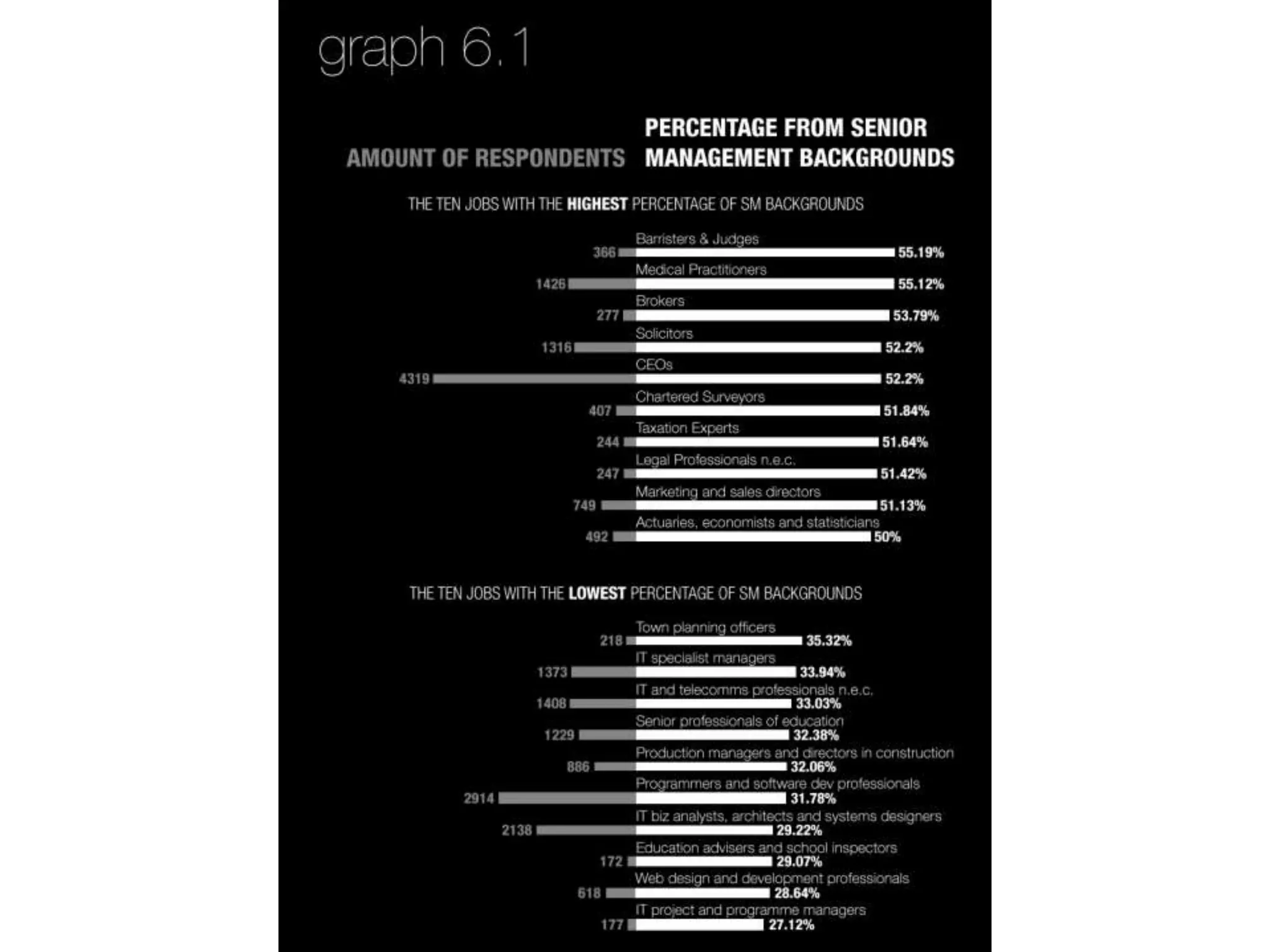
  • #16 This is GBCS work showing that the most advantaged managerial/professional occupations tend to have a higher proportion of their members drawn from more privileged backgrounds – hence there is a mutually reinforcing process between history/ time/ and advantage. Note that many of those with lowest proportions of senior manager backgrounds are in IT – a new field of employment. We see here therefore how time
  • #17 And this is Sam Friedman and Daniel Laurison showing the ‘class ceiling’ – that those with historical privilege earn significantly more than those who are upwardly mobile – even when they are in the same occupation!
  • #18 And finally, I want to bring out the point about age. Lots of work now showing that the growing divide between older and younger people and this is tied into the power of accumulation over the life course as well as intergenerationally
  • #19 Here we move away from linear models and note that there are striking re-inforcements in the top small %ages. We need analytical models which allow us to focus on this
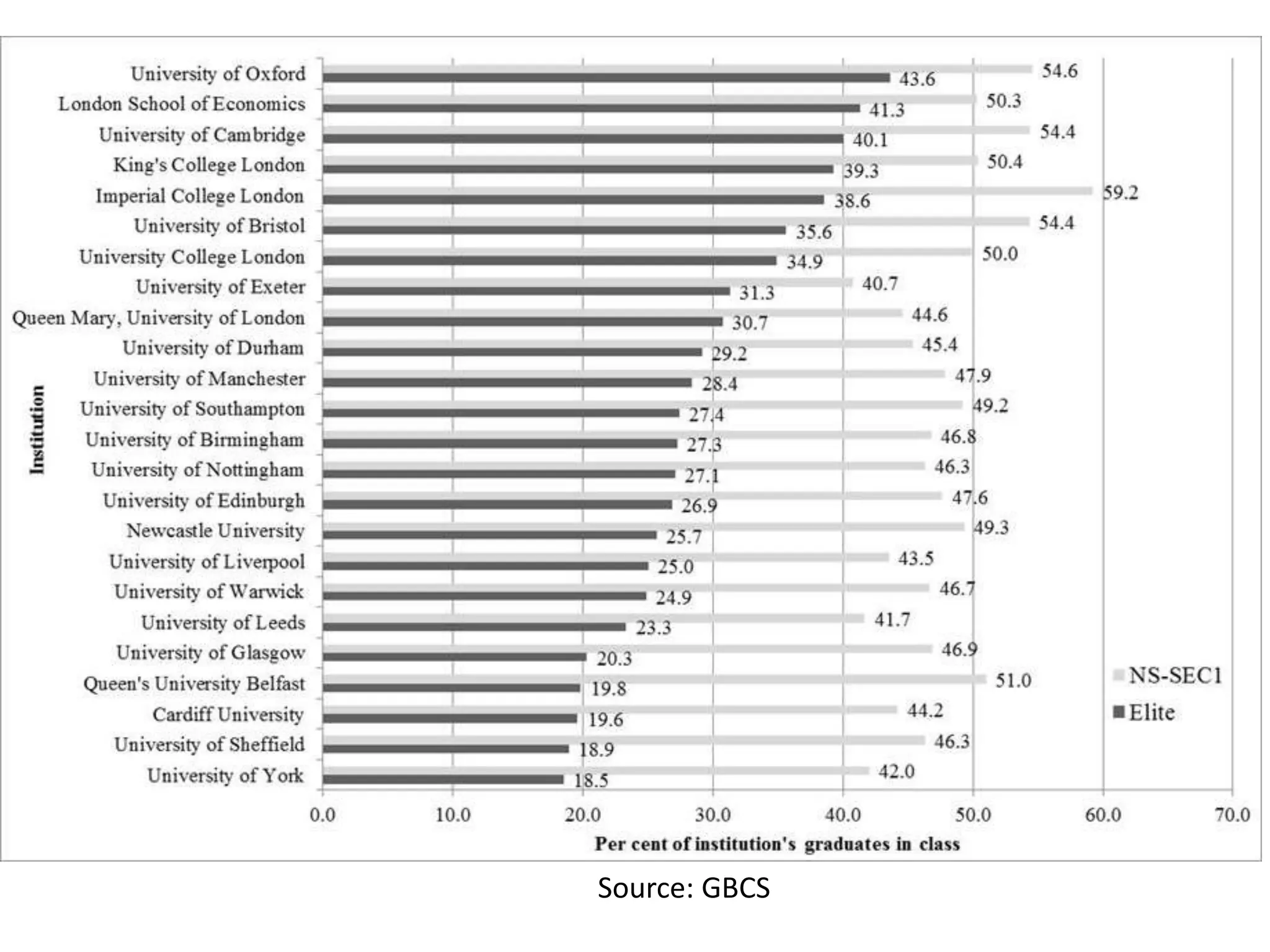
  • #23 Here is an example from our GBCS work. This looks at the % of graduates from russell group universities who get into our ‘elite’ class. The line here also steepens towards the top,
  • #24 Finally, here is an example from Katharina Hecht. She shows that whereas most people don’t think of themselves as upper or upper middle class, the proportion dramatically increases once you look at the really top earners – those earning over £200k a year are twice as likely to think of themselves in these terms compared to those earning 100-149k
  • #26 Finally, here is a possible model of class which is not based on your current job, but on your relationship to historical accumulation processes. It distinguishes between those who have significant accumulated wealth from their family, those who predominantly rely on accumulating capital over their life times (in terms of gaining skills, buying houses, saving, etc) and those who have no prospects of any sustained accumulation. The issue here is that sociologists have predominantly focused on boundaries within the midde class – but what about the two outliers? Isn’t this where our focus should be?