*
Child, Family, and School Social Workers
Child, family, and school social workers offer assistance to children and
youth as well as to their parents and guardians. Many are in child
welfare. They work with families where there has been abuse, or where
there is serious mental or physical illness. They may help parents find
resources they need so that the children can stay in the home or return
to the home. Sometimes this is not feasible; then they have a hand in
finding other placements.
child family school social worker
Social workers also work with children who are in stable home
environments. They respond to crises in the classroom and assess and
counsel school children who are experiencing stress, acting out, and/ or
being targeted by bullies; some conduct groups targeted toward
prevention. They also conduct trainings, make referrals, and serve on
interdisciplinary teams.
Social workers also provide support and therapy to children who have
experienced traumas, losses, or extra-familial abuse. They work with
youth who are experienced serious problems.
*Work settings are varied. Some social workers have offices in
public elementary or secondary schools; they may be stationed
at one school or have responsibilities at several. Other social
workers work for governmental organizations, residential care
facilities, adoption agencies or other social service agencies.
Their job duties may take them out into the community. They
may, for example, visit the homes of parents or prospective
guardians. There are times they need to testify in court.
*Community Social Workers
*Community social workers help communities function. Some work directly
with individuals, conducting needs assessments and making referrals to
resources in the community. Others assess needs on a larger scale. They
may plan and administer programs.
*community
*One type of community social work practice is community organization.
Social workers may be community builders or community organizers. They
may be employed by various nonprofits and grassroots organizations to
raise funds, write grants, drum up support, plan infrastructure. Dr. Mizrahi
of the Hunter College School of Social Work (CUNY) has written that many
people don’t realize they can work on these sorts of projects as a living
(not just in their spare time). A social work degree is not a requirement for
community organizing, but does provide a direct path into the field. Jane
Addams, Mirzahi notes, could be considered a community organizer.
*Service transcends borders. Social workers may work for international
organizations and even travel to distant lands. There is a particular need
for social workers when traditional support structures fail in the wake of
war or natural disaster. Social workers not only help people with immediate
needs, but set up systems that will endure after they leave. The situations
they encounter can be heartbreaking: children who have become mute or
otherwise regressed because of atrocities they have witnessed, adults who
think they are seeing the results of witchcraft… or that there is simply no
help to be offered.
*Hospice and palliative care
*provide medical care, pain management services and treatments, as
well as psychological, emotional, social, and spiritual support to
patients across the age spectrum who are suffering from severely
debilitating conditions or terminal diagnoses. Patients who require
hospice care and their families can experience a number of severe
hardships, such as depression, anger, and anxiety, intense physical
pain or discomfort, financial strain, social isolation, and family
conflict.
*Hospice social workers help both patients and their families navigate
the difficult process of end-of-life planning; manage the mental,
emotional, familial, and monetary stressors of debilitating physical
illness; understand their treatment plan and be vocal about their
needs; overcome crisis situations; and connect to other support
services in the area. Hospice workers are advocates for patients and
their families, and possess a deep knowledge of what their clients
need and what resources are available within and outside of hospice
settings to help them.
*Mental Health and Substance Abuse Social Workers
Mental health and substance abuse social workers work with clients who
have mental conditions and/or addictions. Often it is an “and” – in
schizophrenia and bipolar disorder, rates of substance abuse are well above
the norm. Trauma disordered individuals also turn frequently to alcohol and
other drugs of abuse. Social workers, with their knowledge of humans
systems, can be especially effective at addressing co-occurring disorders.
*substance abuse social worker
*Master’s trained clinical social workers provide psychotherapy. They also
act as case managers for individuals with complex needs. In hospital
settings, they act as discharge planners: navigating systems so that
people have the resources and support when they leave the hospital. In
an age of ever more effective pharmacological interventions – and ever
increasing medical costs – people are often stabilized quickly. There can
be incentive to push them right on out the door. But without long-term
intervention, relapse is unavoidable. Even with it, setbacks happen.
*Social workers uncover hidden problems and implement solutions. Some
provide outreach to aging parents who have spent a good portion of their
lives caring for grown children with mental illnesses. Some implement –
and advocate for – Integrated Dual Disorders Treatment. Integrated
treatment models are important because services have often been denied
to people who needed them because they had a concurrent diagnosis that
the facility did not feel equipped to handle.
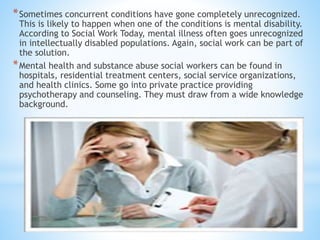
*Sometimes concurrent conditions have gone completely unrecognized.
This is likely to happen when one of the conditions is mental disability.
According to Social Work Today, mental illness often goes unrecognized
in intellectually disabled populations. Again, social work can be part of
the solution.
*Mental health and substance abuse social workers can be found in
hospitals, residential treatment centers, social service organizations,
and health clinics. Some go into private practice providing
psychotherapy and counseling. They must draw from a wide knowledge
background.
*Military and Veterans Affairs Social Workers
*The challenges of functioning in a military family… they’re
nothing new. In All Those Secrets of the World, children’s author
Jane Yolen told a story based on the day her father left for
World War II and the day he returned. When the father was
deployed, the younger child was a baby. When he returned, the
child was old enough to shout at the apparent stranger to get
away from his mama.
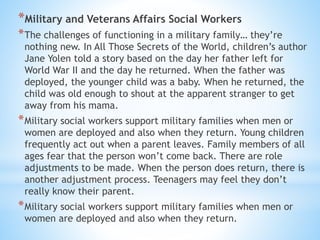
*Military social workers support military families when men or
women are deployed and also when they return. Young children
frequently act out when a parent leaves. Family members of all
ages fear that the person won’t come back. There are role
adjustments to be made. When the person does return, there is
another adjustment process. Teenagers may feel they don’t
really know their parent.
*Military social workers support military families when men or
women are deployed and also when they return.
*Of course it’s often the case, when the serviceperson isn’t traveling to
a war zone, that the whole family moves. This creates its own set of
challenges: children who struggle to form lasting friendships, spouses
who have little opportunity to develop their own careers. Social
workers offer therapy and counseling to the whole family.
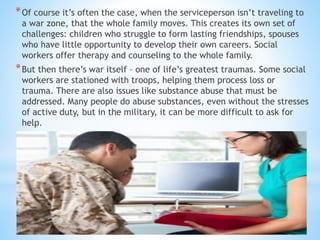
*But then there’s war itself – one of life’s greatest traumas. Some social
workers are stationed with troops, helping them process loss or
trauma. There are also issues like substance abuse that must be
addressed. Many people do abuse substances, even without the stresses
of active duty, but in the military, it can be more difficult to ask for
help.
*Psychiatric Social Workers and How to Become One
*Psychiatric social workers provide mental health services to individuals
with high needs. They may perform psychotherapy and even diagnose
mental illness.
*Duties vary according to work setting. Social workers in inpatient settings
often have primary responsibility for putting together the discharge plan.
This is not something that is filled out right before discharge – it’s an
ongoing process during much of the time the person is hospitalized. The
goal is ambitious: that the person will have the resources to function
optimally within the community. Hospital stays are shorter than they
were in the past, but patients sometimes need to transition to a
residential care center or a day program.
*child family school social worker
*Social workers who are employed at psychiatric hospitals also do
psychosocial assessments and provide therapy. They are in frequent
contact with the family members of patients. They meet with other
members of the mental health team (psychiatrists, nurse practitioners
etc.) to discuss patient care. If the patient is involved in any legal
procedures, the social worker may have a role in information gathering.
*Psychiatric social workers may also be employed in outpatient centers,
working with juveniles and adults. They perform psychotherapy and
assessments, educate the patient and his or her family, and make
referrals as necessary. Mental health therapies include more than just
talk. Social workers may, for example, employ Eye Movement
Desensitization and Reprocessing with young trauma survivors.
*Master’s level social workers serve as case managers for individuals who
have severe needs, those who may require periodic hospitalization as
well as intensive use of community resources. Clients may include those
with schizophrenia and those with complex sets of co-occurring
conditions.
*Governmental agencies and residential care facilities are among the
other employment options for psychiatric social workers. Some
eventually go into private practice as psychotherapists.
* Child Welfare
*The Child Welfare Information Gateway is the congressionally-
mandated and -funded information service of the United States
Children's Bureau, Administration for Children and Families,
United States Department of Health and Human Services.[1] It
was established in 2006 to replace the National Clearinghouse on
Child Abuse and Neglect Information and the National Adoption
Information Clearinghouse.[2][3] The Child Welfare Information
Gateway covers child-welfare topics, including family-centered
practice, child abuse and neglect, abuse and neglect prevention,
child protection, family preservation and support, foster care,
achieving and maintaining permanency, adoption, management
of child welfare agencies and related topics such as child and
family assessment, laws and policies, statistics and coincident
family issues (e.g., domestic violence and substance abuse).[4]
Its website links to sources of print and electronic publications,
websites, databases and online learning tools on these topics.[5]
*
*
* Adoption
* in the Philippines is a process of granting social, emotional and legal family and
kinship membership to an individual from the Philippines, usually a child.[2] It
involves a transfer of parental rights and obligations and provides family
membership. The Department of Social Welfare and Development (DSWD) defines
adoption as a "socio-legal process of giving a permanent family to a child whose
parents have voluntarily or involuntarily given up their parental rights."
* Philippine Republic Act 8552, also known as the Domestic Adoption Act of 1998,
recognizes that children should grow up with their biological parents; however,
should the efforts of biological parents to raise their child be insufficient, other
members of the extended family may take on the responsibility of parenthood for
the child. It is only when members of the extended family are not available that
adoption by non-relatives is allowed to take place.
* Adoption is a process whereby a person assumes the parenting of another, usually
a child, from that person's biological or legal parent or parents, and, in so doing,
permanently transfers all rights and responsibilities, along with filiation, from the
biological parent or parents.
* Unlike guardianship or other systems designed for the care of the young, adoption
is intended to effect a permanent change in status and as such requires societal
recognition, either through legal or religious sanction. Historically, some societies
have enacted specific laws governing adoption; where others have tried to
achieve adoption through less formal means, notably via contracts that specified
inheritance rights and parental responsibilities without an accompanying transfer
of filiation. Modern systems of adoption, arising in the 20th century, tend to be
governed by comprehensive statutes and regulations.
*Legal And Guardianship
*A legal guardian is a person who has the legal authority (and the
corresponding duty) to care for the personal and property interests
of another person, called a ward.[1] Guardians are typically used in
three situations: guardianship for an incapacitated senior (due to old
age or infirmity), guardianship for a minor, and guardianship for
developmentally disabled adults.
*Legal guardianship is a court order that says someone who is not the
child’s parent is in charge of taking care of the child. Legal guardians
have a lot of the same rights and responsibilities as parents. They
can decide where the child lives and goes to school, and they can
make decisions about the child’s health care.
Who are legal guardians?
A guardian does not have to be a relative of the child. Guardians can be:
-Grandparents,
-Sisters and brothers,
-Aunts and uncles,
-Other relatives,
-Foster parents,
-Friends of the family, or
-Someone else who knows the child.
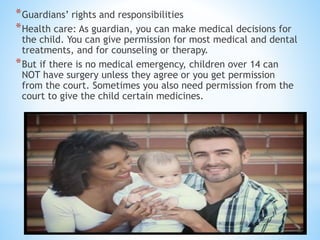
*Guardians’ rights and responsibilities
*Health care: As guardian, you can make medical decisions for
the child. You can give permission for most medical and dental
treatments, and for counseling or therapy.
*But if there is no medical emergency, children over 14 can
NOT have surgery unless they agree or you get permission
from the court. Sometimes you also need permission from the
court to give the child certain medicines.
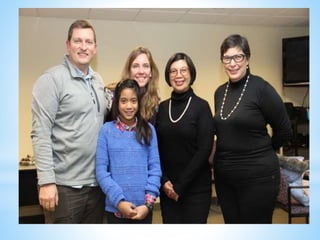
*FOSTERCARE
*Provides orphaned, abandoned and neglected children with a planned
period of substitute family care by foster families, duly licensed by the
Department of Social Welfare and Development (DSWD), when their
biological parents are unable to care for them temporarily or
permanently. Unlike adoption, foster care is temporary in nature. It
can either be on a short-term (less than six months) or long-term basis
(six months or more). It has a goal, which is either the return of the
child to his/her biological family or his/her placement in an adoptive
home.
*If you're new to the world of foster care, the prospect of becoming a
foster parent can be pretty intimidating. Foster parents are often called
"parents plus" because in addition to providing the food, shelter, care,
and love a good parent would provide for their own kids, they also have
to deal with the special circumstances of a foster child.
*Serving as a foster parent generally means working closely with a foster
agency on a regular basis, and often means regular contact with a child's
biological family as well. Foster children may also have special
psychological needs. Many come from abusive environments, and all are
in the stressful situation of being apart from their birth family.
Additionally, foster parents generally take care of the children for a
short time, which can be very difficult emotionally.
*Residential care
*refers to long-term care given to adults or children who stay in a
residential setting rather than in their own home or family home.
*There are various residential care options available, depending on
the needs of the individual. People with disabilities, mental health
problems, learning difficulties, Alzheimers, dementia or who are
frail aged are often cared for at home by paid or voluntary
caregivers, such as family and friends, with additional support
from home care agencies. However, if home-based care is not
available or not appropriate for the individual, residential care
may be required.
*A residential treatment center (RTC), sometimes called a rehab, is
a live-in health care facility providing therapy for substance
abuse, mental illness, or other behavioral problems. Residential
treatment may be considered the "last-ditch" approach to treating
abnormal psychology or psychopathology.
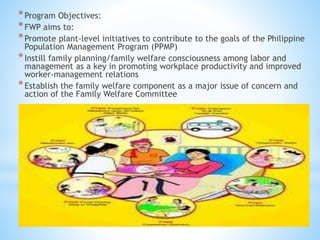
*The Family Welfare Program
*(FWP) seeks to introduce the concept of promoting the welfare of
workers and their families as a key to workplace productivity and
improved worker-management relations. It is an advocacy program
that draws corporate support in promoting workers’ quality of life by
adopting a family centered approach in the workplace.
*The FWP advocates for the integration of the 10 dimensions which also
serve as a guide in implementing the program:
*Reproductive Health and Responsible Parenthood
*Education/Gender Equality
*Spirituality or Value Formation
*Income Generation/Livelihood/Cooperative
*Medical Health Care
*Nutrition
*Environment Protection, hygiene and Sanitation
*Sports and Leisure
*Housing
*Transportation
*Program Objectives:
*FWP aims to:
*Promote plant-level initiatives to contribute to the goals of the Philippine
Population Management Program (PPMP)
*Instill family planning/family welfare consciousness among labor and
management as a key in promoting workplace productivity and improved
worker-management relations
*Establish the family welfare component as a major issue of concern and
action of the Family Welfare Committee
*Healthcare
* social work is a specialty within the social work field. A healthcare
social worker is someone who helps people access services and
education related to health problems. Their goal is to have the client
achieve and maintain a state of optimal health so they can function in
their daily lives. The social worker acts as a client advocate, educator,
advisor, coordinator of care, and strives to preserve the healthcare and
dignity of the population they serve.
*Healthcare social workers help patients navigate the world of
healthcare. These social workers can help individuals do everything
from find medical care to help pay for medical care to recover from an
illness or injury. This might include offering advice, acting as a patient
advocate, or referring a patient to facilities or programs.
*Assessing the needs of a patient is usually the first step that a
healthcare social worker will take. This might involve interviewing the
patient, their family, and their doctors. A thorough patient assessment
will help a healthcare social worker determine what a patient’s needs
are, and how these needs can be met.
*A career in healthcare social work also often involves informing patients of
their rights. In general, a patient’s rights typically include - but, aren’t limited
to - such things as:
*The right to be treated with respect and dignity
*The right to make decisions regarding healthcare
*The right to choose a doctor that can give adequate care
*The right to ask questions and have them answered in easy to understand
terms
*The right to be free of abuse, neglect, or exploitation
*The right to know how much medical treatment will cost before undergoing
any procedures
*The right to access one’s own medical information
*The right to emergency medical treatment regardless of the ability to pay
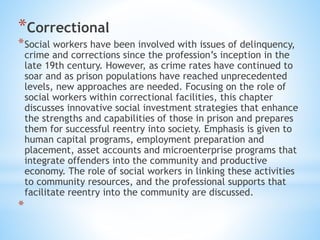
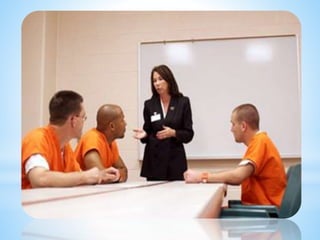
*Correctional
*Social workers have been involved with issues of delinquency,
crime and corrections since the profession’s inception in the
late 19th century. However, as crime rates have continued to
soar and as prison populations have reached unprecedented
levels, new approaches are needed. Focusing on the role of
social workers within correctional facilities, this chapter
discusses innovative social investment strategies that enhance
the strengths and capabilities of those in prison and prepares
them for successful reentry into society. Emphasis is given to
human capital programs, employment preparation and
placement, asset accounts and microenterprise programs that
integrate offenders into the community and productive
economy. The role of social workers in linking these activities
to community resources, and the professional supports that
facilitate reentry into the community are discussed.
*
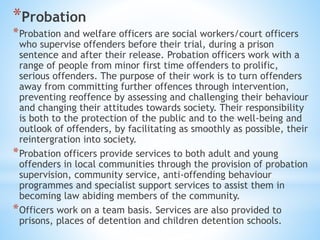
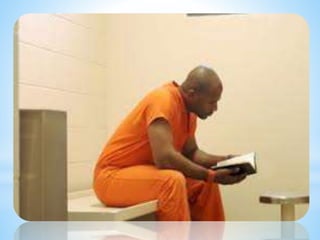
*Probation
*Probation and welfare officers are social workers/court officers
who supervise offenders before their trial, during a prison
sentence and after their release. Probation officers work with a
range of people from minor first time offenders to prolific,
serious offenders. The purpose of their work is to turn offenders
away from committing further offences through intervention,
preventing reoffence by assessing and challenging their behaviour
and changing their attitudes towards society. Their responsibility
is both to the protection of the public and to the well-being and
outlook of offenders, by facilitating as smoothly as possible, their
reintergration into society.
*Probation officers provide services to both adult and young
offenders in local communities through the provision of probation
supervision, community service, anti-offending behaviour
programmes and specialist support services to assist them in
becoming law abiding members of the community.
*Officers work on a team basis. Services are also provided to
prisons, places of detention and children detention schools.
*Parole
* parole agencies share one particular and significant function:
they provide supervision of offenders in the community. After
an offender has been granted probation or parole, a
probation or parole officer, hereafter referred to as "PO," is
expected to supervise that offender in the community. The
basic question remains: What is the purpose of supervision? To
some, the function of supervision, drawn from the field of
social work, is based upon the casework model. Based on this
view, supervision forms the basis of a treatment program. The
officer uses all the information available about the offender
to make a diagnosis of that person's needs and designs a
treatment plan. The treatment plan is an outline based on
the needs of the offender (e.g., employment), and the PO's
strategy for assisting the offenders in meeting their goal
(e.g., enroll the offender in a job skills program).
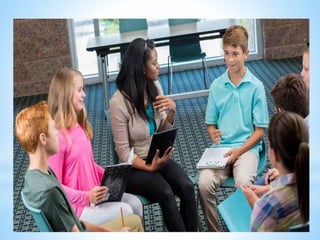
*School
*A school social worker provides counseling and psycho-social
services to children and adolescents in schools at both micro and
macro levels. Social workers work as mental health experts,
leaders of social and emotional development within the school
community, family-school liaisons, and program development
experts. They aim to address student issues by working with an
ecological, systems approach with parents, the school, and the
community. They also work with crisis intervention, group
treatment, child neglect and abuse identification and reporting,
integrating services to culturally and economically diverse
populations, and working on education policy issues. Most school
social workers in the United States hold a Master of Social Work
degree and have specialized training in helping students within
the context of local schools.
Areas of specialization in social work