Gender, Violence, Activism & Politics: 
Necessities for Change 
7th Australian Women’s Health Conference 
Sydney May 7-10 2013
Feminist Informed Practice 
 "lived experiences of women" and informs a discourse 
critical in its examination of power relations, social 
structures, values and beliefs, policies and practices. 
 Gendered violence 
 "the intentional physical, sexual and/or psychological 
abuse of women due to their biological sex and/or their 
social role (Lobmann, Greve, Wetzels, & Bosold, 2003).
Gender Matters 
 Gender power relations and gender inequality are 
consequently acknowledged as central to the practice 
of gender based violence. 
 Women’s experience of violence is shaped by the 
social, historic, cultural, economic and political 
contexts in which they live (Fergus 2012)
Personal is Political 
“Central to feminist philosophy has been the 
commitment to link the personal to the political with 
services using their knowledge from their own service 
provision to build social action and community 
education programmes to fight for structural change.” 
(Eagen and Houston 1999, p. 408 as cited by McDonald, 2005)
Community Based Feminist 
Services: Agents of Change 
Feminist women's services have a triple purpose 
 educating women to increase their personal power and 
control in their lives 
 educating the wider community on women's issues 
 initiating activism contributing to policy and law 
reform 
(Weeks 1994)
Right turn ahead…. 
 Gender neutral service models 
 Neo-liberal ideology - shift to conservative right 
 “Free market” & economic rationalism 
 Competitive tendering 
 “gagging” clauses in funding agreements
Shifting Focus….. 
“....the feminist analysis of family violence has 
experienced ongoing silencing due to an 
increased accountability attached to government 
funding in addition to an increased focus on 
individual empowerment. Due to human services 
being subjected to a competitive market, family 
violence programs are forced to produce 
measurable outcome-based data.”(Webb, 2012, p.6)
Quality? 
little space for feminist informed evaluation strategies and 
narratives that take into account women’s experiences of, 
not only the service they may have received, but the 
differences for her in real and practical terms such as 
access to housing, education, employment and an 
increased sense of safety.
“…to both the growing involvement by mental 
health experts with the issue of domestic violence 
and to the pressure experienced by some refuges 
to secure funding by developing their services in 
line with more conventional social welfare 
agencies. Via processes such as these, it is 
argued that ‘a severe and political problem has 
been transformed into a psychological one’ 
(Gondolf & Fisher, 1988, p.2 cited in Laing, 2001 p. 3.)
Loss of Voice 
“At the heart of the problem is the structuring of a 
competitive market of human services that suppresses 
the social agenda of agencies such as government-funded 
feminist organisations.” 
(Egan and Houston, 1999 as cited by McDonald, 2005)
Holistic? Collaborative?- 
Sounds like Feminist to me! 
women’s services (responding to domestic violence) have 
historically worked in this way to improve access and 
equity to women seeking services and support and to 
raise women’s issues and needs within their communities. 
(Networks and partnerships).
Consequences… 
 Lack of awareness of complexities & dynamics of 
domestic violence/abuse 
 Failure to engage with broader issues 
 Focusing on presenting issue 
 Compromise safety 
 a “problem” rather than a crime 
 “relationship issue” referral for couple counselling
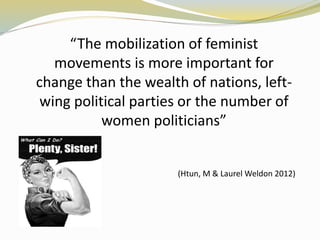
“The mobilization of feminist 
movements is more important for 
change than the wealth of nations, left-wing 
political parties or the number of 
women politicians” 
(Htun, M & Laurel Weldon 2012)

3.4.4 ms betty green

  • 1.
    Gender, Violence, Activism& Politics: Necessities for Change 7th Australian Women’s Health Conference Sydney May 7-10 2013
  • 2.
    Feminist Informed Practice  "lived experiences of women" and informs a discourse critical in its examination of power relations, social structures, values and beliefs, policies and practices.  Gendered violence  "the intentional physical, sexual and/or psychological abuse of women due to their biological sex and/or their social role (Lobmann, Greve, Wetzels, & Bosold, 2003).
  • 3.
    Gender Matters Gender power relations and gender inequality are consequently acknowledged as central to the practice of gender based violence.  Women’s experience of violence is shaped by the social, historic, cultural, economic and political contexts in which they live (Fergus 2012)
  • 4.
    Personal is Political “Central to feminist philosophy has been the commitment to link the personal to the political with services using their knowledge from their own service provision to build social action and community education programmes to fight for structural change.” (Eagen and Houston 1999, p. 408 as cited by McDonald, 2005)
  • 5.
    Community Based Feminist Services: Agents of Change Feminist women's services have a triple purpose  educating women to increase their personal power and control in their lives  educating the wider community on women's issues  initiating activism contributing to policy and law reform (Weeks 1994)
  • 6.
    Right turn ahead….  Gender neutral service models  Neo-liberal ideology - shift to conservative right  “Free market” & economic rationalism  Competitive tendering  “gagging” clauses in funding agreements
  • 7.
    Shifting Focus….. “....thefeminist analysis of family violence has experienced ongoing silencing due to an increased accountability attached to government funding in addition to an increased focus on individual empowerment. Due to human services being subjected to a competitive market, family violence programs are forced to produce measurable outcome-based data.”(Webb, 2012, p.6)
  • 8.
    Quality? little spacefor feminist informed evaluation strategies and narratives that take into account women’s experiences of, not only the service they may have received, but the differences for her in real and practical terms such as access to housing, education, employment and an increased sense of safety.
  • 9.
    “…to both thegrowing involvement by mental health experts with the issue of domestic violence and to the pressure experienced by some refuges to secure funding by developing their services in line with more conventional social welfare agencies. Via processes such as these, it is argued that ‘a severe and political problem has been transformed into a psychological one’ (Gondolf & Fisher, 1988, p.2 cited in Laing, 2001 p. 3.)
  • 10.
    Loss of Voice “At the heart of the problem is the structuring of a competitive market of human services that suppresses the social agenda of agencies such as government-funded feminist organisations.” (Egan and Houston, 1999 as cited by McDonald, 2005)
  • 11.
    Holistic? Collaborative?- Soundslike Feminist to me! women’s services (responding to domestic violence) have historically worked in this way to improve access and equity to women seeking services and support and to raise women’s issues and needs within their communities. (Networks and partnerships).
  • 12.
    Consequences…  Lackof awareness of complexities & dynamics of domestic violence/abuse  Failure to engage with broader issues  Focusing on presenting issue  Compromise safety  a “problem” rather than a crime  “relationship issue” referral for couple counselling
  • 13.
    “The mobilization offeminist movements is more important for change than the wealth of nations, left-wing political parties or the number of women politicians” (Htun, M & Laurel Weldon 2012)