04/06/2015
1
Research Project: 
Students’ reasons for choosing 
Sociology A level and the advice 
they are given
Cambridge Assessment Structure
04/06/2015
2
Research Project:
Students’ reasons for
choosing Sociology A level
and the advice they are
given
Prerna Carroll and Jess Munro
Research Division, Cambridge Assessment
Background
• A level reform: decoupling of AS and A level
• Careers advice and guidance: what advice do
students receive?
• Factors known to affect student choice:
 Personal (enjoyment, prior attainment, aspirations)
 School level (careers advice, teachers, departmental factors)
 Advice from others (parents, teaching staff, friends)
04/06/2015
3
The study
Two online questionnaires covering:
• AS level choices
• A level choices
• Advice received
• Demographic information
Sample
• 341 participants (240 at AS; 101 at A level)
• 82.9% female
• 43 participants had taken GCSE Sociology
• Parental educational background: 39.7% had at
least one graduate parent
• Levels of deprivation (using IDACI score): Low
33.3%/ Medium 34.4%/ High 32.3%
04/06/2015
4
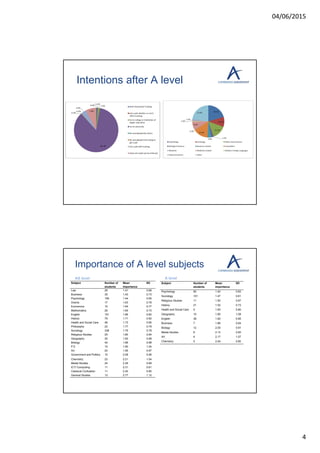
Intentions after A level
Importance of A level subjects
Subject Number of
students
Mean
importance
SD
Law 28 1.41 0.68
Business 35 1.43 0.73
Psychology 190 1.44 0.65
Drama 17 1.63 0.78
Economics 10 1.64 0.77
Mathematics 26 1.65 0.73
English 151 1.66 0.82
History 79 1.71 0.92
Health and Social Care 46 1.73 0.90
Philosophy 22 1.77 0.79
Sociology 338 1.79 0.78
Religious Studies 25 1.80 0.94
Geography 30 1.83 0.99
Biology 44 1.86 0.98
P.E 10 1.90 1.04
Art 20 1.95 0.97
Government and Politics 10 2.08 0.95
Chemistry 23 2.21 1.04
Media Studies 24 2.29 0.89
ICT/ Computing 11 2.31 0.61
Classical Civilization 11 2.40 0.80
General Studies 13 2.77 1.12
Subject Number of
students
Mean
importance
SD
Psychology 60 1.42 0.62
Sociology 101 1.47 0.61
Religious Studies 11 1.50 0.67
History 21 1.52 0.73
Health and Social Care 5 1.60 0.80
Geography 10 1.80 1.08
English 38 1.82 0.85
Business 7 1.86 0.64
Biology 12 2.00 0.91
Media Studies 8 2.13 0.60
Art 6 2.17 1.07
Chemistry 5 2.40 0.80
AS level A level
04/06/2015
5
Reasons for choosing Sociology at AS
Demographic differences at AS
Parental background:
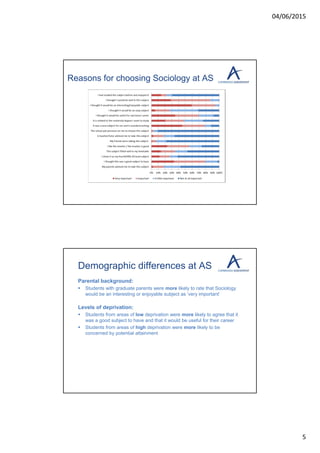
 Students with graduate parents were more likely to rate that Sociology
would be an interesting or enjoyable subject as ‘very important’
Levels of deprivation:
 Students from areas of low deprivation were more likely to agree that it
was a good subject to have and that it would be useful for their career
 Students from areas of high deprivation were more likely to be
concerned by potential attainment
04/06/2015
6
Continuing Sociology
Year Group Intention Number of students Percentage
Year 12 Yes 179 74.9
No 60 25.1
Year 13 Yes 81 80.2
No 19 18.8
Parental background:
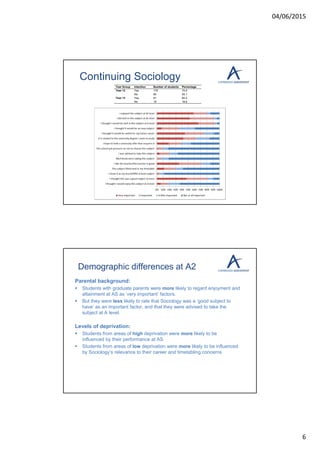
 Students with graduate parents were more likely to regard enjoyment and
attainment at AS as ‘very important’ factors.
 But they were less likely to rate that Sociology was a ‘good subject to
have’ as an important factor, and that they were advised to take the
subject at A level.
Levels of deprivation:
 Students from areas of high deprivation were more likely to be
influenced by their performance at AS
 Students from areas of low deprivation were more likely to be influenced
by Sociology’s relevance to their career and timetabling concerns
Demographic differences at A2
04/06/2015
7
Advice received
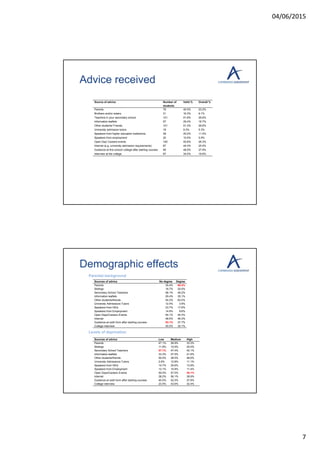
Source of advice Number of
students
Valid % Overall %
Parents 79 40.5% 23.2%
Brothers and/or sisters 31 16.3% 9.1%
Teachers in your secondary school 101 51.8% 29.6%
Information leaflets 57 29.4% 16.7%
Other students/ Friends 101 51.3% 29.6%
University admission tutors 18 9.3% 5.3%
Speakers from higher education institutions 39 20.2% 11.4%
Speakers from employment 20 10.5% 5.9%
Open Day/ Careers events 100 50.8% 29.3%
Internet (e.g. university admission requirements) 87 44.4% 25.5%
Guidance at this school/ college after starting courses 95 48.5% 27.9%
Interview at the college 67 34.0% 19.6%
Demographic effects
Sources of advice No degree Degree
Parents 35.4% 60.4%
Siblings 16.7% 20.0%
Secondary School Teachers 56.1% 46.2%
Information leaflets 29.4% 35.1%
Other students/friends 54.2% 63.0%
University Admissions Tutors 12.4% 3.9%
Speakers from HEIs 23.7% 17.6%
Speakers from Employment 14.9% 9.6%
Open Days/Careers Events 54.1% 45.3%
Internet 48.5% 46.3%
Guidance at sixth form after starting courses 53.1% 37.7%
College interview 30.2% 32.1%
Sources of advice Low Medium High
Parents 47.1% 28.9% 33.3%
Siblings 11.8% 10.5% 25.0%
Secondary School Teachers 57.1% 47.4% 42.1%
Information leaflets 33.3% 27.5% 21.6%
Other students/friends 50.0% 38.5% 48.6%
University Admissions Tutors 2.9% 12.8% 11.1%
Speakers from HEIs 14.7% 25.6% 13.9%
Speakers from Employment 12.1% 15.8% 11.4%
Open Days/Careers Events 50.0% 57.5% 35.1%
Internet 38.2% 56.1% 38.9%
Guidance at sixth form after starting courses 45.5% 52.5% 37.8%
College interview 23.5% 43.6% 32.4%
Parental background
Levels of deprivation
04/06/2015
8
Utility of advice
Positivity of advice
04/06/2015
9
Demographic effects
Parental background
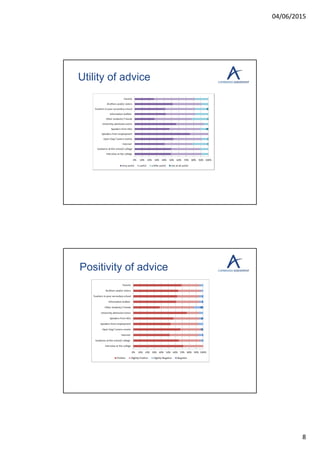
 Students from graduate backgrounds were more likely to find family
members and open days to be useful
 Students from non-graduate backgrounds were more likely to find that
the internet had been very useful
 All advice was broadly positive, but more muted for students from
graduate backgrounds
Levels of deprivation
 Where students from the most deprived areas received advice, they
rated it in line with other students
 Students from areas of low deprivation found their friends to be more
positive about Sociology
 Students from areas of high deprivation found open days and college
interviews to be more positive than other participants
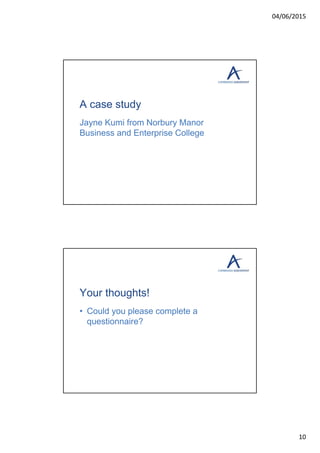
Additional advice wanted
• "People who have done this subject and their experiences.”
• “The amount of work/homework”
• “Where you can go or what you can do with an A level or degree in sociology”
04/06/2015
10
A case study
Jayne Kumi from Norbury Manor
Business and Enterprise College
Your thoughts!
• Could you please complete a
questionnaire?
Background
A level Sociology has been reformed for first teaching from 2015. The reforms mean that all A levels
will move from a modular to a linear system, requiring that students take their exams at the end of
the course, rather than throughout as is currently the case. Additionally, AS and A levels are being
‘decoupled’, meaning that the AS level will become a stand-alone qualification and will no longer
count towards a student’s achievement in the overall A level. This has led to concern about the
possible effects this may have on uptake of Sociology at A level, as it is a popular subject but one
which is usually new to students at this level.
Purpose
Whilst there is a great deal of literature about students’ decision-making at GCSE and A level, none
so far has sought to understand students’ decisions surrounding Sociology specifically.
Consequently, researchers from Cambridge Assessment sought to answer the following research
questions:
1. Why do students choose Sociology at AS level, and why do they continue it to the full A
level?
2. Do students originally plan to study Sociology for both years, or to drop it after AS level?
3. What sources of advice do students receive about studying Sociology at AS and A level? How
useful, and how positive, is this advice?
The findings of this study would therefore help to build a clearer picture of students’ decision-
making about Sociology and provide OCR and schools with more information with which to predict
future changes in A level uptake, as well as how to best promote the subject to prospective
students.
Design
Two online questionnaires were created in collaboration with colleagues from OCR, one for students
taking AS level Sociology and one for students currently taking A level Sociology. The questionnaires
asked about the reasons participants chose to study Sociology in Year 12, as well as why Year 13
students continued to study it after AS level. Additionally, participants were asked about the advice
they had received about studying Sociology, including how useful this advice was and whether it had
been positive or negative.
Colleges offering A level Sociology were invited to ask their students to participate. 341 students
participated, with 240 currently taking AS level and 101 studying at A level.
Findings
Contrary to concerns that students consider Sociology to be a ‘soft’ option, few respondents
Research Project: Students’ reasons for studying Sociology A
level and the advice they receive
Prerna Carroll and Jessica Munro
reported that they considered it to be an easy subject. Additionally, whilst approximately a quarter
of Year 12 students reported choosing it as a fourth or fifth subject, three-quarters planned to
continue Sociology after AS level and 44.8% of all participants planned to study Sociology or another
Social Science at university. The data also indicates that the AS level plays a particular role in
students’ decision-making, with participants reporting that different factors were influential in their
decision to study Sociology at AS and A level. At AS, the most important reasons for studying
Sociology were:
• I thought it would be an interesting/enjoyable subject
• I thought this subject would be useful for my future career
• It was a new subject for me and it sounded exciting
However, at A level participants were influenced by more practical concerns, primarily prior
attainment at AS and expected attainment at A level. The most important reasons were:
• I enjoyed this subject at AS level
• I did well in this subject at AS level
• I thought I would do well in this subject at A level
Nearly one in five Year 13 students also reported that they did not originally plan to continue
studying Sociology after AS level when they began the course, and respondents were more likely to
rate Sociology as an important subject at A level than AS, suggesting that the AS level changes
students’ perceptions of the subject.
With regards to the advice students received, only 53.3% reported receiving any advice about
studying Sociology. Participants were most likely to have received advice from secondary school
teachers, friends and other students, as well as at open days and careers events. Of the most
frequently accessed sources students particularly valued advice from teaching staff at both their
secondary school and their sixth form, as well as at open days, and found that advice from parents
and friends was the least useful. In terms of additional advice, 46% stated that they would have liked
to have received more advice about Sociology, including related careers and degrees, as well as the
course content and assessment at A level.
Implications
The fact that students are influenced by different factors at AS and A level suggests that decoupling
may make students more reluctant to take Sociology at A level without prior experience of the
subject at GCSE. Whilst Sociology is a very popular subject, participants reported that attainment at
AS and expected attainment at A level were the strongest motivating factors in their decision to
continue the subject in Year 13.
However, the findings of this study also suggest that that students have an intrinsic interest in
Sociology and do not consider it to be a ‘soft’ option. Consequently, by providing more information
to prospective students about the A level structure and future pathways into Sociology-related
degrees and careers, OCR and Sociology teaching staff may able to counteract any negative impact
on uptake by ensuring students are properly informed about the realities and benefits of studying
Sociology.

Students’ reasons for choosing Sociology A level and the advice they are given by Helen Hemmings

  • 1.
  • 2.
    04/06/2015 2 Research Project: Students’ reasonsfor choosing Sociology A level and the advice they are given Prerna Carroll and Jess Munro Research Division, Cambridge Assessment Background • A level reform: decoupling of AS and A level • Careers advice and guidance: what advice do students receive? • Factors known to affect student choice:  Personal (enjoyment, prior attainment, aspirations)  School level (careers advice, teachers, departmental factors)  Advice from others (parents, teaching staff, friends)
  • 3.
    04/06/2015 3 The study Two onlinequestionnaires covering: • AS level choices • A level choices • Advice received • Demographic information Sample • 341 participants (240 at AS; 101 at A level) • 82.9% female • 43 participants had taken GCSE Sociology • Parental educational background: 39.7% had at least one graduate parent • Levels of deprivation (using IDACI score): Low 33.3%/ Medium 34.4%/ High 32.3%
  • 4.
    04/06/2015 4 Intentions after Alevel Importance of A level subjects Subject Number of students Mean importance SD Law 28 1.41 0.68 Business 35 1.43 0.73 Psychology 190 1.44 0.65 Drama 17 1.63 0.78 Economics 10 1.64 0.77 Mathematics 26 1.65 0.73 English 151 1.66 0.82 History 79 1.71 0.92 Health and Social Care 46 1.73 0.90 Philosophy 22 1.77 0.79 Sociology 338 1.79 0.78 Religious Studies 25 1.80 0.94 Geography 30 1.83 0.99 Biology 44 1.86 0.98 P.E 10 1.90 1.04 Art 20 1.95 0.97 Government and Politics 10 2.08 0.95 Chemistry 23 2.21 1.04 Media Studies 24 2.29 0.89 ICT/ Computing 11 2.31 0.61 Classical Civilization 11 2.40 0.80 General Studies 13 2.77 1.12 Subject Number of students Mean importance SD Psychology 60 1.42 0.62 Sociology 101 1.47 0.61 Religious Studies 11 1.50 0.67 History 21 1.52 0.73 Health and Social Care 5 1.60 0.80 Geography 10 1.80 1.08 English 38 1.82 0.85 Business 7 1.86 0.64 Biology 12 2.00 0.91 Media Studies 8 2.13 0.60 Art 6 2.17 1.07 Chemistry 5 2.40 0.80 AS level A level
  • 5.
    04/06/2015 5 Reasons for choosingSociology at AS Demographic differences at AS Parental background:  Students with graduate parents were more likely to rate that Sociology would be an interesting or enjoyable subject as ‘very important’ Levels of deprivation:  Students from areas of low deprivation were more likely to agree that it was a good subject to have and that it would be useful for their career  Students from areas of high deprivation were more likely to be concerned by potential attainment
  • 6.
    04/06/2015 6 Continuing Sociology Year GroupIntention Number of students Percentage Year 12 Yes 179 74.9 No 60 25.1 Year 13 Yes 81 80.2 No 19 18.8 Parental background:  Students with graduate parents were more likely to regard enjoyment and attainment at AS as ‘very important’ factors.  But they were less likely to rate that Sociology was a ‘good subject to have’ as an important factor, and that they were advised to take the subject at A level. Levels of deprivation:  Students from areas of high deprivation were more likely to be influenced by their performance at AS  Students from areas of low deprivation were more likely to be influenced by Sociology’s relevance to their career and timetabling concerns Demographic differences at A2
  • 7.
    04/06/2015 7 Advice received Source ofadvice Number of students Valid % Overall % Parents 79 40.5% 23.2% Brothers and/or sisters 31 16.3% 9.1% Teachers in your secondary school 101 51.8% 29.6% Information leaflets 57 29.4% 16.7% Other students/ Friends 101 51.3% 29.6% University admission tutors 18 9.3% 5.3% Speakers from higher education institutions 39 20.2% 11.4% Speakers from employment 20 10.5% 5.9% Open Day/ Careers events 100 50.8% 29.3% Internet (e.g. university admission requirements) 87 44.4% 25.5% Guidance at this school/ college after starting courses 95 48.5% 27.9% Interview at the college 67 34.0% 19.6% Demographic effects Sources of advice No degree Degree Parents 35.4% 60.4% Siblings 16.7% 20.0% Secondary School Teachers 56.1% 46.2% Information leaflets 29.4% 35.1% Other students/friends 54.2% 63.0% University Admissions Tutors 12.4% 3.9% Speakers from HEIs 23.7% 17.6% Speakers from Employment 14.9% 9.6% Open Days/Careers Events 54.1% 45.3% Internet 48.5% 46.3% Guidance at sixth form after starting courses 53.1% 37.7% College interview 30.2% 32.1% Sources of advice Low Medium High Parents 47.1% 28.9% 33.3% Siblings 11.8% 10.5% 25.0% Secondary School Teachers 57.1% 47.4% 42.1% Information leaflets 33.3% 27.5% 21.6% Other students/friends 50.0% 38.5% 48.6% University Admissions Tutors 2.9% 12.8% 11.1% Speakers from HEIs 14.7% 25.6% 13.9% Speakers from Employment 12.1% 15.8% 11.4% Open Days/Careers Events 50.0% 57.5% 35.1% Internet 38.2% 56.1% 38.9% Guidance at sixth form after starting courses 45.5% 52.5% 37.8% College interview 23.5% 43.6% 32.4% Parental background Levels of deprivation
  • 8.
  • 9.
    04/06/2015 9 Demographic effects Parental background Students from graduate backgrounds were more likely to find family members and open days to be useful  Students from non-graduate backgrounds were more likely to find that the internet had been very useful  All advice was broadly positive, but more muted for students from graduate backgrounds Levels of deprivation  Where students from the most deprived areas received advice, they rated it in line with other students  Students from areas of low deprivation found their friends to be more positive about Sociology  Students from areas of high deprivation found open days and college interviews to be more positive than other participants Additional advice wanted • "People who have done this subject and their experiences.” • “The amount of work/homework” • “Where you can go or what you can do with an A level or degree in sociology”
  • 10.
    04/06/2015 10 A case study JayneKumi from Norbury Manor Business and Enterprise College Your thoughts! • Could you please complete a questionnaire?
  • 11.
    Background A level Sociologyhas been reformed for first teaching from 2015. The reforms mean that all A levels will move from a modular to a linear system, requiring that students take their exams at the end of the course, rather than throughout as is currently the case. Additionally, AS and A levels are being ‘decoupled’, meaning that the AS level will become a stand-alone qualification and will no longer count towards a student’s achievement in the overall A level. This has led to concern about the possible effects this may have on uptake of Sociology at A level, as it is a popular subject but one which is usually new to students at this level. Purpose Whilst there is a great deal of literature about students’ decision-making at GCSE and A level, none so far has sought to understand students’ decisions surrounding Sociology specifically. Consequently, researchers from Cambridge Assessment sought to answer the following research questions: 1. Why do students choose Sociology at AS level, and why do they continue it to the full A level? 2. Do students originally plan to study Sociology for both years, or to drop it after AS level? 3. What sources of advice do students receive about studying Sociology at AS and A level? How useful, and how positive, is this advice? The findings of this study would therefore help to build a clearer picture of students’ decision- making about Sociology and provide OCR and schools with more information with which to predict future changes in A level uptake, as well as how to best promote the subject to prospective students. Design Two online questionnaires were created in collaboration with colleagues from OCR, one for students taking AS level Sociology and one for students currently taking A level Sociology. The questionnaires asked about the reasons participants chose to study Sociology in Year 12, as well as why Year 13 students continued to study it after AS level. Additionally, participants were asked about the advice they had received about studying Sociology, including how useful this advice was and whether it had been positive or negative. Colleges offering A level Sociology were invited to ask their students to participate. 341 students participated, with 240 currently taking AS level and 101 studying at A level. Findings Contrary to concerns that students consider Sociology to be a ‘soft’ option, few respondents Research Project: Students’ reasons for studying Sociology A level and the advice they receive Prerna Carroll and Jessica Munro
  • 12.
    reported that theyconsidered it to be an easy subject. Additionally, whilst approximately a quarter of Year 12 students reported choosing it as a fourth or fifth subject, three-quarters planned to continue Sociology after AS level and 44.8% of all participants planned to study Sociology or another Social Science at university. The data also indicates that the AS level plays a particular role in students’ decision-making, with participants reporting that different factors were influential in their decision to study Sociology at AS and A level. At AS, the most important reasons for studying Sociology were: • I thought it would be an interesting/enjoyable subject • I thought this subject would be useful for my future career • It was a new subject for me and it sounded exciting However, at A level participants were influenced by more practical concerns, primarily prior attainment at AS and expected attainment at A level. The most important reasons were: • I enjoyed this subject at AS level • I did well in this subject at AS level • I thought I would do well in this subject at A level Nearly one in five Year 13 students also reported that they did not originally plan to continue studying Sociology after AS level when they began the course, and respondents were more likely to rate Sociology as an important subject at A level than AS, suggesting that the AS level changes students’ perceptions of the subject. With regards to the advice students received, only 53.3% reported receiving any advice about studying Sociology. Participants were most likely to have received advice from secondary school teachers, friends and other students, as well as at open days and careers events. Of the most frequently accessed sources students particularly valued advice from teaching staff at both their secondary school and their sixth form, as well as at open days, and found that advice from parents and friends was the least useful. In terms of additional advice, 46% stated that they would have liked to have received more advice about Sociology, including related careers and degrees, as well as the course content and assessment at A level. Implications The fact that students are influenced by different factors at AS and A level suggests that decoupling may make students more reluctant to take Sociology at A level without prior experience of the subject at GCSE. Whilst Sociology is a very popular subject, participants reported that attainment at AS and expected attainment at A level were the strongest motivating factors in their decision to continue the subject in Year 13. However, the findings of this study also suggest that that students have an intrinsic interest in Sociology and do not consider it to be a ‘soft’ option. Consequently, by providing more information to prospective students about the A level structure and future pathways into Sociology-related degrees and careers, OCR and Sociology teaching staff may able to counteract any negative impact on uptake by ensuring students are properly informed about the realities and benefits of studying Sociology.