SOCIAL CASE
WORK
TABLE OF CONTENTS
 INTRODUCTION TO SOCIAL CASE WORK.
 HISTORICAL EVOLUTION OF SOCIAL CASEWORK
 PRINCIPLES OF SOCIAL CASEWORK:
 STAGES OF SOCIAL CASEWORK:
 COMPONENTS OF SOCIAL CASEWORK:
 TECHNIQUES OF SOCIAL CASE WORK
2
Hello!
I’M PRESENTING A BRIEF INTRODUCTION OF SOCISL CASEWORK
3
INTRODUCTION
SOCIAL CASEWORK
4
“
 Casework is the oldest and the most developed method of solving
individual’s problems and improving his social relations.
 Social case work is a method employed by social workers to help
individuals find a solution to problems of social adjustment which they
are unable to handle in a satisfactory way by their own effort.
5
Historical development of social casework:
 The Association for Improving the Condition of the Poor (A.I.C.P.) formed in America in 1843 approached the
Problem of poverty more individually than had been previously it was.
 The aims of A.I.C.P. were to visit the poor at homes, to give counsel, to assist them practically in obtaining employment, to
instill in them self-respect and self-reliance.
 The first professional School of Social Work was the New York School established in 1898.
 Impact of First World War.
 The First World War made a wide impact on social casework.
 Psychiatry in this period became important.
 Impact of Second World War.
 Social casework was greatly influenced by the events of Second World War.
6
Major Landmarks in the History of
Casework Development
Contribution of Friendly Visitor
7
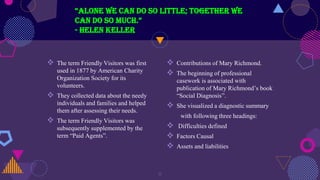
 The term Friendly Visitors was first
used in 1877 by American Charity
Organization Society for its
volunteers.
 They collected data about the needy
individuals and families and helped
them after assessing their needs.
 The term Friendly Visitors was
subsequently supplemented by the
term “Paid Agents”.
“Alone we can do so little; together we
can do so much.”
- Helen Keller
 Contributions of Mary Richmond.
 The beginning of professional
casework is associated with
publication of Mary Richmond’s book
“Social Diagnosis”.
 She visualized a diagnostic summary
with following three headings:
 Difficulties defined
 Factors Causal
 Assets and liabilities
8
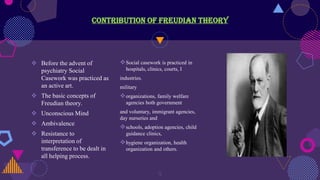
Contribution of Freudian Theory
 Before the advent of
psychiatry Social
Casework was practiced as
an active art.
 The basic concepts of
Freudian theory.
 Unconscious Mind
 Ambivalence
 Resistance to
interpretation of
transference to be dealt in
all helping process.
Social casework is practiced in
hospitals, clinics, courts, I
industries.
military
organizations, family welfare
agencies both government
and voluntary, immigrant agencies,
day nurseries and
schools, adoption agencies, child
guidance clinics,
hygiene organization, health
organization and others.
9
HELLO!
PRESENT THE BASIC PRINCIPLES OF SOCIAL CASEWORK
10
11
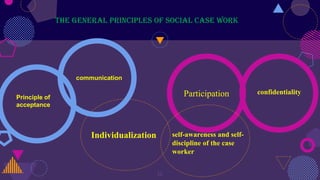
Participation
The general principles of social case work
12
Principle of
acceptance
communication
Individualization
confidentiality
self-awareness and self-
discipline of the case
worker
PRINCIPLES
13
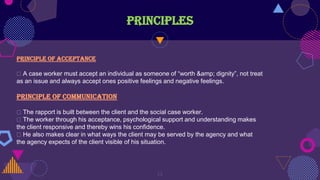
Principle of acceptance
A case worker must accept an individual as someone of “worth & dignity”, not treat
as an issue and always accept ones positive feelings and negative feelings.
Principle of communication
The rapport is built between the client and the social case worker.
The worker through his acceptance, psychological support and understanding makes
the client responsive and thereby wins his confidence.
He also makes clear in what ways the client may be served by the agency and what
the agency expects of the client visible of his situation.
Principle of individualization
 It implies that the case worker accepts each client as an individual in situation
involving a novel combination of biological, psychological and social factors.
 Problem of each individual is different from another & rely upon her/his
intelligence, that the technique of helping must be in step with the Intellectual level,
socio-economic situation and ego strength, ones capacity and resource.
Principle of participation
With this client-worker relationship, the client’s active participation is inspired.
His problem is his own, its alleviation should therefore be devised by him.
14
Principle of confidentiality
 The client must be guaranteed of the confidentiality of his information.
 What the client tells the case worker should not be discussed outside the professional
relationship.
15
Principle of self-awareness and self-discipline of
the case worker
 The case worker must bear in mind of his own
feelings and Limitations.
 His personal likes and dislikes, his own perception
or judgment must not affect his professional
dealings.
16
Hello!
I’M GOING TO PRESENT THE STAGES OF SOCIAL CASEWORK
17
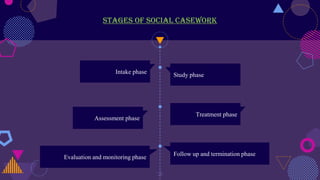
Stages of social casework
Study phase
Follow up and termination phase
Intake phase
18
Assessment phase
Treatment phase
Evaluation and monitoring phase
let’s review the stages
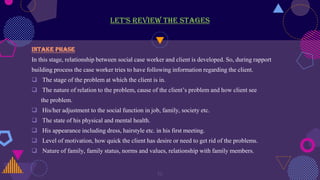
Intake phase
In this stage, relationship between social case worker and client is developed. So, during rapport
building process the case worker tries to have following information regarding the client.
 The stage of the problem at which the client is in.
 The nature of relation to the problem, cause of the client’s problem and how client see
the problem.
 His/her adjustment to the social function in job, family, society etc.
 The state of his physical and mental health.
 His appearance including dress, hairstyle etc. in his first meeting.
 Level of motivation, how quick the client has desire or need to get rid of the problems.
 Nature of family, family status, norms and values, relationship with family members.
19
Study phase
In this phase social case worker studies the case of the client. The case worker
gets following
information regarding the client’s problem.
 Nature of problems.
 Cause of problems.
 Effort made by client and his family members to cope with problem.
 Nature of solution.
20
Assessment / diagnosis phase:
Diagnosis is the case worker’s
professional opinion about the
problem, indicating the lines of
approach towards a solution.
21
The steps used in diagnosis process
 Case worker begin to focus on
problematic behavior.
 Behavior and client’s environment are
studied.
 Data are collected by various methods.
 Information and data are summarized to
find out any major problems for
treatment.
 Selected data are used for treatment in
the final step of diagnosis.
Treatment plan / Intervention phase
The treatment is the main part of social case work with different steps and
techniques. The techniques used in the treatment are as follows:
 Support
 Clarification
 Insight
 Identification
 Resource utilization
 Modification of environment
22
Evaluation and monitoring
Evaluation is one of the important steps in social case work. After
completing all the above steps, the case worker should record his
work with the client, so that he can evaluate his work easily.
Evaluation provides feedback to the case worker regarding the
client like:
◍ Whether the treatment plan is successful or not according to
the desire?
◍. Whether the established goal has been achieved or not?
◍ Modifications in program are essential or not?
23
Follow up and termination
◍It is necessary to check the work done by the case worker. For this the social case worker needs to do follow up
process which is to be done to help the client to maintain the improvements and to get information about the
client and his problem.
◍ During follow up the client is helped to discuss the problem which he is still facing. If client require he is
referred to the proper source for help and service. If he is improving in social functioning he is not prefer.
◍ The follow up should be planned in descending order. (e.g., the social worker will meet the client in
descending order like after two week, then in a month, then six month and a year.)
◍Following this follow up process will lead to the termination process. The follow up process can also be done
by reviewing the record, by asking the questions through telephone calls, home visit, observation etc.
24
Hello!
I’M GOING TO INTRODUCE THE COMPONENTS OF SOCIAL CASEWORK
25
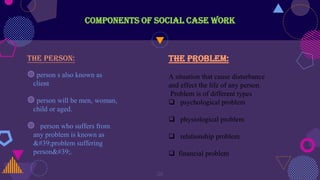
components of social case work
The Person:
◍ person s also known as
client
◍ person will be men, woman,
child or aged.
◍ person who suffers from
any problem is known as
'problem suffering
person'.
26
The problem:
A situation that cause disturbance
and effect the life of any person.
Problem is of different types
 psychological problem
 physiological problem
 relationship problem
 financial problem
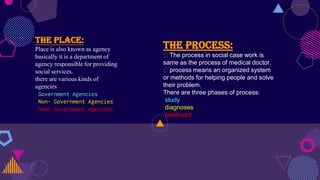
The place:
Place is also known as agency
basically it is a department of
agency responsible for providing
social services.
there are various kinds of
agencies
Government Agencies
Non- Government Agencies
Semi Government Agencies
The pROCESS:
The process in social case work is
same as the process of medical doctor.
process means an organized system
or methods for helping people and solve
their problem.
There are three phases of process:
study
diagnoses
treatment
Professionalism:
 It means have expert in the certain professions which you
choose.
◍ In professionalism the relationship of professional and
client should be strong.
 Relationships like lawyer- client , doctor- patient
◍ Professional relationships are temporary they are finished
when purposes are fulfilled.
👍
28
Hello!
I’M GOING TO INTRODUCE THE TECHNIQUES OF SOCIAL CASEWORK
29
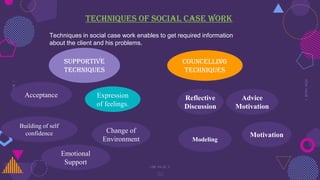
TECHNIQUES OF SOCIAL CASE WORK
30
LOW
VALUE
1
HIGH
VALUE
1
LOW VALUE 2
SUPPORTIVE
TECHNIQUES
Acceptance Expression
of feelings.
COUNCELLING
TECHNIQUES
Techniques in social case work enables to get required information
about the client and his problems.
Building of self
confidence Change of
Environment
Emotional
Support
Reflective
Discussion
Modeling
Advice
Motivation
Motivation
31
SUPPORTIVE TECHNIQUES
 Obsolete and direct the client. These measures diminish client-distress.
ACCEPTANCE:
 Acceptance is conveyed through words, the tone and the overall behavior of
social worker
EXPRESSION OF FEELINGS:
 it is necessary for the client to share his feelings
BUILDING OF SELF CONFIDENCE:
 All techniques should serve the purpose of making the client an active
participant in problem.
 Highlighting the client’s strengths and giving them due credit for their
performance , is helpful in building up self-confidence.
32
EMOTIONAL SUPPORT
 All clients need emotional support so that they may feel comfortable with the social
worker, the organization and themselves to be able to utilize or offer assistance to
handle their problems.
CHANGE OF PHTSICAL ENVIRONMENT:
 The change in a physical environment is another important technique which is
necessary for the better functioning of the client.
Example;
some of the children who has poor academic performance are the one who has no facilities
at home.
COUNSELING TECHNIQUES:
 Counseling techniques help in a manner that the consumer is capable of coping with
issues at present.
 Counseling may also solve the issues of the client within the near destiny.
33
REFLECTIVE DISCUSSION
 It may be necessary to trace the development of the problem
 Most of the problems of living need constructive solutions.
ADVICE:
 Advice is a technique in counseling.
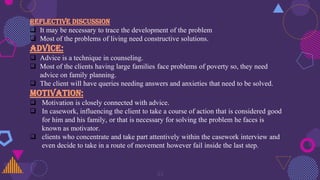
 Most of the clients having large families face problems of poverty so, they need
advice on family planning.
 The client will have queries needing answers and anxieties that need to be solved.
MOTIVATION:
 Motivation is closely connected with advice.
 In casework, influencing the client to take a course of action that is considered good
for him and his family, or that is necessary for solving the problem he faces is
known as motivator.
 clients who concentrate and take part attentively within the casework interview and
even decide to take in a route of movement however fail inside the last step.
34
 In such instances, the social employee might also should offer extra stimulation,
inducement or spurring to set off the client.
 the whole process of advising, discussing, informing, teaching and spurring will
become motivation.
MODELING:
 Social workers acts as a model for the clients as they do learn from what the social
worker says or does.
 When the social worker presents a prototype of behavior with the concept that the
client may learn new forms of speaking and doing, it is the modeling technique.
Thank you
35

Social casework slideshare

  • 1.
  • 2.
    TABLE OF CONTENTS INTRODUCTION TO SOCIAL CASE WORK.  HISTORICAL EVOLUTION OF SOCIAL CASEWORK  PRINCIPLES OF SOCIAL CASEWORK:  STAGES OF SOCIAL CASEWORK:  COMPONENTS OF SOCIAL CASEWORK:  TECHNIQUES OF SOCIAL CASE WORK 2
  • 3.
    Hello! I’M PRESENTING ABRIEF INTRODUCTION OF SOCISL CASEWORK 3
  • 4.
  • 5.
    “  Casework isthe oldest and the most developed method of solving individual’s problems and improving his social relations.  Social case work is a method employed by social workers to help individuals find a solution to problems of social adjustment which they are unable to handle in a satisfactory way by their own effort. 5
  • 6.
    Historical development ofsocial casework:  The Association for Improving the Condition of the Poor (A.I.C.P.) formed in America in 1843 approached the Problem of poverty more individually than had been previously it was.  The aims of A.I.C.P. were to visit the poor at homes, to give counsel, to assist them practically in obtaining employment, to instill in them self-respect and self-reliance.  The first professional School of Social Work was the New York School established in 1898.  Impact of First World War.  The First World War made a wide impact on social casework.  Psychiatry in this period became important.  Impact of Second World War.  Social casework was greatly influenced by the events of Second World War. 6
  • 7.
    Major Landmarks inthe History of Casework Development Contribution of Friendly Visitor 7
  • 8.
     The termFriendly Visitors was first used in 1877 by American Charity Organization Society for its volunteers.  They collected data about the needy individuals and families and helped them after assessing their needs.  The term Friendly Visitors was subsequently supplemented by the term “Paid Agents”. “Alone we can do so little; together we can do so much.” - Helen Keller  Contributions of Mary Richmond.  The beginning of professional casework is associated with publication of Mary Richmond’s book “Social Diagnosis”.  She visualized a diagnostic summary with following three headings:  Difficulties defined  Factors Causal  Assets and liabilities 8
  • 9.
    Contribution of FreudianTheory  Before the advent of psychiatry Social Casework was practiced as an active art.  The basic concepts of Freudian theory.  Unconscious Mind  Ambivalence  Resistance to interpretation of transference to be dealt in all helping process. Social casework is practiced in hospitals, clinics, courts, I industries. military organizations, family welfare agencies both government and voluntary, immigrant agencies, day nurseries and schools, adoption agencies, child guidance clinics, hygiene organization, health organization and others. 9
  • 10.
    HELLO! PRESENT THE BASICPRINCIPLES OF SOCIAL CASEWORK 10
  • 11.
  • 12.
    Participation The general principlesof social case work 12 Principle of acceptance communication Individualization confidentiality self-awareness and self- discipline of the case worker
  • 13.
    PRINCIPLES 13 Principle of acceptance Acase worker must accept an individual as someone of “worth & dignity”, not treat as an issue and always accept ones positive feelings and negative feelings. Principle of communication The rapport is built between the client and the social case worker. The worker through his acceptance, psychological support and understanding makes the client responsive and thereby wins his confidence. He also makes clear in what ways the client may be served by the agency and what the agency expects of the client visible of his situation.
  • 14.
    Principle of individualization It implies that the case worker accepts each client as an individual in situation involving a novel combination of biological, psychological and social factors.  Problem of each individual is different from another & rely upon her/his intelligence, that the technique of helping must be in step with the Intellectual level, socio-economic situation and ego strength, ones capacity and resource. Principle of participation With this client-worker relationship, the client’s active participation is inspired. His problem is his own, its alleviation should therefore be devised by him. 14
  • 15.
    Principle of confidentiality The client must be guaranteed of the confidentiality of his information.  What the client tells the case worker should not be discussed outside the professional relationship. 15
  • 16.
    Principle of self-awarenessand self-discipline of the case worker  The case worker must bear in mind of his own feelings and Limitations.  His personal likes and dislikes, his own perception or judgment must not affect his professional dealings. 16
  • 17.
    Hello! I’M GOING TOPRESENT THE STAGES OF SOCIAL CASEWORK 17
  • 18.
    Stages of socialcasework Study phase Follow up and termination phase Intake phase 18 Assessment phase Treatment phase Evaluation and monitoring phase
  • 19.
    let’s review thestages Intake phase In this stage, relationship between social case worker and client is developed. So, during rapport building process the case worker tries to have following information regarding the client.  The stage of the problem at which the client is in.  The nature of relation to the problem, cause of the client’s problem and how client see the problem.  His/her adjustment to the social function in job, family, society etc.  The state of his physical and mental health.  His appearance including dress, hairstyle etc. in his first meeting.  Level of motivation, how quick the client has desire or need to get rid of the problems.  Nature of family, family status, norms and values, relationship with family members. 19
  • 20.
    Study phase In thisphase social case worker studies the case of the client. The case worker gets following information regarding the client’s problem.  Nature of problems.  Cause of problems.  Effort made by client and his family members to cope with problem.  Nature of solution. 20
  • 21.
    Assessment / diagnosisphase: Diagnosis is the case worker’s professional opinion about the problem, indicating the lines of approach towards a solution. 21 The steps used in diagnosis process  Case worker begin to focus on problematic behavior.  Behavior and client’s environment are studied.  Data are collected by various methods.  Information and data are summarized to find out any major problems for treatment.  Selected data are used for treatment in the final step of diagnosis.
  • 22.
    Treatment plan /Intervention phase The treatment is the main part of social case work with different steps and techniques. The techniques used in the treatment are as follows:  Support  Clarification  Insight  Identification  Resource utilization  Modification of environment 22
  • 23.
    Evaluation and monitoring Evaluationis one of the important steps in social case work. After completing all the above steps, the case worker should record his work with the client, so that he can evaluate his work easily. Evaluation provides feedback to the case worker regarding the client like: ◍ Whether the treatment plan is successful or not according to the desire? ◍. Whether the established goal has been achieved or not? ◍ Modifications in program are essential or not? 23
  • 24.
    Follow up andtermination ◍It is necessary to check the work done by the case worker. For this the social case worker needs to do follow up process which is to be done to help the client to maintain the improvements and to get information about the client and his problem. ◍ During follow up the client is helped to discuss the problem which he is still facing. If client require he is referred to the proper source for help and service. If he is improving in social functioning he is not prefer. ◍ The follow up should be planned in descending order. (e.g., the social worker will meet the client in descending order like after two week, then in a month, then six month and a year.) ◍Following this follow up process will lead to the termination process. The follow up process can also be done by reviewing the record, by asking the questions through telephone calls, home visit, observation etc. 24
  • 25.
    Hello! I’M GOING TOINTRODUCE THE COMPONENTS OF SOCIAL CASEWORK 25
  • 26.
    components of socialcase work The Person: ◍ person s also known as client ◍ person will be men, woman, child or aged. ◍ person who suffers from any problem is known as 'problem suffering person'. 26 The problem: A situation that cause disturbance and effect the life of any person. Problem is of different types  psychological problem  physiological problem  relationship problem  financial problem
  • 27.
    The place: Place isalso known as agency basically it is a department of agency responsible for providing social services. there are various kinds of agencies Government Agencies Non- Government Agencies Semi Government Agencies The pROCESS: The process in social case work is same as the process of medical doctor. process means an organized system or methods for helping people and solve their problem. There are three phases of process: study diagnoses treatment
  • 28.
    Professionalism:  It meanshave expert in the certain professions which you choose. ◍ In professionalism the relationship of professional and client should be strong.  Relationships like lawyer- client , doctor- patient ◍ Professional relationships are temporary they are finished when purposes are fulfilled. 👍 28
  • 29.
    Hello! I’M GOING TOINTRODUCE THE TECHNIQUES OF SOCIAL CASEWORK 29
  • 30.
    TECHNIQUES OF SOCIALCASE WORK 30 LOW VALUE 1 HIGH VALUE 1 LOW VALUE 2 SUPPORTIVE TECHNIQUES Acceptance Expression of feelings. COUNCELLING TECHNIQUES Techniques in social case work enables to get required information about the client and his problems. Building of self confidence Change of Environment Emotional Support Reflective Discussion Modeling Advice Motivation Motivation
  • 31.
    31 SUPPORTIVE TECHNIQUES  Obsoleteand direct the client. These measures diminish client-distress. ACCEPTANCE:  Acceptance is conveyed through words, the tone and the overall behavior of social worker EXPRESSION OF FEELINGS:  it is necessary for the client to share his feelings BUILDING OF SELF CONFIDENCE:  All techniques should serve the purpose of making the client an active participant in problem.  Highlighting the client’s strengths and giving them due credit for their performance , is helpful in building up self-confidence.
  • 32.
    32 EMOTIONAL SUPPORT  Allclients need emotional support so that they may feel comfortable with the social worker, the organization and themselves to be able to utilize or offer assistance to handle their problems. CHANGE OF PHTSICAL ENVIRONMENT:  The change in a physical environment is another important technique which is necessary for the better functioning of the client. Example; some of the children who has poor academic performance are the one who has no facilities at home. COUNSELING TECHNIQUES:  Counseling techniques help in a manner that the consumer is capable of coping with issues at present.  Counseling may also solve the issues of the client within the near destiny.
  • 33.
    33 REFLECTIVE DISCUSSION  Itmay be necessary to trace the development of the problem  Most of the problems of living need constructive solutions. ADVICE:  Advice is a technique in counseling.  Most of the clients having large families face problems of poverty so, they need advice on family planning.  The client will have queries needing answers and anxieties that need to be solved. MOTIVATION:  Motivation is closely connected with advice.  In casework, influencing the client to take a course of action that is considered good for him and his family, or that is necessary for solving the problem he faces is known as motivator.  clients who concentrate and take part attentively within the casework interview and even decide to take in a route of movement however fail inside the last step.

  • 34.
    34  In suchinstances, the social employee might also should offer extra stimulation, inducement or spurring to set off the client.  the whole process of advising, discussing, informing, teaching and spurring will become motivation. MODELING:  Social workers acts as a model for the clients as they do learn from what the social worker says or does.  When the social worker presents a prototype of behavior with the concept that the client may learn new forms of speaking and doing, it is the modeling technique.
  • 35.