WELCOME
IMMUNODEFICIENCY
RANJITHA K.M.
PGS15AGR6842
Ranjitha K.M.
PGS15AGR6842
Content
 Introduction
 Classification
 B celldeficiency
 T Celldeficiency
 SCID
 Secondaryimmunodeficiency
 TreatmenttoIDs
WHAT WILL
I LEARN
TODAY?
What is immunodeficiency?
 Immunodeficiency (or immune deficiency) is a
state in which the immune system's ability to
fight infectious disease is compromised or entirely
absent.
Classification
 Primary immunodeficiency
 Secondary immunodeficiency
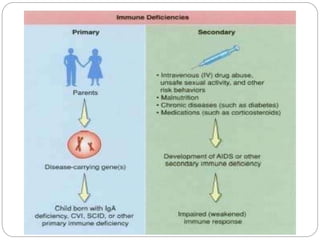
Primary immunodeficiency
 Defects in genes for components of the immune
system.
 Victims are born with these diseases, which are
the result either of inherited or developmental
defects.
 Cause: mutations in genes involved in the
development and function of immune organs,
cells, and molecules.
Secondary immunodeficiency
 Due to factors that have an adverse impact on
the immune system.
 These are acquired as secondary results of
various disease states, due either to the disease
processes themselves or the therapy used to
treat them.
 Loss of previously functional immunity due to
infection, toxicity, radiation, splenectomy and
malnutrition
Four Categories Immune Mechanisms
 Primary immunodeficiency
Humoral (Antibody or B-cell mediated)
Cell-mediated (T-cell mediated)
Complement system
Phagocytosis
B CELL DEFICIENCY
 X liked a gammaglobuinemia
 Early maturation of B cells fails,
 Few or no B cells in blood
 Very small lymph nodes and tonsils
 No Ig,Small amount of Ig G in early age
 Recurrent pyogenic infection
 IgA and IgG subclass deficiency
 IgA deficiency is most common
 Patients tend to develop immune complex disease
 About 20% lack IgG2 and IgG4
 Susceptible to pyogenic infection
 Result from failure in terminal differentiation of B cells
 Immunodeficiency with increased IgM
 Results in patients with IgA and IgG deficiency
 Production of large amount of IgM >200mg/dl of polyclonal IgM
 Susceptible to pyogenic infection
 Treatment by iv gamma globulin
 Formation of IgM to neutrophils, platelets and other blood components
 Transient hypogammaglobulinaemia of infancy
 Due to delay in in IgG synthesis approximately up to 36 months
 In normal infants synthesis begins at 3 months
 Normal B lymphocytes
 Probably lack help of T lymphocytes
 Common variable immundeficiency
 There are defect in T cell signaling to B cells
 Acquired a gammaglobulinemia in the 2nd or 3rd decade of life
 May follow viral infection, Pyogenic infection
 80% of patients have B cells that are not functioning
 B cells are not defective. They fail to receive signaling from T
lymphocytes
T cell deficiencies
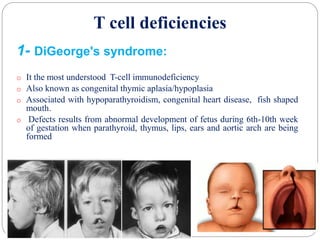
1- DiGeorge's syndrome:
o It the most understood T-cell immunodeficiency
o Also known as congenital thymic aplasia/hypoplasia
o Associated with hypoparathyroidism, congenital heart disease, fish shaped
mouth.
o Defects results from abnormal development of fetus during 6th-10th week
of gestation when parathyroid, thymus, lips, ears and aortic arch are being
formed
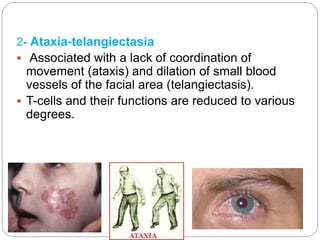
2- Ataxia-telangiectasia
 Associated with a lack of coordination of
movement (ataxis) and dilation of small blood
vessels of the facial area (telangiectasis).
 T-cells and their functions are reduced to various
degrees.
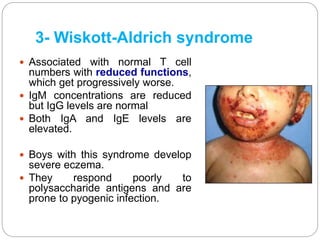
3- Wiskott-Aldrich syndrome
 Associated with normal T cell
numbers with reduced functions,
which get progressively worse.
 IgM concentrations are reduced
but IgG levels are normal
 Both IgA and IgE levels are
elevated.
 Boys with this syndrome develop
severe eczema.
 They respond poorly to
polysaccharide antigens and are
prone to pyogenic infection.
MHC DEFICIENCY
(Bare leukocyte syndrome):
 Due to defect in the MHC class II transactivator (CIITA)
protein gene, which results in a lack of class-II MHC molecule
on APC.
 Patients have fewer CD4 cells and are infection prone.
 There are also individuals who have a defect in their transport
associated protein (TAP) gene and hence do not express the
class-I MHC molecules and consequently are deficient in
CD8+ T cells.
Defects of the phagocytic system
Defects of phagocytic cells (numbers and/or functions) can
lead to increased susceptibility to a variety of infections.
1- Cyclic neutropenia:
It is marked by low numbers of circulating neutrophil
approximately every three weeks. The neutropenia lasts
about a week during which the patients are susceptible to
infection. The defect appears to be due to poor regulation
of neutrophil production.
2- Chronic granulomatous disease (CGD):
 In majority of patients with CGD, the deficiency is due to
a defect in NADPH oxidase that participate in phagocytic
respiratory burst.
Disorders of complement system:
 Complement abnormalities also lead to increased
susceptibility to infections.
 There are genetic deficiencies of various components
of complement system, which lead to increased
infections.
 The most serious among these is the C3 deficiency
which may arise from low C3 synthesis or deficiency in
factor I or factor H.
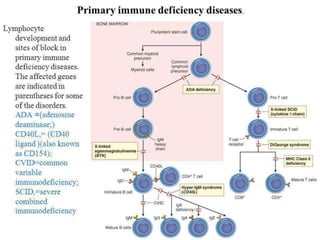
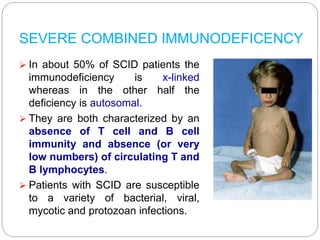
SEVERE COMBINED IMMUNODEFICENCY
 In about 50% of SCID patients the
immunodeficiency is x-linked
whereas in the other half the
deficiency is autosomal.
 They are both characterized by an
absence of T cell and B cell
immunity and absence (or very
low numbers) of circulating T and
B lymphocytes.
 Patients with SCID are susceptible
to a variety of bacterial, viral,
mycotic and protozoan infections.
 The x-linked SCID is due to a defect in gamma-chain of IL-2
also shared by IL-4, -7, -11 and 15, all involved in lymphocyte
proliferation and/or differentiation.
 The autosomal SCIDs arise primarily from defects in
adenosine deaminase (ADA) or purine nucleoside
phosphorylase (PNP) genes which results is accumulation of
dATP or dGTP, respectively, and cause toxicity to lymphoid
stem cells
Secondary immunodeficiencies
• Acute and chronic viral infections – infectious mononucleosis,
influenza
• Metabolic disorders – diabetes mellitus, uremia
• Autoimmune diseases – autoantibodies against immunocompetent
cells (neutrophils, lymphocytes); autoimmune phenomena also after
administration of certain drugs (e.g. oxacilin, quinidine)
• Chronic GIT diseases
• Malignant diseases (leukemia)
• Hypersplenism/asplenia
• Burn, postoperative status, injuries
• Severe nutritional disorders
• Chronic infections
• Ionizing radiation
• Drug induced immunodeficiencies (chemotherapy)
• Immunosupressive therapy
• Chronic stress
• Chronic exposure to harmful chemical substances
 Severe protein-calorie malnutrtion is primarily associated
with a depression of cell-mediated immunity.
Ex: kwashiorkor
 Deficiencies of pyridoxine, folic acid, and vitamin A are
usually associated with cellular immunodeficiency.
 Pantothenic acid deficiency is usually associated with a
depression of the primary and secondary humoral
immune responses.
 Vitamin E deficiency is associated with a combined
immunodeficiency.
 Burn-Associated Immunodeficiency. Bacterial
infections are a frequent and severe complication
in burn patients, often leading to death.
 Postsurgery immunodeficiency: Any type of
surgery represents an acute trauma that can
reduce the antiinfectious defenses in a variety of
ways
 Immunosuppression Associated with Infections
 Immunosuppression Associated with Drug Abuse.
 The Acquired Immunodeficiency Syndrome
(AIDS)
When to suspect immunodeficiency ?
 Very frequent infections
 Very severe infections
 Family history
 Unusual microorganism at unusual site
 Recurrent respiratory tract infections
 Severe bacterial infection
 Persistent infection with incomplete response
 Persistent sinusitis/mastoiditis
 FTT/Growth retardation
 Diarrhea/malabsorption
Treatment options incude:
 Supportive therapy- antibiotics
 Replacement therapy-IV immunoglobulin
infusion, ADA-rich RBC infusions
 Definitive therapy- Fetal thymic grafts, bone
marrow transplantation
 Stem-cell therapy
 Gene therapy
THANK YOU

ranjithakm-180315143057.pdf

  • 1.
  • 2.
  • 3.
    Content  Introduction  Classification B celldeficiency  T Celldeficiency  SCID  Secondaryimmunodeficiency  TreatmenttoIDs WHAT WILL I LEARN TODAY?
  • 4.
    What is immunodeficiency? Immunodeficiency (or immune deficiency) is a state in which the immune system's ability to fight infectious disease is compromised or entirely absent.
  • 5.
  • 6.
    Primary immunodeficiency  Defectsin genes for components of the immune system.  Victims are born with these diseases, which are the result either of inherited or developmental defects.  Cause: mutations in genes involved in the development and function of immune organs, cells, and molecules.
  • 7.
    Secondary immunodeficiency  Dueto factors that have an adverse impact on the immune system.  These are acquired as secondary results of various disease states, due either to the disease processes themselves or the therapy used to treat them.  Loss of previously functional immunity due to infection, toxicity, radiation, splenectomy and malnutrition
  • 10.
    Four Categories ImmuneMechanisms  Primary immunodeficiency Humoral (Antibody or B-cell mediated) Cell-mediated (T-cell mediated) Complement system Phagocytosis
  • 11.
    B CELL DEFICIENCY X liked a gammaglobuinemia  Early maturation of B cells fails,  Few or no B cells in blood  Very small lymph nodes and tonsils  No Ig,Small amount of Ig G in early age  Recurrent pyogenic infection  IgA and IgG subclass deficiency  IgA deficiency is most common  Patients tend to develop immune complex disease  About 20% lack IgG2 and IgG4  Susceptible to pyogenic infection  Result from failure in terminal differentiation of B cells
  • 12.
     Immunodeficiency withincreased IgM  Results in patients with IgA and IgG deficiency  Production of large amount of IgM >200mg/dl of polyclonal IgM  Susceptible to pyogenic infection  Treatment by iv gamma globulin  Formation of IgM to neutrophils, platelets and other blood components  Transient hypogammaglobulinaemia of infancy  Due to delay in in IgG synthesis approximately up to 36 months  In normal infants synthesis begins at 3 months  Normal B lymphocytes  Probably lack help of T lymphocytes
  • 13.
     Common variableimmundeficiency  There are defect in T cell signaling to B cells  Acquired a gammaglobulinemia in the 2nd or 3rd decade of life  May follow viral infection, Pyogenic infection  80% of patients have B cells that are not functioning  B cells are not defective. They fail to receive signaling from T lymphocytes
  • 14.
    T cell deficiencies 1-DiGeorge's syndrome: o It the most understood T-cell immunodeficiency o Also known as congenital thymic aplasia/hypoplasia o Associated with hypoparathyroidism, congenital heart disease, fish shaped mouth. o Defects results from abnormal development of fetus during 6th-10th week of gestation when parathyroid, thymus, lips, ears and aortic arch are being formed
  • 15.
    2- Ataxia-telangiectasia  Associatedwith a lack of coordination of movement (ataxis) and dilation of small blood vessels of the facial area (telangiectasis).  T-cells and their functions are reduced to various degrees.
  • 16.
    3- Wiskott-Aldrich syndrome Associated with normal T cell numbers with reduced functions, which get progressively worse.  IgM concentrations are reduced but IgG levels are normal  Both IgA and IgE levels are elevated.  Boys with this syndrome develop severe eczema.  They respond poorly to polysaccharide antigens and are prone to pyogenic infection.
  • 17.
    MHC DEFICIENCY (Bare leukocytesyndrome):  Due to defect in the MHC class II transactivator (CIITA) protein gene, which results in a lack of class-II MHC molecule on APC.  Patients have fewer CD4 cells and are infection prone.  There are also individuals who have a defect in their transport associated protein (TAP) gene and hence do not express the class-I MHC molecules and consequently are deficient in CD8+ T cells.
  • 18.
    Defects of thephagocytic system Defects of phagocytic cells (numbers and/or functions) can lead to increased susceptibility to a variety of infections. 1- Cyclic neutropenia: It is marked by low numbers of circulating neutrophil approximately every three weeks. The neutropenia lasts about a week during which the patients are susceptible to infection. The defect appears to be due to poor regulation of neutrophil production. 2- Chronic granulomatous disease (CGD):  In majority of patients with CGD, the deficiency is due to a defect in NADPH oxidase that participate in phagocytic respiratory burst.
  • 19.
    Disorders of complementsystem:  Complement abnormalities also lead to increased susceptibility to infections.  There are genetic deficiencies of various components of complement system, which lead to increased infections.  The most serious among these is the C3 deficiency which may arise from low C3 synthesis or deficiency in factor I or factor H.
  • 20.
    SEVERE COMBINED IMMUNODEFICENCY In about 50% of SCID patients the immunodeficiency is x-linked whereas in the other half the deficiency is autosomal.  They are both characterized by an absence of T cell and B cell immunity and absence (or very low numbers) of circulating T and B lymphocytes.  Patients with SCID are susceptible to a variety of bacterial, viral, mycotic and protozoan infections.
  • 21.
     The x-linkedSCID is due to a defect in gamma-chain of IL-2 also shared by IL-4, -7, -11 and 15, all involved in lymphocyte proliferation and/or differentiation.  The autosomal SCIDs arise primarily from defects in adenosine deaminase (ADA) or purine nucleoside phosphorylase (PNP) genes which results is accumulation of dATP or dGTP, respectively, and cause toxicity to lymphoid stem cells
  • 22.
    Secondary immunodeficiencies • Acuteand chronic viral infections – infectious mononucleosis, influenza • Metabolic disorders – diabetes mellitus, uremia • Autoimmune diseases – autoantibodies against immunocompetent cells (neutrophils, lymphocytes); autoimmune phenomena also after administration of certain drugs (e.g. oxacilin, quinidine) • Chronic GIT diseases • Malignant diseases (leukemia) • Hypersplenism/asplenia • Burn, postoperative status, injuries • Severe nutritional disorders • Chronic infections • Ionizing radiation • Drug induced immunodeficiencies (chemotherapy) • Immunosupressive therapy • Chronic stress • Chronic exposure to harmful chemical substances
  • 23.
     Severe protein-caloriemalnutrtion is primarily associated with a depression of cell-mediated immunity. Ex: kwashiorkor  Deficiencies of pyridoxine, folic acid, and vitamin A are usually associated with cellular immunodeficiency.  Pantothenic acid deficiency is usually associated with a depression of the primary and secondary humoral immune responses.  Vitamin E deficiency is associated with a combined immunodeficiency.
  • 24.
     Burn-Associated Immunodeficiency.Bacterial infections are a frequent and severe complication in burn patients, often leading to death.  Postsurgery immunodeficiency: Any type of surgery represents an acute trauma that can reduce the antiinfectious defenses in a variety of ways  Immunosuppression Associated with Infections  Immunosuppression Associated with Drug Abuse.  The Acquired Immunodeficiency Syndrome (AIDS)
  • 25.
    When to suspectimmunodeficiency ?  Very frequent infections  Very severe infections  Family history  Unusual microorganism at unusual site  Recurrent respiratory tract infections  Severe bacterial infection  Persistent infection with incomplete response  Persistent sinusitis/mastoiditis  FTT/Growth retardation  Diarrhea/malabsorption
  • 26.
    Treatment options incude: Supportive therapy- antibiotics  Replacement therapy-IV immunoglobulin infusion, ADA-rich RBC infusions  Definitive therapy- Fetal thymic grafts, bone marrow transplantation  Stem-cell therapy  Gene therapy
  • 27.