Permutations And
Combinations
MADE BY :- ANUBHAV KUMAR
CLASS :- 11TH ‘A’
Introduction
 Suppose you have a suitcase with a number lock. The number lock has 4 wheels each labelled with
10 digits from 0 to 9. The lock can be opened if 4 specific digits are arranged in a particular
sequence with no repetition. Some how, you have forgotten this specific sequence of digits. You
remember only the first digit which is 7. In order to open the lock, how many sequences of 3-digits
you may have to check with? To answer this question, you may, immediately, start listing all possible
arrangements of 9 remaining digits taken 3 at a time. But, this method will be tedious, because the
number of possible sequences may be large. Here, in this Chapter, we shall learn some basic
counting techniques which will enable us to answer this question without actually listing 3-digit
arrangements. In fact, these techniques will be useful in determining the number of different ways of
arranging and selecting objects without actually listing them. As a first step, we shall examine a
principle which is most fundamental to the learning of these techniques.
Jacob Bernoulli
 Jacob Bernoulli (also known as James or Jacques; 6 January 1655
[O.S. 27 December 1654] – 16 August 1705) was one of the
many prominent mathematicians in the Bernoulli family. He was
an early proponent of Leibnizian calculus and had sided with
Leibniz during the Leibniz–Newton calculus controversy. He is
known for his numerous contributions to calculus, and along
with his brother Johann, was one of the founders of the calculus
of variations. However, his most important contribution was in
the field of probability, where he derived the first version of
the law of large numbers in his work Ars Conjectandi.
OVERVIEW
 The study of permutations and combinations is concerned with determining
the number of different ways of arranging and selecting objects out of a
given number of objects without actually listing them. There are some basic
counting techniques which will be useful in determining the number of
different ways of arranging or selecting objects. The two basic counting
principle are given below:
 FUNDAMENTAL PRINCIPLE OF COUNTING
MULTIPLICATION PRINCIPLE
Suppose an event E can occur in m different ways
and associated with each way of occurring of E,
another event F can occur in n different ways, then
the total number of occurrence of the two events in
the given order is m × n.
ADDITION PRINCIPLE
If an event E can occur in m ways and another
event F can occur in n ways, and suppose that
both can not occur together, then E or F can
occur in m + n ways.
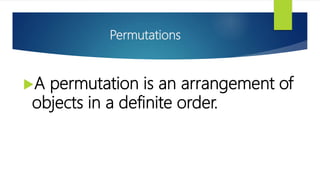
Permutations
A permutation is an arrangement of
objects in a definite order.
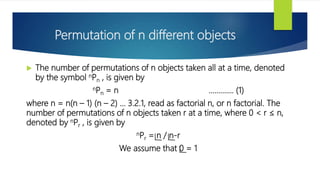
Permutation of n different objects
 The number of permutations of n objects taken all at a time, denoted
by the symbol nPn , is given by
nPn = n …………. (1)
where n = n(n – 1) (n – 2) ... 3.2.1, read as factorial n, or n factorial. The
number of permutations of n objects taken r at a time, where 0 < r ≤ n,
denoted by nPr , is given by
nPr = n / n-r
We assume that 0 = 1
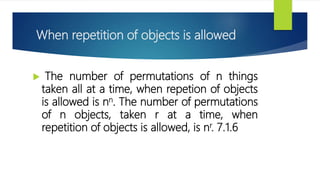
When repetition of objects is allowed
 The number of permutations of n things
taken all at a time, when repetion of objects
is allowed is nn. The number of permutations
of n objects, taken r at a time, when
repetition of objects is allowed, is nr. 7.1.6
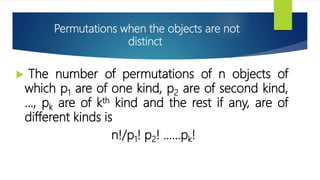
Permutations when the objects are not
distinct
 The number of permutations of n objects of
which p1 are of one kind, p2 are of second kind,
..., pk are of kth kind and the rest if any, are of
different kinds is
n!/p1! p2! ……pk!
Combinations
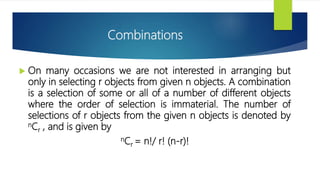
 On many occasions we are not interested in arranging but
only in selecting r objects from given n objects. A combination
is a selection of some or all of a number of different objects
where the order of selection is immaterial. The number of
selections of r objects from the given n objects is denoted by
nCr , and is given by
nCr = n!/ r! (n-r)!
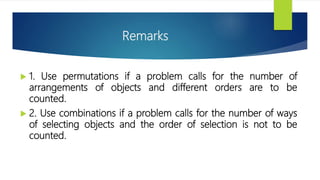
Remarks
 1. Use permutations if a problem calls for the number of
arrangements of objects and different orders are to be
counted.
 2. Use combinations if a problem calls for the number of ways
of selecting objects and the order of selection is not to be
counted.
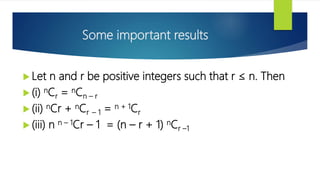
Some important results
 Let n and r be positive integers such that r ≤ n. Then
 (i) nCr = nCn – r
 (ii) nCr + nCr – 1 = n + 1Cr
 (iii) n n – 1Cr – 1 = (n – r + 1) nCr –1
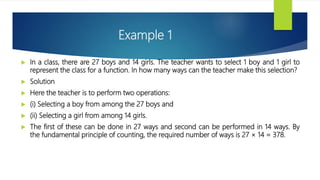
Example 1
 In a class, there are 27 boys and 14 girls. The teacher wants to select 1 boy and 1 girl to
represent the class for a function. In how many ways can the teacher make this selection?
 Solution
 Here the teacher is to perform two operations:
 (i) Selecting a boy from among the 27 boys and
 (ii) Selecting a girl from among 14 girls.
 The first of these can be done in 27 ways and second can be performed in 14 ways. By
the fundamental principle of counting, the required number of ways is 27 × 14 = 378.
Example 2
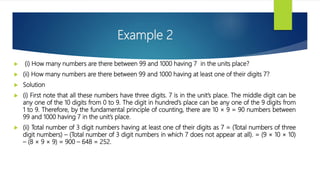
 (i) How many numbers are there between 99 and 1000 having 7 in the units place?
 (ii) How many numbers are there between 99 and 1000 having at least one of their digits 7?
 Solution
 (i) First note that all these numbers have three digits. 7 is in the unit’s place. The middle digit can be
any one of the 10 digits from 0 to 9. The digit in hundred’s place can be any one of the 9 digits from
1 to 9. Therefore, by the fundamental principle of counting, there are 10 × 9 = 90 numbers between
99 and 1000 having 7 in the unit’s place.
 (ii) Total number of 3 digit numbers having at least one of their digits as 7 = (Total numbers of three
digit numbers) – (Total number of 3 digit numbers in which 7 does not appear at all). = (9 × 10 × 10)
– (8 × 9 × 9) = 900 – 648 = 252.
Example 11
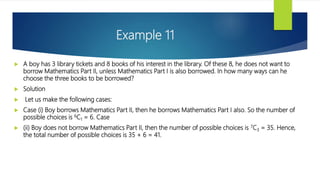
 A boy has 3 library tickets and 8 books of his interest in the library. Of these 8, he does not want to
borrow Mathematics Part II, unless Mathematics Part I is also borrowed. In how many ways can he
choose the three books to be borrowed?
 Solution
 Let us make the following cases:
 Case (i) Boy borrows Mathematics Part II, then he borrows Mathematics Part I also. So the number of
possible choices is 6C1 = 6. Case
 (ii) Boy does not borrow Mathematics Part II, then the number of possible choices is 7C3 = 35. Hence,
the total number of possible choices is 35 + 6 = 41.
Permutations and Combinations (All Formulas)

Permutations and Combinations (All Formulas)

  • 1.
    Permutations And Combinations MADE BY:- ANUBHAV KUMAR CLASS :- 11TH ‘A’
  • 2.
    Introduction  Suppose youhave a suitcase with a number lock. The number lock has 4 wheels each labelled with 10 digits from 0 to 9. The lock can be opened if 4 specific digits are arranged in a particular sequence with no repetition. Some how, you have forgotten this specific sequence of digits. You remember only the first digit which is 7. In order to open the lock, how many sequences of 3-digits you may have to check with? To answer this question, you may, immediately, start listing all possible arrangements of 9 remaining digits taken 3 at a time. But, this method will be tedious, because the number of possible sequences may be large. Here, in this Chapter, we shall learn some basic counting techniques which will enable us to answer this question without actually listing 3-digit arrangements. In fact, these techniques will be useful in determining the number of different ways of arranging and selecting objects without actually listing them. As a first step, we shall examine a principle which is most fundamental to the learning of these techniques.
  • 3.
    Jacob Bernoulli  JacobBernoulli (also known as James or Jacques; 6 January 1655 [O.S. 27 December 1654] – 16 August 1705) was one of the many prominent mathematicians in the Bernoulli family. He was an early proponent of Leibnizian calculus and had sided with Leibniz during the Leibniz–Newton calculus controversy. He is known for his numerous contributions to calculus, and along with his brother Johann, was one of the founders of the calculus of variations. However, his most important contribution was in the field of probability, where he derived the first version of the law of large numbers in his work Ars Conjectandi.
  • 4.
    OVERVIEW  The studyof permutations and combinations is concerned with determining the number of different ways of arranging and selecting objects out of a given number of objects without actually listing them. There are some basic counting techniques which will be useful in determining the number of different ways of arranging or selecting objects. The two basic counting principle are given below:  FUNDAMENTAL PRINCIPLE OF COUNTING
  • 5.
    MULTIPLICATION PRINCIPLE Suppose anevent E can occur in m different ways and associated with each way of occurring of E, another event F can occur in n different ways, then the total number of occurrence of the two events in the given order is m × n.
  • 6.
    ADDITION PRINCIPLE If anevent E can occur in m ways and another event F can occur in n ways, and suppose that both can not occur together, then E or F can occur in m + n ways.
  • 7.
    Permutations A permutation isan arrangement of objects in a definite order.
  • 8.
    Permutation of ndifferent objects  The number of permutations of n objects taken all at a time, denoted by the symbol nPn , is given by nPn = n …………. (1) where n = n(n – 1) (n – 2) ... 3.2.1, read as factorial n, or n factorial. The number of permutations of n objects taken r at a time, where 0 < r ≤ n, denoted by nPr , is given by nPr = n / n-r We assume that 0 = 1
  • 9.
    When repetition ofobjects is allowed  The number of permutations of n things taken all at a time, when repetion of objects is allowed is nn. The number of permutations of n objects, taken r at a time, when repetition of objects is allowed, is nr. 7.1.6
  • 10.
    Permutations when theobjects are not distinct  The number of permutations of n objects of which p1 are of one kind, p2 are of second kind, ..., pk are of kth kind and the rest if any, are of different kinds is n!/p1! p2! ……pk!
  • 11.
    Combinations  On manyoccasions we are not interested in arranging but only in selecting r objects from given n objects. A combination is a selection of some or all of a number of different objects where the order of selection is immaterial. The number of selections of r objects from the given n objects is denoted by nCr , and is given by nCr = n!/ r! (n-r)!
  • 12.
    Remarks  1. Usepermutations if a problem calls for the number of arrangements of objects and different orders are to be counted.  2. Use combinations if a problem calls for the number of ways of selecting objects and the order of selection is not to be counted.
  • 13.
    Some important results Let n and r be positive integers such that r ≤ n. Then  (i) nCr = nCn – r  (ii) nCr + nCr – 1 = n + 1Cr  (iii) n n – 1Cr – 1 = (n – r + 1) nCr –1
  • 14.
    Example 1  Ina class, there are 27 boys and 14 girls. The teacher wants to select 1 boy and 1 girl to represent the class for a function. In how many ways can the teacher make this selection?  Solution  Here the teacher is to perform two operations:  (i) Selecting a boy from among the 27 boys and  (ii) Selecting a girl from among 14 girls.  The first of these can be done in 27 ways and second can be performed in 14 ways. By the fundamental principle of counting, the required number of ways is 27 × 14 = 378.
  • 15.
    Example 2  (i)How many numbers are there between 99 and 1000 having 7 in the units place?  (ii) How many numbers are there between 99 and 1000 having at least one of their digits 7?  Solution  (i) First note that all these numbers have three digits. 7 is in the unit’s place. The middle digit can be any one of the 10 digits from 0 to 9. The digit in hundred’s place can be any one of the 9 digits from 1 to 9. Therefore, by the fundamental principle of counting, there are 10 × 9 = 90 numbers between 99 and 1000 having 7 in the unit’s place.  (ii) Total number of 3 digit numbers having at least one of their digits as 7 = (Total numbers of three digit numbers) – (Total number of 3 digit numbers in which 7 does not appear at all). = (9 × 10 × 10) – (8 × 9 × 9) = 900 – 648 = 252.
  • 16.
    Example 11  Aboy has 3 library tickets and 8 books of his interest in the library. Of these 8, he does not want to borrow Mathematics Part II, unless Mathematics Part I is also borrowed. In how many ways can he choose the three books to be borrowed?  Solution  Let us make the following cases:  Case (i) Boy borrows Mathematics Part II, then he borrows Mathematics Part I also. So the number of possible choices is 6C1 = 6. Case  (ii) Boy does not borrow Mathematics Part II, then the number of possible choices is 7C3 = 35. Hence, the total number of possible choices is 35 + 6 = 41.