Bahir Dar University
First Year M.SC In Textile Chemistry
Seminar on Mass Spectroscopy and Gas Chromatography
Prepared by: Asnake Ketema5/31/2018
Ethiopia Institute of Textile and Fashion Technology (EiTEX
Mass Spectrometry
 Analytical method to measure the
molecular or atomic weight of samples
22/12/2017
3
DEFINITION:
Mass spectrometry (MS) is an analytical chemistry
technique that helps identify the amount and type of
chemicals present in a sample by measuring the mass- to-
charge ratio and abundance of gas-phase ions.
PRINCIPLE:
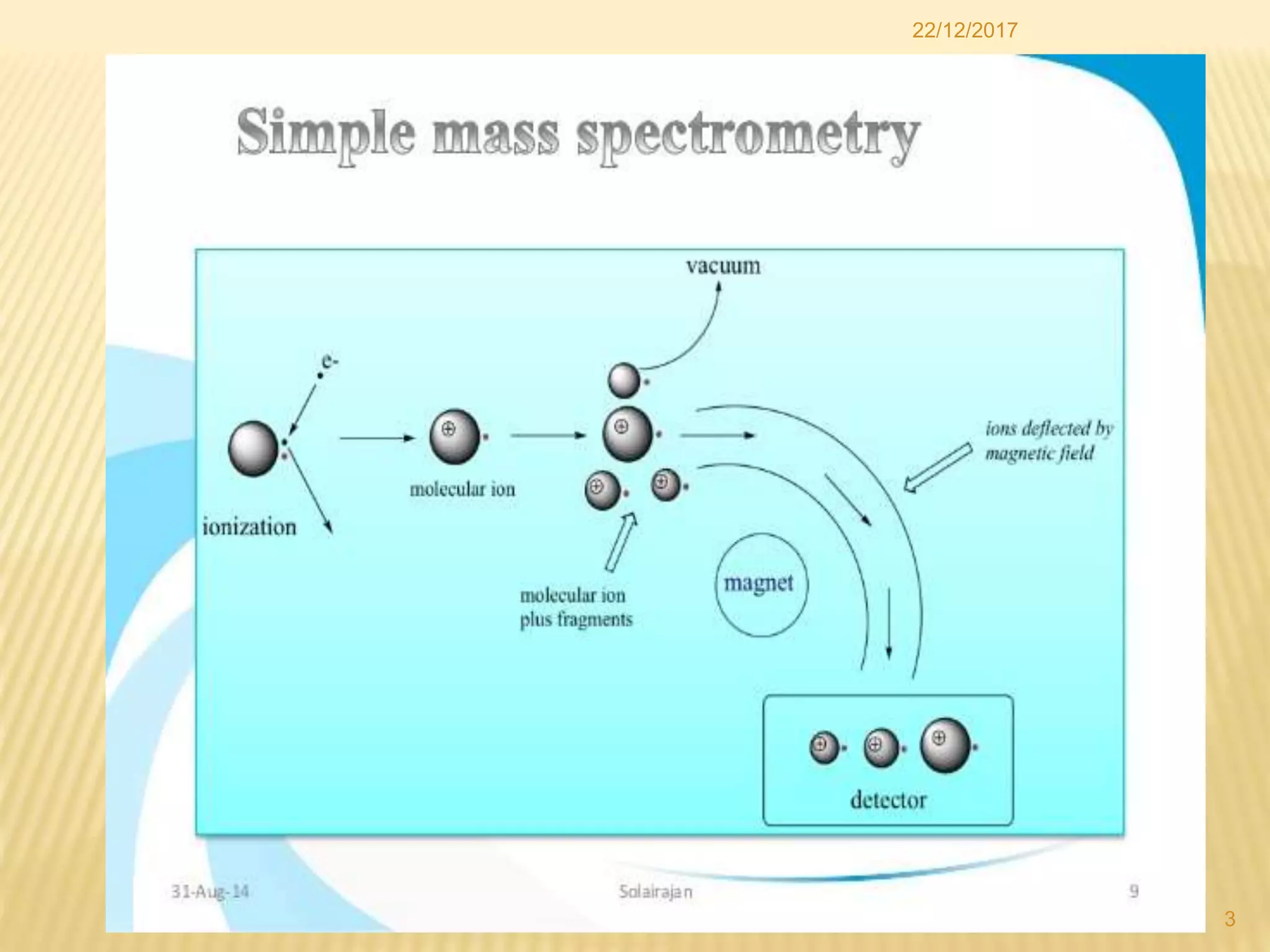
A mass spectrometer generates multiple ions from the
sample under investigation
This molecular ion undergoes fragmentation. Each
primary product ion derived from the molecular ion, in
turn, undergoes fragmentation, and so on.
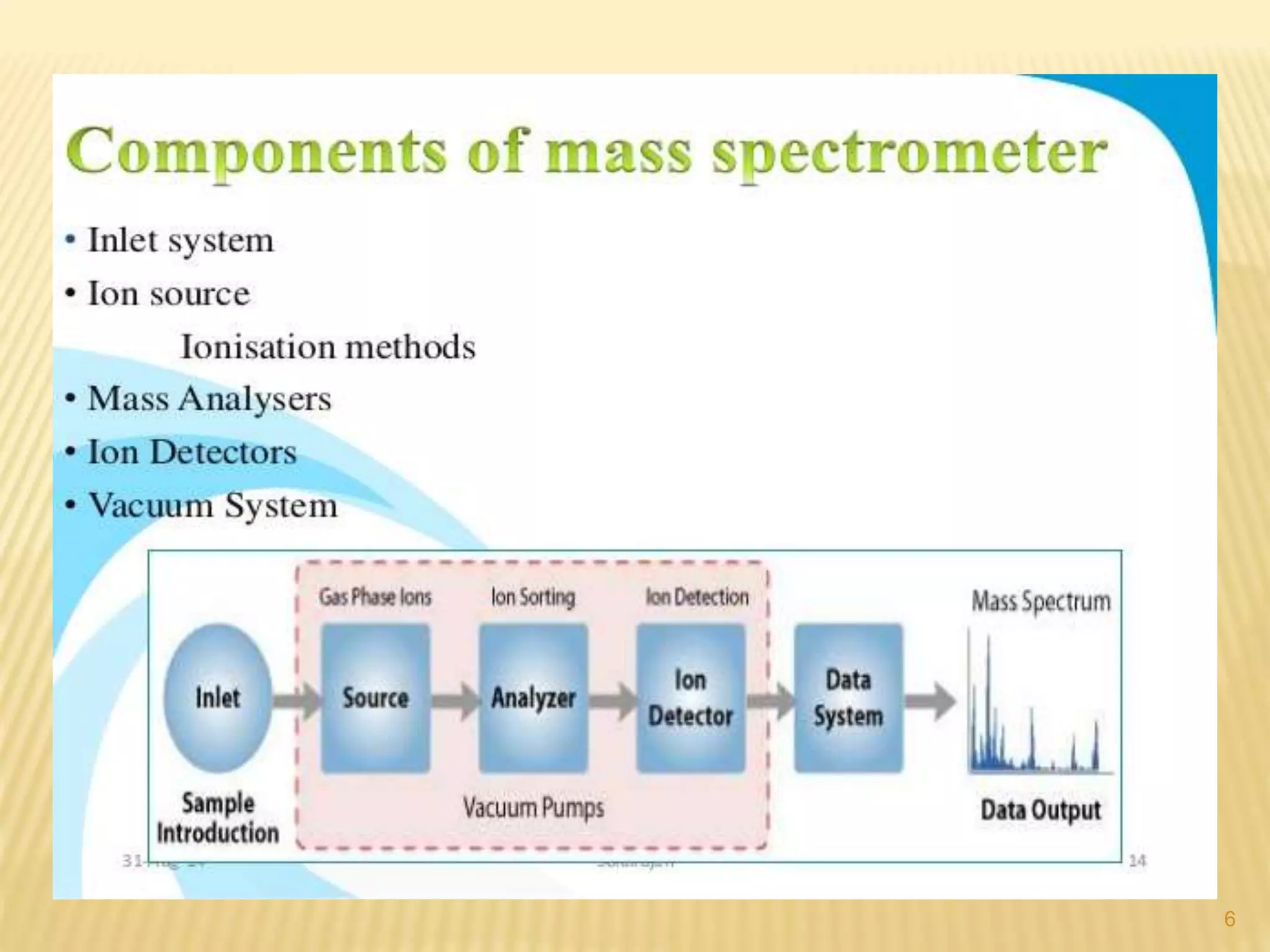
The ions are separated in the mass spectrometer
according to their mass-to-charge ratio, and are
detected in proportion to their abundance. A mass
spectrum of the molecule is thus produced.
It displays the result in the form of a plot of ion
abundance versus mass-to-charge ratio
6
Gas Chromatography
22/12/2017
8
Gas chromatography (GC) is a common technique for
separating and analyzing components of a mixture.
INTRODUCTION
Chromatography:- is a technique for
separating chemical substances that relies on
differences in partitioning behavior between a
flowing mobile phase and a stationary phase to
separate the components in a mixture.
22/12/2017
9
Volatility:- high‐vapor pressure or a relatively low
boiling point
Polarity
Mechanisms Of G.C
22/12/2017
10
Operational Principle G.C
First- a vaporized sample is injected onto the
chromatographic column.
Second- the sample moves through the
column through the flow of inert gas.
Third- the components are recorded as a
sequence of peaks as they leave the column.
22/12/2017
11
Main Components Of G.C
Carrier Gas
supply
Analyst
Instrument control
Data acquisition
Data processing
Data storage
Gas Flow Controller
Data System
OvenColumn
Injection Port
Sample
GC
Detector
22/12/2017
12
1. Carrier gas
2. Flow regulators & Flow meters
3. Injection devices
4. Columns
5. Temperature control devices
6. Detectors
7. Recorders & Integrators
Practical Requirements
22/12/2017
13
Chromatographic Separation
• Mobile – inert gas used as carrier.
• Stationary – liquid coated on a solid or
a solid within a column.
22/12/2017
14
22/12/2017
15
Chromatographic Analysis
1. The number of components in a sample is
determined by the number of peaks
2. The amount of a given component in a sample is
determined by the area under the peaks.
3. The identity of components can be determined
by the given retention times
22/12/2017
16
Conti . . .
Peak area proportional to mass of compound
injected
Peak time dependent on velocity through
column
22/12/2017
17
detector
output
Applications Of G.C
1.Separation & identification of lipids, carbohydrates &
proteins.
2. amino acids in urine
3. Measurement of drugs & other metabolites in biological
fluids.
5. Analysis of pesticides in soil, water, food.
7. analysis of blood and urine alcohol levels
8. identify nitro-compounds in trace quantities
22/12/2017
18
Advantage Dis-Advantage
 very small samples with
little preparation
 separating complex
mixtures into components
 Results fast(1-100
minutes)
 Very high precision
 Equipment is not very
complex. it can be easily
analysis the data from the
graph.
 Only use volatile
compounds ( which
can be converted in to
vapor
 Dirty samples not give
correct result
22/12/2017
19
Pyrolysis Gas Chromatography
When the heat energy applied to the polymer
chains is greater than the energy of specific
bonds in that polymer chain, these bonds will
fragment.
22/12/2017seminar on Gas Chromatography
20
Illustrate polymer analysis by G.C
protein samples shown to be useful for analysis of proteins
other than wool fibers by using different special programs
reflecting different amino acid compositions.
acetaldehyde from alanine
isobutyronitrile from valine
22/12/2017
21
thermally-denatured samples of wool fiber which
cannot be identified successfully by morphological
inspection using a microscope or by using Fourier-
transform infrared micro spectroscopy.
Conti . .
22/12/2017
22
FIBERS - COTTON AND POLYESTER
PET, on the other hand, degrades to
produce aromatics, including
benzene, benzoic acid, and
oligomeric fragments of the polymer
generated from a
piece of cotton thread heated to 750°C
for 15 seconds. When cellulose
degrades thermally,
it produces water and carbon dioxide,
and many
other organic materials, including
aldehydes and ketones.
22/12/2017
23
References
22/12/2017
24
Ravi Shankar, text book of pharmaceutical
analysis.
Skoog.D.A, Holler .F.J; principles of instrumental
analysis.
P.C.Kamboj; pharmaceutical analysis- II,
instrumental methods, pg.no: 281-322.
P.D.Sethi; quantitative analysis of drugs; 3rd
edition.
A.V.Kasture; pharmaceutical analysis- volume II.
mass spectroscopy

mass spectroscopy

  • 1.
    Bahir Dar University FirstYear M.SC In Textile Chemistry Seminar on Mass Spectroscopy and Gas Chromatography Prepared by: Asnake Ketema5/31/2018 Ethiopia Institute of Textile and Fashion Technology (EiTEX
  • 2.
    Mass Spectrometry  Analyticalmethod to measure the molecular or atomic weight of samples
  • 3.
  • 4.
    DEFINITION: Mass spectrometry (MS)is an analytical chemistry technique that helps identify the amount and type of chemicals present in a sample by measuring the mass- to- charge ratio and abundance of gas-phase ions. PRINCIPLE: A mass spectrometer generates multiple ions from the sample under investigation This molecular ion undergoes fragmentation. Each primary product ion derived from the molecular ion, in turn, undergoes fragmentation, and so on.
  • 5.
    The ions areseparated in the mass spectrometer according to their mass-to-charge ratio, and are detected in proportion to their abundance. A mass spectrum of the molecule is thus produced. It displays the result in the form of a plot of ion abundance versus mass-to-charge ratio
  • 6.
  • 8.
    Gas Chromatography 22/12/2017 8 Gas chromatography(GC) is a common technique for separating and analyzing components of a mixture.
  • 9.
    INTRODUCTION Chromatography:- is atechnique for separating chemical substances that relies on differences in partitioning behavior between a flowing mobile phase and a stationary phase to separate the components in a mixture. 22/12/2017 9
  • 10.
    Volatility:- high‐vapor pressureor a relatively low boiling point Polarity Mechanisms Of G.C 22/12/2017 10
  • 11.
    Operational Principle G.C First-a vaporized sample is injected onto the chromatographic column. Second- the sample moves through the column through the flow of inert gas. Third- the components are recorded as a sequence of peaks as they leave the column. 22/12/2017 11
  • 12.
    Main Components OfG.C Carrier Gas supply Analyst Instrument control Data acquisition Data processing Data storage Gas Flow Controller Data System OvenColumn Injection Port Sample GC Detector 22/12/2017 12
  • 13.
    1. Carrier gas 2.Flow regulators & Flow meters 3. Injection devices 4. Columns 5. Temperature control devices 6. Detectors 7. Recorders & Integrators Practical Requirements 22/12/2017 13
  • 14.
    Chromatographic Separation • Mobile– inert gas used as carrier. • Stationary – liquid coated on a solid or a solid within a column. 22/12/2017 14
  • 15.
  • 16.
    Chromatographic Analysis 1. Thenumber of components in a sample is determined by the number of peaks 2. The amount of a given component in a sample is determined by the area under the peaks. 3. The identity of components can be determined by the given retention times 22/12/2017 16
  • 17.
    Conti . .. Peak area proportional to mass of compound injected Peak time dependent on velocity through column 22/12/2017 17 detector output
  • 18.
    Applications Of G.C 1.Separation& identification of lipids, carbohydrates & proteins. 2. amino acids in urine 3. Measurement of drugs & other metabolites in biological fluids. 5. Analysis of pesticides in soil, water, food. 7. analysis of blood and urine alcohol levels 8. identify nitro-compounds in trace quantities 22/12/2017 18
  • 19.
    Advantage Dis-Advantage  verysmall samples with little preparation  separating complex mixtures into components  Results fast(1-100 minutes)  Very high precision  Equipment is not very complex. it can be easily analysis the data from the graph.  Only use volatile compounds ( which can be converted in to vapor  Dirty samples not give correct result 22/12/2017 19
  • 20.
    Pyrolysis Gas Chromatography Whenthe heat energy applied to the polymer chains is greater than the energy of specific bonds in that polymer chain, these bonds will fragment. 22/12/2017seminar on Gas Chromatography 20
  • 21.
    Illustrate polymer analysisby G.C protein samples shown to be useful for analysis of proteins other than wool fibers by using different special programs reflecting different amino acid compositions. acetaldehyde from alanine isobutyronitrile from valine 22/12/2017 21
  • 22.
    thermally-denatured samples ofwool fiber which cannot be identified successfully by morphological inspection using a microscope or by using Fourier- transform infrared micro spectroscopy. Conti . . 22/12/2017 22
  • 23.
    FIBERS - COTTONAND POLYESTER PET, on the other hand, degrades to produce aromatics, including benzene, benzoic acid, and oligomeric fragments of the polymer generated from a piece of cotton thread heated to 750°C for 15 seconds. When cellulose degrades thermally, it produces water and carbon dioxide, and many other organic materials, including aldehydes and ketones. 22/12/2017 23
  • 24.
    References 22/12/2017 24 Ravi Shankar, textbook of pharmaceutical analysis. Skoog.D.A, Holler .F.J; principles of instrumental analysis. P.C.Kamboj; pharmaceutical analysis- II, instrumental methods, pg.no: 281-322. P.D.Sethi; quantitative analysis of drugs; 3rd edition. A.V.Kasture; pharmaceutical analysis- volume II.