A sailor offers a coastal resident in 1500s Spain a strange red fruit called a "tomatl" that was brought from the Americas. The resident is unsure whether to taste it out of fear it may be poisonous. The sailor dares them to try it.
You live ina coastal town in Spain in the 1500s. This
week, several ships have returned from the
Americas, bringing silver for the royal court. But
that’s not all. The crew has also brought back some
strange foods. One sailor offers you a round, red
fruit. Natives in the Americas call it a “tomatl” he
tells you. He dares you to taste it, but you are afraid
it might be poison.
Will you taste the tomato? Why or Why
not?
Bell Ringer 2/25/15
2.
Objective
• I canevaluate the cause and effect of the new
economic system on Europe and the New World.
• 7.63 Explain the origins of modern capitalism, the
influence of mercantilism, and the cottage industry;
the elements and importance of a market economy in
17th century Europe; the changing international
trading and marketing patterns; including their
locations on a world map; and the influence of
explorers and mapmakers.
3.
Columbian Exchange
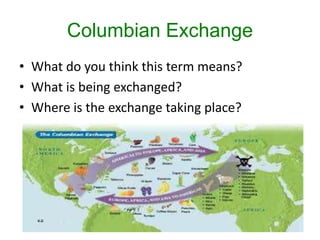
• Whatdo you think this term means?
• What is being exchanged?
• Where is the exchange taking place?
4.
Columbian Exchange
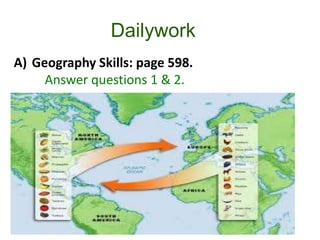
• Theexchange of plants, animals, and ideas
between the New World and the Old World
• Europeans introduced many new plants to the
Americas: bananas, sugarcane, oranges, onions,
and lettuce. They also brought new animals such
as cows, goats, sheep, pigs, horses, and chickens
• In the Americas the people found many plants
and animals and took back to Europe, as well as
to Africa and Asia such as potatoes, beans,
squash, and chocolate.
5.
Positives & Negatives
•Europeans also brought technologies such as guns
and steel to the New World. The introduction of
sheep and sugarcane created new industries. Colonist
began to grow sugarcane on plantations- large farms.
• Plantations and mines in the Americas made money
for Portugal and Spain. Many of the Indians that
were forced to work on the land died from harsh
treatment or European diseases. So Europeans
started using enslaved Africans as workers.
B) Columbian Exchange“Menu”
k Try to plan a menu using just the
items from the Europe (old world) or
Americas (new world)
k It should be something you would
actually eat!
k Think of an appetizer, main course,
and dessert
8.
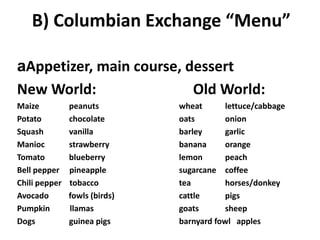
B) Columbian Exchange“Menu”
aAppetizer, main course, dessert
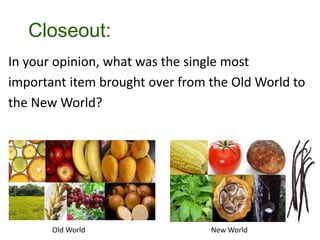
New World: Old World:
Maize peanuts wheat lettuce/cabbage
Potato chocolate oats onion
Squash vanilla barley garlic
Manioc strawberry banana orange
Tomato blueberry lemon peach
Bell pepper pineapple sugarcane coffee
Chili pepper tobacco tea horses/donkey
Avocado fowls (birds) cattle pigs
Pumpkin llamas goats sheep
Dogs guinea pigs barnyard fowl apples
9.
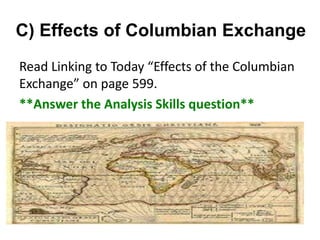
C) Effects ofColumbian Exchange
Read Linking to Today “Effects of the Columbian
Exchange” on page 599.
**Answer the Analysis Skills question**
10.
Closeout:
In your opinion,what was the single most
important item brought over from the Old World to
the New World?
Old World New World
Editor's Notes
#10 Europeans saw the colonies as their way to get rich


![Middle ages [ppt]](https://cdn.slidesharecdn.com/ss_thumbnails/middleagesppt-190208135629-thumbnail.jpg?width=640&height=640&fit=bounds)


