Abdominal Palpation for
Fetal Position
Purpose
1. Determine the position of
the baby in utero
2. Determine the expected
presentation during labor
and delivery
Questions to ask yourself when performing the
abdominal palpation examination:
1. Is the fundal height consistent with the fetal
maturity?
2. Is the, transvelie longitudinalrse or oblique?
3. Is the presentation cephalic or breech?
4. If cephalic, is the attitude vertex or facial?
5. What is the position of the denominator?
6. Is the vertex engaged?
The fetal lie is either:
 Longitudinal
o long axis of the fetus is alligned to the mother’s
o this is the only NORMAL position
 Transverse
o long axis of the fetus is perpendicular to that of the
mother’s
 Oblique
o long axis of the fetus is 0-90 degrees (or 90-180 degrees)
to that of the mother’s
Fetal Lie
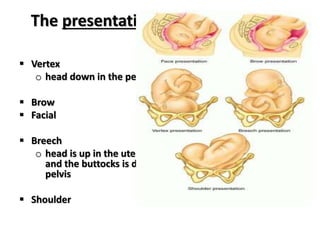
The presentation is either:
 Vertex
o head down in the pelvis
 Brow
 Facial
 Breech
o head is up in the uterine fundus
and the buttocks is down in the
pelvis
 Shoulder
Attitude
 The attitude is the relationship of the fetal
parts to each other:
o Flexed
o Deflexed
o Extended
Denominator
• The denominator (center identifying letter) is
the fetal part presenting itself
Occiput - O
Sacrum - S
Mentum - M
Frontal - F
Acromion - AC or Scapula SC
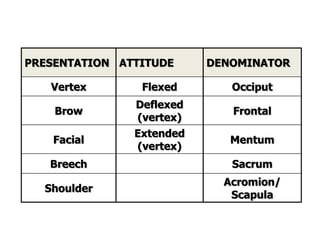
PRESENTATION ATTITUDE DENOMINATOR
Vertex Flexed Occiput
Brow
Deflexed
(vertex)
Frontal
Facial
Extended
(vertex)
Mentum
Breech Sacrum
Shoulder
Acromion/
Scapula
Flexed Vertex Presentation
8 Possibilities
 LOL
 ROL
 LOA
 ROA
ROP
LOP
OP
OA
• Full/Complete Breech
o arms & legs flexed in the
o fetal position
• Incomplete Breech
• Frank Breech
o arms flexed but legs
extended straight up over
head
• Footling Breech
o one or both feet extended
downward and may exit the
birth canal first
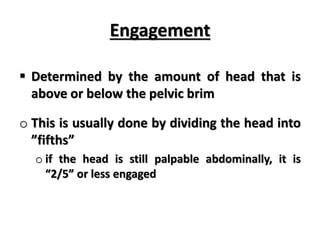
Engagement
 Determined by the amount of head that is
above or below the pelvic brim
o This is usually done by dividing the head into
”fifths”
o if the head is still palpable abdominally, it is
“2/5” or less engaged
Leopold’s Maneuver
PURPOSES
 To provide information about fetal
presentation, position, presenting part i.e. lie,
attitude, and descent
 To aid in location of fetal heart rates
 To aid in assessment of fetal size
 To determination of single versus multiple
gestation
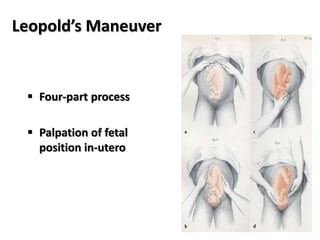
Leopold’s Maneuver
 Four-part process
 Palpation of fetal
position in-utero
Preparation
 Woman is supine, head slightly elevated and
knees slightly flexed
 Place a small rolled towel under her right hip
If the nurse is R handed, stand at the woman’s R
side facing her for the first 3 steps, then turn and
face her feet for the last step (L handed, left
side).
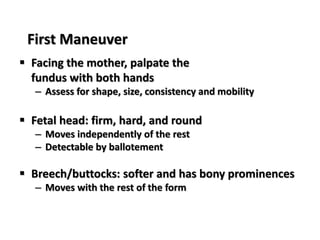
First Maneuver
 Facing the mother, palpate the
fundus with both hands
– Assess for shape, size, consistency and mobility
 Fetal head: firm, hard, and round
– Moves independently of the rest
– Detectable by ballotement
 Breech/buttocks: softer and has bony prominences
– Moves with the rest of the form
Second Maneuver
Determine position of the back.
 Still facing the mother, place both palms on the
abdomen
o Hold R hand still and with deep but gentle pressure,
use L hand to feel for the firm, smooth back
o Repeat using opposite hands
 Confirm your findings by palpating the fetal
extremities on the opposite side
o small protrusions, “lumpy”
Third Maneuver
Determine what part is lying
above the inlet.
 Gently grasp the lower portion of the abdomen
(just above symphisis pubis) with the thumb and
fingers of the R hand
 Confirm presenting part
(opposite of what’s in the fundus)
 Head will feel firm
 Buttocks will feel softer and irregular
 If it’s not engaged, it may be gently pushed
back and forth
 Proceed to the 4th step if it’s not engaged…
Fourth Maneuver
1. Locate brow.
2. Assess descent of the presenting part.
 Turn to face the woman’s feet
 Move fingers of both hands gently down
the sides of the abdomen towards the pubis
- Palpate for the cephalic prominence (vertex)
Fourth Maneuver (cont’d)
 Prominence on the same side as the small parts
suggests that the head is flexed (optimum)
 Prominence on the same side as the back suggests
that the head is extended

15. LEOPOLD_MANEUVERS.pptx

  • 1.
  • 2.
    Purpose 1. Determine theposition of the baby in utero 2. Determine the expected presentation during labor and delivery
  • 3.
    Questions to askyourself when performing the abdominal palpation examination: 1. Is the fundal height consistent with the fetal maturity? 2. Is the, transvelie longitudinalrse or oblique? 3. Is the presentation cephalic or breech? 4. If cephalic, is the attitude vertex or facial? 5. What is the position of the denominator? 6. Is the vertex engaged?
  • 4.
    The fetal lieis either:  Longitudinal o long axis of the fetus is alligned to the mother’s o this is the only NORMAL position  Transverse o long axis of the fetus is perpendicular to that of the mother’s  Oblique o long axis of the fetus is 0-90 degrees (or 90-180 degrees) to that of the mother’s
  • 5.
  • 6.
    The presentation iseither:  Vertex o head down in the pelvis  Brow  Facial  Breech o head is up in the uterine fundus and the buttocks is down in the pelvis  Shoulder
  • 7.
    Attitude  The attitudeis the relationship of the fetal parts to each other: o Flexed o Deflexed o Extended
  • 8.
    Denominator • The denominator(center identifying letter) is the fetal part presenting itself Occiput - O Sacrum - S Mentum - M Frontal - F Acromion - AC or Scapula SC
  • 9.
    PRESENTATION ATTITUDE DENOMINATOR VertexFlexed Occiput Brow Deflexed (vertex) Frontal Facial Extended (vertex) Mentum Breech Sacrum Shoulder Acromion/ Scapula
  • 10.
    Flexed Vertex Presentation 8Possibilities  LOL  ROL  LOA  ROA ROP LOP OP OA
  • 11.
    • Full/Complete Breech oarms & legs flexed in the o fetal position • Incomplete Breech • Frank Breech o arms flexed but legs extended straight up over head • Footling Breech o one or both feet extended downward and may exit the birth canal first
  • 12.
    Engagement  Determined bythe amount of head that is above or below the pelvic brim o This is usually done by dividing the head into ”fifths” o if the head is still palpable abdominally, it is “2/5” or less engaged
  • 13.
  • 14.
    PURPOSES  To provideinformation about fetal presentation, position, presenting part i.e. lie, attitude, and descent  To aid in location of fetal heart rates  To aid in assessment of fetal size  To determination of single versus multiple gestation
  • 15.
    Leopold’s Maneuver  Four-partprocess  Palpation of fetal position in-utero
  • 16.
    Preparation  Woman issupine, head slightly elevated and knees slightly flexed  Place a small rolled towel under her right hip If the nurse is R handed, stand at the woman’s R side facing her for the first 3 steps, then turn and face her feet for the last step (L handed, left side).
  • 17.
    First Maneuver  Facingthe mother, palpate the fundus with both hands – Assess for shape, size, consistency and mobility  Fetal head: firm, hard, and round – Moves independently of the rest – Detectable by ballotement  Breech/buttocks: softer and has bony prominences – Moves with the rest of the form
  • 18.
    Second Maneuver Determine positionof the back.  Still facing the mother, place both palms on the abdomen o Hold R hand still and with deep but gentle pressure, use L hand to feel for the firm, smooth back o Repeat using opposite hands  Confirm your findings by palpating the fetal extremities on the opposite side o small protrusions, “lumpy”
  • 19.
    Third Maneuver Determine whatpart is lying above the inlet.  Gently grasp the lower portion of the abdomen (just above symphisis pubis) with the thumb and fingers of the R hand  Confirm presenting part (opposite of what’s in the fundus)
  • 20.
     Head willfeel firm  Buttocks will feel softer and irregular  If it’s not engaged, it may be gently pushed back and forth  Proceed to the 4th step if it’s not engaged…
  • 21.
    Fourth Maneuver 1. Locatebrow. 2. Assess descent of the presenting part.  Turn to face the woman’s feet  Move fingers of both hands gently down the sides of the abdomen towards the pubis - Palpate for the cephalic prominence (vertex)
  • 22.
    Fourth Maneuver (cont’d) Prominence on the same side as the small parts suggests that the head is flexed (optimum)  Prominence on the same side as the back suggests that the head is extended